1. Just when the Government thought they could celebrate, yet another political storm took over
Brazil. On 18 May, exactly 13 days before the official 1Q 2017 GDP numbers confirmed the first positive
result for the past 8 quarters (1%), an audio leakage sparked the most recent political crisis in Temer’s
Government. In conversation with one of the owners of the largest meat-packing company in the
country (JBS), Temer is allegedly heard endorsing the payment of hush money to Eduardo Cunha, a
politician jailed for his role in the Petrobras corruption scandal. In a related sting, police filmed Rodrigo
Loures, a congressman from Temer’s party and formerly his right-hand man, allegedly accepting a bag
of cash worth the equivalent of £150,000. According to JBS’s founder, Temer solicited millions in
irregular payments.
2. Following the immediate impacts of what’s now being called the JBS shock, markets cautiously await
the prospect of the reform agenda – especially on social security. As expected, the immediate
reaction by financial markets was characterized by stampeding herd behavior; the morning after the
revelations, the Brazilian Stock Exchange circuit breaker mechanism was triggered for the first time
since October 2008, while the Brazilian currency suffered its largest daily slump since 1999, falling
more than 8.16% against the US dollar. Nonetheless, three weeks after the audio leak, the main
economic indicators signal what could be considered a “stability on-hold” mode. As the ongoing
political crisis will continue to bring surprises with President Temer trying to hang on to power (a more
likely scenario after the Electoral Court’s decision to acquit the Dilma-Temer 2014 ticket from campaign
wrongdoings), analysts and market players wait for clearer signs on the Government’s ability to move
forward the reform agenda – especially regarding the social security system.
3. Reforming Brazil’s social security system is urgent and will be crucial for the return of fiscal
sustainability in the long run – and there is no shortcut. The current system is unsustainable. First, for
the simple maths of demography doesn’t add up. The aging population will grow by over 200% in the
coming decades, jumping from 19% of total population at present to 30% by 2050. Second, for its
dangerously increasing weight on public finances. Social Security spending has grown faster than GDP
for a long time. From 1995 to 2014, social security spending grew by 8.2% an average annually,
compared to 2% average GDP growth. If no changes occur, the World Bank calculates the deficit in the
social security system will reach 16% of GDP by 2060. As recently highlighted by Ajay Kapur
(investment strategist from Bank of America Meryl Linch), “the reforms are going to happen because
there’s no other alternative”.
4. Nonetheless, the reform is also vital for Government’s short term fiscal sanity. According to a study
conducted by the Independent Fiscal Analysis Institution (Instituto Fiscal Independente), the
Government’s narrow fiscal margin (the difference between what can be included in the spending cap
and government’s total mandatory expenditures) left by the spending cap leaves no room for a “no
reform scenario”. In the absence of a social security reform, this margin will gradually shrink until 2022,
when the Government would have to opt between complying with the constitutional limit and
“shutting down” - delaying expenditures indefinitely. To illustrate, the calculated fiscal margin for 2017
(54% of which corresponds to investments) equates to £27.bn, which represents 4% of federal
Government’s total revenue in 2016.
What about the reform agenda?
BRAZIL ECONOMIC FOCUS: June 2017
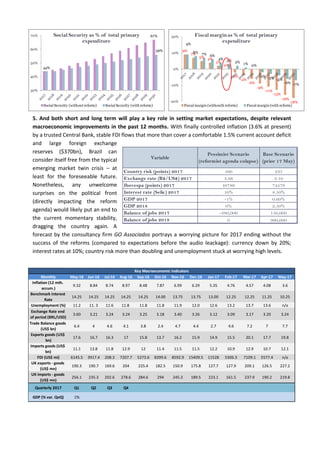
5. And both short and long term will play a key role in setting market expectations, despite relevant
macroeconomic improvements in the past 12 months. With finally controlled inflation (3.6% at present)
by a trusted Central Bank, stable FDI flows that more than cover a comfortable 1.5% current account deficit
and large foreign exchange
reserves ($370bn), Brazil can
consider itself free from the typical
emerging market twin crisis – at
least for the foreseeable future.
Nonetheless, any unwelcome
surprises on the political front
(directly impacting the reform
agenda) would likely put an end to
the current momentary stability,
dragging the country again. A
forecast by the consultancy firm GO Associados portrays a worrying picture for 2017 ending without the
success of the reforms (compared to expectations before the audio leackage): currency down by 20%;
interest rates at 10%; country risk more than doubling and unemployment stuck at worrying high levels.
44%
67%
56%
30%
40%
50%
60%
70% Social Security as % of total primary
expenditure
Social Security (without reform) Social Security (with reform)
9%
7%
5% 4%
2%
0%
-2%
-4%
-6%
-9%
-11%
-13%
-16%
-18%
9%
8% 7% 6%
4% 3% 2% 1% 0%
-2% -3% -4%
-6% -7%
-20%
-10%
0%
10%
20% Fiscal marginas % of total primary
expenditure
Fiscal margin (withouth reform) Fiscal margin (with reform)
Variable
Pessimist Scenario
(reformist agenda colapse)
Base Scenario
(prior 17 May)
Country risk (points) 2017 500 235
Exchange rate (R$/US$) 2017 3.66 3.10
Ibovespa (points) 2017 48789 74576
Interest rate (Selic) 2017 10% 8.50%
GDP 2017 -1% 0.60%
GDP 2018 0% 2.50%
Balance of jobs 2017 -380,000 150,000
Balance of jobs 2018 0 960,000
Monthly May-16 Jun-16 Jul-16 Aug-16 Sep-16 Oct-16 Nov-16 Dec-16 Jan-17 Feb-17 Mar-17 Apr-17 May-17
Inflation (12 mth.
accum.)
9.32 8.84 8.74 8.97 8.48 7.87 6.99 6.29 5.35 4.76 4.57 4.08 3.6
Benchmark Interest
Rate
14.25 14.25 14.25 14.25 14.25 14.00 13.75 13.75 13.00 12.25 12.25 11.25 10.25
Unemployment (%) 11.2 11. 3 11.6 11.8 11.8 11.8 11.9 12.0 12.6 13.2 13.7 13.6 n/a
Exchange Rate end
of period (BRL/USD)
3.60 3.21 3.24 3.24 3.25 3.18 3.40 3.26 3.12 3.09 3.17 3.20 3.24
Trade Balance goods
(US$ bn)
6.4 4 4.6 4.1 3.8 2.4 4.7 4.4 2.7 4.6 7.2 7 7.7
Exports goods (US$
bn)
17.6 16.7 16.3 17 15.8 13.7 16.2 15.9 14.9 15.5 20.1 17.7 19.8
Imports goods (US$
bn)
11.1 13.8 11.8 12.9 12 11.4 11.5 11.5 12.2 10.9 12.9 10.7 12.1
FDI (US$ mi) 6145.5 3917.4 208.3 7207.7 5273.6 8399.6 8592.9 15409.5 11528 5306.3 7109.1 5577.4 n/a
UK exports - goods
(US$ mn)
190.3 190.7 169.6 204 225.4 182.5 150.9 175.8 127.7 127.9 209.1 126.5 227.2
UK imports - goods
(US$ mn)
256.1 235.3 202.6 278.6 284.6 294 245.3 189.5 223.1 161.5 237.9 190.2 219.8
Quarterly 2017 Q1 Q2 Q3 Q4
GDP (% var. QoQ) 1%
Key Macroeconomic Indicators

Brazil Economic Focus | June 2017

  • 1.
    1. Just whenthe Government thought they could celebrate, yet another political storm took over Brazil. On 18 May, exactly 13 days before the official 1Q 2017 GDP numbers confirmed the first positive result for the past 8 quarters (1%), an audio leakage sparked the most recent political crisis in Temer’s Government. In conversation with one of the owners of the largest meat-packing company in the country (JBS), Temer is allegedly heard endorsing the payment of hush money to Eduardo Cunha, a politician jailed for his role in the Petrobras corruption scandal. In a related sting, police filmed Rodrigo Loures, a congressman from Temer’s party and formerly his right-hand man, allegedly accepting a bag of cash worth the equivalent of £150,000. According to JBS’s founder, Temer solicited millions in irregular payments. 2. Following the immediate impacts of what’s now being called the JBS shock, markets cautiously await the prospect of the reform agenda – especially on social security. As expected, the immediate reaction by financial markets was characterized by stampeding herd behavior; the morning after the revelations, the Brazilian Stock Exchange circuit breaker mechanism was triggered for the first time since October 2008, while the Brazilian currency suffered its largest daily slump since 1999, falling more than 8.16% against the US dollar. Nonetheless, three weeks after the audio leak, the main economic indicators signal what could be considered a “stability on-hold” mode. As the ongoing political crisis will continue to bring surprises with President Temer trying to hang on to power (a more likely scenario after the Electoral Court’s decision to acquit the Dilma-Temer 2014 ticket from campaign wrongdoings), analysts and market players wait for clearer signs on the Government’s ability to move forward the reform agenda – especially regarding the social security system. 3. Reforming Brazil’s social security system is urgent and will be crucial for the return of fiscal sustainability in the long run – and there is no shortcut. The current system is unsustainable. First, for the simple maths of demography doesn’t add up. The aging population will grow by over 200% in the coming decades, jumping from 19% of total population at present to 30% by 2050. Second, for its dangerously increasing weight on public finances. Social Security spending has grown faster than GDP for a long time. From 1995 to 2014, social security spending grew by 8.2% an average annually, compared to 2% average GDP growth. If no changes occur, the World Bank calculates the deficit in the social security system will reach 16% of GDP by 2060. As recently highlighted by Ajay Kapur (investment strategist from Bank of America Meryl Linch), “the reforms are going to happen because there’s no other alternative”. 4. Nonetheless, the reform is also vital for Government’s short term fiscal sanity. According to a study conducted by the Independent Fiscal Analysis Institution (Instituto Fiscal Independente), the Government’s narrow fiscal margin (the difference between what can be included in the spending cap and government’s total mandatory expenditures) left by the spending cap leaves no room for a “no reform scenario”. In the absence of a social security reform, this margin will gradually shrink until 2022, when the Government would have to opt between complying with the constitutional limit and “shutting down” - delaying expenditures indefinitely. To illustrate, the calculated fiscal margin for 2017 (54% of which corresponds to investments) equates to £27.bn, which represents 4% of federal Government’s total revenue in 2016. What about the reform agenda? BRAZIL ECONOMIC FOCUS: June 2017
  • 2.
    5. And bothshort and long term will play a key role in setting market expectations, despite relevant macroeconomic improvements in the past 12 months. With finally controlled inflation (3.6% at present) by a trusted Central Bank, stable FDI flows that more than cover a comfortable 1.5% current account deficit and large foreign exchange reserves ($370bn), Brazil can consider itself free from the typical emerging market twin crisis – at least for the foreseeable future. Nonetheless, any unwelcome surprises on the political front (directly impacting the reform agenda) would likely put an end to the current momentary stability, dragging the country again. A forecast by the consultancy firm GO Associados portrays a worrying picture for 2017 ending without the success of the reforms (compared to expectations before the audio leackage): currency down by 20%; interest rates at 10%; country risk more than doubling and unemployment stuck at worrying high levels. 44% 67% 56% 30% 40% 50% 60% 70% Social Security as % of total primary expenditure Social Security (without reform) Social Security (with reform) 9% 7% 5% 4% 2% 0% -2% -4% -6% -9% -11% -13% -16% -18% 9% 8% 7% 6% 4% 3% 2% 1% 0% -2% -3% -4% -6% -7% -20% -10% 0% 10% 20% Fiscal marginas % of total primary expenditure Fiscal margin (withouth reform) Fiscal margin (with reform) Variable Pessimist Scenario (reformist agenda colapse) Base Scenario (prior 17 May) Country risk (points) 2017 500 235 Exchange rate (R$/US$) 2017 3.66 3.10 Ibovespa (points) 2017 48789 74576 Interest rate (Selic) 2017 10% 8.50% GDP 2017 -1% 0.60% GDP 2018 0% 2.50% Balance of jobs 2017 -380,000 150,000 Balance of jobs 2018 0 960,000 Monthly May-16 Jun-16 Jul-16 Aug-16 Sep-16 Oct-16 Nov-16 Dec-16 Jan-17 Feb-17 Mar-17 Apr-17 May-17 Inflation (12 mth. accum.) 9.32 8.84 8.74 8.97 8.48 7.87 6.99 6.29 5.35 4.76 4.57 4.08 3.6 Benchmark Interest Rate 14.25 14.25 14.25 14.25 14.25 14.00 13.75 13.75 13.00 12.25 12.25 11.25 10.25 Unemployment (%) 11.2 11. 3 11.6 11.8 11.8 11.8 11.9 12.0 12.6 13.2 13.7 13.6 n/a Exchange Rate end of period (BRL/USD) 3.60 3.21 3.24 3.24 3.25 3.18 3.40 3.26 3.12 3.09 3.17 3.20 3.24 Trade Balance goods (US$ bn) 6.4 4 4.6 4.1 3.8 2.4 4.7 4.4 2.7 4.6 7.2 7 7.7 Exports goods (US$ bn) 17.6 16.7 16.3 17 15.8 13.7 16.2 15.9 14.9 15.5 20.1 17.7 19.8 Imports goods (US$ bn) 11.1 13.8 11.8 12.9 12 11.4 11.5 11.5 12.2 10.9 12.9 10.7 12.1 FDI (US$ mi) 6145.5 3917.4 208.3 7207.7 5273.6 8399.6 8592.9 15409.5 11528 5306.3 7109.1 5577.4 n/a UK exports - goods (US$ mn) 190.3 190.7 169.6 204 225.4 182.5 150.9 175.8 127.7 127.9 209.1 126.5 227.2 UK imports - goods (US$ mn) 256.1 235.3 202.6 278.6 284.6 294 245.3 189.5 223.1 161.5 237.9 190.2 219.8 Quarterly 2017 Q1 Q2 Q3 Q4 GDP (% var. QoQ) 1% Key Macroeconomic Indicators