Jean-Marc Fournier
6 December 2017
The effect of the size and mix
of public spending on
growth and inequality
http://www.oecd.org/eco/the-effect-of-the-size-and-mix-of-public-spending-on-
growth-and-inequality.htm
ECOSCOPE blog: oecdecoscope.wordpress.com
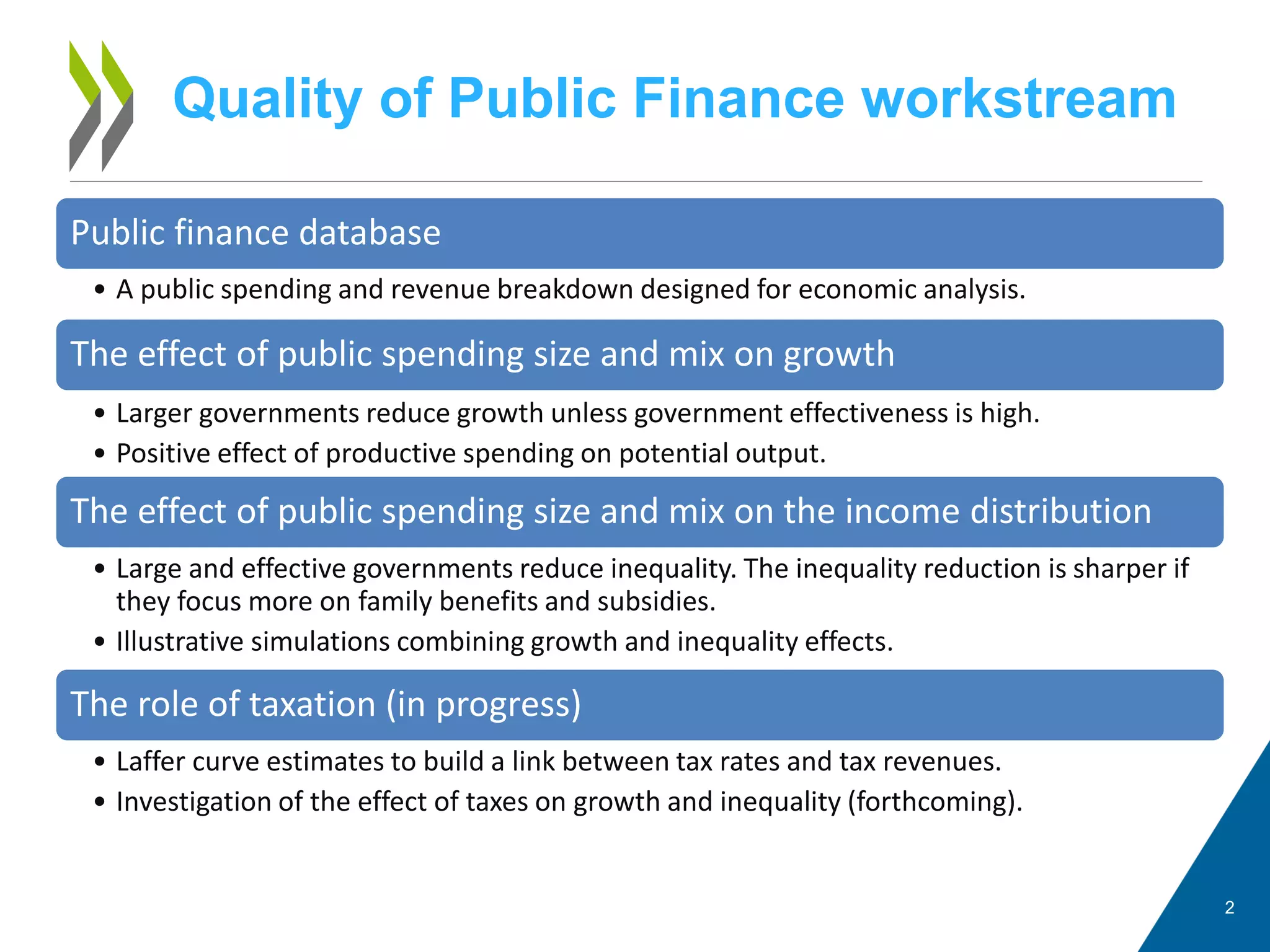
Quality of Public Finance workstream
2
Public finance database
• A public spending and revenue breakdown designed for economic analysis.
The effect of public spending size and mix on growth
• Larger governments reduce growth unless government effectiveness is high.
• Positive effect of productive spending on potential output.
The effect of public spending size and mix on the income distribution
• Large and effective governments reduce inequality. The inequality reduction is sharper if
they focus more on family benefits and subsidies.
• Illustrative simulations combining growth and inequality effects.
The role of taxation (in progress)
• Laffer curve estimates to build a link between tax rates and tax revenues.
• Investigation of the effect of taxes on growth and inequality (forthcoming).
3
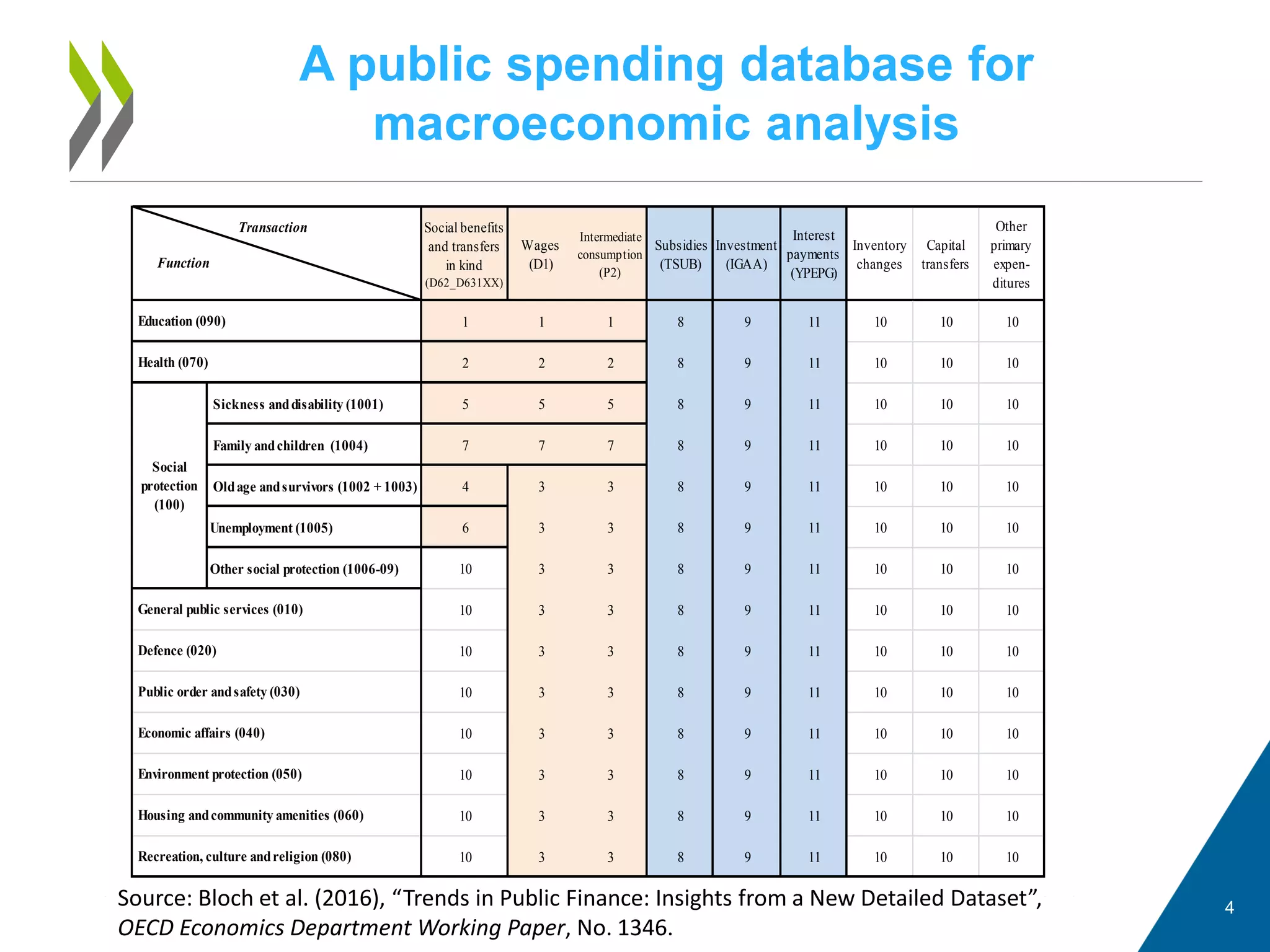
1. Public finance database
Social benefits
and transfers
in kind
(D62_D631XX)
Wages
(D1)
Intermediate
consumption
(P2)
Subsidies
(TSUB)
Investment
(IGAA)
Interest
payments
(YPEPG)
Inventory
changes
Capital
transfers
Other
primary
expen-
ditures
1 1 1 8 9 11 10 10 10
2 2 2 8 9 11 10 10 10
Sickness anddisability (1001) 5 5 5 8 9 11 10 10 10
Family andchildren (1004) 7 7 7 8 9 11 10 10 10
Oldage andsurvivors (1002 + 1003) 4 3 3 8 9 11 10 10 10
Unemployment (1005) 6 3 3 8 9 11 10 10 10
Other social protection (1006-09) 10 3 3 8 9 11 10 10 10
10 3 3 8 9 11 10 10 10
10 3 3 8 9 11 10 10 10
10 3 3 8 9 11 10 10 10
10 3 3 8 9 11 10 10 10
10 3 3 8 9 11 10 10 10
10 3 3 8 9 11 10 10 10
10 3 3 8 9 11 10 10 10
Economic affairs (040)
Environment protection (050)
Housing andcommunity amenities (060)
Recreation, culture andreligion (080)
Social
protection
(100)
Public order andsafety (030)
Defence (020)
General public services (010)
Education (090)
Health (070)
Function
Transaction
A public spending database for
macroeconomic analysis
4Source: Bloch et al. (2016), “Trends in Public Finance: Insights from a New Detailed Dataset”,
OECD Economics Department Working Paper, No. 1346.
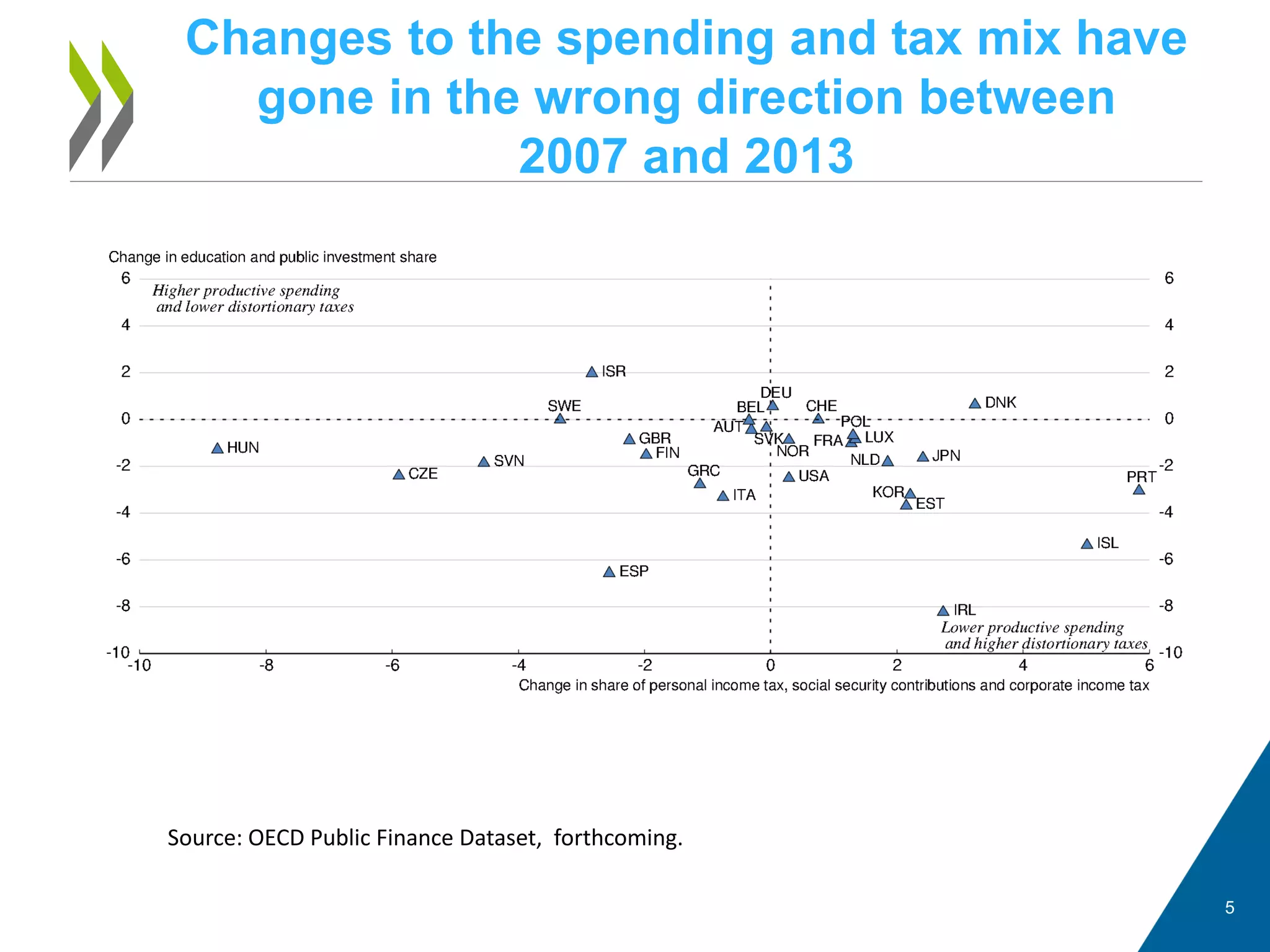
Changes to the spending and tax mix have
gone in the wrong direction between
2007 and 2013
5
Source: OECD Public Finance Dataset, forthcoming.
6
2. The effect of public
spending size and mix
on growth
The effect of size and effectiveness of
government on potential GDP
7
GDP convergence model like Barro (2015)
• Mankiw et al. (1992) Solow model with human capital : in the steady state, GDP
per capita depends on the stock of human capital and on the saving rate
(investment here).
• Barro (2015) on convergence equations with small time dimension: the omitted
variable bias may be smaller than the Hurwicz (1950)-type bias linked with
country fixed effects.
• Implementation of Barro (2015) approach with a large set of controls to
mitigate the risk of omitted variable bias.
The effect of public spending on growth
• The convergence model is augmented with public finance variable to estimate
the effect of public spending size, effectiveness and mix on growth:
tittitiitititi
tititiitititititi
vYIbPISAschoolingbSaGa
XaYIaPISAschoolingaPOPYaPOPY
,,,2,11,51,4
1,31,1,21,11,1,,,
)/ln()*ln(]...
...)/ln()*ln()/[ln()/ln(
ε
φ
++∆+∆+−
−−−−−=∆
−−
−−−−−−
Source: Fournier, J-M. and A. Johansson (2016), “The effect of the size and mix of public
spending on growth and inequality”, OECD Economics Department Working Papers, No. 1344.
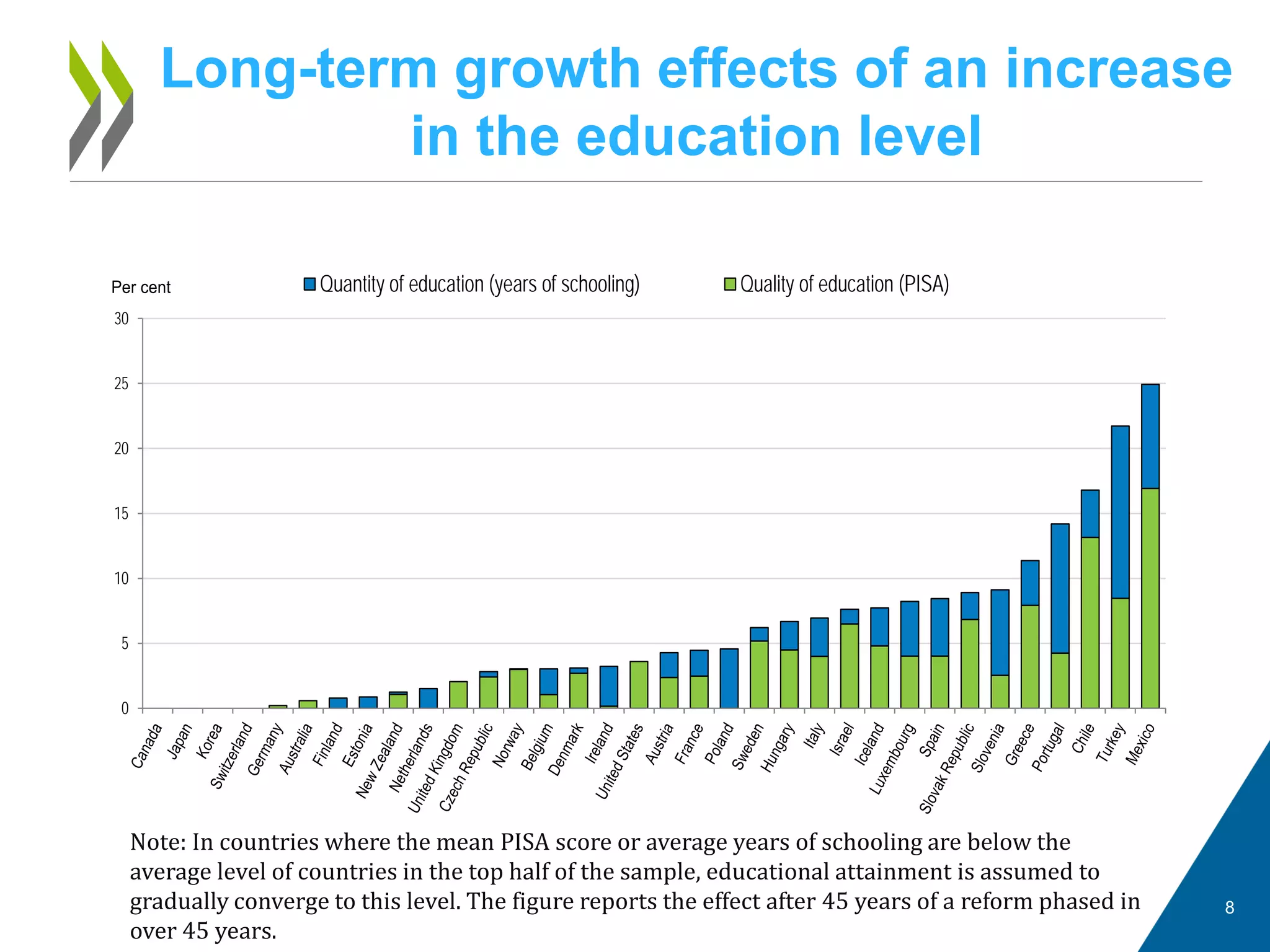
Long-term growth effects of an increase
in the education level
8
0
5
10
15
20
25
30
Quantity of education (years of schooling) Quality of education (PISA)Per cent
Note: In countries where the mean PISA score or average years of schooling are below the
average level of countries in the top half of the sample, educational attainment is assumed to
gradually converge to this level. The figure reports the effect after 45 years of a reform phased in
over 45 years.
The effect of size and effectiveness of
government on potential GDP
9
The effect of public spending size on growth
• Large governments may reduce growth (e.g. associated with more
distortive taxation), see for instance Barro (1991), or Bergh and Henrekson
(2011) for a recent overview.
• Freeman (1995) «welfare-state- as-system» hypothesis: high level of
effectiveness and trust in public institutions may have offset the adverse
growth effect.
• The model interacts public spending to GDP with perceived government
effectiveness:
tittitiitititititi
tititiitititititi
vYIbPISAschoolingbGEGaGEaGa
XaYIaPISAschoolingaPOPYaPOPY
,,,2,11,1,61,51,4
1,31,1,21,11,1,,,
)/ln()*ln(]...
...)/ln()*ln()/[ln()/ln(
ε
φ
++∆+∆+−−
−−−−−=∆
−−−−
−−−−−−
Source: Fournier, J-M. and A. Johansson (2016), “The effect of the size and mix of public
spending on growth and inequality”, OECD Economics Department Working Papers, No. 1344.
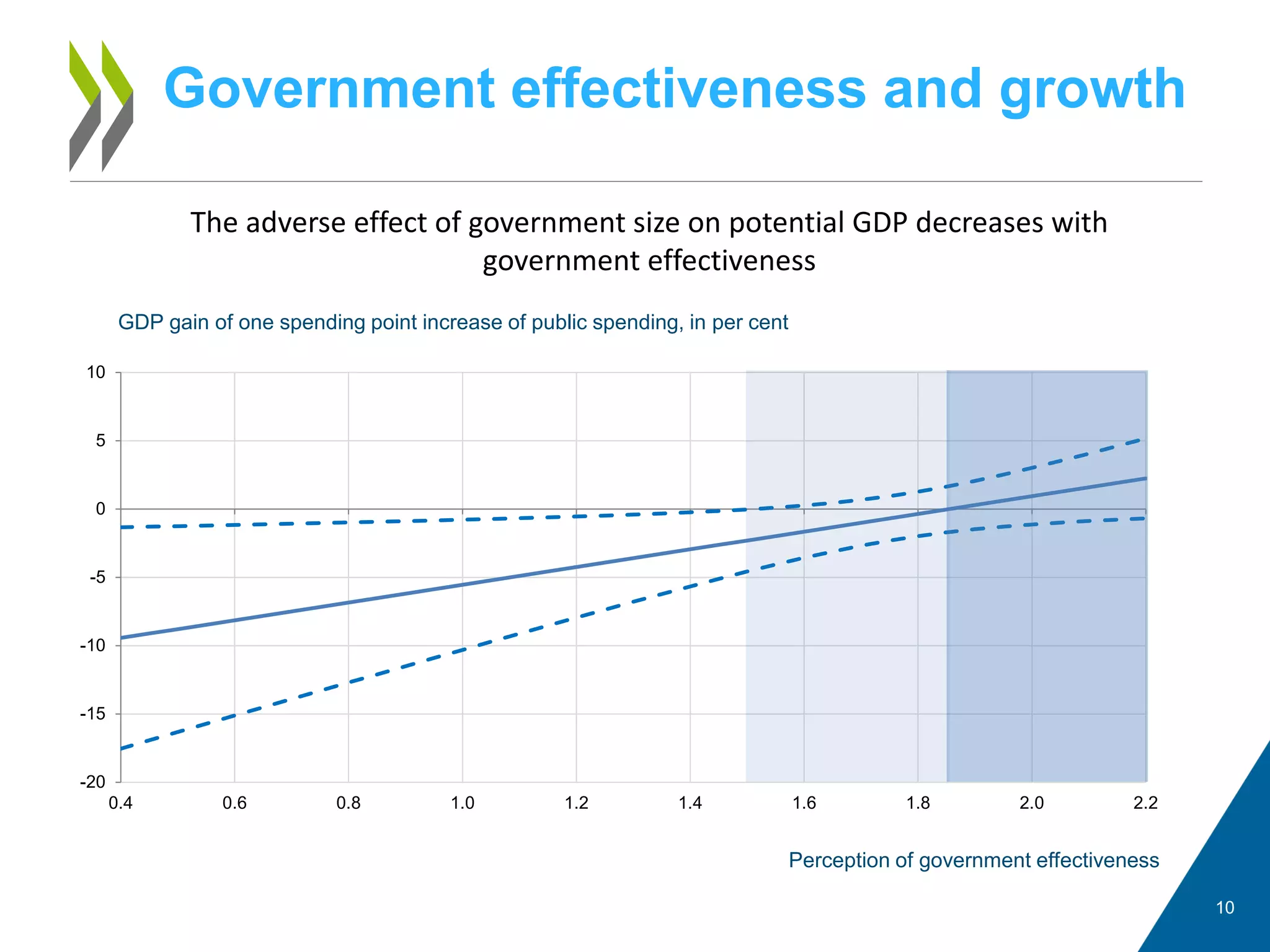
Government effectiveness and growth
10
The adverse effect of government size on potential GDP decreases with
government effectiveness
GDP gain of one spending point increase of public spending, in per cent
Perception of government effectiveness
-20
-15
-10
-5
0
5
10
0.4 0.6 0.8 1.0 1.2 1.4 1.6 1.8 2.0 2.2
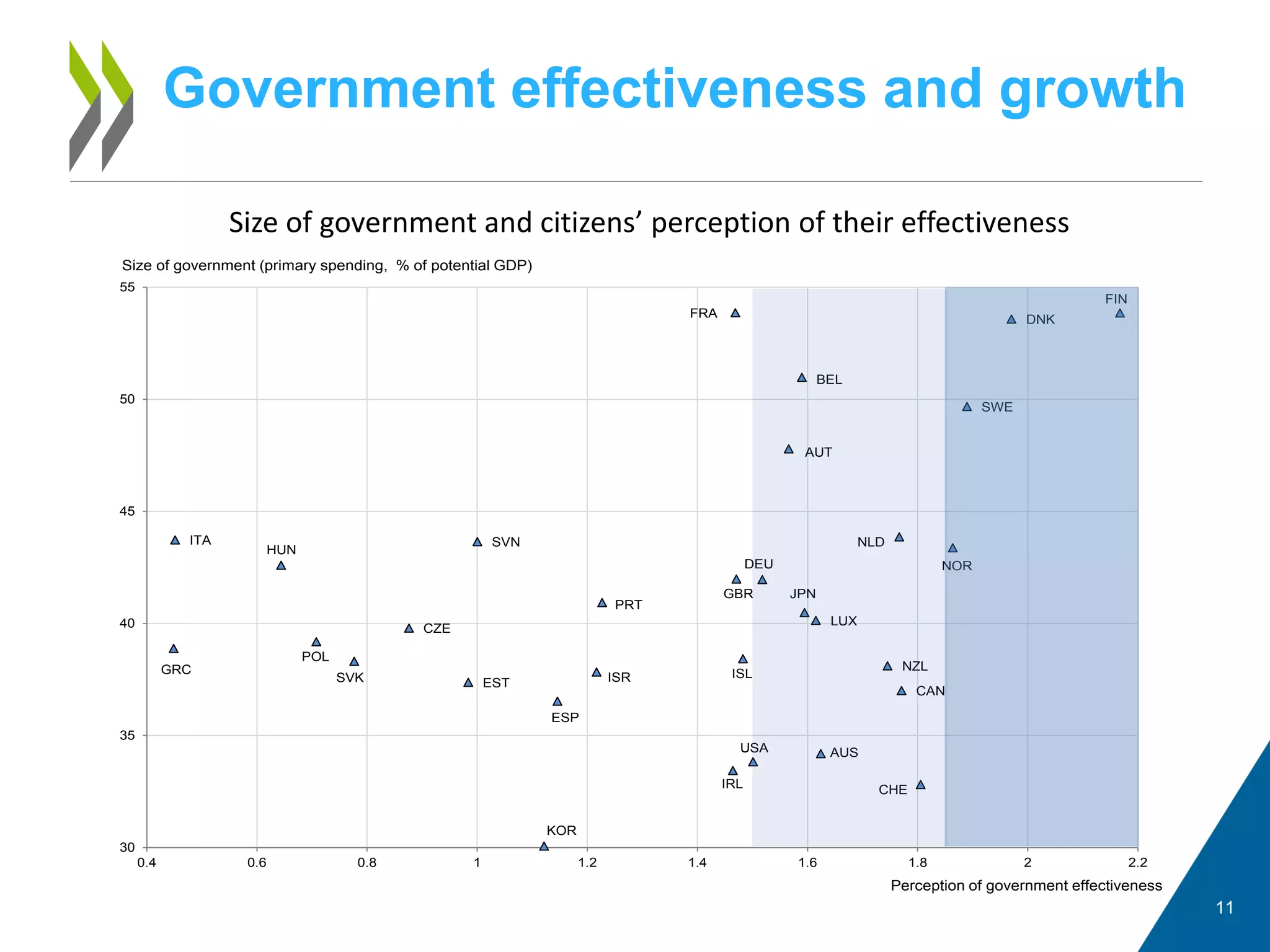
Government effectiveness and growth
11
Size of government and citizens’ perception of their effectiveness
AUS
AUT
BEL
CAN
CHE
CZE
DEU
DNK
ESP
EST
FIN
FRA
GBR
GRC
HUN
IRL
ISLISR
ITA
JPN
KOR
LUX
NLD
NOR
NZL
POL
PRT
SVK
SVN
SWE
USA
30
35
40
45
50
55
0.4 0.6 0.8 1 1.2 1.4 1.6 1.8 2 2.2
Perception of government effectiveness
Size of government (primary spending, % of potential GDP)
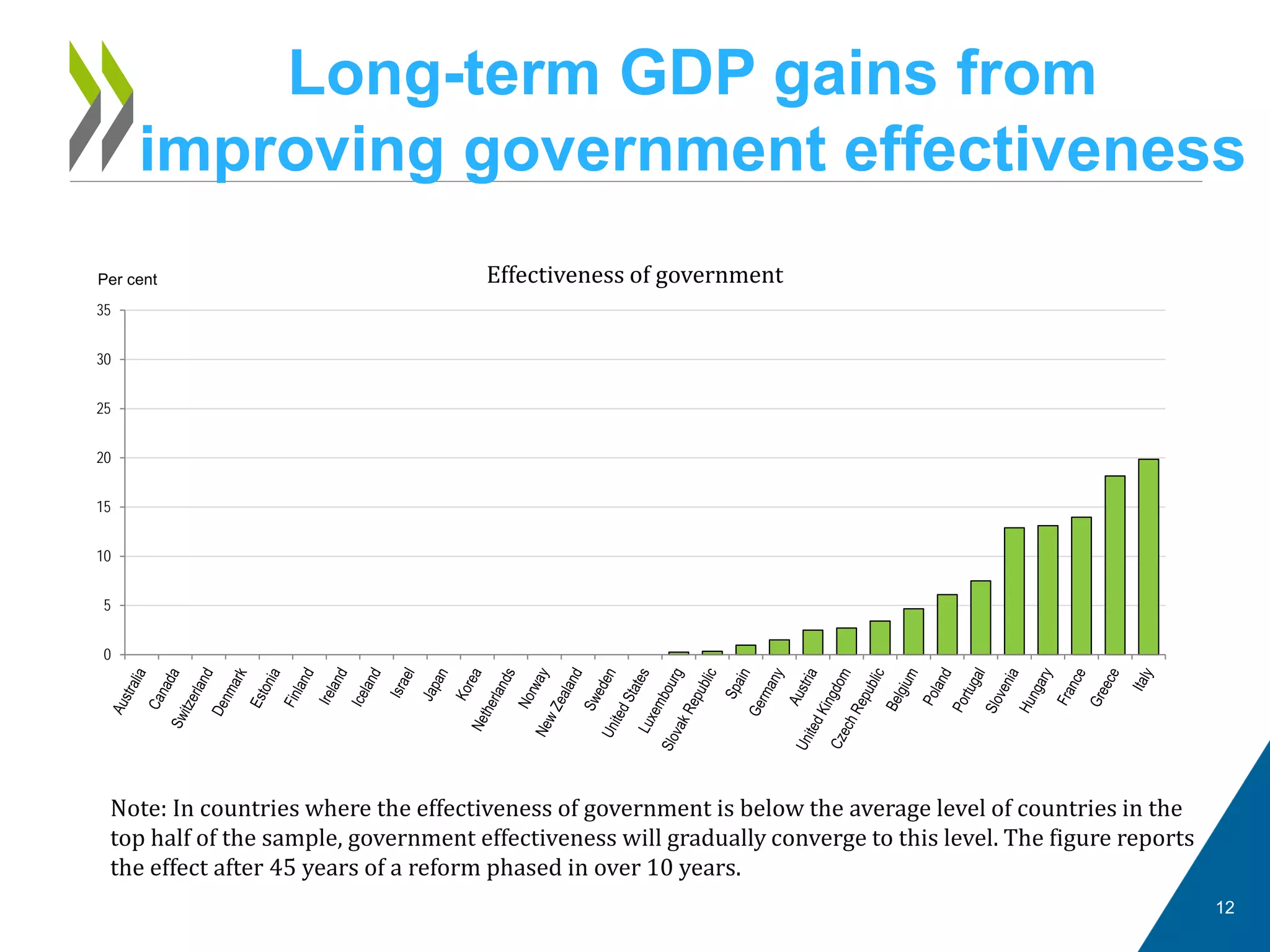
Long-term GDP gains from
improving government effectiveness
12
0
5
10
15
20
25
30
35
Effectiveness of governmentPer cent
Note: In countries where the effectiveness of government is below the average level of countries in the
top half of the sample, government effectiveness will gradually converge to this level. The figure reports
the effect after 45 years of a reform phased in over 10 years.
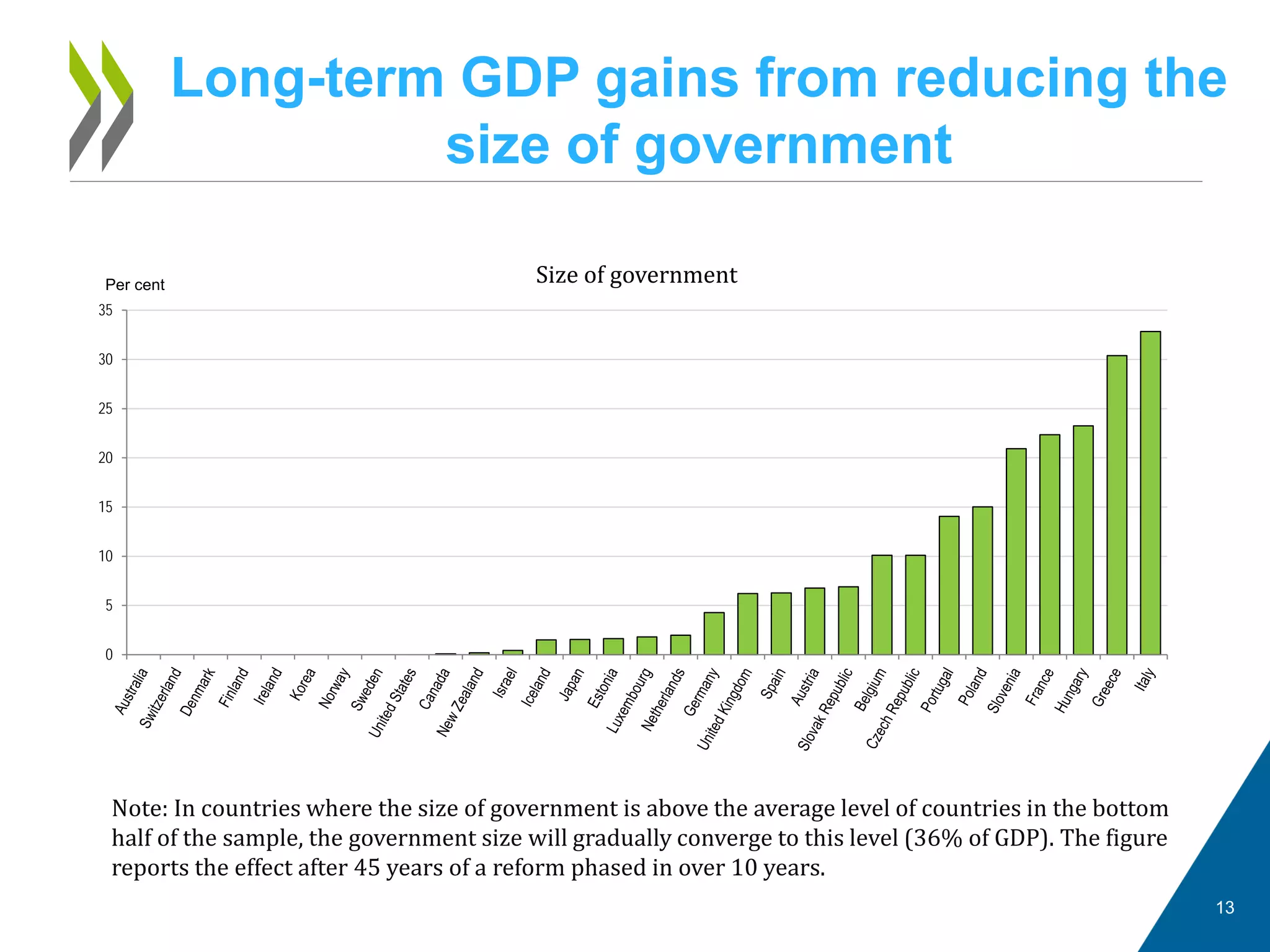
Long-term GDP gains from reducing the
size of government
13
0
5
10
15
20
25
30
35
Size of governmentPer cent
Note: In countries where the size of government is above the average level of countries in the bottom
half of the sample, the government size will gradually converge to this level (36% of GDP). The figure
reports the effect after 45 years of a reform phased in over 10 years.
Decreasing returns to public investment
14
The effect of public investment on potential GDP decreases with the level
of capital stock
GDP gain of one spending point increase of public investment, in per cent
Public capital stock, per cent of potential GDP
The analysis suggests that all OECD countries, except Japan, have room
for additional public investment.
-15
-10
-5
0
5
10
15
20 40 60 80 100 120
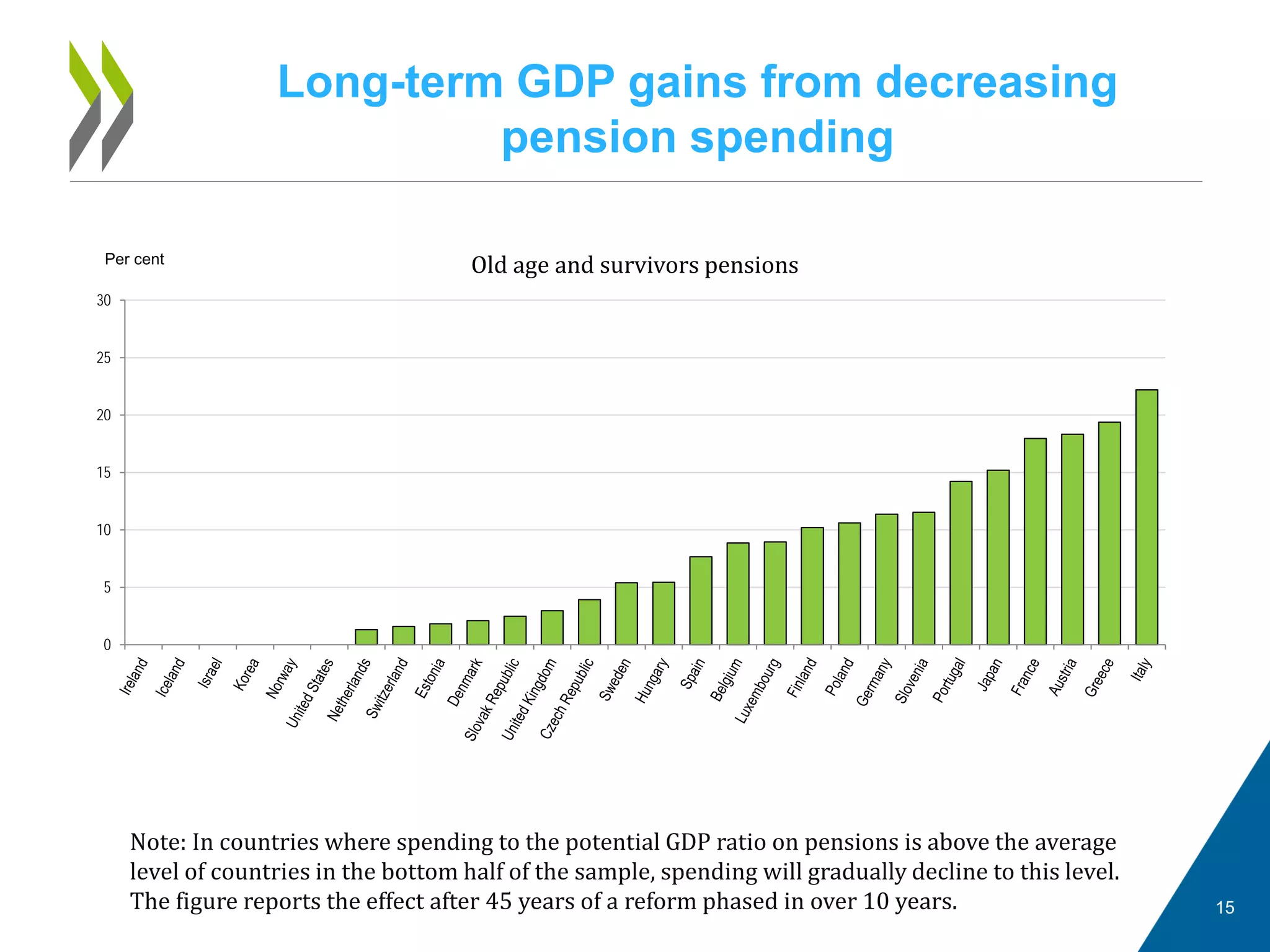
Long-term GDP gains from decreasing
pension spending
15
0
5
10
15
20
25
30
Old age and survivors pensionsPer cent
Note: In countries where spending to the potential GDP ratio on pensions is above the average
level of countries in the bottom half of the sample, spending will gradually decline to this level.
The figure reports the effect after 45 years of a reform phased in over 10 years.
16
3. The effect of public
spending size and mix on
the income distribution
Combining growth and inequality:
Effects on the income distribution
17
The effect of public spending size and mix on inequality.
• The estimated equation follows Hermansen et al. (2016), with :
• where is an income level indicator that captures a part of the distribution of income
(e.g. decile)
The overall effect on the distribution of disposable income is the
sum of the direct effect on disposable income and the indirect
growth effect
• Effect of growth on income is not significantly different from one
Source: Fournier, J-M. and A. Johansson (2016), “The effect of the size and mix of public
spending on growth and inequality”, OECD Economics Department Working Papers, No. 1344.
]lnln)([lnln*))(ln( ,,1,41,31,21,11,,2,,1, tititititititititi SGNEGDPxGDPx ηγϕϕϕϕζββζ αα −−−−−−−∆= −−−−−
tix ,)(ζ
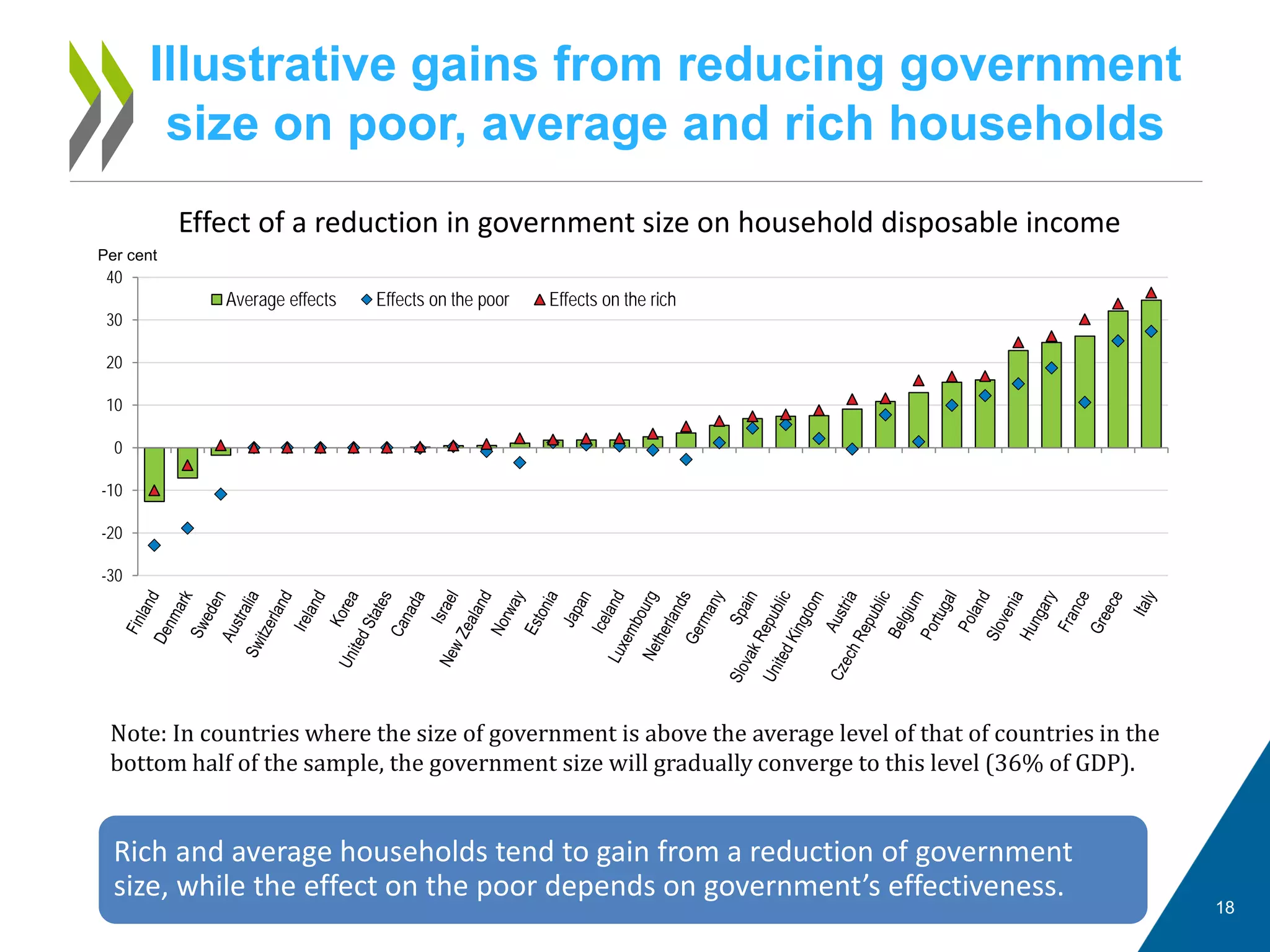
Illustrative gains from reducing government
size on poor, average and rich households
18
Effect of a reduction in government size on household disposable income
Note: In countries where the size of government is above the average level of that of countries in the
bottom half of the sample, the government size will gradually converge to this level (36% of GDP).
Rich and average households tend to gain from a reduction of government
size, while the effect on the poor depends on government’s effectiveness.
-30
-20
-10
0
10
20
30
40
Average effects Effects on the poor Effects on the rich
Per cent
Illustrative gains from raising family and
child benefits on disposable income
19
Note: In countries where family benefits to potential GDP is below the average ratio of that of
countries in the top half of the sample, family benefits will gradually converge to this average
ratio.
-10
0
10
20
30
40
Average effects Effects on the poor Effects on the rich
Per cent
Illustrative gains from decreasing
public subsidies
20
Note: In countries where subsidies to potential GDP are above the average ratio of that of
countries in the bottom half of the sample, subsidies will gradually decline to this ratio.
-10
0
10
20
30
40
Average effects Effects on the poor Effects on the rich
Per cent
21
4. The role of taxation
(in progress)
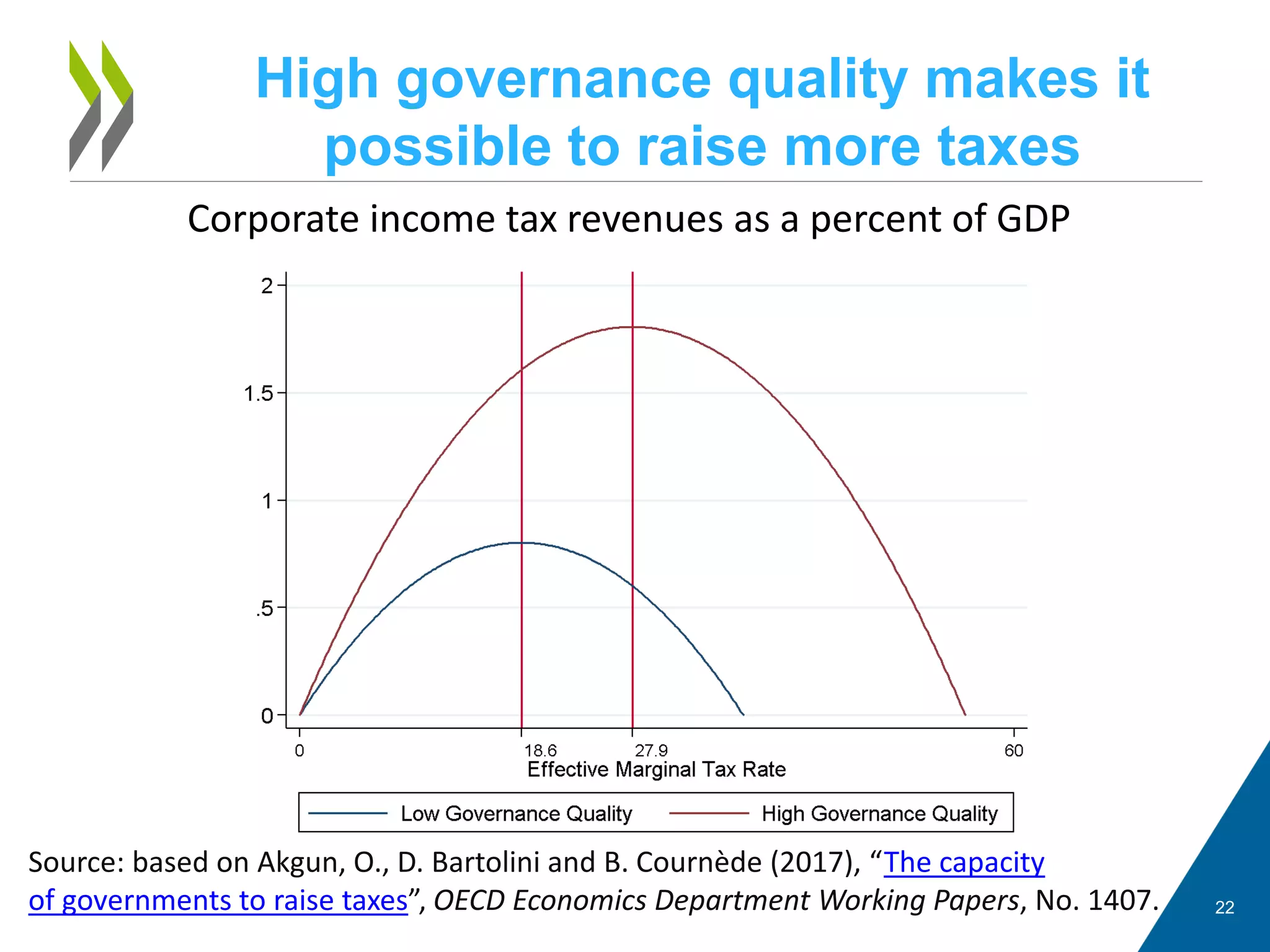
High governance quality makes it
possible to raise more taxes
22
Corporate income tax revenues as a percent of GDP
Source: based on Akgun, O., D. Bartolini and B. Cournède (2017), “The capacity
of governments to raise taxes”, OECD Economics Department Working Papers, No. 1407.
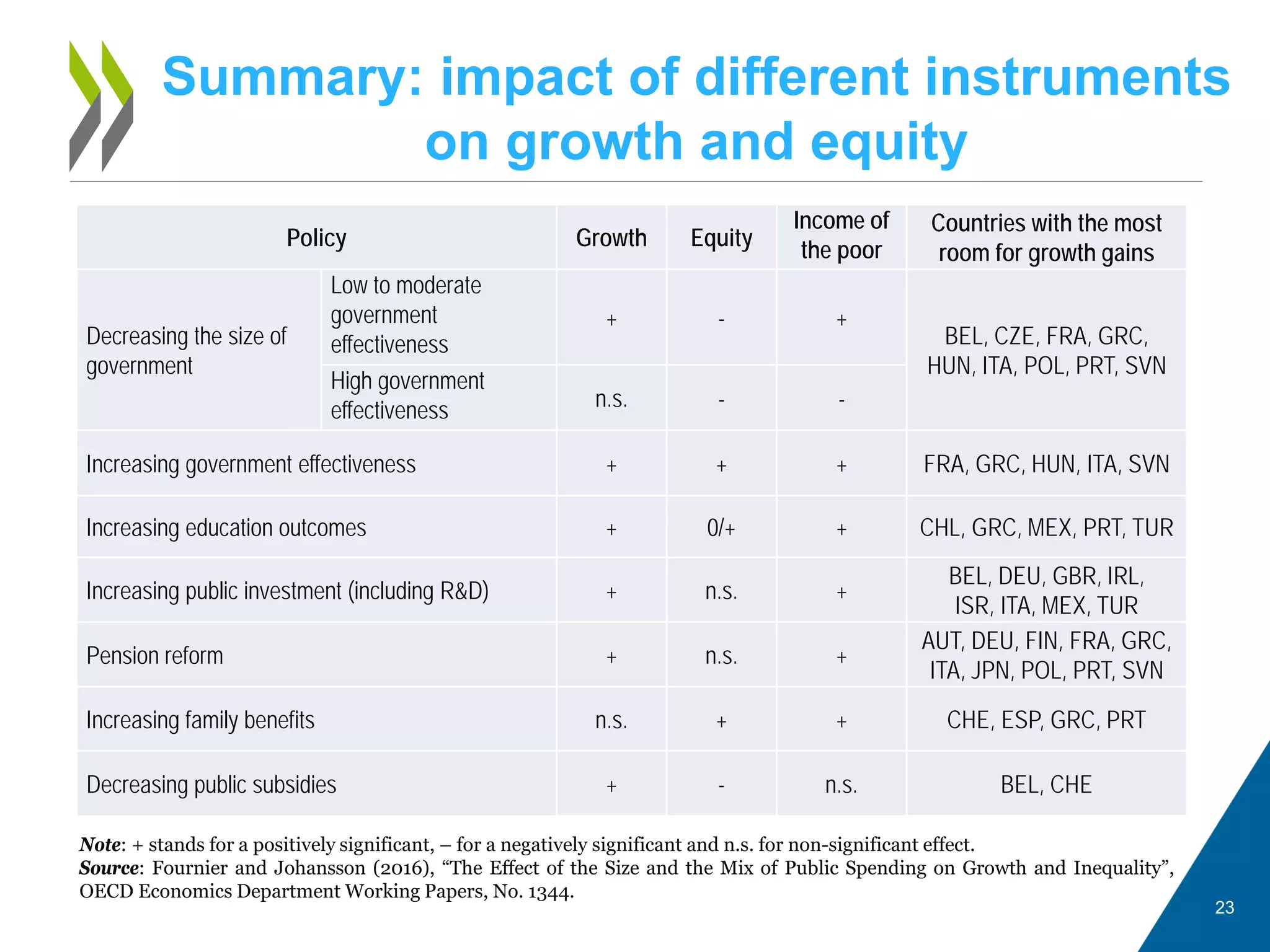
Summary: impact of different instruments
on growth and equity
23
Policy Growth Equity
Income of
the poor
Countries with the most
room for growth gains
Decreasing the size of
government
Low to moderate
government
effectiveness
+ - +
BEL, CZE, FRA, GRC,
HUN, ITA, POL, PRT, SVN
High government
effectiveness n.s. - -
Increasing government effectiveness + + + FRA, GRC, HUN, ITA, SVN
Increasing education outcomes + 0/+ + CHL, GRC, MEX, PRT, TUR
Increasing public investment (including R&D) + n.s. +
BEL, DEU, GBR, IRL,
ISR, ITA, MEX, TUR
Pension reform + n.s. +
AUT, DEU, FIN, FRA, GRC,
ITA, JPN, POL, PRT, SVN
Increasing family benefits n.s. + + CHE, ESP, GRC, PRT
Decreasing public subsidies + - n.s. BEL, CHE
Note: + stands for a positively significant, – for a negatively significant and n.s. for non-significant effect.
Source: Fournier and Johansson (2016), “The Effect of the Size and the Mix of Public Spending on Growth and Inequality”,
OECD Economics Department Working Papers, No. 1344.
24
More information
Fournier, J-M. and A Johansson (2016), “The effect of the size and mix of public
spending on growth and inequality”, OECD Economics Department Working
Papers, No. 1344.
Bloch et al. (2016), “Trends in public finance: Insights from a new dataset”, OECD
Economics Department Working Papers, No. 1345.
Johansson, A. (2016), “Public finance, economic growth and inequality: A survey of
the evidence”, OECD Economics Department Working Papers, No. 1346.
Fournier, J-M. (2016), “The positive effect of public investment on potential
growth”, OECD Economics Department Working Papers, No. 1347.
Akgun, O., D. Bartolini and B. Cournède (2017), “The capacity of governments to
raise taxes”, OECD Economics Department Working Papers, No. 1407.
Disclaimers:
The statistical data for Israel are supplied by and under the responsibility of the relevant Israeli authorities. The use of such data
by the OECD is without prejudice to the status of the Golan Heights, East Jerusalem and Israeli settlements in the West Bank
under the terms of international law.
This document and any map included herein are without prejudice to the status of or sovereignty over any territory, to the
delimitation of international frontiers and boundaries and to the name of any territory, city or area.

Restructuring public spending for efficiency - Jean-Marc FOURNIER, OECD

  • 1.
    Jean-Marc Fournier 6 December2017 The effect of the size and mix of public spending on growth and inequality http://www.oecd.org/eco/the-effect-of-the-size-and-mix-of-public-spending-on- growth-and-inequality.htm ECOSCOPE blog: oecdecoscope.wordpress.com
  • 2.
    Quality of PublicFinance workstream 2 Public finance database • A public spending and revenue breakdown designed for economic analysis. The effect of public spending size and mix on growth • Larger governments reduce growth unless government effectiveness is high. • Positive effect of productive spending on potential output. The effect of public spending size and mix on the income distribution • Large and effective governments reduce inequality. The inequality reduction is sharper if they focus more on family benefits and subsidies. • Illustrative simulations combining growth and inequality effects. The role of taxation (in progress) • Laffer curve estimates to build a link between tax rates and tax revenues. • Investigation of the effect of taxes on growth and inequality (forthcoming).
  • 3.
  • 4.
    Social benefits and transfers inkind (D62_D631XX) Wages (D1) Intermediate consumption (P2) Subsidies (TSUB) Investment (IGAA) Interest payments (YPEPG) Inventory changes Capital transfers Other primary expen- ditures 1 1 1 8 9 11 10 10 10 2 2 2 8 9 11 10 10 10 Sickness anddisability (1001) 5 5 5 8 9 11 10 10 10 Family andchildren (1004) 7 7 7 8 9 11 10 10 10 Oldage andsurvivors (1002 + 1003) 4 3 3 8 9 11 10 10 10 Unemployment (1005) 6 3 3 8 9 11 10 10 10 Other social protection (1006-09) 10 3 3 8 9 11 10 10 10 10 3 3 8 9 11 10 10 10 10 3 3 8 9 11 10 10 10 10 3 3 8 9 11 10 10 10 10 3 3 8 9 11 10 10 10 10 3 3 8 9 11 10 10 10 10 3 3 8 9 11 10 10 10 10 3 3 8 9 11 10 10 10 Economic affairs (040) Environment protection (050) Housing andcommunity amenities (060) Recreation, culture andreligion (080) Social protection (100) Public order andsafety (030) Defence (020) General public services (010) Education (090) Health (070) Function Transaction A public spending database for macroeconomic analysis 4Source: Bloch et al. (2016), “Trends in Public Finance: Insights from a New Detailed Dataset”, OECD Economics Department Working Paper, No. 1346.
  • 5.
    Changes to thespending and tax mix have gone in the wrong direction between 2007 and 2013 5 Source: OECD Public Finance Dataset, forthcoming.
  • 6.
    6 2. The effectof public spending size and mix on growth
  • 7.
    The effect ofsize and effectiveness of government on potential GDP 7 GDP convergence model like Barro (2015) • Mankiw et al. (1992) Solow model with human capital : in the steady state, GDP per capita depends on the stock of human capital and on the saving rate (investment here). • Barro (2015) on convergence equations with small time dimension: the omitted variable bias may be smaller than the Hurwicz (1950)-type bias linked with country fixed effects. • Implementation of Barro (2015) approach with a large set of controls to mitigate the risk of omitted variable bias. The effect of public spending on growth • The convergence model is augmented with public finance variable to estimate the effect of public spending size, effectiveness and mix on growth: tittitiitititi tititiitititititi vYIbPISAschoolingbSaGa XaYIaPISAschoolingaPOPYaPOPY ,,,2,11,51,4 1,31,1,21,11,1,,, )/ln()*ln(]... ...)/ln()*ln()/[ln()/ln( ε φ ++∆+∆+− −−−−−=∆ −− −−−−−− Source: Fournier, J-M. and A. Johansson (2016), “The effect of the size and mix of public spending on growth and inequality”, OECD Economics Department Working Papers, No. 1344.
  • 8.
    Long-term growth effectsof an increase in the education level 8 0 5 10 15 20 25 30 Quantity of education (years of schooling) Quality of education (PISA)Per cent Note: In countries where the mean PISA score or average years of schooling are below the average level of countries in the top half of the sample, educational attainment is assumed to gradually converge to this level. The figure reports the effect after 45 years of a reform phased in over 45 years.
  • 9.
    The effect ofsize and effectiveness of government on potential GDP 9 The effect of public spending size on growth • Large governments may reduce growth (e.g. associated with more distortive taxation), see for instance Barro (1991), or Bergh and Henrekson (2011) for a recent overview. • Freeman (1995) «welfare-state- as-system» hypothesis: high level of effectiveness and trust in public institutions may have offset the adverse growth effect. • The model interacts public spending to GDP with perceived government effectiveness: tittitiitititititi tititiitititititi vYIbPISAschoolingbGEGaGEaGa XaYIaPISAschoolingaPOPYaPOPY ,,,2,11,1,61,51,4 1,31,1,21,11,1,,, )/ln()*ln(]... ...)/ln()*ln()/[ln()/ln( ε φ ++∆+∆+−− −−−−−=∆ −−−− −−−−−− Source: Fournier, J-M. and A. Johansson (2016), “The effect of the size and mix of public spending on growth and inequality”, OECD Economics Department Working Papers, No. 1344.
  • 10.
    Government effectiveness andgrowth 10 The adverse effect of government size on potential GDP decreases with government effectiveness GDP gain of one spending point increase of public spending, in per cent Perception of government effectiveness -20 -15 -10 -5 0 5 10 0.4 0.6 0.8 1.0 1.2 1.4 1.6 1.8 2.0 2.2
  • 11.
    Government effectiveness andgrowth 11 Size of government and citizens’ perception of their effectiveness AUS AUT BEL CAN CHE CZE DEU DNK ESP EST FIN FRA GBR GRC HUN IRL ISLISR ITA JPN KOR LUX NLD NOR NZL POL PRT SVK SVN SWE USA 30 35 40 45 50 55 0.4 0.6 0.8 1 1.2 1.4 1.6 1.8 2 2.2 Perception of government effectiveness Size of government (primary spending, % of potential GDP)
  • 12.
    Long-term GDP gainsfrom improving government effectiveness 12 0 5 10 15 20 25 30 35 Effectiveness of governmentPer cent Note: In countries where the effectiveness of government is below the average level of countries in the top half of the sample, government effectiveness will gradually converge to this level. The figure reports the effect after 45 years of a reform phased in over 10 years.
  • 13.
    Long-term GDP gainsfrom reducing the size of government 13 0 5 10 15 20 25 30 35 Size of governmentPer cent Note: In countries where the size of government is above the average level of countries in the bottom half of the sample, the government size will gradually converge to this level (36% of GDP). The figure reports the effect after 45 years of a reform phased in over 10 years.
  • 14.
    Decreasing returns topublic investment 14 The effect of public investment on potential GDP decreases with the level of capital stock GDP gain of one spending point increase of public investment, in per cent Public capital stock, per cent of potential GDP The analysis suggests that all OECD countries, except Japan, have room for additional public investment. -15 -10 -5 0 5 10 15 20 40 60 80 100 120
  • 15.
    Long-term GDP gainsfrom decreasing pension spending 15 0 5 10 15 20 25 30 Old age and survivors pensionsPer cent Note: In countries where spending to the potential GDP ratio on pensions is above the average level of countries in the bottom half of the sample, spending will gradually decline to this level. The figure reports the effect after 45 years of a reform phased in over 10 years.
  • 16.
    16 3. The effectof public spending size and mix on the income distribution
  • 17.
    Combining growth andinequality: Effects on the income distribution 17 The effect of public spending size and mix on inequality. • The estimated equation follows Hermansen et al. (2016), with : • where is an income level indicator that captures a part of the distribution of income (e.g. decile) The overall effect on the distribution of disposable income is the sum of the direct effect on disposable income and the indirect growth effect • Effect of growth on income is not significantly different from one Source: Fournier, J-M. and A. Johansson (2016), “The effect of the size and mix of public spending on growth and inequality”, OECD Economics Department Working Papers, No. 1344. ]lnln)([lnln*))(ln( ,,1,41,31,21,11,,2,,1, tititititititititi SGNEGDPxGDPx ηγϕϕϕϕζββζ αα −−−−−−−∆= −−−−− tix ,)(ζ
  • 18.
    Illustrative gains fromreducing government size on poor, average and rich households 18 Effect of a reduction in government size on household disposable income Note: In countries where the size of government is above the average level of that of countries in the bottom half of the sample, the government size will gradually converge to this level (36% of GDP). Rich and average households tend to gain from a reduction of government size, while the effect on the poor depends on government’s effectiveness. -30 -20 -10 0 10 20 30 40 Average effects Effects on the poor Effects on the rich Per cent
  • 19.
    Illustrative gains fromraising family and child benefits on disposable income 19 Note: In countries where family benefits to potential GDP is below the average ratio of that of countries in the top half of the sample, family benefits will gradually converge to this average ratio. -10 0 10 20 30 40 Average effects Effects on the poor Effects on the rich Per cent
  • 20.
    Illustrative gains fromdecreasing public subsidies 20 Note: In countries where subsidies to potential GDP are above the average ratio of that of countries in the bottom half of the sample, subsidies will gradually decline to this ratio. -10 0 10 20 30 40 Average effects Effects on the poor Effects on the rich Per cent
  • 21.
    21 4. The roleof taxation (in progress)
  • 22.
    High governance qualitymakes it possible to raise more taxes 22 Corporate income tax revenues as a percent of GDP Source: based on Akgun, O., D. Bartolini and B. Cournède (2017), “The capacity of governments to raise taxes”, OECD Economics Department Working Papers, No. 1407.
  • 23.
    Summary: impact ofdifferent instruments on growth and equity 23 Policy Growth Equity Income of the poor Countries with the most room for growth gains Decreasing the size of government Low to moderate government effectiveness + - + BEL, CZE, FRA, GRC, HUN, ITA, POL, PRT, SVN High government effectiveness n.s. - - Increasing government effectiveness + + + FRA, GRC, HUN, ITA, SVN Increasing education outcomes + 0/+ + CHL, GRC, MEX, PRT, TUR Increasing public investment (including R&D) + n.s. + BEL, DEU, GBR, IRL, ISR, ITA, MEX, TUR Pension reform + n.s. + AUT, DEU, FIN, FRA, GRC, ITA, JPN, POL, PRT, SVN Increasing family benefits n.s. + + CHE, ESP, GRC, PRT Decreasing public subsidies + - n.s. BEL, CHE Note: + stands for a positively significant, – for a negatively significant and n.s. for non-significant effect. Source: Fournier and Johansson (2016), “The Effect of the Size and the Mix of Public Spending on Growth and Inequality”, OECD Economics Department Working Papers, No. 1344.
  • 24.
    24 More information Fournier, J-M.and A Johansson (2016), “The effect of the size and mix of public spending on growth and inequality”, OECD Economics Department Working Papers, No. 1344. Bloch et al. (2016), “Trends in public finance: Insights from a new dataset”, OECD Economics Department Working Papers, No. 1345. Johansson, A. (2016), “Public finance, economic growth and inequality: A survey of the evidence”, OECD Economics Department Working Papers, No. 1346. Fournier, J-M. (2016), “The positive effect of public investment on potential growth”, OECD Economics Department Working Papers, No. 1347. Akgun, O., D. Bartolini and B. Cournède (2017), “The capacity of governments to raise taxes”, OECD Economics Department Working Papers, No. 1407. Disclaimers: The statistical data for Israel are supplied by and under the responsibility of the relevant Israeli authorities. The use of such data by the OECD is without prejudice to the status of the Golan Heights, East Jerusalem and Israeli settlements in the West Bank under the terms of international law. This document and any map included herein are without prejudice to the status of or sovereignty over any territory, to the delimitation of international frontiers and boundaries and to the name of any territory, city or area.