HEALTH AND HISTORICAL LITERACY:
THE ROLE OF THE ARTS AND SCIENCES
ERASMO CORONADO GAMBOA
Review of early U.S. Immigration Policy; Increasing Restrictions
1903 Contract labor prohibited
1907 Head Tax, $4
1917 Literacy Requirement, head tax $8
1921 Immigration Act, limits through quotas 3% of 1910 population
1924 U.S. Border Patrol
1924 National Origins Act, Asian excluded, quotas at 2% of 1890 population
Immigrants,14 yrs. or older, who could neither read or write 1899-1910 by race or people
Neither read or write
Outline: Mexican Immigration and Migration
General Overview
• 1900-1930 Open entry from Mexico
• Depression and deportation
• WWII State managed labor flows through contract labor (Braceros)
Alamo City, Texas, Labor Recruitment Agency for Employers in Northern States
i
recession depression
Legal Mexican Immigrants Admitted to the U.S., 1920-1930
State Managed Deportation as an Answer to Unemployment
• PECE, Jobs for Americans
• Public support for apprehension and removal of “undocumented immigrants”
• Los Angeles, California
• San Antonio, Texas
• Chicago, Illinois
• Total 600,000 (low estimate) 2 million (high estimate) including thousands (50%?) of American
citizens of Mexican descent
World War II: The Great War
War and Post War Contract Labor Programs
• War Program, 1942-1947
• National Farm Labor Program
• ¼ million farm workers, food
processing
• 130,000 railroad workers, 1943-1945
• Post War Farm Program, 1947-1964
• Regional program, braceros no longer
contracted to all the U.S.
• Contracted exclusively to U.S. farms
• Over 5,000,000 contracted during post
war years.
The agreement:
• Manage Mexican immigration
• Temporary work force, system intended to force return and sidestep social
concerns
•Work contract guarantees basic social and work conditions but lax enforcement
renders work agreement null and practically worthless.
• Cheap, plentiful, and tractable labor for labor intensive industries
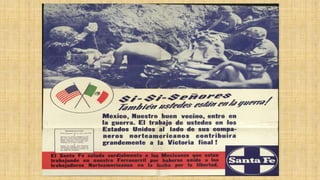
Soldiers on the domestic front
August 14, 1945
Aggregate Mexican
Labor 1900-1970s
Depression WWII and Post War Braceros 1970s
0
200000
400000
600000
800000
1000000
1200000
Population
Year
Population of Contracted and Undocumented Workers
Contracts, from
Mexico
Apprehensions,
Mexican
Operation “Wetback”
1954
Latino Population 1900-1960
• Estimates of Latino Population in the US % of total
• 1900 503,189 0.66
• 1910 797,994 0.87
• 1920 1,286,154 1.22
• 1930 Depression
• 1940 2,142,716 1.63
• 1950 3,558,761 2.36
• 1960 5,814,784 3.24
Bracero Saturated Areas
Labor Deficient Areas
Mexico’s Economy Restructured 1960-1980s
• Key characteristics of the Mexican Economy
Between 1930-1970s, Mexico attempted to break dependency by pining economic
growth on “import substitution”
In 1970s turned to neo-liberal import export economy, increasing imports from the
U.S.
• Results GDP Fell:
1980 8.2% growth
1988 1.2% growth
1995 -1.1 negative contraction
1996 -.1 Year of Crisis
U.S. Outsourcing Jobs to Low Wage Border Maquiladoras 1965
U.S. Immigration Policy and Mexico 1952-1980
• 1964 Bracero Program Ends
• 1965 National Origins System (1924)
Replaced With Preference System Based on
1. Family Reunification
2. Labor Market Needs
Number of Immigrants Determined by Hemispheric Limits
Favoring the Americas (120,000 from the Americas and 170,000 from the rest of the world)
• 1973 End to Preference for Immigration From the Americas
• 1976 Immigration Limits by Nationality (20,000) Extended to the Americas
1986 Immigration Reform and Control Act (IRCA)
• Keys
1. Employer sanctions against hiring undocumented workers
2. System Alien Verification Entitlement (SAVE) Entitlement key issue
today control entry as well as the whole person of undocumented
immigrants
3. Amnesty, path to legalization with proof of continuous residence in
the U.S. prior to January 1982
4. Allowed for Contracting of Supplemental Temporary Legal
Agricultural Labor Special Agricultural Workers (Guest Workers)
Outcomes:
1. Lack of enforcement of employer sanctions, “knowingly hired”
2. Amnesty, proof of permanent residency gave rise to fear of not winning
amnesty and ensuing document black market
3. Undocumented remained in the shadow of immigration law
4. Beginning of end to circular migration between Mexico and the U.S. and
growth of resident population in response to border deterrence and growing
public anxiety over Mexican immigration
5. Beginning of dispersal away from traditional gateway cities and states to the
rest of the nation
6. SAW coupled to BIP and conditions in Mexico re-energizes culture of
immigration
Immigration cont.
Outcomes in Mexico:
1. Free trade market trade places Mexico’s industrial and farming economy
in an unfavorable position compared to the U.S.
2. Near collapse of farm sectors (apples, corn, livestock) in some areas of
Mexico
3. National manufacturing unable to complete with U.S. exports
4. Worsening balance of trade leads to renegotiation of loans to avert
bankruptcy
1994 North American Free Trade Agreement, NAFTA
The Mexican immigrant “threat” and the Public Response
• Four Levels of Public Response:
1. Federal, Congress
2. State Centered
Texas Tyler v. Doe 1982 “DACA”
California Prop 187 1992
Hazelton PA
3. Non-government organizations, Minute Men
1996 Illegal Immigration Reform and Immigrant Responsibility Act
• Increased border deterrence
doubled border patrol, fence
• Admission more stringent
125% above poverty levels
clean criminal record
no previous deportation
• Expedited removal, restricted judicial review
• Increased penalty for smuggling immigrants across border
• Resident aliens with felony convictions may be deported
• Personal Responsibility and Work Opportunity Act
• Legal and undocumented immigrants no longer eligible for
federal public benefits
Recent Changes to Immigration Policy
• September 11, 2001- tightened security-accelerated deportations
• 2003, Homeland Security Act:
Immigration Naturalization Service Reorganized as Immigration and
Customs Enforcement (ICE)
Customs and Border Protection (CBP) and Naturalization and
Immigration
• 2008 Secure Communities Act:
Partnership between local, state, and federal governments to address
undocumented immigration
Identify and remove dangerous criminal aliens
Forecasts enforcement of immigration rules and deportation
Initially quotas set at 400K annually
2008 ICE and Local Law Officials operated in 14 jurisdictions
Today collaboration between ICE and local authorities ongoing in more than
1,210 communities
Changes cont.
Federal Directives: Deferred Action for Childhood Arrivals DACA
• Congressional (house) Refusal to Act on Immigration Reform
• 2012 President Obama invoked executive power to order Homeland Security not to
deport certain undocumented youth immigrants
• DACA:
Relief from deportation for 2 years and renewable
Temporary residency not a path to citizenship
Allows undocumented youth to obtain a work permit
DACA determined on a case by case basis
born after 1981 and entered before 16 birthday
continued resident since 2007
not in immigration detention
high school graduate, served in military
no felonies or serious misdemeanors
pass background check
Birth Place of Calif
Farmworkers, 2003-2004
Birth Place in Mexico of Calif Farmworkers, 2003-2004
Shift in Mexican Sending Areas to Southern States With High Indigenous Populations
Immigration Protest March, Seattle 2006

01 opening remarks_erasmogamboa

  • 1.
    HEALTH AND HISTORICALLITERACY: THE ROLE OF THE ARTS AND SCIENCES ERASMO CORONADO GAMBOA
  • 2.
    Review of earlyU.S. Immigration Policy; Increasing Restrictions 1903 Contract labor prohibited 1907 Head Tax, $4 1917 Literacy Requirement, head tax $8 1921 Immigration Act, limits through quotas 3% of 1910 population 1924 U.S. Border Patrol 1924 National Origins Act, Asian excluded, quotas at 2% of 1890 population
  • 3.
    Immigrants,14 yrs. orolder, who could neither read or write 1899-1910 by race or people Neither read or write
  • 5.
    Outline: Mexican Immigrationand Migration General Overview • 1900-1930 Open entry from Mexico • Depression and deportation • WWII State managed labor flows through contract labor (Braceros)
  • 6.
    Alamo City, Texas,Labor Recruitment Agency for Employers in Northern States
  • 7.
    i recession depression Legal MexicanImmigrants Admitted to the U.S., 1920-1930
  • 8.
    State Managed Deportationas an Answer to Unemployment • PECE, Jobs for Americans • Public support for apprehension and removal of “undocumented immigrants” • Los Angeles, California • San Antonio, Texas • Chicago, Illinois • Total 600,000 (low estimate) 2 million (high estimate) including thousands (50%?) of American citizens of Mexican descent
  • 9.
    World War II:The Great War
  • 10.
    War and PostWar Contract Labor Programs • War Program, 1942-1947 • National Farm Labor Program • ¼ million farm workers, food processing • 130,000 railroad workers, 1943-1945 • Post War Farm Program, 1947-1964 • Regional program, braceros no longer contracted to all the U.S. • Contracted exclusively to U.S. farms • Over 5,000,000 contracted during post war years. The agreement: • Manage Mexican immigration • Temporary work force, system intended to force return and sidestep social concerns •Work contract guarantees basic social and work conditions but lax enforcement renders work agreement null and practically worthless. • Cheap, plentiful, and tractable labor for labor intensive industries
  • 12.
    Soldiers on thedomestic front
  • 14.
  • 17.
    Aggregate Mexican Labor 1900-1970s DepressionWWII and Post War Braceros 1970s
  • 18.
    0 200000 400000 600000 800000 1000000 1200000 Population Year Population of Contractedand Undocumented Workers Contracts, from Mexico Apprehensions, Mexican Operation “Wetback” 1954
  • 19.
    Latino Population 1900-1960 •Estimates of Latino Population in the US % of total • 1900 503,189 0.66 • 1910 797,994 0.87 • 1920 1,286,154 1.22 • 1930 Depression • 1940 2,142,716 1.63 • 1950 3,558,761 2.36 • 1960 5,814,784 3.24
  • 21.
  • 24.
    Mexico’s Economy Restructured1960-1980s • Key characteristics of the Mexican Economy Between 1930-1970s, Mexico attempted to break dependency by pining economic growth on “import substitution” In 1970s turned to neo-liberal import export economy, increasing imports from the U.S. • Results GDP Fell: 1980 8.2% growth 1988 1.2% growth 1995 -1.1 negative contraction 1996 -.1 Year of Crisis
  • 25.
    U.S. Outsourcing Jobsto Low Wage Border Maquiladoras 1965
  • 26.
    U.S. Immigration Policyand Mexico 1952-1980 • 1964 Bracero Program Ends • 1965 National Origins System (1924) Replaced With Preference System Based on 1. Family Reunification 2. Labor Market Needs Number of Immigrants Determined by Hemispheric Limits Favoring the Americas (120,000 from the Americas and 170,000 from the rest of the world) • 1973 End to Preference for Immigration From the Americas • 1976 Immigration Limits by Nationality (20,000) Extended to the Americas
  • 27.
    1986 Immigration Reformand Control Act (IRCA) • Keys 1. Employer sanctions against hiring undocumented workers 2. System Alien Verification Entitlement (SAVE) Entitlement key issue today control entry as well as the whole person of undocumented immigrants 3. Amnesty, path to legalization with proof of continuous residence in the U.S. prior to January 1982 4. Allowed for Contracting of Supplemental Temporary Legal Agricultural Labor Special Agricultural Workers (Guest Workers)
  • 28.
    Outcomes: 1. Lack ofenforcement of employer sanctions, “knowingly hired” 2. Amnesty, proof of permanent residency gave rise to fear of not winning amnesty and ensuing document black market 3. Undocumented remained in the shadow of immigration law 4. Beginning of end to circular migration between Mexico and the U.S. and growth of resident population in response to border deterrence and growing public anxiety over Mexican immigration 5. Beginning of dispersal away from traditional gateway cities and states to the rest of the nation 6. SAW coupled to BIP and conditions in Mexico re-energizes culture of immigration Immigration cont.
  • 29.
    Outcomes in Mexico: 1.Free trade market trade places Mexico’s industrial and farming economy in an unfavorable position compared to the U.S. 2. Near collapse of farm sectors (apples, corn, livestock) in some areas of Mexico 3. National manufacturing unable to complete with U.S. exports 4. Worsening balance of trade leads to renegotiation of loans to avert bankruptcy 1994 North American Free Trade Agreement, NAFTA
  • 30.
    The Mexican immigrant“threat” and the Public Response • Four Levels of Public Response: 1. Federal, Congress 2. State Centered Texas Tyler v. Doe 1982 “DACA” California Prop 187 1992 Hazelton PA 3. Non-government organizations, Minute Men
  • 31.
    1996 Illegal ImmigrationReform and Immigrant Responsibility Act • Increased border deterrence doubled border patrol, fence • Admission more stringent 125% above poverty levels clean criminal record no previous deportation • Expedited removal, restricted judicial review • Increased penalty for smuggling immigrants across border • Resident aliens with felony convictions may be deported • Personal Responsibility and Work Opportunity Act • Legal and undocumented immigrants no longer eligible for federal public benefits
  • 32.
    Recent Changes toImmigration Policy • September 11, 2001- tightened security-accelerated deportations • 2003, Homeland Security Act: Immigration Naturalization Service Reorganized as Immigration and Customs Enforcement (ICE) Customs and Border Protection (CBP) and Naturalization and Immigration
  • 33.
    • 2008 SecureCommunities Act: Partnership between local, state, and federal governments to address undocumented immigration Identify and remove dangerous criminal aliens Forecasts enforcement of immigration rules and deportation Initially quotas set at 400K annually 2008 ICE and Local Law Officials operated in 14 jurisdictions Today collaboration between ICE and local authorities ongoing in more than 1,210 communities Changes cont.
  • 34.
    Federal Directives: DeferredAction for Childhood Arrivals DACA • Congressional (house) Refusal to Act on Immigration Reform • 2012 President Obama invoked executive power to order Homeland Security not to deport certain undocumented youth immigrants • DACA: Relief from deportation for 2 years and renewable Temporary residency not a path to citizenship Allows undocumented youth to obtain a work permit DACA determined on a case by case basis born after 1981 and entered before 16 birthday continued resident since 2007 not in immigration detention high school graduate, served in military no felonies or serious misdemeanors pass background check
  • 35.
    Birth Place ofCalif Farmworkers, 2003-2004
  • 36.
    Birth Place inMexico of Calif Farmworkers, 2003-2004
  • 37.
    Shift in MexicanSending Areas to Southern States With High Indigenous Populations
  • 38.