BRANEWORLD COSMOLOGY AND TACHYON
INFLATION – RSII NUMERICAL MODELS
MILAN MILOŠEVIĆ
Department of Physics
Faculty of Sciences and Mathematics
University of Niš, Serbia
XVIII Serbian Astronomical Conference, Belgrade, 17-21 October 2017
In collaboration with N. Bilić (Zagreb), G. Đorđević,
D. Dimitrijević, D. Delibašić, M. Stojanović (Niš)
Based on: N. Bilic, D.D. Dimitrijevic, G.S. Djordjevic, M. Milosevic, Tachyon inflation in an
AdS braneworld with back-reaction, International Journal of Modern Physics A. 32 (2017) 1750039.
OUTLINE
• Introduction
• Tachyon Inflation
• Randall - Sundrum Models (RS)
• Numerical results
• Conclusion
INTRODUCTION AND MOTIVATION
• The inflationary universe scenario in which the
early universe undergoes a rapid expansion has
been generally accepted as a solution to the
horizon problem and some other related problems
of the standard big-bang cosmology
• Quantum cosmology: probably the best way to
describe the evolution of the early universe.
• Recent years - a lot of evidence from WMAP and
Planck observations of the CMB
OBSERVATIONAL PARAMETERS
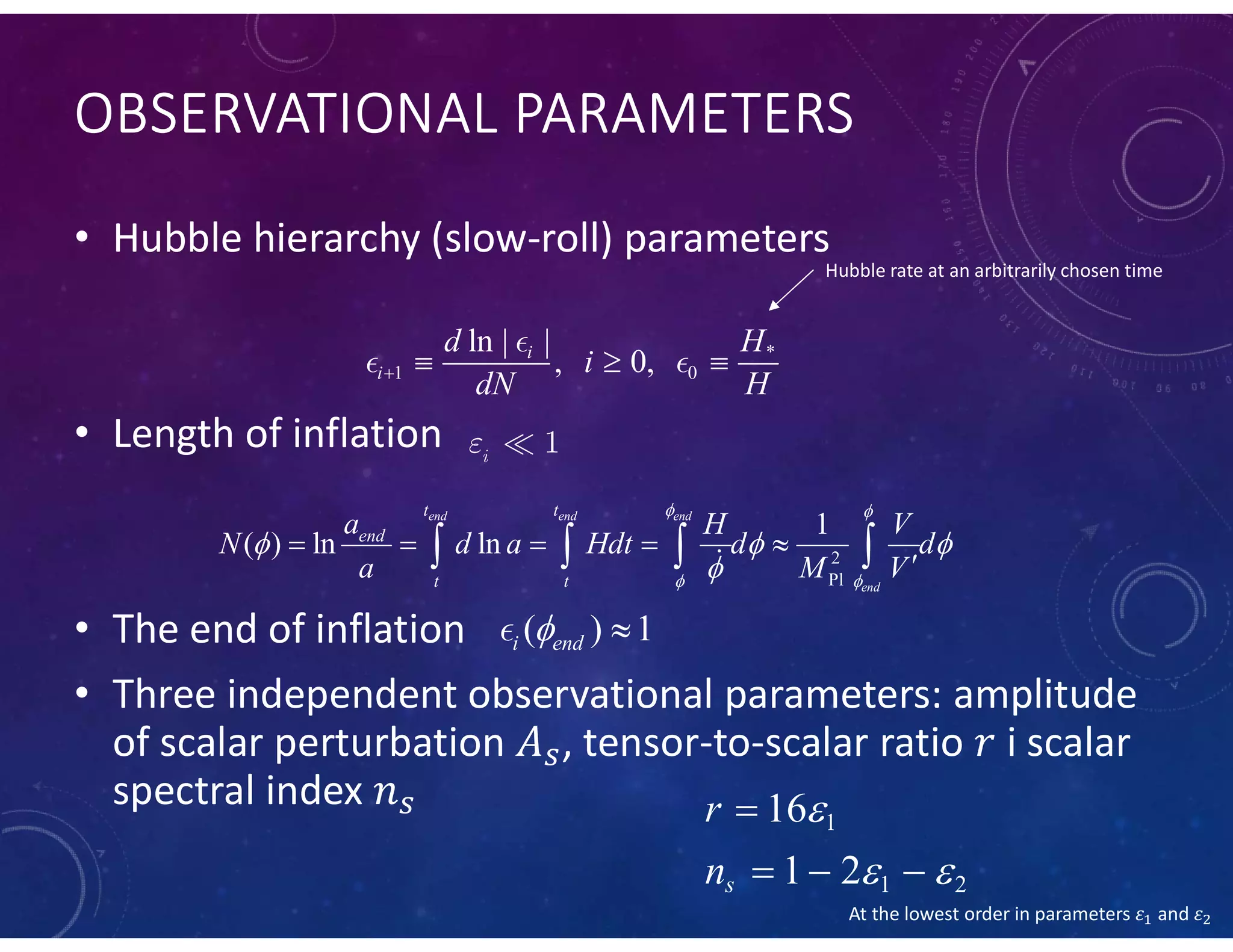
• Hubble hierarchy (slow-roll) parameters
• Length of inflation
• The end of inflation
• Three independent observational parameters: amplitude
of scalar perturbation , tensor-to-scalar ratio i scalar
spectral index
*
1 0
ln | |
, 0,i
i
d H
i
dN H   

 
Hubble rate at an arbitrarily chosen time
2
Pl
1
( ) ln ln
end end end
end
t t
end
t t
a H V
N d a Hdt d d
a M V
 
 
  

    
   
 1i

( ) 1i end 
1
1 2
16
1 2s
r
n

 

  
At the lowest order in parameters 𝜀 and 𝜀
OBSERVATIONAL PARAMETERS
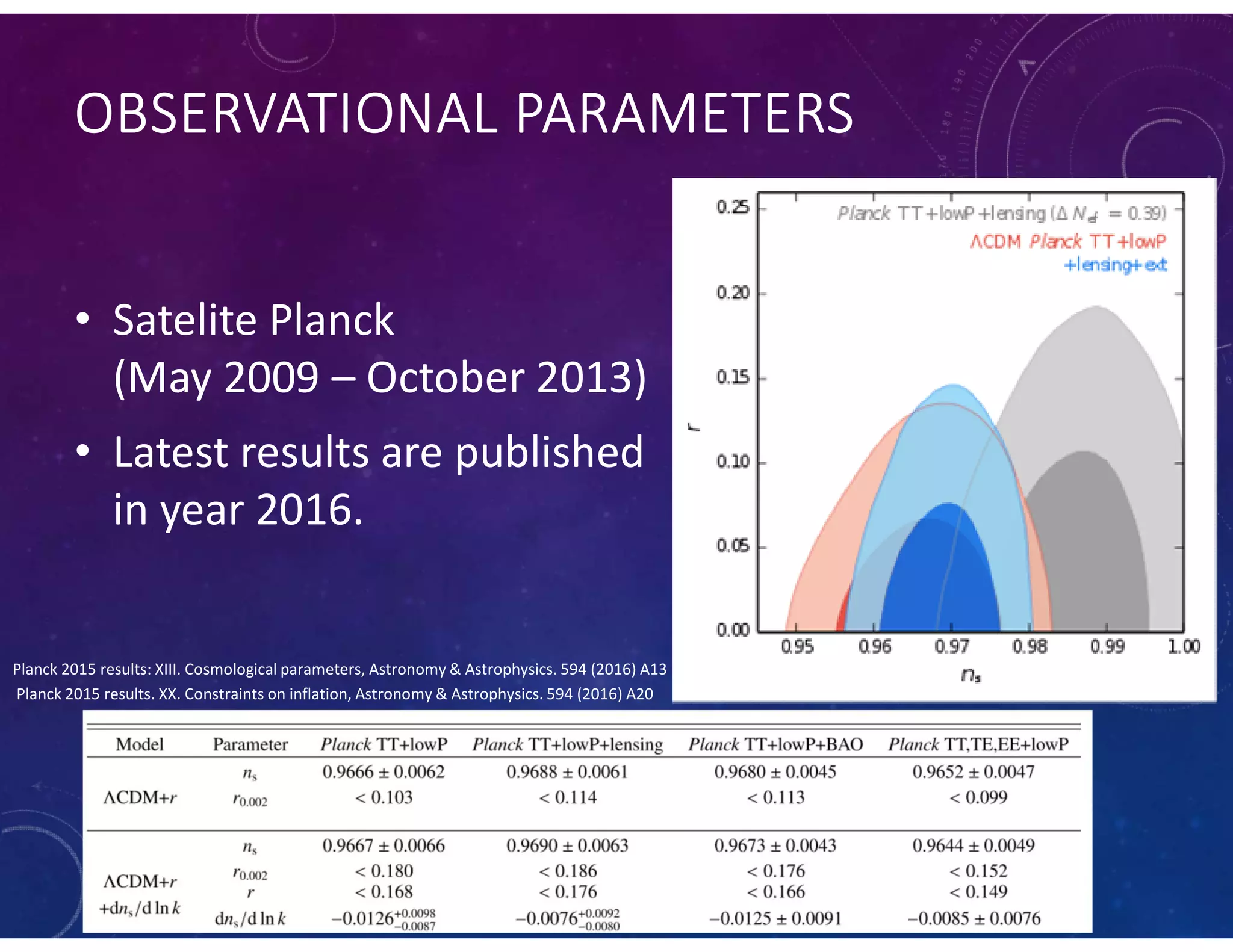
• Satelite Planck
(May 2009 – October 2013)
• Latest results are published
in year 2016.
Planck 2015 results: XIII. Cosmological parameters, Astronomy & Astrophysics. 594 (2016) A13
Planck 2015 results. XX. Constraints on inflation, Astronomy & Astrophysics. 594 (2016) A20
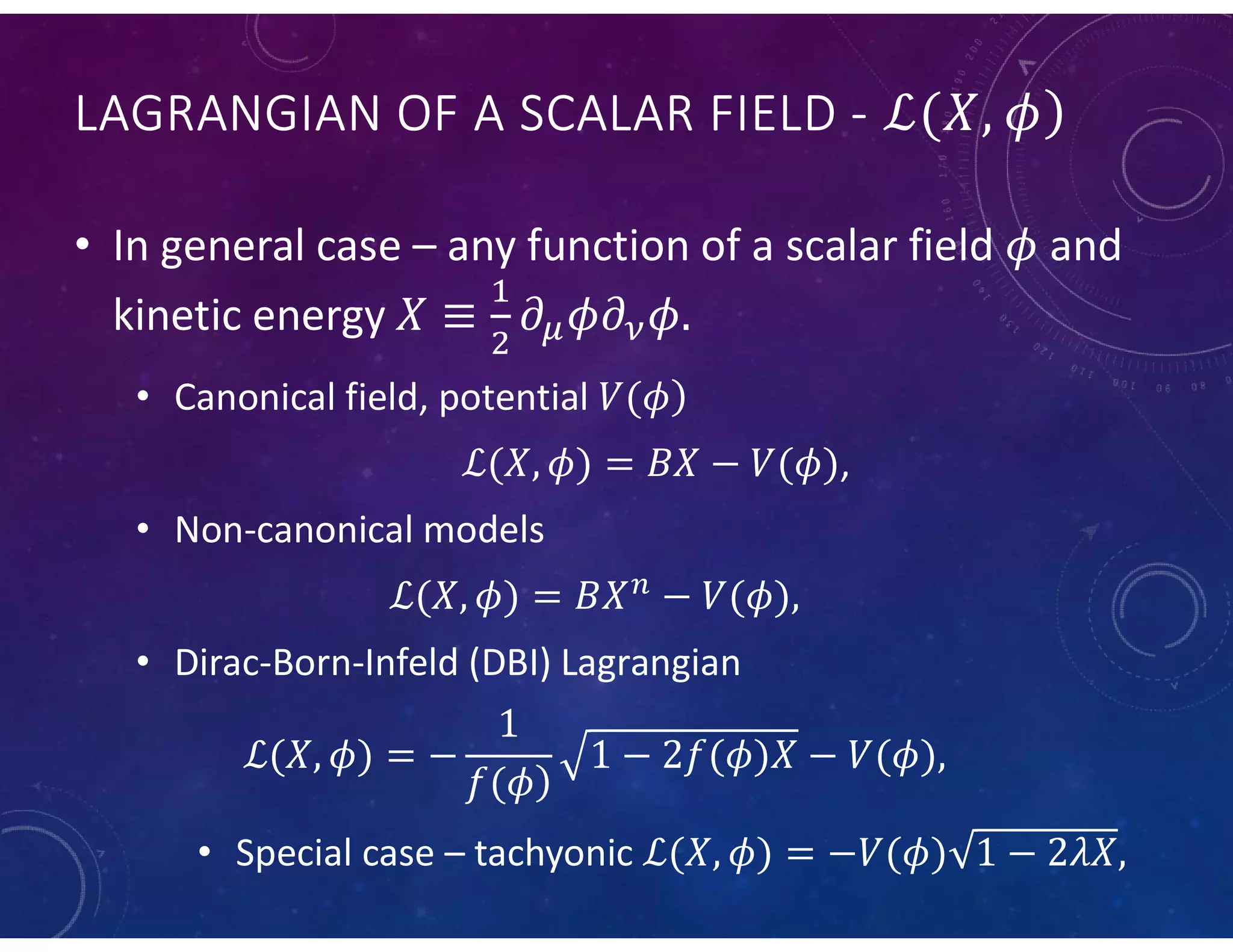
LAGRANGIAN OF A SCALAR FIELD -
• In general case – any function of a scalar field and
kinetic energy
• Canonical field, potential
,
• Non-canonical models
• Dirac-Born-Infeld (DBI) Lagrangian
• Special case – tachyonic
TACHYONS
• Traditionally, the word tachyon was used to describe a
hypothetical particle which propagates faster than
light.
• In modern physics this meaning has been changed
• The effective tachyonic field theory was proposed by A. Sen
• String theory: states of quantum fields with imaginary mass
(i.e. negative mass squared)
• It was believed: such fields permitted propagation faster
than light
• However it was realized that the imaginary mass creates an
instability and tachyons spontaneously decay through the
process known as tachyon condensation
TACHYION FIELDS
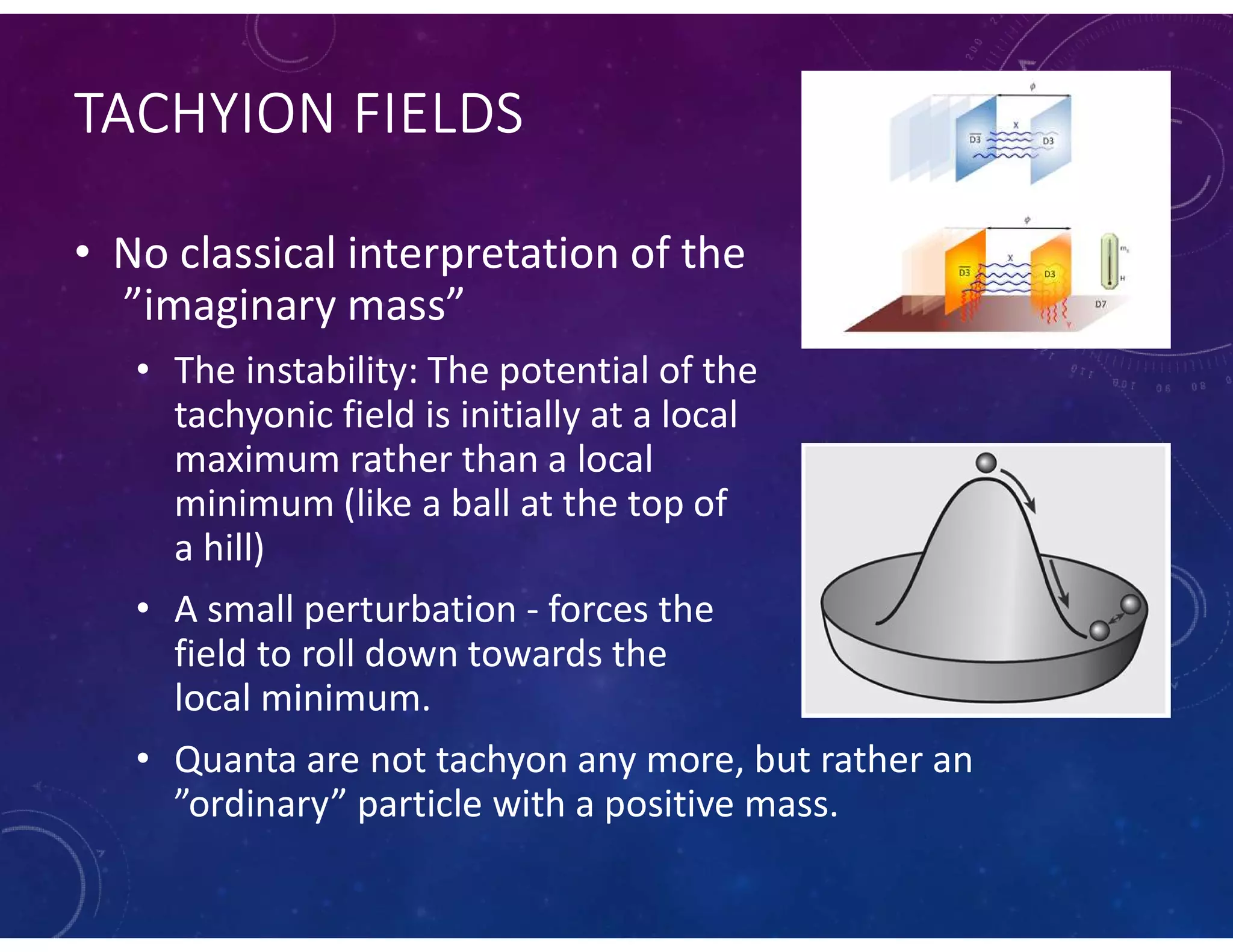
• No classical interpretation of the
”imaginary mass”
• The instability: The potential of the
tachyonic field is initially at a local
maximum rather than a local
minimum (like a ball at the top of
a hill)
• A small perturbation - forces the
field to roll down towards the
local minimum.
• Quanta are not tachyon any more, but rather an
”ordinary” particle with a positive mass.
TACHYON INFLATION
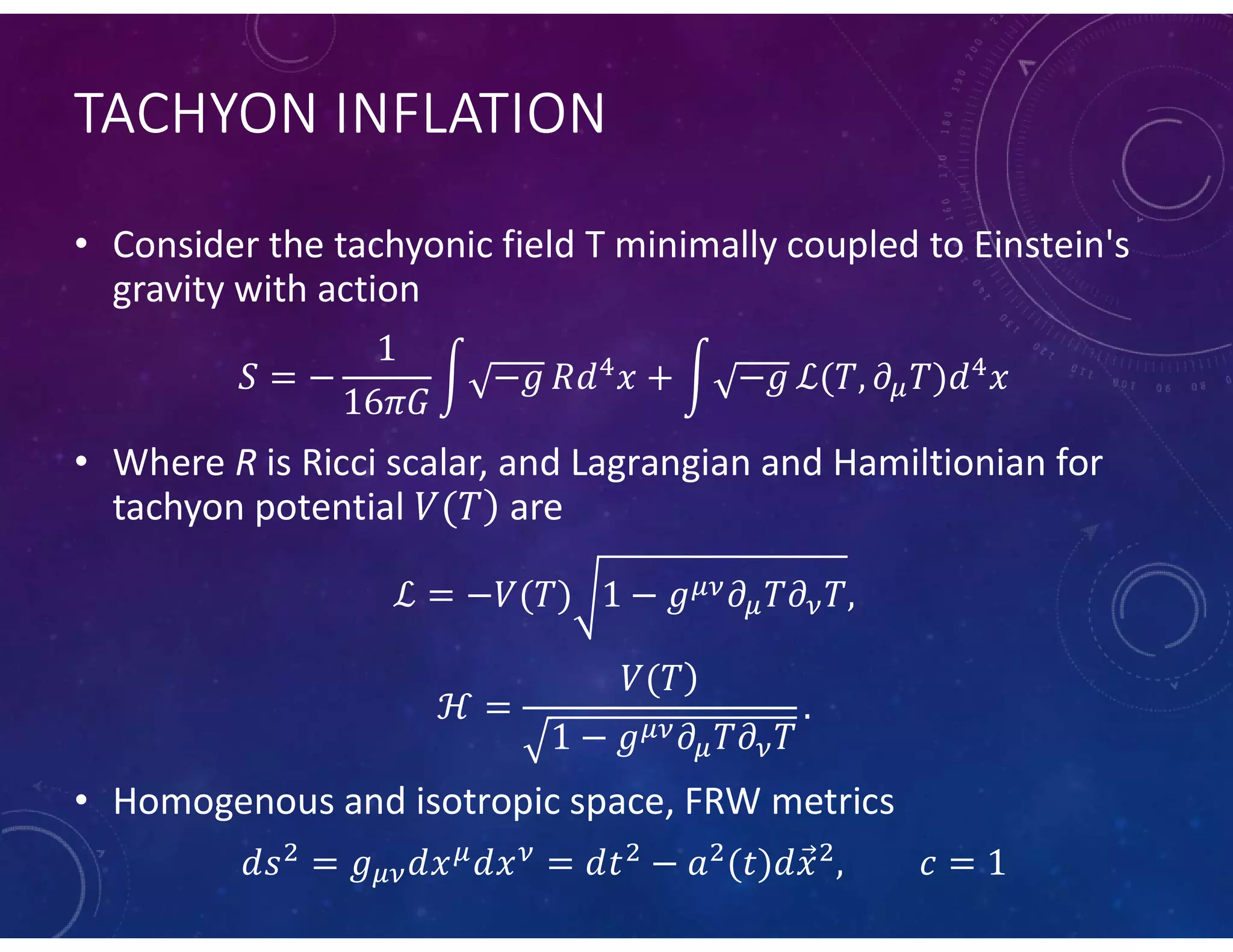
• Consider the tachyonic field T minimally coupled to Einstein's
gravity with action
• Where R is Ricci scalar, and Lagrangian and Hamiltionian for
tachyon potential are
• Homogenous and isotropic space, FRW metrics
TACHYON INFLATION
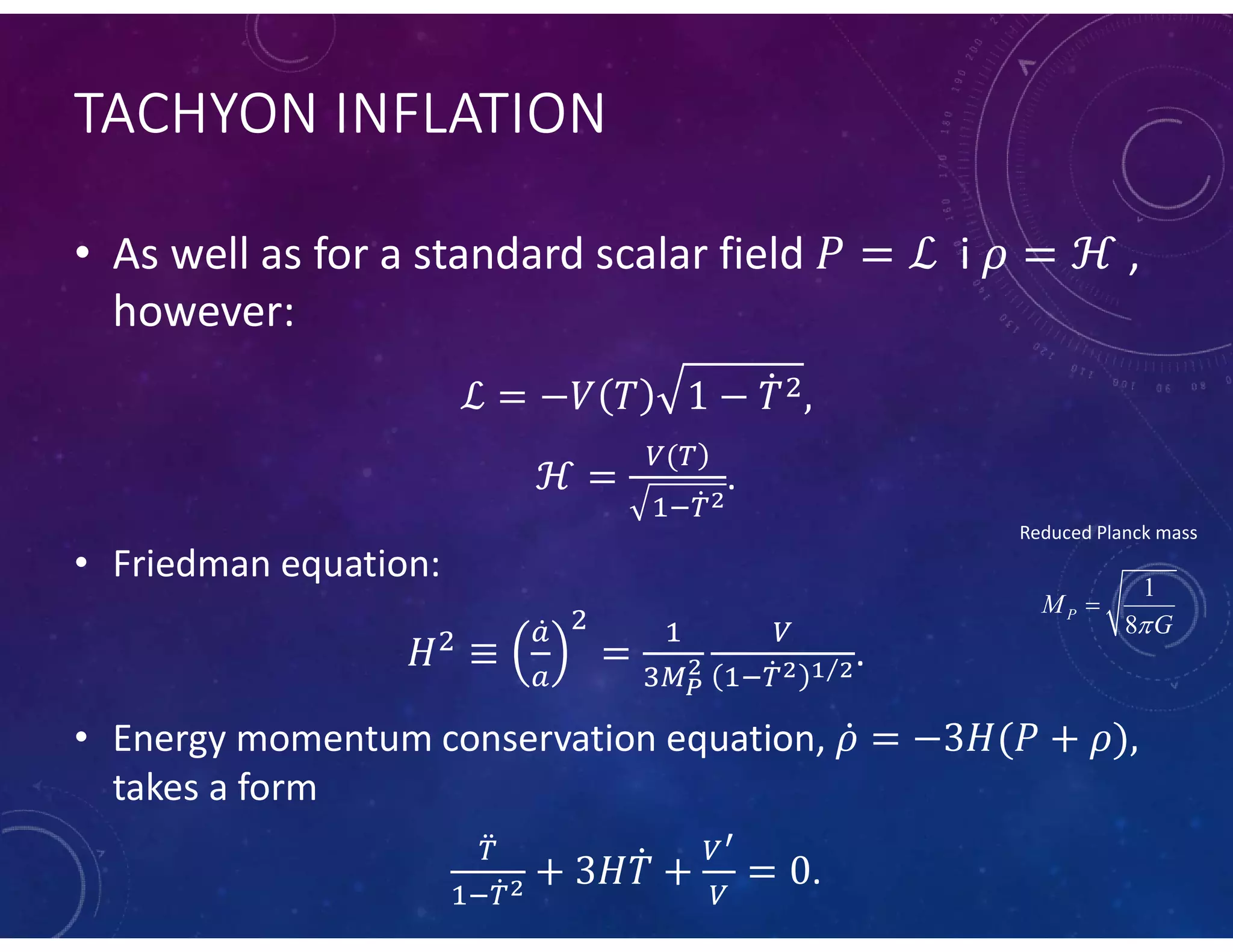
• As well as for a standard scalar field i ,
however:
.
• Friedman equation:
⁄ .
• Energy momentum conservation equation,
takes a form
.
1
8
PM
G

Reduced Planck mass
TACHYON INFLATION
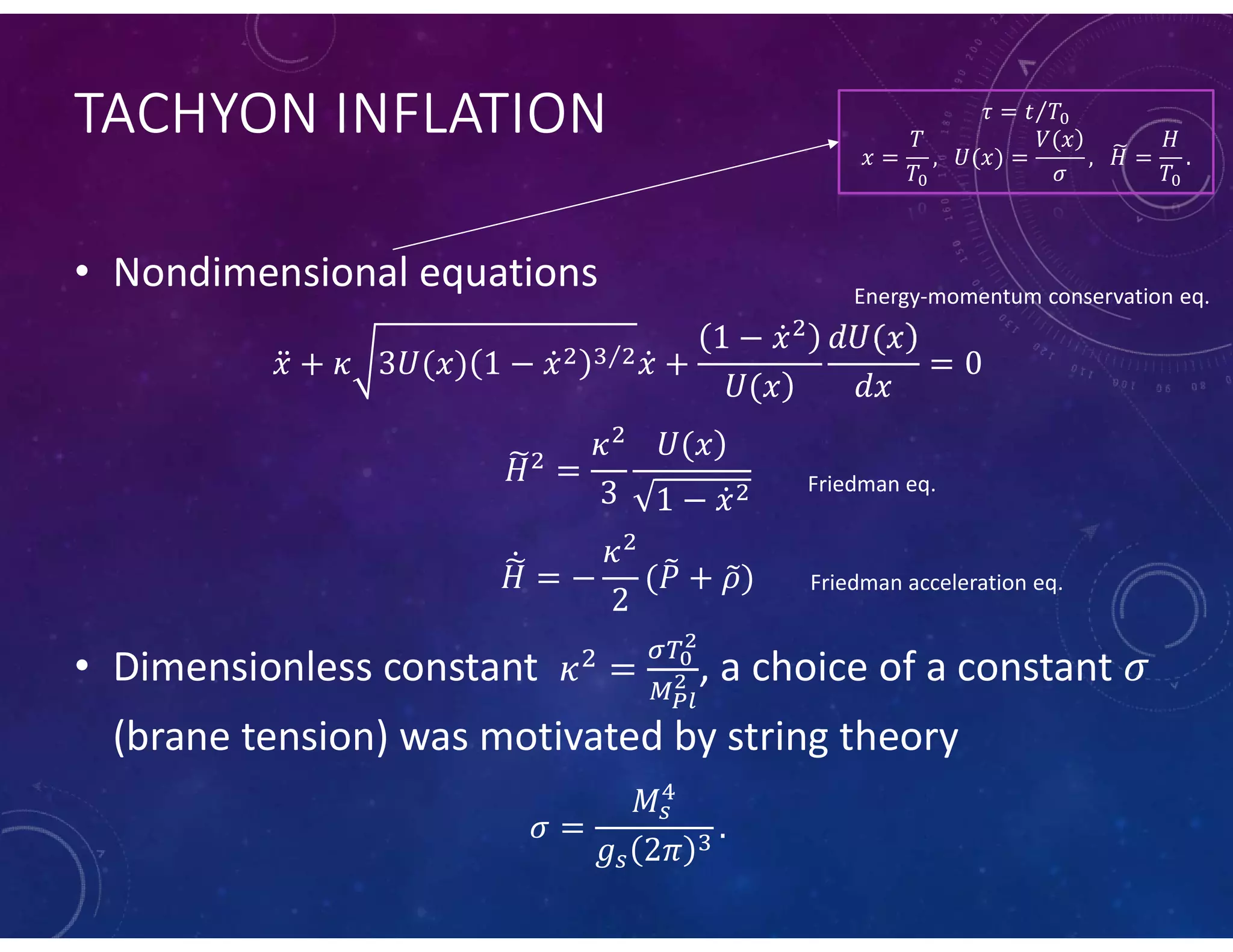
• Nondimensional equations
⁄
• Dimensionless constant , a choice of a constant
(brane tension) was motivated by string theory
𝜏 = 𝑡 𝑇⁄
𝑥 =
𝑇
𝑇
,     𝑈(𝑥) =
𝑉(𝑥)
𝜎
,     𝐻 =
𝐻
𝑇
.
Energy-momentum conservation eq.
Friedman eq.
Friedman acceleration eq.
CONDITION FOR TACHYON INFLATION
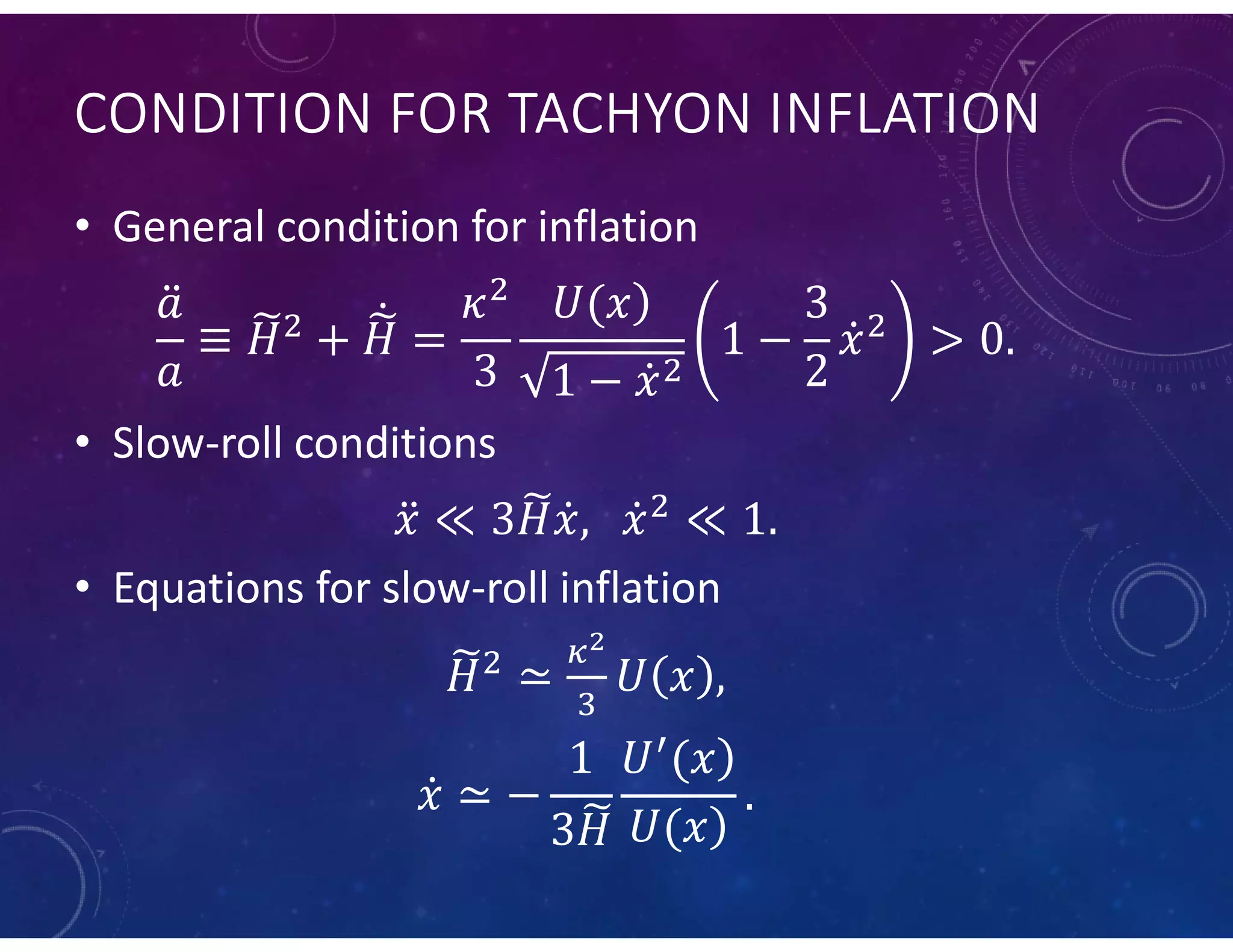
• General condition for inflation
• Slow-roll conditions
• Equations for slow-roll inflation
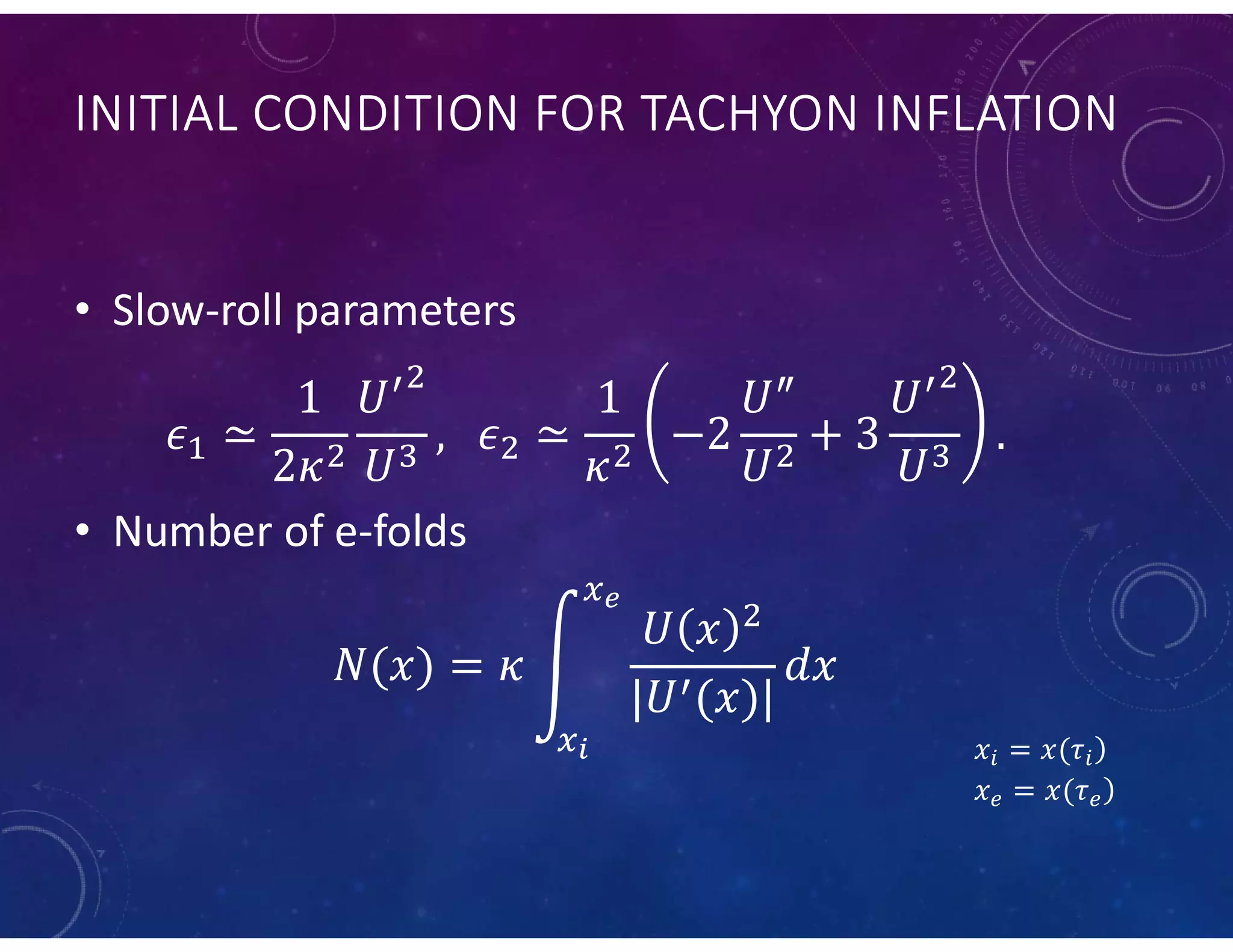
INITIAL CONDITION FOR TACHYON INFLATION
• Slow-roll parameters
• Number of e-folds
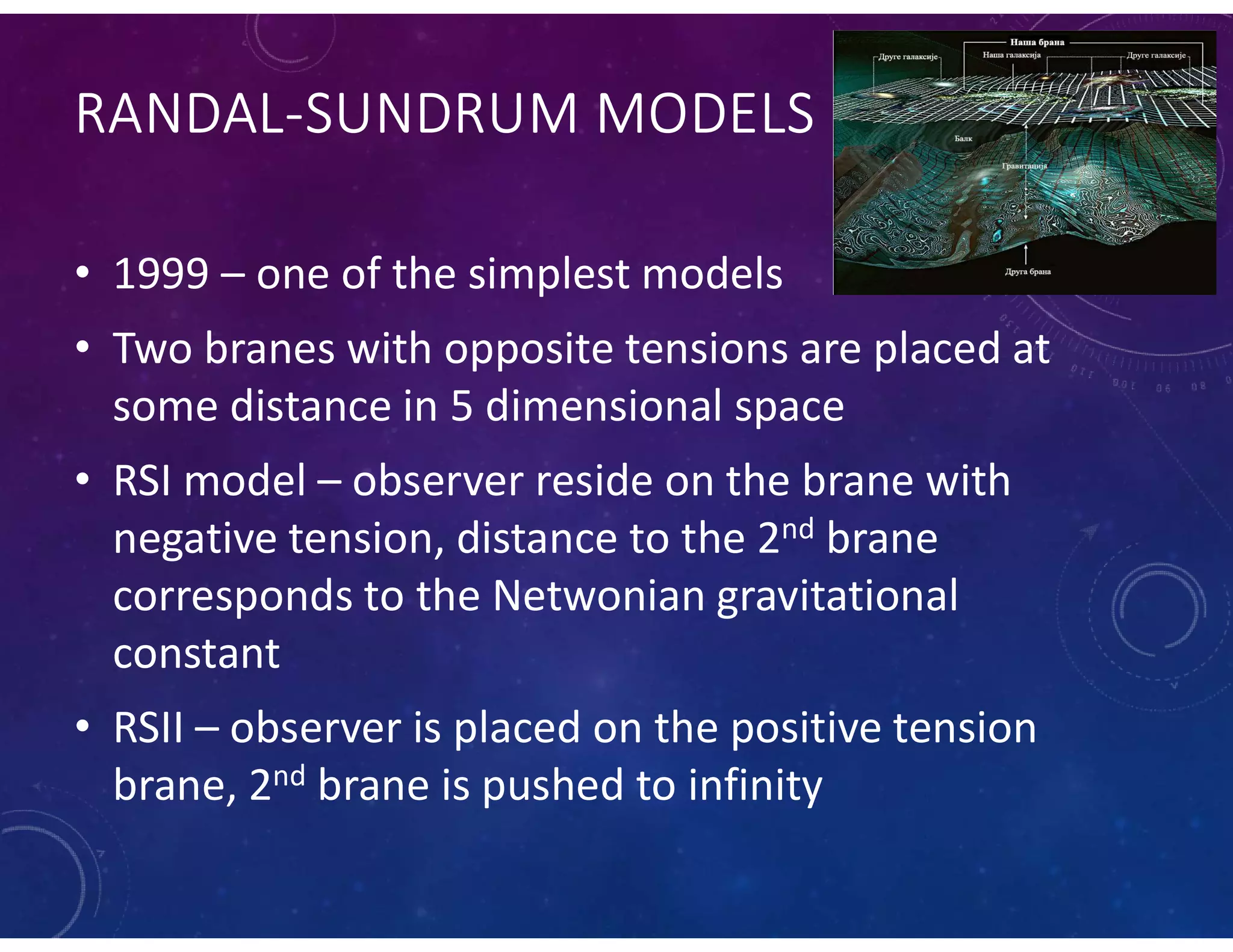
RANDAL-SUNDRUM MODELS
• 1999 – one of the simplest models
• Two branes with opposite tensions are placed at
some distance in 5 dimensional space
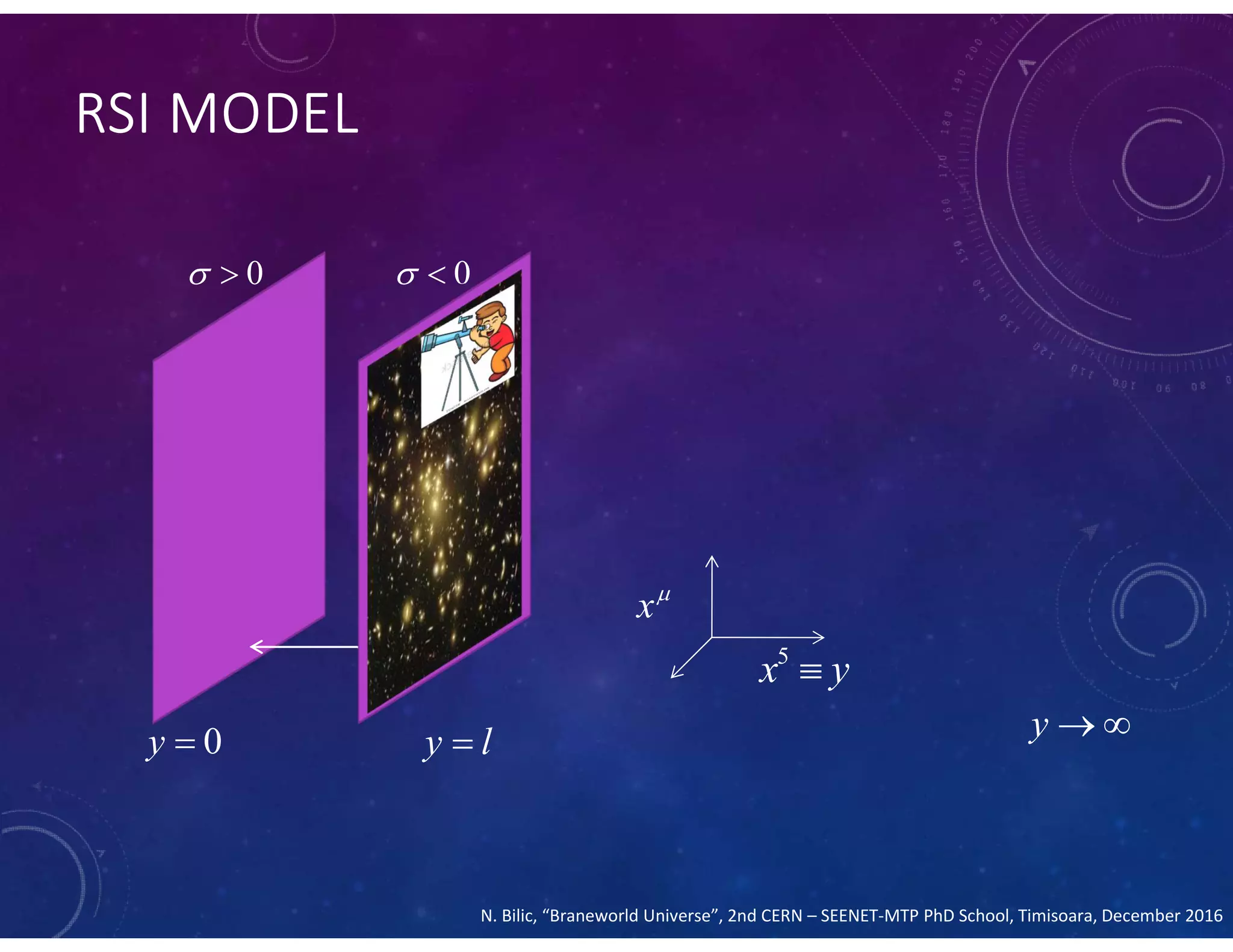
• RSI model – observer reside on the brane with
negative tension, distance to the 2nd brane
corresponds to the Netwonian gravitational
constant
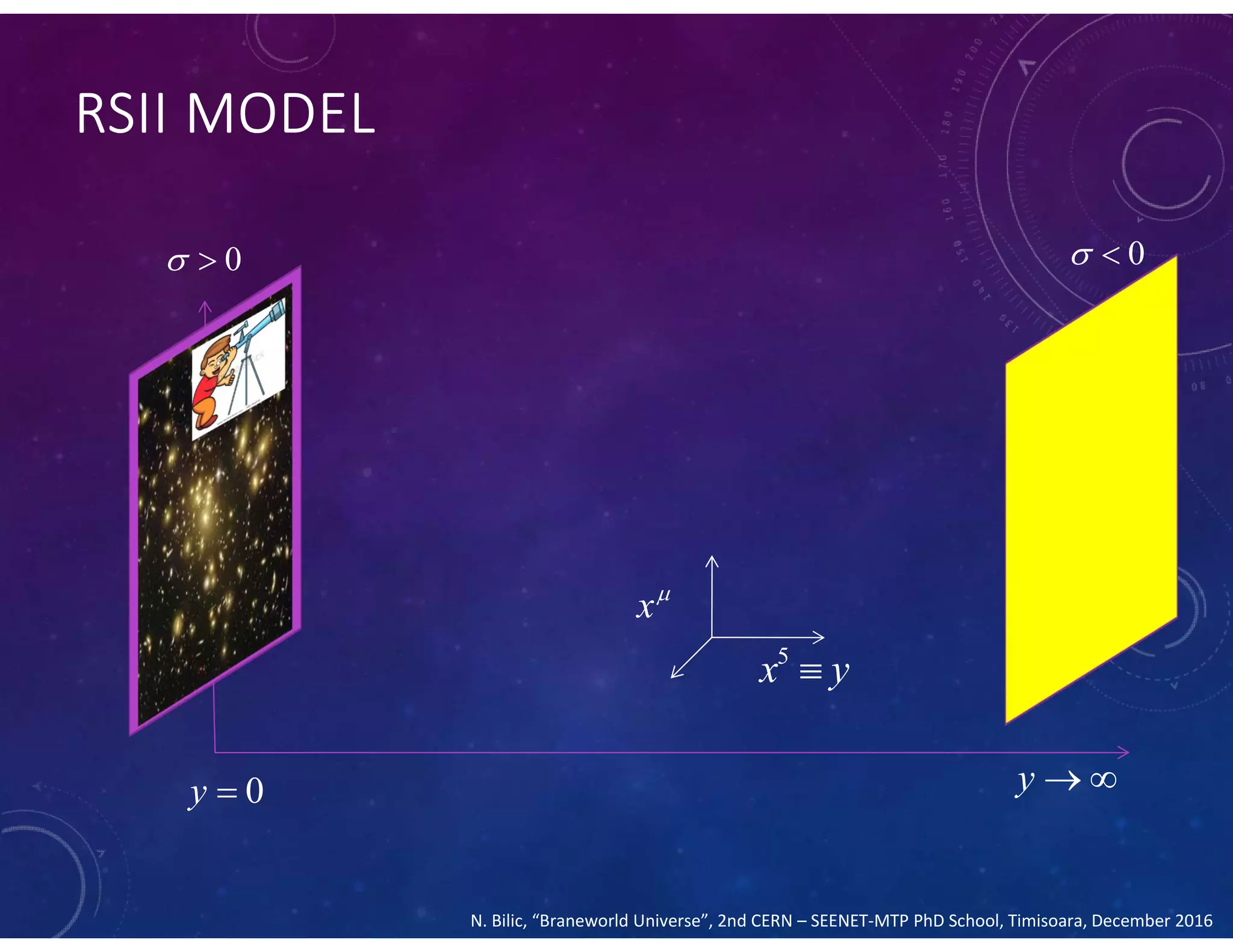
• RSII – observer is placed on the positive tension
brane, 2nd brane is pushed to infinity
RSI MODEL
x
5
x y
0y  y l y  
N. Bilic, “Braneworld Universe”, 2nd CERN – SEENET-MTP PhD School, Timisoara, December 2016
0  0 
RSII MODEL
0y  y  
0  0 
N. Bilic, “Braneworld Universe”, 2nd CERN – SEENET-MTP PhD School, Timisoara, December 2016
x
5
x y
RSII MODEL
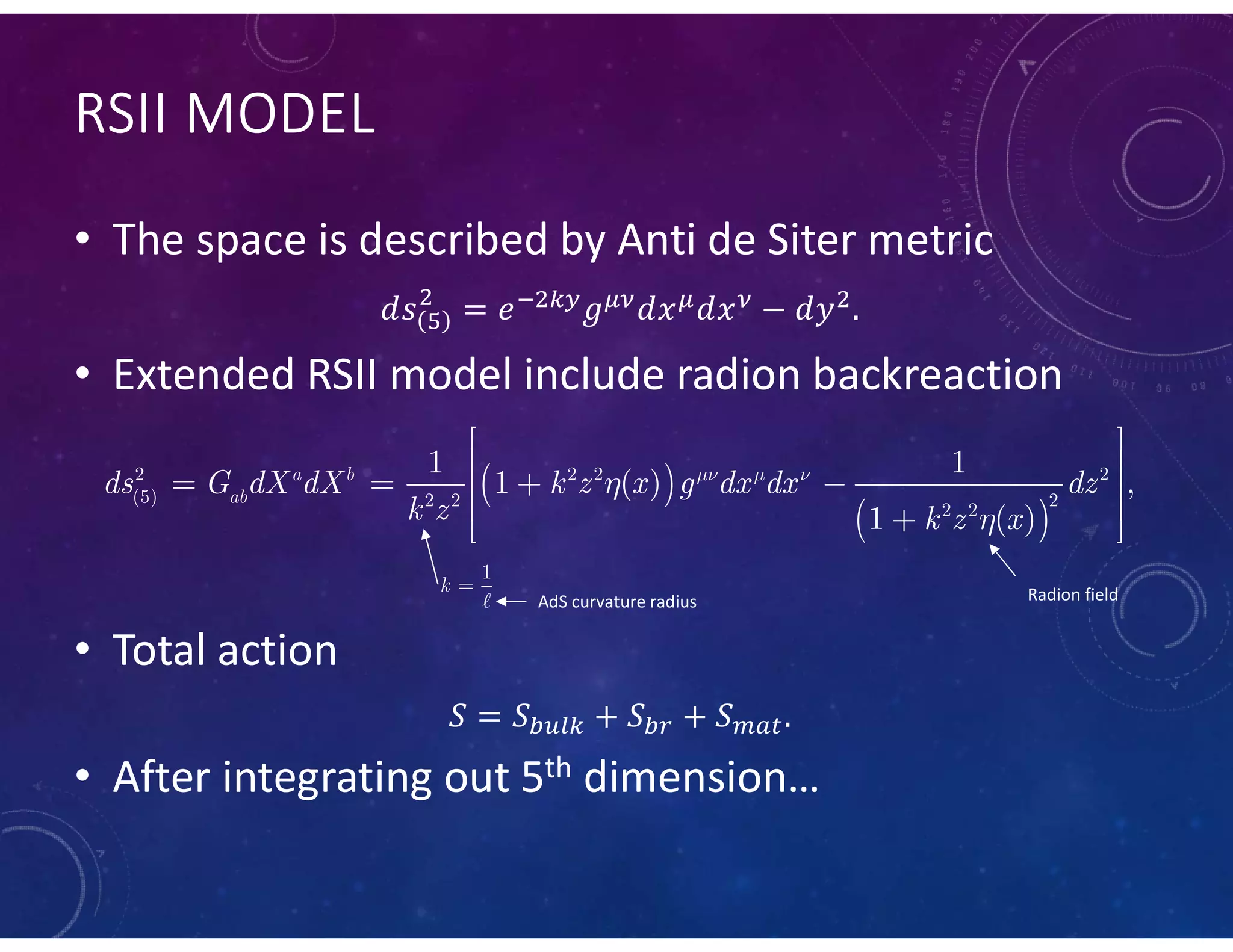
• The space is described by Anti de Siter metric
• Extended RSII model include radion backreaction
• Total action
• After integrating out 5th dimension…
 
 
2 2 2 2
(5) 2 2 2
2 2
1 1
1 ( ) ,
1 ( )
a b
ab
ds G dX dX k z x g dx dx dz
k z k z x
  


 
 
    
  

1
k 
AdS curvature radius Radion field
RSII MODEL
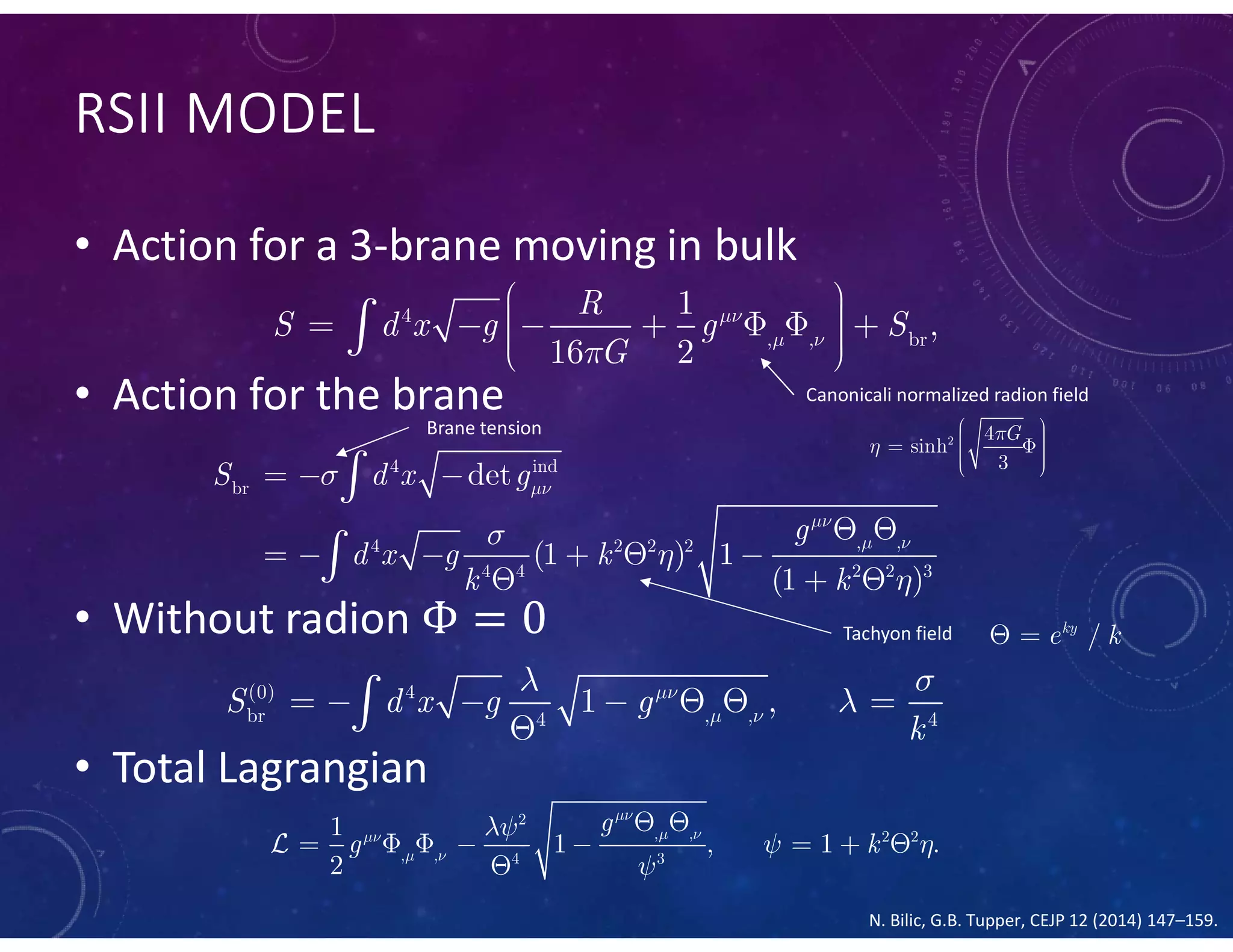
• Action for a 3-brane moving in bulk
• Action for the brane
• Without radion
• Total Lagrangian
4
, , br
1
,
16 2
R
S d x g g S
G

 

         
Canonicali normalized radion field
2 4
sinh
3
G

      4 ind
br
, ,4 2 2 2
4 4 2 2 3
det
(1 ) 1
(1 )
S d x g
g
d x g k
k k


 




  
 
     
  


Brane tension
Tachyon field /ky
e k 
(0) 4
br , ,4 4
1 ,S d x g g
k

 
 
      

2
, , 2 2
, , 4 3
1
1 , 1 .
2
g
g k

 
 

 

 
       


N. Bilic, G.B. Tupper, CEJP 12 (2014) 147–159.
RSII MODEL
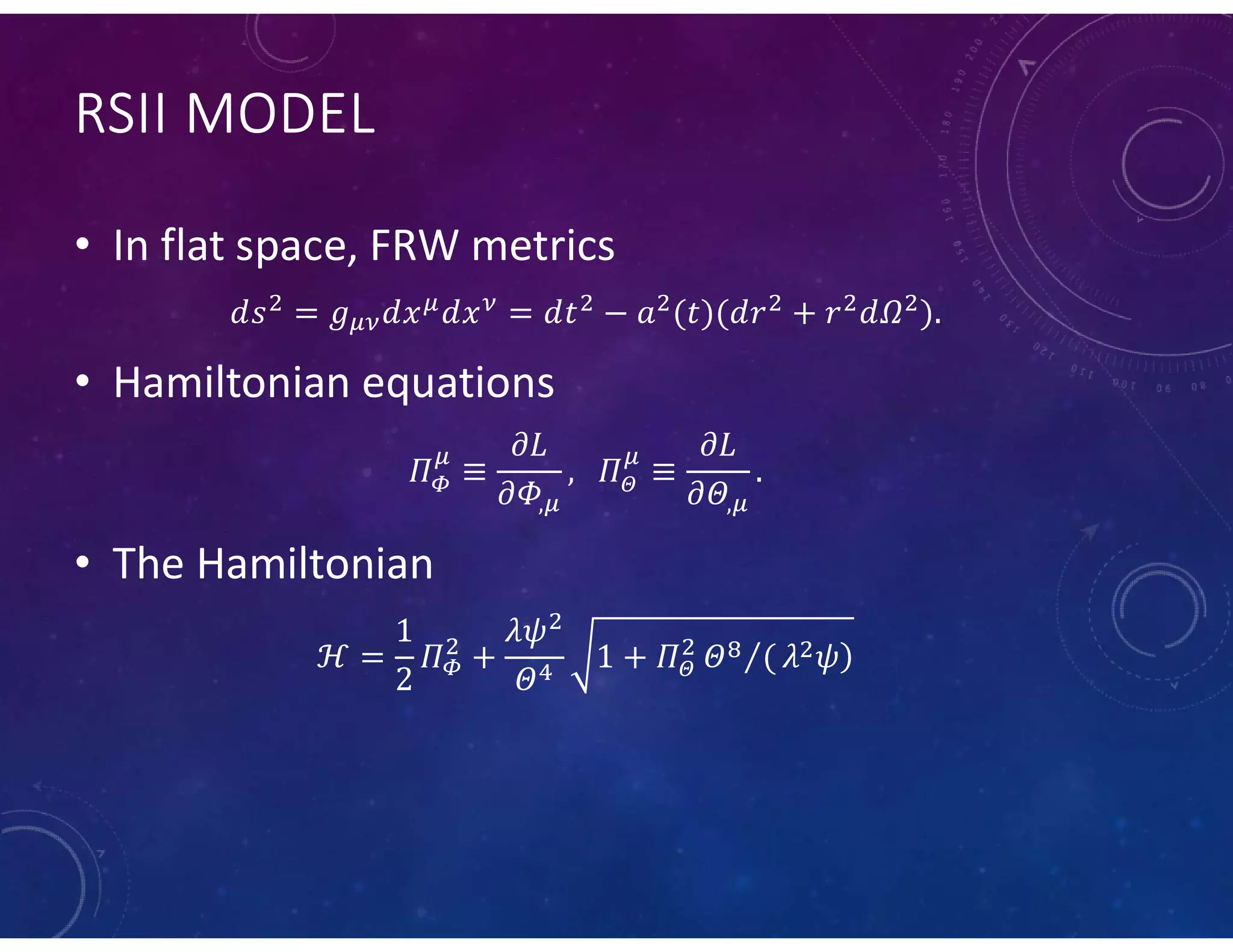
• In flat space, FRW metrics
• Hamiltonian equations
, ,
• The Hamiltonian
RSII MODEL
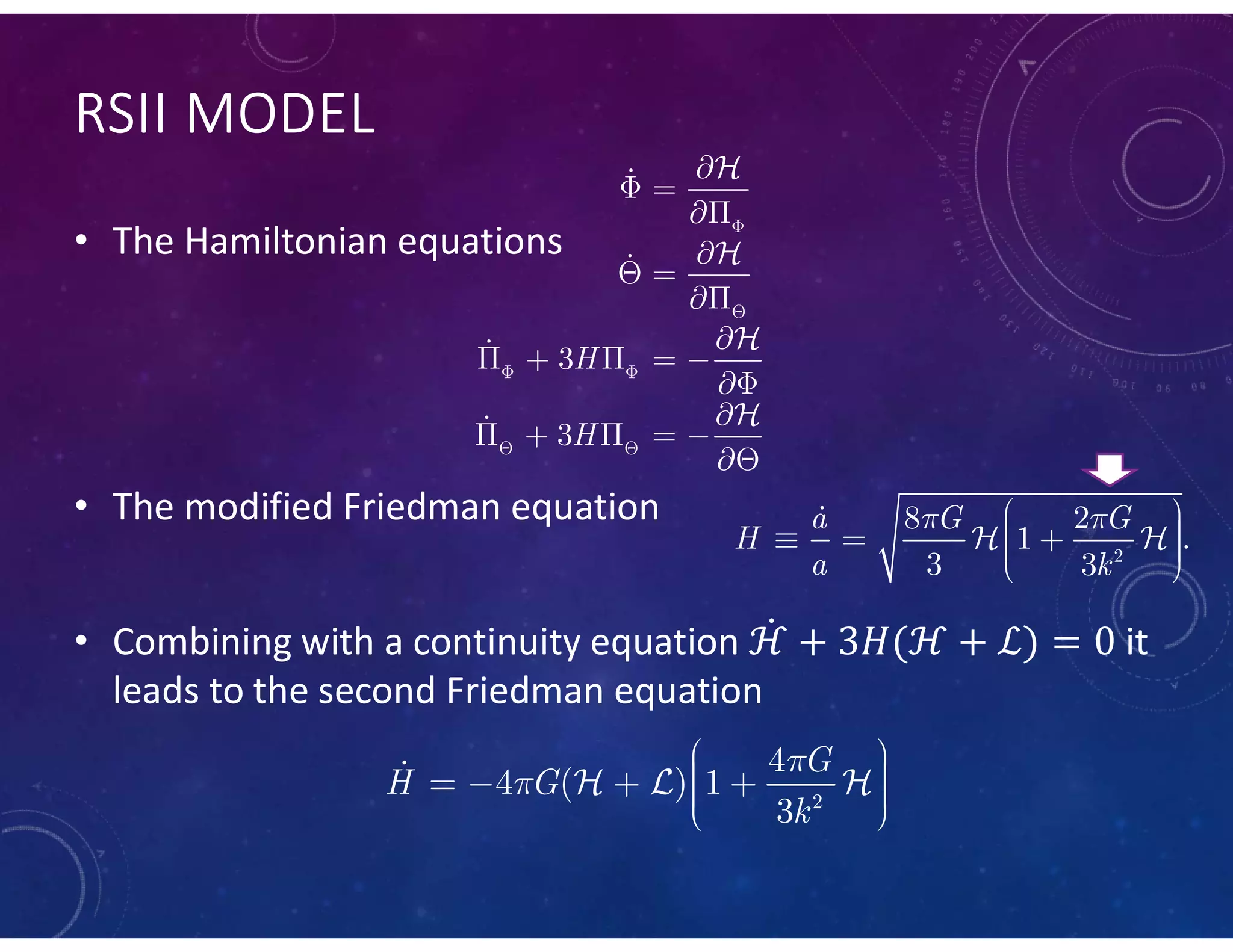
• The Hamiltonian equations
• The modified Friedman equation
• Combining with a continuity equation it
leads to the second Friedman equation




3
3
H
H


 
 

 


 


    


    






2
8 2
1 .
3 3
a G G
H
a k
       
 

2
4
4 ( ) 1
3
G
H G
k


       
  
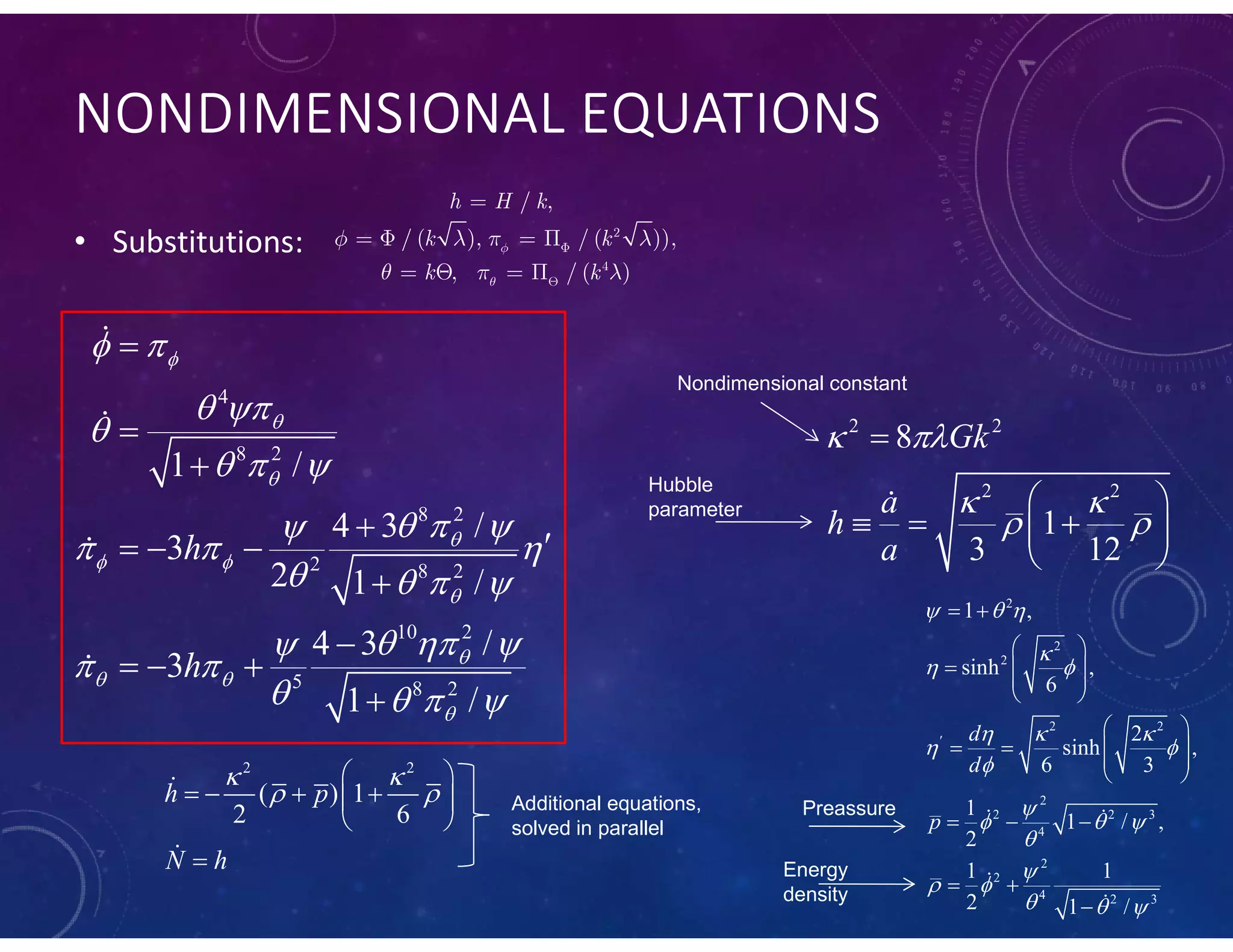
NONDIMENSIONAL EQUATIONS
• Substitutions:
4
8 2
8 2
2 8 2
10 2
5 8 2
1 /
4 3 /
3
2 1 /
4 3 /
3
1 /
h
h




 


 

 
 

  
  
  
   
  
 
   




  


  





2 2
2 2
8
1
3 12
Gk
a
h
a
 
 
 

 
   
 

2
2
2
2 2
2
2 2 3
4
2
2
4 2 3
1 ,
sinh ,
6
2
sinh ,
6 3
1
1 / ,
2
1 1
2 1 /
d
d
p
  

 
  
 


  


 
  

 
 
   
 
 
    
 
  
 

 


Nondimensional constant
Hubble
parameter
Preassure
Energy
density
2 2
( ) 1
2 6
h p
N h
 
 
 
    
 



Additional equations,
solved in parallel
2
4
/ ,
/ ( ), / ( )),
, / ( )
h H k
k k
k k


   
  



   
   
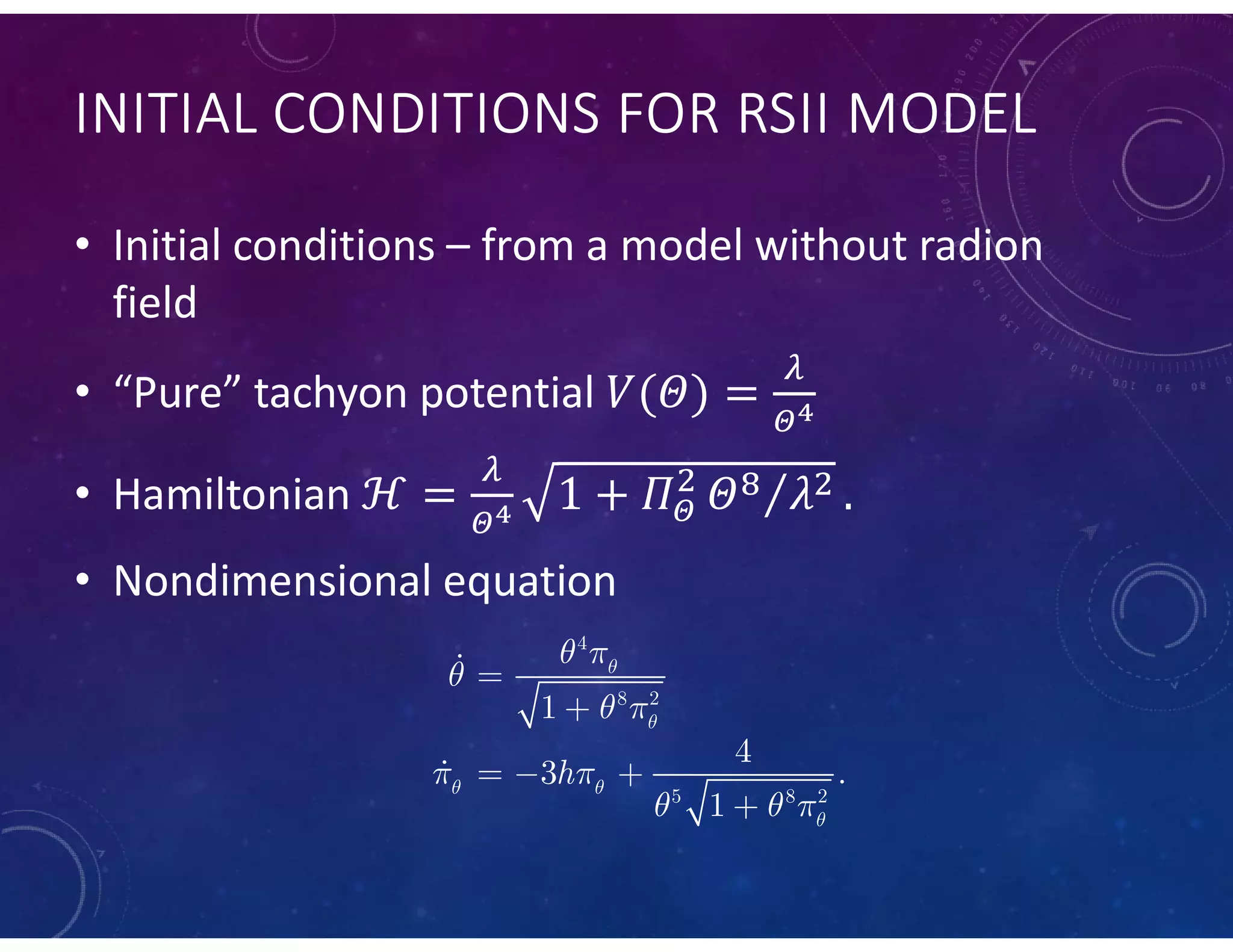
INITIAL CONDITIONS FOR RSII MODEL
• Initial conditions – from a model without radion
field
• “Pure” tachyon potential
• Hamiltonian
• Nondimensional equation


4
8 2
5 8 2
1
4
3 .
1
h


 

 

 
 
  


  

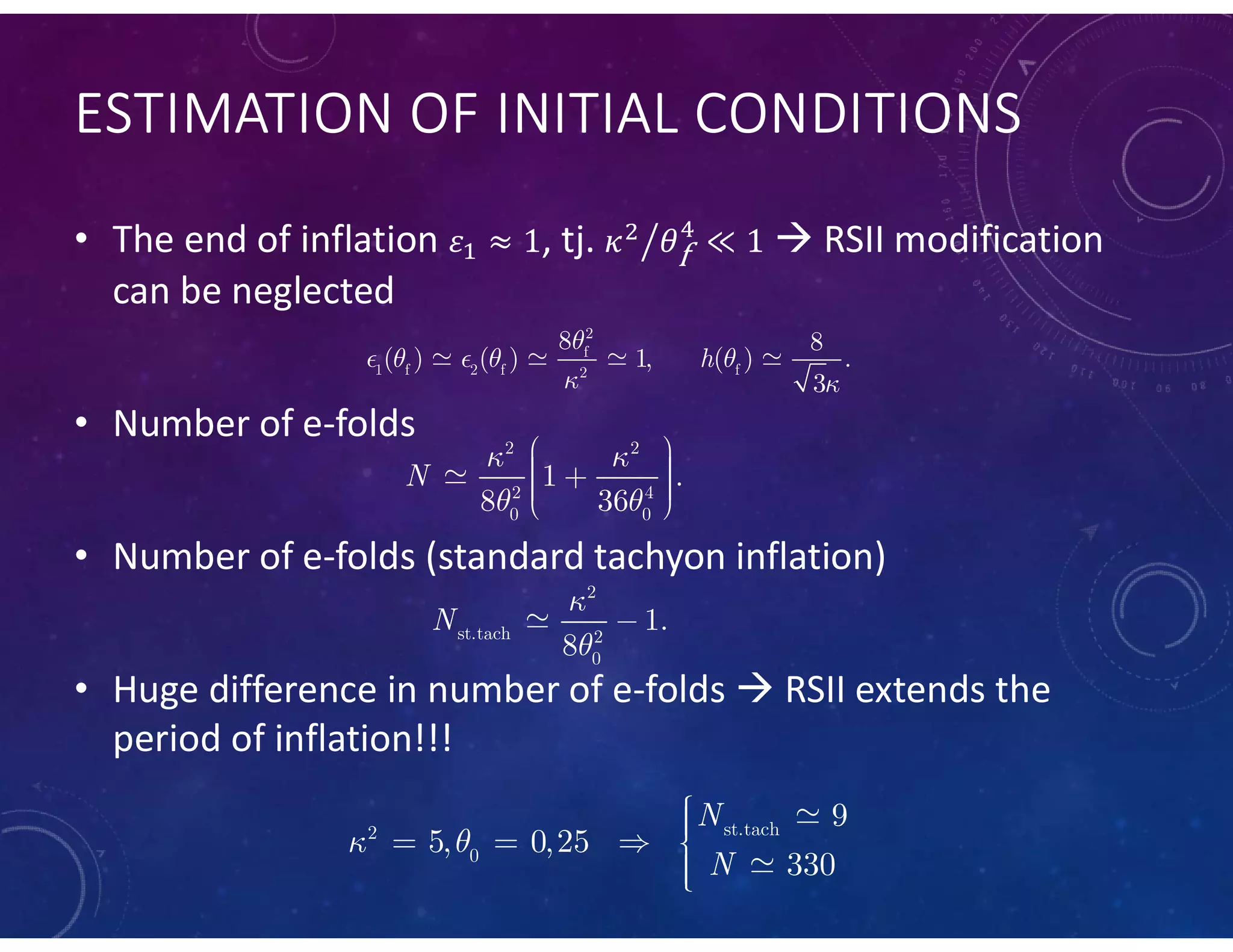
ESTIMATION OF INITIAL CONDITIONS
• The end of inflation , tj.  RSII modification
can be neglected
• Number of e-folds
• Number of e-folds (standard tachyon inflation)
• Huge difference in number of e-folds  RSII extends the
period of inflation!!!
   
2
f
1 f 2 f f2
8 8
( ) ( ) 1, ( ) .
3
h

  
 
 

2 2
2 4
0 0
1 .
8 36
N
 
 
     

2
st.tach 2
0
1.
8
N





st.tach2
0
9
5, 0,25
330
N
N
 
   

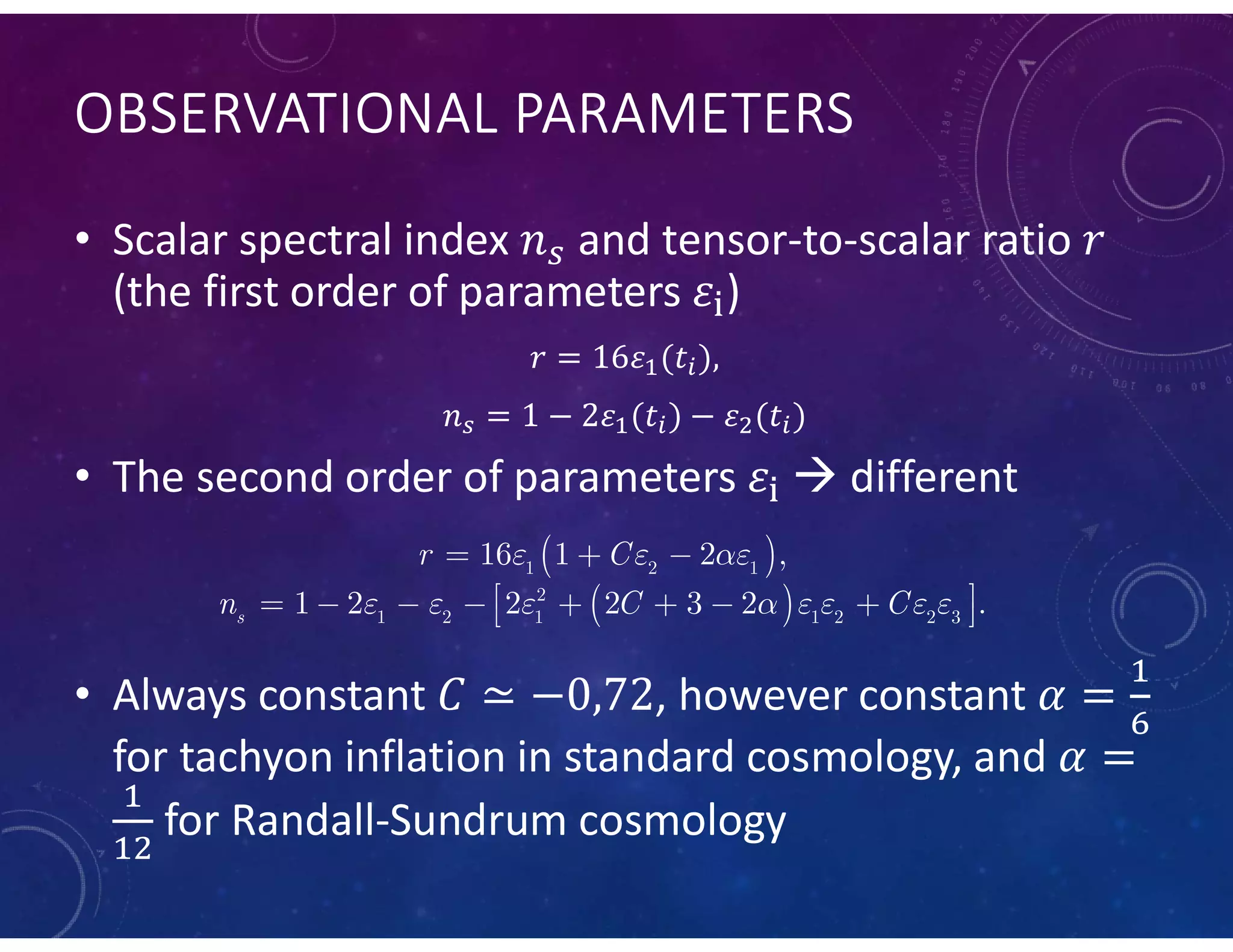
OBSERVATIONAL PARAMETERS
• Scalar spectral index and tensor-to-scalar ratio
(the first order of parameters )
• The second order of parameters  different
• Always constant , however constant
for tachyon inflation in standard cosmology, and
for Randall-Sundrum cosmology
 
 
1 2 1
2
1 2 1 1 2 2 3
16 1 2 ,
1 2 2 2 3 2 .s
r C
n C C
  
       
  
         
NUMERICAL RESULTS
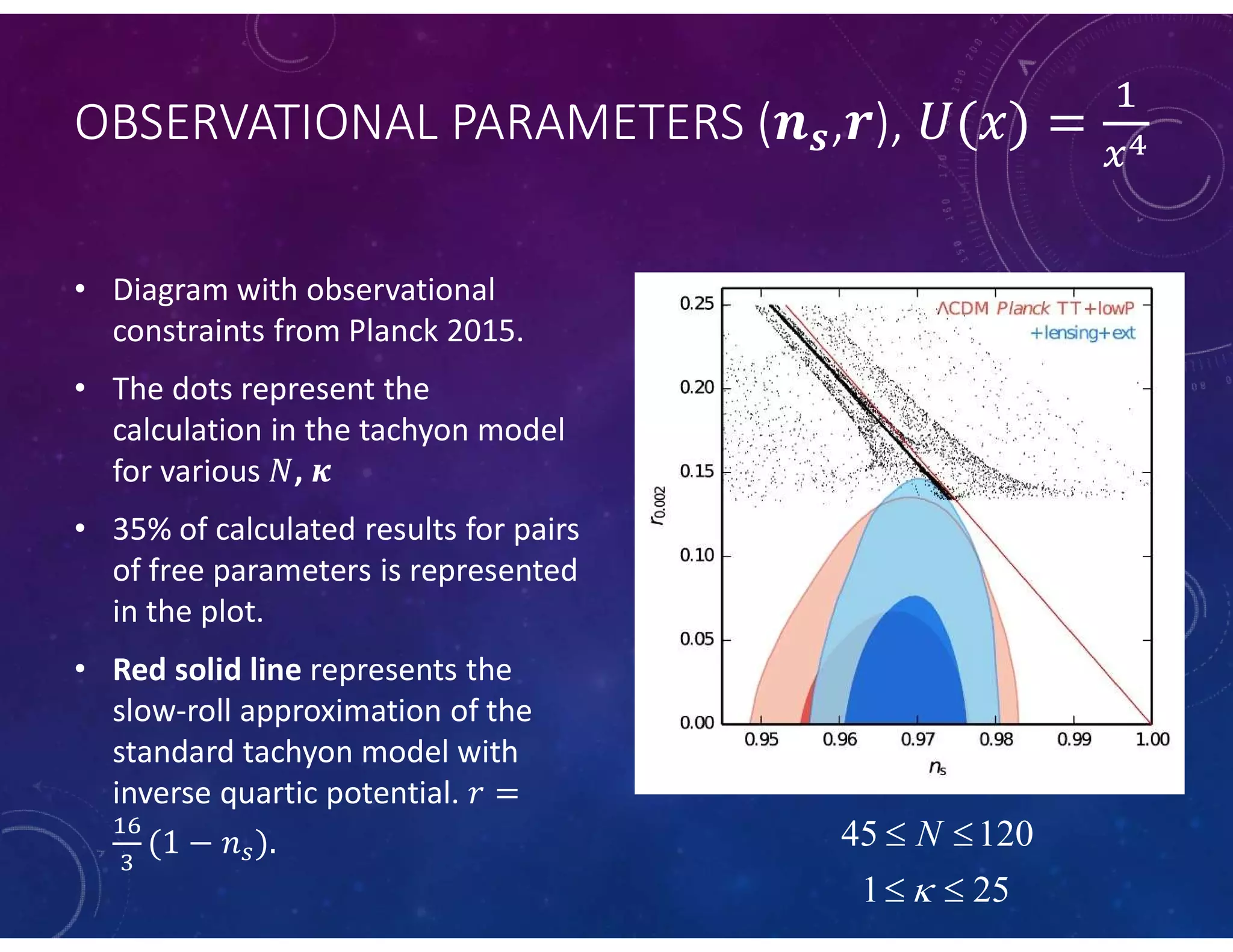
OBSERVATIONAL PARAMETERS ( , ),
• Diagram with observational
constraints from Planck 2015.
• The dots represent the
calculation in the tachyon model
for various ,
• 35% of calculated results for pairs
of free parameters is represented
in the plot.
• Red solid line represents the
slow-roll approximation of the
standard tachyon model with
inverse quartic potential.
45 120
1 25
N

 
 
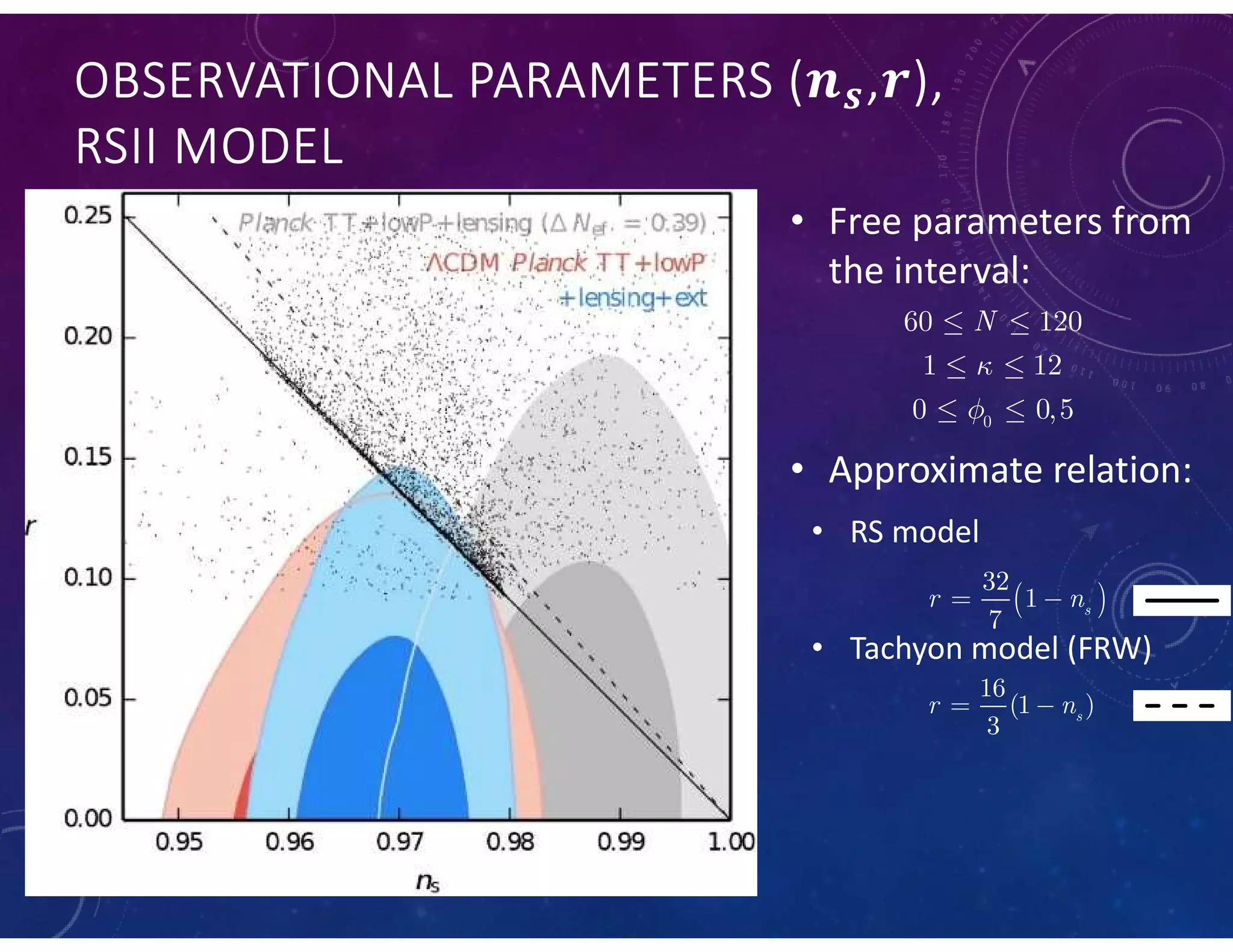
OBSERVATIONAL PARAMETERS ( , ),
RSII MODEL
• Free parameters from
the interval:
• Approximate relation:
• RS model
• Tachyon model (FRW)
0
60 120
1 12
0 0,5
N


 
 
 
 
32
1
7 s
r n 
16
(1 )
3
s
r n 
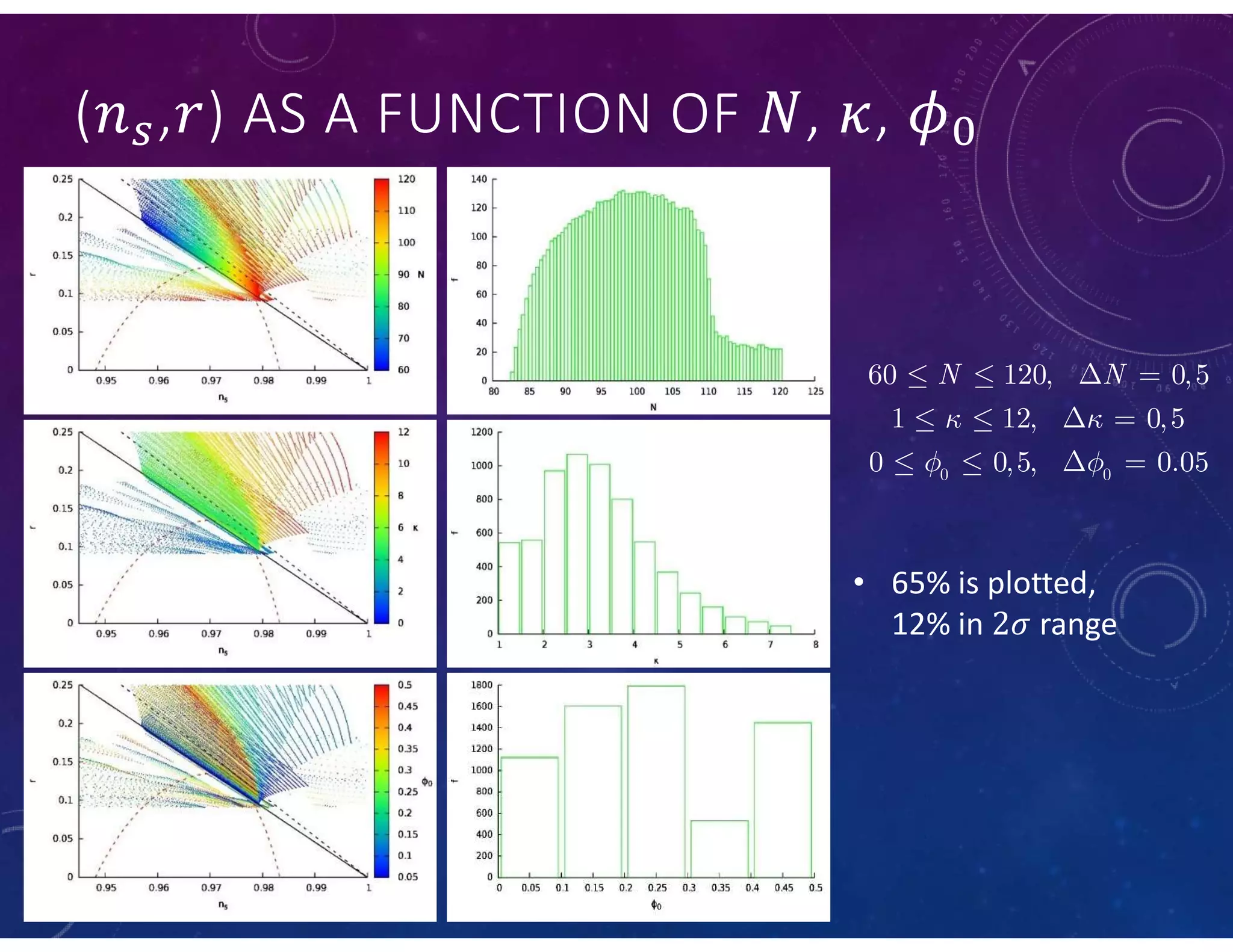
( , ) AS A FUNCTION OF , ,
• 65% is plotted,
12% in range
0 0
60 120, 0,5
1 12, 0,5
0 0,5, 0.05
N N
 
 
   
   
   
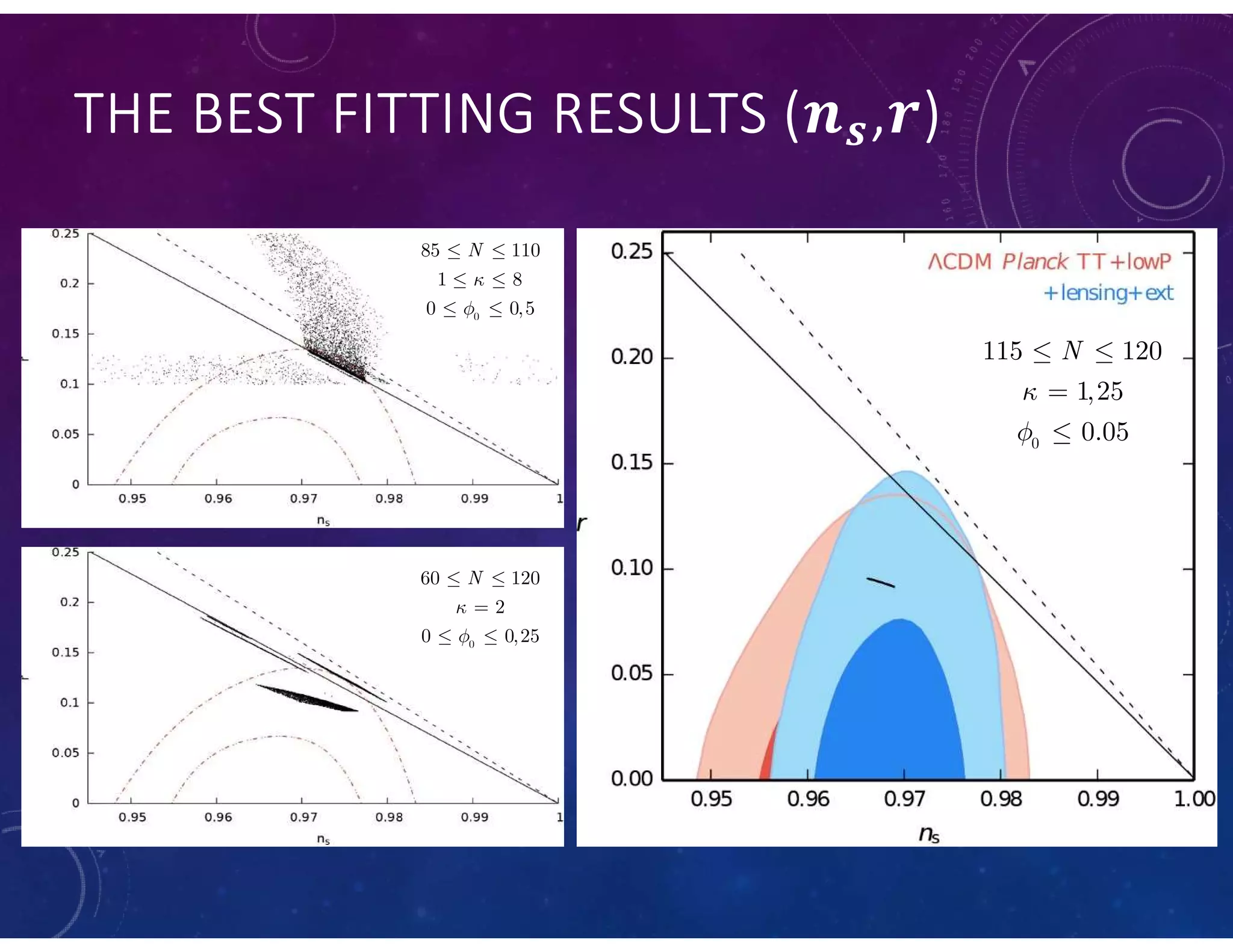
THE BEST FITTING RESULTS ( , )
0
85 110
1 8
0 0,5
N


 
 
 
0
60 120
2
0 0,25
N


 

 
0
115 120
1,25
0.05
N


 


CONCLUSION
• We have investigated a model of inflation based on the dynamics of a
D3-brane in the AdS5 bulk of the RSII model. The bulk metric is
extended to include the backreaction of the radion excitations.
• The agreement with observations is not ideal, the present model is
disfavored but not excluded. However, the model is based on the
brane dynamics which results in a definite potential with one free
parameter only.
• The simplest tachyon model that stems from the dynamics of a D3-
brane in an AdS5 bulk yielding basically an inverse quartic potential.
• The same mechanism could lead to a more general tachyon potential
if the AdS5 background metric is deformed by the presence of matter
in the bulk, e.g. in the form of a minimally coupled scalar field with an
arbitrary self-interaction potential.
• This work is supported by the SEENET-MTP
Network under the ICTP grant NT-03.
• The financial support of the Serbian Ministry for
Education and Science, Projects OI 174020 and OI
176021 is also kindly acknowledged.
THE MOST IMPORTANT REFERENCES
• N. Bilic, G.B. Tupper, AdS braneworld with backreaction, Cent. Eur. J. Phys. 12 (2014) 147–159.
• D. Steer, F. Vernizzi, Tachyon inflation: Tests and comparison with single scalar field inflation, Phys. Rev. D. 70 (2004)
43527.
• P.A.R. Ade, N. Aghanim, M. Arnaud, F. Arroja, M. Ashdown, J. Aumont, et al., Planck 2015 results: XX. Constraints on
inflation, Astron. Astrophys. 594 (2016) A20.
• L. Randall, R. Sundrum, Large Mass Hierarchy from a Small Extra Dimension, Physical Review Letters. 83 (1999)
3370–3373; L. Randall, R. Sundrum, An Alternative to Compactification, Physical Review Letters. 83 (1999) 4690–
4693.
• N. Bilic, D.D. Dimitrijevic, G.S. Djordjevic, M. Milosevic, Tachyon inflation in an AdS braneworld with back-reaction,
International Journal of Modern Physics A. 32 (2017) 1750039.
• M. Milosevic, D.D. Dimitrijevic, G.S. Djordjevic, M.D. Stojanovic, Dynamics of tachyon fields and inflation -
comparison of analytical and numerical results with observation, Serbian Astronomical Journal. 192 (2016) 1–8.
• M. Milosevic, G.S. Djordjevic, Tachyonic Inflation on (non-)Archimedean Spaces, Facta Universitatis (Niš) Series:
Physics, Chemistry and Technology. 14 (2016) 257–274.
• N. Bilic, D.D. Dimitrijevic, G.S. Djordjevic, M. Milosevic, M. Stojanovic, Dynamics of tachyon fields and inflation:
Analytical vs numerical solutions, AIP Vol 1722 No 1 (2016) 50002.
• G.S. Djordjevic, D.D. Dimitrijevic, M. Milosevic, On Canonical Transformation and Tachyon-Like ”Particles” in
Inflationary Cosmology, Romanian Journal of Physics. 61 (2016) 99–109.
• D.D. Dimitrijevic, G.S. Djordjevic, M. Milosevic, Classicalization and quantization of tachyon-like matter on
(non)archimedean spaces, Romanian Reports in Physics. 68 (2016) 5–18.
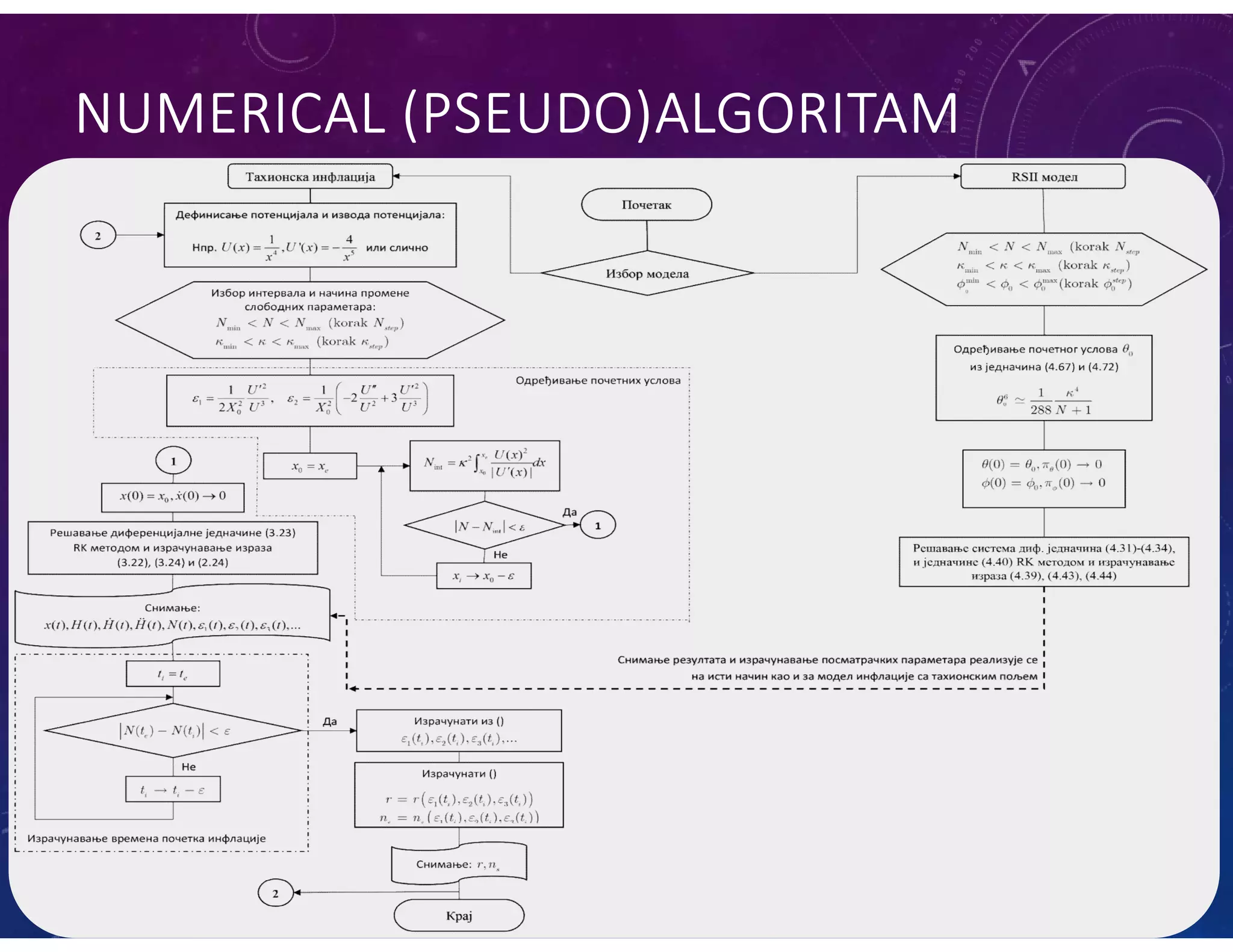
NUMERICAL (PSEUDO)ALGORITAM

Braneworld Cosmology and Tachyon Inflation - RSII Numerical Models

  • 1.
    BRANEWORLD COSMOLOGY ANDTACHYON INFLATION – RSII NUMERICAL MODELS MILAN MILOŠEVIĆ Department of Physics Faculty of Sciences and Mathematics University of Niš, Serbia XVIII Serbian Astronomical Conference, Belgrade, 17-21 October 2017 In collaboration with N. Bilić (Zagreb), G. Đorđević, D. Dimitrijević, D. Delibašić, M. Stojanović (Niš) Based on: N. Bilic, D.D. Dimitrijevic, G.S. Djordjevic, M. Milosevic, Tachyon inflation in an AdS braneworld with back-reaction, International Journal of Modern Physics A. 32 (2017) 1750039.
  • 2.
    OUTLINE • Introduction • TachyonInflation • Randall - Sundrum Models (RS) • Numerical results • Conclusion
  • 3.
    INTRODUCTION AND MOTIVATION •The inflationary universe scenario in which the early universe undergoes a rapid expansion has been generally accepted as a solution to the horizon problem and some other related problems of the standard big-bang cosmology • Quantum cosmology: probably the best way to describe the evolution of the early universe. • Recent years - a lot of evidence from WMAP and Planck observations of the CMB
  • 4.
    OBSERVATIONAL PARAMETERS • Hubblehierarchy (slow-roll) parameters • Length of inflation • The end of inflation • Three independent observational parameters: amplitude of scalar perturbation , tensor-to-scalar ratio i scalar spectral index * 1 0 ln | | , 0,i i d H i dN H       Hubble rate at an arbitrarily chosen time 2 Pl 1 ( ) ln ln end end end end t t end t t a H V N d a Hdt d d a M V                   1i  ( ) 1i end  1 1 2 16 1 2s r n        At the lowest order in parameters 𝜀 and 𝜀
  • 5.
    OBSERVATIONAL PARAMETERS • SatelitePlanck (May 2009 – October 2013) • Latest results are published in year 2016. Planck 2015 results: XIII. Cosmological parameters, Astronomy & Astrophysics. 594 (2016) A13 Planck 2015 results. XX. Constraints on inflation, Astronomy & Astrophysics. 594 (2016) A20
  • 6.
    LAGRANGIAN OF ASCALAR FIELD - • In general case – any function of a scalar field and kinetic energy • Canonical field, potential , • Non-canonical models • Dirac-Born-Infeld (DBI) Lagrangian • Special case – tachyonic
  • 7.
    TACHYONS • Traditionally, theword tachyon was used to describe a hypothetical particle which propagates faster than light. • In modern physics this meaning has been changed • The effective tachyonic field theory was proposed by A. Sen • String theory: states of quantum fields with imaginary mass (i.e. negative mass squared) • It was believed: such fields permitted propagation faster than light • However it was realized that the imaginary mass creates an instability and tachyons spontaneously decay through the process known as tachyon condensation
  • 8.
    TACHYION FIELDS • Noclassical interpretation of the ”imaginary mass” • The instability: The potential of the tachyonic field is initially at a local maximum rather than a local minimum (like a ball at the top of a hill) • A small perturbation - forces the field to roll down towards the local minimum. • Quanta are not tachyon any more, but rather an ”ordinary” particle with a positive mass.
  • 9.
    TACHYON INFLATION • Considerthe tachyonic field T minimally coupled to Einstein's gravity with action • Where R is Ricci scalar, and Lagrangian and Hamiltionian for tachyon potential are • Homogenous and isotropic space, FRW metrics
  • 10.
    TACHYON INFLATION • Aswell as for a standard scalar field i , however: . • Friedman equation: ⁄ . • Energy momentum conservation equation, takes a form . 1 8 PM G  Reduced Planck mass
  • 11.
    TACHYON INFLATION • Nondimensionalequations ⁄ • Dimensionless constant , a choice of a constant (brane tension) was motivated by string theory 𝜏 = 𝑡 𝑇⁄ 𝑥 = 𝑇 𝑇 ,     𝑈(𝑥) = 𝑉(𝑥) 𝜎 ,     𝐻 = 𝐻 𝑇 . Energy-momentum conservation eq. Friedman eq. Friedman acceleration eq.
  • 12.
    CONDITION FOR TACHYONINFLATION • General condition for inflation • Slow-roll conditions • Equations for slow-roll inflation
  • 13.
    INITIAL CONDITION FORTACHYON INFLATION • Slow-roll parameters • Number of e-folds
  • 14.
    RANDAL-SUNDRUM MODELS • 1999– one of the simplest models • Two branes with opposite tensions are placed at some distance in 5 dimensional space • RSI model – observer reside on the brane with negative tension, distance to the 2nd brane corresponds to the Netwonian gravitational constant • RSII – observer is placed on the positive tension brane, 2nd brane is pushed to infinity
  • 15.
    RSI MODEL x 5 x y 0y y l y   N. Bilic, “Braneworld Universe”, 2nd CERN – SEENET-MTP PhD School, Timisoara, December 2016 0  0 
  • 16.
    RSII MODEL 0y y   0  0  N. Bilic, “Braneworld Universe”, 2nd CERN – SEENET-MTP PhD School, Timisoara, December 2016 x 5 x y
  • 17.
    RSII MODEL • Thespace is described by Anti de Siter metric • Extended RSII model include radion backreaction • Total action • After integrating out 5th dimension…     2 2 2 2 (5) 2 2 2 2 2 1 1 1 ( ) , 1 ( ) a b ab ds G dX dX k z x g dx dx dz k z k z x                   1 k  AdS curvature radius Radion field
  • 18.
    RSII MODEL • Actionfor a 3-brane moving in bulk • Action for the brane • Without radion • Total Lagrangian 4 , , br 1 , 16 2 R S d x g g S G               Canonicali normalized radion field 2 4 sinh 3 G        4 ind br , ,4 2 2 2 4 4 2 2 3 det (1 ) 1 (1 ) S d x g g d x g k k k                         Brane tension Tachyon field /ky e k  (0) 4 br , ,4 4 1 ,S d x g g k              2 , , 2 2 , , 4 3 1 1 , 1 . 2 g g k                      N. Bilic, G.B. Tupper, CEJP 12 (2014) 147–159.
  • 19.
    RSII MODEL • Inflat space, FRW metrics • Hamiltonian equations , , • The Hamiltonian
  • 20.
    RSII MODEL • TheHamiltonian equations • The modified Friedman equation • Combining with a continuity equation it leads to the second Friedman equation     3 3 H H                                  2 8 2 1 . 3 3 a G G H a k            2 4 4 ( ) 1 3 G H G k             
  • 21.
    NONDIMENSIONAL EQUATIONS • Substitutions: 4 82 8 2 2 8 2 10 2 5 8 2 1 / 4 3 / 3 2 1 / 4 3 / 3 1 / h h                                                        2 2 2 2 8 1 3 12 Gk a h a                 2 2 2 2 2 2 2 2 3 4 2 2 4 2 3 1 , sinh , 6 2 sinh , 6 3 1 1 / , 2 1 1 2 1 / d d p                                                      Nondimensional constant Hubble parameter Preassure Energy density 2 2 ( ) 1 2 6 h p N h                 Additional equations, solved in parallel 2 4 / , / ( ), / ( )), , / ( ) h H k k k k k                    
  • 22.
    INITIAL CONDITIONS FORRSII MODEL • Initial conditions – from a model without radion field • “Pure” tachyon potential • Hamiltonian • Nondimensional equation   4 8 2 5 8 2 1 4 3 . 1 h                     
  • 23.
    ESTIMATION OF INITIALCONDITIONS • The end of inflation , tj.  RSII modification can be neglected • Number of e-folds • Number of e-folds (standard tachyon inflation) • Huge difference in number of e-folds  RSII extends the period of inflation!!!     2 f 1 f 2 f f2 8 8 ( ) ( ) 1, ( ) . 3 h          2 2 2 4 0 0 1 . 8 36 N            2 st.tach 2 0 1. 8 N      st.tach2 0 9 5, 0,25 330 N N       
  • 24.
    OBSERVATIONAL PARAMETERS • Scalarspectral index and tensor-to-scalar ratio (the first order of parameters ) • The second order of parameters  different • Always constant , however constant for tachyon inflation in standard cosmology, and for Randall-Sundrum cosmology     1 2 1 2 1 2 1 1 2 2 3 16 1 2 , 1 2 2 2 3 2 .s r C n C C                        
  • 25.
  • 26.
    OBSERVATIONAL PARAMETERS (, ), • Diagram with observational constraints from Planck 2015. • The dots represent the calculation in the tachyon model for various , • 35% of calculated results for pairs of free parameters is represented in the plot. • Red solid line represents the slow-roll approximation of the standard tachyon model with inverse quartic potential. 45 120 1 25 N     
  • 27.
    OBSERVATIONAL PARAMETERS (, ), RSII MODEL • Free parameters from the interval: • Approximate relation: • RS model • Tachyon model (FRW) 0 60 120 1 12 0 0,5 N           32 1 7 s r n  16 (1 ) 3 s r n 
  • 28.
    ( , )AS A FUNCTION OF , , • 65% is plotted, 12% in range 0 0 60 120, 0,5 1 12, 0,5 0 0,5, 0.05 N N                
  • 29.
    THE BEST FITTINGRESULTS ( , ) 0 85 110 1 8 0 0,5 N         0 60 120 2 0 0,25 N        0 115 120 1,25 0.05 N      
  • 30.
    CONCLUSION • We haveinvestigated a model of inflation based on the dynamics of a D3-brane in the AdS5 bulk of the RSII model. The bulk metric is extended to include the backreaction of the radion excitations. • The agreement with observations is not ideal, the present model is disfavored but not excluded. However, the model is based on the brane dynamics which results in a definite potential with one free parameter only. • The simplest tachyon model that stems from the dynamics of a D3- brane in an AdS5 bulk yielding basically an inverse quartic potential. • The same mechanism could lead to a more general tachyon potential if the AdS5 background metric is deformed by the presence of matter in the bulk, e.g. in the form of a minimally coupled scalar field with an arbitrary self-interaction potential.
  • 31.
    • This workis supported by the SEENET-MTP Network under the ICTP grant NT-03. • The financial support of the Serbian Ministry for Education and Science, Projects OI 174020 and OI 176021 is also kindly acknowledged.
  • 32.
    THE MOST IMPORTANTREFERENCES • N. Bilic, G.B. Tupper, AdS braneworld with backreaction, Cent. Eur. J. Phys. 12 (2014) 147–159. • D. Steer, F. Vernizzi, Tachyon inflation: Tests and comparison with single scalar field inflation, Phys. Rev. D. 70 (2004) 43527. • P.A.R. Ade, N. Aghanim, M. Arnaud, F. Arroja, M. Ashdown, J. Aumont, et al., Planck 2015 results: XX. Constraints on inflation, Astron. Astrophys. 594 (2016) A20. • L. Randall, R. Sundrum, Large Mass Hierarchy from a Small Extra Dimension, Physical Review Letters. 83 (1999) 3370–3373; L. Randall, R. Sundrum, An Alternative to Compactification, Physical Review Letters. 83 (1999) 4690– 4693. • N. Bilic, D.D. Dimitrijevic, G.S. Djordjevic, M. Milosevic, Tachyon inflation in an AdS braneworld with back-reaction, International Journal of Modern Physics A. 32 (2017) 1750039. • M. Milosevic, D.D. Dimitrijevic, G.S. Djordjevic, M.D. Stojanovic, Dynamics of tachyon fields and inflation - comparison of analytical and numerical results with observation, Serbian Astronomical Journal. 192 (2016) 1–8. • M. Milosevic, G.S. Djordjevic, Tachyonic Inflation on (non-)Archimedean Spaces, Facta Universitatis (Niš) Series: Physics, Chemistry and Technology. 14 (2016) 257–274. • N. Bilic, D.D. Dimitrijevic, G.S. Djordjevic, M. Milosevic, M. Stojanovic, Dynamics of tachyon fields and inflation: Analytical vs numerical solutions, AIP Vol 1722 No 1 (2016) 50002. • G.S. Djordjevic, D.D. Dimitrijevic, M. Milosevic, On Canonical Transformation and Tachyon-Like ”Particles” in Inflationary Cosmology, Romanian Journal of Physics. 61 (2016) 99–109. • D.D. Dimitrijevic, G.S. Djordjevic, M. Milosevic, Classicalization and quantization of tachyon-like matter on (non)archimedean spaces, Romanian Reports in Physics. 68 (2016) 5–18.
  • 33.