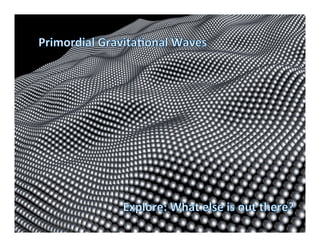
Primordial	Gravita-onal	Waves	
Robert	Caldwell	/	Dartmouth	College
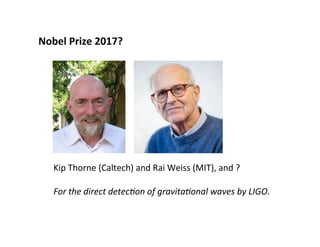
Nobel	Prize	2017?	
Kip	Thorne	(Caltech)	and	Rai	Weiss	(MIT),	and	?	
For	the	direct	detec+on	of	gravita+onal	waves	by	LIGO.
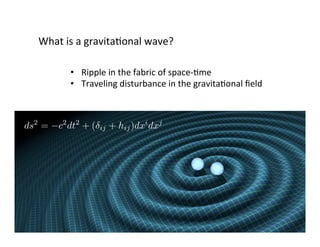
What	is	a	gravitaBonal	wave?	
•  Ripple	in	the	fabric	of	space-Bme	
•  Traveling	disturbance	in	the	gravitaBonal	field	
ds2
= c2
dt2
+ ( ij + hij)dxi
dxj
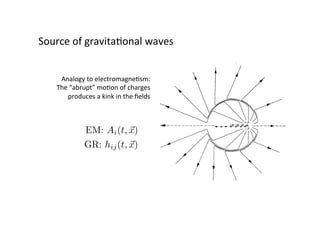
Source	of	gravitaBonal	waves	
Analogy	to	electromagneBsm:	
The	“abrupt”	moBon	of	charges	
produces	a	kink	in	the	fields	
EM: Ai(t, ~x)
GR: hij(t, ~x)
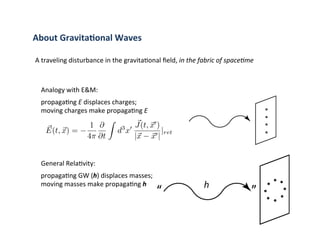
About	Gravita-onal	Waves	
A	traveling	disturbance	in	the	gravitaBonal	field,	in	the	fabric	of	space+me	
Analogy	with	E&M:	
propagaBng	E	displaces	charges;	
moving	charges	make	propagaBng	E	
~E(t, ~x) =
1
4⇡
@
@t
Z
d3
x0
~J(t, ~x0
)
|~x ~x0|
|ret
General	RelaBvity:	
propagaBng	GW	(h)	displaces	masses;	
moving	masses	make	propagaBng	h
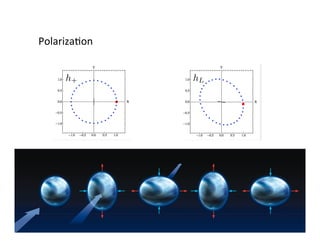
PolarizaBon	
h+ hL
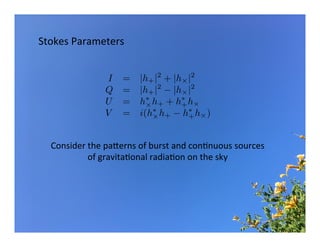
Stokes	Parameters	
I = |h+|2
+ |h⇥|2
Q = |h+|2
|h⇥|2
U = h⇤
⇥h+ + h⇤
+h⇥
V = i(h⇤
⇥h+ h⇤
+h⇥)
Consider	the	paSerns	of	burst	and	conBnuous	sources	
of	gravitaBonal	radiaBon	on	the	sky
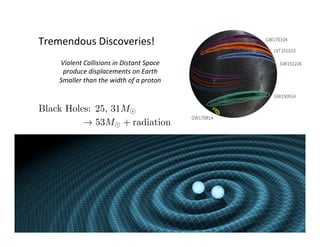
Tremendous	Discoveries!	
Black Holes: 25, 31M
! 53M + radiation
Violent	Collisions	in	Distant	Space	
produce	displacements	on	Earth	
Smaller	than	the	width	of	a	proton
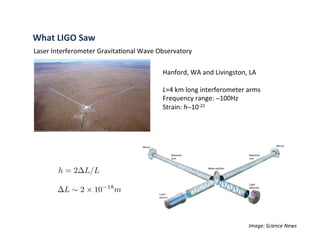
What	LIGO	Saw	
Laser	Interferometer	GravitaBonal	Wave	Observatory	
Hanford,	WA	and	Livingston,	LA	
	
L=4	km	long	interferometer	arms	
Frequency	range:	∼100Hz	
Strain:	h∼10-21		
h = 2 L/L
L ⇠ 2 ⇥ 10 18
m
Image:	Science	News
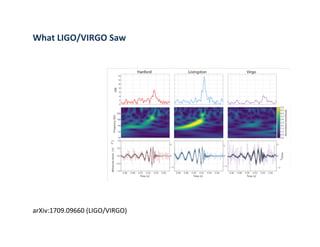
What	LIGO/VIRGO	Saw	
arXiv:1709.09660	(LIGO/VIRGO)
Cosmic	Origins
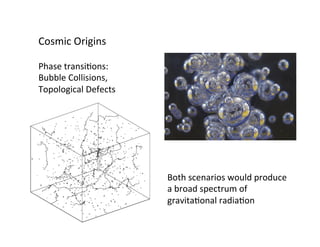
Cosmic	Origins	
Phase	transiBons:	
Bubble	Collisions,	
Topological	Defects	
Both	scenarios	would	produce	
a	broad	spectrum	of	
gravitaBonal	radiaBon
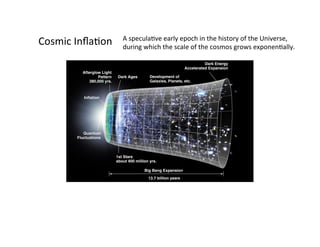
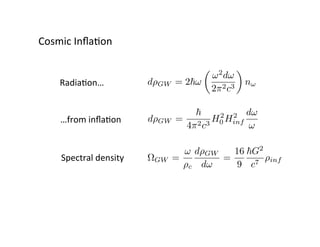
Cosmic	InflaBon	 A	speculaBve	early	epoch	in	the	history	of	the	Universe,	
during	which	the	scale	of	the	cosmos	grows	exponenBally.
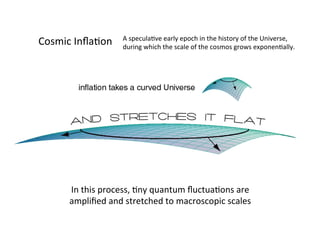
Cosmic	InflaBon	 A	speculaBve	early	epoch	in	the	history	of	the	Universe,	
during	which	the	scale	of	the	cosmos	grows	exponenBally.	
In	this	process,	Bny	quantum	fluctuaBons	are	
amplified	and	stretched	to	macroscopic	scales
d⇢GW = 2~!
✓
!2
d!
2⇡2c3
◆
n!
d⇢GW =
~
4⇡2c3
H2
0 H2
inf
d!
!
RadiaBon…	
…from	inflaBon	
Spectral	density	 ⌦GW =
!
⇢c
d⇢GW
d!
=
16
9
~G2
c7
⇢inf
Cosmic	InflaBon
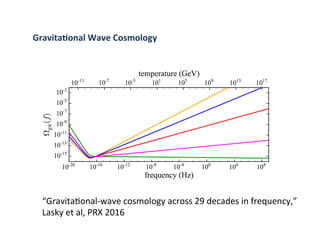
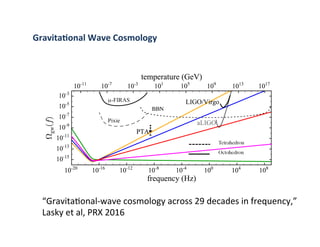
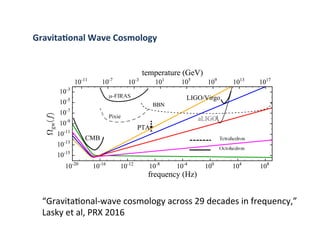
Gravita-onal	Wave	Cosmology	
“GravitaBonal-wave	cosmology	across	29	decades	in	frequency,”		
Lasky	et	al,	PRX	2016
ds2
= dt2
+ ( ij + ✏ hij)dxi
dxj
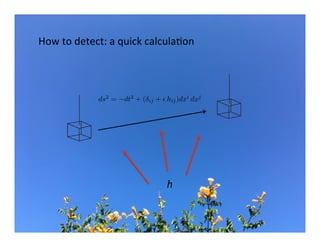
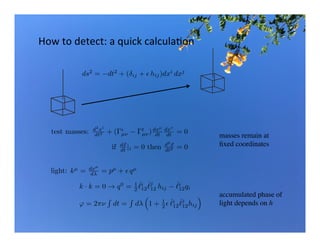
How	to	detect:	a	quick	calculaBon	
h
if d~x
dt |i = 0 then d2
~x
dt2 = 0
test masses: d2
xi
dt2 + ( i
µ⌫
t
µ⌫)dxµ
dt
dx⌫
dt = 0
k · k = 0 ! q0
= 1
2
ˆ`i
12
ˆ`j
12 hij
ˆ`i
12qi
light: kµ
= dxµ
d = pµ
+ ✏ qµ
' = 2⇡⌫
R
dt =
R
d
⇣
1 + 1
2 ✏ ˆ`i
12
ˆ`j
12hij
⌘
ds2
= dt2
+ ( ij + ✏ hij)dxi
dxj
masses remain at
fixed coordinates
accumulated phase of
light depends on h
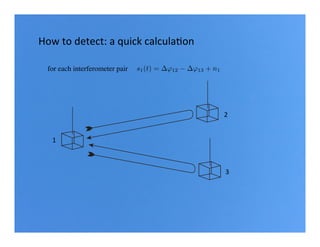
How	to	detect:	a	quick	calculaBon
for each interferometer pair s1(t) = '12 '13 + n1
How	to	detect:	a	quick	calculaBon	
1	
2	
3
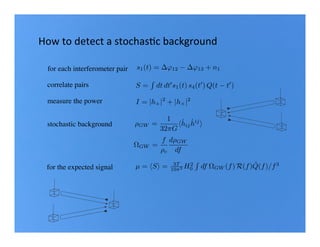
for each interferometer pair
correlate pairs
measure the power
s1(t) = '12 '13 + n1
S =
R
dt dt0
s1(t) s4(t0
) Q(t t0
)
How	to	detect	a	stochasBc	background	
I = |h+|2
+ |h⇥|2
µ = hSi = 3T
10⇡2 H2
0
R
df ⌦GW (f) R(f) ˜Q(f)/f3
for the expected signal
stochastic background
⌦GW =
f
⇢c
d⇢GW
df
⇢GW =
1
32⇡G
h˙hij
˙hij
i
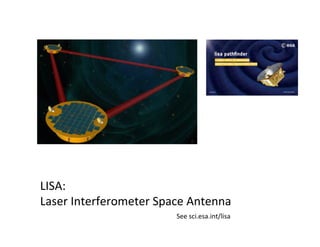
LISA:		
Laser	Interferometer	Space	Antenna	
See	sci.esa.int/lisa
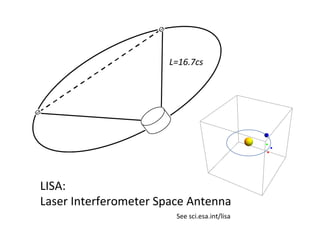
LISA:		
Laser	Interferometer	Space	Antenna	
See	sci.esa.int/lisa	
L=16.7cs
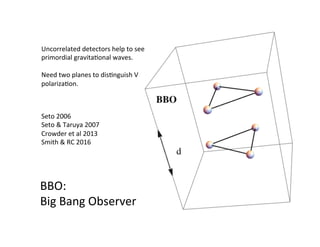
BBO:		
Big	Bang	Observer	
Seto	2006		
Seto	&	Taruya	2007	
Crowder	et	al	2013	
Smith	&	RC	2016	
Uncorrelated	detectors	help	to	see	
primordial	gravitaBonal	waves.	
	
Need	two	planes	to	disBnguish	V	
polarizaBon.
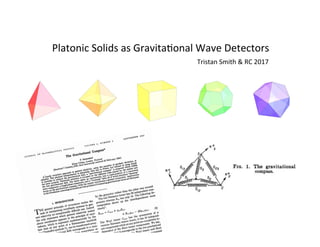
Platonic	Solids	as	GravitaBonal	Wave	Detectors	
Tristan	Smith	&	RC	2017
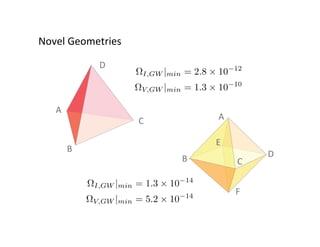
Novel	Geometries	
⌦I,GW |min = 1.3 ⇥ 10 14
⌦V,GW |min = 5.2 ⇥ 10 14
⌦I,GW |min = 2.8 ⇥ 10 12
⌦V,GW |min = 1.3 ⇥ 10 10
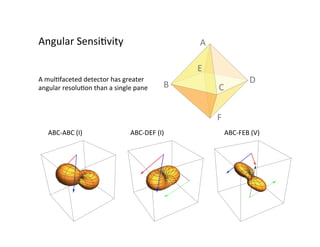
Angular	SensiBvity	
ABC-ABC	(I)	 ABC-DEF	(I)	 ABC-FEB	(V)	
A	mulBfaceted	detector	has	greater	
angular	resoluBon	than	a	single	pane
Gravita-onal	Wave	Cosmology	
“GravitaBonal-wave	cosmology	across	29	decades	in	frequency,”		
Lasky	et	al,	PRX	2016
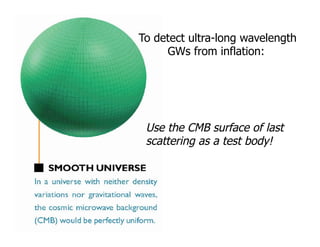
To detect ultra-long wavelength
GWs from inflation:
Use the CMB surface of last
scattering as a test body!
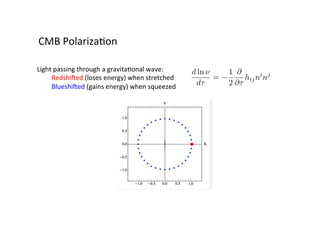
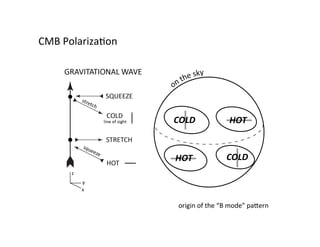
Light	passing	through	a	gravitaBonal	wave:	
	Redshiled	(loses	energy)	when	stretched	
	Blueshiled	(gains	energy)	when	squeezed	
d ln ⌫
d⌧
=
1
2
@
@⌧
hijni
nj
CMB	PolarizaBon
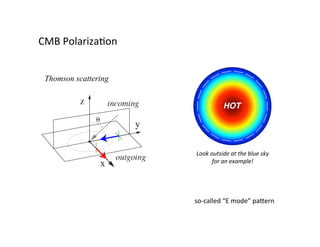
Look	outside	at	the	blue	sky	
for	an	example!	
Thomson scattering
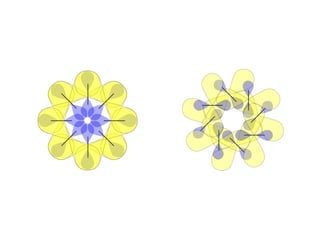
so-called	“E	mode”	paSern	
CMB	PolarizaBon
CMB	PolarizaBon	
origin	of	the	“B	mode”	paSern
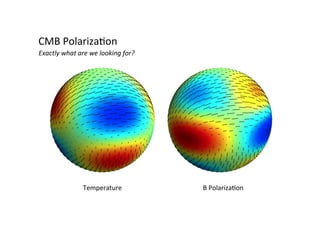
Temperature	 B	PolarizaBon	
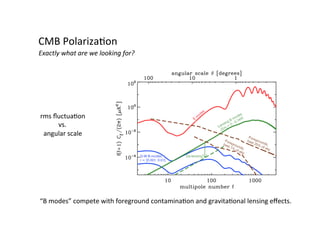
Exactly	what	are	we	looking	for?	
CMB	PolarizaBon
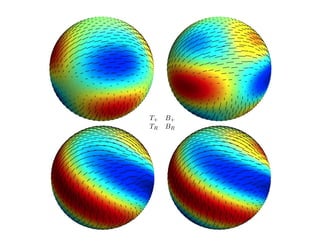
T+ B+
TR BR
rms	fluctuaBon	
vs.	
angular	scale	
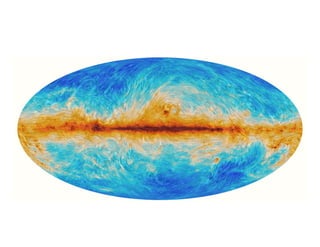
“B	modes”	compete	with	foreground	contaminaBon	and	gravitaBonal	lensing	effects.	
Exactly	what	are	we	looking	for?	
CMB	PolarizaBon
Gravita-onal	Wave	Cosmology	
“GravitaBonal-wave	cosmology	across	29	decades	in	frequency,”		
Lasky	et	al,	PRX	2016
Looking	forward	to	a	new	era	of	
GravitaBonal	Wave	Cosmology
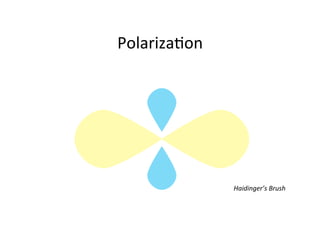
PolarizaBon	
Haidinger’s	Brush
Caldwellcolloquium

Caldwellcolloquium