Control of Uncertain Hybrid Nonlinear Systems
Using Particle Filters
Leonhard Asselborn

Martin Jilg

Olaf Stursberg

Institute of Control and System Theory
University of Kassel

l.asselborn@uni-kassel.de
martin.jilg@uni-kassel.de
stursberg@uni-kassel.de

www.control.eecs.uni-kassel.de
Introduction

•

•
•

Considered class of models: hybrid nonlinear system with deterministic and
nondeterministic transitions and uncertain continuous dynamics.
Formulation of a point-to-region open-loop optimal control problem.
Contribution: proposal of a particle-filter based solution and feasibility
study for an example.

Introduction

Model Definition

Problem Setup

Method

Example

Conclusion

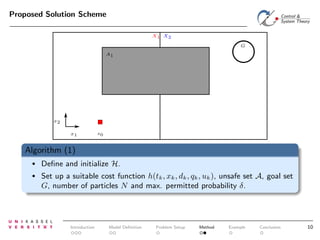
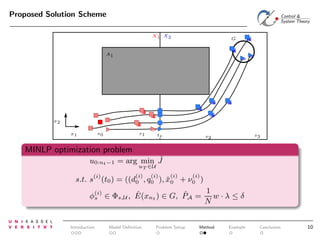
2
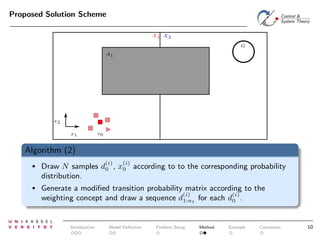
Introduction

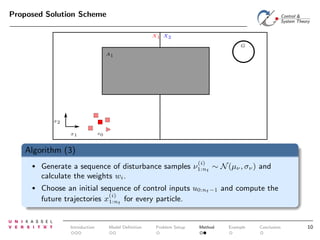
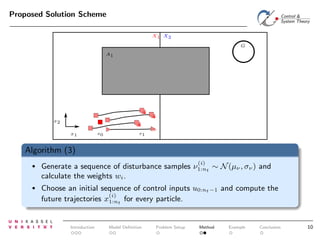
•

•
•

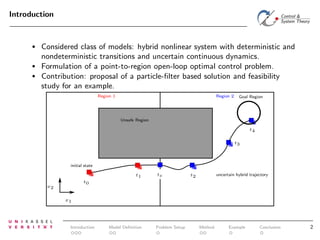
Considered class of models: hybrid nonlinear system with deterministic and
nondeterministic transitions and uncertain continuous dynamics.
Formulation of a point-to-region open-loop optimal control problem.
Contribution: proposal of a particle-filter based solution and feasibility
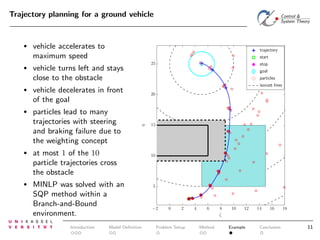
study for an example.
Region 1

Region 2

Goal Region

Unsafe Region
t4
t3

initial state
t1

te

uncertain hybrid trajectory

t2

t0

x2
x1

Introduction

Model Definition

Problem Setup

Method

Example

Conclusion

2
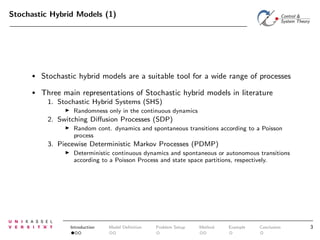
Stochastic Hybrid Models (1)

•

Stochastic hybrid models are a suitable tool for a wide range of processes

Introduction

Model Definition

Problem Setup

Method

Example

Conclusion

3
Stochastic Hybrid Models (1)

•

Stochastic hybrid models are a suitable tool for a wide range of processes

•

Three main representations of Stochastic hybrid models in literature
1. Stochastic Hybrid Systems (SHS)
◮

Randomness only in the continuous dynamics

2. Switching Diffusion Processes (SDP)
◮

Random cont. dynamics and spontaneous transitions according to a Poisson
process

3. Piecewise Deterministic Markov Processes (PDMP)
◮

Deterministic continuous dynamics and spontaneous or autonomous transitions
according to a Poisson Process and state space partitions, respectively.

Introduction

Model Definition

Problem Setup

Method

Example

Conclusion

3
Stochastic Hybrid Models (2)

Control methods for Stochastic Hybrid Models in the literature (as far as
relevant for this paper):
Method specification
optimal
control
[1]

particle
filter

chance
constraints

nonlinear
dynamics

-

-

[2]

Model specification
uncertain
dynamics

-

-

[3]

-

[4]
[6]
[1]:
[2]:
[3]:
[4]:
[5]:
[6]:

-

-

-

-

[5]

stochastic deterministic
events
events

-

-

-

-

-

-

-

-

-

-

Bemporad et. al.: Model-Predictive Control of Discrete Hybrid Stochastic Automata, 2011,
Blackmore et. al.: Optimal Robust Predictive Control of Nonlinear Systems under Probabilistic Uncertainty using Particles, 2007,
Adamek et. al.: Stochastic Optimal Control for Hybrid Systems with Uncertain Dynamics, 2008,
Ding et. al.: Increasing Efficiency of Optimization-based Path Planning for Robotic Manipulators, 2011,
Li et. al.: Risk-Sensitive Cubature Filtering for Jump Markov Nonlinear Systems and Its Application to Land Vehicle Positioning, 2011,
Vitus et. al.: Closed-Loop Belief Space Planning for Linear, Gaussian Systems, 2011

Introduction

Model Definition

Problem Setup

Method

Example

Conclusion

4
Considered Class of Model
The “Jump Markov Nonlinear Hybrid Automaton (JMNHA)”:
• No resets in the continuous state variable for autonomous transitions
based on a state space partition
•

Spontaneous transitions according to a Markov Process.

•

Uncertain nonlinear dynamics: deterministic behavior for t ∈]tk , tk+1 [,
stochastic pertubation at tk .

→ Model simplification by evaluating the nondeterministic events in discrete
time.
Introduction

Model Definition

Problem Setup

Method

Example

Conclusion

5
Considered Class of Model
The “Jump Markov Nonlinear Hybrid Automaton (JMNHA)”:
• No resets in the continuous state variable for autonomous transitions
based on a state space partition
•

Spontaneous transitions according to a Markov Process.

•

Uncertain nonlinear dynamics: deterministic behavior for t ∈]tk , tk+1 [,
stochastic pertubation at tk .

PDMP

→ Model simplification by evaluating the nondeterministic events in discrete
time.
Introduction

Model Definition

Problem Setup

Method

Example

Conclusion

5
Considered Class of Model
The “Jump Markov Nonlinear Hybrid Automaton (JMNHA)”:
• No resets in the continuous state variable for autonomous transitions
based on a state space partition
•

Spontaneous transitions according to a Markov Process.

•

Uncertain nonlinear dynamics: deterministic behavior for t ∈]tk , tk+1 [,
stochastic pertubation at tk .

PDMP

→ Model simplification by evaluating the nondeterministic events in discrete
time.
Introduction

Model Definition

Problem Setup

Method

Example

Conclusion

5
Considered Class of Model
The “Jump Markov Nonlinear Hybrid Automaton (JMNHA)”:
• No resets in the continuous state variable for autonomous transitions
based on a state space partition
•

Spontaneous transitions according to a Markov Process.

•

Uncertain nonlinear dynamics: deterministic behavior for t ∈]tk , tk+1 [,
stochastic pertubation at tk .

PDMP

→ Model simplification by evaluating the nondeterministic events in discrete
time.
Introduction

Model Definition

Problem Setup

Method

Example

Conclusion

5
Considered Class of Model
The “Jump Markov Nonlinear Hybrid Automaton (JMNHA)”:
• No resets in the continuous state variable for autonomous transitions
based on a state space partition
•

Spontaneous transitions according to a Markov Process.

•

Uncertain nonlinear dynamics: deterministic behavior for t ∈]tk , tk+1 [,
stochastic pertubation at tk .

PDMP
JMNHA
→ Model simplification by evaluating the nondeterministic events in discrete
time.
Introduction

Model Definition

Problem Setup

Method

Example

Conclusion

5
Considered Class of Model
The “Jump Markov Nonlinear Hybrid Automaton (JMNHA)”:
• No resets in the continuous state variable for autonomous transitions
based on a state space partition
•

Spontaneous transitions according to a Markov Process.

•

Uncertain nonlinear dynamics: deterministic behavior for t ∈]tk , tk+1 [,
stochastic pertubation at tk .

xk+1

PDMP

xk

xk+1 = xk +

tk+1
t

f (τ )dτ + νk

k
JMNHA
→ Model simplification by evaluating the nondeterministic events in discrete
time.

Introduction

Model Definition

Problem Setup

Method

Example

Conclusion

5
A class of Stochastic Hybrid Systems

Definition 1:
A Jump Markov Nonlinear Hybrid Automaton is defined by
H = (T, Tk , Z, X, U, U, f, ψq , ψd , ν)
with t ∈ T , tk ∈ Tk
•

nonlinear continuous dynamics x = f (x, u, d, q), x(t) ∈ X, u(t) ∈ U ,
˙
d(tk ) ∈ D, q(tk ) ∈ Q

•

hybrid state space S = X × Z, x ∈ X, z = (d, q) ∈ Z

•

update function ψq : X × X → 2Q for the state space region

•

update function ψd : D × D → [0, 1]nd for the Markov process

•

uncertainty ν in the continuous state variable x, xk+1 = xk+1 + νk+1
ˇ

Introduction

Model Definition

Problem Setup

Method

Example

Conclusion

6
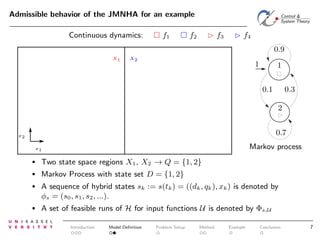
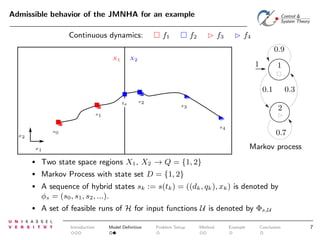
Admissible behavior of the JMNHA for an example
Continuous dynamics:

f1

f2

⊲ f3

⊲ f4
0.9

X1

X2

1

1
0.1

0.3
2
0.7

x2

Markov process

x1

•

Two state space regions X1 , X2 → Q = {1, 2}

•

Markov Process with state set D = {1, 2}

•

A sequence of hybrid states sk := s(tk ) = ((dk , qk ), xk ) is denoted by
φs = (s0 , s1 , s2 , ...).

•

A set of feasible runs of H for input functions U is denoted by Φs,U
Introduction

Model Definition

Problem Setup

Method

Example

Conclusion

7
Admissible behavior of the JMNHA for an example
Continuous dynamics:

f1

f2

⊲ f3

⊲ f4
0.9

X1

X2

1

1
0.1

te

s2

s3

0.3
2

s1
s4

s0

x2

0.7
Markov process

x1

•

Two state space regions X1 , X2 → Q = {1, 2}

•

Markov Process with state set D = {1, 2}

•

A sequence of hybrid states sk := s(tk ) = ((dk , qk ), xk ) is denoted by
φs = (s0 , s1 , s2 , ...).

•

A set of feasible runs of H for input functions U is denoted by Φs,U
Introduction

Model Definition

Problem Setup

Method

Example

Conclusion

7
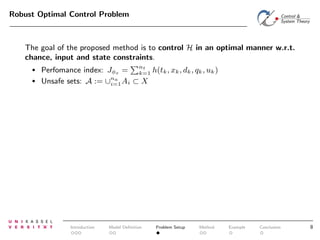
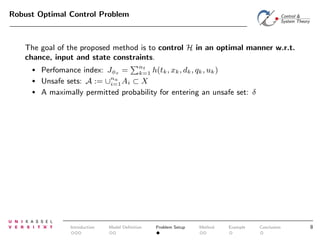
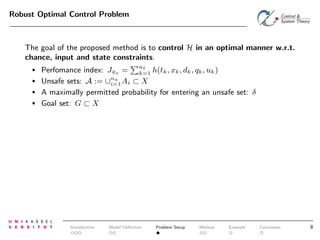
Robust Optimal Control Problem

The goal of the proposed method is to control H in an optimal manner w.r.t.
chance, input and state constraints.

Introduction

Model Definition

Problem Setup

Method

Example

Conclusion

8
Robust Optimal Control Problem

The goal of the proposed method is to control H in an optimal manner w.r.t.
chance, input and state constraints.
•

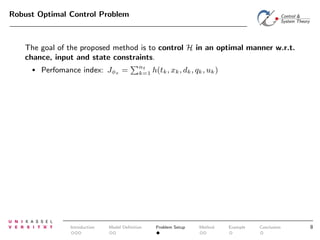
Perfomance index: Jφs =

Introduction

nt
k=1

Model Definition

h(tk , xk , dk , qk , uk )

Problem Setup

Method

Example

Conclusion

8
Robust Optimal Control Problem

The goal of the proposed method is to control H in an optimal manner w.r.t.
chance, input and state constraints.
•
•

Perfomance index: Jφs = nt h(tk , xk , dk , qk , uk )
k=1
Unsafe sets: A := ∪na Ai ⊂ X
i=1

Introduction

Model Definition

Problem Setup

Method

Example

Conclusion

8
Robust Optimal Control Problem

The goal of the proposed method is to control H in an optimal manner w.r.t.
chance, input and state constraints.
•
•
•

Perfomance index: Jφs = nt h(tk , xk , dk , qk , uk )
k=1
Unsafe sets: A := ∪na Ai ⊂ X
i=1
A maximally permitted probability for entering an unsafe set: δ

Introduction

Model Definition

Problem Setup

Method

Example

Conclusion

8
Robust Optimal Control Problem

The goal of the proposed method is to control H in an optimal manner w.r.t.
chance, input and state constraints.
•
•
•
•

Perfomance index: Jφs = nt h(tk , xk , dk , qk , uk )
k=1
Unsafe sets: A := ∪na Ai ⊂ X
i=1
A maximally permitted probability for entering an unsafe set: δ
Goal set: G ⊂ X

Introduction

Model Definition

Problem Setup

Method

Example

Conclusion

8
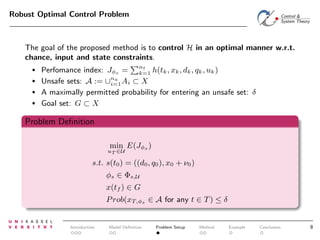
Robust Optimal Control Problem

The goal of the proposed method is to control H in an optimal manner w.r.t.
chance, input and state constraints.
•
•
•
•

Perfomance index: Jφs = nt h(tk , xk , dk , qk , uk )
k=1
Unsafe sets: A := ∪na Ai ⊂ X
i=1
A maximally permitted probability for entering an unsafe set: δ
Goal set: G ⊂ X

Problem Definition
min E(Jφs )

uT ∈U

s.t. s(t0 ) = ((d0 , q0 ), x0 + ν0 )
φs ∈ Φs,U
x(tf ) ∈ G
P rob(xT,φs ∈ A for any t ∈ T ) ≤ δ

Introduction

Model Definition

Problem Setup

Method

Example

Conclusion

8
Approximation by Particle Filters

The main properties of a Particle Filter

1

1
[2]: L. Blackmore, B. C. Williams: Optimal Robust Predictive Control of Nonlinear Systems
under Probabilistic Uncertainty using Particles, 2007

Introduction

Model Definition

Problem Setup

Method

Example

Conclusion

9
Approximation by Particle Filters

The main properties of a Particle Filter

1

•

A particle represents a sample of a random variable Ξ drawn from a given
probability distribution: ξ (1) , . . . , ξ (N)

•

The expected value can be approximated by the sample mean:
N
1
(i)
ˆ
E(Ξ) = N
i=1 ξ

•

Each particle represents a deterministic realization of the JMNHA over a finite
horizon.

1
[2]: L. Blackmore, B. C. Williams: Optimal Robust Predictive Control of Nonlinear Systems
under Probabilistic Uncertainty using Particles, 2007

Introduction

Model Definition

Problem Setup

Method

Example

Conclusion

9
Approximation by Particle Filters

The main properties of a Particle Filter

1

•

A particle represents a sample of a random variable Ξ drawn from a given
probability distribution: ξ (1) , . . . , ξ (N)

•

The expected value can be approximated by the sample mean:
N
1
(i)
ˆ
E(Ξ) = N
i=1 ξ

•

Each particle represents a deterministic realization of the JMNHA over a finite
horizon.

The particles are used to transform a stochastic optimization problem into
a deterministic variant.

1
[2]: L. Blackmore, B. C. Williams: Optimal Robust Predictive Control of Nonlinear Systems
under Probabilistic Uncertainty using Particles, 2007

Introduction

Model Definition

Problem Setup

Method

Example

Conclusion

9
Approximation by Particle Filters

The main properties of a Particle Filter

1

•

A particle represents a sample of a random variable Ξ drawn from a given
probability distribution: ξ (1) , . . . , ξ (N)

•

The expected value can be approximated by the sample mean:
N
1
(i)
ˆ
E(Ξ) = N
i=1 ξ

•

Each particle represents a deterministic realization of the JMNHA over a finite
horizon.

The particles are used to transform a stochastic optimization problem into
a deterministic variant.

The setup of a chance constraint
(i)

•

Indicator function 1A (x1:nt ) denotes if the i-th trajectory is in A at any time.

•

Binary vector λ ∈ {0, 1}N×1 is used for a mixed integer formulation:
1
ˆ
PA = N · w · λ ≤ δ with weighting vector w.

1
[2]: L. Blackmore, B. C. Williams: Optimal Robust Predictive Control of Nonlinear Systems
under Probabilistic Uncertainty using Particles, 2007

Introduction

Model Definition

Problem Setup

Method

Example

Conclusion

9
Proposed Solution Scheme
X1 X2
G
A1

x2
x1

s0

Algorithm (1)
•

Define and initialize H.

•

Set up a suitable cost function h(tk , xk , dk , qk , uk ), unsafe set A, goal set
G, number of particles N and max. permitted probability δ.

Introduction

Model Definition

Problem Setup

Method

Example

Conclusion

10
Proposed Solution Scheme
X1 X2
G
A1

x2
x1

s0

Algorithm (2)
(i)

(i)

•

Draw N samples d0 , x0 according to to the corresponding probability
distribution.

•

Generate a modified transition probability matrix according to the
(i)
(i)
weighting concept and draw a sequence d1:nt for each d0 .

Introduction

Model Definition

Problem Setup

Method

Example

Conclusion

10
Proposed Solution Scheme
X1 X2
G
A1

x2
x1

s0

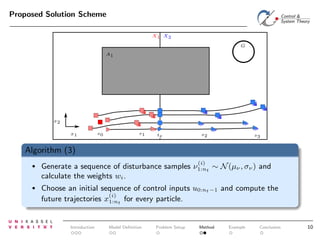
Algorithm (3)
(i)

•

Generate a sequence of disturbance samples ν1:nt ∼ N (µν , σν ) and
calculate the weights wi .

•

Choose an initial sequence of control inputs u0:nt −1 and compute the
(i)
future trajectories x1:nt for every particle.

Introduction

Model Definition

Problem Setup

Method

Example

Conclusion

10
Proposed Solution Scheme
X1 X2
G
A1

x2
x1

s0

s1

Algorithm (3)
(i)

•

Generate a sequence of disturbance samples ν1:nt ∼ N (µν , σν ) and
calculate the weights wi .

•

Choose an initial sequence of control inputs u0:nt −1 and compute the
(i)
future trajectories x1:nt for every particle.

Introduction

Model Definition

Problem Setup

Method

Example

Conclusion

10
Proposed Solution Scheme
X1 X2
G
A1

x2
x1

s0

s1

te

s2

s3

Algorithm (3)
(i)

•

Generate a sequence of disturbance samples ν1:nt ∼ N (µν , σν ) and
calculate the weights wi .

•

Choose an initial sequence of control inputs u0:nt −1 and compute the
(i)
future trajectories x1:nt for every particle.

Introduction

Model Definition

Problem Setup

Method

Example

Conclusion

10
Proposed Solution Scheme
X1 X2
G
A1

x2
s1

s0

x1

s2

te

s3

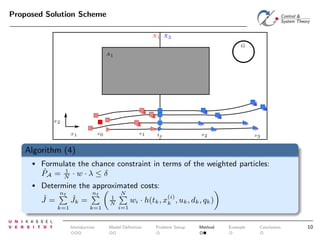
Algorithm (4)
•

Formulate the chance constraint in terms of the weighted particles:
1
ˆ
PA = N · w · λ ≤ δ

•

Determine the approximated costs:
ˆ
J=

nt
k=1

ˆ
Jk =

nt
k=1

Introduction

1
N

N
i=1

(i)

wi · h(tk , xk , uk , dk , qk )

Model Definition

Problem Setup

Method

Example

Conclusion

10
Proposed Solution Scheme
X1 X2
G
A1

x2
s1

s0

x1

te

s3

s2

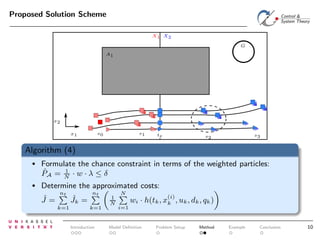
Algorithm (4)
•

Formulate the chance constraint in terms of the weighted particles:
1
ˆ
PA = N · w · λ ≤ δ

•

Determine the approximated costs:
ˆ
J=

nt
k=1

ˆ
Jk =

nt
k=1

Introduction

1
N

N
i=1

(i)

wi · h(tk , xk , uk , dk , qk )

Model Definition

Problem Setup

Method

Example

Conclusion

10
Proposed Solution Scheme
X1 X2
G
A1

x2
s1

s0

x1

te

s3

s2

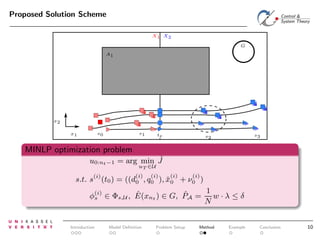
MINLP optimization problem
ˆ
u0:nt −1 = arg min J
uT ∈U

(i)

s.t. s (t0 ) =

(i)
(i)
(i)
((d0 , q0 ), x0
ˇ

(i)

+ ν0 )

1
ˆ
ˆ
φ(i) ∈ Φs,U , E(xnt ) ∈ G, PA = w · λ ≤ δ
s
N

Introduction

Model Definition

Problem Setup

Method

Example

Conclusion

10
Proposed Solution Scheme
X1 X2

G

A1

x2
s1

s0

x1

te

s3

s2

MINLP optimization problem
ˆ
u0:nt −1 = arg min J
uT ∈U

(i)

s.t. s (t0 ) =

(i)
(i)
(i)
((d0 , q0 ), x0
ˇ

(i)

+ ν0 )

1
ˆ
ˆ
φ(i) ∈ Φs,U , E(xnt ) ∈ G, PA = w · λ ≤ δ
s
N

Introduction

Model Definition

Problem Setup

Method

Example

Conclusion

10
Trajectory planning for a ground vehicle

•

•

•

vehicle accelerates to
maximum speed

trajectory
start
25

vehicle turns left and stays
close to the obstacle

stop
goal
particles
isocost lines

vehicle decelerates in front
of the goal

20

particles lead to many
trajectories with steering
and braking failure due to
the weighting concept

15

•

at most 1 of the 10
particle trajectories cross
the obstacle

•

η

•

MINLP was solved with an
SQP method within a
Branch-and-Bound
environment.
Introduction

Model Definition

10

5

−2

0

2

Problem Setup

4

6

Method

8
ζ

10

12

Example

14

16

Conclusion

18

11
Conclusion

Conclusion
Summary:
•

Introduction of an uncertain nonlinear hybrid system.

•

Presentation of an algorithm for optimal open-loop control.

•

A numerical example showed the results of the proposed method.

Remarks:
•

Scheme generates a probabilistically safe sub-optimal trajectory

•

Computationally expensive due to the complex model class and the
challenging problem.

•

Branch-and-Bound may cut off branches which contain feasible solutions.

Future work:
•

Efficient encoding of the chance constraints and alternatives for solving
the optimization.

•

Theoretical analysis concerning the convergence of the approximated
optimization problem.
Introduction

Model Definition

Problem Setup

Method

Example

Conclusion

12

Control of Uncertain Hybrid Nonlinear Systems Using Particle Filters

  • 1.
    Control of UncertainHybrid Nonlinear Systems Using Particle Filters Leonhard Asselborn Martin Jilg Olaf Stursberg Institute of Control and System Theory University of Kassel l.asselborn@uni-kassel.de martin.jilg@uni-kassel.de stursberg@uni-kassel.de www.control.eecs.uni-kassel.de
  • 2.
    Introduction • • • Considered class ofmodels: hybrid nonlinear system with deterministic and nondeterministic transitions and uncertain continuous dynamics. Formulation of a point-to-region open-loop optimal control problem. Contribution: proposal of a particle-filter based solution and feasibility study for an example. Introduction Model Definition Problem Setup Method Example Conclusion 2
  • 3.
    Introduction • • • Considered class ofmodels: hybrid nonlinear system with deterministic and nondeterministic transitions and uncertain continuous dynamics. Formulation of a point-to-region open-loop optimal control problem. Contribution: proposal of a particle-filter based solution and feasibility study for an example. Region 1 Region 2 Goal Region Unsafe Region t4 t3 initial state t1 te uncertain hybrid trajectory t2 t0 x2 x1 Introduction Model Definition Problem Setup Method Example Conclusion 2
  • 4.
    Stochastic Hybrid Models(1) • Stochastic hybrid models are a suitable tool for a wide range of processes Introduction Model Definition Problem Setup Method Example Conclusion 3
  • 5.
    Stochastic Hybrid Models(1) • Stochastic hybrid models are a suitable tool for a wide range of processes • Three main representations of Stochastic hybrid models in literature 1. Stochastic Hybrid Systems (SHS) ◮ Randomness only in the continuous dynamics 2. Switching Diffusion Processes (SDP) ◮ Random cont. dynamics and spontaneous transitions according to a Poisson process 3. Piecewise Deterministic Markov Processes (PDMP) ◮ Deterministic continuous dynamics and spontaneous or autonomous transitions according to a Poisson Process and state space partitions, respectively. Introduction Model Definition Problem Setup Method Example Conclusion 3
  • 6.
    Stochastic Hybrid Models(2) Control methods for Stochastic Hybrid Models in the literature (as far as relevant for this paper): Method specification optimal control [1] particle filter chance constraints nonlinear dynamics - - [2] Model specification uncertain dynamics - - [3] - [4] [6] [1]: [2]: [3]: [4]: [5]: [6]: - - - - [5] stochastic deterministic events events - - - - - - - - - - Bemporad et. al.: Model-Predictive Control of Discrete Hybrid Stochastic Automata, 2011, Blackmore et. al.: Optimal Robust Predictive Control of Nonlinear Systems under Probabilistic Uncertainty using Particles, 2007, Adamek et. al.: Stochastic Optimal Control for Hybrid Systems with Uncertain Dynamics, 2008, Ding et. al.: Increasing Efficiency of Optimization-based Path Planning for Robotic Manipulators, 2011, Li et. al.: Risk-Sensitive Cubature Filtering for Jump Markov Nonlinear Systems and Its Application to Land Vehicle Positioning, 2011, Vitus et. al.: Closed-Loop Belief Space Planning for Linear, Gaussian Systems, 2011 Introduction Model Definition Problem Setup Method Example Conclusion 4
  • 7.
    Considered Class ofModel The “Jump Markov Nonlinear Hybrid Automaton (JMNHA)”: • No resets in the continuous state variable for autonomous transitions based on a state space partition • Spontaneous transitions according to a Markov Process. • Uncertain nonlinear dynamics: deterministic behavior for t ∈]tk , tk+1 [, stochastic pertubation at tk . → Model simplification by evaluating the nondeterministic events in discrete time. Introduction Model Definition Problem Setup Method Example Conclusion 5
  • 8.
    Considered Class ofModel The “Jump Markov Nonlinear Hybrid Automaton (JMNHA)”: • No resets in the continuous state variable for autonomous transitions based on a state space partition • Spontaneous transitions according to a Markov Process. • Uncertain nonlinear dynamics: deterministic behavior for t ∈]tk , tk+1 [, stochastic pertubation at tk . PDMP → Model simplification by evaluating the nondeterministic events in discrete time. Introduction Model Definition Problem Setup Method Example Conclusion 5
  • 9.
    Considered Class ofModel The “Jump Markov Nonlinear Hybrid Automaton (JMNHA)”: • No resets in the continuous state variable for autonomous transitions based on a state space partition • Spontaneous transitions according to a Markov Process. • Uncertain nonlinear dynamics: deterministic behavior for t ∈]tk , tk+1 [, stochastic pertubation at tk . PDMP → Model simplification by evaluating the nondeterministic events in discrete time. Introduction Model Definition Problem Setup Method Example Conclusion 5
  • 10.
    Considered Class ofModel The “Jump Markov Nonlinear Hybrid Automaton (JMNHA)”: • No resets in the continuous state variable for autonomous transitions based on a state space partition • Spontaneous transitions according to a Markov Process. • Uncertain nonlinear dynamics: deterministic behavior for t ∈]tk , tk+1 [, stochastic pertubation at tk . PDMP → Model simplification by evaluating the nondeterministic events in discrete time. Introduction Model Definition Problem Setup Method Example Conclusion 5
  • 11.
    Considered Class ofModel The “Jump Markov Nonlinear Hybrid Automaton (JMNHA)”: • No resets in the continuous state variable for autonomous transitions based on a state space partition • Spontaneous transitions according to a Markov Process. • Uncertain nonlinear dynamics: deterministic behavior for t ∈]tk , tk+1 [, stochastic pertubation at tk . PDMP JMNHA → Model simplification by evaluating the nondeterministic events in discrete time. Introduction Model Definition Problem Setup Method Example Conclusion 5
  • 12.
    Considered Class ofModel The “Jump Markov Nonlinear Hybrid Automaton (JMNHA)”: • No resets in the continuous state variable for autonomous transitions based on a state space partition • Spontaneous transitions according to a Markov Process. • Uncertain nonlinear dynamics: deterministic behavior for t ∈]tk , tk+1 [, stochastic pertubation at tk . xk+1 PDMP xk xk+1 = xk + tk+1 t f (τ )dτ + νk k JMNHA → Model simplification by evaluating the nondeterministic events in discrete time. Introduction Model Definition Problem Setup Method Example Conclusion 5
  • 13.
    A class ofStochastic Hybrid Systems Definition 1: A Jump Markov Nonlinear Hybrid Automaton is defined by H = (T, Tk , Z, X, U, U, f, ψq , ψd , ν) with t ∈ T , tk ∈ Tk • nonlinear continuous dynamics x = f (x, u, d, q), x(t) ∈ X, u(t) ∈ U , ˙ d(tk ) ∈ D, q(tk ) ∈ Q • hybrid state space S = X × Z, x ∈ X, z = (d, q) ∈ Z • update function ψq : X × X → 2Q for the state space region • update function ψd : D × D → [0, 1]nd for the Markov process • uncertainty ν in the continuous state variable x, xk+1 = xk+1 + νk+1 ˇ Introduction Model Definition Problem Setup Method Example Conclusion 6
  • 14.
    Admissible behavior ofthe JMNHA for an example Continuous dynamics: f1 f2 ⊲ f3 ⊲ f4 0.9 X1 X2 1 1 0.1 0.3 2 0.7 x2 Markov process x1 • Two state space regions X1 , X2 → Q = {1, 2} • Markov Process with state set D = {1, 2} • A sequence of hybrid states sk := s(tk ) = ((dk , qk ), xk ) is denoted by φs = (s0 , s1 , s2 , ...). • A set of feasible runs of H for input functions U is denoted by Φs,U Introduction Model Definition Problem Setup Method Example Conclusion 7
  • 15.
    Admissible behavior ofthe JMNHA for an example Continuous dynamics: f1 f2 ⊲ f3 ⊲ f4 0.9 X1 X2 1 1 0.1 te s2 s3 0.3 2 s1 s4 s0 x2 0.7 Markov process x1 • Two state space regions X1 , X2 → Q = {1, 2} • Markov Process with state set D = {1, 2} • A sequence of hybrid states sk := s(tk ) = ((dk , qk ), xk ) is denoted by φs = (s0 , s1 , s2 , ...). • A set of feasible runs of H for input functions U is denoted by Φs,U Introduction Model Definition Problem Setup Method Example Conclusion 7
  • 16.
    Robust Optimal ControlProblem The goal of the proposed method is to control H in an optimal manner w.r.t. chance, input and state constraints. Introduction Model Definition Problem Setup Method Example Conclusion 8
  • 17.
    Robust Optimal ControlProblem The goal of the proposed method is to control H in an optimal manner w.r.t. chance, input and state constraints. • Perfomance index: Jφs = Introduction nt k=1 Model Definition h(tk , xk , dk , qk , uk ) Problem Setup Method Example Conclusion 8
  • 18.
    Robust Optimal ControlProblem The goal of the proposed method is to control H in an optimal manner w.r.t. chance, input and state constraints. • • Perfomance index: Jφs = nt h(tk , xk , dk , qk , uk ) k=1 Unsafe sets: A := ∪na Ai ⊂ X i=1 Introduction Model Definition Problem Setup Method Example Conclusion 8
  • 19.
    Robust Optimal ControlProblem The goal of the proposed method is to control H in an optimal manner w.r.t. chance, input and state constraints. • • • Perfomance index: Jφs = nt h(tk , xk , dk , qk , uk ) k=1 Unsafe sets: A := ∪na Ai ⊂ X i=1 A maximally permitted probability for entering an unsafe set: δ Introduction Model Definition Problem Setup Method Example Conclusion 8
  • 20.
    Robust Optimal ControlProblem The goal of the proposed method is to control H in an optimal manner w.r.t. chance, input and state constraints. • • • • Perfomance index: Jφs = nt h(tk , xk , dk , qk , uk ) k=1 Unsafe sets: A := ∪na Ai ⊂ X i=1 A maximally permitted probability for entering an unsafe set: δ Goal set: G ⊂ X Introduction Model Definition Problem Setup Method Example Conclusion 8
  • 21.
    Robust Optimal ControlProblem The goal of the proposed method is to control H in an optimal manner w.r.t. chance, input and state constraints. • • • • Perfomance index: Jφs = nt h(tk , xk , dk , qk , uk ) k=1 Unsafe sets: A := ∪na Ai ⊂ X i=1 A maximally permitted probability for entering an unsafe set: δ Goal set: G ⊂ X Problem Definition min E(Jφs ) uT ∈U s.t. s(t0 ) = ((d0 , q0 ), x0 + ν0 ) φs ∈ Φs,U x(tf ) ∈ G P rob(xT,φs ∈ A for any t ∈ T ) ≤ δ Introduction Model Definition Problem Setup Method Example Conclusion 8
  • 22.
    Approximation by ParticleFilters The main properties of a Particle Filter 1 1 [2]: L. Blackmore, B. C. Williams: Optimal Robust Predictive Control of Nonlinear Systems under Probabilistic Uncertainty using Particles, 2007 Introduction Model Definition Problem Setup Method Example Conclusion 9
  • 23.
    Approximation by ParticleFilters The main properties of a Particle Filter 1 • A particle represents a sample of a random variable Ξ drawn from a given probability distribution: ξ (1) , . . . , ξ (N) • The expected value can be approximated by the sample mean: N 1 (i) ˆ E(Ξ) = N i=1 ξ • Each particle represents a deterministic realization of the JMNHA over a finite horizon. 1 [2]: L. Blackmore, B. C. Williams: Optimal Robust Predictive Control of Nonlinear Systems under Probabilistic Uncertainty using Particles, 2007 Introduction Model Definition Problem Setup Method Example Conclusion 9
  • 24.
    Approximation by ParticleFilters The main properties of a Particle Filter 1 • A particle represents a sample of a random variable Ξ drawn from a given probability distribution: ξ (1) , . . . , ξ (N) • The expected value can be approximated by the sample mean: N 1 (i) ˆ E(Ξ) = N i=1 ξ • Each particle represents a deterministic realization of the JMNHA over a finite horizon. The particles are used to transform a stochastic optimization problem into a deterministic variant. 1 [2]: L. Blackmore, B. C. Williams: Optimal Robust Predictive Control of Nonlinear Systems under Probabilistic Uncertainty using Particles, 2007 Introduction Model Definition Problem Setup Method Example Conclusion 9
  • 25.
    Approximation by ParticleFilters The main properties of a Particle Filter 1 • A particle represents a sample of a random variable Ξ drawn from a given probability distribution: ξ (1) , . . . , ξ (N) • The expected value can be approximated by the sample mean: N 1 (i) ˆ E(Ξ) = N i=1 ξ • Each particle represents a deterministic realization of the JMNHA over a finite horizon. The particles are used to transform a stochastic optimization problem into a deterministic variant. The setup of a chance constraint (i) • Indicator function 1A (x1:nt ) denotes if the i-th trajectory is in A at any time. • Binary vector λ ∈ {0, 1}N×1 is used for a mixed integer formulation: 1 ˆ PA = N · w · λ ≤ δ with weighting vector w. 1 [2]: L. Blackmore, B. C. Williams: Optimal Robust Predictive Control of Nonlinear Systems under Probabilistic Uncertainty using Particles, 2007 Introduction Model Definition Problem Setup Method Example Conclusion 9
  • 26.
    Proposed Solution Scheme X1X2 G A1 x2 x1 s0 Algorithm (1) • Define and initialize H. • Set up a suitable cost function h(tk , xk , dk , qk , uk ), unsafe set A, goal set G, number of particles N and max. permitted probability δ. Introduction Model Definition Problem Setup Method Example Conclusion 10
  • 27.
    Proposed Solution Scheme X1X2 G A1 x2 x1 s0 Algorithm (2) (i) (i) • Draw N samples d0 , x0 according to to the corresponding probability distribution. • Generate a modified transition probability matrix according to the (i) (i) weighting concept and draw a sequence d1:nt for each d0 . Introduction Model Definition Problem Setup Method Example Conclusion 10
  • 28.
    Proposed Solution Scheme X1X2 G A1 x2 x1 s0 Algorithm (3) (i) • Generate a sequence of disturbance samples ν1:nt ∼ N (µν , σν ) and calculate the weights wi . • Choose an initial sequence of control inputs u0:nt −1 and compute the (i) future trajectories x1:nt for every particle. Introduction Model Definition Problem Setup Method Example Conclusion 10
  • 29.
    Proposed Solution Scheme X1X2 G A1 x2 x1 s0 s1 Algorithm (3) (i) • Generate a sequence of disturbance samples ν1:nt ∼ N (µν , σν ) and calculate the weights wi . • Choose an initial sequence of control inputs u0:nt −1 and compute the (i) future trajectories x1:nt for every particle. Introduction Model Definition Problem Setup Method Example Conclusion 10
  • 30.
    Proposed Solution Scheme X1X2 G A1 x2 x1 s0 s1 te s2 s3 Algorithm (3) (i) • Generate a sequence of disturbance samples ν1:nt ∼ N (µν , σν ) and calculate the weights wi . • Choose an initial sequence of control inputs u0:nt −1 and compute the (i) future trajectories x1:nt for every particle. Introduction Model Definition Problem Setup Method Example Conclusion 10
  • 31.
    Proposed Solution Scheme X1X2 G A1 x2 s1 s0 x1 s2 te s3 Algorithm (4) • Formulate the chance constraint in terms of the weighted particles: 1 ˆ PA = N · w · λ ≤ δ • Determine the approximated costs: ˆ J= nt k=1 ˆ Jk = nt k=1 Introduction 1 N N i=1 (i) wi · h(tk , xk , uk , dk , qk ) Model Definition Problem Setup Method Example Conclusion 10
  • 32.
    Proposed Solution Scheme X1X2 G A1 x2 s1 s0 x1 te s3 s2 Algorithm (4) • Formulate the chance constraint in terms of the weighted particles: 1 ˆ PA = N · w · λ ≤ δ • Determine the approximated costs: ˆ J= nt k=1 ˆ Jk = nt k=1 Introduction 1 N N i=1 (i) wi · h(tk , xk , uk , dk , qk ) Model Definition Problem Setup Method Example Conclusion 10
  • 33.
    Proposed Solution Scheme X1X2 G A1 x2 s1 s0 x1 te s3 s2 MINLP optimization problem ˆ u0:nt −1 = arg min J uT ∈U (i) s.t. s (t0 ) = (i) (i) (i) ((d0 , q0 ), x0 ˇ (i) + ν0 ) 1 ˆ ˆ φ(i) ∈ Φs,U , E(xnt ) ∈ G, PA = w · λ ≤ δ s N Introduction Model Definition Problem Setup Method Example Conclusion 10
  • 34.
    Proposed Solution Scheme X1X2 G A1 x2 s1 s0 x1 te s3 s2 MINLP optimization problem ˆ u0:nt −1 = arg min J uT ∈U (i) s.t. s (t0 ) = (i) (i) (i) ((d0 , q0 ), x0 ˇ (i) + ν0 ) 1 ˆ ˆ φ(i) ∈ Φs,U , E(xnt ) ∈ G, PA = w · λ ≤ δ s N Introduction Model Definition Problem Setup Method Example Conclusion 10
  • 35.
    Trajectory planning fora ground vehicle • • • vehicle accelerates to maximum speed trajectory start 25 vehicle turns left and stays close to the obstacle stop goal particles isocost lines vehicle decelerates in front of the goal 20 particles lead to many trajectories with steering and braking failure due to the weighting concept 15 • at most 1 of the 10 particle trajectories cross the obstacle • η • MINLP was solved with an SQP method within a Branch-and-Bound environment. Introduction Model Definition 10 5 −2 0 2 Problem Setup 4 6 Method 8 ζ 10 12 Example 14 16 Conclusion 18 11
  • 36.
    Conclusion Conclusion Summary: • Introduction of anuncertain nonlinear hybrid system. • Presentation of an algorithm for optimal open-loop control. • A numerical example showed the results of the proposed method. Remarks: • Scheme generates a probabilistically safe sub-optimal trajectory • Computationally expensive due to the complex model class and the challenging problem. • Branch-and-Bound may cut off branches which contain feasible solutions. Future work: • Efficient encoding of the chance constraints and alternatives for solving the optimization. • Theoretical analysis concerning the convergence of the approximated optimization problem. Introduction Model Definition Problem Setup Method Example Conclusion 12