
Brand identity Kapferer identity prism model
•Download as PPTX, PDF•
4 likes•6,892 views

The document discusses Jean-Noel Kapferer's six element "Brand Identity Prism" model for defining a brand's identity. The six elements are: Physique (visual/tangible qualities), Personality (character), Culture (values), Relationship (with customers), Reflection (of typical customer), and Self-Image. Together these facets define a brand's identity and boundaries for developing it over time in a coherent way. The identity prism shows how the elements interconnect to form a structured whole, providing a basis for long-term branding strategy and activities.

Recommended
More Related Content
What's hot
What's hot (20)
Similar to Brand identity Kapferer identity prism model
Similar to Brand identity Kapferer identity prism model (20)
More from Sander Janssens
More from Sander Janssens (15)
Recently uploaded
Recently uploaded (20)
Brand identity Kapferer identity prism model
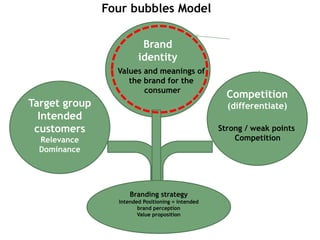
- 1. Competition (differentiate)Target group Intended customers Relevance Dominance Brand identity Four bubbles Model Strong / weak points Competition Values and meanings of the brand for the consumer Branding strategy Intended Positioning = intended brand perception Value proposition
- 2. Brand identity There are many different perceptions of what the brand identity consists of. Common definition: “A set of associations the brand strategist seek to create or maintain.” (Aaker and Joachimsthalert 2002) The brand identity must express the particular vision and uniqueness of the brand. What the brand stands for basically and must be of a long lasting nature. If the brand identity is both unique, distinct, and a clear expression of what the the brand is all about as well as long lasting, then it can create the basis of a solid, coherent and long lasting brand and be the driver of all brand-related activities. Brand (identity)
- 3. What are the values of and what is the character of Angela Merkel ? https://nl.pinterest.com/pin/474003929508501207/
- 6. Rebranding British Airways 1997 – 1999. Focus on global cosmopolitan traveler. Cost £ 60 miljoen (€84 mil) Identity unclear Confusion British Airways, ditched the Union Flag for an "ethnic" tail-fin in 1997.
- 7. Former British prime minister Margareth Thatcher at a conservative party congress: “We fly the British flag, not these awful things." Thatcher also indicated with these fins the airline would lose its identity. She threw her handkerchief to cover the tail fin. Virgin Atlantic could now claim they were Britain's national flagcarrier.
- 8. Relationship What kind of relationship with other people ? Physique Tangible physical qualities. Logo, colours, housestyle Personality What kind of person if it were human ? Reflection Who is the stereotypical customer ? Culture A set of values, fundamental ideas Aspirational Self-Image Brand Identity Prism – 6 Elements ‘Brand Identity Prism’ by Jean-Noel Kapferer, The New Strategic Brand Management, 2012, p.156 Rallying Cry Picture of sender Picture of receiver Externalisation Internalisation
- 9. Physique is the set of the brand’s physical features, which are evoked in people’s minds when the brand name is mentioned. Kapferer states that this aspect has to be considered the basis of the brand. (Visual identity, tone of voice) A moodboard is often used to describe the physique.
- 10. Personality is the brand’s character. This can be realized by using a specific style of writing, using specific design features or using specific colour schemes. Also a person can be used to vitalize a brand. Archetypal personalities usually work well.
- 11. A brand is a relationship. Brands are often at the crux of transactions and exchanges between people. Each brand has some kind of a relationship with it’s customers. The laughing cow is at the heart of a “mother child” relationship.
- 12. Culture is the system of values and basic principles on which a brand has to base its behaviour (products and communication). Many associations in this area are linked to the country of origin; Coca-Cola appeals to American values, Mercedes-Benz to German ones and Citroën to French ones.
- 13. Reflection (of the consumer) makes reference to the stereotypical user of the brand and is the source for identification. When thinking in terms of reflection, in the case of Coca-Cola you could describe the consumer base as15 to18 year olds (with values such as fun, sporty and friendship), while the actual target group of this brand is far broader.
- 14. Self-image is kind of a mirror the target group holds up to itself. A Porsche driver who thinks others will think he is rich because he can afford such a flash car. Research has shown that Lacoste users see themselves as members of a sporty club, even if they do not actively play any sports.
- 15. Relationship What kind of relationship with other people ? Physique Tangible physical qualities. Logo, colours, housestyle Personality What kind of person if it were human ? Reflection Who is the stereotypical customer ? Culture A set of values, fundamental ideas Aspirational Self-Image Brand Identity Prism – 6 Elements ‘Brand Identity Prism’ by Jean-Noel Kapferer, The New Strategic Brand Management, 2012, p.156 Rallying Cry Picture of sender Picture of receiver Externalisation Internalisation
- 19. Relationship Social conformity and distinction Physique Quality shirt, Tennis, Golf, Sportswear, crocodile Personality Discreet without fancy Reflection Neither hyper feminine nor Hyper masculine transgeneration Culture Individualism, aristocratic ideals, classicism Self image / Aspirational Belonging to a club Brand Identity Prism – 6 Elements ‘Brand Identity Prism’ by Jean-Noel Kapferer, The New Strategic Brand Management, 2012, p.156 Picture of sender Picture of receiver Externalisation Internalisation
- 20. Gisele Bundchen goes barefoot in Paris for Chanel's relaxed new ad campaign Ms Bundchen was chosen by Chanel for her 'natural beauty and modern femininity', the brand said in a statement, and joins the long list of icons that have represented the perfume including Lauren Hutton, Catherine Deneuve, Audrey Tautou, and Brad Pitt.
- 22. Conclusion: Brand Identity Prism The six facets define identity as well as the boundary within which it is free to change or develop. The brand identity prism demonstrates that these facets are all interrelated and form a well structured entity. If the brand identity is both unique, distinct, and a clear expression of what the the brand is all about as well as long lasting, then it can create the basis of a solid, coherent and long lasting brand and be the driver of all brand-related activities.
Editor's Notes
- Identity vs image
- Since its formation in 1974, though to a limited extent until all aircraft were repainted, British Airways' aeroplanes carried a Union Jack scheme painted on their tail fins. The original tail scheme was changed in 1984 as part of a new livery designed by Landor Associates.[119] On 10 June 1997 there was a highly controversial change from the use of the British colours to ethnic logos and abstract world images,[120] such as Delftware or Chinese calligraphy for example. All the designs related to countries on the company's network of routes. This caused problems with air traffic control: whereas previously controllers had been able to tell pilots to follow a BA plane, they were now harder to visually identify because each plane was painted in a range of different colours and colour schemes.[121] Several people spoke out against the change from the traditional Union Flag scheme, including the former Prime Minister Margaret Thatcher who covered the tail of a model BA plane with a white handkerchief captured by BBC News cameras.[122] BA's traditional rival, Virgin Atlantic, quickly adopted the British flag along with the slogan "Britain's national flagcarrier".[123] On 6 June 1999, BA CEO Bob Ayling announced that all BA planes would be repainted with the Union Flag, based on a design first used on Concorde.[124] BRITISH AIRWAYS chief executive Bob Ayling last night denied that the airline's "ethnic" tailfin designs had been a flop - as BA announced it was returning more to the traditional colours of the Union Jack. He told The Independent that the multi-cultural logos introduced two years ago had been hugely popular with BA's overseas customers, allowing the airline to penetrate new markets.Nevertheless, within the next 18 months, more than half of BA's fleet of 308 aircraft will be re-painted with a redesigned Union Flag logo on the tail. Mr Ayling said last night: "What we have been trying to do is to find global images which strike chords with as many people in as many of the markets that we serve, as we possibly can. We have had overwhelming support from people outside of Britain, allowing us to develop business in places such as Germany, South Africa and France, with designs appropriate to those particular markets. He said that the reaction of the British people had not surprised him. Britons wanted images they could identify with as being part of their own culture, just as BA's overseas passengers had wanted images reflecting their own heritage. Mr Ayling added that though the relaunch had been widely publicised as costing pounds 60 million, it would only only cost about pounds 2 million to repaint aircraft. Currently, around two thirds of the airline's jets sport "world image" designs ranging from Chinese calligraphy to a Polish design of a cockerel. Only half will do so by the end of 2001. The rest will be repainted with a "wavy" Union flag design, based on the flag used by Admiral Nelson at the Battle of Trafalgar in 1805. This design, which was originally part of the 1997 rebranding, adorns BA's seven Concordes, one 757 jet and the 767 used to fly the Queen to South Korea in April. Despite winning some fans overseas, the ethnic tailfins have come in for fierce criticism domestically. Lady Thatcher famously having covered up a model of one of the tailfins with a handkerchief at the 1997 Tory conference. Air traffic controllers have also said the varying designs made BA aircraft more difficult to identify. Richard Branson's Virgin, that introduced the Union flag on its aircraft when BA first announced its ethnic designs, today unveils an updated look: the Union flag will feature strongly in a metallic silver livery. http://www.independent.co.uk/news/union-jack-is-back-on-the-worlds-favourite-airline-1098648.html
- http://www.dailymail.co.uk/femail/article-2890489/Gisele-Bundchen-goes-barefoot-Paris-Chanel-s-relaxed-new-ad-campaign.html
- https://nl.pinterest.com/pin/114349278015676803/