Branding and
Identity
An Overview Lecture
By David Franek
2
“Clarity in expressing the brand—
whether it be for a product, a
corporation, or an institution—may
be the final [business] frontier.”
3
What is Branding
 Branding is the strategic staking out of an appropriate, credible
market space for a company and/or its products and services.
 Branding provides a vision upon which the company can
build —- an identity that it can maintain and add value, even
while the company and its offerings grow.
 Branding is a promise a company makes to the marketplace —
a promise that it’s going to fulfill certain expectations.
 It’s permission to believe.
 Branding is awareness building of a company and/or its
products and services within the marketplace.
 A brand, if carefully crafted and maintained, never expires —
it’s the one thing that really lasts.
4
What Branding Can Do
 Branding is a crowbar for breaking through the clutter of
competitive messages, making a company better known, and
making it more memorable.
 Branding steers how the marketplace thinks about the company.
 Branding, by increasing awareness and by providing a context
for sales and marketing messages, paves the way for sales
efforts; it eases the sales process and increases the likelihood
that it will be successful.
5
Branding Process
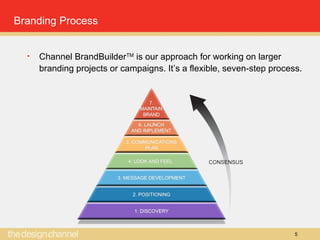
• Channel BrandBuilderTM
is our approach for working on larger
branding projects or campaigns. It’s a flexible, seven-step process.
6
Discovery Process: Brand Audit
 This is when we look at an organization’s existing image and
brand and evaluate its strengths and weaknesses (like getting a
checkup at the doctors). Once we know where you are, we can
figure out how to get you where you need to be.
 Brand Equity
 Corporate Logo
 Product Names and Identities
 Marketing Materials
 Benchmarking
7
Brand Equity
 Brand equity is a set of brand assets and liabilities linked to its
brand, its name and symbol, that add or subtract from the
value provided by a product or service to an organization
and/or that organization’s customers.
 It has also been defined as the effect of brand knowledge on
customer response to the brand. As such, brand equity is the
value of the brand name in the marketplace.
8
Brand Equity
What is the value of a brand equity?
 Building strong brand equity is essential to secure competitive
advantage. Increasingly, it is the brand, which provides the sole
means of differentiation, as Fortune magazine famously said:
- “In the 21st
century, branding ultimately will be the only
differentiator between companies. Brand equity is now a
key asset.”
- What Fortune is asserting is that sooner or later most
companies will be competing on a level playing field. In
these circumstances the reputation encapsulated in their
brands will become the chief determinant of customer
choice.
9
The Art of Positioning
 Positioning is the first creative step in the branding process.
 It’s the most basic of all strategy statements and the
foundation upon which the branding is built.
 The positioning statement must define three things:
 Target audience
 Competitive category
 The most meaningful point of difference for your brand
Positioning is about creating a simple strategy that
meaningfully differentiates your brand
10
The Art of Positioning
 Positioning is about turning things inside out …
 Positioning is not so much created by looking for the solution
inside the company, or inside your own mind but inside the
prospect’s mind.
 Positioning is not what you do to a product or company.
Positioning is what you do to the mind of the prospect or the
marketplace.
Positioning is about creating an impression
in the mind of the prospect
11
The Art of Positioning
 Positioning comes to grips with the difficult problem of getting
heard in our over-communicated marketplace.
 Everyday thousands of messages compete for a share of the
prospect’s mind. The mind is a battleground.
 In communication, as in architecture, less is more. You have to
sharpen your message to cut into the mind. You have to
jettison the ambiguities, simplify the message and then simplify
it some more if you want to make a long-lasting impression.
The best approach in creating a positioning statement
is with an oversimplified message
12
The Art of Positioning
Summary – 3 key premises:
 Positioning must set a company or product apart from its
competitors.
 You must position the company or product in the mind of the
prospect.
 Positioning must be singular: one simple message.
The moral of the story is:
 You must sacrifice. You cannot be all things to all people, you
must focus on one thing.
13
Brand identity
 The brand identity is a company’s signature and should
represent its core attributes. It is intended to enhance
perception by creating a visual contact between the brand
owner and the public or marketplace.
 Brand identity is all about the visual and verbal attributes of a
company presented in their marketing materials; how the logo,
positioning, messaging, and look and feel are illustrated and
integrated across the various components. Building blocks that
fall into this category include tag line, marketplace messages,
color, photography or illustration use, graphic elements, and
more.
 When multiple product lines are involved, a strong brand
architecture can clearly organize the offerings as well as support
one another through consistency and shared equity.
14
Types of Brand Identity Architecture
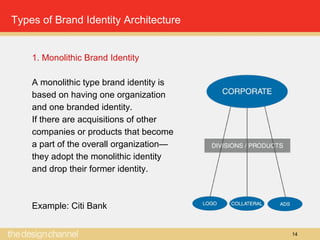
1. Monolithic Brand Identity
A monolithic type brand identity is
based on having one organization
and one branded identity.
If there are acquisitions of other
companies or products that become
a part of the overall organization—
they adopt the monolithic identity
and drop their former identity.
Example: Citi Bank
15
Types of Brand Identity Architecture
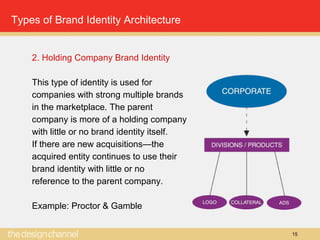
2. Holding Company Brand Identity
This type of identity is used for
companies with strong multiple brands
in the marketplace. The parent
company is more of a holding company
with little or no brand identity itself.
If there are new acquisitions—the
acquired entity continues to use their
brand identity with little or no
reference to the parent company.
Example: Proctor & Gamble
16
Types of Brand Identity Architecture
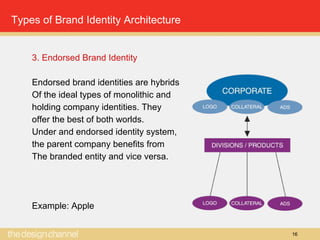
3. Endorsed Brand Identity
Endorsed brand identities are hybrids
Of the ideal types of monolithic and
holding company identities. They
offer the best of both worlds.
Under and endorsed identity system,
the parent company benefits from
The branded entity and vice versa.
Example: Apple
17
The Design Channel
Branding and Integrated Marketing Communications
www.thedesignchannel.com
301-951-9196

Branding and identity an overview lecture

  • 1.
    Branding and Identity An OverviewLecture By David Franek
  • 2.
    2 “Clarity in expressingthe brand— whether it be for a product, a corporation, or an institution—may be the final [business] frontier.”
  • 3.
    3 What is Branding Branding is the strategic staking out of an appropriate, credible market space for a company and/or its products and services.  Branding provides a vision upon which the company can build —- an identity that it can maintain and add value, even while the company and its offerings grow.  Branding is a promise a company makes to the marketplace — a promise that it’s going to fulfill certain expectations.  It’s permission to believe.  Branding is awareness building of a company and/or its products and services within the marketplace.  A brand, if carefully crafted and maintained, never expires — it’s the one thing that really lasts.
  • 4.
    4 What Branding CanDo  Branding is a crowbar for breaking through the clutter of competitive messages, making a company better known, and making it more memorable.  Branding steers how the marketplace thinks about the company.  Branding, by increasing awareness and by providing a context for sales and marketing messages, paves the way for sales efforts; it eases the sales process and increases the likelihood that it will be successful.
  • 5.
    5 Branding Process • ChannelBrandBuilderTM is our approach for working on larger branding projects or campaigns. It’s a flexible, seven-step process.
  • 6.
    6 Discovery Process: BrandAudit  This is when we look at an organization’s existing image and brand and evaluate its strengths and weaknesses (like getting a checkup at the doctors). Once we know where you are, we can figure out how to get you where you need to be.  Brand Equity  Corporate Logo  Product Names and Identities  Marketing Materials  Benchmarking
  • 7.
    7 Brand Equity  Brandequity is a set of brand assets and liabilities linked to its brand, its name and symbol, that add or subtract from the value provided by a product or service to an organization and/or that organization’s customers.  It has also been defined as the effect of brand knowledge on customer response to the brand. As such, brand equity is the value of the brand name in the marketplace.
  • 8.
    8 Brand Equity What isthe value of a brand equity?  Building strong brand equity is essential to secure competitive advantage. Increasingly, it is the brand, which provides the sole means of differentiation, as Fortune magazine famously said: - “In the 21st century, branding ultimately will be the only differentiator between companies. Brand equity is now a key asset.” - What Fortune is asserting is that sooner or later most companies will be competing on a level playing field. In these circumstances the reputation encapsulated in their brands will become the chief determinant of customer choice.
  • 9.
    9 The Art ofPositioning  Positioning is the first creative step in the branding process.  It’s the most basic of all strategy statements and the foundation upon which the branding is built.  The positioning statement must define three things:  Target audience  Competitive category  The most meaningful point of difference for your brand Positioning is about creating a simple strategy that meaningfully differentiates your brand
  • 10.
    10 The Art ofPositioning  Positioning is about turning things inside out …  Positioning is not so much created by looking for the solution inside the company, or inside your own mind but inside the prospect’s mind.  Positioning is not what you do to a product or company. Positioning is what you do to the mind of the prospect or the marketplace. Positioning is about creating an impression in the mind of the prospect
  • 11.
    11 The Art ofPositioning  Positioning comes to grips with the difficult problem of getting heard in our over-communicated marketplace.  Everyday thousands of messages compete for a share of the prospect’s mind. The mind is a battleground.  In communication, as in architecture, less is more. You have to sharpen your message to cut into the mind. You have to jettison the ambiguities, simplify the message and then simplify it some more if you want to make a long-lasting impression. The best approach in creating a positioning statement is with an oversimplified message
  • 12.
    12 The Art ofPositioning Summary – 3 key premises:  Positioning must set a company or product apart from its competitors.  You must position the company or product in the mind of the prospect.  Positioning must be singular: one simple message. The moral of the story is:  You must sacrifice. You cannot be all things to all people, you must focus on one thing.
  • 13.
    13 Brand identity  Thebrand identity is a company’s signature and should represent its core attributes. It is intended to enhance perception by creating a visual contact between the brand owner and the public or marketplace.  Brand identity is all about the visual and verbal attributes of a company presented in their marketing materials; how the logo, positioning, messaging, and look and feel are illustrated and integrated across the various components. Building blocks that fall into this category include tag line, marketplace messages, color, photography or illustration use, graphic elements, and more.  When multiple product lines are involved, a strong brand architecture can clearly organize the offerings as well as support one another through consistency and shared equity.
  • 14.
    14 Types of BrandIdentity Architecture 1. Monolithic Brand Identity A monolithic type brand identity is based on having one organization and one branded identity. If there are acquisitions of other companies or products that become a part of the overall organization— they adopt the monolithic identity and drop their former identity. Example: Citi Bank
  • 15.
    15 Types of BrandIdentity Architecture 2. Holding Company Brand Identity This type of identity is used for companies with strong multiple brands in the marketplace. The parent company is more of a holding company with little or no brand identity itself. If there are new acquisitions—the acquired entity continues to use their brand identity with little or no reference to the parent company. Example: Proctor & Gamble
  • 16.
    16 Types of BrandIdentity Architecture 3. Endorsed Brand Identity Endorsed brand identities are hybrids Of the ideal types of monolithic and holding company identities. They offer the best of both worlds. Under and endorsed identity system, the parent company benefits from The branded entity and vice versa. Example: Apple
  • 17.
    17 The Design Channel Brandingand Integrated Marketing Communications www.thedesignchannel.com 301-951-9196