Proprietary & Confiden0al
brand	growth	strategy	
Brand	Architecture	
		
	
Process	&	Frameworks	
	
	
Michael	Million	
mmillion@fullsurge.com
PROPRIETARY	AND	CONFIDENTIAL	
SUBSECTION	TITLE	
2	
Agenda	
§  What	is	brand	architecture?	
§  What	business	issues	does	brand	architecture	help	address?	
§  A	methodology	to	develop	brand	architecture?	
§  Examples	of	deliverables
PROPRIETARY	AND	CONFIDENTIAL	
SUBSECTION	TITLE	
3	
What	is	brand	architecture?	
	The	way	in	which	internal	entities	(business	units,	divisions,	capabilities)	and	offerings	
(products,	services,	programs)	in	an	organization’s	portfolio	are	related	to	each	other	
perspective	(parent	/	child,	leader	/	follower,	etc.)	from	an	external	perspective.	
	
While	some	degree	of	relatedness	is	beneficial,	the	external	view	of	the	portfolio	does	
not	necessarily	have	to	align	precisely	with	how	the	organization	is	actually	structured	
internally	(brand	architecture	and	organizational	P&L	structure	are	not	the	same	thing,	
but	brand-dedicated	teams	are	desirable).	
	
Effective	brand	architectures	are	structured	to	drive	synergies	across	the	portfolio	
(sharing	and	leveraging	equity),	clarity	and	distinction	among	brands,	and	provide	
direction	for	future	acquisitions	of	new	brands	by	determining	how	the	portfolio	should	
be	organized	to	drive	growth.	
	
Brand	architecture	is	created	with	a	long-term	view	and	typically	is	accompanied	by	
some	type	so	decision	tool	with	strong	business	rationale	for	determining	IF	entities	/	
offerings	should	be	branded,	and	if	so,	HOW	they	should	be	branded.
PROPRIETARY	AND	CONFIDENTIAL	
SUBSECTION	TITLE	
4	
Three	essential	elements	of	brand	architecture	
	
	
1.  End-state	Framework	composed	of:	
A.  Brand	hierarchy	-	a	tiered	structure	that	clarifies	which	entities	/	offerings	are	most	
important	to	those	less	important	in	achieve	business	objectives,	and	the	types	of	brands	
associated	with	them.	
B.  Organizing	principle	–	an	overarching	approach	toward	strategically	structuring	a	
portfolio	in	ways	that	enable	the	organization	to	grow	and	achieve	its	objectives.	There	
are	two	types	of	organizing	principles:	
•  Relationship	of	entities	/	offerings	to	their	parent	(typically	referred	to	as	a	spectrum	from	
“branded	house”	to	“house	of	brands”	
•  Strategic	orientation	(the	underpinning	for	how	brands	are	organized	–	the	“organized	by”	
portion	of	an	architecture	–	e.g.	by	customer	segments,	by	product	lines,	by	geographies)	
2.  Decision	tree	–	a	criteria-based	tool	that	guides	decisions	around	what	entities	/	
offerings	should	and	should	not	be	branded	and	what	type	of	brand	they	should	
become	(e.g.	master	brand,	product	brand,	sub-brand,	ingredient	brand,	etc.)	
3.  Migration	plan	–	an	approach	to	move	the	current	portfolio	from	the	current	state	
to	the	desired	end-state,	including	timing	/	sequencing,	operational	imperatives,	
customer	communications,	etc.
PROPRIETARY	AND	CONFIDENTIAL	
SUBSECTION	TITLE	
5	
Business	issues	brand	architecture	helps	address	
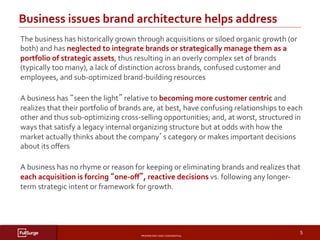
The	business	has	historically	grown	through	acquisitions	or	siloed	organic	growth	(or	
both)	and	has	neglected	to	integrate	brands	or	strategically	manage	them	as	a	
portfolio	of	strategic	assets,	thus	resulting	in	an	overly	complex	set	of	brands	
(typically	too	many),	a	lack	of	distinction	across	brands,	confused	customer	and	
employees,	and	sub-optimized	brand-building	resources	
	
A	business	has	“seen	the	light”	relative	to	becoming	more	customer	centric	and	
realizes	that	their	portfolio	of	brands	are,	at	best,	have	confusing	relationships	to	each	
other	and	thus	sub-optimizing	cross-selling	opportunities;	and,	at	worst,	structured	in	
ways	that	satisfy	a	legacy	internal	organizing	structure	but	at	odds	with	how	the	
market	actually	thinks	about	the	company’s	category	or	makes	important	decisions	
about	its	offers		
	
A	business	has	no	rhyme	or	reason	for	keeping	or	eliminating	brands	and	realizes	that	
each	acquisition	is	forcing	“one-off”,	reactive	decisions	vs.	following	any	longer-
term	strategic	intent	or	framework	for	growth.
PROPRIETARY	AND	CONFIDENTIAL	
SUBSECTION	TITLE	
6	
1	
Assessment	
2	
Hypotheses	
3	
ValidaEon	&		
Refinement*		
4	
Strategy	&		
MigraEon		
Methodology	for	developing	brand	architecture	
§  Gather	and	synthesize	
existing	information	
§  Conduct	executive	
interviews	
§  Conduct	communications	
audit	(client	and	
competitors		
§  Map	current-state	brand	
architecture	(as	
comprehensively	as	
possible)	
§  Gain	insights	from	current-
state,	competition	&	best	
practices	
§  Assess	brand	strengths	&	
weaknesses*	(based	on	
criteria	that	incorporates	as	
much	financial)	
§  Establish	guiding	
principles	for	future		
architecture	–	mapped	to	
client’s	big	strategic	
objectives	and	agreed	
upon	by	executive	team	
§  Develop	hypotheses	for	
future	architecture	led	by	
guiding	principles	
§  Develop	several	
alternative	architectural	
scenarios	–	challenging	
expected	solutions	
§  Illustrate	scenarios	in	
representative		
communications	
§  Facilitate	executive	work	
sessions	to	narrow	options	
§  Develop	research	plan	
(sample,	methodology,	
discussion	guide)	
§  Analyze	findings	
§  Clarify	Implications	
§  Finalize	brand	
architecture	
§  Clarify	new	brand	
roles,	scopes	and	
relationships	
§  Develop	migration	
plan		
*Could	require	primary	research	if	no	brand-specific	data	exists
PROPRIETARY	AND	CONFIDENTIAL	
SUBSECTION	TITLE	
7	
Case:		Situation	&	Scope	of	Brands	
	M&A	activity	has	complicated	the	current	Regal	Beloit	brand	portfolio	
§  The	accelerated	pace	of	acquisitions	has	filled	capability	gaps	and	capitalized	on	opportunities,	but	also	
created	an	overly	complex	portfolio	with	too	many	brands	to	effectively	manage	on	a	global	scale	
§  While	the	sheer	quantity	of	brands	and	overlap	in	their	offers	are	contributing	to	confusion,	simply	
eliminating	brands	will	not	be	easy,	as	internal	and	external	loyalties	to	many	brands	remain	strong	
§  Future	M&A	activity	will	continue	as	Regal	Beloit	continues	to	grow,	so	establishing	a	long-term	brand	
portfolio	strategy	is	paramount	not	only	for	the	current	brands,	but	also	for	future	integration	efforts	
		Com.	&	Ind l														HVACR																		Air	Moving															Controls																		Mechanical																		International
PROPRIETARY	AND	CONFIDENTIAL	
SUBSECTION	TITLE	
8	
Project	Objectives	
	
Key	Questions	to	be	answered	in	this	project	
Strategically	organize	Regal	Beloit’s	brands	to	achieve	greater	clarity,	realize	efficiencies	/	
synergies,	and	build	stronger	brand	equities	across	the	portfolio	
§  The	strategic	role	of	each	brand	in	the	future	portfolio	(e.g.	leader,	challenger,	revenue	generator,	equity	builder)	
§  The	appropriate	scope	of	each	brand	in	the	future	portfolio	(offers,	geographies,	customer	types)	
§  The	optimal	relationships	among	the	portfolio	brands	(e.g.	master	branded,	endorsed,	sub-brand,	endorsed)	
Parent	Brand	
§  What	is	the	“directional”	awareness	level	of	Regal	Beloit	as	the	corporate	brand?	
§  What	is	the	optimal	positioning	for	the	corporate	brand	(Regal	Beloit	or	other)?	
§  Can/should	a	new	brand	name	be	developed	for	the	corporate	entity?	
BU	Brands	
§  Which	BU	brands	have	the	most	equity	in	the	market	today?	What	are	those	equities?	
§  Should	any	BU	brands	be	eliminated.	If,	so	which	ones?	Should	BU	brand	change	
profiles?	
§  For	surviving	brands,	what	is	the	strategic	role	it	serves	within	the	portfolio?	
Brand	Architecture	
§  What	is	optimal	relationship	between	surviving	BU	brands	and	the	corporate	brand?	
§  What	is	the	relative	hierarchy/emphasis	for	brands	that	are	linked	together?	
§  Does	this	parent/BU	relationship	vary	by	BU	brand,	or	is	it	standard/consistent?	
Visual		
Representation	
§  How	is	the	brand	architecture	“brought	to	life”	visually	(i.e.,	high	level	representation)?
PROPRIETARY	AND	CONFIDENTIAL	
SUBSECTION	TITLE	
9	
1	
Assessment	
2	
Hypotheses	
3	
ValidaEon	&		
Refinement		
4	
Strategy	&		
MigraEon		
Approach	
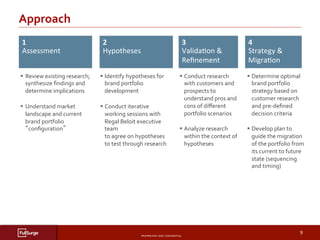
§  Review	existing	research;	
synthesize	findings	and	
determine	implications	
§  Understand	market	
landscape	and	current	
brand	portfolio	
“configuration”	
§ Identify	hypotheses	for	
brand	portfolio	
development		
§ Conduct	iterative	
working	sessions	with	
Regal	Beloit	executive	
team		
to	agree	on	hypotheses	
to	test	through	research		
§ Conduct	research	
with	customers	and	
prospects	to	
understand	pros	and	
cons	of	different	
portfolio	scenarios	
§ Analyze	research	
within	the	context	of	
hypotheses	
§ Determine	optimal	
brand	portfolio	
strategy	based	on	
customer	research	
and	pre-defined	
decision	criteria	
§ Develop	plan	to	
guide	the	migration	
of	the	portfolio	from	
its	current	to	future	
state	(sequencing	
and	timing)
PROPRIETARY	AND	CONFIDENTIAL	
SUBSECTION	TITLE	
10	
1	
Assessment	
2	
Hypotheses	
3	
ValidaEon	&		
Refinement		
4	
Strategy	&		
MigraEon		
Deliverables	
§  Synthesis	of	existing	
research,	planning	
documents,	&	mgt.	
interviews	
§  Insights	from	current-state	
brand	architecture,	
competition	&	best	
practices	
§  Brand	scorecards	/	
assessment	summary	of	
strengths,	weaknesses	&	
future	considerations	
§  Guiding	principles	for	the	
future	brand	portfolio	
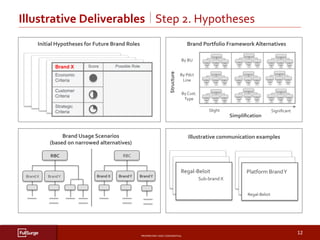
§  Initial	hypotheses	for	
future	brand	roles,	based	
on	assessments	
§  Brand	portfolio	framework	
alternatives	
§  Brand	usage	scenarios	/	
applying	different	sets	of	
brands	to	portfolio	
frameworks		
§  Illustrative	communication	
examples	of	
representative	brand	
relationships		
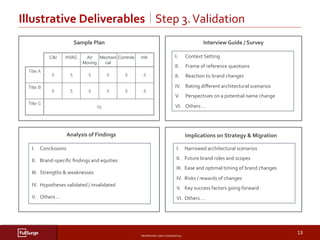
§  Research	plan	(sample,	
methodology,	
discussion	guide/
stimuli)	
§  Analysis	of	findings	
§  Implications	on	
strategy	and	migration	
plan	
§  Final	brand	
architecture	
§  Brand	portfolio	
profiles	
§  Strategic	roles	
§  Scopes	(offers,	geos,	
customers)	
§  Identity	relationships	
with	Regal	Beloit		
§  Expression	approaches	
§  Decision	tool(s)	
§  Migration	plan		
§  Clarified	implications	
of	recommended	
changes
PROPRIETARY	AND	CONFIDENTIAL	
SUBSECTION	TITLE	
11	
Illustrative	Deliverables				Step	1.	Assessment		
	
Synthesis	of	Existing	Information	&	Exec.	Interviews	 Insights	from	Current-state	Brand	
Architecture,	Competition	&	Best	Practices	
Brand	Assessment	Scorecards	
Brand X Sources Score Comments
Economic
Criteria
• A
• B
• C
…….. …
…… …….
… …….
Customer
Criteria
• A
• B
• C
…….. …
…… …
Strategic
Criteria
• A
• B
…….. …
…… ……
Guiding	Principles	for	the	Future	Brand	
Portfolio	
	
Summaries			
&		
Implications	
	
Existing	Information	
• 	Strategic	plans	
• 	Brand	research	
• 	Customer	Sat	reports	
Executive	Interviews	
• 		Chairman	
• 	CEO	
• 	COO	
	
	
•  Build	equity	into	the	Regal-Beloit	brand	
•  Make	the	portfolio	easy	to	understand	and	
navigate	for	customers	and	sales	force	
•  Move	toward	fewer,	stronger	brands	
•  Do:	build	brands	/	Don’t:	add	names	
•  Express	“systemness”	
Level	1	
Level	2	
Level	3	
Level	4
PROPRIETARY	AND	CONFIDENTIAL	
SUBSECTION	TITLE	
12	
Illustrative	Deliverables				Step	2.	Hypotheses		
	
Initial	Hypotheses	for	Future	Brand	Roles	 Brand	Portfolio	Framework	Alternatives	
	
Brand	Usage	Scenarios		
(based	on	narrowed	alternatives)		
Brand X Score Possible Role
Economic
Criteria
Customer
Criteria
Strategic
Criteria
Illustrative	communication	examples		
RBC	
Brand	X	 Brand	Y	
		
Regal-Beloit	
Sub-brand	X	
Structure	
By	BU	
By	Pdct	
Line	
By	Cust.	
Type	
Simplification	
Slight	 Significant	
RBC	
Brand	X	 Brand	Y	
		
Brand	Y	
Platform	Brand	Y	
Regal-Beloit
PROPRIETARY	AND	CONFIDENTIAL	
SUBSECTION	TITLE	
13	
Illustrative	Deliverables				Step	3.	Validation		
	
Sample	Plan	 Interview	Guide	/	Survey	
	
Analysis	of	Findings		 Implications	on	Strategy	&	Migration	
C&I HVAC Air
Moving
Mechani
cal
Controls Intl.
Title A
5 5 5 5 5 5
Title B
5 5 5 5 5 5
Title C
10
I. 	Context	Setting	
II. 	Frame	of	reference	questions	
II. 	Reaction	to	brand	changes	
IV. 	Rating	different	architectural	scenarios	
V.  Perspectives	on	a	potential	name	change	
VI.  Others	…	
I.  Conclusions	
II.  Brand-specific	findings	and	equities	
III.  Strengths	&	weaknesses	
IV.  Hypotheses	validated	/	invalidated	
V.  Others	…	
I.  Narrowed	architectural	scenarios	
II.  Future	brand	roles	and	scopes	
III.  Ease	and	optimal	timing	of	brand	changes	
IV.  Risks	/	rewards	of	changes	
V.  Key	success	factors	going	forward	
VI.  Others	…
PROPRIETARY	AND	CONFIDENTIAL	
SUBSECTION	TITLE	
14	
Illustrative	Deliverables				Step	4.	Strategy	&	Migration		
	 Final	Brand	Architecture	 Brand	Portfolio	Profiles	
Decision	Tool(s)	 Migration	Plan	
Strategic
Role
Scope Relationship
to RCB
Expression
Approach
Brand 1
Brand 2
Brand 3
Level	1	
Level	2	
Level	3	
Level	4
PROPRIETARY	AND	CONFIDENTIAL	
SUBSECTION	TITLE	
15	
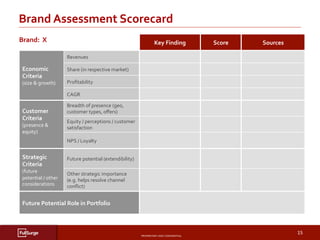
Brand	Assessment	Scorecard	
	
	
Brand:		X	 Key	Finding	 Score	 Sources	
Economic	
Criteria	
(size	&	growth)	
Revenues	
Share	(in	respective	market)	
Profitability	
CAGR	
Customer	
Criteria	
(presence	&	
equity)	
	
Breadth	of	presence	(geo,	
customer	types,	offers)	
Equity	/	perceptions	/	customer	
satisfaction	
NPS	/	Loyalty	
Strategic	
Criteria	
(future	
potential	/	other	
considerations		
Future	potential	(extendibility)	
Other	strategic	importance	
(e.g.	helps	resolve	channel	
conflict)	
Future	Potential	Role	in	Portfolio
PROPRIETARY	AND	CONFIDENTIAL	
SUBSECTION	TITLE	
16	
Click	to	edit	Master	title	style	
1603	Orrington	
Evanston	IL	60201	
MMillion@fullsurge.com	
fullsurge.com	
	
Thank	you

Brand Architecture Process