














Brand
SAM Husaini
What is a brand?
A brand is a set of differentiating promises
that link a product to its customers.
The brand assures the customer of consistent quality plus a
superior value (both functional and emotional) for which the
customer is willing to give loyalty and pay a price that brings a
reasonable return to the brand
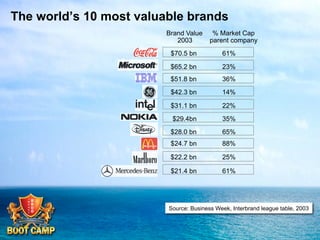
The world’s 10 most valuable brands
Brand Value
2003

% Market Cap
parent company

$70.5 bn

61%

$65.2 bn

23%

$51.8 bn

36%

$42.3 bn

14%

$31.1 bn

22%

$29.4bn

35%

$28.0 bn

65%

$24.7 bn

88%

$22.2 bn

25%

$21.4 bn

61%

Source: Business Week, Interbrand league table, 2003
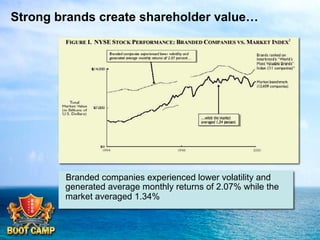
Strong brands create shareholder value…

 Branded companies experienced lower volatility and
generated average monthly returns of 2.07% while the
market averaged 1.34%
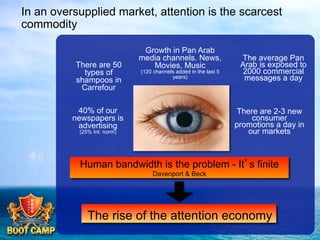
In an oversupplied market, attention is the scarcest
commodity

There are 50
types of
shampoos in
Carrefour

Growth in Pan Arab
media channels. News,
Movies, Music
(120 channels added in the last 5
years)

40% of our
newspapers is
advertising

The average Pan
Arab is exposed to
2000 commercial
messages a day

There are 2-3 new
consumer
promotions a day in
our markets

(25% Int. norm)

Human bandwidth is the problem - It’s finite
Davenport & Beck

The rise of the attention economy
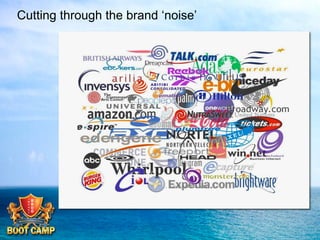
Cutting through the brand ‘noise’
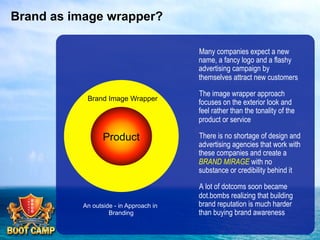
Brand as image wrapper?
 Many companies expect a new
name, a fancy logo and a flashy
advertising campaign by
themselves attract new customers
Brand Image Wrapper

Product

An outside - in Approach in
Branding

 The image wrapper approach
focuses on the exterior look and
feel rather than the tonality of the
product or service
 There is no shortage of design and
advertising agencies that work with
these companies and create a
BRAND MIRAGE with no
substance or credibility behind it
 A lot of dotcoms soon became
dot.bombs realizing that building
brand reputation is much harder
than buying brand awareness
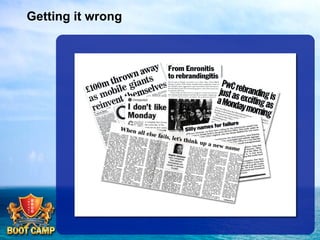
Getting it wrong
Brand
Genetics
in an age of Integration
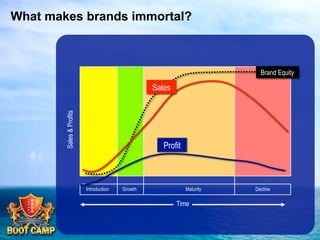
What makes brands immortal?

Brand Equity

Sales & Profits

Sales

Profit

Introduction

Growth

Maturity

Time

Decline
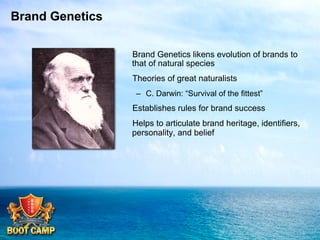
Brand Genetics
 Brand Genetics likens evolution of brands to
that of natural species
 Theories of great naturalists
–  C. Darwin: “Survival of the fittest”

 Establishes rules for brand success
 Helps to articulate brand heritage, identifiers,
personality, and belief
Survival of the fittest

“ ... the individual with, for example, the sharper beak, the
longer horn, or the brighter feather would have the best
chance of surviving and procreating its kind”
Charles Darwin
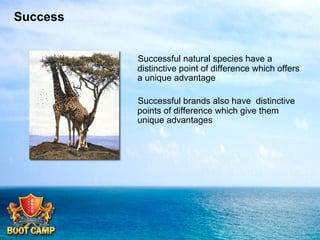
Success
 Successful natural species have a
distinctive point of difference which offers
a unique advantage
 Successful brands also have distinctive
points of difference which give them
unique advantages
Adaptation
“When a plant or animal is placed in a new country ... we
should have to modify it in a different way .. to give it some
advantages over a different set of competitors”
Charles Darwin
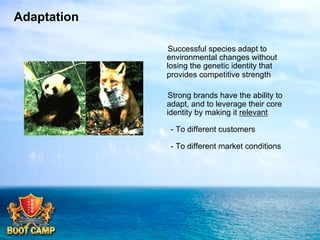
Adaptation
Successful species adapt to
environmental changes without
losing the genetic identity that
provides competitive strength
Strong brands have the ability to
adapt, and to leverage their core
identity by making it relevant
- To different customers
- To different market conditions
Dominance
“.... largeness of area is still more important, especially for
the production of species which shall prove capable of
enduring for a long period, and of spreading widely ....
.... there will be a better chance of favourable variations ....”
Charles Darwin
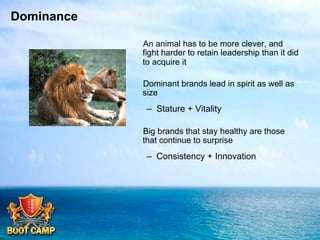
Dominance
 An animal has to be more clever, and
fight harder to retain leadership than it did
to acquire it
 Dominant brands lead in spirit as well as
size

–  Stature + Vitality
 Big brands that stay healthy are those
that continue to surprise

–  Consistency + Innovation
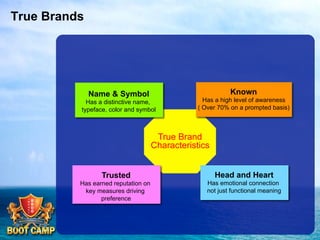
True Brands

Known

Name & Symbol
Has a distinctive name,
typeface, color and symbol

Has a high level of awareness
( Over 70% on a prompted basis)

True Brand
Characteristics
Trusted
Has earned reputation on
key measures driving
preference

Head and Heart
Has emotional connection
not just functional meaning
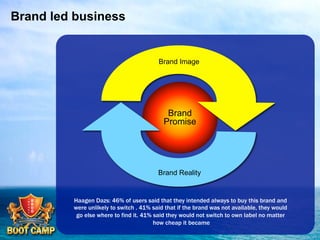
Brand led business

Brand Image

Brand
Promise

Brand Reality

Haagen Dazs: 46% of users said that they intended always to buy this brand and
were unlikely to switch . 41% said that if the brand was not available, they would
go else where to find it. 41% said they would not switch to own label no matter
how cheap it became
s
Business form
Publications

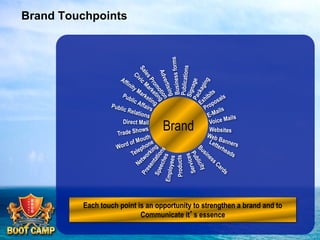
Brand Touchpoints

Brand

ails
Voice M
Websites
Web
Bann
ers

Employ
e

es
Products
ices
Serv

Publi
c Rel
ation
s
Direct Mail
ows
Trade Sh
outh
of M
Word

Each touch point is an opportunity to strengthen a brand and to
Communicate it’s essence
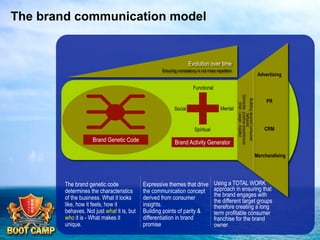
The brand communication model

Evolution over time
Ensuring consistency is not mere repetition

Advertising

Functional

Spiritual

Brand Genetic Code

Brand Activity Generator

Building desired consumer
behavior
Generate positive experiences
(trial - usage - loyalty)

Mental

Social

PR

CRM

Merchandising

The brand genetic code
determines the characteristics
of the business. What it looks
like, how it feels, how it
behaves. Not just what it is, but
who it is - What makes it
unique.

Expressive themes that drive
the communication concept
derived from consumer
insights.
Building points of parity &
differentiation in brand
promise

Using a TOTAL WORK
approach in ensuring that
the brand engages with
the different target groups
therefore creating a long
term profitable consumer
franchise for the brand
owner
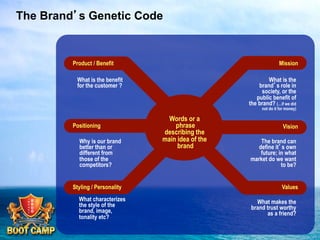
The Brand’s Genetic Code

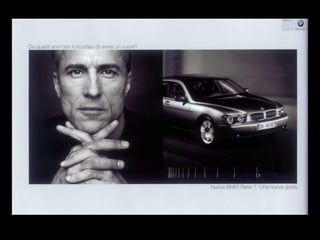
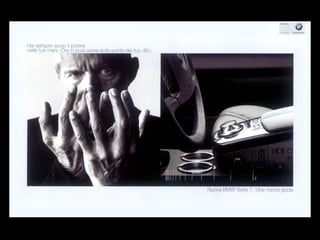
Product / Benefit

Mission

What is the benefit
for the customer ?

What is the
brand’s role in
society, or the
public benefit of
the brand? (…if we did
not do it for money)

Positioning
Why is our brand
better than or
different from
those of the
competitors?
Styling / Personality
What characterizes
the style of the
brand, image,
tonality etc?

Words or a
phrase
describing the
main idea of the
brand

Vision
The brand can
define it’s own
future; in what
market do we want
to be?
Values
What makes the
brand trust worthy
as a friend?
Product Benefits
 A carefully phrased description of the benefits of your
company, the product, service knowledge and so on
 This can be an easy task, but takes more work to get beyond
clichés
 Rational benefits
 Emotional benefits

This aspect of the code generally drives expression themes in the
functional dimension
Rational benefits
 Rational benefits are those benefits that speak through logical
reasoning to the consumer
 For a retail outlet these could:
–  The brand that offers the widest range of products available
–  The brand that offers the best value for money
–  The brand that caters for women (men / young children etc.)

 For FMCG brands
– 
– 
– 
– 

The biscuit brand that fills you up
The shampoo brand that makes your hair healthier
The toothpaste brand that makes your teeth whiter
The washing up liquid that kills germs

 For a service brand
–  We deliver in 24 hours worldwide
–  We offer a quiet ride
–  We have a large network
–  We have a fast access time
Rational benefits
 

These are all rational benefits that can be justified and are
easily accepted by consumers because of a reasoned
argument


However because they are rational they are easily matched
or copied by competitors


Rational benefits often provide the entry conditions to
interest a consumer, without which they will pass the brand
by


Once the brand has entered the consumer’s consideration
set with an implicit rational benefit, the choice between
brands will then be made based on the emotional benefit
that differentiates brands with identical rational benefits
Emotional benefits
 Emotional benefits speak to the humane, intuitive side of the
consumer
 They are expressed through ideas and images that are
irrational yet compelling and often aspirational and
inspirational in nature
 Examples of emotional brand benefits might be:
–  The washing powder for the caring mother
–  The face cream to make you beautiful
–  The sexiest clothing brand
–  The most exclusive car brand
Emotional benefits
 The emotional benefit is also often the theme that generates
the aura around a brand that makes it special and this can be
heavily leveraged to persuade consumers to buy
 Because this aura is unique it provides an excellent defense
mechanism against competitors who may be able to replicate
the rational benefits of the brand
Positioning
 This is your response to : Why are you better than and or
different than your competitors?
 The brand is the differentiation code for your company
 Usually this includes the competence of doing something very
well for a specific TA.
 You might also have competencies that are not necessarily
as yet communicated in the benefit you deliver to your
customers

This aspect of the code generally drives expression themes in the
functional dimension
Style / Personality
 This describe the personal traits, image, attitude and behavior
of the brand
 The personal appearance that immediately meets the eye
 

This aspect of the code generally drives expression themes in the
social dimension
Mission
 What would we do if we did not do it for money?
 For most companies recruiting young talent is a crucial part of
their brand code
 Young people in particular ask for a meaningful job, which is
equally or more important than compensation
 Companies that can not explain what contribution they make
to society may not be on the short list
 The mission is very useful in driving public relation activities

This aspect of the code generally drives expression themes in the
spiritual dimension
Vision
 Vision in the brand code is the positioning for the future - In
what market do we want to be?
 Quite often you have to create your own market
 A typical example of this is when Rollerblades created the
market for in-line skating
 This avoided the degeneration of its brand. (Think of what
happened to Xerox, Vespa and thermos)
 Really successful brands have clear vision on
–  The future market place
–  What will we offer
–  To whom & when
Values
 ‘Rules of life’
 Values emphasize the trust worthiness of the brand
 The long term personality that guarantees continuity, as
values do in personal friendship
 Though they are mainly non verbal. The key words must be
chosen with care
 In entrepreneurial business, the values of the founder are
usually set as corporate values
 This makes them more genuine than contrived corporate
strategy
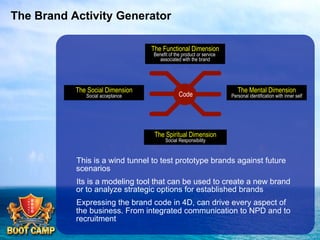
The Brand Activity Generator
The Functional Dimension
Benefit of the product or service
associated with the brand

The Social Dimension
Social acceptance

Code

The Mental Dimension

Personal identification with inner self

The Spiritual Dimension
Social Responsibility

 This is a wind tunnel to test prototype brands against future
scenarios
 Its is a modeling tool that can be used to create a new brand
or to analyze strategic options for established brands
 Expressing the brand code in 4D, can drive every aspect of
the business. From integrated communication to NPD and to
recruitment
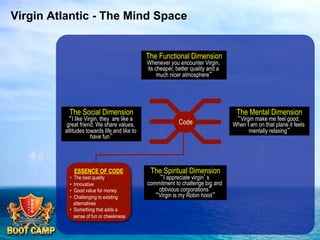
Virgin Atlantic - The Mind Space

The Functional Dimension
Whenever you encounter Virgin,
its cheaper, better quality and a
much nicer atmosphere”

The Social Dimension

“I like Virgin, they are like a
great friend. We share values,
attitudes towards life and like to
have fun”

• 
• 
• 
• 

ESSENCE OF CODE

The best quality
Innovative
Good value for money
Challenging to existing
alternatives
•  Something that adds a
sense of fun or cheekiness

The Mental Dimension

Code

The Spiritual Dimension

“I appreciate virgin’s
commitment to challenge big and
oblivious corporations”
“Virgin is my Robin hood”

“Virgin make me feel good.
When I am on that plane it feels
mentally relaxing”
Brand Belief: IKEA
 IKEA believes it is unjust that only the rich should be able to
afford well designed furniture.
 So, with a commitment to equality and innovation, IKEA
provides a wide range of good design home furnishings at
prices so low that the majority of people can afford them.
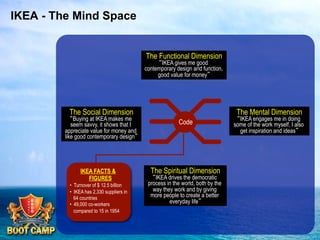
IKEA - The Mind Space

The Functional Dimension

“IKEA gives me good
contemporary design and function,
good value for money”

The Social Dimension

“Buying at IKEA makes me
seem savvy, it shows that I
appreciate value for money and
like good contemporary design”

IKEA FACTS &
FIGURES
•  Turnover of $ 12.5 billion
•  IKEA has 2,330 suppliers in
64 countries
•  49,000 co-workers
compared to 15 in 1954

The Mental Dimension

Code

The Spiritual Dimension

“IKEA drives the democratic
process in the world, both by the
way they work and by giving
more people to create a better
everyday life”

“IKEA engages me in doing
some of the work myself, I also
get inspiration and ideas”
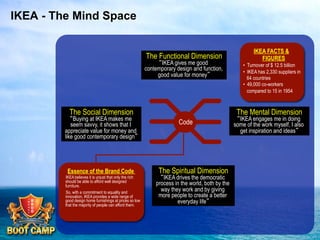
IKEA - The Mind Space

The Functional Dimension

“IKEA gives me good
contemporary design and function,
good value for money”

The Social Dimension

“Buying at IKEA makes me
seem savvy, it shows that I
appreciate value for money and
like good contemporary design”

Essence of the Brand Code
  IKEA believes it is unjust that only the rich
should be able to afford well designed
furniture.
  So, with a commitment to equality and
innovation, IKEA provides a wide range of
good design home furnishings at prices so low
that the majority of people can afford them.

IKEA FACTS &
FIGURES
•  Turnover of $ 12.5 billion
•  IKEA has 2,330 suppliers in
64 countries
•  49,000 co-workers
compared to 15 in 1954

The Mental Dimension

Code

The Spiritual Dimension

“IKEA drives the democratic
process in the world, both by the
way they work and by giving
more people to create a better
everyday life”

“IKEA engages me in doing
some of the work myself, I also
get inspiration and ideas”
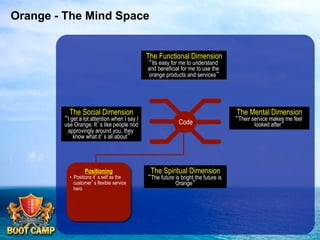
Orange - The Mind Space

The Functional Dimension
“Its easy for me to understand
and beneficial for me to use the
orange products and services”

The Social Dimension

“I get a lot attention when I say I
use Orange. It’s like people nod
approvingly around you, they
know what it’s all about”

Positioning

•  Positions it’s self as the
customer’s flexible service
hero

The Mental Dimension

Code

The Spiritual Dimension

“The future is bright the future is
Orange”

“Their service makes me feel
looked after”
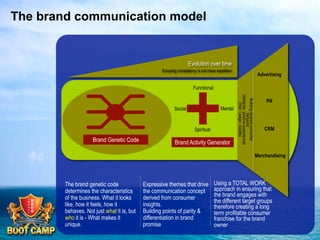
The brand communication model

Evolution over time
Ensuring consistency is not mere repetition

Advertising

Functional

Spiritual

Brand Genetic Code

Brand Activity Generator

Building desired consumer
behavior
Generate positive experiences
(trial - usage - loyalty)

Mental

Social

PR

CRM

Merchandising

The brand genetic code
determines the characteristics
of the business. What it looks
like, how it feels, how it
behaves. Not just what it is, but
who it is - What makes it
unique.

Expressive themes that drive
the communication concept
derived from consumer
insights.
Building points of parity &
differentiation in brand
promise

Using a TOTAL WORK
approach in ensuring that
the brand engages with
the different target groups
therefore creating a long
term profitable consumer
franchise for the brand
owner

Brand Genetics

  • 1.
  • 2.
    What is abrand? A brand is a set of differentiating promises that link a product to its customers. The brand assures the customer of consistent quality plus a superior value (both functional and emotional) for which the customer is willing to give loyalty and pay a price that brings a reasonable return to the brand
  • 3.
    The world’s 10most valuable brands Brand Value 2003 % Market Cap parent company $70.5 bn 61% $65.2 bn 23% $51.8 bn 36% $42.3 bn 14% $31.1 bn 22% $29.4bn 35% $28.0 bn 65% $24.7 bn 88% $22.2 bn 25% $21.4 bn 61% Source: Business Week, Interbrand league table, 2003
  • 4.
    Strong brands createshareholder value…  Branded companies experienced lower volatility and generated average monthly returns of 2.07% while the market averaged 1.34%
  • 5.
    In an oversuppliedmarket, attention is the scarcest commodity There are 50 types of shampoos in Carrefour Growth in Pan Arab media channels. News, Movies, Music (120 channels added in the last 5 years) 40% of our newspapers is advertising The average Pan Arab is exposed to 2000 commercial messages a day There are 2-3 new consumer promotions a day in our markets (25% Int. norm) Human bandwidth is the problem - It’s finite Davenport & Beck The rise of the attention economy
  • 6.
    Cutting through thebrand ‘noise’
  • 7.
    Brand as imagewrapper?  Many companies expect a new name, a fancy logo and a flashy advertising campaign by themselves attract new customers Brand Image Wrapper Product An outside - in Approach in Branding  The image wrapper approach focuses on the exterior look and feel rather than the tonality of the product or service  There is no shortage of design and advertising agencies that work with these companies and create a BRAND MIRAGE with no substance or credibility behind it  A lot of dotcoms soon became dot.bombs realizing that building brand reputation is much harder than buying brand awareness
  • 8.
  • 9.
  • 10.
    What makes brandsimmortal? Brand Equity Sales & Profits Sales Profit Introduction Growth Maturity Time Decline
  • 11.
    Brand Genetics  Brand Geneticslikens evolution of brands to that of natural species  Theories of great naturalists –  C. Darwin: “Survival of the fittest”  Establishes rules for brand success  Helps to articulate brand heritage, identifiers, personality, and belief
  • 12.
    Survival of thefittest “ ... the individual with, for example, the sharper beak, the longer horn, or the brighter feather would have the best chance of surviving and procreating its kind” Charles Darwin
  • 13.
    Success  Successful natural specieshave a distinctive point of difference which offers a unique advantage  Successful brands also have distinctive points of difference which give them unique advantages
  • 14.
    Adaptation “When a plantor animal is placed in a new country ... we should have to modify it in a different way .. to give it some advantages over a different set of competitors” Charles Darwin
  • 15.
    Adaptation Successful species adaptto environmental changes without losing the genetic identity that provides competitive strength Strong brands have the ability to adapt, and to leverage their core identity by making it relevant - To different customers - To different market conditions
  • 16.
    Dominance “.... largeness ofarea is still more important, especially for the production of species which shall prove capable of enduring for a long period, and of spreading widely .... .... there will be a better chance of favourable variations ....” Charles Darwin
  • 17.
    Dominance  An animal hasto be more clever, and fight harder to retain leadership than it did to acquire it  Dominant brands lead in spirit as well as size –  Stature + Vitality  Big brands that stay healthy are those that continue to surprise –  Consistency + Innovation
  • 18.
    True Brands Known Name &Symbol Has a distinctive name, typeface, color and symbol Has a high level of awareness ( Over 70% on a prompted basis) True Brand Characteristics Trusted Has earned reputation on key measures driving preference Head and Heart Has emotional connection not just functional meaning
  • 19.
    Brand led business BrandImage Brand Promise Brand Reality Haagen Dazs: 46% of users said that they intended always to buy this brand and were unlikely to switch . 41% said that if the brand was not available, they would go else where to find it. 41% said they would not switch to own label no matter how cheap it became
  • 20.
    s Business form Publications Brand Touchpoints Brand ails VoiceM Websites Web Bann ers Employ e es Products ices Serv Publi c Rel ation s Direct Mail ows Trade Sh outh of M Word Each touch point is an opportunity to strengthen a brand and to Communicate it’s essence
  • 21.
    The brand communicationmodel Evolution over time Ensuring consistency is not mere repetition Advertising Functional Spiritual Brand Genetic Code Brand Activity Generator Building desired consumer behavior Generate positive experiences (trial - usage - loyalty) Mental Social PR CRM Merchandising The brand genetic code determines the characteristics of the business. What it looks like, how it feels, how it behaves. Not just what it is, but who it is - What makes it unique. Expressive themes that drive the communication concept derived from consumer insights. Building points of parity & differentiation in brand promise Using a TOTAL WORK approach in ensuring that the brand engages with the different target groups therefore creating a long term profitable consumer franchise for the brand owner
  • 22.
    The Brand’s GeneticCode Product / Benefit Mission What is the benefit for the customer ? What is the brand’s role in society, or the public benefit of the brand? (…if we did not do it for money) Positioning Why is our brand better than or different from those of the competitors? Styling / Personality What characterizes the style of the brand, image, tonality etc? Words or a phrase describing the main idea of the brand Vision The brand can define it’s own future; in what market do we want to be? Values What makes the brand trust worthy as a friend?
  • 23.
    Product Benefits  A carefullyphrased description of the benefits of your company, the product, service knowledge and so on  This can be an easy task, but takes more work to get beyond clichés  Rational benefits  Emotional benefits This aspect of the code generally drives expression themes in the functional dimension
  • 24.
    Rational benefits  Rational benefitsare those benefits that speak through logical reasoning to the consumer  For a retail outlet these could: –  The brand that offers the widest range of products available –  The brand that offers the best value for money –  The brand that caters for women (men / young children etc.)  For FMCG brands –  –  –  –  The biscuit brand that fills you up The shampoo brand that makes your hair healthier The toothpaste brand that makes your teeth whiter The washing up liquid that kills germs  For a service brand –  We deliver in 24 hours worldwide –  We offer a quiet ride –  We have a large network –  We have a fast access time
  • 25.
    Rational benefits   These areall rational benefits that can be justified and are easily accepted by consumers because of a reasoned argument   However because they are rational they are easily matched or copied by competitors   Rational benefits often provide the entry conditions to interest a consumer, without which they will pass the brand by   Once the brand has entered the consumer’s consideration set with an implicit rational benefit, the choice between brands will then be made based on the emotional benefit that differentiates brands with identical rational benefits
  • 31.
    Emotional benefits  Emotional benefitsspeak to the humane, intuitive side of the consumer  They are expressed through ideas and images that are irrational yet compelling and often aspirational and inspirational in nature  Examples of emotional brand benefits might be: –  The washing powder for the caring mother –  The face cream to make you beautiful –  The sexiest clothing brand –  The most exclusive car brand
  • 32.
    Emotional benefits  The emotionalbenefit is also often the theme that generates the aura around a brand that makes it special and this can be heavily leveraged to persuade consumers to buy  Because this aura is unique it provides an excellent defense mechanism against competitors who may be able to replicate the rational benefits of the brand
  • 38.
    Positioning  This is yourresponse to : Why are you better than and or different than your competitors?  The brand is the differentiation code for your company  Usually this includes the competence of doing something very well for a specific TA.  You might also have competencies that are not necessarily as yet communicated in the benefit you deliver to your customers This aspect of the code generally drives expression themes in the functional dimension
  • 40.
    Style / Personality  Thisdescribe the personal traits, image, attitude and behavior of the brand  The personal appearance that immediately meets the eye   This aspect of the code generally drives expression themes in the social dimension
  • 44.
    Mission  What would wedo if we did not do it for money?  For most companies recruiting young talent is a crucial part of their brand code  Young people in particular ask for a meaningful job, which is equally or more important than compensation  Companies that can not explain what contribution they make to society may not be on the short list  The mission is very useful in driving public relation activities This aspect of the code generally drives expression themes in the spiritual dimension
  • 45.
    Vision  Vision in thebrand code is the positioning for the future - In what market do we want to be?  Quite often you have to create your own market  A typical example of this is when Rollerblades created the market for in-line skating  This avoided the degeneration of its brand. (Think of what happened to Xerox, Vespa and thermos)  Really successful brands have clear vision on –  The future market place –  What will we offer –  To whom & when
  • 46.
    Values  ‘Rules of life’  Valuesemphasize the trust worthiness of the brand  The long term personality that guarantees continuity, as values do in personal friendship  Though they are mainly non verbal. The key words must be chosen with care  In entrepreneurial business, the values of the founder are usually set as corporate values  This makes them more genuine than contrived corporate strategy
  • 47.
    The Brand ActivityGenerator The Functional Dimension Benefit of the product or service associated with the brand The Social Dimension Social acceptance Code The Mental Dimension Personal identification with inner self The Spiritual Dimension Social Responsibility  This is a wind tunnel to test prototype brands against future scenarios  Its is a modeling tool that can be used to create a new brand or to analyze strategic options for established brands  Expressing the brand code in 4D, can drive every aspect of the business. From integrated communication to NPD and to recruitment
  • 48.
    Virgin Atlantic -The Mind Space The Functional Dimension Whenever you encounter Virgin, its cheaper, better quality and a much nicer atmosphere” The Social Dimension “I like Virgin, they are like a great friend. We share values, attitudes towards life and like to have fun” •  •  •  •  ESSENCE OF CODE The best quality Innovative Good value for money Challenging to existing alternatives •  Something that adds a sense of fun or cheekiness The Mental Dimension Code The Spiritual Dimension “I appreciate virgin’s commitment to challenge big and oblivious corporations” “Virgin is my Robin hood” “Virgin make me feel good. When I am on that plane it feels mentally relaxing”
  • 51.
    Brand Belief: IKEA  IKEAbelieves it is unjust that only the rich should be able to afford well designed furniture.  So, with a commitment to equality and innovation, IKEA provides a wide range of good design home furnishings at prices so low that the majority of people can afford them.
  • 52.
    IKEA - TheMind Space The Functional Dimension “IKEA gives me good contemporary design and function, good value for money” The Social Dimension “Buying at IKEA makes me seem savvy, it shows that I appreciate value for money and like good contemporary design” IKEA FACTS & FIGURES •  Turnover of $ 12.5 billion •  IKEA has 2,330 suppliers in 64 countries •  49,000 co-workers compared to 15 in 1954 The Mental Dimension Code The Spiritual Dimension “IKEA drives the democratic process in the world, both by the way they work and by giving more people to create a better everyday life” “IKEA engages me in doing some of the work myself, I also get inspiration and ideas”
  • 53.
    IKEA - TheMind Space The Functional Dimension “IKEA gives me good contemporary design and function, good value for money” The Social Dimension “Buying at IKEA makes me seem savvy, it shows that I appreciate value for money and like good contemporary design” Essence of the Brand Code   IKEA believes it is unjust that only the rich should be able to afford well designed furniture.   So, with a commitment to equality and innovation, IKEA provides a wide range of good design home furnishings at prices so low that the majority of people can afford them. IKEA FACTS & FIGURES •  Turnover of $ 12.5 billion •  IKEA has 2,330 suppliers in 64 countries •  49,000 co-workers compared to 15 in 1954 The Mental Dimension Code The Spiritual Dimension “IKEA drives the democratic process in the world, both by the way they work and by giving more people to create a better everyday life” “IKEA engages me in doing some of the work myself, I also get inspiration and ideas”
  • 56.
    Orange - TheMind Space The Functional Dimension “Its easy for me to understand and beneficial for me to use the orange products and services” The Social Dimension “I get a lot attention when I say I use Orange. It’s like people nod approvingly around you, they know what it’s all about” Positioning •  Positions it’s self as the customer’s flexible service hero The Mental Dimension Code The Spiritual Dimension “The future is bright the future is Orange” “Their service makes me feel looked after”
  • 59.
    The brand communicationmodel Evolution over time Ensuring consistency is not mere repetition Advertising Functional Spiritual Brand Genetic Code Brand Activity Generator Building desired consumer behavior Generate positive experiences (trial - usage - loyalty) Mental Social PR CRM Merchandising The brand genetic code determines the characteristics of the business. What it looks like, how it feels, how it behaves. Not just what it is, but who it is - What makes it unique. Expressive themes that drive the communication concept derived from consumer insights. Building points of parity & differentiation in brand promise Using a TOTAL WORK approach in ensuring that the brand engages with the different target groups therefore creating a long term profitable consumer franchise for the brand owner