BRANDING
&
IDENTITY
Anil Kumar ,
Lecturer (Textile Design)
Pandit Lakhmichand State University of
Performing & Visual Arts , Rohtak
E-mail-anilkumar@plcsupva.ac.in
Mobile no. +919729138649
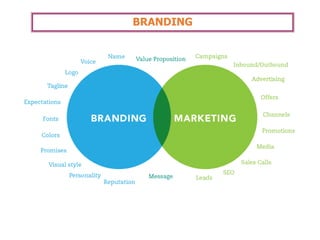
BRANDING
BRANDING
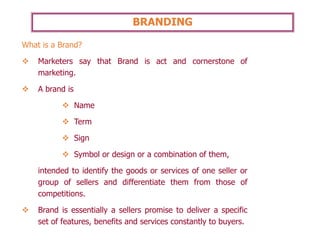
What is a Brand?
❖ Marketers say that Brand is act and cornerstone of
marketing.
❖ A brand is
❖ Name
❖ Term
❖ Sign
❖ Symbol or design or a combination of them,
intended to identify the goods or services of one seller or
group of sellers and differentiate them from those of
competitions.
❖ Brand is essentially a sellers promise to deliver a specific
set of features, benefits and services constantly to buyers.
BRANDING
What is a Brand?
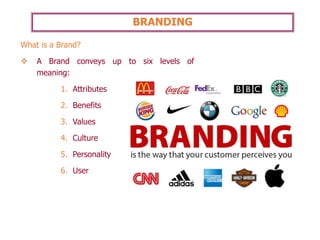
❖ A Brand conveys up to six levels of
meaning:
1. Attributes
2. Benefits
3. Values
4. Culture
5. Personality
6. User
BRANDING
Attributes:
❖ A brand brings to mind certain attributes. E.g.: Mercedes
suggests expensive, well built, well engineered, durable, high
prestige automobile.
Benefits:
❖ Attributes translated into functional and emotional benefits.
E.g.: Durable could translate into the functional benefit i.e. I
wont have to buy another car for several years. Expensive
translates into the emotional benefit i.e. the car makes me feel
important and admired.
Values:
❖ The brand also says something about the producer’s values. i.e.
Mercedes stands for high performance, safety and prestige.
BRANDING
Culture:
❖ The brand may represent certain culture.eg Mercedes
represents German culture organized, efficient high quality.
Personality:
❖ A brand can project certain personality.Mercedes may suggest a
no nonsense boss (person) or an
User:
❖ The brand suggests the kind of consumer who buys or uses the
product. We would expect to see a 55 year old top executive
behind the wheel of a Mercedes, not a 20 year old secretary.
❖ The Branding challenge is to develop a deep set of the associations
for the brand.
❖ Some of examples are Sony, Toyota, Goldstar, Samsung, Levis,
Maruti, Raymonds, Colorplus etc.
BRANDING
Brand Equity:
❖ Brand vary in the amount of power & value in the market place. E.g.
at one extreme brands are not known by most buyers.
❖ There are brands for which buyers have a fairly high degree of brand
awareness.
❖ There are brands with high degree of brand acceptability.
❖ There are brands that enjoy a high degree of brand loyalty.
❖ 5 levels of customer attitude towards his or her brand, from lowest
to the highest
1. Customer will change brands, especially for price reason.
2. Customer is satisfied. No reason to change
3. Customer is satisfied and would incur costs by changing brand
4. Customer values the brand and sees it as a friend.
5. Customer is devoted to the brand.
BRANDING
Brand Equity:
❖ Brand equity is highly related to how many customers are in classes
3, 4, or 5.
❖ It is also related to the degree of brand name recognition, perceived
brand quality, strong mental and emotional associations and other
assets such as trademarks.
❖ The world’s 8 must valuable brands in 1997 were in rank order
1. Coca Cola
2. Marlboro
3. IBM
4. Mc DONALDS
5. Disney
6. Sony
7. Kodak
8. Gillette
BRANDING
Brand Identity:
❖ Building the brand identity requires additional decisions on the
brand’s
❖ Name
❖ Logo
❖ Colors
❖ Tagline and
❖ Symbol
❖ Brand is much more than what is mentioned above and is essentially
company’s promise to deliver specific set of features, benefits and
services consistently to their buyers.
❖ Brand Bonding occurs when customers experience the company as
delivering on its benefit promise.
Brands are not built by advertising but by brand experience.
BRANDING
Brand Repositioning:
❖ Despite of a good brand positioning, the company may have to
reposition it later when facing new competitions or changing
customer preferences. E.g.
❖ 7 up was one several soft drinks preferred by older generation
for its lemon flavor. Research indicated that, though majority of
the soft drink consumers preferred cola, they did not prefer it
all the time and also many are non cola drinkers.
❖ 7 up went for leadership in non cola segment by calling itself
UN COLA. The campaign featured the UN COLA as youthful and
refreshing drink, whereby 7 up established itself as an
alternative to colas.

Branding & Identity

  • 1.
    BRANDING & IDENTITY Anil Kumar , Lecturer(Textile Design) Pandit Lakhmichand State University of Performing & Visual Arts , Rohtak E-mail-anilkumar@plcsupva.ac.in Mobile no. +919729138649
  • 2.
  • 3.
    BRANDING What is aBrand? ❖ Marketers say that Brand is act and cornerstone of marketing. ❖ A brand is ❖ Name ❖ Term ❖ Sign ❖ Symbol or design or a combination of them, intended to identify the goods or services of one seller or group of sellers and differentiate them from those of competitions. ❖ Brand is essentially a sellers promise to deliver a specific set of features, benefits and services constantly to buyers.
  • 4.
    BRANDING What is aBrand? ❖ A Brand conveys up to six levels of meaning: 1. Attributes 2. Benefits 3. Values 4. Culture 5. Personality 6. User
  • 5.
    BRANDING Attributes: ❖ A brandbrings to mind certain attributes. E.g.: Mercedes suggests expensive, well built, well engineered, durable, high prestige automobile. Benefits: ❖ Attributes translated into functional and emotional benefits. E.g.: Durable could translate into the functional benefit i.e. I wont have to buy another car for several years. Expensive translates into the emotional benefit i.e. the car makes me feel important and admired. Values: ❖ The brand also says something about the producer’s values. i.e. Mercedes stands for high performance, safety and prestige.
  • 6.
    BRANDING Culture: ❖ The brandmay represent certain culture.eg Mercedes represents German culture organized, efficient high quality. Personality: ❖ A brand can project certain personality.Mercedes may suggest a no nonsense boss (person) or an User: ❖ The brand suggests the kind of consumer who buys or uses the product. We would expect to see a 55 year old top executive behind the wheel of a Mercedes, not a 20 year old secretary. ❖ The Branding challenge is to develop a deep set of the associations for the brand. ❖ Some of examples are Sony, Toyota, Goldstar, Samsung, Levis, Maruti, Raymonds, Colorplus etc.
  • 7.
    BRANDING Brand Equity: ❖ Brandvary in the amount of power & value in the market place. E.g. at one extreme brands are not known by most buyers. ❖ There are brands for which buyers have a fairly high degree of brand awareness. ❖ There are brands with high degree of brand acceptability. ❖ There are brands that enjoy a high degree of brand loyalty. ❖ 5 levels of customer attitude towards his or her brand, from lowest to the highest 1. Customer will change brands, especially for price reason. 2. Customer is satisfied. No reason to change 3. Customer is satisfied and would incur costs by changing brand 4. Customer values the brand and sees it as a friend. 5. Customer is devoted to the brand.
  • 8.
    BRANDING Brand Equity: ❖ Brandequity is highly related to how many customers are in classes 3, 4, or 5. ❖ It is also related to the degree of brand name recognition, perceived brand quality, strong mental and emotional associations and other assets such as trademarks. ❖ The world’s 8 must valuable brands in 1997 were in rank order 1. Coca Cola 2. Marlboro 3. IBM 4. Mc DONALDS 5. Disney 6. Sony 7. Kodak 8. Gillette
  • 9.
    BRANDING Brand Identity: ❖ Buildingthe brand identity requires additional decisions on the brand’s ❖ Name ❖ Logo ❖ Colors ❖ Tagline and ❖ Symbol ❖ Brand is much more than what is mentioned above and is essentially company’s promise to deliver specific set of features, benefits and services consistently to their buyers. ❖ Brand Bonding occurs when customers experience the company as delivering on its benefit promise. Brands are not built by advertising but by brand experience.
  • 10.
    BRANDING Brand Repositioning: ❖ Despiteof a good brand positioning, the company may have to reposition it later when facing new competitions or changing customer preferences. E.g. ❖ 7 up was one several soft drinks preferred by older generation for its lemon flavor. Research indicated that, though majority of the soft drink consumers preferred cola, they did not prefer it all the time and also many are non cola drinkers. ❖ 7 up went for leadership in non cola segment by calling itself UN COLA. The campaign featured the UN COLA as youthful and refreshing drink, whereby 7 up established itself as an alternative to colas.