Presented by
SHUBHAM PAUL
M.PHARM(PHARMACEUTICS)
2nd Semester
NSHM KNOWLEDGE CAMPUS,
KOLKATA
GROUP OF INSTITUTIONS
GUIDED BY:- Prof. Tapas Kumar Pal
Brand Name Drugs
These drugs are also called as Innovator Drugs invented
by Pharmaceutical companies to prevent them from being
copied or reverse engineered by other companies.
Generic Drug
A generic drug is defined as “A drug product that is
comparable to brand/innovator drug in dosage
from, strength, route of administration, quality and
performance characteristics and intended use”. It
should contain the same active ingredients as the original
formulation.
According to the FDA, generic drugs are
identical or within an acceptable bioequivalent range to
the brand-name counterpart with respect to
pharmacokinetics and pharmacodynamic properties.
Some Example of Generic and
Branded Drug with their Price
Category Generic Drug Price
Branded
Drug
Price
Analgesic Paracetamol Rs 2.45 Crocin Rs 11
Diclofenacsodium
+Paracetamol
Rs 4.4 Diclogesic Rs 19.40
Antibiotic Amoxyclin Rs 13.2 LMX Rs 40
Remox Rs 38.7
Azithromycin Rs 41.8 Azee Rs 107
Azithral Rs 128.55
Vitamin Folic acid Rs 2.8 Folivite Rs 11.8
B-Complex Rs 1.8 Becosul Rs 11.0
Cardiovascular(Blood
Pressure) Drug
Atenolol Rs 7.0 Aten Rs 23.8
Modern Trends for Shifting Pharmaceutical
Market from Branded Drug to Generic Drug
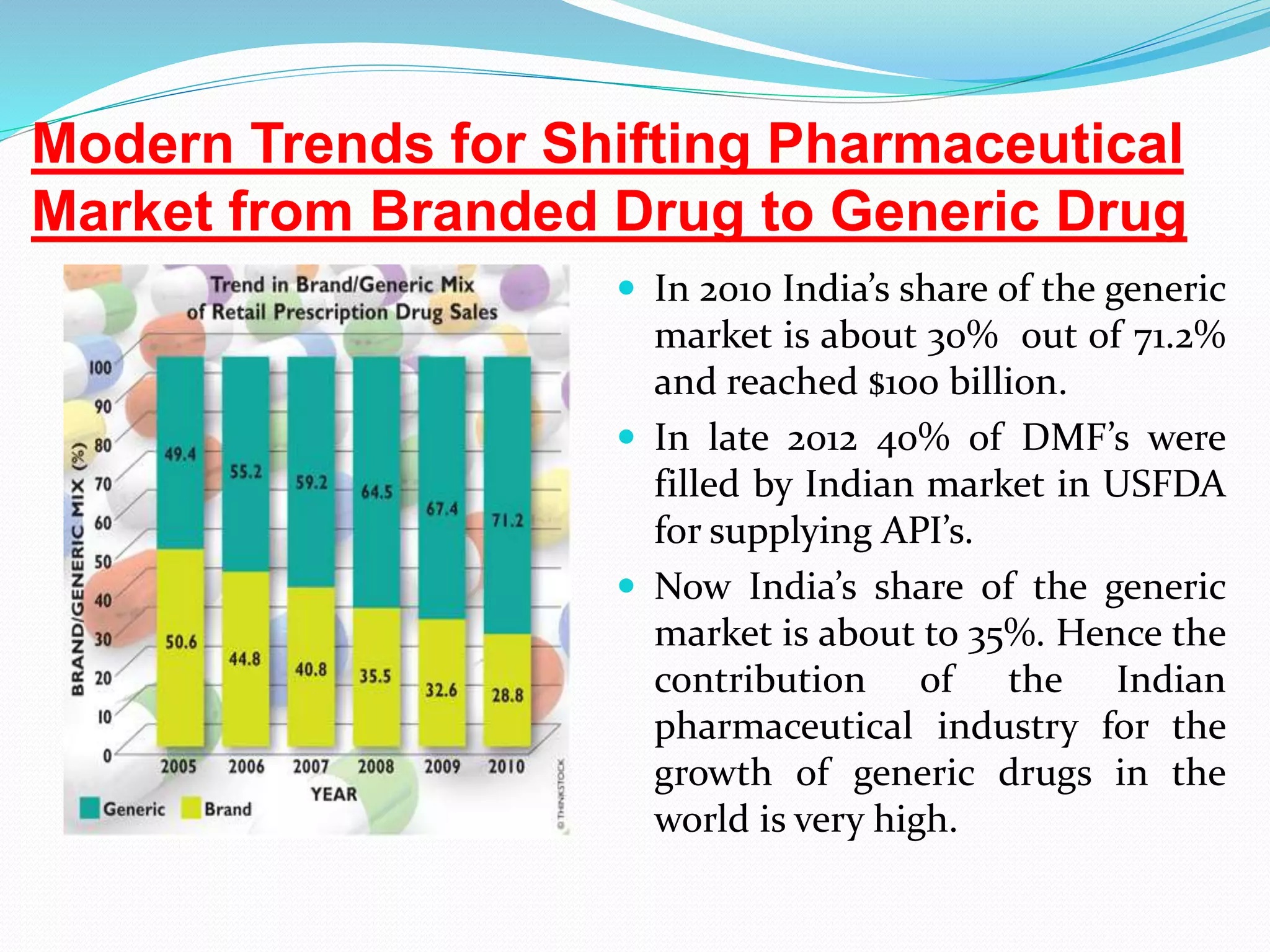
 In 2010 India’s share of the generic
market is about 30% out of 71.2%
and reached $100 billion.
 In late 2012 40% of DMF’s were
filled by Indian market in USFDA
for supplying API’s.
 Now India’s share of the generic
market is about to 35%. Hence the
contribution of the Indian
pharmaceutical industry for the
growth of generic drugs in the
world is very high.
Comparison between Generic and Brand
Name Drugs
Similarities Dissimilarities
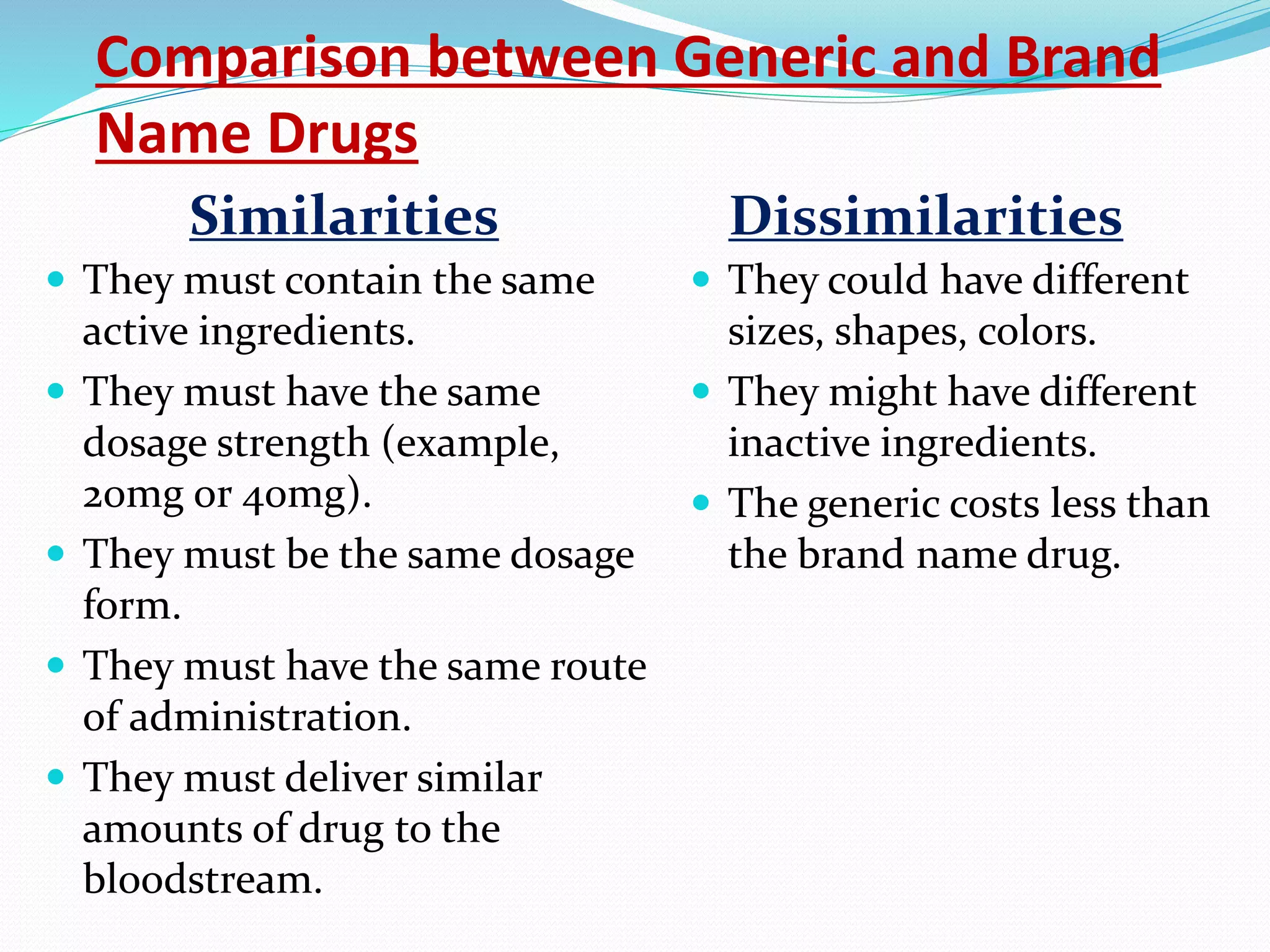
 They must contain the same
active ingredients.
 They must have the same
dosage strength (example,
20mg or 40mg).
 They must be the same dosage
form.
 They must have the same route
of administration.
 They must deliver similar
amounts of drug to the
bloodstream.
 They could have different
sizes, shapes, colors.
 They might have different
inactive ingredients.
 The generic costs less than
the brand name drug.
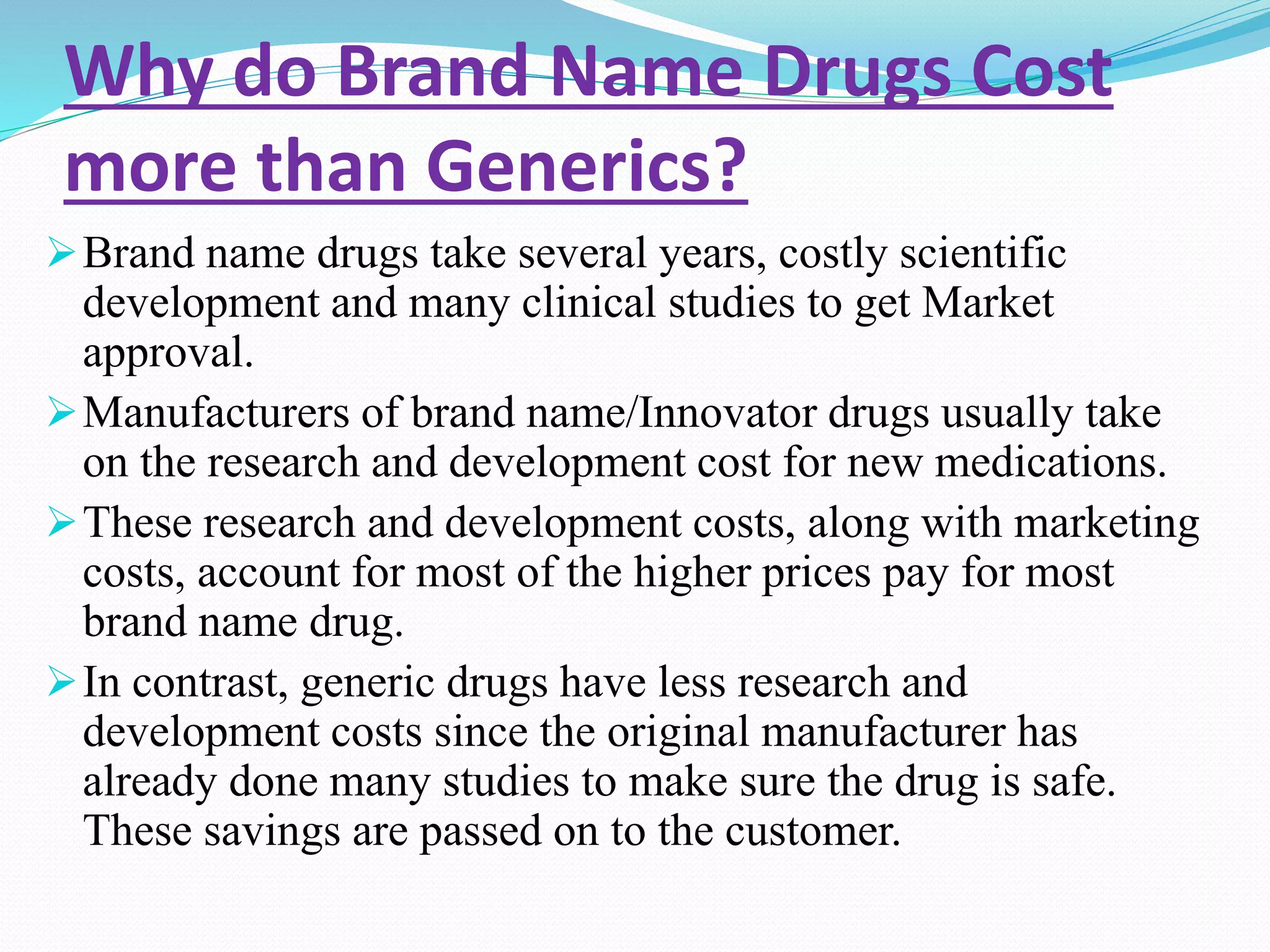
Why do Brand Name Drugs Cost
more than Generics?
Brand name drugs take several years, costly scientific
development and many clinical studies to get Market
approval.
Manufacturers of brand name/Innovator drugs usually take
on the research and development cost for new medications.
These research and development costs, along with marketing
costs, account for most of the higher prices pay for most
brand name drug.
In contrast, generic drugs have less research and
development costs since the original manufacturer has
already done many studies to make sure the drug is safe.
These savings are passed on to the customer.
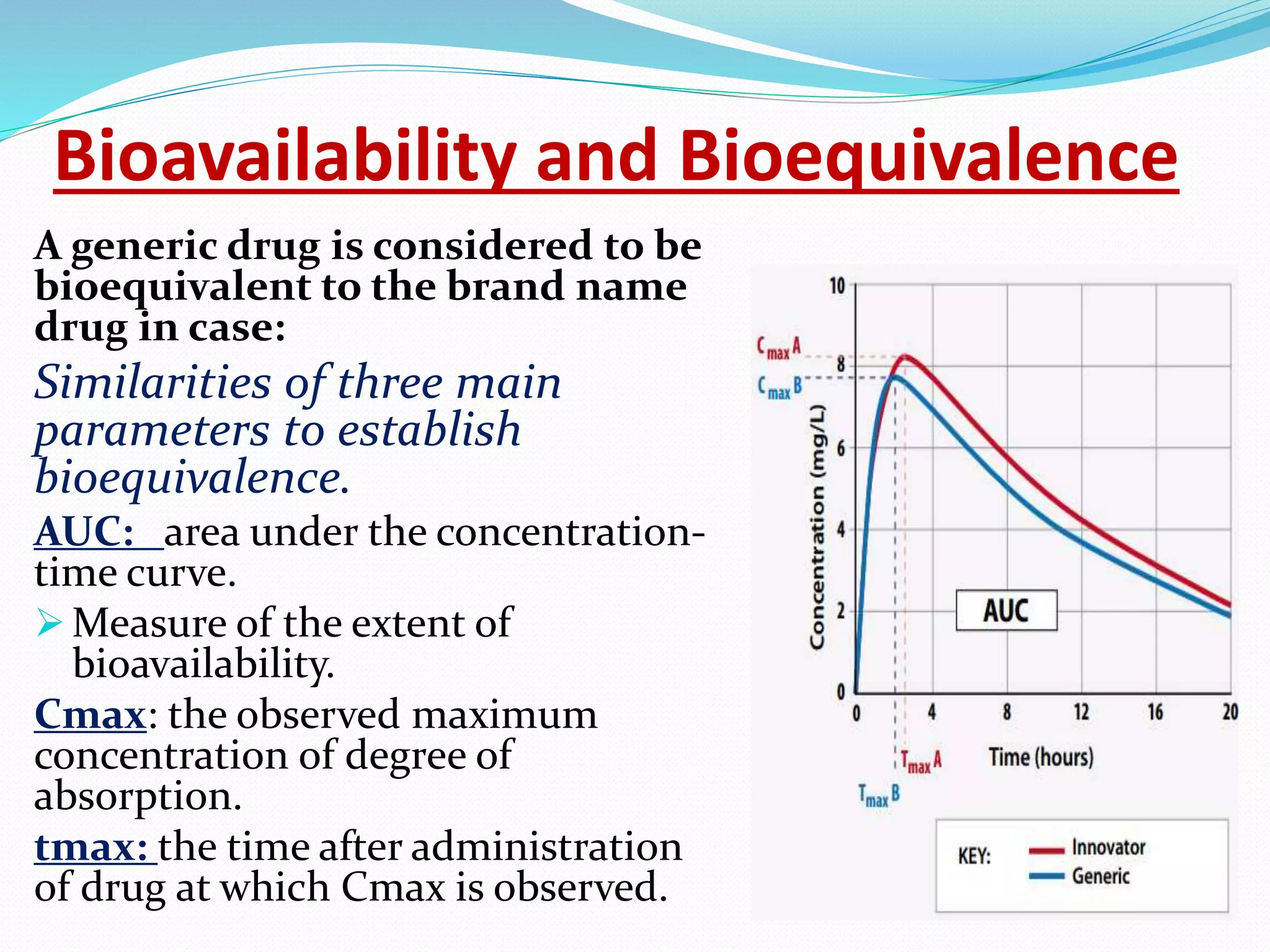
Bioavailability and Bioequivalence
A generic drug is considered to be
bioequivalent to the brand name
drug in case:
Similarities of three main
parameters to establish
bioequivalence.
AUC: area under the concentration-
time curve.
 Measure of the extent of
bioavailability.
Cmax: the observed maximum
concentration of degree of
absorption.
tmax: the time after administration
of drug at which Cmax is observed.
Contd……
AUC Ratio:
The 90% confidence interval for this measure of relative
bioavailability should be within a bioequivalence range
of 80-125%.
Cmax ratio:
For maximal concentration data, the acceptance limit of
80-125% should be applied to the 90% confidence
interval for the mean Cmax ratio.
tmax difference:
Statistical evaluation of tmax makes sense only if there is
a clinically relevant claim for rigid onset of action or
concerns about adverse effects.
ANDA
• An Abbreviated New Drug Application (ANDA)
contains data which when submitted to FDA's Centre for
Drug Evaluation and Research, Office of Generic Drugs,
provides for the review and ultimate approval of a generic
drug product.
• Generic applicants must scientifically demonstrate that
their product is bioequivalent to the Innovator drug.
• Scientists demonstrate bioequivalence is to measure the
time it takes the generic drug to reach the bloodstream in
24 to 36 healthy volunteers. This gives them the rate of
absorption, or bioavailability, of the generic drug, which
they can then compare to that of the innovator drug.
• The generic version must deliver the same amount of
active ingredients into a patient's bloodstream in the same
amount of time as the innovator drug.
Similar FDA Requirements for Brand-
Name and Generic Drugs
FDA Requirements Brand
Drug
Generic
Drug
For reformulations of a brand-name drug or generic
versions of a drug, FDA reviews data showing the
drug is bioequivalent to the one used in the original
safety and efficacy testing.
√ √
FDA evaluates the manufacturer's adherence to good
manufacturing practices before the drug is marketed.
√ √
FDA reviews the active and inactive ingredients used
in the formulation before the drug is marketed.
√ √
FDA reviews the actual drug product. √ √
FDA reviews the drug's labeling. √ √
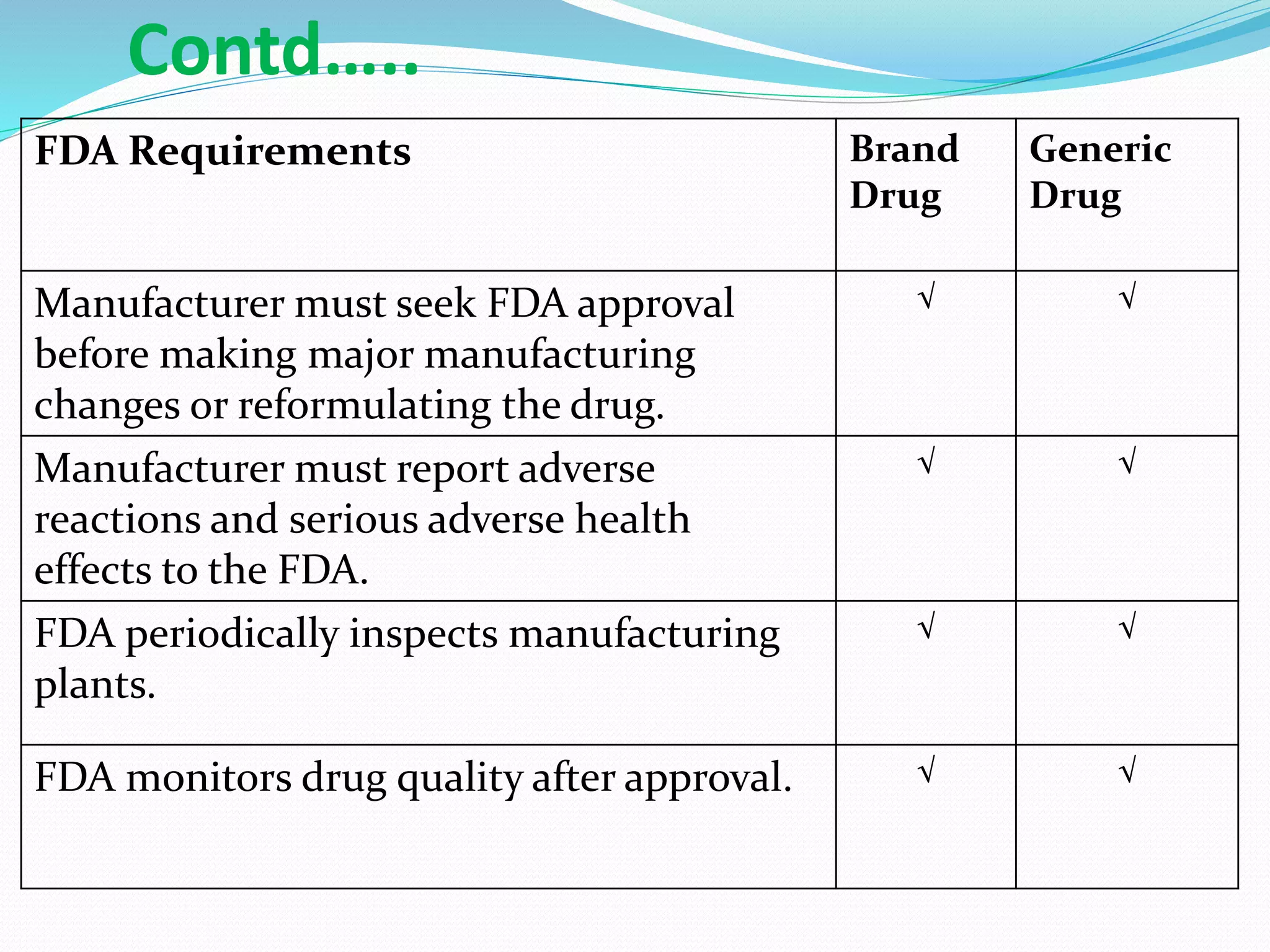
Contd…..
FDA Requirements Brand
Drug
Generic
Drug
Manufacturer must seek FDA approval
before making major manufacturing
changes or reformulating the drug.
√ √
Manufacturer must report adverse
reactions and serious adverse health
effects to the FDA.
√ √
FDA periodically inspects manufacturing
plants.
√ √
FDA monitors drug quality after approval. √ √
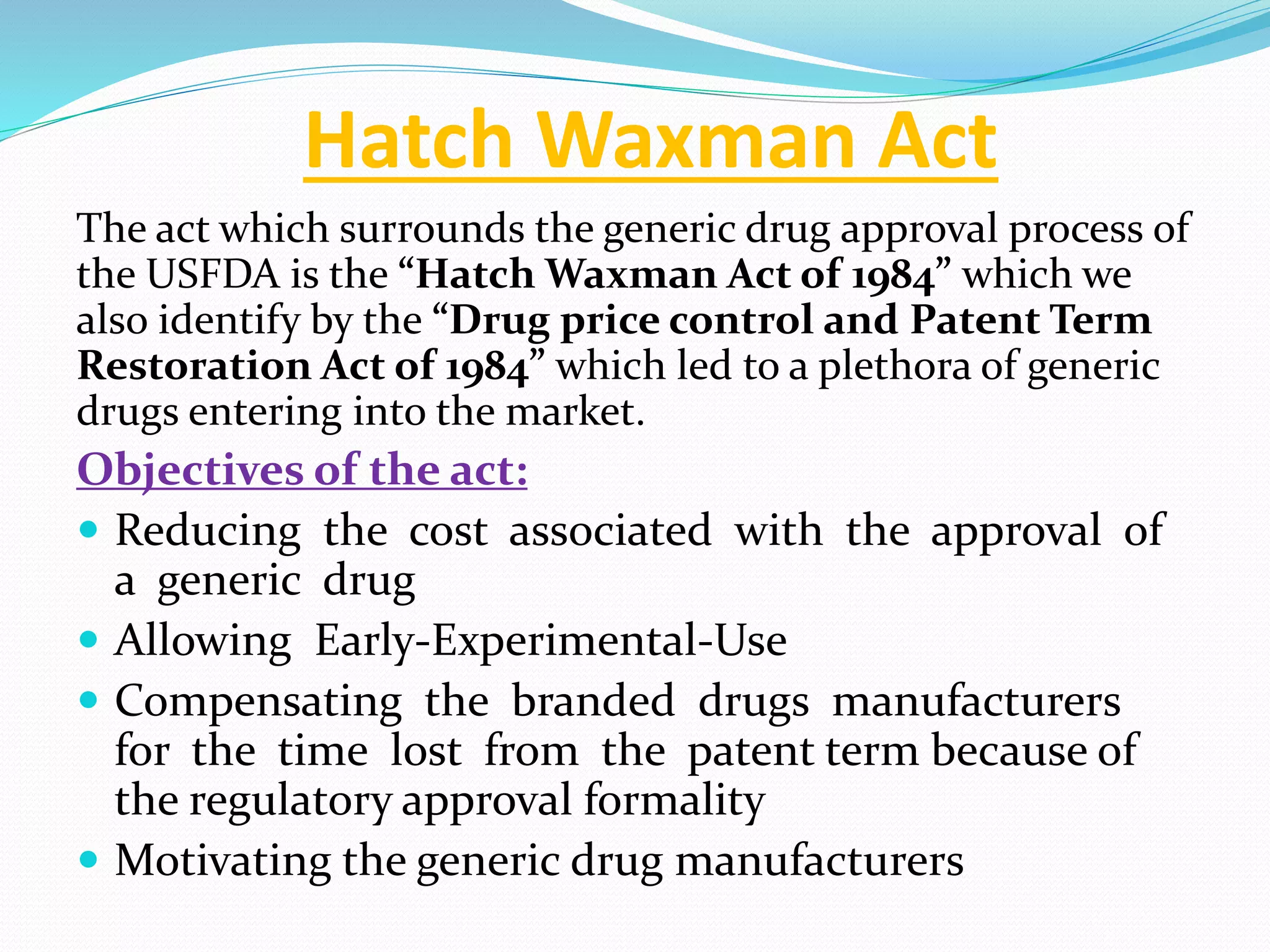
Hatch Waxman Act
The act which surrounds the generic drug approval process of
the USFDA is the “Hatch Waxman Act of 1984” which we
also identify by the “Drug price control and Patent Term
Restoration Act of 1984” which led to a plethora of generic
drugs entering into the market.
Objectives of the act:
 Reducing the cost associated with the approval of
a generic drug
 Allowing Early-Experimental-Use
 Compensating the branded drugs manufacturers
for the time lost from the patent term because of
the regulatory approval formality
 Motivating the generic drug manufacturers
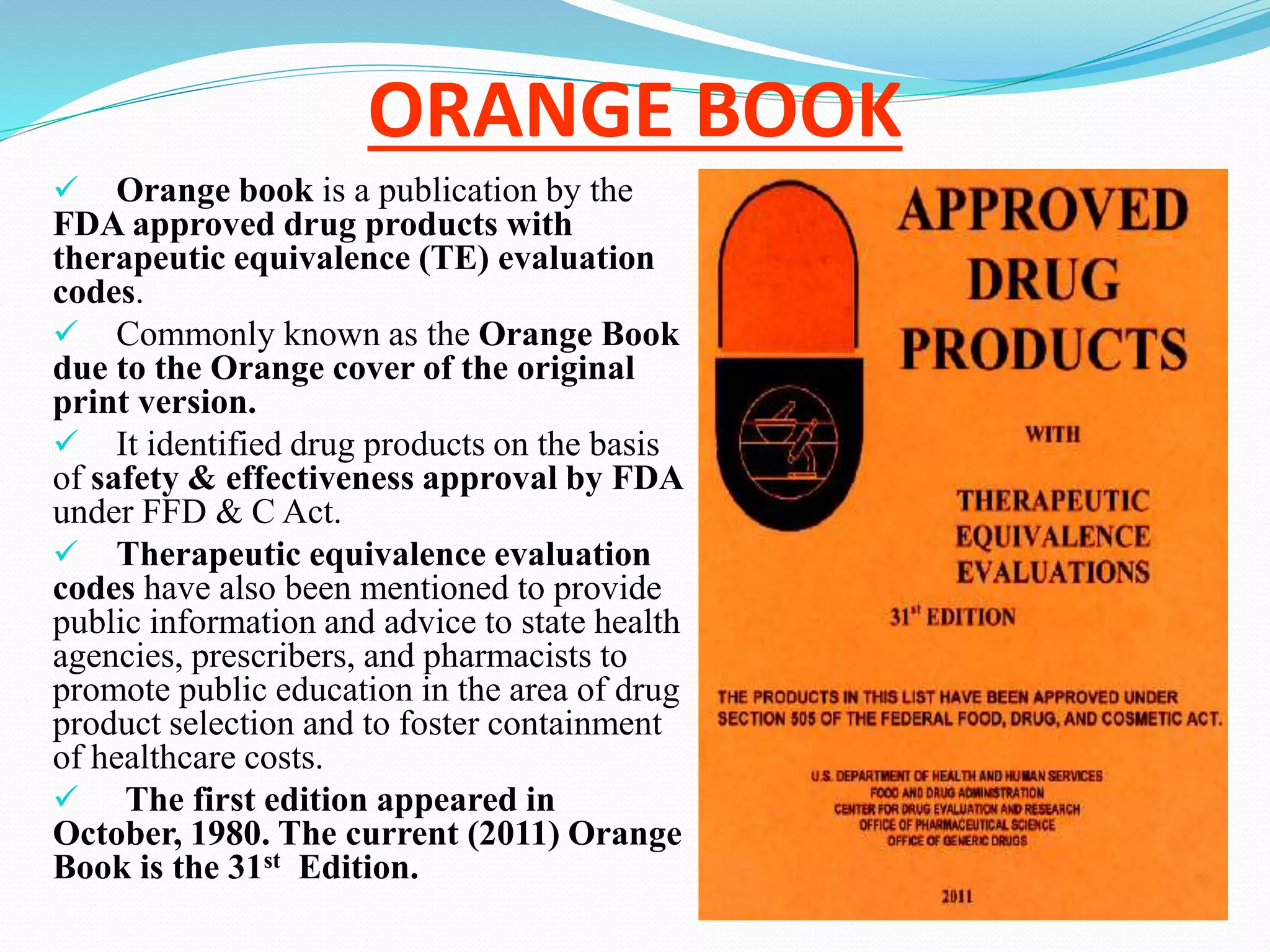
ORANGE BOOK
 Orange book is a publication by the
FDA approved drug products with
therapeutic equivalence (TE) evaluation
codes.
 Commonly known as the Orange Book
due to the Orange cover of the original
print version.
 It identified drug products on the basis
of safety & effectiveness approval by FDA
under FFD & C Act.
 Therapeutic equivalence evaluation
codes have also been mentioned to provide
public information and advice to state health
agencies, prescribers, and pharmacists to
promote public education in the area of drug
product selection and to foster containment
of healthcare costs.
 The first edition appeared in
October, 1980. The current (2011) Orange
Book is the 31st Edition.
Recent Rules by FDA for Generic Drug for India
 Generic drug manufacturers would be able to independently
update product labelling (also called prescribing information or
package inserts) with newly-acquired safety information before
the FDA’s review of the change, in the same way brand drug
manufacturers do today. Generic manufacturers would also be
required to inform the brand name manufacturer about the
change.
 All generic drug makers (like Ranbaxy Laboratories, Cipla,
Dr Reddy's Laboratories, Lupin) are now required to pay a fee
to the US drug regulator while seeking permission to launch
their products in the world's largest drug market.
 The recently enacted Generic Drug User Fee Act (GDUFA)
legislation adds a $20,000-$30,000 fee at the first time the DMF
is referenced in an ANDA. However, the high rates are likely to
affect the number of DMFs filed in the coming years from India
and around the world.
DRAWBACKS of Generic Medicine
 There may be some variations during reformulations.
 Some patients may be allergic to new colour, flavour etc.
 Generic drugs are not possible in all the cases. Because it
takes long time to expire any patent.
 During bioequivalence studies, some error may arise
which may lead to some complications. More over
bioequivalence studies are less accurate than
bioavailability studies.
Government role
 To promote cheap drugs in 2008, the govt. had set up a
scheme called “Jan Ausadhi” whose purpose was to set up
Generic Drugs across the Country.
 The initial plan was to set up 3000 store across the country
but 3 years later only 300 exists.
 But this scheme fails due to lack of awareness and
incentives involved from pharma companies to doctors.
 Recently, Medical Council of India (MCI) release a
circular issued to medical colleges, state medical
councils and state governments about prescribing
generic drug to patients.
Conclusion
 Generic drug are the answer to better healthcare for all.
 India has one of the highest out-of –pocket healthcare
expenditure in the world and despite providing very cheap
services (compared to rates of the countries like USA and
UK) it’s still inaccessible to many due to poor purchasing
power.
 The only way to promote generic drugs is to curb illicit
medical practices and moreover the MCI needs to provide
more practical guidelines rather than an archaic set of rubs
which simply can’t be followed in the real world.
Reference
[1] Simoens S. Generic and therapeutic substitution: ethics meets health economics.
International Journal of Clinical Pharmacology 2011;33(3):469–70.
[2] Frank RG. The ongoing regulation of generic drugs. New England Journal of
Medicine 2007;357(20):1993–6.
[3] Kozlowski S, et al. Developing the Nation’s Biosimilars Program. New England
Journal of Medicine 2011;365(5):385–8.
[4] Kamerow D. The pros and cons of generic drugs. British Medical Journal
2011:d4584343 2011:d4584.
[5] Bligh J. Tomorrow’s Doctors: extending the role of public health medicine in medical
education. Med. Educ. 2002;201–320.
[6] lopez-Casasnovas G, Puig-Junoy J. Review of the literature on reference pricing.
Health Policy. 2000:87-123.
[7] Berndt, E. R. (2002). "Pharmaceuticals in U.S Health Care: Determinants of quantity
and price." Journal of Economic Perspectives 2002: 45-66.
[8] Caves, R. E., Whiston, M. D., Hurwitz, M. (1991). "Patent Expiration, Entry, and
Competition in the U.S. Pharmaceutical industry." Brookings Papers on Economic
Activity 1991: 1- 66.
Thank You

Brand drug vs generic drug

  • 1.
    Presented by SHUBHAM PAUL M.PHARM(PHARMACEUTICS) 2ndSemester NSHM KNOWLEDGE CAMPUS, KOLKATA GROUP OF INSTITUTIONS GUIDED BY:- Prof. Tapas Kumar Pal
  • 2.
    Brand Name Drugs Thesedrugs are also called as Innovator Drugs invented by Pharmaceutical companies to prevent them from being copied or reverse engineered by other companies. Generic Drug A generic drug is defined as “A drug product that is comparable to brand/innovator drug in dosage from, strength, route of administration, quality and performance characteristics and intended use”. It should contain the same active ingredients as the original formulation. According to the FDA, generic drugs are identical or within an acceptable bioequivalent range to the brand-name counterpart with respect to pharmacokinetics and pharmacodynamic properties.
  • 3.
    Some Example ofGeneric and Branded Drug with their Price Category Generic Drug Price Branded Drug Price Analgesic Paracetamol Rs 2.45 Crocin Rs 11 Diclofenacsodium +Paracetamol Rs 4.4 Diclogesic Rs 19.40 Antibiotic Amoxyclin Rs 13.2 LMX Rs 40 Remox Rs 38.7 Azithromycin Rs 41.8 Azee Rs 107 Azithral Rs 128.55 Vitamin Folic acid Rs 2.8 Folivite Rs 11.8 B-Complex Rs 1.8 Becosul Rs 11.0 Cardiovascular(Blood Pressure) Drug Atenolol Rs 7.0 Aten Rs 23.8
  • 4.
    Modern Trends forShifting Pharmaceutical Market from Branded Drug to Generic Drug  In 2010 India’s share of the generic market is about 30% out of 71.2% and reached $100 billion.  In late 2012 40% of DMF’s were filled by Indian market in USFDA for supplying API’s.  Now India’s share of the generic market is about to 35%. Hence the contribution of the Indian pharmaceutical industry for the growth of generic drugs in the world is very high.
  • 5.
    Comparison between Genericand Brand Name Drugs Similarities Dissimilarities  They must contain the same active ingredients.  They must have the same dosage strength (example, 20mg or 40mg).  They must be the same dosage form.  They must have the same route of administration.  They must deliver similar amounts of drug to the bloodstream.  They could have different sizes, shapes, colors.  They might have different inactive ingredients.  The generic costs less than the brand name drug.
  • 6.
    Why do BrandName Drugs Cost more than Generics? Brand name drugs take several years, costly scientific development and many clinical studies to get Market approval. Manufacturers of brand name/Innovator drugs usually take on the research and development cost for new medications. These research and development costs, along with marketing costs, account for most of the higher prices pay for most brand name drug. In contrast, generic drugs have less research and development costs since the original manufacturer has already done many studies to make sure the drug is safe. These savings are passed on to the customer.
  • 7.
    Bioavailability and Bioequivalence Ageneric drug is considered to be bioequivalent to the brand name drug in case: Similarities of three main parameters to establish bioequivalence. AUC: area under the concentration- time curve.  Measure of the extent of bioavailability. Cmax: the observed maximum concentration of degree of absorption. tmax: the time after administration of drug at which Cmax is observed.
  • 8.
    Contd…… AUC Ratio: The 90%confidence interval for this measure of relative bioavailability should be within a bioequivalence range of 80-125%. Cmax ratio: For maximal concentration data, the acceptance limit of 80-125% should be applied to the 90% confidence interval for the mean Cmax ratio. tmax difference: Statistical evaluation of tmax makes sense only if there is a clinically relevant claim for rigid onset of action or concerns about adverse effects.
  • 9.
    ANDA • An AbbreviatedNew Drug Application (ANDA) contains data which when submitted to FDA's Centre for Drug Evaluation and Research, Office of Generic Drugs, provides for the review and ultimate approval of a generic drug product. • Generic applicants must scientifically demonstrate that their product is bioequivalent to the Innovator drug. • Scientists demonstrate bioequivalence is to measure the time it takes the generic drug to reach the bloodstream in 24 to 36 healthy volunteers. This gives them the rate of absorption, or bioavailability, of the generic drug, which they can then compare to that of the innovator drug. • The generic version must deliver the same amount of active ingredients into a patient's bloodstream in the same amount of time as the innovator drug.
  • 10.
    Similar FDA Requirementsfor Brand- Name and Generic Drugs FDA Requirements Brand Drug Generic Drug For reformulations of a brand-name drug or generic versions of a drug, FDA reviews data showing the drug is bioequivalent to the one used in the original safety and efficacy testing. √ √ FDA evaluates the manufacturer's adherence to good manufacturing practices before the drug is marketed. √ √ FDA reviews the active and inactive ingredients used in the formulation before the drug is marketed. √ √ FDA reviews the actual drug product. √ √ FDA reviews the drug's labeling. √ √
  • 11.
    Contd….. FDA Requirements Brand Drug Generic Drug Manufacturermust seek FDA approval before making major manufacturing changes or reformulating the drug. √ √ Manufacturer must report adverse reactions and serious adverse health effects to the FDA. √ √ FDA periodically inspects manufacturing plants. √ √ FDA monitors drug quality after approval. √ √
  • 12.
    Hatch Waxman Act Theact which surrounds the generic drug approval process of the USFDA is the “Hatch Waxman Act of 1984” which we also identify by the “Drug price control and Patent Term Restoration Act of 1984” which led to a plethora of generic drugs entering into the market. Objectives of the act:  Reducing the cost associated with the approval of a generic drug  Allowing Early-Experimental-Use  Compensating the branded drugs manufacturers for the time lost from the patent term because of the regulatory approval formality  Motivating the generic drug manufacturers
  • 13.
    ORANGE BOOK  Orangebook is a publication by the FDA approved drug products with therapeutic equivalence (TE) evaluation codes.  Commonly known as the Orange Book due to the Orange cover of the original print version.  It identified drug products on the basis of safety & effectiveness approval by FDA under FFD & C Act.  Therapeutic equivalence evaluation codes have also been mentioned to provide public information and advice to state health agencies, prescribers, and pharmacists to promote public education in the area of drug product selection and to foster containment of healthcare costs.  The first edition appeared in October, 1980. The current (2011) Orange Book is the 31st Edition.
  • 14.
    Recent Rules byFDA for Generic Drug for India  Generic drug manufacturers would be able to independently update product labelling (also called prescribing information or package inserts) with newly-acquired safety information before the FDA’s review of the change, in the same way brand drug manufacturers do today. Generic manufacturers would also be required to inform the brand name manufacturer about the change.  All generic drug makers (like Ranbaxy Laboratories, Cipla, Dr Reddy's Laboratories, Lupin) are now required to pay a fee to the US drug regulator while seeking permission to launch their products in the world's largest drug market.  The recently enacted Generic Drug User Fee Act (GDUFA) legislation adds a $20,000-$30,000 fee at the first time the DMF is referenced in an ANDA. However, the high rates are likely to affect the number of DMFs filed in the coming years from India and around the world.
  • 15.
    DRAWBACKS of GenericMedicine  There may be some variations during reformulations.  Some patients may be allergic to new colour, flavour etc.  Generic drugs are not possible in all the cases. Because it takes long time to expire any patent.  During bioequivalence studies, some error may arise which may lead to some complications. More over bioequivalence studies are less accurate than bioavailability studies.
  • 16.
    Government role  Topromote cheap drugs in 2008, the govt. had set up a scheme called “Jan Ausadhi” whose purpose was to set up Generic Drugs across the Country.  The initial plan was to set up 3000 store across the country but 3 years later only 300 exists.  But this scheme fails due to lack of awareness and incentives involved from pharma companies to doctors.  Recently, Medical Council of India (MCI) release a circular issued to medical colleges, state medical councils and state governments about prescribing generic drug to patients.
  • 17.
    Conclusion  Generic drugare the answer to better healthcare for all.  India has one of the highest out-of –pocket healthcare expenditure in the world and despite providing very cheap services (compared to rates of the countries like USA and UK) it’s still inaccessible to many due to poor purchasing power.  The only way to promote generic drugs is to curb illicit medical practices and moreover the MCI needs to provide more practical guidelines rather than an archaic set of rubs which simply can’t be followed in the real world.
  • 18.
    Reference [1] Simoens S.Generic and therapeutic substitution: ethics meets health economics. International Journal of Clinical Pharmacology 2011;33(3):469–70. [2] Frank RG. The ongoing regulation of generic drugs. New England Journal of Medicine 2007;357(20):1993–6. [3] Kozlowski S, et al. Developing the Nation’s Biosimilars Program. New England Journal of Medicine 2011;365(5):385–8. [4] Kamerow D. The pros and cons of generic drugs. British Medical Journal 2011:d4584343 2011:d4584. [5] Bligh J. Tomorrow’s Doctors: extending the role of public health medicine in medical education. Med. Educ. 2002;201–320. [6] lopez-Casasnovas G, Puig-Junoy J. Review of the literature on reference pricing. Health Policy. 2000:87-123. [7] Berndt, E. R. (2002). "Pharmaceuticals in U.S Health Care: Determinants of quantity and price." Journal of Economic Perspectives 2002: 45-66. [8] Caves, R. E., Whiston, M. D., Hurwitz, M. (1991). "Patent Expiration, Entry, and Competition in the U.S. Pharmaceutical industry." Brookings Papers on Economic Activity 1991: 1- 66.
  • 19.