Real-time Bangla License Plate Recognition System
for Low Resource Video-based Applications
Alif Ashrafee
alifashrafee@iut-dhaka.edu
Islamic University of Technology
Akib Mohammed Khan
akibmohammed@iut-dhaka.edu
Islamic University of Technology
Mohammad Sabik Irbaz
sabikirbaz@iut-dhaka.edu
Pioneer Alpha Ltd.
MD Abdullah Al Nasim
nasim.abdullah@ieee.org
Pioneer Alpha Ltd.
1
Winter Conference on Applications
of Computer Vision 2022
Real-World Surveillance:
Applications and Challenges Workshop
(RWS @ WACV2022)
2
Introduction
● Automatic License Plate Recognition (ALPR) systems aim to detect, localize,
and recognize license plate characters from vehicles appearing in images or
video frames.
● There are no publicly available Bangla datasets for training such systems.
● Our main focus is to provide comprehensive image and video datasets of
Bangla license plates in-the-wild.
● We aim to provide a system for real time inference to recognizing license
plates from video frames in low resource environments.
3
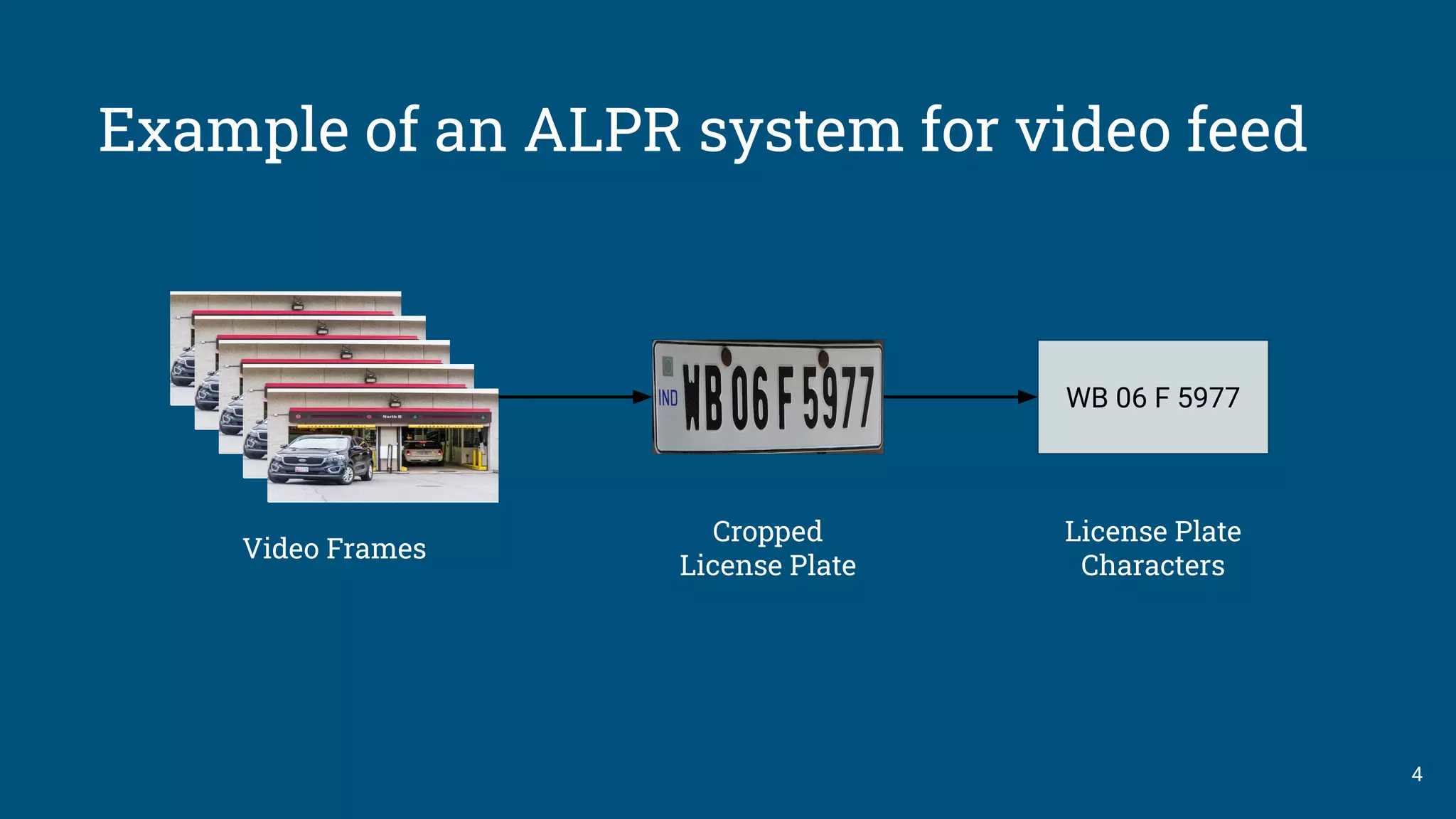
4
Video Frames
Cropped
License Plate
WB 06 F 5977
License Plate
Characters
Example of an ALPR system for video feed
Motivation
5
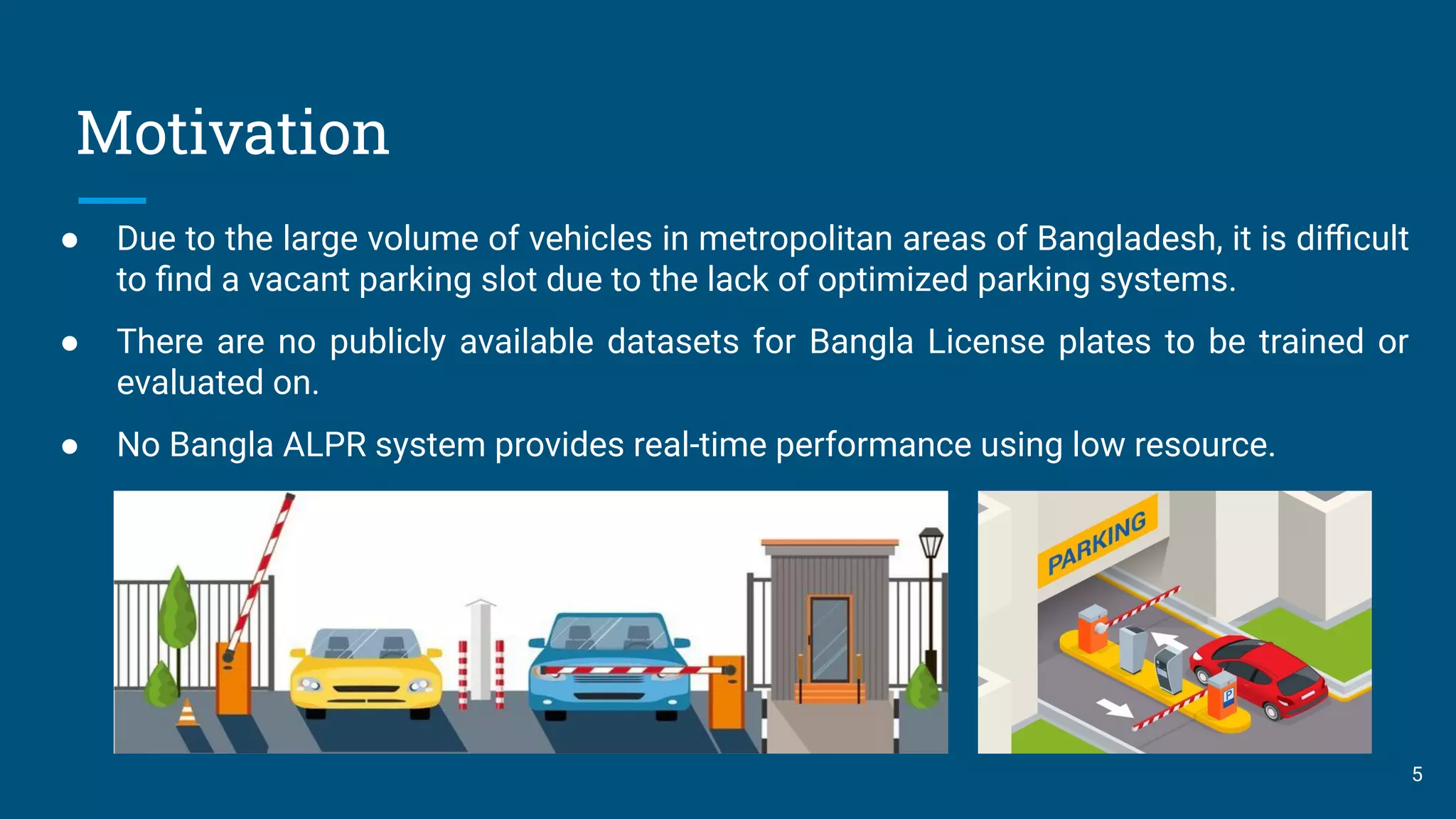
● Due to the large volume of vehicles in metropolitan areas of Bangladesh, it is difficult
to find a vacant parking slot due to the lack of optimized parking systems.
● There are no publicly available datasets for Bangla License plates to be trained or
evaluated on.
● No Bangla ALPR system provides real-time performance using low resource.
Problem
Statement
6
Given a video feed of cars and
motorcycles having Bangla license
plates, can we teach the machine to
identify and recognize license plates?
7
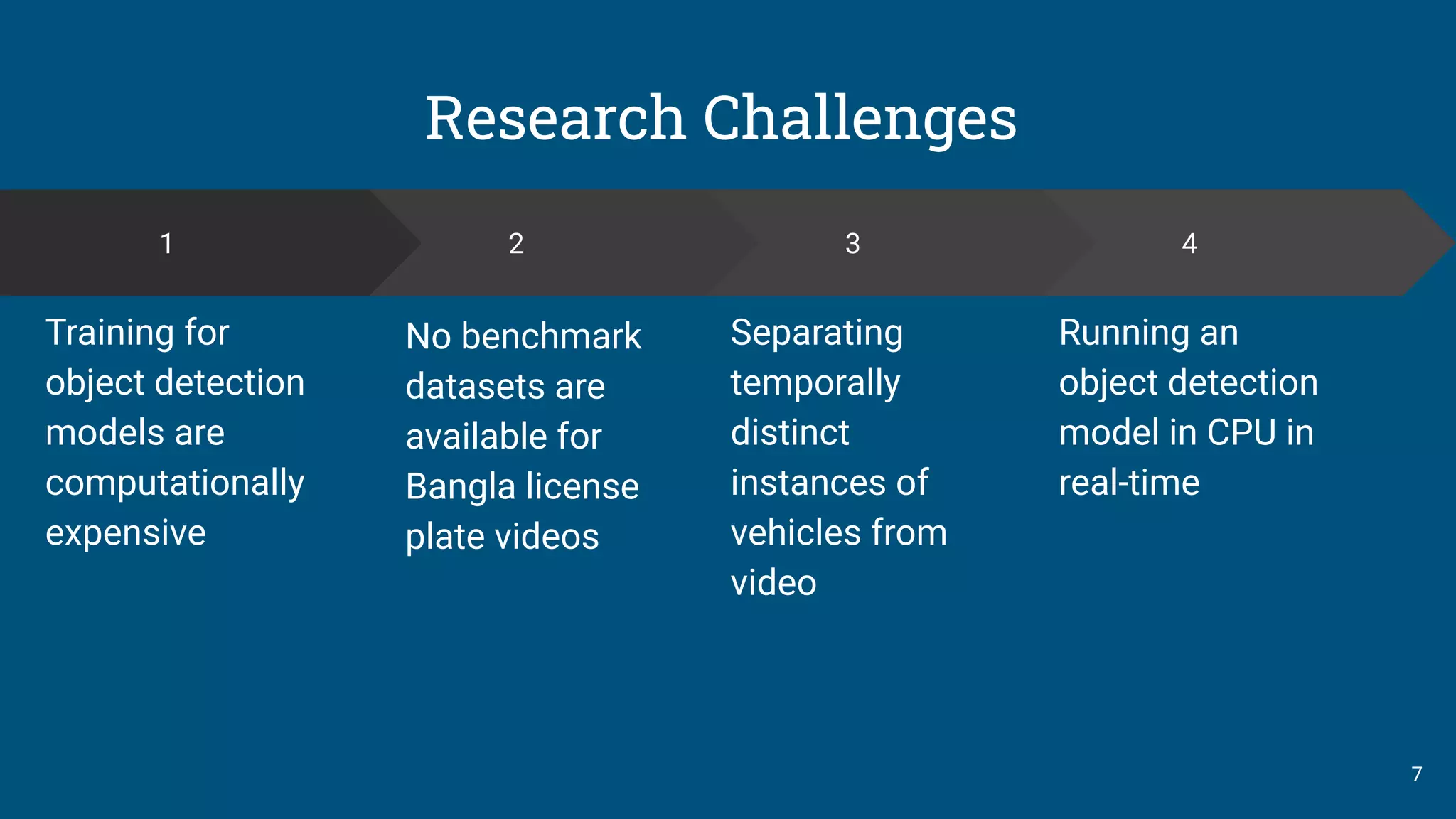
Training for
object detection
models are
computationally
expensive
No benchmark
datasets are
available for
Bangla license
plate videos
Separating
temporally
distinct
instances of
vehicles from
video
Running an
object detection
model in CPU in
real-time
Research Challenges
1 2 3 4
Related Works
8
Cascade Classifier [Viola et. al., 2001]
9
● Trained using positive and negative
examples.
● Consists of multiple stages, where each
stage is an ensemble of weak classifiers.
● Divide the image into sub-windows.
● The weak classifiers are used to discard
the negative subwindows as fast as
possible.
● Detect all the positive instances to
achieve low false-positive rates.
MobileNet SSDv2 [Chiu et. al., 2020]
10
● Single Shot object detection (SSD) model based on MobileNet-v2[1].
● Lightweight and can be applied with limited computational resources.
● Includes feature pyramid network
Two stage detection with Temporal
Redundancy [Laroca et. al., 2018]
11
● Detection in two stages, vehicle detection and then LP detection.
● Temporal redundancy information through the union of all frames
belonging to the same vehicle.
YOLO vs RCNN vs SSD [Adarsh et. al., 2020]
12
● SSD provides an optimal solution for both accuracy and speed.
● YOLO is fast but not very accurate, Faster RCNN is more accurate but slower.
Datasets
13
License Plate Image Dataset
14
➔ We created our own dataset of 1000 images.
➔ With different distances, angles and lighting conditions around Dhaka City
captured using varying models of smartphones.
➔ Converted to 800 x 800 pixels.
➔ We manually annotated them by drawing bounding boxes around the license
plate regions for training our detection models.
15
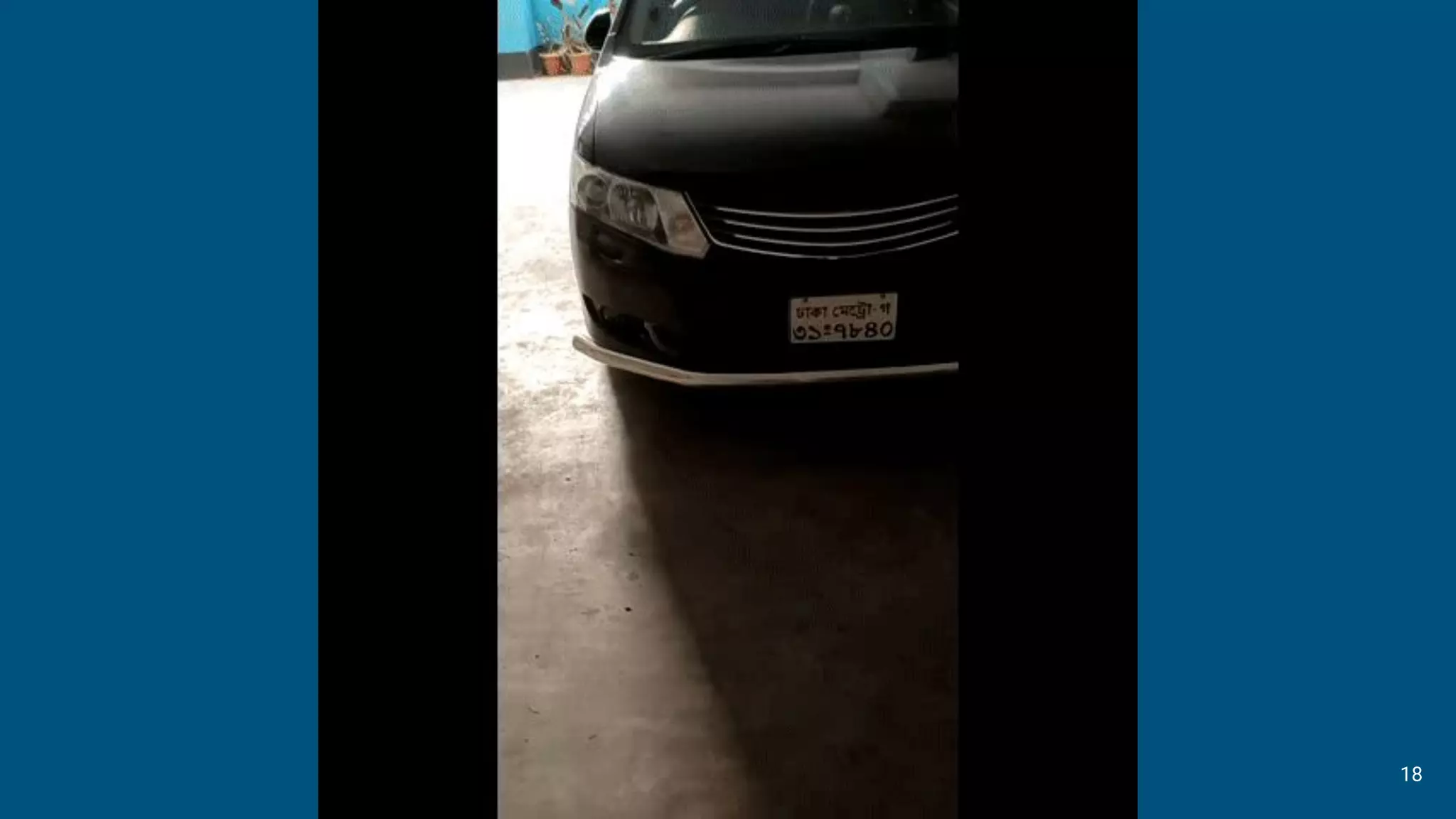
License Plate Video Dataset
16
➔ We collected 79 video clips containing 98 license plates from different types
of vehicles using crowdsourcing.
➔ Each clip includes single or multiple vehicles from around different districts
of Bangladesh.
➔ Converted all of the videos to a resolution of 480 x 480 pixels.
➔ Each video contains an average of 254 frames and the frame rate of each
video was 24 frames per second (FPS).
➔ Videos were taken in a variety of locations, such as inside garages, car
parks, lanes, and highways.
License Plate Video Dataset (cont.)
➔ Since videos were taken from several different districts, there is a good
distribution of the authorized characters in our dataset.
➔ Videos include plate variations, artifacts on plates, occlusions, illumination
changes, and unclear characters.
➔ We annotated the content of each plate: the ground truth of each character
present in the plate, and the number of license plates present in each video.
17
18
Proposed Method
19
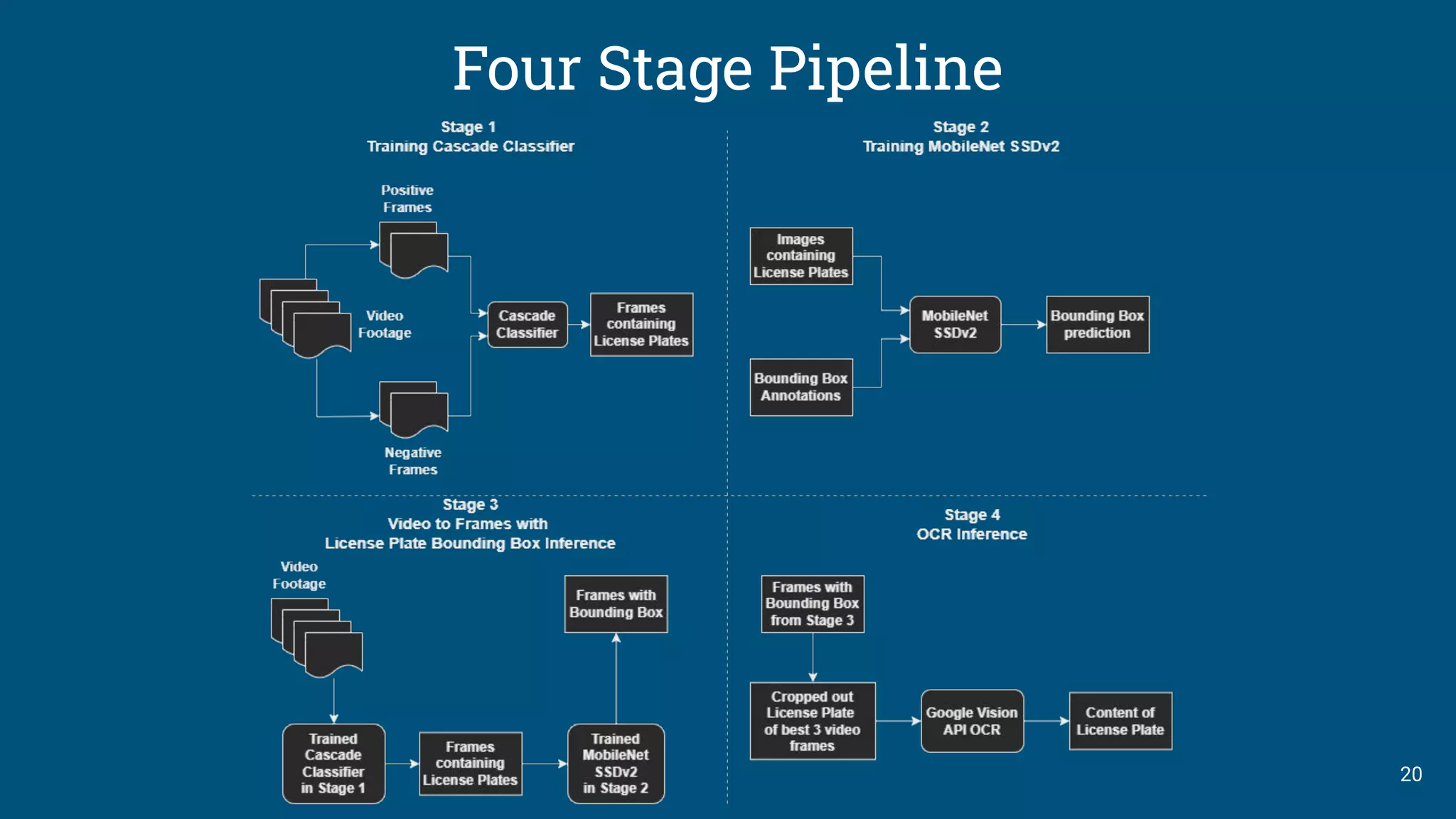
20
Four Stage Pipeline
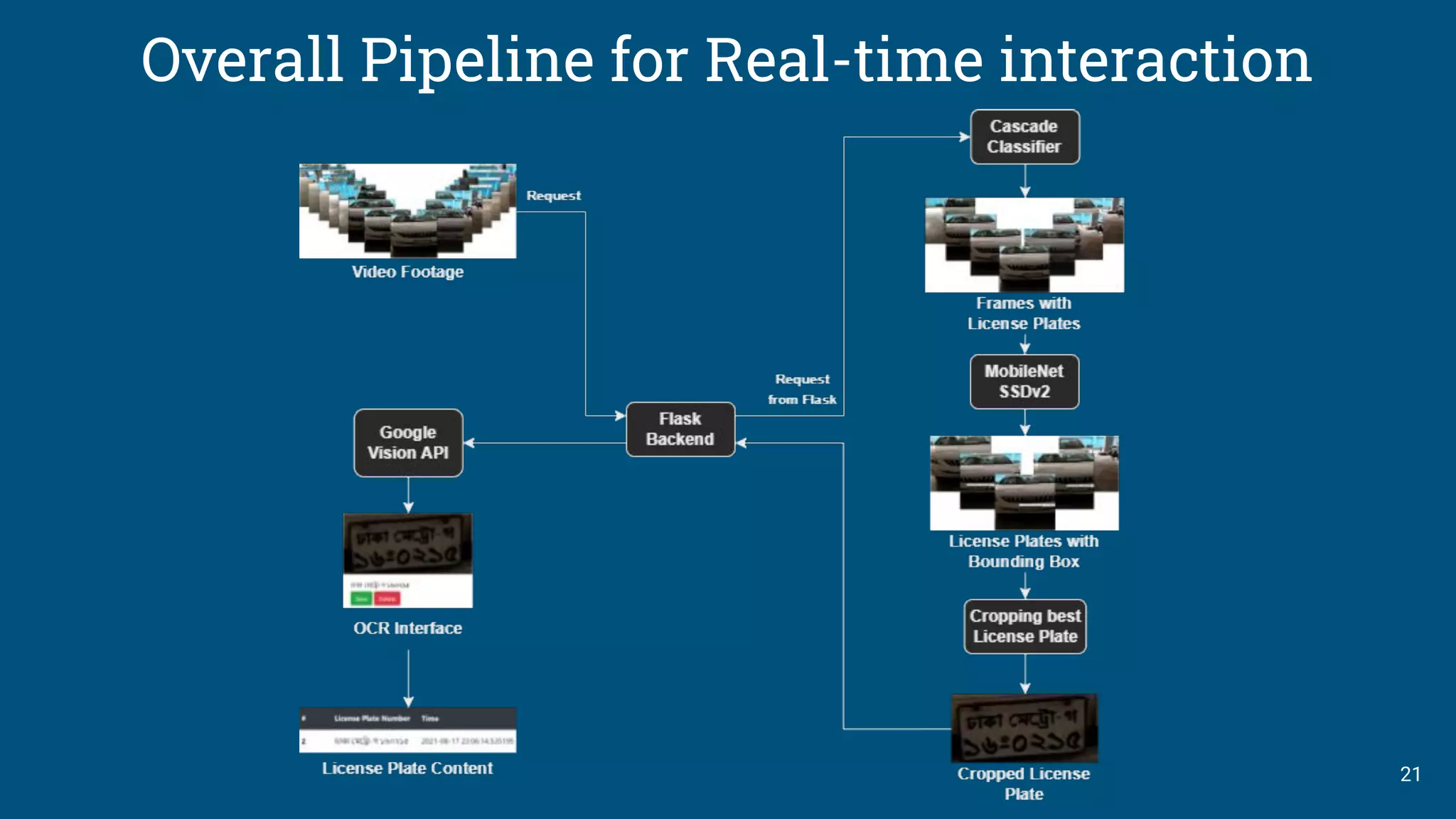
21
Overall Pipeline for Real-time interaction
Experimental Analysis
22
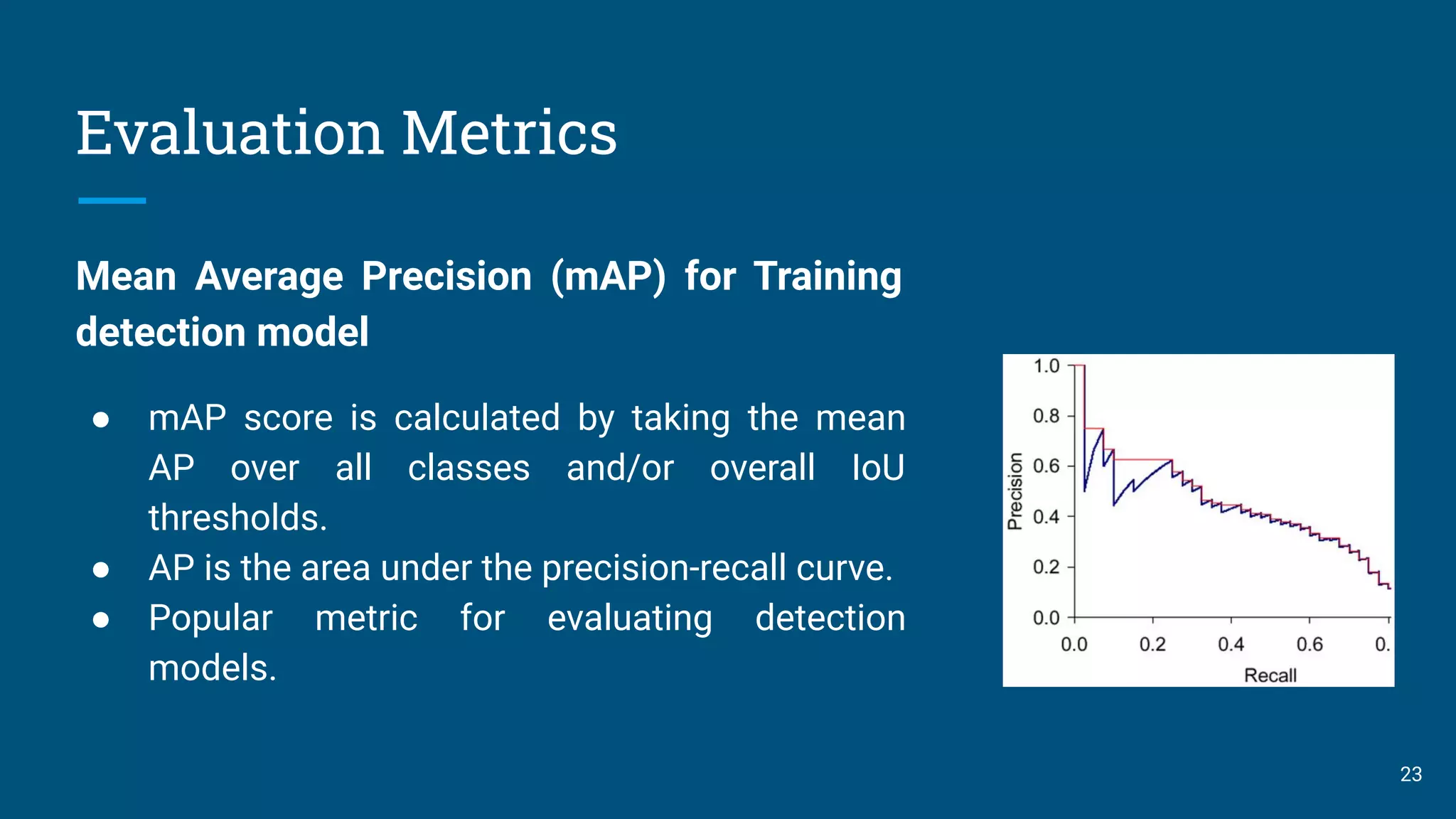
Evaluation Metrics
23
Mean Average Precision (mAP) for Training
detection model
● mAP score is calculated by taking the mean
AP over all classes and/or overall IoU
thresholds.
● AP is the area under the precision-recall curve.
● Popular metric for evaluating detection
models.
24
Evaluation Metrics (cont.)
Levenshtein Distance for Character Recognition [2]
● Measures the difference between two strings based on the number of
insertions, deletions, and substitutions that have to be performed on the
target string in order to match it with the reference string.
Cₑᵣᵣₒᵣ = Total character error
Cₐₙₙ = # characters in the aligned
sequence
CH
= # characters in hypothesis string
CR
= # characters in reference string
Experimental Setup
25
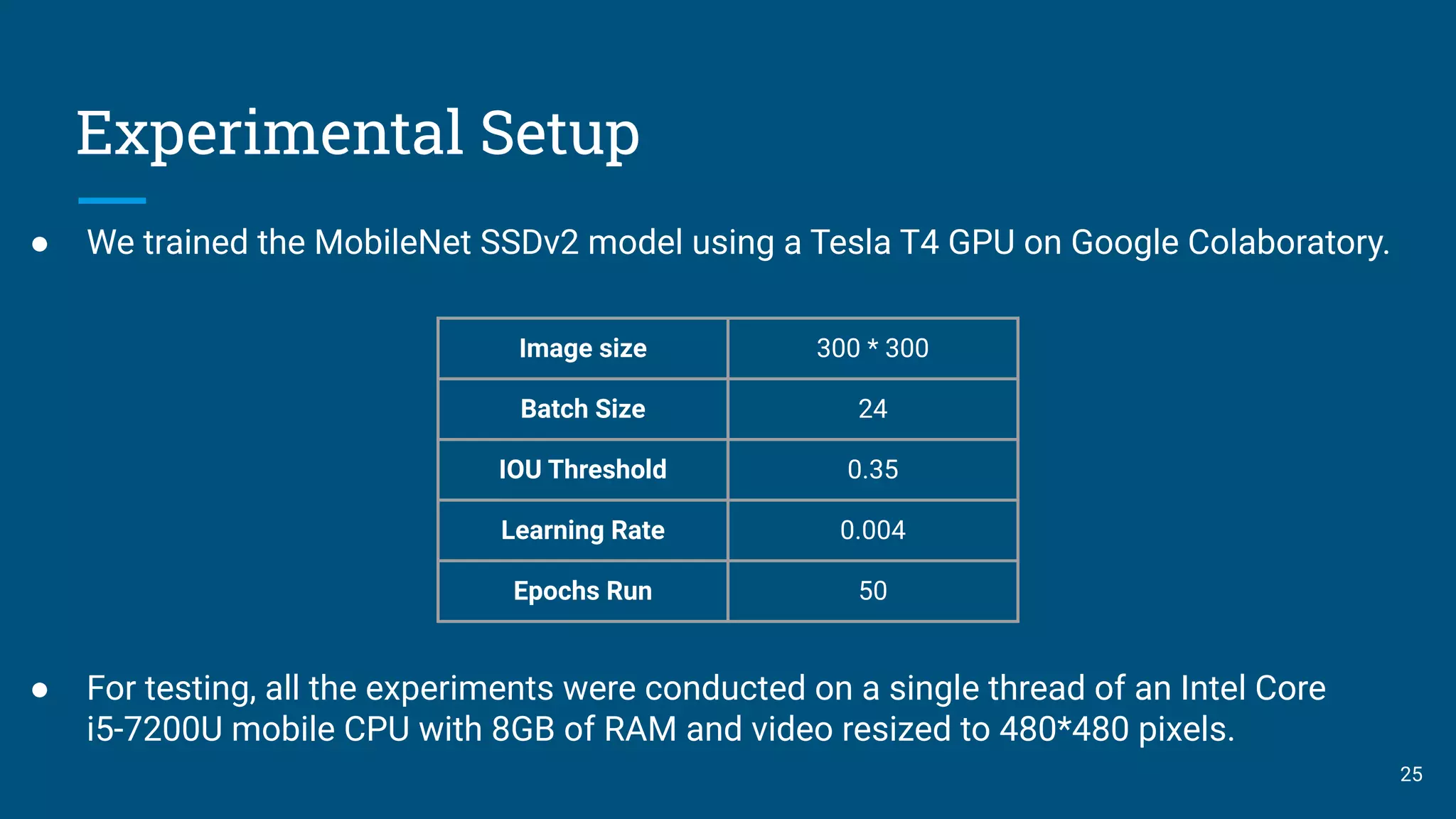
● We trained the MobileNet SSDv2 model using a Tesla T4 GPU on Google Colaboratory.
● For testing, all the experiments were conducted on a single thread of an Intel Core
i5-7200U mobile CPU with 8GB of RAM and video resized to 480*480 pixels.
Image size 300 * 300
Batch Size 24
IOU Threshold 0.35
Learning Rate 0.004
Epochs Run 50
Result Analysis (Quantitative)
26
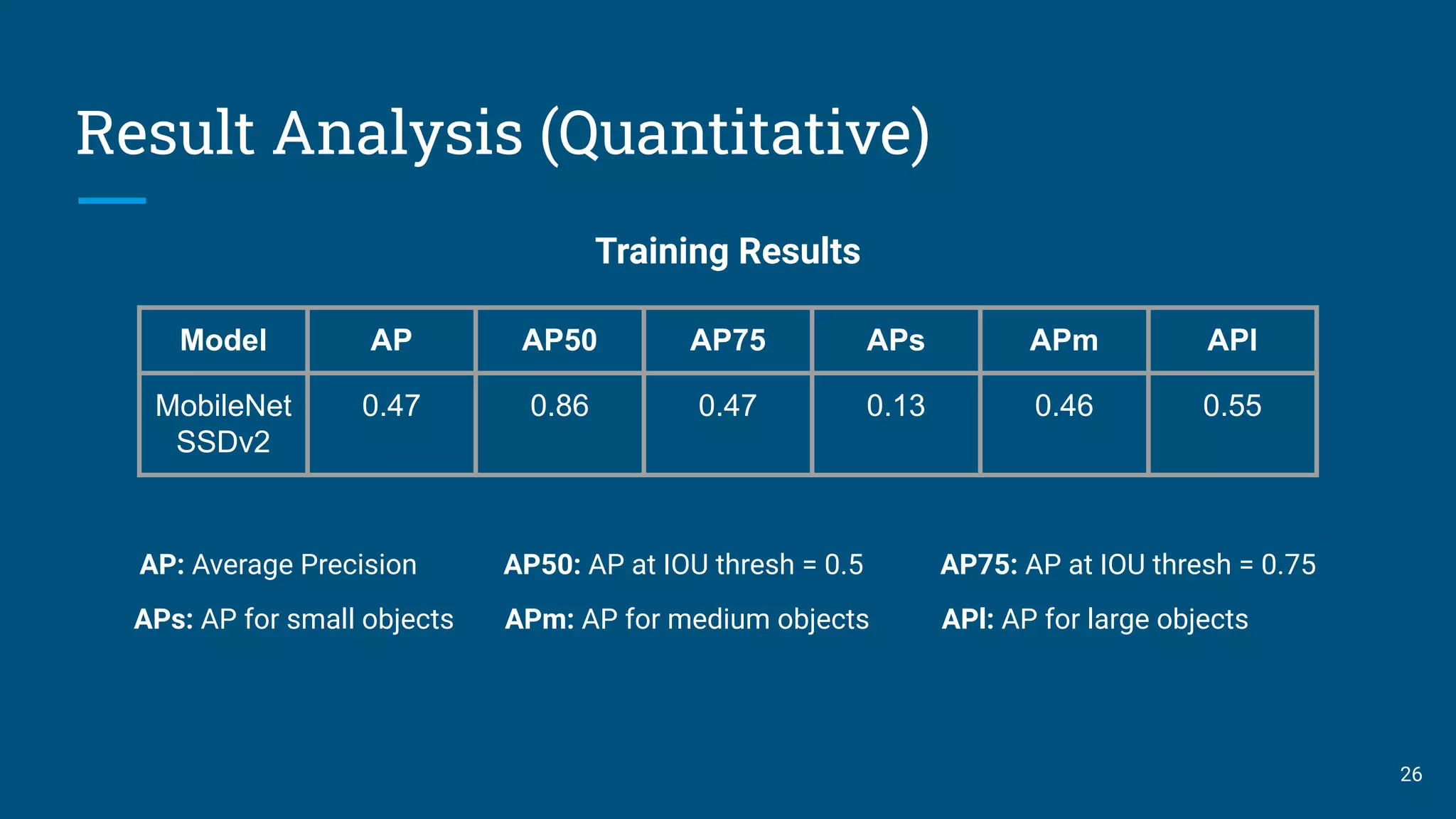
Training Results
Model AP AP50 AP75 APs APm APl
MobileNet
SSDv2
0.47 0.86 0.47 0.13 0.46 0.55
AP: Average Precision AP50: AP at IOU thresh = 0.5 AP75: AP at IOU thresh = 0.75
APs: AP for small objects APm: AP for medium objects APl: AP for large objects
Result Analysis (Quantitative) (cont.)
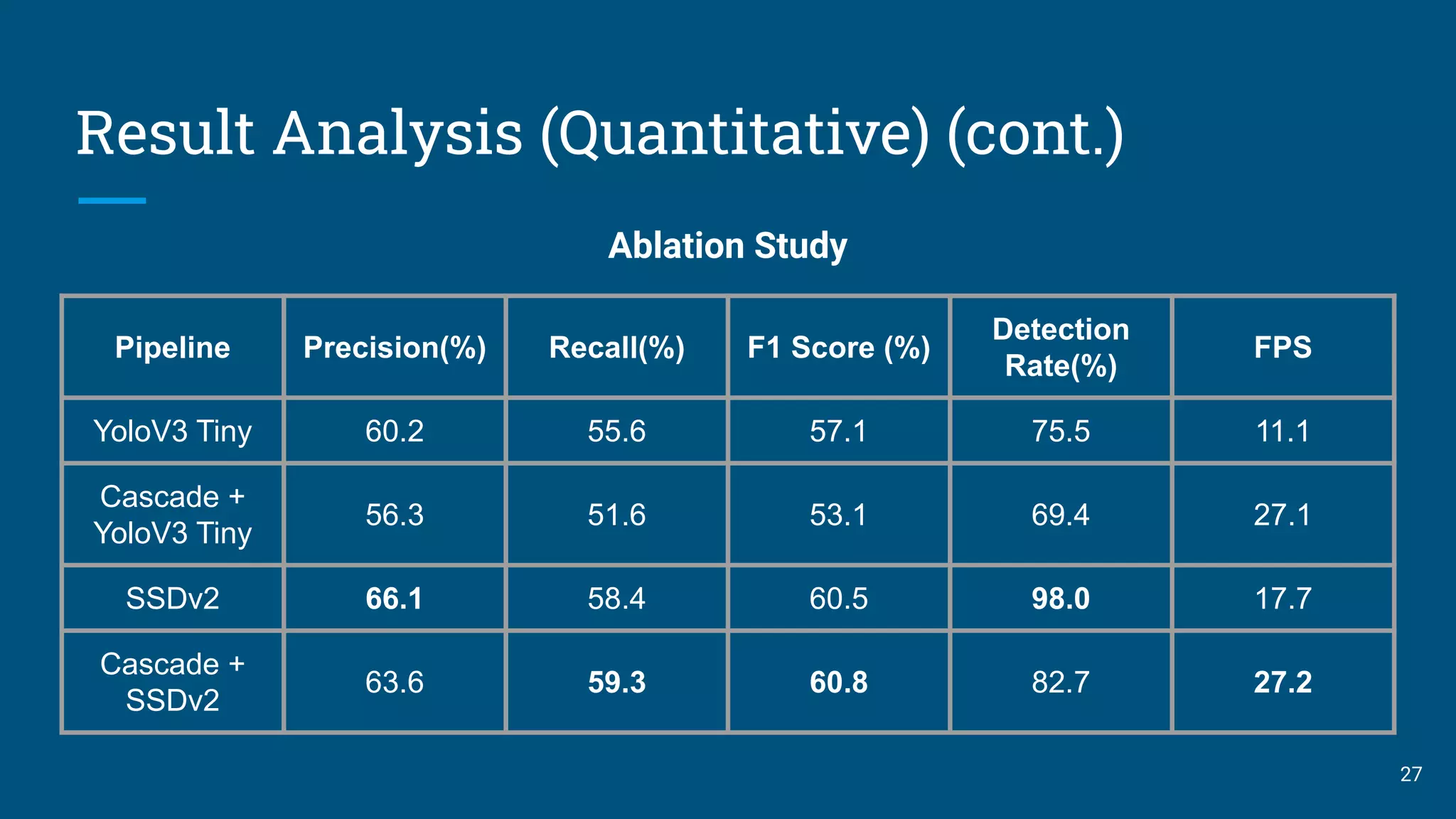
Ablation Study
27
Pipeline Precision(%) Recall(%) F1 Score (%)
Detection
Rate(%)
FPS
YoloV3 Tiny 60.2 55.6 57.1 75.5 11.1
Cascade +
YoloV3 Tiny
56.3 51.6 53.1 69.4 27.1
SSDv2 66.1 58.4 60.5 98.0 17.7
Cascade +
SSDv2
63.6 59.3 60.8 82.7 27.2
Result Analysis (Qualitative)
28
29
29
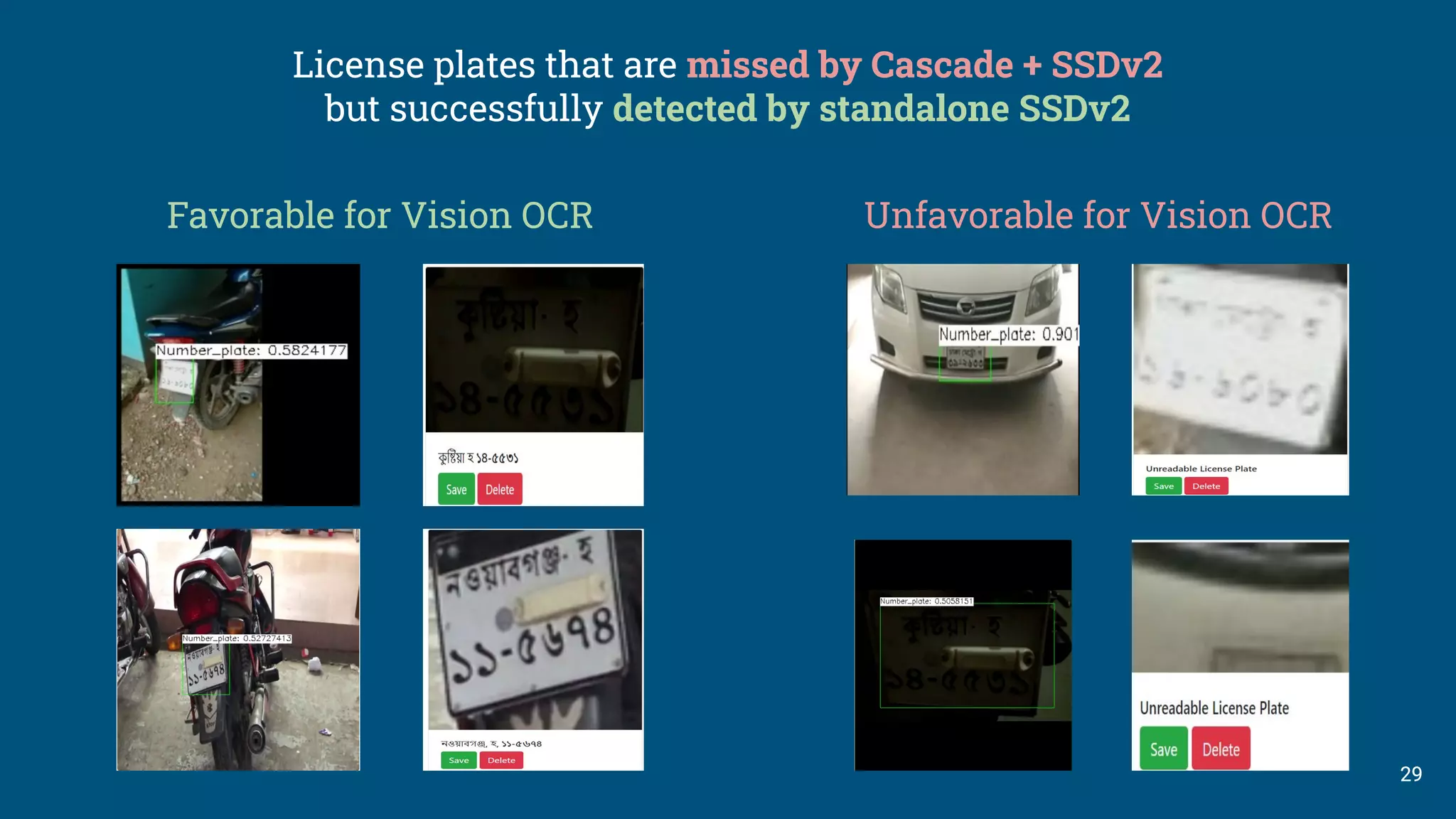
License plates that are missed by Cascade + SSDv2
but successfully detected by standalone SSDv2
Favorable for Vision OCR Unfavorable for Vision OCR
30
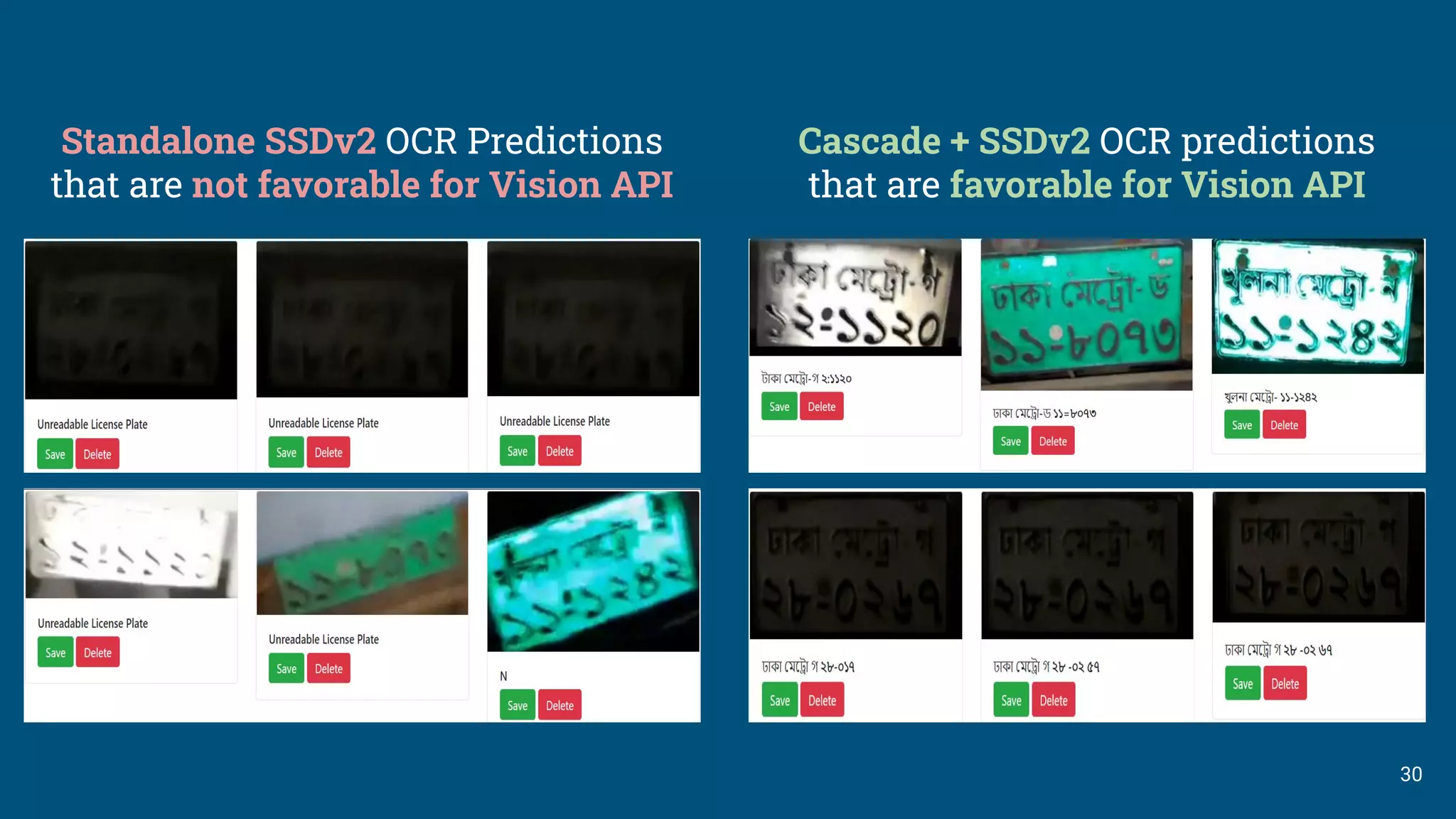
Standalone SSDv2 OCR Predictions
that are not favorable for Vision API
Cascade + SSDv2 OCR predictions
that are favorable for Vision API
Conclusion and Future Work
● We provide two Bangla license plate image and video datasets.
● We propose a robust system that can detect license plates from video
footage in low resource environment.
● Consists of a method for individually storing temporally separate instances
of different vehicles appearing in the same video.
● We plan to deploy our system in various real-life environments and verify its
day-to-day performance.
● We also plan to build our own Bangla license plate OCR system that can
improve the recognition performance.
31
References
[1] Sandler, Mark, et al. "Mobilenetv2: Inverted residuals and linear bottlenecks." Proceedings of
the IEEE conference on computer vision and pattern recognition. 2018.
[2] Karpinski, Romain, Devashish Lohani, and Abdel Belaid. "Metrics for Complete Evaluation of
OCR Performance." IPCV'18-The 22nd Int'l Conf on Image Processing, Computer Vision, & Pattern
Recognition. 2018.
32
Thank you!
33

Real-time Bangla License Plate Recognition System for Low Resource Video-based Applications

  • 1.
    Real-time Bangla LicensePlate Recognition System for Low Resource Video-based Applications Alif Ashrafee alifashrafee@iut-dhaka.edu Islamic University of Technology Akib Mohammed Khan akibmohammed@iut-dhaka.edu Islamic University of Technology Mohammad Sabik Irbaz sabikirbaz@iut-dhaka.edu Pioneer Alpha Ltd. MD Abdullah Al Nasim nasim.abdullah@ieee.org Pioneer Alpha Ltd. 1
  • 2.
    Winter Conference onApplications of Computer Vision 2022 Real-World Surveillance: Applications and Challenges Workshop (RWS @ WACV2022) 2
  • 3.
    Introduction ● Automatic LicensePlate Recognition (ALPR) systems aim to detect, localize, and recognize license plate characters from vehicles appearing in images or video frames. ● There are no publicly available Bangla datasets for training such systems. ● Our main focus is to provide comprehensive image and video datasets of Bangla license plates in-the-wild. ● We aim to provide a system for real time inference to recognizing license plates from video frames in low resource environments. 3
  • 4.
    4 Video Frames Cropped License Plate WB06 F 5977 License Plate Characters Example of an ALPR system for video feed
  • 5.
    Motivation 5 ● Due tothe large volume of vehicles in metropolitan areas of Bangladesh, it is difficult to find a vacant parking slot due to the lack of optimized parking systems. ● There are no publicly available datasets for Bangla License plates to be trained or evaluated on. ● No Bangla ALPR system provides real-time performance using low resource.
  • 6.
    Problem Statement 6 Given a videofeed of cars and motorcycles having Bangla license plates, can we teach the machine to identify and recognize license plates?
  • 7.
    7 Training for object detection modelsare computationally expensive No benchmark datasets are available for Bangla license plate videos Separating temporally distinct instances of vehicles from video Running an object detection model in CPU in real-time Research Challenges 1 2 3 4
  • 8.
  • 9.
    Cascade Classifier [Violaet. al., 2001] 9 ● Trained using positive and negative examples. ● Consists of multiple stages, where each stage is an ensemble of weak classifiers. ● Divide the image into sub-windows. ● The weak classifiers are used to discard the negative subwindows as fast as possible. ● Detect all the positive instances to achieve low false-positive rates.
  • 10.
    MobileNet SSDv2 [Chiuet. al., 2020] 10 ● Single Shot object detection (SSD) model based on MobileNet-v2[1]. ● Lightweight and can be applied with limited computational resources. ● Includes feature pyramid network
  • 11.
    Two stage detectionwith Temporal Redundancy [Laroca et. al., 2018] 11 ● Detection in two stages, vehicle detection and then LP detection. ● Temporal redundancy information through the union of all frames belonging to the same vehicle.
  • 12.
    YOLO vs RCNNvs SSD [Adarsh et. al., 2020] 12 ● SSD provides an optimal solution for both accuracy and speed. ● YOLO is fast but not very accurate, Faster RCNN is more accurate but slower.
  • 13.
  • 14.
    License Plate ImageDataset 14 ➔ We created our own dataset of 1000 images. ➔ With different distances, angles and lighting conditions around Dhaka City captured using varying models of smartphones. ➔ Converted to 800 x 800 pixels. ➔ We manually annotated them by drawing bounding boxes around the license plate regions for training our detection models.
  • 15.
  • 16.
    License Plate VideoDataset 16 ➔ We collected 79 video clips containing 98 license plates from different types of vehicles using crowdsourcing. ➔ Each clip includes single or multiple vehicles from around different districts of Bangladesh. ➔ Converted all of the videos to a resolution of 480 x 480 pixels. ➔ Each video contains an average of 254 frames and the frame rate of each video was 24 frames per second (FPS). ➔ Videos were taken in a variety of locations, such as inside garages, car parks, lanes, and highways.
  • 17.
    License Plate VideoDataset (cont.) ➔ Since videos were taken from several different districts, there is a good distribution of the authorized characters in our dataset. ➔ Videos include plate variations, artifacts on plates, occlusions, illumination changes, and unclear characters. ➔ We annotated the content of each plate: the ground truth of each character present in the plate, and the number of license plates present in each video. 17
  • 18.
  • 19.
  • 20.
  • 21.
    21 Overall Pipeline forReal-time interaction
  • 22.
  • 23.
    Evaluation Metrics 23 Mean AveragePrecision (mAP) for Training detection model ● mAP score is calculated by taking the mean AP over all classes and/or overall IoU thresholds. ● AP is the area under the precision-recall curve. ● Popular metric for evaluating detection models.
  • 24.
    24 Evaluation Metrics (cont.) LevenshteinDistance for Character Recognition [2] ● Measures the difference between two strings based on the number of insertions, deletions, and substitutions that have to be performed on the target string in order to match it with the reference string. Cₑᵣᵣₒᵣ = Total character error Cₐₙₙ = # characters in the aligned sequence CH = # characters in hypothesis string CR = # characters in reference string
  • 25.
    Experimental Setup 25 ● Wetrained the MobileNet SSDv2 model using a Tesla T4 GPU on Google Colaboratory. ● For testing, all the experiments were conducted on a single thread of an Intel Core i5-7200U mobile CPU with 8GB of RAM and video resized to 480*480 pixels. Image size 300 * 300 Batch Size 24 IOU Threshold 0.35 Learning Rate 0.004 Epochs Run 50
  • 26.
    Result Analysis (Quantitative) 26 TrainingResults Model AP AP50 AP75 APs APm APl MobileNet SSDv2 0.47 0.86 0.47 0.13 0.46 0.55 AP: Average Precision AP50: AP at IOU thresh = 0.5 AP75: AP at IOU thresh = 0.75 APs: AP for small objects APm: AP for medium objects APl: AP for large objects
  • 27.
    Result Analysis (Quantitative)(cont.) Ablation Study 27 Pipeline Precision(%) Recall(%) F1 Score (%) Detection Rate(%) FPS YoloV3 Tiny 60.2 55.6 57.1 75.5 11.1 Cascade + YoloV3 Tiny 56.3 51.6 53.1 69.4 27.1 SSDv2 66.1 58.4 60.5 98.0 17.7 Cascade + SSDv2 63.6 59.3 60.8 82.7 27.2
  • 28.
  • 29.
    29 29 License plates thatare missed by Cascade + SSDv2 but successfully detected by standalone SSDv2 Favorable for Vision OCR Unfavorable for Vision OCR
  • 30.
    30 Standalone SSDv2 OCRPredictions that are not favorable for Vision API Cascade + SSDv2 OCR predictions that are favorable for Vision API
  • 31.
    Conclusion and FutureWork ● We provide two Bangla license plate image and video datasets. ● We propose a robust system that can detect license plates from video footage in low resource environment. ● Consists of a method for individually storing temporally separate instances of different vehicles appearing in the same video. ● We plan to deploy our system in various real-life environments and verify its day-to-day performance. ● We also plan to build our own Bangla license plate OCR system that can improve the recognition performance. 31
  • 32.
    References [1] Sandler, Mark,et al. "Mobilenetv2: Inverted residuals and linear bottlenecks." Proceedings of the IEEE conference on computer vision and pattern recognition. 2018. [2] Karpinski, Romain, Devashish Lohani, and Abdel Belaid. "Metrics for Complete Evaluation of OCR Performance." IPCV'18-The 22nd Int'l Conf on Image Processing, Computer Vision, & Pattern Recognition. 2018. 32
  • 33.