BRACHIAL PLEXUS INJURY IN
NEONATES
Dr. Maher Shoblaq
Dr. Zuhair ALDajani
1764 Obstetrical brachial palsy described by Smellie.
1874 Wilhelm H. Erb described brachial plexus
paralysis in adults which involved the upper roots and
described certain types of “delivery paralysis”. He
credited Duchenne for describing the brachial palsy
following delivery in affected newborns.
1885 Augusta Klumpke first described the clinical
picture resulting from injury to lower roots.
BACKGROUN
D
EPIDEMIOLOGY
Incidence of brachial plexus palsy is reported to affect
0.5 to 1.9 per 1000 live births (Bar et al 2001)
90% Erb palsy
Most common on the right side because the most common
delivery presentation is left occiput anterior vertex.
Associated with: pre and gestational diabetes
older maternal age
increased BW, LGA
Newborns with BP injuries have a higher incidence of low
Apgar scores of less than 7 at 1 and 5 mins and of asphyxia
than matched controls
Brachial plexus palsy occurs in 26% of cases of shoulder
Dystocia
Both Shoulder dystocia and brachial plexus palsy are more
common in LGA babies and Infants of diabetic mothers
Infants of diabetic mothers have a higher incidence of
permanent impairment
In infants of diabetic mothers, the macrosomic process
affects the trunk but not the head (large biacromial diameter)
The head shoulder disproportion is difficult to predict in
Utero.
EPIDEMIOLOGY
Clavicular fractures are often associated with shoulder
dystocia , but the incidence of brachial palsy in these
Cases is only 11%.
Clavicular fracture =more mobility of shoulder
Not always associated with difficult delivery (Intrauterine
Maladaption palsy). Cases of in utero origin supported by
EMG findings if denervation at birth.
EPIDEMIOLOGY
ANATOMY
ANATOMY
Brachial plexus is comprised of a group of nerves
arising form the nerve roots C5-T1.
The uppper (C5-C6) roots innervate the deltoid, spinati,biceps,
brachioradialis, biceps supinator and flexor muscles of
the forearm.
The lower roots (C7-T1) innervate the intrinsic muscles
of the hand.
The phrenic nerve, arising from C3-C5 can be involved
resulting in ipsilateral diaphragmatic paralysis causing a
decrease in thoracic space, tidal volume and vital capacity.
Involvement of the sympathetic nerves from T1 that give rise
to the sup cervical symp ganglion can result in Horner Synd.
HORNER SYNDROME
Ptosis
Miosis and
anhydrosis
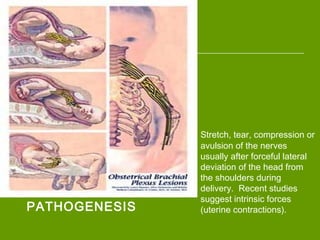
Stretch, tear, compression or
avulsion of the nerves
usually after forceful lateral
deviation of the head from
the shoulders during
delivery. Recent studies
suggest intrinsic forces
(uterine contractions).PATHOGENESIS
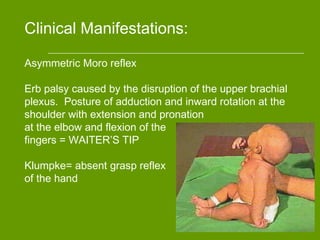
Clinical Manifestations:
Asymmetric Moro reflex
Erb palsy caused by the disruption of the upper brachial
plexus. Posture of adduction and inward rotation at the
shoulder with extension and pronation
at the elbow and flexion of the
fingers = WAITER’S TIP
Klumpke= absent grasp reflex
of the hand
Clinical Manifestations
If phrenic nerve is involved, as mentioned earlier
respiratory distress may be present.
DIFFERENTIAL DIAGNOSIS
Cervical Injury
Cervical Spine injury
Dislocation of upper extremity/fractures of upper
extremity
Intrauterine maladaptation palsy
The physical findings of BP palsy are so unique so it is
difficult to mistaken if for other diagnosis.
DIAGNOSTIC WORKUP
Evaluation can be undertaken by multiple modes of
Imaging.
EMG
MRI
Chest X ray
Real time UltraSonography
MANAGEMENT
The majority of patients with brachial plexus palsy
Dx at birth will recover from neurologic deficit.
Those who do not recover during 3-6month period will
Require surgical intervention.
1-2 week rest of affected limb
Early referral to upper extremity clinic and PT
Caregivers should be instructed on how to handle baby:
No traction of affected arm, no pressure under axila.
Baby to be carried in football hold
Resting position
MANAGEMENT
Surgica
l •Exploration
•Neurolysis
•Excision of scar tissue
•Nerve grafting (local end to end anastomosis or remote
nerve transplant)
•Surgical plication in case of diaphragmatic involvement
Special considerations in post surgical care:
Edema of neck and compromise of airway
Injury to vagal and laryngeal nerves
Risk for meningitis
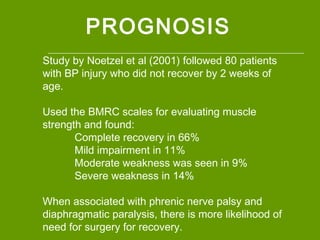
PROGNOSIS
Study by Noetzel et al (2001) followed 80 patients
with BP injury who did not recover by 2 weeks of
age.
Used the BMRC scales for evaluating muscle
strength and found:
Complete recovery in 66%
Mild impairment in 11%
Moderate weakness was seen in 9%
Severe weakness in 14%
When associated with phrenic nerve palsy and
diaphragmatic paralysis, there is more likelihood of
need for surgery for recovery.
REFERENCES
 Brachial plexus palsy in neonates
John B Cahil, Medlink
Brachial plexus injury and
obstetrical risk factors. Int J
Gynecol Obst 2001;73 (1) 21-5
Brachial plexus injuries, emedicine
Aug 2004
THANK YOU

Brachial plexus

  • 1.
    BRACHIAL PLEXUS INJURYIN NEONATES Dr. Maher Shoblaq Dr. Zuhair ALDajani
  • 2.
    1764 Obstetrical brachialpalsy described by Smellie. 1874 Wilhelm H. Erb described brachial plexus paralysis in adults which involved the upper roots and described certain types of “delivery paralysis”. He credited Duchenne for describing the brachial palsy following delivery in affected newborns. 1885 Augusta Klumpke first described the clinical picture resulting from injury to lower roots. BACKGROUN D
  • 3.
    EPIDEMIOLOGY Incidence of brachialplexus palsy is reported to affect 0.5 to 1.9 per 1000 live births (Bar et al 2001) 90% Erb palsy Most common on the right side because the most common delivery presentation is left occiput anterior vertex. Associated with: pre and gestational diabetes older maternal age increased BW, LGA Newborns with BP injuries have a higher incidence of low Apgar scores of less than 7 at 1 and 5 mins and of asphyxia than matched controls
  • 4.
    Brachial plexus palsyoccurs in 26% of cases of shoulder Dystocia Both Shoulder dystocia and brachial plexus palsy are more common in LGA babies and Infants of diabetic mothers Infants of diabetic mothers have a higher incidence of permanent impairment In infants of diabetic mothers, the macrosomic process affects the trunk but not the head (large biacromial diameter) The head shoulder disproportion is difficult to predict in Utero. EPIDEMIOLOGY
  • 5.
    Clavicular fractures areoften associated with shoulder dystocia , but the incidence of brachial palsy in these Cases is only 11%. Clavicular fracture =more mobility of shoulder Not always associated with difficult delivery (Intrauterine Maladaption palsy). Cases of in utero origin supported by EMG findings if denervation at birth. EPIDEMIOLOGY
  • 10.
  • 11.
  • 12.
    Brachial plexus iscomprised of a group of nerves arising form the nerve roots C5-T1. The uppper (C5-C6) roots innervate the deltoid, spinati,biceps, brachioradialis, biceps supinator and flexor muscles of the forearm. The lower roots (C7-T1) innervate the intrinsic muscles of the hand. The phrenic nerve, arising from C3-C5 can be involved resulting in ipsilateral diaphragmatic paralysis causing a decrease in thoracic space, tidal volume and vital capacity. Involvement of the sympathetic nerves from T1 that give rise to the sup cervical symp ganglion can result in Horner Synd.
  • 13.
  • 14.
    Stretch, tear, compressionor avulsion of the nerves usually after forceful lateral deviation of the head from the shoulders during delivery. Recent studies suggest intrinsic forces (uterine contractions).PATHOGENESIS
  • 15.
    Clinical Manifestations: Asymmetric Mororeflex Erb palsy caused by the disruption of the upper brachial plexus. Posture of adduction and inward rotation at the shoulder with extension and pronation at the elbow and flexion of the fingers = WAITER’S TIP Klumpke= absent grasp reflex of the hand
  • 17.
    Clinical Manifestations If phrenicnerve is involved, as mentioned earlier respiratory distress may be present.
  • 18.
    DIFFERENTIAL DIAGNOSIS Cervical Injury CervicalSpine injury Dislocation of upper extremity/fractures of upper extremity Intrauterine maladaptation palsy The physical findings of BP palsy are so unique so it is difficult to mistaken if for other diagnosis.
  • 19.
    DIAGNOSTIC WORKUP Evaluation canbe undertaken by multiple modes of Imaging. EMG MRI Chest X ray Real time UltraSonography
  • 20.
    MANAGEMENT The majority ofpatients with brachial plexus palsy Dx at birth will recover from neurologic deficit. Those who do not recover during 3-6month period will Require surgical intervention. 1-2 week rest of affected limb Early referral to upper extremity clinic and PT Caregivers should be instructed on how to handle baby: No traction of affected arm, no pressure under axila. Baby to be carried in football hold
  • 21.
  • 22.
    MANAGEMENT Surgica l •Exploration •Neurolysis •Excision ofscar tissue •Nerve grafting (local end to end anastomosis or remote nerve transplant) •Surgical plication in case of diaphragmatic involvement Special considerations in post surgical care: Edema of neck and compromise of airway Injury to vagal and laryngeal nerves Risk for meningitis
  • 23.
    PROGNOSIS Study by Noetzelet al (2001) followed 80 patients with BP injury who did not recover by 2 weeks of age. Used the BMRC scales for evaluating muscle strength and found: Complete recovery in 66% Mild impairment in 11% Moderate weakness was seen in 9% Severe weakness in 14% When associated with phrenic nerve palsy and diaphragmatic paralysis, there is more likelihood of need for surgery for recovery.
  • 24.
    REFERENCES  Brachial plexuspalsy in neonates John B Cahil, Medlink Brachial plexus injury and obstetrical risk factors. Int J Gynecol Obst 2001;73 (1) 21-5 Brachial plexus injuries, emedicine Aug 2004
  • 25.