PERIPHERAL NERVOUS SYSTEM
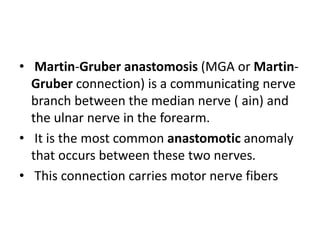
• Martin-Gruber anastomosis (MGA or Martin-
Gruber connection) is a communicating nerve
branch between the median nerve ( ain) and
the ulnar nerve in the forearm.
• It is the most common anastomotic anomaly
that occurs between these two nerves.
• This connection carries motor nerve fibers
• Riche-Cannieu anastomosis is communication
between recurrent branch of median nerve
and deep branch of ulnar nerve in hand.
• BP formed b/w anterior & middle scalene m/s &
Cervical roots hav a dwnward couse twds the 1 st
rib wereas T1 root is directed upwards over 1st rib
top join plexus
• trunk located in posterior traingle of neck
bounded by scm, upper trapezius , clavicle
• Omohyoid m/s divides post triangle into upper &
lower parts –with upper & middle trunk lying
above & lower trunk inferior to omohyoid
• Each trunk divides retroclavicularly into divisions
cords – 2nd part of axillary artery
• Reconstruction – delayed procedure by 3 mts
early repair indicates a repair 8 to 12 weeks of
injury in traction induced severe bpi ( flail
limb, +ve horner)
• Rx – direct nerve repair
• Nerve grafing – sural nerve, medial cutaneous
nerve of FA ,LCNFA
• Nv transfer – 6 to 9mts after injury
Preganglionic
• Nv root avulsion
• Parascapular m/s paralysed
• Horner syn +
• Paravertebral anesthesia +
• Absent tinel sign
• Sensory nerve action potential +
• Histamine test + ve
Postganglionic
• Proximal stump & neuroma – tinel sign + ve
• Roots intact
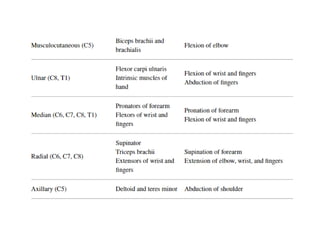
• Elbow flexors (biceps) are innervated by C5
• C6 the wrist extensors
• C7 the elbow extensors (triceps),
• C8 the finger flexors
• T1 the little finger abductor (Movement of the
little finger away from others).
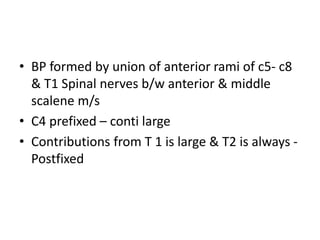
• BP formed by union of anterior rami of c5- c8
& T1 Spinal nerves b/w anterior & middle
scalene m/s
• C4 prefixed – conti large
• Contributions from T 1 is large & T2 is always -
Postfixed
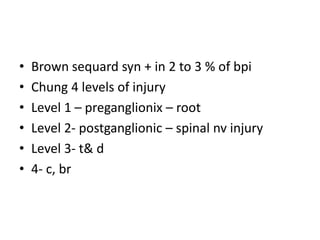
• Brown sequard syn + in 2 to 3 % of bpi
• Chung 4 levels of injury
• Level 1 – preganglionix – root
• Level 2- postganglionic – spinal nv injury
• Level 3- t& d
• 4- c, br
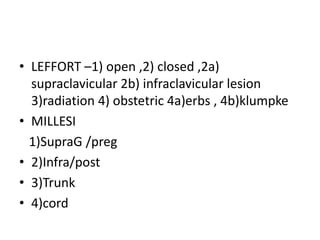
• LEFFORT –1) open ,2) closed ,2a)
supraclavicular 2b) infraclavicular lesion
3)radiation 4) obstetric 4a)erbs , 4b)klumpke
• MILLESI
1)SupraG /preg
• 2)Infra/post
• 3)Trunk
• 4)cord
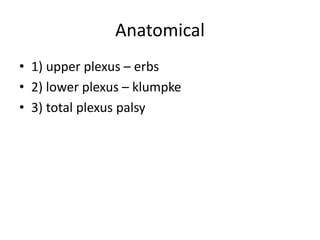
Anatomical
• 1) upper plexus – erbs
• 2) lower plexus – klumpke
• 3) total plexus palsy
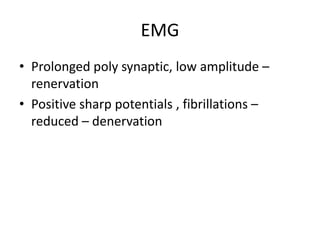
EMG
• Prolonged poly synaptic, low amplitude –
renervation
• Positive sharp potentials , fibrillations –
reduced – denervation
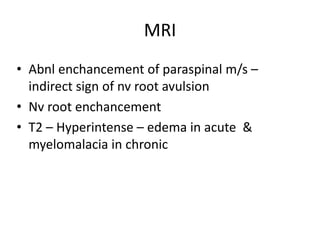
MRI
• Abnl enchancement of paraspinal m/s –
indirect sign of nv root avulsion
• Nv root enchancement
• T2 – Hyperintense – edema in acute &
myelomalacia in chronic
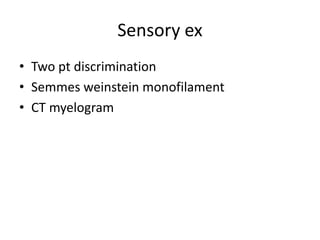
Sensory ex
• Two pt discrimination
• Semmes weinstein monofilament
• CT myelogram
• Intradermal histamine test –
• If there is response with flare in an otherwise
unconscious skin area, then the lesion has to
be proximal to the dorsal root ganglion, which
means that it must be a root avulsion injury.
• postganglionic the test will be negative as the
continuity between the skin and dorsal root
ganglion will have been interrupted.
• Electromyography (EMG) tests muscles at rest
and during activity.
• Denervation changes (fibrillation potentials)
can be seen as early as 10 to 14 days after
injury in proximal muscles and as late as 3 to 6
weeks in distal muscles.
• The presence of voluntary motor unit
potentials with limited fibrillation potentials
signifies better prognosis
• SNAPs will be absent in a postganglionic or
combined pre- and postganglionic lesion.
preganglionic injuries there are normal SNAPs
• Combined electrodiagnostic techniques like
nerve action potentials (NAPs),
somatosensory evoked potentials (SSEPs), and
compound muscle action potentials (CMAPs)
may give adequate additional information in
order to help the surgeon in decision making
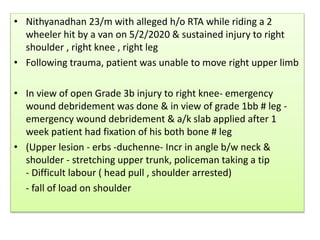
• Nithyanadhan 23/m with alleged h/o RTA while riding a 2
wheeler hit by a van on 5/2/2020 & sustained injury to right
shoulder , right knee , right leg
• Following trauma, patient was unable to move right upper limb
• In view of open Grade 3b injury to right knee- emergency
wound debridement was done & in view of grade 1bb # leg -
emergency wound debridement & a/k slab applied after 1
week patient had fixation of his both bone # leg
• (Upper lesion - erbs -duchenne- Incr in angle b/w neck &
shoulder - stretching upper trunk, policeman taking a tip
- Difficult labour ( head pull , shoulder arrested)
- fall of load on shoulder
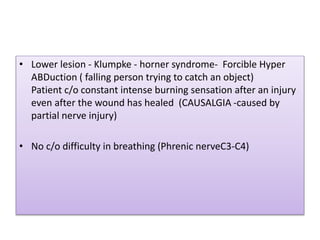
• Lower lesion - Klumpke - horner syndrome- Forcible Hyper
ABDuction ( falling person trying to catch an object)
Patient c/o constant intense burning sensation after an injury
even after the wound has healed (CAUSALGIA -caused by
partial nerve injury)
• No c/o difficulty in breathing (Phrenic nerveC3-C4)
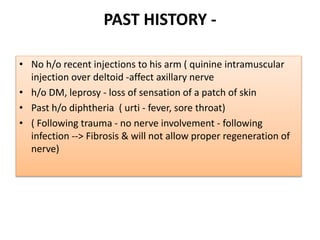
PAST HISTORY -
• No h/o recent injections to his arm ( quinine intramuscular
injection over deltoid -affect axillary nerve
• h/o DM, leprosy - loss of sensation of a patch of skin
• Past h/o diphtheria ( urti - fever, sore throat)
• ( Following trauma - no nerve involvement - following
infection --> Fibrosis & will not allow proper regeneration of
nerve)
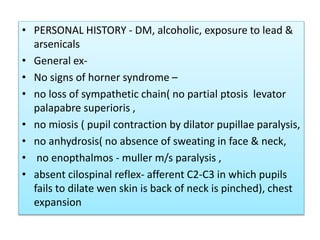
• PERSONAL HISTORY - DM, alcoholic, exposure to lead &
arsenicals
• General ex-
• No signs of horner syndrome –
• no loss of sympathetic chain( no partial ptosis levator
palapabre superioris ,
• no miosis ( pupil contraction by dilator pupillae paralysis,
• no anhydrosis( no absence of sweating in face & neck,
• no enopthalmos - muller m/s paralysis ,
• absent cilospinal reflex- afferent C2-C3 in which pupils
fails to dilate wen skin is back of neck is pinched), chest
expansion
• LOCAL EXAMINATION -
• Inspection -
• 1) Attitude & deformity -
• Head in midline
• Shoulder levels
Anteriorly -
• 2) Wasting- deltoid , (forearm )thenar, hypothenar eminence,
hollows b/w metacarpals due to atrophy of interossei
• 3) Skin - dry ( no sweating due to involvement of sympathetic
nerve)
• complete paralysis - glossy , smooth with disappearance of
cutaneous folds & subcutaneous fat
• partial lesion - causalgia
• Vasomotor changes - Pallor, cyanosis ,excessive
sweating and trophic disturbances such as ridged
nails & brittle nails
• Sometimes trophic ulcer seen
• 4) Scar or wound - healed abrasion over rt
infraclavicular region, bony prominence + over rt lat
end of clavicle,
Wrist drop +
PALPATION -
• 1) Temperature - usually cold in paralysed side
• 2)Muscles - softer & more flabby & fn of m/s
hampered
• 3) Skin- axillary sensations
If hyperaesthesia - Site of nerve regeneration (
by shifting of this site of hyperaesthesia we can
access speed of regeneration
• 4) Scar tenderness ( adhesion of nerve to scar)
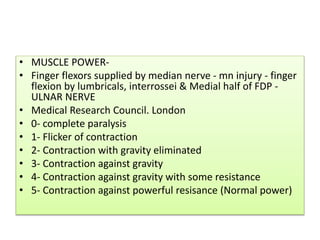
• MUSCLE POWER-
• Finger flexors supplied by median nerve - mn injury - finger
flexion by lumbricals, interrossei & Medial half of FDP -
ULNAR NERVE
• Medical Research Council. London
• 0- complete paralysis
• 1- Flicker of contraction
• 2- Contraction with gravity eliminated
• 3- Contraction against gravity
• 4- Contraction against gravity with some resistance
• 5- Contraction against powerful resisance (Normal power)
• MUSCLES TESTED FOR INDIVIDUAL NERVES-
• CN 11- Accessory nerve- Trapezius- Elevate sh against
resistance, sternocleidomastoid - turn his head opp side
against resistance
• CN 12- Hypoglossal nerve - protrude tongue - in
hemiparesis - tip of tongue to side of lesion
• Long thoracic nerve - Push wall with outstretched hands -
Winging of scapula ( prominence of vertebral border &
inferior border of scapula) - Long thoracic nerve of bell
anterior rami of three spinal nerve roots: the fifth, sixth,
and seventh cervical nerves (C5-C7) (Sir Charles Bell)-
protraction of the scapula - "big swing muscle" or "boxer's
muscle" serratus anterior superior ,intermediate ,inferior
• AXILLARY NERVE - DELTOID - sh ABD + elbow - 90 - against
resist, palpate D for contraction
• RADIAL NERVE -
• 1)Brachioradialis - FA - Midprone + E- Flexion - resist - m/s wil stand
out as prominent band
• 2)Extensors of wrist joint - PIN ( xcpt ECRL )- Wrist drop - extend
wrist against resistance - grade
• 3)Extensor digitorum - MCP extension, also extend IP jt along with
corresponding interossei & lumbricals
• If paralysed , absent MCP extension , but wil be able to extend IP
joints to some extent
MEDIAN NERVE -
• 1) Flexor pollicis longus - Bend Terminal phalanx
against resistance
• Hold prox phalanx by
clinician
• PARALYSED OLY WEN MEDIAN NERVE IS INJURIED
AT OR ABOVE ELBOW
• 2) FDS , FDP( lat half)- Clasp hands - Index finger
fails to flex & remains as pointing index /
ochsners clasping test
• 3) AB P B - Hand flat on table - thumb 90 to palm
- ABD thumb - pen test
• 4) opponens pollicis - Thumb across palm touch
finger tips of other fingers ( short of proper
opposition movt by add pollicis by ulnar)
• Ulnar nerve-
• 1) Flexor carpi ulnaris - Wrist flexed against
extension , hand tend to deviate towards radial
side
• 2) Interossei- Dab , pad of fingers -- interossei +
lumbricals flex MCP & extend both pip & dip jts
• Card - hold card by adducting 2 fingers- try to
pull out card -- strength of palmar interossei
• MCP flexion cant be tested as FDS & FDP does
it
• MCP extension by ED
• PIP & DIP EXTENSION BY INTEROSSEI
• steady prox phalanx & extend middle &
terminal phalanx against resistance - strength
of interossei & lumbricals
• RADIAL NERVE
• C5-T1-Post cord- descends behind 3rd part of axillary
art & infront of subcapularis &the tendons of
latissimus dorsi & teres major.
• Passes obliquely across the post aspect of
humerus,1st b/w lat & medial head of triceps being
accompained by profundi brachii to reach lat side of
humerus where it pierces lat intermuscular septum &
enters ant compt of arm.
• Descends b/w brachialis on one side & brachioradialis
above & ecrl below on the other side.
• In front of lat epicondyle it divides into superficial &
deep
• Superficial br - descends in front of lAt epic & lies in
front of supinator & behind brachioradialis
• it now runs in front of pronator , radial head of fds &
FPL
• At about 7cm above the wrist , nv turns back round the
lateral side of radius, pierces the deep fascia & divides
into five dorsal digital nerves- to supply skin on radial
side of thumb ,adjoining part of thenar eminence,
medial side of thumb, IF,MF, Lat half of RF
• It do not supply upto tip of fingers, but they stop as far
as the root of nail in thumb, as far as middle phalanx in
IF & upto PIP jt in case of MF & RF
• PIN /Deep br - winds round lat side of radius b/w 2
planes of fibres of supinator to reach back of forearm
• b4 it enters supinator m/s it gives br to ECRB & another
to supinator
• after it cums out of S, it gives off 3 short br -
ED,EDM,ECU & 2 Long br - EPL & EI & another to ABpl,
epb
• 3 cutaneous br - PCNA,PCNFA, lower LCNA
• rAdial nerv - m/s br - triceps, anconeus, brachioradialis,
ecrl & lat one fourth of brachialis
Radial nerve - Compression in prox FA
• Compression in prox FA – pin syn , radial
tunnel/supinator syn / resistant tennis elbow
5 sites
M/C Arcade of froshe – fibrous portion of prox edge of S
Leash of henry – recurrent rad art fans out across nerve
at radial neck level
ECRB
Substance or distal edge of supinator
Fibrous band ant to radiohumeral lig b/w BR lat &
brachialis medially
Wartenburg syn
• Symptoms exacerbate by FA pronation –
tendons of BR & ECRL approximate &
compress the nerve
• DELTOID -
• Multipennate - ant,( FLEXORS & MEDIAL
ROTATORS) mid, post fibres (E, LR)
Median nerve – lat root of LC (
sensory)+ med root of m cord( motor)
• Chief nerve of arm
• Labourers nv
• No br in arm
• Cubital fossa - Lies medial to br.art , behind
bicipital aponeurosis, in front of brachialis
• Enters forearm by passing b/w 2 heads of
pronator teres
• Along ulnar artery,it passes beneath fibrous arch
of FDS & runs deep to this m/s on the surface of
FDP
• About 5cm above flexor retinaculum, it
becomes superficial & lies b/w tendons of FCR
laterally & FDS medially
• It is overlapped by palmaris longus tendon
• Enters palm by passing deep to FR thro carpal
tunnel
Branches
• Muscular br given off in cubital fossa-
FCR,Palmaris longus ,FDS
• AI br- FPL, Lat half of FDP ( Tendons of IF &
MF) , pronator quadratus
• Palmar cutaneous br – thenar eminenec
• Articular br to elbow & pruj
• Vascular br & communicating br
• Ligment of Sruthers complex/ supracondylar
spur
• Normal anatomical variant seen in 1%
responsible for high median nerve
compression
AIN SYN/KILOH NEVIN SYN
• Pure motor nv
• Fibrosus arch b/w 2 heads of pronator teres
• Fibrosus arch of FDS
• Spinner accessory bicipital aponeurosis
• Acc & anomalous m/s
• Gantzer m/s – acc.head of FDP
• Palmaris profundus
• FCR BREVIS
• Parsonage-Turner Syndrome (PTS), also
referred to as idiopathic brachial plexopathy
or neuralgic amyotrophy, is a rare disorder
consisting of a complex constellation of
symptoms with abrupt onset of shoulder pain,
usually unilaterally, followed by progressive
neurologic deficits of motor weakness,
ULNAR NERVE –MUSICIAN NERVE
• Palpable as it lies behind medial epicondyle
humerus & not a content in cubital fossa
• Enters FA b/w 2 heads of FCU
• FA - Runs b/w FDP medially & FDS laterally
• At wrist – ulnar neurovascular bundle lies b/w
FCU & FDS
• Enters palm by passing superficial to FR lat to
pisiform
• m/s br supplies FCU & MEDIAL HALF OF FDP

brachial plexus

  • 1.
  • 3.
    • Martin-Gruber anastomosis(MGA or Martin- Gruber connection) is a communicating nerve branch between the median nerve ( ain) and the ulnar nerve in the forearm. • It is the most common anastomotic anomaly that occurs between these two nerves. • This connection carries motor nerve fibers
  • 4.
    • Riche-Cannieu anastomosisis communication between recurrent branch of median nerve and deep branch of ulnar nerve in hand.
  • 5.
    • BP formedb/w anterior & middle scalene m/s & Cervical roots hav a dwnward couse twds the 1 st rib wereas T1 root is directed upwards over 1st rib top join plexus • trunk located in posterior traingle of neck bounded by scm, upper trapezius , clavicle • Omohyoid m/s divides post triangle into upper & lower parts –with upper & middle trunk lying above & lower trunk inferior to omohyoid • Each trunk divides retroclavicularly into divisions cords – 2nd part of axillary artery
  • 6.
    • Reconstruction –delayed procedure by 3 mts early repair indicates a repair 8 to 12 weeks of injury in traction induced severe bpi ( flail limb, +ve horner) • Rx – direct nerve repair • Nerve grafing – sural nerve, medial cutaneous nerve of FA ,LCNFA • Nv transfer – 6 to 9mts after injury
  • 7.
    Preganglionic • Nv rootavulsion • Parascapular m/s paralysed • Horner syn + • Paravertebral anesthesia + • Absent tinel sign • Sensory nerve action potential + • Histamine test + ve
  • 8.
    Postganglionic • Proximal stump& neuroma – tinel sign + ve • Roots intact
  • 9.
    • Elbow flexors(biceps) are innervated by C5 • C6 the wrist extensors • C7 the elbow extensors (triceps), • C8 the finger flexors • T1 the little finger abductor (Movement of the little finger away from others).
  • 13.
    • BP formedby union of anterior rami of c5- c8 & T1 Spinal nerves b/w anterior & middle scalene m/s • C4 prefixed – conti large • Contributions from T 1 is large & T2 is always - Postfixed
  • 14.
    • Brown sequardsyn + in 2 to 3 % of bpi • Chung 4 levels of injury • Level 1 – preganglionix – root • Level 2- postganglionic – spinal nv injury • Level 3- t& d • 4- c, br
  • 15.
    • LEFFORT –1)open ,2) closed ,2a) supraclavicular 2b) infraclavicular lesion 3)radiation 4) obstetric 4a)erbs , 4b)klumpke • MILLESI 1)SupraG /preg • 2)Infra/post • 3)Trunk • 4)cord
  • 16.
    Anatomical • 1) upperplexus – erbs • 2) lower plexus – klumpke • 3) total plexus palsy
  • 17.
    EMG • Prolonged polysynaptic, low amplitude – renervation • Positive sharp potentials , fibrillations – reduced – denervation
  • 18.
    MRI • Abnl enchancementof paraspinal m/s – indirect sign of nv root avulsion • Nv root enchancement • T2 – Hyperintense – edema in acute & myelomalacia in chronic
  • 19.
    Sensory ex • Twopt discrimination • Semmes weinstein monofilament • CT myelogram
  • 20.
    • Intradermal histaminetest – • If there is response with flare in an otherwise unconscious skin area, then the lesion has to be proximal to the dorsal root ganglion, which means that it must be a root avulsion injury. • postganglionic the test will be negative as the continuity between the skin and dorsal root ganglion will have been interrupted.
  • 21.
    • Electromyography (EMG)tests muscles at rest and during activity. • Denervation changes (fibrillation potentials) can be seen as early as 10 to 14 days after injury in proximal muscles and as late as 3 to 6 weeks in distal muscles. • The presence of voluntary motor unit potentials with limited fibrillation potentials signifies better prognosis
  • 22.
    • SNAPs willbe absent in a postganglionic or combined pre- and postganglionic lesion. preganglionic injuries there are normal SNAPs
  • 23.
    • Combined electrodiagnostictechniques like nerve action potentials (NAPs), somatosensory evoked potentials (SSEPs), and compound muscle action potentials (CMAPs) may give adequate additional information in order to help the surgeon in decision making
  • 24.
    • Nithyanadhan 23/mwith alleged h/o RTA while riding a 2 wheeler hit by a van on 5/2/2020 & sustained injury to right shoulder , right knee , right leg • Following trauma, patient was unable to move right upper limb • In view of open Grade 3b injury to right knee- emergency wound debridement was done & in view of grade 1bb # leg - emergency wound debridement & a/k slab applied after 1 week patient had fixation of his both bone # leg • (Upper lesion - erbs -duchenne- Incr in angle b/w neck & shoulder - stretching upper trunk, policeman taking a tip - Difficult labour ( head pull , shoulder arrested) - fall of load on shoulder
  • 25.
    • Lower lesion- Klumpke - horner syndrome- Forcible Hyper ABDuction ( falling person trying to catch an object) Patient c/o constant intense burning sensation after an injury even after the wound has healed (CAUSALGIA -caused by partial nerve injury) • No c/o difficulty in breathing (Phrenic nerveC3-C4)
  • 26.
    PAST HISTORY - •No h/o recent injections to his arm ( quinine intramuscular injection over deltoid -affect axillary nerve • h/o DM, leprosy - loss of sensation of a patch of skin • Past h/o diphtheria ( urti - fever, sore throat) • ( Following trauma - no nerve involvement - following infection --> Fibrosis & will not allow proper regeneration of nerve)
  • 27.
    • PERSONAL HISTORY- DM, alcoholic, exposure to lead & arsenicals • General ex- • No signs of horner syndrome – • no loss of sympathetic chain( no partial ptosis levator palapabre superioris , • no miosis ( pupil contraction by dilator pupillae paralysis, • no anhydrosis( no absence of sweating in face & neck, • no enopthalmos - muller m/s paralysis , • absent cilospinal reflex- afferent C2-C3 in which pupils fails to dilate wen skin is back of neck is pinched), chest expansion
  • 28.
    • LOCAL EXAMINATION- • Inspection - • 1) Attitude & deformity - • Head in midline • Shoulder levels Anteriorly - • 2) Wasting- deltoid , (forearm )thenar, hypothenar eminence, hollows b/w metacarpals due to atrophy of interossei • 3) Skin - dry ( no sweating due to involvement of sympathetic nerve) • complete paralysis - glossy , smooth with disappearance of cutaneous folds & subcutaneous fat • partial lesion - causalgia
  • 29.
    • Vasomotor changes- Pallor, cyanosis ,excessive sweating and trophic disturbances such as ridged nails & brittle nails • Sometimes trophic ulcer seen • 4) Scar or wound - healed abrasion over rt infraclavicular region, bony prominence + over rt lat end of clavicle, Wrist drop +
  • 30.
    PALPATION - • 1)Temperature - usually cold in paralysed side • 2)Muscles - softer & more flabby & fn of m/s hampered • 3) Skin- axillary sensations If hyperaesthesia - Site of nerve regeneration ( by shifting of this site of hyperaesthesia we can access speed of regeneration • 4) Scar tenderness ( adhesion of nerve to scar)
  • 31.
    • MUSCLE POWER- •Finger flexors supplied by median nerve - mn injury - finger flexion by lumbricals, interrossei & Medial half of FDP - ULNAR NERVE • Medical Research Council. London • 0- complete paralysis • 1- Flicker of contraction • 2- Contraction with gravity eliminated • 3- Contraction against gravity • 4- Contraction against gravity with some resistance • 5- Contraction against powerful resisance (Normal power)
  • 32.
    • MUSCLES TESTEDFOR INDIVIDUAL NERVES- • CN 11- Accessory nerve- Trapezius- Elevate sh against resistance, sternocleidomastoid - turn his head opp side against resistance • CN 12- Hypoglossal nerve - protrude tongue - in hemiparesis - tip of tongue to side of lesion • Long thoracic nerve - Push wall with outstretched hands - Winging of scapula ( prominence of vertebral border & inferior border of scapula) - Long thoracic nerve of bell anterior rami of three spinal nerve roots: the fifth, sixth, and seventh cervical nerves (C5-C7) (Sir Charles Bell)- protraction of the scapula - "big swing muscle" or "boxer's muscle" serratus anterior superior ,intermediate ,inferior
  • 33.
    • AXILLARY NERVE- DELTOID - sh ABD + elbow - 90 - against resist, palpate D for contraction • RADIAL NERVE - • 1)Brachioradialis - FA - Midprone + E- Flexion - resist - m/s wil stand out as prominent band • 2)Extensors of wrist joint - PIN ( xcpt ECRL )- Wrist drop - extend wrist against resistance - grade • 3)Extensor digitorum - MCP extension, also extend IP jt along with corresponding interossei & lumbricals • If paralysed , absent MCP extension , but wil be able to extend IP joints to some extent
  • 34.
    MEDIAN NERVE - •1) Flexor pollicis longus - Bend Terminal phalanx against resistance • Hold prox phalanx by clinician • PARALYSED OLY WEN MEDIAN NERVE IS INJURIED AT OR ABOVE ELBOW • 2) FDS , FDP( lat half)- Clasp hands - Index finger fails to flex & remains as pointing index / ochsners clasping test • 3) AB P B - Hand flat on table - thumb 90 to palm - ABD thumb - pen test
  • 35.
    • 4) opponenspollicis - Thumb across palm touch finger tips of other fingers ( short of proper opposition movt by add pollicis by ulnar) • Ulnar nerve- • 1) Flexor carpi ulnaris - Wrist flexed against extension , hand tend to deviate towards radial side • 2) Interossei- Dab , pad of fingers -- interossei + lumbricals flex MCP & extend both pip & dip jts
  • 36.
    • Card -hold card by adducting 2 fingers- try to pull out card -- strength of palmar interossei • MCP flexion cant be tested as FDS & FDP does it • MCP extension by ED • PIP & DIP EXTENSION BY INTEROSSEI • steady prox phalanx & extend middle & terminal phalanx against resistance - strength of interossei & lumbricals
  • 37.
    • RADIAL NERVE •C5-T1-Post cord- descends behind 3rd part of axillary art & infront of subcapularis &the tendons of latissimus dorsi & teres major. • Passes obliquely across the post aspect of humerus,1st b/w lat & medial head of triceps being accompained by profundi brachii to reach lat side of humerus where it pierces lat intermuscular septum & enters ant compt of arm. • Descends b/w brachialis on one side & brachioradialis above & ecrl below on the other side. • In front of lat epicondyle it divides into superficial & deep
  • 38.
    • Superficial br- descends in front of lAt epic & lies in front of supinator & behind brachioradialis • it now runs in front of pronator , radial head of fds & FPL • At about 7cm above the wrist , nv turns back round the lateral side of radius, pierces the deep fascia & divides into five dorsal digital nerves- to supply skin on radial side of thumb ,adjoining part of thenar eminence, medial side of thumb, IF,MF, Lat half of RF • It do not supply upto tip of fingers, but they stop as far as the root of nail in thumb, as far as middle phalanx in IF & upto PIP jt in case of MF & RF
  • 39.
    • PIN /Deepbr - winds round lat side of radius b/w 2 planes of fibres of supinator to reach back of forearm • b4 it enters supinator m/s it gives br to ECRB & another to supinator • after it cums out of S, it gives off 3 short br - ED,EDM,ECU & 2 Long br - EPL & EI & another to ABpl, epb • 3 cutaneous br - PCNA,PCNFA, lower LCNA • rAdial nerv - m/s br - triceps, anconeus, brachioradialis, ecrl & lat one fourth of brachialis
  • 40.
    Radial nerve -Compression in prox FA • Compression in prox FA – pin syn , radial tunnel/supinator syn / resistant tennis elbow 5 sites M/C Arcade of froshe – fibrous portion of prox edge of S Leash of henry – recurrent rad art fans out across nerve at radial neck level ECRB Substance or distal edge of supinator Fibrous band ant to radiohumeral lig b/w BR lat & brachialis medially
  • 41.
    Wartenburg syn • Symptomsexacerbate by FA pronation – tendons of BR & ECRL approximate & compress the nerve
  • 42.
    • DELTOID - •Multipennate - ant,( FLEXORS & MEDIAL ROTATORS) mid, post fibres (E, LR)
  • 43.
    Median nerve –lat root of LC ( sensory)+ med root of m cord( motor) • Chief nerve of arm • Labourers nv • No br in arm • Cubital fossa - Lies medial to br.art , behind bicipital aponeurosis, in front of brachialis • Enters forearm by passing b/w 2 heads of pronator teres • Along ulnar artery,it passes beneath fibrous arch of FDS & runs deep to this m/s on the surface of FDP
  • 44.
    • About 5cmabove flexor retinaculum, it becomes superficial & lies b/w tendons of FCR laterally & FDS medially • It is overlapped by palmaris longus tendon • Enters palm by passing deep to FR thro carpal tunnel
  • 45.
    Branches • Muscular brgiven off in cubital fossa- FCR,Palmaris longus ,FDS • AI br- FPL, Lat half of FDP ( Tendons of IF & MF) , pronator quadratus • Palmar cutaneous br – thenar eminenec • Articular br to elbow & pruj • Vascular br & communicating br
  • 46.
    • Ligment ofSruthers complex/ supracondylar spur • Normal anatomical variant seen in 1% responsible for high median nerve compression
  • 47.
    AIN SYN/KILOH NEVINSYN • Pure motor nv • Fibrosus arch b/w 2 heads of pronator teres • Fibrosus arch of FDS • Spinner accessory bicipital aponeurosis • Acc & anomalous m/s • Gantzer m/s – acc.head of FDP • Palmaris profundus • FCR BREVIS
  • 48.
    • Parsonage-Turner Syndrome(PTS), also referred to as idiopathic brachial plexopathy or neuralgic amyotrophy, is a rare disorder consisting of a complex constellation of symptoms with abrupt onset of shoulder pain, usually unilaterally, followed by progressive neurologic deficits of motor weakness,
  • 49.
    ULNAR NERVE –MUSICIANNERVE • Palpable as it lies behind medial epicondyle humerus & not a content in cubital fossa • Enters FA b/w 2 heads of FCU • FA - Runs b/w FDP medially & FDS laterally • At wrist – ulnar neurovascular bundle lies b/w FCU & FDS • Enters palm by passing superficial to FR lat to pisiform • m/s br supplies FCU & MEDIAL HALF OF FDP