‫أكاديمية الحكومة اإللكترونية الفلسطينية‬
            The Palestinian eGovernment Academy
                             www.egovacademy.ps


    Tutorial 1: Data and Business Process Modeling

                          Session 11-12
Business Process Modeling Notation Fundamentals

                By: Stephen A. White, IBM
            (With Modification and extensions)
              Dr. Mahmoud H. M. Saheb
                    Palestinian Polytechnic University
                              Reviewed by
                               PalGov © 2011
               Prof. Marco Ronchetti, Trento University, Italy       1
About

This tutorial is part of the PalGov project, funded by the TEMPUS IV program of the
Commission of the European Communities, grant agreement 511159-TEMPUS-1-
2010-1-PS-TEMPUS-JPHES. The project website: www.egovacademy.ps
Project Consortium:
             Birzeit University, Palestine
                                                           University of Trento, Italy
             (Coordinator )


             Palestine Polytechnic University, Palestine   Vrije Universiteit Brussel, Belgium


             Palestine Technical University, Palestine
                                                           Université de Savoie, France

             Ministry of Telecom and IT, Palestine
                                                           University of Namur, Belgium
             Ministry of Interior, Palestine
                                                           TrueTrust, UK
             Ministry of Local Government, Palestine


Coordinator:
Dr. Mustafa Jarrar
Birzeit University, P.O.Box 14- Birzeit, Palestine
Telfax:+972 2 2982935 mjarrar@birzeit.eduPalGov © 2011
                                                                                                 2
© Copyright Notes
Everyone is encouraged to use this material, or part of it, but should properly
cite the project (logo and website), and the author of that part.


No part of this tutorial may be reproduced or modified in any form or by any
means, without prior written permission from the project, who have the full
copyrights on the material.


                   Attribution-NonCommercial-ShareAlike
                                CC-BY-NC-SA

This license lets others remix, tweak, and build upon your work non-
commercially, as long as they credit you and license their new creations
under the identical terms.

                                    PalGov © 2011                                 3
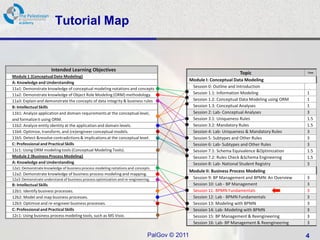
Tutorial Map


                       Intended Learning Objectives
                                                                                                                      Topic                       Time
Module 1 (Conceptual Date Modeling)
                                                                                               Module I: Conceptual Data Modeling
A: Knowledge and Understanding
11a1: Demonstrate knowledge of conceptual modeling notations and concepts                       Session 0: Outline and Introduction
11a2: Demonstrate knowledge of Object Role Modeling (ORM) methodology.                          Session 1.1: Information Modeling                 1
11a3: Explain and demonstrate the concepts of data integrity & business rules                   Session 1.2: Conceptual Data Modeling using ORM   1
B: Intellectual Skills                                                                          Session 1.3: Conceptual Analyses                  1
11b1: Analyze application and domain requirements at the conceptual level,                      Session 2: Lab- Conceptual Analyses               3
and formalize it using ORM.                                                                     Session 3.1: Uniqueness Rules                     1.5
11b2: Analyze entity identity at the application and domain levels.                             Session 3.2: Mandatory Rules                      1.5
11b4: Optimize, transform, and (re)engineer conceptual models.                                  Session 4: Lab- Uniqueness & Mandatory Rules      3
11b5: Detect &resolve contradictions & implications at the conceptual level.                    Session 5: Subtypes and Other Rules               3
C: Professional and Practical Skills                                                            Session 6: Lab- Subtypes and Other Rules          3
11c1: Using ORM modeling tools (Conceptual Modeling Tools).                                     Session 7.1: Schema Equivalence &Optimization     1.5
Module 2 (Business Process Modeling)                                                            Session 7.2: Rules Check &Schema Engineering      1.5
A: Knowledge and Understanding                                                                  Session 8: Lab- National Student Registry         3
12a1: Demonstrate knowledge of business process modeling notations and concepts.
                                                                                               Module II: Business Process Modeling
12a2: Demonstrate knowledge of business process modeling and mapping.
12a3: Demonstrate understand of business process optimization and re-engineering.               Session 9: BP Management and BPMN: An Overview    3
B: Intellectual Skills                                                                          Session 10: Lab - BP Management                   3
12b1: Identify business processes.                                                              Session 11: BPMN Fundamentals                     3
12b2: Model and map business processes.                                                         Session 12: Lab - BPMN Fundamentals               3
12b3: Optimize and re-engineer business processes.                                              Session 13: Modeling with BPMN                    3
C: Professional and Practical Skills                                                            Session 14: Lab- Modeling with BPMN               3
12c1: Using business process modeling tools, such as MS Visio.                                  Session 15: BP Management & Reengineering         3
                                                                                                Session 16: Lab- BP Management & Reengineering    3

                                                                               PalGov © 2011                                                      4
Session 11: BPMN Fundamentals

Session ILOs
After completing this session students will be able to:
1. Demonstrate knowledge of business process
    modeling and mapping.
2. Business Process Modeling for Normal Flow, B2B
    Modeling, Exception Handling, Compensation
    Handling, Complex Process.
3. Modeling orchestration and choreography


                   PalGov © 2011                      5
Session Outline


• BPMN Status

• BPMN Notation


                  PalGov © 2011   6
Background


History

Definition of BPMN

Initial Charter

Within the OMG


                  PalGov © 2011   7
History

Formation of Notation Working Group
    August, 2001, the Notation Working Group is formed. Currently, the Notation Working
       Group is composed of 58 members representing 35 companies, organizations, or
       individuals.
BPMN 0.9 Draft
    November, 2002, the BPMN 0.9 draft specification was released to the public
BPMN 1.0 Draft
    August, 2003, the BPMN 1.0 draft specification was released to the public
BPMN 1.0
    May, 2004, the BPMN 1.0 specification was released to the public.
    Currently, there are 28 companies that have implementations of BPMN and there are
       5 companies developing implementations.
Merger with OMG
    June, 2005, BPMN 1.x was in development. BPMN 1.0 is OMG IP, but an RFC/FTF
       process is underway to establish as an OMG specification and to allow
       continuation of work.
BPMN 2.0
    The final version of the specification was released in January, 2011


                                   PalGov © 2011                                    8
Definition of BPMN


Business Process Modeling Notation (BPMN)
  BPMN provides businesses with the capability of
  defining and understanding their internal and external
  business procedures through a Business Process
  Diagram, which will give organizations the ability to
  communicate these procedures in a standard manner.
  BPMN also is supported with an internal model that
  enables the generation of executable BPEL4WS.


                     PalGov © 2011                     9
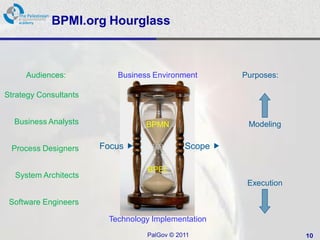
BPMI.org Hourglass


     Audiences:           Business Environment        Purposes:

Strategy Consultants


  Business Analysts              BPMN                  Modeling


 Process Designers     Focus      BP       Scope 

                                 BPEL
  System Architects
                                                       Execution

 Software Engineers

                        Technology Implementation
                                 PalGov © 2011                     10
BPMN Semantics


The BPMN 1.0 Specification did not
formally define the semantics of the
Business Process Diagram (i.e., a
metamodel)


              PalGov © 2011            11
Within the OMG

•Business Modeling Integration (BMI) Domain Task Force (DTF)
    – BMI is developing a Business Process Definition Metamodel (BDPM)
    – BPDM could possibly serve as the Metamodel for BPMN
        • The Metamodel would be used to generate a BPMN schema for exchange of
          BPMN Diagram Semantic information
    – BPMN RFC approved, an FTF to be established this meeting
        • This will allow the continuation of BPMN development–a future RFP or
          consolidate with BPDM?


•Other OMG Work
    – Has developed UML2, which includes an Activity Diagram
        • The Activity Diagram is often used by IT specialists for process modeling, but
          not many business analysts (which use BPMN)
        • The merging of BPMN and UML Activity Diagrams would bring together the two
          modeling audiences
    – Other Process-related work:
    –   UML Profile for DODAF/MODAF; SPEM; SysML; PSL
    – Has developed an XML Interchange Format (XMI) for the exchange of
      diagrams
        • XMI could be used for the exchange of BPMN Diagram Layout information


                            PalGov © 2011                                            12
Major changes in BPMN2

• Choreographies
   – Choreographies-model

   – Conversation-model

• Complete Metamodel
• BPMN Core
• BPMN Execution Semantics
• BPMN - BPEL Mapping


                   PalGov © 2011   13
Topics


BPMN Status

Notation


              PalGov © 2011   14
Notation

• Business Process Diagram Elements
  – Core Set of Diagram Elements
  – Complete Set of Diagram Elements
• Business Process Diagram Samples
  – Normal Flow
  – B2B Modeling
  – Exception Handling
  – Compensation Handling
  – A Complex Process
• Mapping to BPEL4WS Sample

                     PalGov © 2011     15
basic categories of elements


•   Flow Objects
•   Connecting Objects
•   Swimlanes
•   Artifacts


               PalGov © 2011   16
Core Set of Diagram Elements


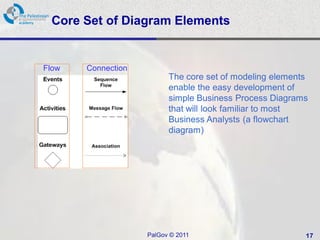
Flow   Connection
                          The core set of modeling elements
                          enable the easy development of
                          simple Business Process Diagrams
                          that will look familiar to most
                          Business Analysts (a flowchart
                          diagram)


                    PalGov © 2011                         17
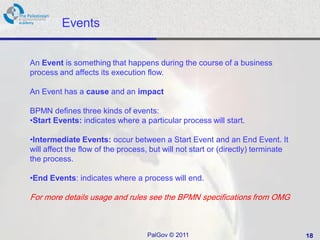
Events


An Event is something that happens during the course of a business
process and affects its execution flow.

An Event has a cause and an impact

BPMN defines three kinds of events:
•Start Events: indicates where a particular process will start.

•Intermediate Events: occur between a Start Event and an End Event. It
will affect the flow of the process, but will not start or (directly) terminate
the process.

•End Events: indicates where a process will end.

For more details usage and rules see the BPMN specifications from OMG


                                   PalGov © 2011                                  18
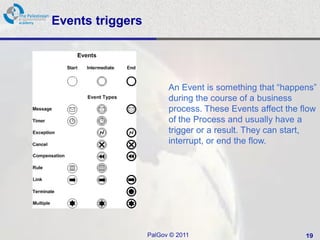
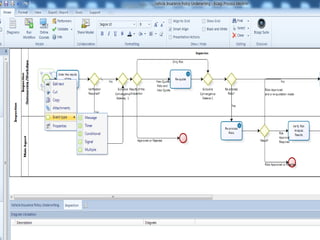
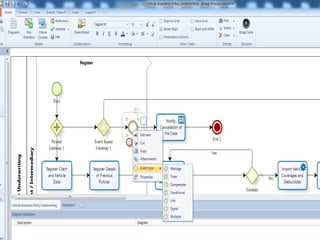
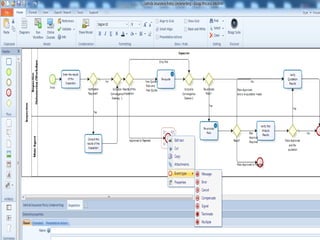
Events triggers


                        An Event is something that “happens”
                        during the course of a business
                        process. These Events affect the flow
                        of the Process and usually have a
                        trigger or a result. They can start,
                        interrupt, or end the flow.


                  PalGov © 2011                           19
PalGov © 2011   20
PalGov © 2011   21
PalGov © 2011   22
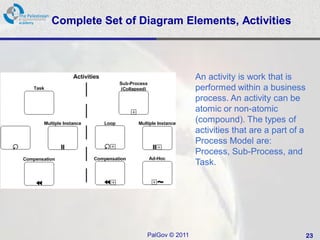
Complete Set of Diagram Elements, Activities


                                 An activity is work that is
                                 performed within a business
                                 process. An activity can be
                                 atomic or non-atomic
                                 (compound). The types of
                                 activities that are a part of a
                                 Process Model are:
                                 Process, Sub-Process, and
                                 Task.


                 PalGov © 2011                                     23
PalGov © 2011   24
PalGov © 2011   25
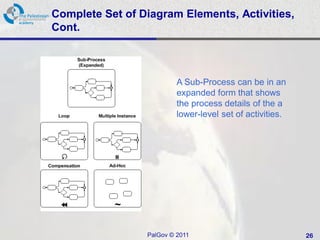
Complete Set of Diagram Elements, Activities,
Cont.


                          A Sub-Process can be in an
                          expanded form that shows
                          the process details of the a
                          lower-level set of activities.


                 PalGov © 2011                             26
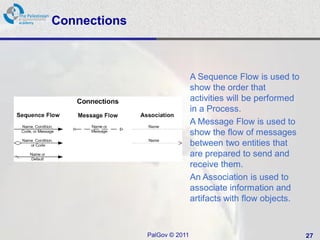
Connections


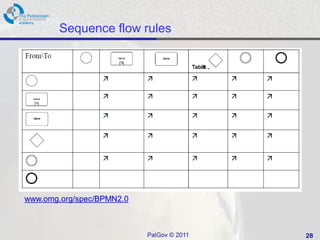
                              A Sequence Flow is used to
                              show the order that
                              activities will be performed
                              in a Process.
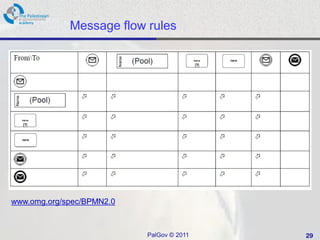
                              A Message Flow is used to
                              show the flow of messages
                              between two entities that
                              are prepared to send and
                              receive them.
                              An Association is used to
                              associate information and
                              artifacts with flow objects.


              PalGov © 2011                                  27
Sequence flow rules


www.omg.org/spec/BPMN2.0


                           PalGov © 2011   28
Message flow rules


www.omg.org/spec/BPMN2.0


                           PalGov © 2011   29
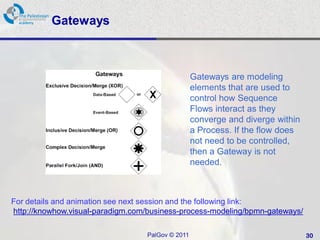
Gateways


                                                  Gateways are modeling
                                                  elements that are used to
                                                  control how Sequence
                                                  Flows interact as they
                                                  converge and diverge within
                                                  a Process. If the flow does
                                                  not need to be controlled,
                                                  then a Gateway is not
                                                  needed.


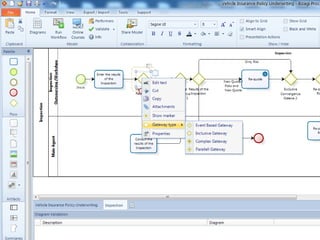
For details and animation see next session and the following link:
http://knowhow.visual-paradigm.com/business-process-modeling/bpmn-gateways/

                                  PalGov © 2011                                 30
PalGov © 2011   31
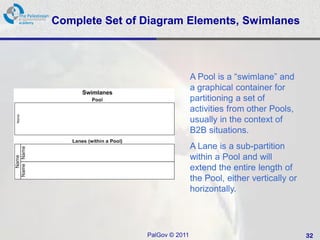
Complete Set of Diagram Elements, Swimlanes


                                A Pool is a “swimlane” and
                                a graphical container for
                                partitioning a set of
                                activities from other Pools,
                                usually in the context of
                                B2B situations.
                                A Lane is a sub-partition
                                within a Pool and will
                                extend the entire length of
                                the Pool, either vertically or
                                horizontally.


                PalGov © 2011                                    32
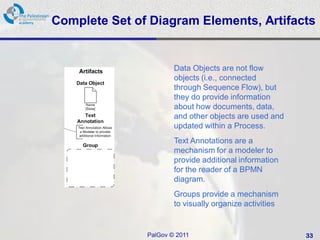
Complete Set of Diagram Elements, Artifacts


                       Data Objects are not flow
                       objects (i.e., connected
                       through Sequence Flow), but
                       they do provide information
                       about how documents, data,
                       and other objects are used and
                       updated within a Process.
                       Text Annotations are a
                       mechanism for a modeler to
                       provide additional information
                       for the reader of a BPMN
                       diagram.
                       Groups provide a mechanism
                       to visually organize activities


               PalGov © 2011                             33
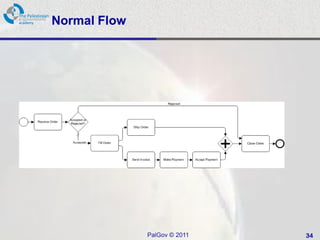
Normal Flow


              PalGov © 2011   34
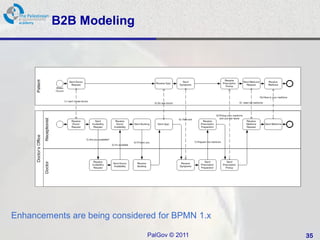
B2B Modeling


Enhancements are being considered for BPMN 1.x

                               PalGov © 2011     35
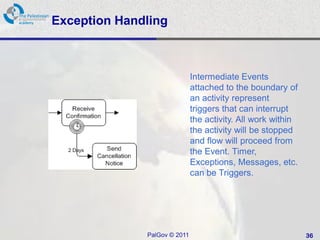
Exception Handling


                              Intermediate Events
                              attached to the boundary of
                              an activity represent
                              triggers that can interrupt
                              the activity. All work within
                              the activity will be stopped
                              and flow will proceed from
                              the Event. Timer,
                              Exceptions, Messages, etc.
                              can be Triggers.


              PalGov © 2011                                   36
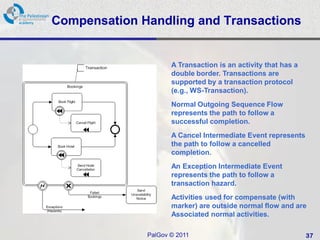
Compensation Handling and Transactions


                     A Transaction is an activity that has a
                     double border. Transactions are
                     supported by a transaction protocol
                     (e.g., WS-Transaction).
                     Normal Outgoing Sequence Flow
                     represents the path to follow a
                     successful completion.
                     A Cancel Intermediate Event represents
                     the path to follow a cancelled
                     completion.
                     An Exception Intermediate Event
                     represents the path to follow a
                     transaction hazard.
                     Activities used for compensate (with
                     marker) are outside normal flow and are
                     Associated normal activities.

              PalGov © 2011                                    37
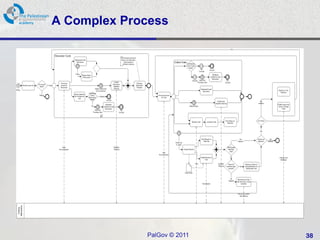
A Complex Process


             PalGov © 2011   38
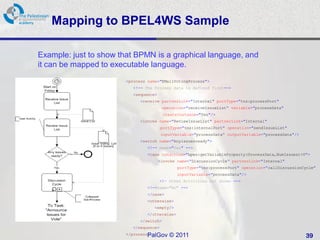
Mapping to BPEL4WS Sample

Example: just to show that BPMN is a graphical language, and
it can be mapped to executable language.
                       <process name="EMailVotingProcess">
                          <!-- The Process data is defined first-->
                          <sequence>
                             <receive partnerLink="Internal" portType="tns:processPort"
                                        operation="receiveIssueList“ variable="processData"
                                         createInstance="Yes"/>
                             <invoke name="ReviewIssueList" partnerLink="Internal"
                                        portType="tns:internalPort" operation="sendIssueList"
                                        inputVariable="processData“ outputVariable="processData"/>
                             <switch name="Anyissuesready">
                                <!-- name="Yes" -->
                                <case condition="bpws:getVariableProperty(ProcessData,NumIssues)>0">
                                       <invoke name=“DiscussionCycle“ partnerLink="Internal"
                                               portType="tns:processPort" operation=“callDiscussionCycle"
                                               inputVariable="processData"/>
                                       <!– Other Activities not shown -->
                                <!--name="No" -->
                                </case>
                                <otherwise>
                                  <empty/>
                                </otherwise>
                             </switch>
                          </sequence>
                       </process>
                                PalGov     © 2011                                                    39
Choreography vs Orchestration

The difference between orchestration and choreography like this:
• Orchestration == Executable Process
Web Service Orchestration relates to the execution of specific
  business processes. WS-BPEL is a language for defining
  processes that can be executed on an orchestration engine.
• Choreography == Multi-party Collaboration
Web Service Choreography relates to describing externally
  observable interactions between web services. WS-CDL is a
  language for describing multi-party contracts and is somewhat
  like an extension of WSDL: WSDL describes web services
  interfaces, WS-CDL describes collaborations between web
  services.


                      PalGov © 2011                           40
Orchestration: Workflow, internal processes,
private processes.

Choreography: Contained within one Pool
processes Collaboration, global processes, B2B
Defined by the interaction between Pools


                   PalGov © 2011               41
Session 12: lab Activities and Assignment


• Video
      • BPD Basic elements 15:00
      • BPMN complete set 22:00 (next Session)
      • Gate Ways 16:00 (next Session)
      Discussion
• Examples of BPMN diagrams
   – Travel Request Expenses report (Bizagi)
   – Purchase Request (Bizagi)
   Discussion


                  PalGov © 2011                  42
Most Common BP Mistakes in BPMN
             Process Modeling

                  With Demo and Slides
•   Pattern 1. Activities in one pool are not connected
•   Pattern 2. Process does not contain a start event
•   Pattern 3. Process does not contain an end event
•   Pattern 4. Sequence flow crosses process boundary
•   Pattern 5. Sequence flow crosses pool boundary
•   Pattern 6. Gateway receives, evaluates or sends a message
•   Pattern 7. Intermediate events are placed on the edge of the pool
•   Pattern 8. Hanging intermediate events or activities
•   Pattern 9. Each lane in the pool contains start event
•   Pattern 10. Incorrect use of time events Solution: the meaning!
•   Pattern 11. Sequence and message event represent data flow
•   Pattern 12. Event is used as a message flow source
•   Pattern 13. Improper use of flow elements
•   Pattern 14. Starting timer placed instead of intermediate timer
•   Pattern 15. Exception flow is not connected to the exception

                          PalGov © 2011                                 43
Readings                                    Course Activity


• Business Process Model and notation (BPMN) V2.0
  Course Activity
www.omg.org/spec/BPMN2.0
(chapter 7)

• BPMN Quick Reference Guide (From bizagi)
http://www.bizagi.com/docs/BPMN_Quick_Reference_Guide_ENG.pdf


                           PalGov © 2011                        44
Summary


• In this session we have discussed the
  status, the notation of BPMN and the
  most common mistakes.
• Next session will discuss:
     • BPMN complete set
     • Gate Ways
     • Most Common BP Mistakes in BPMN process
       Modeling


               PalGov © 2011                45
References

1. BPMN Fundamentals, Stephen A. White, IBM,
     http://www.zurich.ibm.com/~olz/teaching/ETH2011/White-BPMN-
     Intro.pdf

2. Business Process Model and notation (BPMN) V2.0,
    www.omg.org/spec/BPMN2.0

3. BizAgi, www.bizagi.com

4. DiveIntoPBM http://www.diveintobpm.org/index.jsp

5. Process Modeler for visio http://help.itp-commerce.com

poster

6. ttp://bpmessentials.com/uploads/media/BPMN_2.0-Poster.pdf

7. http://www.adonis-community.com/fileadmin/media/BPMN/BPMN-2.0-
    poster.pdf

                        PalGov © 2011                              46
Thanks…


          Dr. Mahmoud H. Saheb


             PalGov © 2011       47

Business Process Modeling Notation Fundamentals

  • 1.
    ‫أكاديمية الحكومة اإللكترونيةالفلسطينية‬ The Palestinian eGovernment Academy www.egovacademy.ps Tutorial 1: Data and Business Process Modeling Session 11-12 Business Process Modeling Notation Fundamentals By: Stephen A. White, IBM (With Modification and extensions) Dr. Mahmoud H. M. Saheb Palestinian Polytechnic University Reviewed by PalGov © 2011 Prof. Marco Ronchetti, Trento University, Italy 1
  • 2.
    About This tutorial ispart of the PalGov project, funded by the TEMPUS IV program of the Commission of the European Communities, grant agreement 511159-TEMPUS-1- 2010-1-PS-TEMPUS-JPHES. The project website: www.egovacademy.ps Project Consortium: Birzeit University, Palestine University of Trento, Italy (Coordinator ) Palestine Polytechnic University, Palestine Vrije Universiteit Brussel, Belgium Palestine Technical University, Palestine Université de Savoie, France Ministry of Telecom and IT, Palestine University of Namur, Belgium Ministry of Interior, Palestine TrueTrust, UK Ministry of Local Government, Palestine Coordinator: Dr. Mustafa Jarrar Birzeit University, P.O.Box 14- Birzeit, Palestine Telfax:+972 2 2982935 mjarrar@birzeit.eduPalGov © 2011 2
  • 3.
    © Copyright Notes Everyoneis encouraged to use this material, or part of it, but should properly cite the project (logo and website), and the author of that part. No part of this tutorial may be reproduced or modified in any form or by any means, without prior written permission from the project, who have the full copyrights on the material. Attribution-NonCommercial-ShareAlike CC-BY-NC-SA This license lets others remix, tweak, and build upon your work non- commercially, as long as they credit you and license their new creations under the identical terms. PalGov © 2011 3
  • 4.
    Tutorial Map Intended Learning Objectives Topic Time Module 1 (Conceptual Date Modeling) Module I: Conceptual Data Modeling A: Knowledge and Understanding 11a1: Demonstrate knowledge of conceptual modeling notations and concepts Session 0: Outline and Introduction 11a2: Demonstrate knowledge of Object Role Modeling (ORM) methodology. Session 1.1: Information Modeling 1 11a3: Explain and demonstrate the concepts of data integrity & business rules Session 1.2: Conceptual Data Modeling using ORM 1 B: Intellectual Skills Session 1.3: Conceptual Analyses 1 11b1: Analyze application and domain requirements at the conceptual level, Session 2: Lab- Conceptual Analyses 3 and formalize it using ORM. Session 3.1: Uniqueness Rules 1.5 11b2: Analyze entity identity at the application and domain levels. Session 3.2: Mandatory Rules 1.5 11b4: Optimize, transform, and (re)engineer conceptual models. Session 4: Lab- Uniqueness & Mandatory Rules 3 11b5: Detect &resolve contradictions & implications at the conceptual level. Session 5: Subtypes and Other Rules 3 C: Professional and Practical Skills Session 6: Lab- Subtypes and Other Rules 3 11c1: Using ORM modeling tools (Conceptual Modeling Tools). Session 7.1: Schema Equivalence &Optimization 1.5 Module 2 (Business Process Modeling) Session 7.2: Rules Check &Schema Engineering 1.5 A: Knowledge and Understanding Session 8: Lab- National Student Registry 3 12a1: Demonstrate knowledge of business process modeling notations and concepts. Module II: Business Process Modeling 12a2: Demonstrate knowledge of business process modeling and mapping. 12a3: Demonstrate understand of business process optimization and re-engineering. Session 9: BP Management and BPMN: An Overview 3 B: Intellectual Skills Session 10: Lab - BP Management 3 12b1: Identify business processes. Session 11: BPMN Fundamentals 3 12b2: Model and map business processes. Session 12: Lab - BPMN Fundamentals 3 12b3: Optimize and re-engineer business processes. Session 13: Modeling with BPMN 3 C: Professional and Practical Skills Session 14: Lab- Modeling with BPMN 3 12c1: Using business process modeling tools, such as MS Visio. Session 15: BP Management & Reengineering 3 Session 16: Lab- BP Management & Reengineering 3 PalGov © 2011 4
  • 5.
    Session 11: BPMNFundamentals Session ILOs After completing this session students will be able to: 1. Demonstrate knowledge of business process modeling and mapping. 2. Business Process Modeling for Normal Flow, B2B Modeling, Exception Handling, Compensation Handling, Complex Process. 3. Modeling orchestration and choreography PalGov © 2011 5
  • 6.
    Session Outline • BPMNStatus • BPMN Notation PalGov © 2011 6
  • 7.
    Background History Definition of BPMN InitialCharter Within the OMG PalGov © 2011 7
  • 8.
    History Formation of NotationWorking Group August, 2001, the Notation Working Group is formed. Currently, the Notation Working Group is composed of 58 members representing 35 companies, organizations, or individuals. BPMN 0.9 Draft November, 2002, the BPMN 0.9 draft specification was released to the public BPMN 1.0 Draft August, 2003, the BPMN 1.0 draft specification was released to the public BPMN 1.0 May, 2004, the BPMN 1.0 specification was released to the public. Currently, there are 28 companies that have implementations of BPMN and there are 5 companies developing implementations. Merger with OMG June, 2005, BPMN 1.x was in development. BPMN 1.0 is OMG IP, but an RFC/FTF process is underway to establish as an OMG specification and to allow continuation of work. BPMN 2.0 The final version of the specification was released in January, 2011 PalGov © 2011 8
  • 9.
    Definition of BPMN BusinessProcess Modeling Notation (BPMN) BPMN provides businesses with the capability of defining and understanding their internal and external business procedures through a Business Process Diagram, which will give organizations the ability to communicate these procedures in a standard manner. BPMN also is supported with an internal model that enables the generation of executable BPEL4WS. PalGov © 2011 9
  • 10.
    BPMI.org Hourglass Audiences: Business Environment Purposes: Strategy Consultants Business Analysts BPMN Modeling Process Designers Focus  BP Scope  BPEL System Architects Execution Software Engineers Technology Implementation PalGov © 2011 10
  • 11.
    BPMN Semantics The BPMN1.0 Specification did not formally define the semantics of the Business Process Diagram (i.e., a metamodel) PalGov © 2011 11
  • 12.
    Within the OMG •BusinessModeling Integration (BMI) Domain Task Force (DTF) – BMI is developing a Business Process Definition Metamodel (BDPM) – BPDM could possibly serve as the Metamodel for BPMN • The Metamodel would be used to generate a BPMN schema for exchange of BPMN Diagram Semantic information – BPMN RFC approved, an FTF to be established this meeting • This will allow the continuation of BPMN development–a future RFP or consolidate with BPDM? •Other OMG Work – Has developed UML2, which includes an Activity Diagram • The Activity Diagram is often used by IT specialists for process modeling, but not many business analysts (which use BPMN) • The merging of BPMN and UML Activity Diagrams would bring together the two modeling audiences – Other Process-related work: – UML Profile for DODAF/MODAF; SPEM; SysML; PSL – Has developed an XML Interchange Format (XMI) for the exchange of diagrams • XMI could be used for the exchange of BPMN Diagram Layout information PalGov © 2011 12
  • 13.
    Major changes inBPMN2 • Choreographies – Choreographies-model – Conversation-model • Complete Metamodel • BPMN Core • BPMN Execution Semantics • BPMN - BPEL Mapping PalGov © 2011 13
  • 14.
  • 15.
    Notation • Business ProcessDiagram Elements – Core Set of Diagram Elements – Complete Set of Diagram Elements • Business Process Diagram Samples – Normal Flow – B2B Modeling – Exception Handling – Compensation Handling – A Complex Process • Mapping to BPEL4WS Sample PalGov © 2011 15
  • 16.
    basic categories ofelements • Flow Objects • Connecting Objects • Swimlanes • Artifacts PalGov © 2011 16
  • 17.
    Core Set ofDiagram Elements Flow Connection The core set of modeling elements enable the easy development of simple Business Process Diagrams that will look familiar to most Business Analysts (a flowchart diagram) PalGov © 2011 17
  • 18.
    Events An Event issomething that happens during the course of a business process and affects its execution flow. An Event has a cause and an impact BPMN defines three kinds of events: •Start Events: indicates where a particular process will start. •Intermediate Events: occur between a Start Event and an End Event. It will affect the flow of the process, but will not start or (directly) terminate the process. •End Events: indicates where a process will end. For more details usage and rules see the BPMN specifications from OMG PalGov © 2011 18
  • 19.
    Events triggers An Event is something that “happens” during the course of a business process. These Events affect the flow of the Process and usually have a trigger or a result. They can start, interrupt, or end the flow. PalGov © 2011 19
  • 20.
  • 21.
  • 22.
  • 23.
    Complete Set ofDiagram Elements, Activities An activity is work that is performed within a business process. An activity can be atomic or non-atomic (compound). The types of activities that are a part of a Process Model are: Process, Sub-Process, and Task. PalGov © 2011 23
  • 24.
  • 25.
  • 26.
    Complete Set ofDiagram Elements, Activities, Cont. A Sub-Process can be in an expanded form that shows the process details of the a lower-level set of activities. PalGov © 2011 26
  • 27.
    Connections A Sequence Flow is used to show the order that activities will be performed in a Process. A Message Flow is used to show the flow of messages between two entities that are prepared to send and receive them. An Association is used to associate information and artifacts with flow objects. PalGov © 2011 27
  • 28.
  • 29.
  • 30.
    Gateways Gateways are modeling elements that are used to control how Sequence Flows interact as they converge and diverge within a Process. If the flow does not need to be controlled, then a Gateway is not needed. For details and animation see next session and the following link: http://knowhow.visual-paradigm.com/business-process-modeling/bpmn-gateways/ PalGov © 2011 30
  • 31.
  • 32.
    Complete Set ofDiagram Elements, Swimlanes A Pool is a “swimlane” and a graphical container for partitioning a set of activities from other Pools, usually in the context of B2B situations. A Lane is a sub-partition within a Pool and will extend the entire length of the Pool, either vertically or horizontally. PalGov © 2011 32
  • 33.
    Complete Set ofDiagram Elements, Artifacts Data Objects are not flow objects (i.e., connected through Sequence Flow), but they do provide information about how documents, data, and other objects are used and updated within a Process. Text Annotations are a mechanism for a modeler to provide additional information for the reader of a BPMN diagram. Groups provide a mechanism to visually organize activities PalGov © 2011 33
  • 34.
    Normal Flow PalGov © 2011 34
  • 35.
    B2B Modeling Enhancements arebeing considered for BPMN 1.x PalGov © 2011 35
  • 36.
    Exception Handling Intermediate Events attached to the boundary of an activity represent triggers that can interrupt the activity. All work within the activity will be stopped and flow will proceed from the Event. Timer, Exceptions, Messages, etc. can be Triggers. PalGov © 2011 36
  • 37.
    Compensation Handling andTransactions A Transaction is an activity that has a double border. Transactions are supported by a transaction protocol (e.g., WS-Transaction). Normal Outgoing Sequence Flow represents the path to follow a successful completion. A Cancel Intermediate Event represents the path to follow a cancelled completion. An Exception Intermediate Event represents the path to follow a transaction hazard. Activities used for compensate (with marker) are outside normal flow and are Associated normal activities. PalGov © 2011 37
  • 38.
    A Complex Process PalGov © 2011 38
  • 39.
    Mapping to BPEL4WSSample Example: just to show that BPMN is a graphical language, and it can be mapped to executable language. <process name="EMailVotingProcess"> <!-- The Process data is defined first--> <sequence> <receive partnerLink="Internal" portType="tns:processPort" operation="receiveIssueList“ variable="processData" createInstance="Yes"/> <invoke name="ReviewIssueList" partnerLink="Internal" portType="tns:internalPort" operation="sendIssueList" inputVariable="processData“ outputVariable="processData"/> <switch name="Anyissuesready"> <!-- name="Yes" --> <case condition="bpws:getVariableProperty(ProcessData,NumIssues)>0"> <invoke name=“DiscussionCycle“ partnerLink="Internal" portType="tns:processPort" operation=“callDiscussionCycle" inputVariable="processData"/> <!– Other Activities not shown --> <!--name="No" --> </case> <otherwise> <empty/> </otherwise> </switch> </sequence> </process> PalGov © 2011 39
  • 40.
    Choreography vs Orchestration Thedifference between orchestration and choreography like this: • Orchestration == Executable Process Web Service Orchestration relates to the execution of specific business processes. WS-BPEL is a language for defining processes that can be executed on an orchestration engine. • Choreography == Multi-party Collaboration Web Service Choreography relates to describing externally observable interactions between web services. WS-CDL is a language for describing multi-party contracts and is somewhat like an extension of WSDL: WSDL describes web services interfaces, WS-CDL describes collaborations between web services. PalGov © 2011 40
  • 41.
    Orchestration: Workflow, internalprocesses, private processes. Choreography: Contained within one Pool processes Collaboration, global processes, B2B Defined by the interaction between Pools PalGov © 2011 41
  • 42.
    Session 12: labActivities and Assignment • Video • BPD Basic elements 15:00 • BPMN complete set 22:00 (next Session) • Gate Ways 16:00 (next Session) Discussion • Examples of BPMN diagrams – Travel Request Expenses report (Bizagi) – Purchase Request (Bizagi) Discussion PalGov © 2011 42
  • 43.
    Most Common BPMistakes in BPMN Process Modeling With Demo and Slides • Pattern 1. Activities in one pool are not connected • Pattern 2. Process does not contain a start event • Pattern 3. Process does not contain an end event • Pattern 4. Sequence flow crosses process boundary • Pattern 5. Sequence flow crosses pool boundary • Pattern 6. Gateway receives, evaluates or sends a message • Pattern 7. Intermediate events are placed on the edge of the pool • Pattern 8. Hanging intermediate events or activities • Pattern 9. Each lane in the pool contains start event • Pattern 10. Incorrect use of time events Solution: the meaning! • Pattern 11. Sequence and message event represent data flow • Pattern 12. Event is used as a message flow source • Pattern 13. Improper use of flow elements • Pattern 14. Starting timer placed instead of intermediate timer • Pattern 15. Exception flow is not connected to the exception PalGov © 2011 43
  • 44.
    Readings Course Activity • Business Process Model and notation (BPMN) V2.0 Course Activity www.omg.org/spec/BPMN2.0 (chapter 7) • BPMN Quick Reference Guide (From bizagi) http://www.bizagi.com/docs/BPMN_Quick_Reference_Guide_ENG.pdf PalGov © 2011 44
  • 45.
    Summary • In thissession we have discussed the status, the notation of BPMN and the most common mistakes. • Next session will discuss: • BPMN complete set • Gate Ways • Most Common BP Mistakes in BPMN process Modeling PalGov © 2011 45
  • 46.
    References 1. BPMN Fundamentals,Stephen A. White, IBM, http://www.zurich.ibm.com/~olz/teaching/ETH2011/White-BPMN- Intro.pdf 2. Business Process Model and notation (BPMN) V2.0, www.omg.org/spec/BPMN2.0 3. BizAgi, www.bizagi.com 4. DiveIntoPBM http://www.diveintobpm.org/index.jsp 5. Process Modeler for visio http://help.itp-commerce.com poster 6. ttp://bpmessentials.com/uploads/media/BPMN_2.0-Poster.pdf 7. http://www.adonis-community.com/fileadmin/media/BPMN/BPMN-2.0- poster.pdf PalGov © 2011 46
  • 47.
    Thanks… Dr. Mahmoud H. Saheb PalGov © 2011 47