Business Performance Management – Strategy & Execution
Ravi Tirumalai , Board Member
ISACA Singapore Chapter
Agenda


• Complexity In Today’s Business
• Managing Enterprise Performance
• How do we achieve
• Q&A
Most Organizations have problem executing strategy


                       Why?
Headlines !
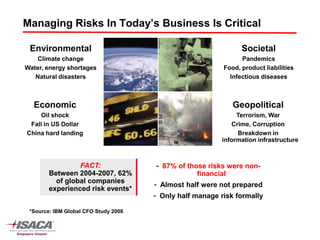
Managing Risks In Today‟s Business Is Critical

 Environmental                                                  Societal
    Climate change                                              Pandemics
Water, energy shortages                                   Food, product liabilities
   Natural disasters                                        Infectious diseases


  Economic                                                    Geopolitical
    Oil shock                                                  Terrorism, War
 Fall in US Dollar                                           Crime, Corruption
China hard landing                                             Breakdown in
                                                          information infrastructure


                 FACT:                - 87% of those risks were non-
        Between 2004-2007, 62%                    financial
          of global companies
        experienced risk events*
                                      - Almost half were not prepared
                                      - Only half manage risk formally
 *Source: IBM Global CFO Study 2008
Business Models Have Changed: From Vertical
Integration to Virtual Integration


                                                     100 years later
                                                      The Boeing 787
                                        Only the Vertical Fin Manufactured in Seattle
                                                 The ultimate Virtual Chain


Ford’s River Rouge Plant; 27 miles of
              conveyor,
 The epitome of Vertical Integration

           Early 1900s
Business Models Have Changed: From Mass
Production To Mass Customization

                                                100 years later
                                                Each Laptop / Desktop
                                                  Customized to your
                                                     Requirement
                                           The perfect „Make to Order‟ Model


    Model „T‟ first introduced in 1908
     Model „T‟ phased out in 1927 !
  “The Customer can have any color
 that they want, as long as it is BLACK”
   The perfect „Make to Stock‟ Model

          Early 1900s

                     Adding further complexity?
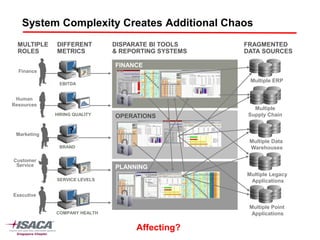
System Complexity Creates Additional Chaos
  MULTIPLE   DIFFERENT        DISPARATE BI TOOLS    FRAGMENTED
  ROLES      METRICS          & REPORTING SYSTEMS   DATA SOURCES

                              FINANCE
  Finance
                                                     Multiple ERP
              EBITDA


 Human
Resources
                                                       Multiple
             HIRING QUALITY   OPERATIONS             Supply Chain


 Marketing
                                                     Multiple Data
              BRAND                                  Warehouses

Customer
 Service                      PLANNING
                                                    Multiple Legacy
             SERVICE LEVELS                          Applications

Executive

                                                     Multiple Point
             COMPANY HEALTH                           Applications

                                    Affecting?
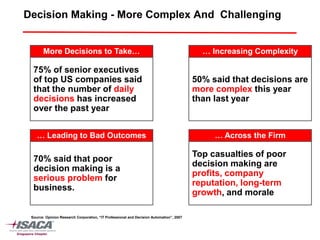
Decision Making - More Complex And Challenging


       More Decisions to Take…                                                             … Increasing Complexity

  75% of senior executives
  of top US companies said                                                               50% said that decisions are
  that the number of daily                                                               more complex this year
  decisions has increased                                                                than last year
  over the past year


    … Leading to Bad Outcomes                                                                 … Across the Firm

                                                                                         Top casualties of poor
  70% said that poor
                                                                                         decision making are
  decision making is a
                                                                                         profits, company
  serious problem for
                                                                                         reputation, long-term
  business.
                                                                                         growth, and morale

 Source: Opinion Research Corporation, “IT Professional and Decision Automation”, 2007
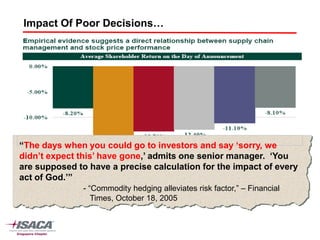
Impact Of Poor Decisions…


“The days when you could go to investors and say „sorry, we
didn‟t expect this‟ have gone,‟ admits one senior manager. „You
are supposed to have a precise calculation for the impact of every
act of God.‟”
               - “Commodity hedging alleviates risk factor,” – Financial
                  Times, October 18, 2005
Growth...?   Monitor/Analyze…?


 Risk...?        Trustworthy...?
Agenda


• Complexity In Today’s Business
• Managing Enterprise Performance
• How do we achieve
• Q&A
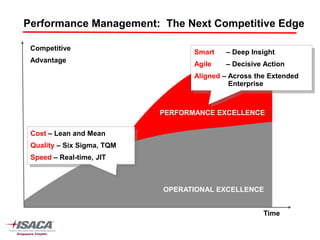
Performance Management: The Next Competitive Edge

 Competitive
                                   Smart   – Deep Insight
 Advantage
                                   Agile   – Decisive Action
                                   Aligned – Across the Extended
                                             Enterprise


                            PERFORMANCE EXCELLENCE

 Cost – Lean and Mean
 Quality – Six Sigma, TQM
 Speed – Real-time, JIT


                            OPERATIONAL EXCELLENCE


                                                      Time
Who is Responsible for Performance
      Management – Strategy and Execution?


                   C-Suite and Board of
                        Directors

Office of CFO                             Line of Business
                                             Managers
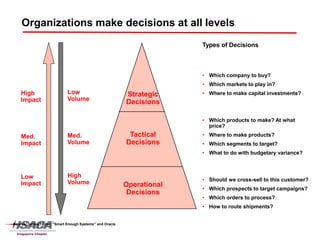
Organizations make decisions at all levels
                                                                        Types of Decisions


                                                                        • Which company to buy?
                                                                        • Which markets to play in?
    High                     Low                          Strategic     • Where to make capital investments?
    Impact                   Volume
                                                          Decisions

                                                                        • Which products to make? At what
                                                                          price?

    Med.                     Med.                          Tactical     • Where to make products?
    Impact                   Volume                       Decisions     • Which segments to target?
                                                                        • What to do with budgetary variance?


    Low                      High
                                                                        • Should we cross-sell to this customer?
    Impact                   Volume                       Operational
                                                                        • Which prospects to target campaigns?
                                                           Decisions
                                                                        • Which orders to process?
                                                                        • How to route shipments?


Source: James Taylor, “Smart Enough Systems” and Oracle
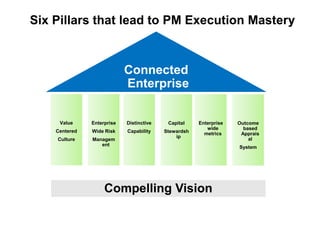
Six Pillars that lead to PM Execution Mastery


                            Connected
                            Enterprise

     Value     Enterprise   Distinctive    Capital    Enterprise   Outcome
                                                         wide        based
    Centered   Wide Risk    Capability    Stewardsh     metrics     Apprais
                                              ip                       al
    Culture    Managem
                  ent
                                                                   System


                    Compelling Vision
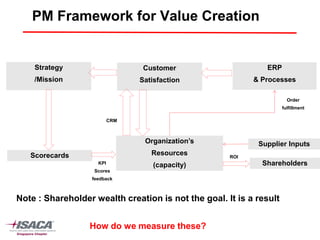
PM Framework for Value Creation


    Strategy                     Customer                     ERP
    /Mission                    Satisfaction               & Processes

                                                                       Order
                                                                     fulfillment

                          CRM


                                 Organization‟s             Supplier Inputs
   Scorecards                      Resources         ROI
                    KPI
                                    (capacity)               Shareholders
                   Scores
                  feedback


Note : Shareholder wealth creation is not the goal. It is a result


                  How do we measure these?
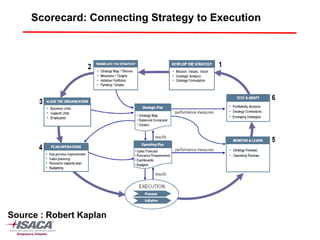
Scorecard: Connecting Strategy to Execution


Source : Robert Kaplan
Excellence in Stakeholder Reporting
Agenda


• Complexity In Today’s Business
• Managing Enterprise Performance
• How do we connect strategy to execution
• Q&A
Where is Your Organization Today?
      Focus on                 Focus on                   Focus on
      Reporting                 Metrics                    Value


                                           Fragmented • Integrated approach
  Costs                                     Approach           to PM
                                                       • Aiming to improve
                         • Compliant but at a               performance
                                 high cost
                                                            • GRC is a
                            • Limited view of                by-product
                           interdependencies
  • Reacting to a few    • Looking to reduce
     high-priority PM       resources spent
         projects
   • May not realize                                  Integrated Approach
   full extent of need


                                                   # of PM Projects
Harmonising the Elements of IT Governance


                      IT
                  Governance


                  Resource
                 Management


         2009 ISACA All Rights reserved. 22
®
The COBIT Framework


 How do we execute on the above?
Deploy Technology: The Most Popular Software Tool…


                   80
                   70
% of respondents


                   60
                   50
                   40
                   30
                   20
                   10
                    0

                                                                    ER
                        N


                                      Sp


                                                      C


                                                                                   B
                        o


                                                      us


                                                                                   PM
                                        re


                                                                      P
                            so


                                                         t


                                                                      so
                                         ad


                                                          om


                                                                                       so
                              ftw


                                            s


                                                                          ftw


                                                                                        ftw
                                             he


                                                             B
                                 ar


                                                               PM


                                                                             ar
                                                et


                                                                                            ar
                                 e


                                                                               e
                                                  s


                                                                                              e
Enterprise Performance Management System
       Integrates Transaction, Intelligence, Financial Systems


                                          Modeling         Planning &      Financial      Financial &       Metrics &
                                                           Budgeting      Management       Statutory        Scorecards
                                                                                           Reporting


                                                     Performance Management


                                                                        Enterprise
                                                                        Performance
                                                                        Management
                                                                          System

     Transactional Systems                                                                                                      BI Systems
                                                                                                                         Operational
                                                                                                                          Business
                                                                                                                         Intelligence
Sales & CRM   Financials   Supply Chain   HR         Procurement                Data           Data       Query &        OLAP     Dashboards   Enterprise/   Alerts &
                                                                              Warehouse     Integration   Analysis                             Operational   Workflow
                                                                                                                                                Reporting


                                How do we ensure the outcome is achieved?
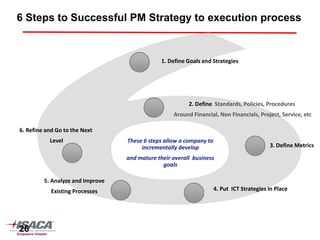
6 Steps to Successful PM Strategy to execution process


                                               1. Define Goals and Strategies


                                                         2. Define Standards, Policies, Procedures
                                                   Around Financial, Non Financials, Project, Service, etc

6. Refine and Go to the Next
           Level                  These 6 steps allow a company to
                                       incrementally develop                               3. Define Metrics

                                  and mature their overall business
                                               goals

         5. Analyze and Improve
            Existing Processes                                       4. Put ICT Strategies in Place


26
Goals & Strategies

• Business and IT Goals
• ICT Strategy
• Existing Capabilities
• IT Roadmap
• Journey Management


27
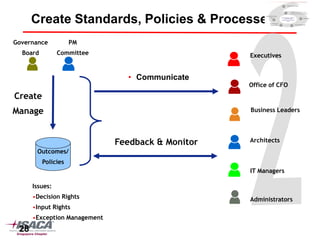
Create Standards, Policies & Processes
Governance           PM
  Board         Committee                          Executives


                                • Communicate
                                                   Office of CFO
Create
Manage                                             Business Leaders


                              Feedback & Monitor   Architects
       Outcomes/
          Policies
                                                   IT Managers

      Issues:
      •Decision Rights                             Administrators
      •Input Rights
      •Exception Management
 28
Define Metrics for Success

• Why Measure ?
   • Ensure Business Goals
   • Deliver ICT Strategy
• What to Measure ?
   • standards, compliance, # of Financial metrics, # of non
     financial metrics, # of process failures, impact to business due
     to decisions, # of exceptions, # of outcomes achieved vs
     planned, # of metrics roll up to serve linkage to goals, etc
• How to Measure ?
   • What can be automated?
   • What can be easily captured?


29
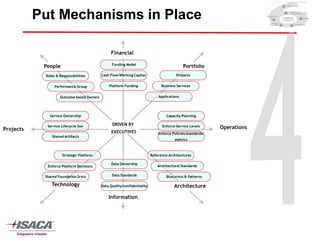
Put Mechanisms in Place

                                                Financial

                                                 Funding Model
            People                                                                           Portfolio
            Roles & Responsibilities       Cash Flow/Working Capital                    Projects


                 Performance Group             Platform Funding                 Business Services


                    Outcome based Owners                                      Applications


              Service Ownership                                                    Capacity Planning

                                                 DRIVEN BY
Projects
             Service Lifecycle Gov                                              Enforce Service Levels      Operations
                                                 EXECUTIVES                   Enforce Policies/standards/
               Shared Artifacts
                                                                                        metrics


                     Strategic Platform                                   Reference Architectures

                                                 Data Ownership
             Enforce Platform Decisions                                       Architectural Standards

            Shared Foundation Srvcs              Data Standards                    Blueprints & Patterns

               Technology                  Data Quality/confidentiality                Architecture

                                               Information
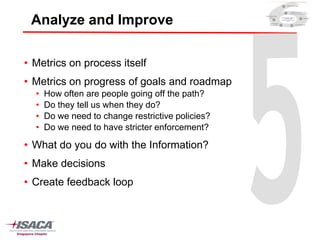
Analyze and Improve

• Metrics on process itself
• Metrics on progress of goals and roadmap
  •   How often are people going off the path?
  •   Do they tell us when they do?
  •   Do we need to change restrictive policies?
  •   Do we need to have stricter enforcement?

• What do you do with the Information?
• Make decisions
• Create feedback loop
Refine and Go to the Next Maturity Level


• ICT strategies, goals, objectives met for this ICT
  maturity level level
• Refine ICT strategies, goals, objectives for
  current maturity level
• Create new ICT strategies, goals, objectives for
  next ICT maturity level
About ISACA


Key Message
As an independent, nonprofit, global membership association, ISACA
engages in the development, adoption and use of globally accepted,
industry-leading knowledge and practices for information systems.
ISACA helps its members achieve individual and organizational
success, resulting in greater trust in, and value from, information
systems. Its members and certification holders are qualified and
skilled professionals who make a difference.
Your Needs             +         Our Certifications


      Winning Solution
                     CONTACT:
       Ravi Tirumalai, ACA, ACMA, CGEIT, CISA
         Board Member – ISACA Singapore
               Ravitnc@hotmail.com
               http://www.isaca.org
             http://www.isacatacs.com

BPM - Strategy and Execution

  • 1.
    Business Performance Management– Strategy & Execution Ravi Tirumalai , Board Member ISACA Singapore Chapter
  • 2.
    Agenda • Complexity InToday’s Business • Managing Enterprise Performance • How do we achieve • Q&A
  • 3.
    Most Organizations haveproblem executing strategy Why?
  • 4.
  • 5.
    Managing Risks InToday‟s Business Is Critical Environmental Societal Climate change Pandemics Water, energy shortages Food, product liabilities Natural disasters Infectious diseases Economic Geopolitical Oil shock Terrorism, War Fall in US Dollar Crime, Corruption China hard landing Breakdown in information infrastructure FACT: - 87% of those risks were non- Between 2004-2007, 62% financial of global companies experienced risk events* - Almost half were not prepared - Only half manage risk formally *Source: IBM Global CFO Study 2008
  • 6.
    Business Models HaveChanged: From Vertical Integration to Virtual Integration 100 years later The Boeing 787 Only the Vertical Fin Manufactured in Seattle The ultimate Virtual Chain Ford’s River Rouge Plant; 27 miles of conveyor, The epitome of Vertical Integration Early 1900s
  • 7.
    Business Models HaveChanged: From Mass Production To Mass Customization 100 years later Each Laptop / Desktop Customized to your Requirement The perfect „Make to Order‟ Model Model „T‟ first introduced in 1908 Model „T‟ phased out in 1927 ! “The Customer can have any color that they want, as long as it is BLACK” The perfect „Make to Stock‟ Model Early 1900s Adding further complexity?
  • 8.
    System Complexity CreatesAdditional Chaos MULTIPLE DIFFERENT DISPARATE BI TOOLS FRAGMENTED ROLES METRICS & REPORTING SYSTEMS DATA SOURCES FINANCE Finance Multiple ERP EBITDA Human Resources Multiple HIRING QUALITY OPERATIONS Supply Chain Marketing Multiple Data BRAND Warehouses Customer Service PLANNING Multiple Legacy SERVICE LEVELS Applications Executive Multiple Point COMPANY HEALTH Applications Affecting?
  • 9.
    Decision Making -More Complex And Challenging More Decisions to Take… … Increasing Complexity 75% of senior executives of top US companies said 50% said that decisions are that the number of daily more complex this year decisions has increased than last year over the past year … Leading to Bad Outcomes … Across the Firm Top casualties of poor 70% said that poor decision making are decision making is a profits, company serious problem for reputation, long-term business. growth, and morale Source: Opinion Research Corporation, “IT Professional and Decision Automation”, 2007
  • 10.
    Impact Of PoorDecisions… “The days when you could go to investors and say „sorry, we didn‟t expect this‟ have gone,‟ admits one senior manager. „You are supposed to have a precise calculation for the impact of every act of God.‟” - “Commodity hedging alleviates risk factor,” – Financial Times, October 18, 2005
  • 11.
    Growth...? Monitor/Analyze…? Risk...? Trustworthy...?
  • 12.
    Agenda • Complexity InToday’s Business • Managing Enterprise Performance • How do we achieve • Q&A
  • 13.
    Performance Management: TheNext Competitive Edge Competitive Smart – Deep Insight Advantage Agile – Decisive Action Aligned – Across the Extended Enterprise PERFORMANCE EXCELLENCE Cost – Lean and Mean Quality – Six Sigma, TQM Speed – Real-time, JIT OPERATIONAL EXCELLENCE Time
  • 14.
    Who is Responsiblefor Performance Management – Strategy and Execution? C-Suite and Board of Directors Office of CFO Line of Business Managers
  • 15.
    Organizations make decisionsat all levels Types of Decisions • Which company to buy? • Which markets to play in? High Low Strategic • Where to make capital investments? Impact Volume Decisions • Which products to make? At what price? Med. Med. Tactical • Where to make products? Impact Volume Decisions • Which segments to target? • What to do with budgetary variance? Low High • Should we cross-sell to this customer? Impact Volume Operational • Which prospects to target campaigns? Decisions • Which orders to process? • How to route shipments? Source: James Taylor, “Smart Enough Systems” and Oracle
  • 16.
    Six Pillars thatlead to PM Execution Mastery Connected Enterprise Value Enterprise Distinctive Capital Enterprise Outcome wide based Centered Wide Risk Capability Stewardsh metrics Apprais ip al Culture Managem ent System Compelling Vision
  • 17.
    PM Framework forValue Creation Strategy Customer ERP /Mission Satisfaction & Processes Order fulfillment CRM Organization‟s Supplier Inputs Scorecards Resources ROI KPI (capacity) Shareholders Scores feedback Note : Shareholder wealth creation is not the goal. It is a result How do we measure these?
  • 18.
    Scorecard: Connecting Strategyto Execution Source : Robert Kaplan
  • 19.
  • 20.
    Agenda • Complexity InToday’s Business • Managing Enterprise Performance • How do we connect strategy to execution • Q&A
  • 21.
    Where is YourOrganization Today? Focus on Focus on Focus on Reporting Metrics Value Fragmented • Integrated approach Costs Approach to PM • Aiming to improve • Compliant but at a performance high cost • GRC is a • Limited view of by-product interdependencies • Reacting to a few • Looking to reduce high-priority PM resources spent projects • May not realize Integrated Approach full extent of need # of PM Projects
  • 22.
    Harmonising the Elementsof IT Governance IT Governance Resource Management 2009 ISACA All Rights reserved. 22
  • 23.
    ® The COBIT Framework How do we execute on the above?
  • 24.
    Deploy Technology: TheMost Popular Software Tool… 80 70 % of respondents 60 50 40 30 20 10 0 ER N Sp C B o us PM re P so t so ad om so ftw s ftw ftw he B ar PM ar et ar e e s e
  • 25.
    Enterprise Performance ManagementSystem Integrates Transaction, Intelligence, Financial Systems Modeling Planning & Financial Financial & Metrics & Budgeting Management Statutory Scorecards Reporting Performance Management Enterprise Performance Management System Transactional Systems BI Systems Operational Business Intelligence Sales & CRM Financials Supply Chain HR Procurement Data Data Query & OLAP Dashboards Enterprise/ Alerts & Warehouse Integration Analysis Operational Workflow Reporting How do we ensure the outcome is achieved?
  • 26.
    6 Steps toSuccessful PM Strategy to execution process 1. Define Goals and Strategies 2. Define Standards, Policies, Procedures Around Financial, Non Financials, Project, Service, etc 6. Refine and Go to the Next Level These 6 steps allow a company to incrementally develop 3. Define Metrics and mature their overall business goals 5. Analyze and Improve Existing Processes 4. Put ICT Strategies in Place 26
  • 27.
    Goals & Strategies •Business and IT Goals • ICT Strategy • Existing Capabilities • IT Roadmap • Journey Management 27
  • 28.
    Create Standards, Policies& Processes Governance PM Board Committee Executives • Communicate Office of CFO Create Manage Business Leaders Feedback & Monitor Architects Outcomes/ Policies IT Managers Issues: •Decision Rights Administrators •Input Rights •Exception Management 28
  • 29.
    Define Metrics forSuccess • Why Measure ? • Ensure Business Goals • Deliver ICT Strategy • What to Measure ? • standards, compliance, # of Financial metrics, # of non financial metrics, # of process failures, impact to business due to decisions, # of exceptions, # of outcomes achieved vs planned, # of metrics roll up to serve linkage to goals, etc • How to Measure ? • What can be automated? • What can be easily captured? 29
  • 30.
    Put Mechanisms inPlace Financial Funding Model People Portfolio Roles & Responsibilities Cash Flow/Working Capital Projects Performance Group Platform Funding Business Services Outcome based Owners Applications Service Ownership Capacity Planning DRIVEN BY Projects Service Lifecycle Gov Enforce Service Levels Operations EXECUTIVES Enforce Policies/standards/ Shared Artifacts metrics Strategic Platform Reference Architectures Data Ownership Enforce Platform Decisions Architectural Standards Shared Foundation Srvcs Data Standards Blueprints & Patterns Technology Data Quality/confidentiality Architecture Information
  • 31.
    Analyze and Improve •Metrics on process itself • Metrics on progress of goals and roadmap • How often are people going off the path? • Do they tell us when they do? • Do we need to change restrictive policies? • Do we need to have stricter enforcement? • What do you do with the Information? • Make decisions • Create feedback loop
  • 32.
    Refine and Goto the Next Maturity Level • ICT strategies, goals, objectives met for this ICT maturity level level • Refine ICT strategies, goals, objectives for current maturity level • Create new ICT strategies, goals, objectives for next ICT maturity level
  • 33.
    About ISACA Key Message Asan independent, nonprofit, global membership association, ISACA engages in the development, adoption and use of globally accepted, industry-leading knowledge and practices for information systems. ISACA helps its members achieve individual and organizational success, resulting in greater trust in, and value from, information systems. Its members and certification holders are qualified and skilled professionals who make a difference.
  • 34.
    Your Needs + Our Certifications Winning Solution CONTACT: Ravi Tirumalai, ACA, ACMA, CGEIT, CISA Board Member – ISACA Singapore Ravitnc@hotmail.com http://www.isaca.org http://www.isacatacs.com