Strategic Financial Management (SFM)
      SFM is “the assessment of Strategic Options, Choices and
    Business performance by both strategic and financial
    analysis”.
    SFM examines how a united view of strategic and financial
    issues can become a practical reality.
          This is achieved by looking at
•   the links between corporate strategy and SFM
•   managing for value-enabling financial management to play a
    positive and proactive role in strategic management.
•   the process of value management
     - These include strategic management accounting and
       strategic and financial planning.
•   key applications including strategic investment decisions,
    acquisitions, strategic cost management, and value business
    change.
•   implementing SFM.
STRATEGY:
Simplicity:
  Simplicity resides in their being a relatively a few
  number of competitive fundamentals which are
  limited up to deliver VALUE.
EX: Brand Differentiation.
    Service Excellence.
    First mover advantage.
Thinking:
  Strategy is also about thinking – Strategic Thinking?
  Where are we? Where do we want to reach?
Results – Focus:
  Strategies do not necessarily have very easily
  quantified value these strategies ultimately have
  only if and when are cashed in for real money.
Action:
  Strategy must also therefore be about action.
  Because managers are not held accountable for both
  the Strategic and Financial performance of business
  they can continue to misjudge the future and get
  away with it.
Timing:
  Strategy very much requires close attention to the
  timing, specifically external events of other
  competitive conditions. Time-window of a strategy
  can have a profound impact on its ‘Financial value’
  (IBM).
Energizing:
  Strategy is essentially an energizing force provides
  fresh vigor and sense of purpose into managers
  otherwise buffeted by operational turbulence.
Goal Driven:
  Strategy mean clear linkages with specific
  operational and financial goals. This means not just
  setting directions but also establishing controls.
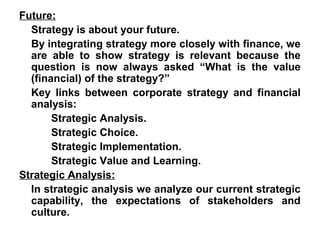
Future:
  Strategy is about your future.
  By integrating strategy more closely with finance, we
  are able to show strategy is relevant because the
  question is now always asked “What is the value
  (financial) of the strategy?”
  Key links between corporate strategy and financial
  analysis:
       Strategic Analysis.
       Strategic Choice.
       Strategic Implementation.
       Strategic Value and Learning.
Strategic Analysis:
  In strategic analysis we analyze our current strategic
  capability, the expectations of stakeholders and
  culture.
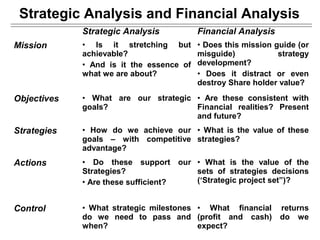
Strategic Analysis and Financial Analysis
             Strategic Analysis           Financial Analysis
Mission      • Is it stretching but       • Does this mission guide (or
             achievable?                  misguide)            strategy
             • And is it the essence of   development?
             what we are about?           • Does it distract or even
                                          destroy Share holder value?

Objectives   • What are our strategic • Are these consistent with
             goals?                   Financial realities? Present
                                      and future?
Strategies   • How do we achieve our • What is the value of these
             goals – with competitive strategies?
             advantage?
Actions      • Do these support our • What is the value of the
             Strategies?             sets of strategies decisions
             • Are these sufficient? (‘Strategic project set”)?


Control      • What strategic milestones • What financial      returns
             do we need to pass and (profit and cash)          do we
             when?                       expect?
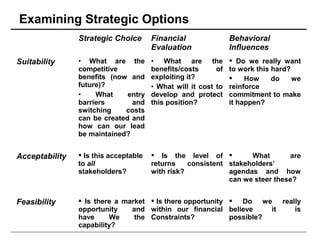
Examining Strategic Options
                Strategic Choice       Financial                Behavioral
                                       Evaluation               Influences
Suitability     • What are the         • What are the            Do we really want
                competitive            benefits/costs      of   to work this hard?
                benefits (now and      exploiting it?               How     do    we
                future)?               • What will it cost to   reinforce
                •    What     entry    develop and protect      commitment to make
                barriers       and     this position?           it happen?
                switching    costs
                can be created and
                how can our lead
                be maintained?


Acceptability    Is this acceptable    Is the level of          What       are
                to all                 returns    consistent stakeholders’
                stakeholders?          with risk?            agendas and how
                                                             can we steer these?


Feasibility      Is there a market  Is there opportunity  Do we really
                opportunity    and within our financial believe      it is
                have     We     the Constraints?           possible?
                capability?
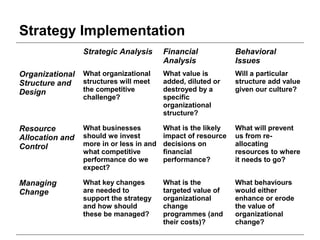
Strategy Implementation
                 Strategic Analysis       Financial            Behavioral
                                          Analysis             Issues
Organizational   What organizational      What value is        Will a particular
Structure and    structures will meet     added, diluted or    structure add value
Design           the competitive          destroyed by a       given our culture?
                 challenge?               specific
                                          organizational
                                          structure?

Resource         What businesses          What is the likely   What will prevent
Allocation and   should we invest         impact of resource   us from re-
Control          more in or less in and   decisions on         allocating
                 what competitive         financial            resources to where
                 performance do we        performance?         it needs to go?
                 expect?

Managing         What key changes         What is the          What behaviours
Change           are needed to            targeted value of    would either
                 support the strategy     organizational       enhance or erode
                 and how should           change               the value of
                 these be managed?        programmes (and      organizational
                                          their costs)?        change?
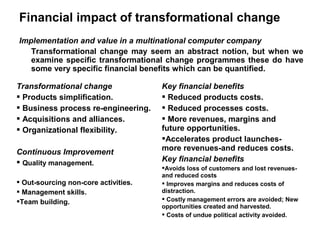
Financial impact of transformational change
Implementation and value in a multinational computer company
   Transformational change may seem an abstract notion, but when we
   examine specific transformational change programmes these do have
   some very specific financial benefits which can be quantified.

Transformational change               Key financial benefits
 Products simplification.             Reduced products costs.
 Business process re-engineering.     Reduced processes costs.
 Acquisitions and alliances.          More revenues, margins and
 Organizational flexibility.         future opportunities.
                                      Accelerates product launches-
Continuous Improvement                more revenues-and reduces costs.
 Quality management.                 Key financial benefits
                                      Avoids loss of customers and lost revenues-
                                      and reduced costs
 Out-sourcing non-core activities.    Improves margins and reduces costs of
 Management skills.                  distraction.
Team building.                        Costly management errors are avoided; New
                                      opportunities created and harvested.
                                       Costs of undue political activity avoided.
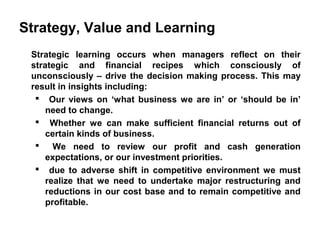
Strategy, Value and Learning
 Strategic learning occurs when managers reflect on their
 strategic and financial recipes which consciously of
 unconsciously – drive the decision making process. This may
 result in insights including:
   Our views on ‘what business we are in’ or ‘should be in’
     need to change.
   Whether we can make sufficient financial returns out of
     certain kinds of business.
   We need to review our profit and cash generation
     expectations, or our investment priorities.
   due to adverse shift in competitive environment we must
     realize that we need to undertake major restructuring and
     reductions in our cost base and to remain competitive and
     profitable.
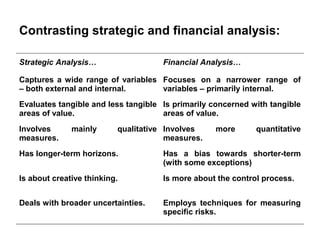
Contrasting strategic and financial analysis:

Strategic Analysis…                  Financial Analysis…

Captures a wide range of variables Focuses on a narrower range of
– both external and internal.      variables – primarily internal.
Evaluates tangible and less tangible Is primarily concerned with tangible
areas of value.                      areas of value.
Involves      mainly      qualitative Involves    more       quantitative
measures.                             measures.
Has longer-term horizons.            Has a bias towards shorter-term
                                     (with some exceptions)
Is about creative thinking.          Is more about the control process.


Deals with broader uncertainties.    Employs techniques for measuring
                                     specific risks.

Sfm intro

  • 1.
    Strategic Financial Management(SFM) SFM is “the assessment of Strategic Options, Choices and Business performance by both strategic and financial analysis”. SFM examines how a united view of strategic and financial issues can become a practical reality. This is achieved by looking at • the links between corporate strategy and SFM • managing for value-enabling financial management to play a positive and proactive role in strategic management. • the process of value management - These include strategic management accounting and strategic and financial planning. • key applications including strategic investment decisions, acquisitions, strategic cost management, and value business change. • implementing SFM.
  • 2.
    STRATEGY: Simplicity: Simplicityresides in their being a relatively a few number of competitive fundamentals which are limited up to deliver VALUE. EX: Brand Differentiation. Service Excellence. First mover advantage. Thinking: Strategy is also about thinking – Strategic Thinking? Where are we? Where do we want to reach? Results – Focus: Strategies do not necessarily have very easily quantified value these strategies ultimately have only if and when are cashed in for real money.
  • 3.
    Action: Strategymust also therefore be about action. Because managers are not held accountable for both the Strategic and Financial performance of business they can continue to misjudge the future and get away with it. Timing: Strategy very much requires close attention to the timing, specifically external events of other competitive conditions. Time-window of a strategy can have a profound impact on its ‘Financial value’ (IBM). Energizing: Strategy is essentially an energizing force provides fresh vigor and sense of purpose into managers otherwise buffeted by operational turbulence. Goal Driven: Strategy mean clear linkages with specific operational and financial goals. This means not just setting directions but also establishing controls.
  • 4.
    Future: Strategyis about your future. By integrating strategy more closely with finance, we are able to show strategy is relevant because the question is now always asked “What is the value (financial) of the strategy?” Key links between corporate strategy and financial analysis: Strategic Analysis. Strategic Choice. Strategic Implementation. Strategic Value and Learning. Strategic Analysis: In strategic analysis we analyze our current strategic capability, the expectations of stakeholders and culture.
  • 5.
    Strategic Analysis andFinancial Analysis Strategic Analysis Financial Analysis Mission • Is it stretching but • Does this mission guide (or achievable? misguide) strategy • And is it the essence of development? what we are about? • Does it distract or even destroy Share holder value? Objectives • What are our strategic • Are these consistent with goals? Financial realities? Present and future? Strategies • How do we achieve our • What is the value of these goals – with competitive strategies? advantage? Actions • Do these support our • What is the value of the Strategies? sets of strategies decisions • Are these sufficient? (‘Strategic project set”)? Control • What strategic milestones • What financial returns do we need to pass and (profit and cash) do we when? expect?
  • 6.
    Examining Strategic Options Strategic Choice Financial Behavioral Evaluation Influences Suitability • What are the • What are the  Do we really want competitive benefits/costs of to work this hard? benefits (now and exploiting it?  How do we future)? • What will it cost to reinforce • What entry develop and protect commitment to make barriers and this position? it happen? switching costs can be created and how can our lead be maintained? Acceptability  Is this acceptable  Is the level of  What are to all returns consistent stakeholders’ stakeholders? with risk? agendas and how can we steer these? Feasibility  Is there a market  Is there opportunity  Do we really opportunity and within our financial believe it is have We the Constraints? possible? capability?
  • 7.
    Strategy Implementation Strategic Analysis Financial Behavioral Analysis Issues Organizational What organizational What value is Will a particular Structure and structures will meet added, diluted or structure add value Design the competitive destroyed by a given our culture? challenge? specific organizational structure? Resource What businesses What is the likely What will prevent Allocation and should we invest impact of resource us from re- Control more in or less in and decisions on allocating what competitive financial resources to where performance do we performance? it needs to go? expect? Managing What key changes What is the What behaviours Change are needed to targeted value of would either support the strategy organizational enhance or erode and how should change the value of these be managed? programmes (and organizational their costs)? change?
  • 8.
    Financial impact oftransformational change Implementation and value in a multinational computer company Transformational change may seem an abstract notion, but when we examine specific transformational change programmes these do have some very specific financial benefits which can be quantified. Transformational change Key financial benefits  Products simplification.  Reduced products costs.  Business process re-engineering.  Reduced processes costs.  Acquisitions and alliances.  More revenues, margins and  Organizational flexibility. future opportunities. Accelerates product launches- Continuous Improvement more revenues-and reduces costs.  Quality management. Key financial benefits Avoids loss of customers and lost revenues- and reduced costs  Out-sourcing non-core activities.  Improves margins and reduces costs of  Management skills. distraction. Team building.  Costly management errors are avoided; New opportunities created and harvested.  Costs of undue political activity avoided.
  • 9.
    Strategy, Value andLearning Strategic learning occurs when managers reflect on their strategic and financial recipes which consciously of unconsciously – drive the decision making process. This may result in insights including:  Our views on ‘what business we are in’ or ‘should be in’ need to change.  Whether we can make sufficient financial returns out of certain kinds of business.  We need to review our profit and cash generation expectations, or our investment priorities.  due to adverse shift in competitive environment we must realize that we need to undertake major restructuring and reductions in our cost base and to remain competitive and profitable.
  • 10.
    Contrasting strategic andfinancial analysis: Strategic Analysis… Financial Analysis… Captures a wide range of variables Focuses on a narrower range of – both external and internal. variables – primarily internal. Evaluates tangible and less tangible Is primarily concerned with tangible areas of value. areas of value. Involves mainly qualitative Involves more quantitative measures. measures. Has longer-term horizons. Has a bias towards shorter-term (with some exceptions) Is about creative thinking. Is more about the control process. Deals with broader uncertainties. Employs techniques for measuring specific risks.