

BPM and SOA Are Going Mobile
An Architectural Perspective

Guido Schmutz
Trivadis
Torsten Winterberg
OPITZ CONSULTING Deutschland GmbH
DOAG, November 2013
Mobile Development
What does this mean today?
An architectural point of view
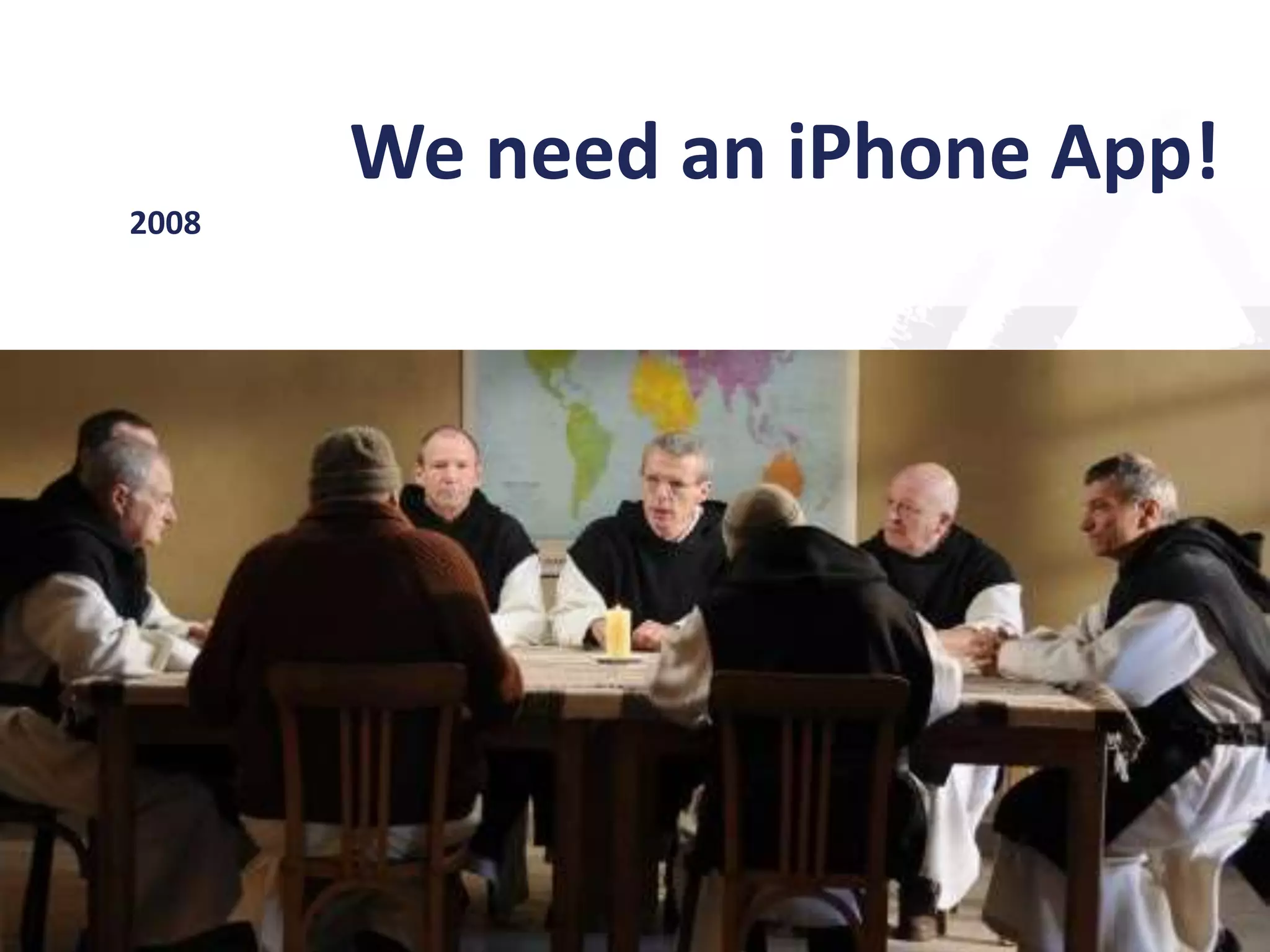
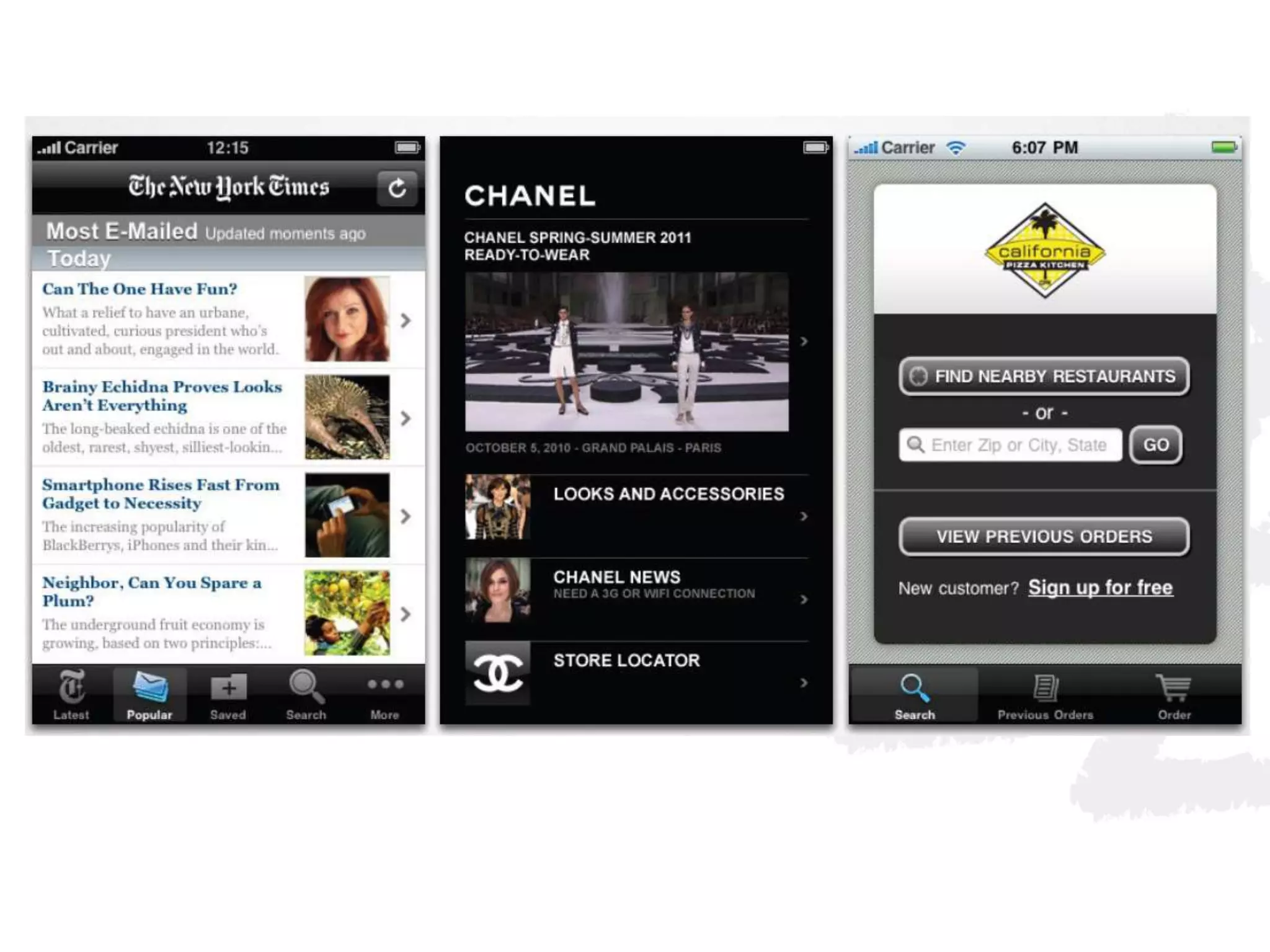
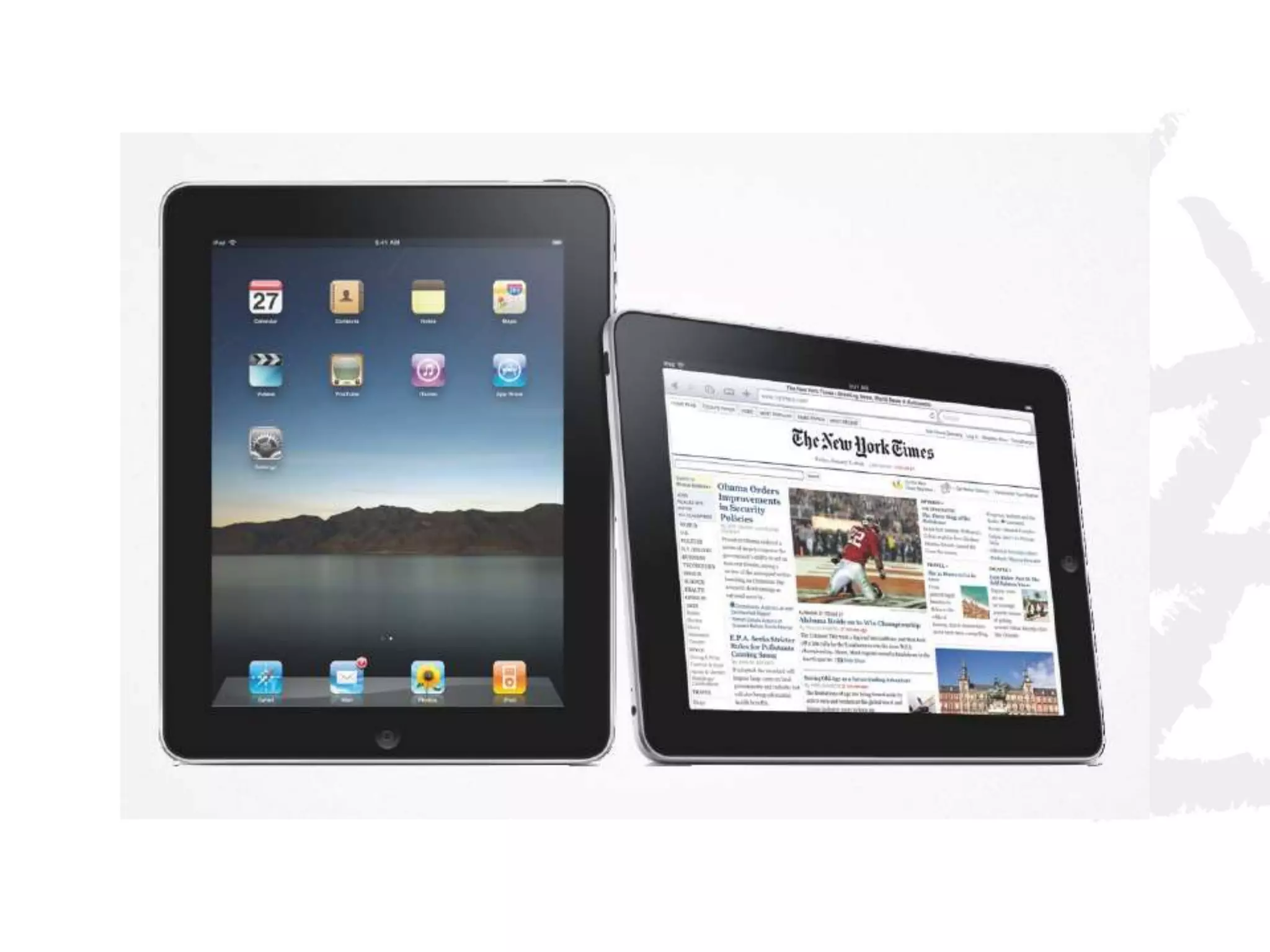
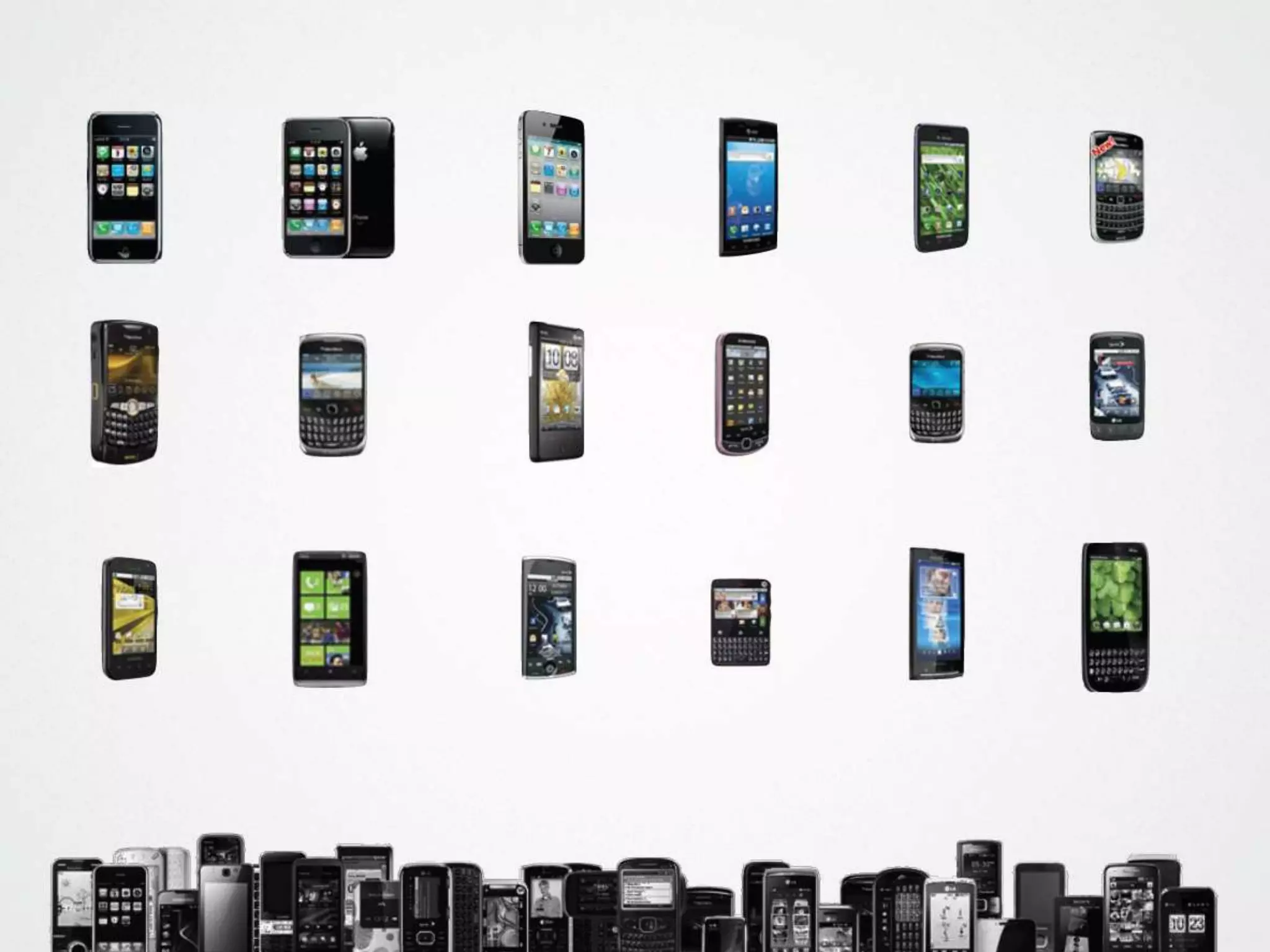
We need an iPhone App!
2008
Cloud-Services become more
and more important

Dropbox, Evernote, …
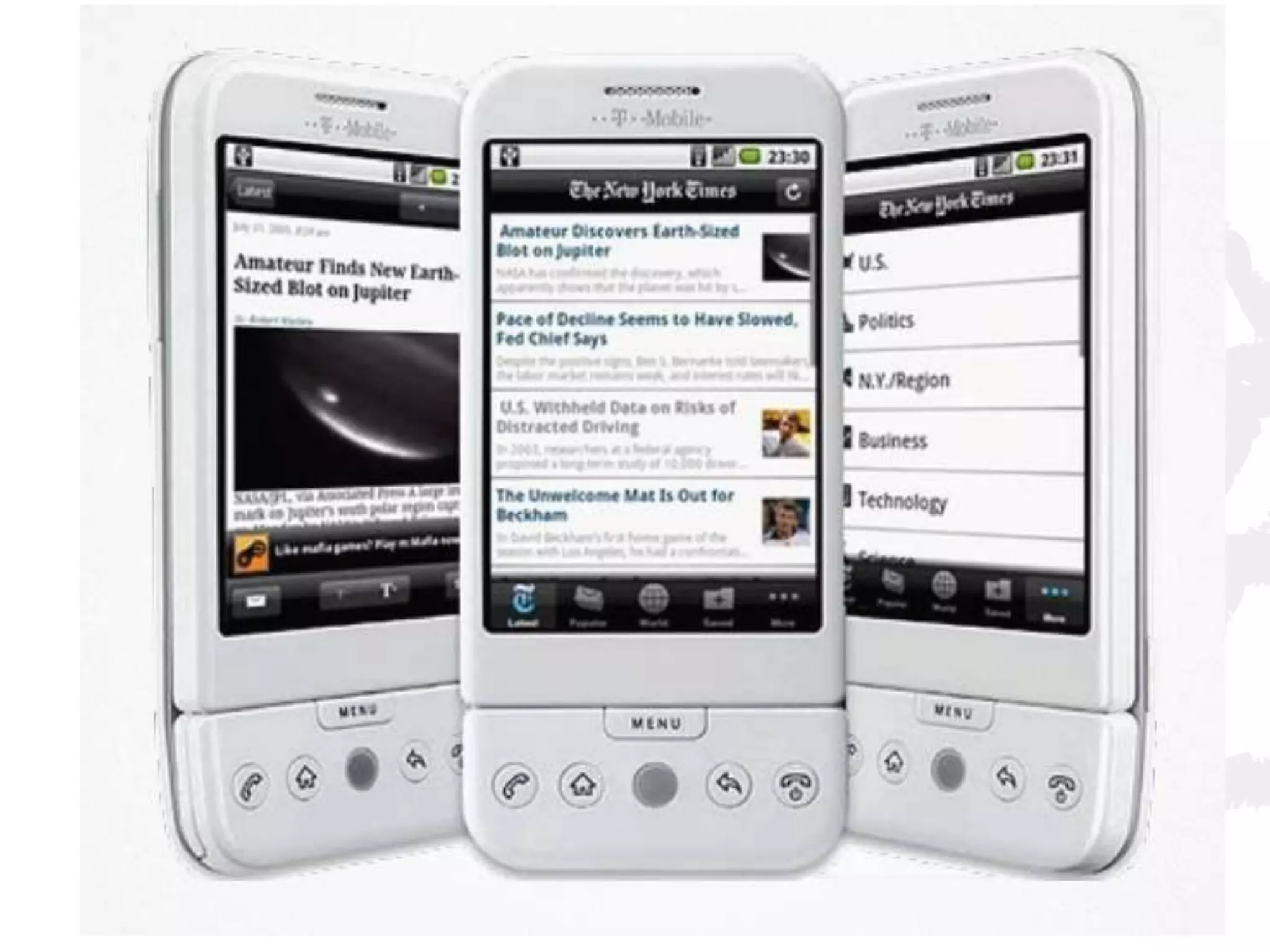
We need an Android App!
2010
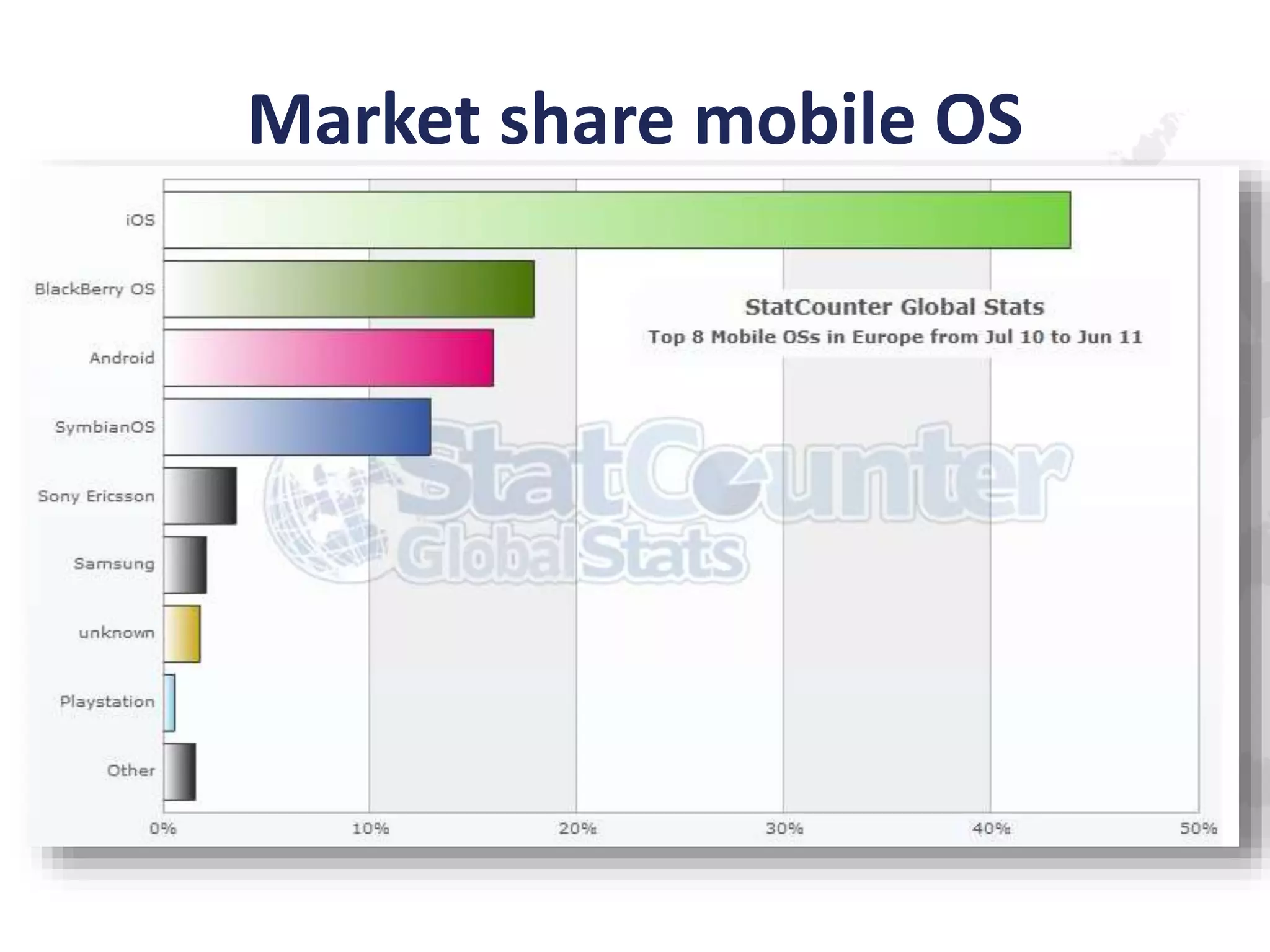
Market share mobile OS
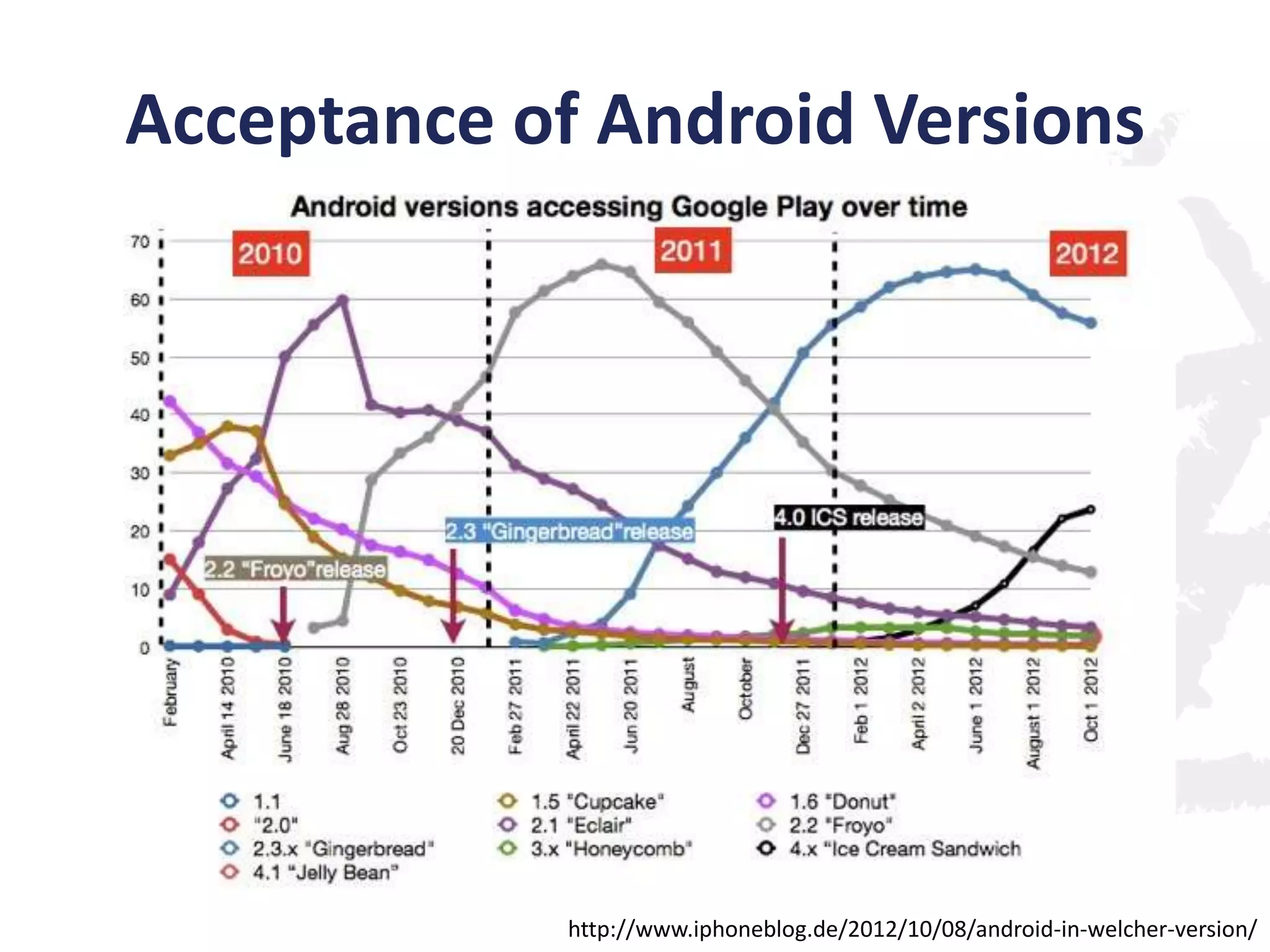
Acceptance of Android Versions

http://www.iphoneblog.de/2012/10/08/android-in-welcher-version/
The Web: Cross-Plattform
Write Once, run everywhere
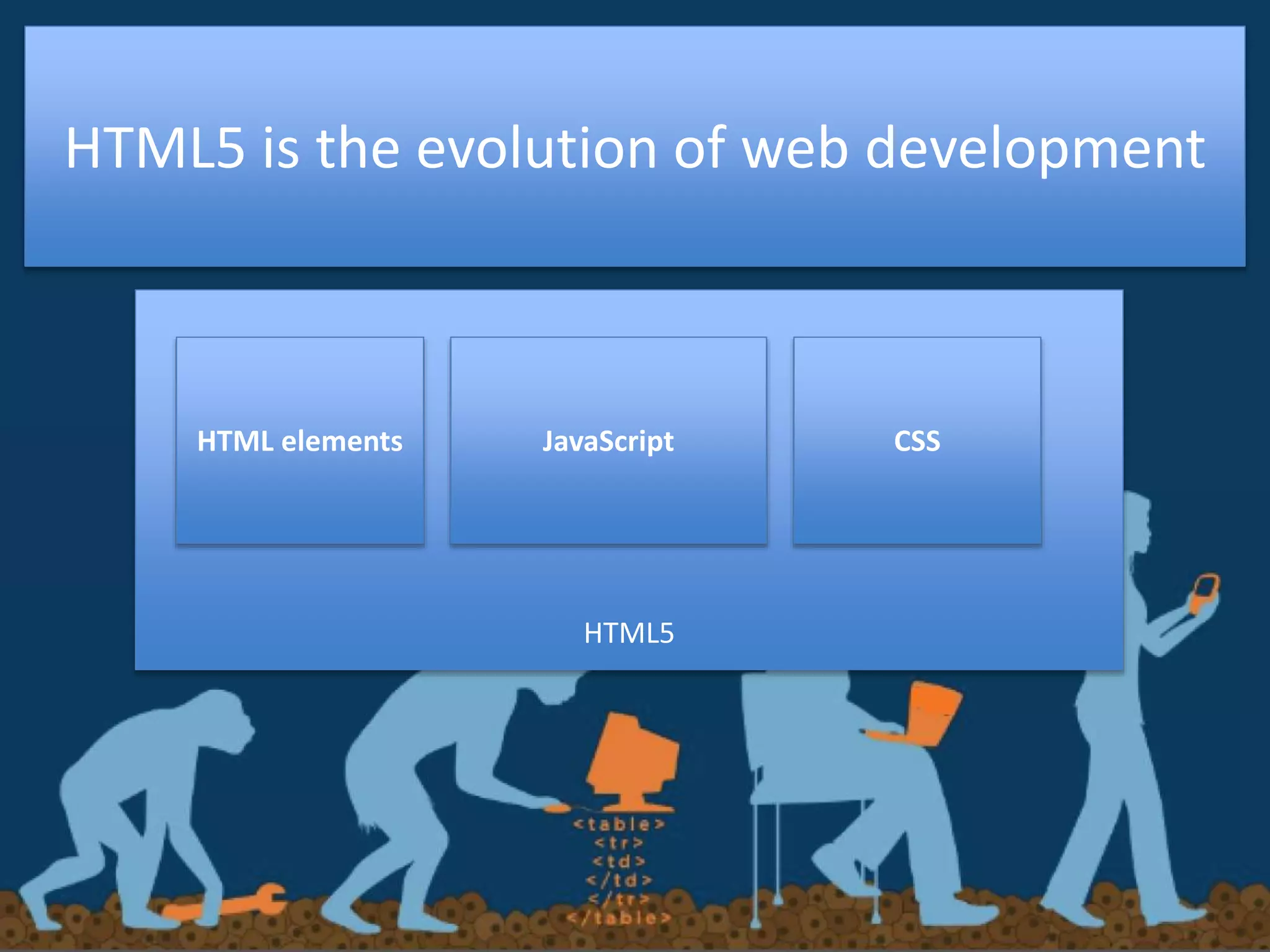
HTML5 is the evolution of web development

HTML elements

JavaScript

HTML5

CSS
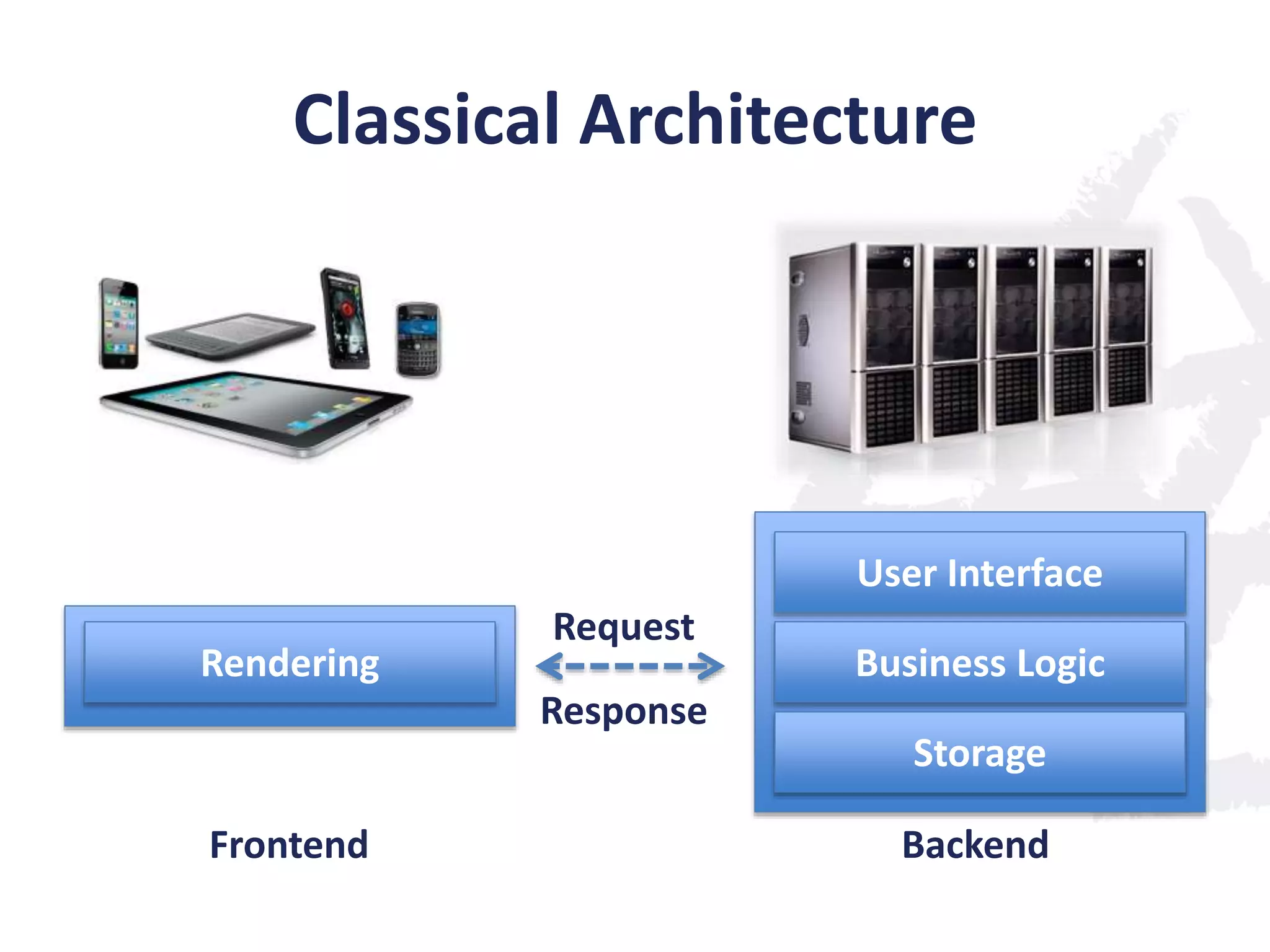
Classical Architecture

User Interface
Rendering

Request

Business Logic

Response

Storage
Frontend

Backend
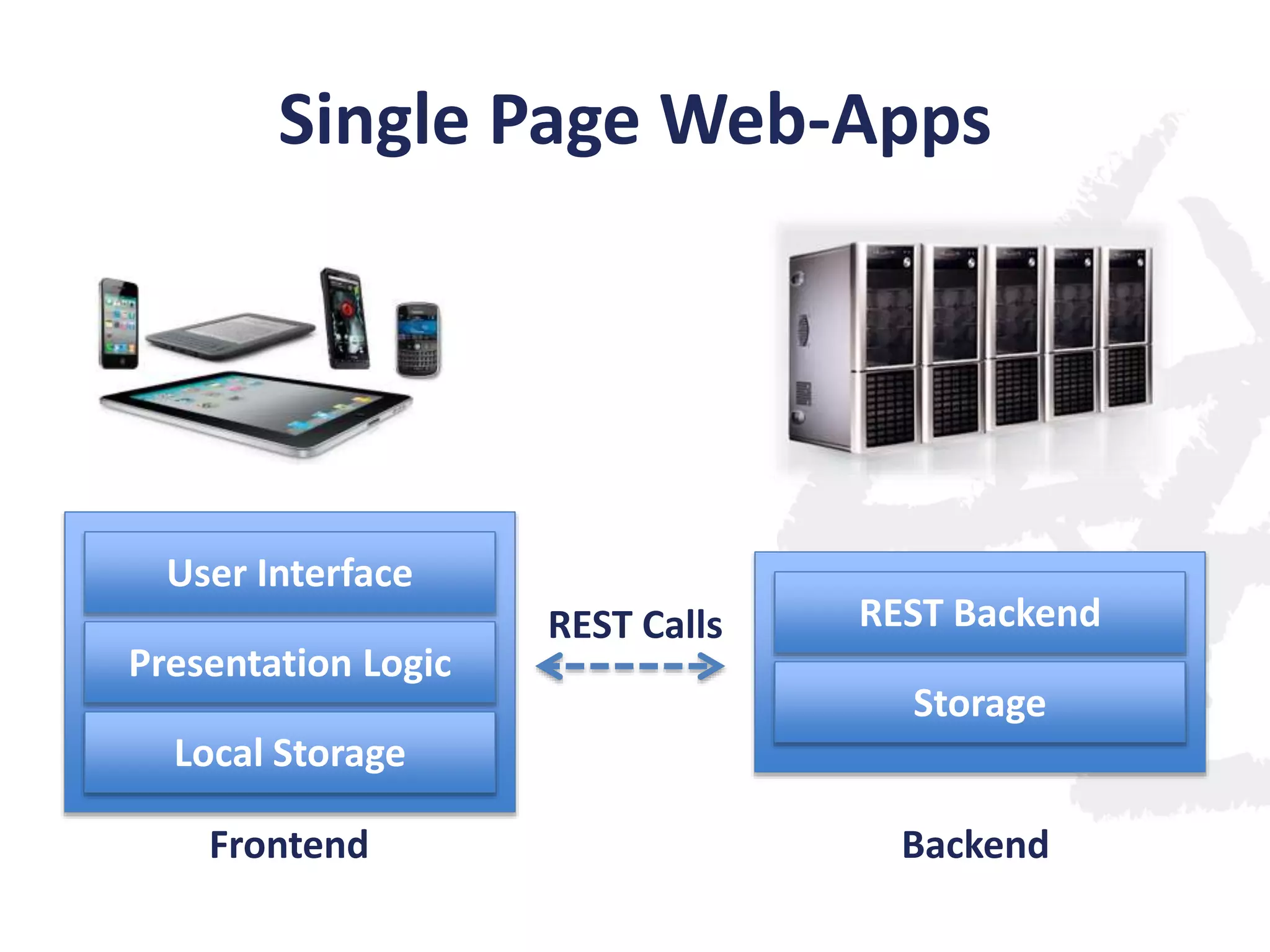
Single Page Web-Apps

User Interface
Presentation Logic

REST Calls

REST Backend
Storage

Local Storage
Frontend

Backend
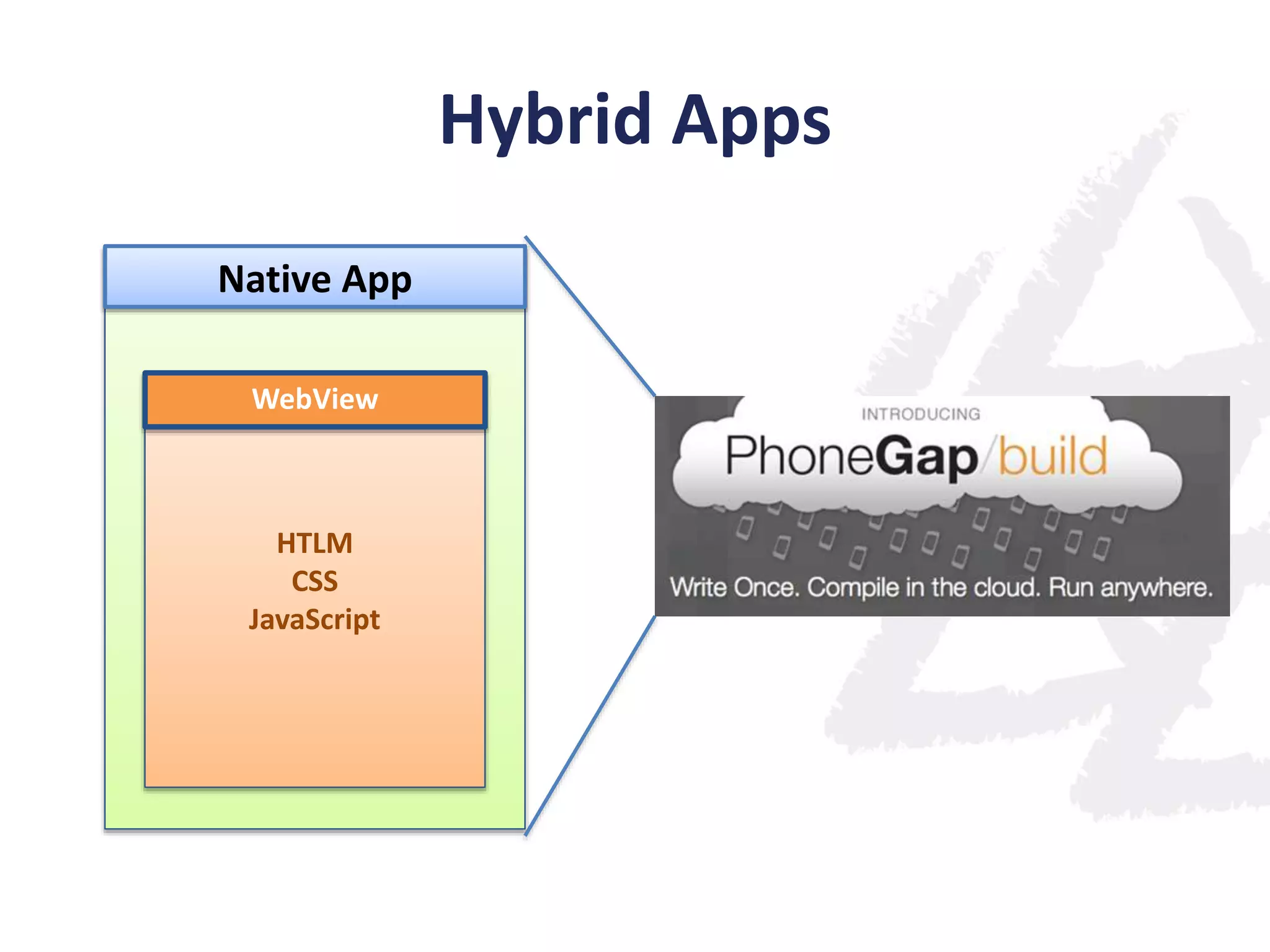
Hybrid Apps
Native App
WebView

HTLM
CSS
JavaScript
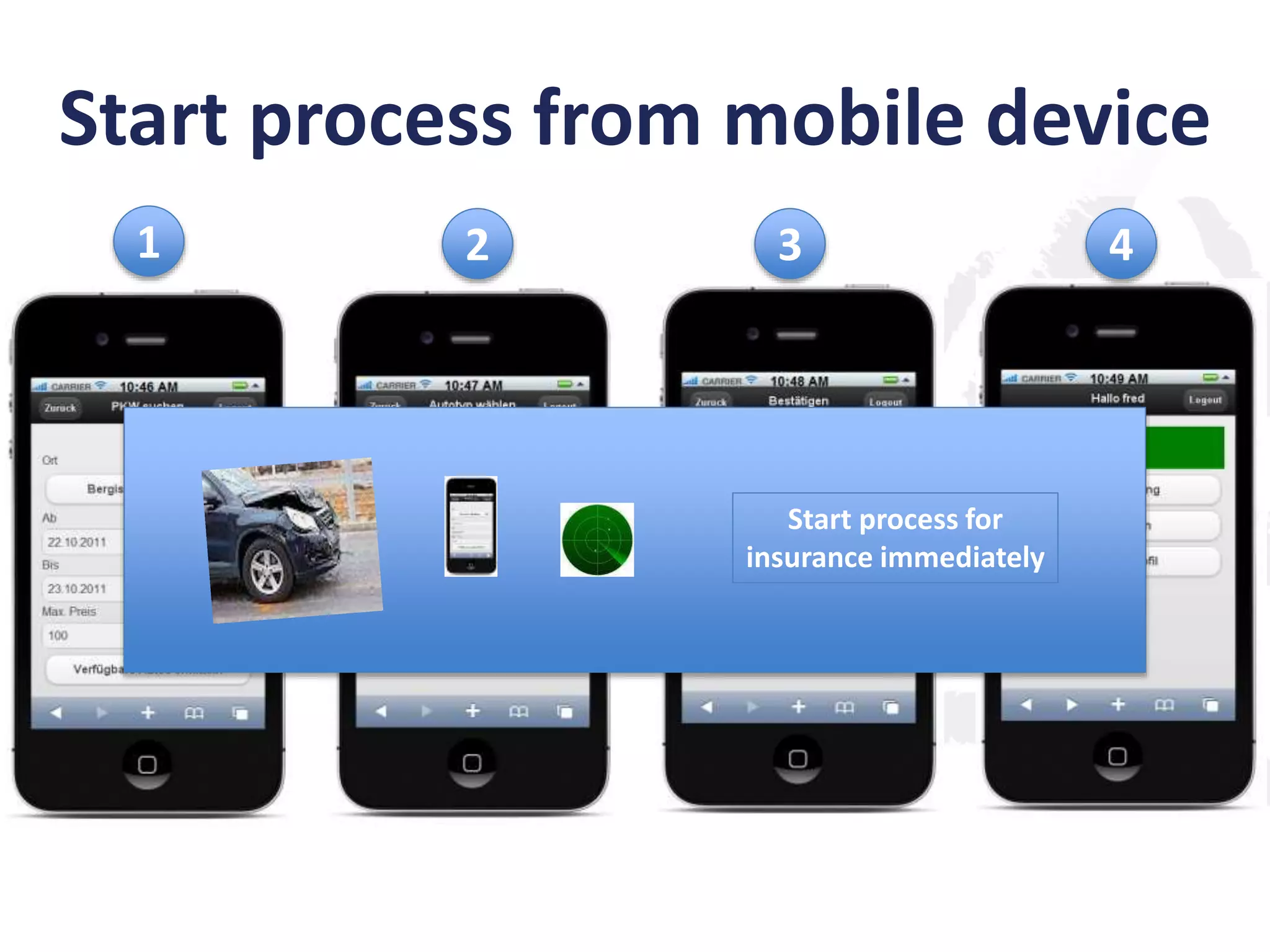
Start process from mobile device
1

2

3

Start process for
insurance immediately

4
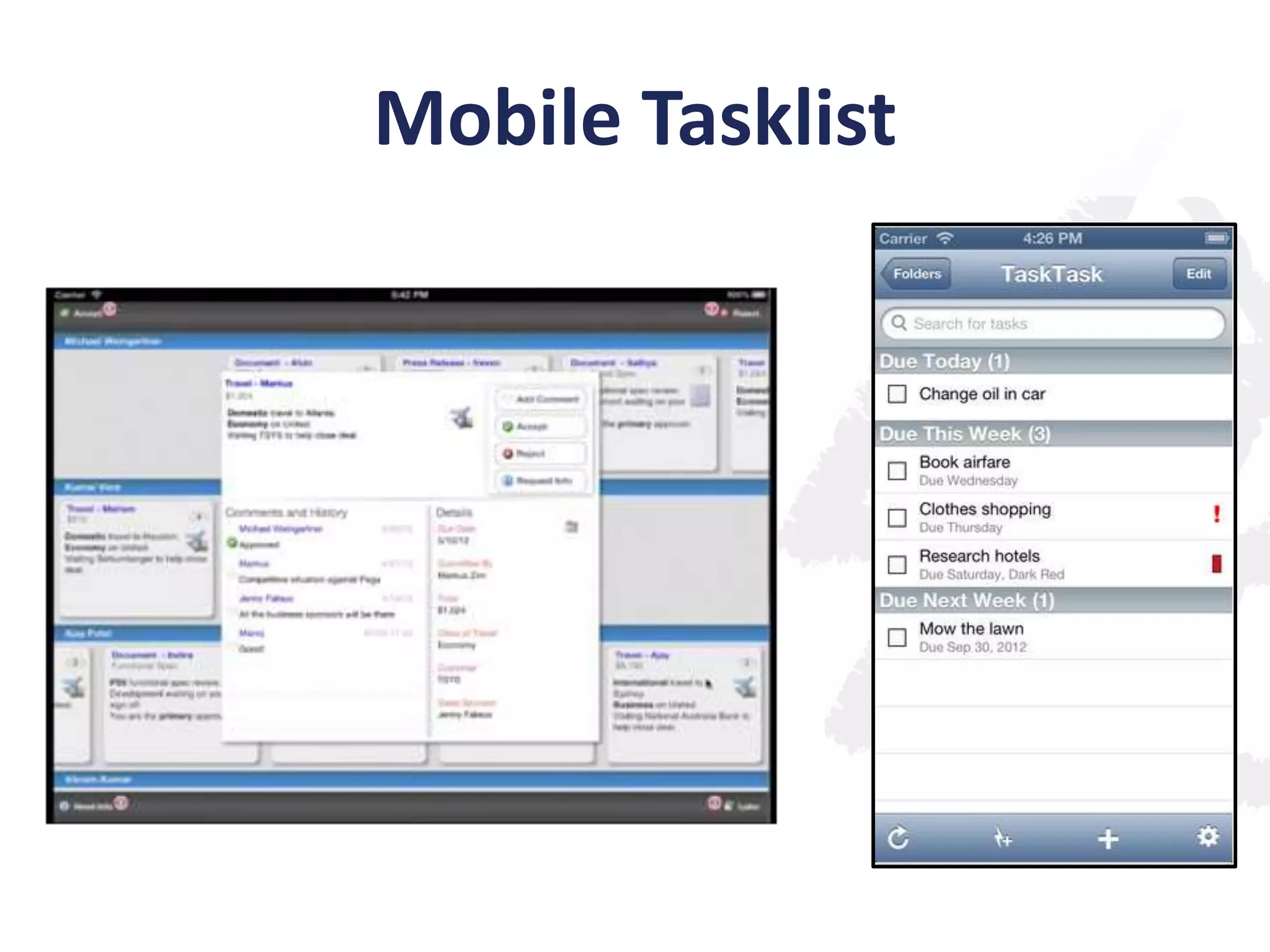
Mobile Tasklist
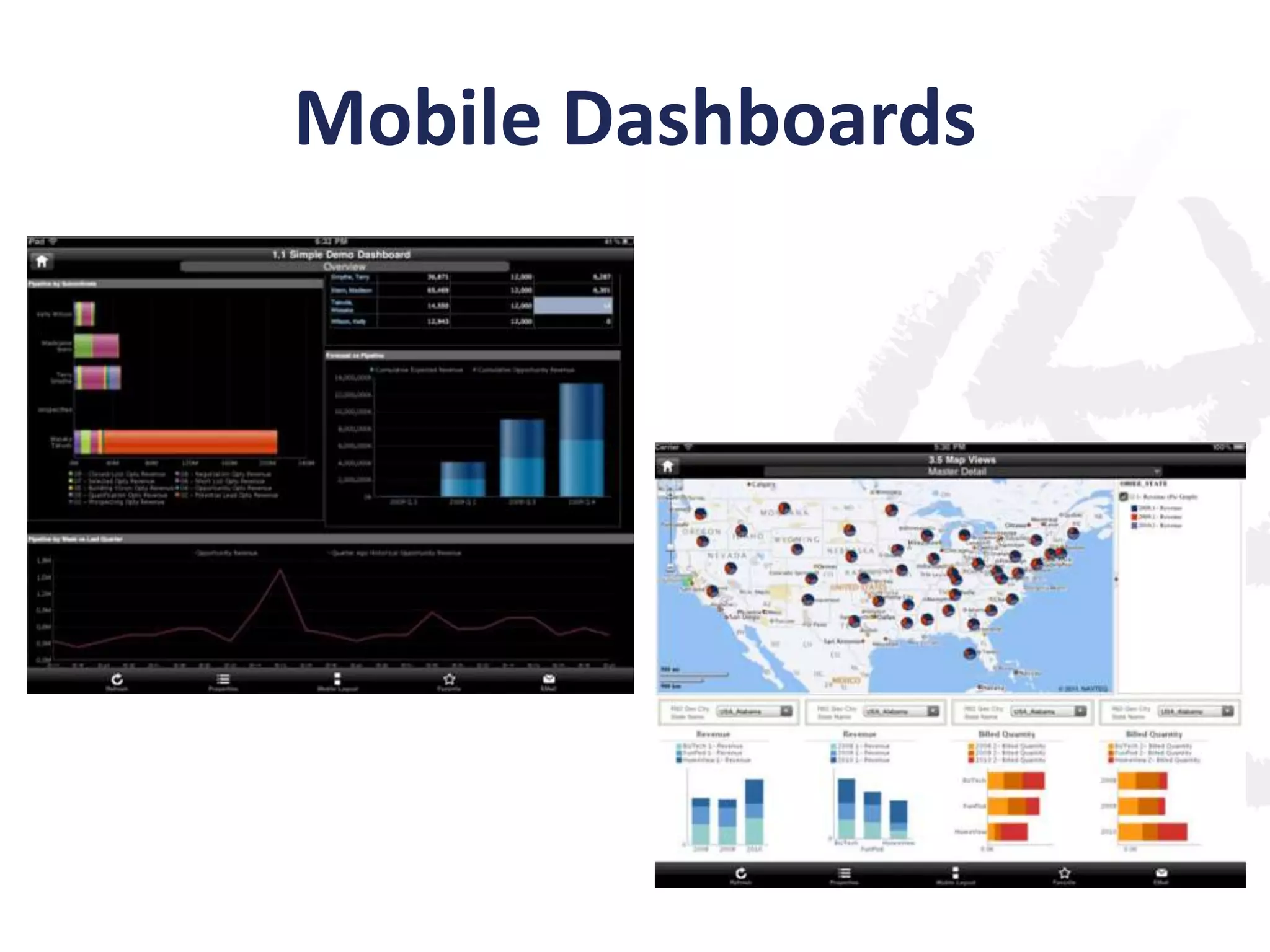
Mobile Dashboards
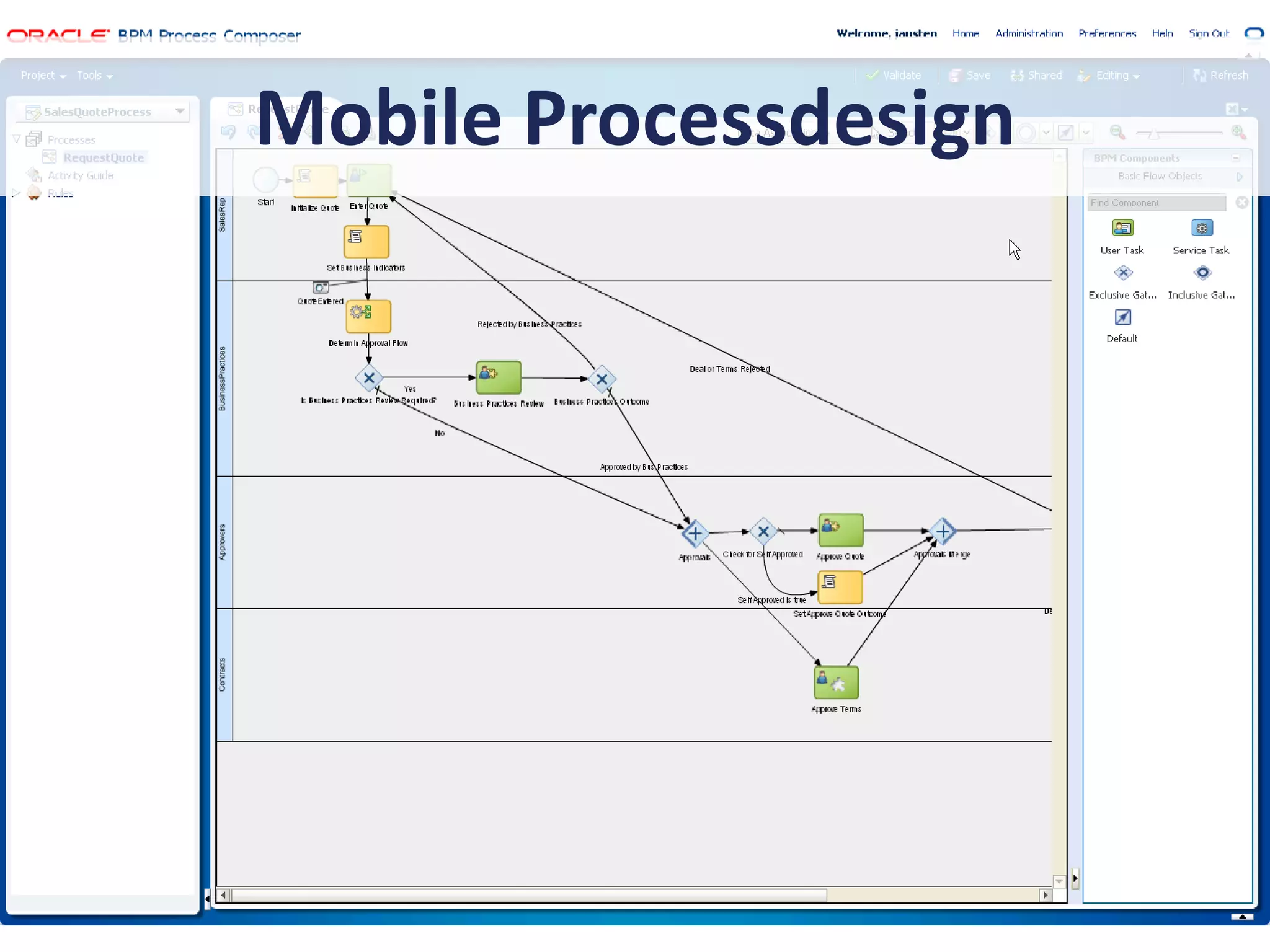
Mobile Processdesign
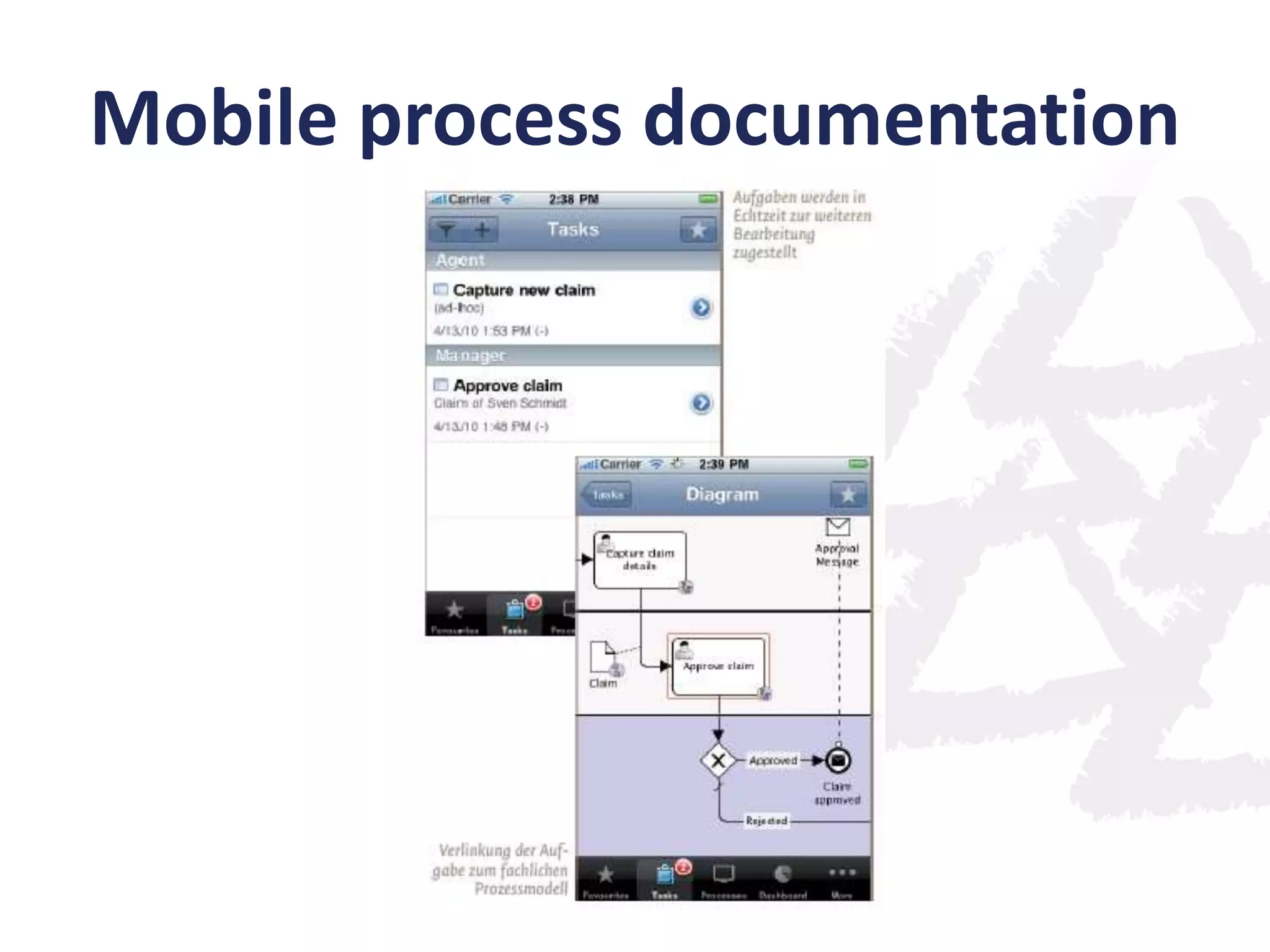
Mobile process documentation
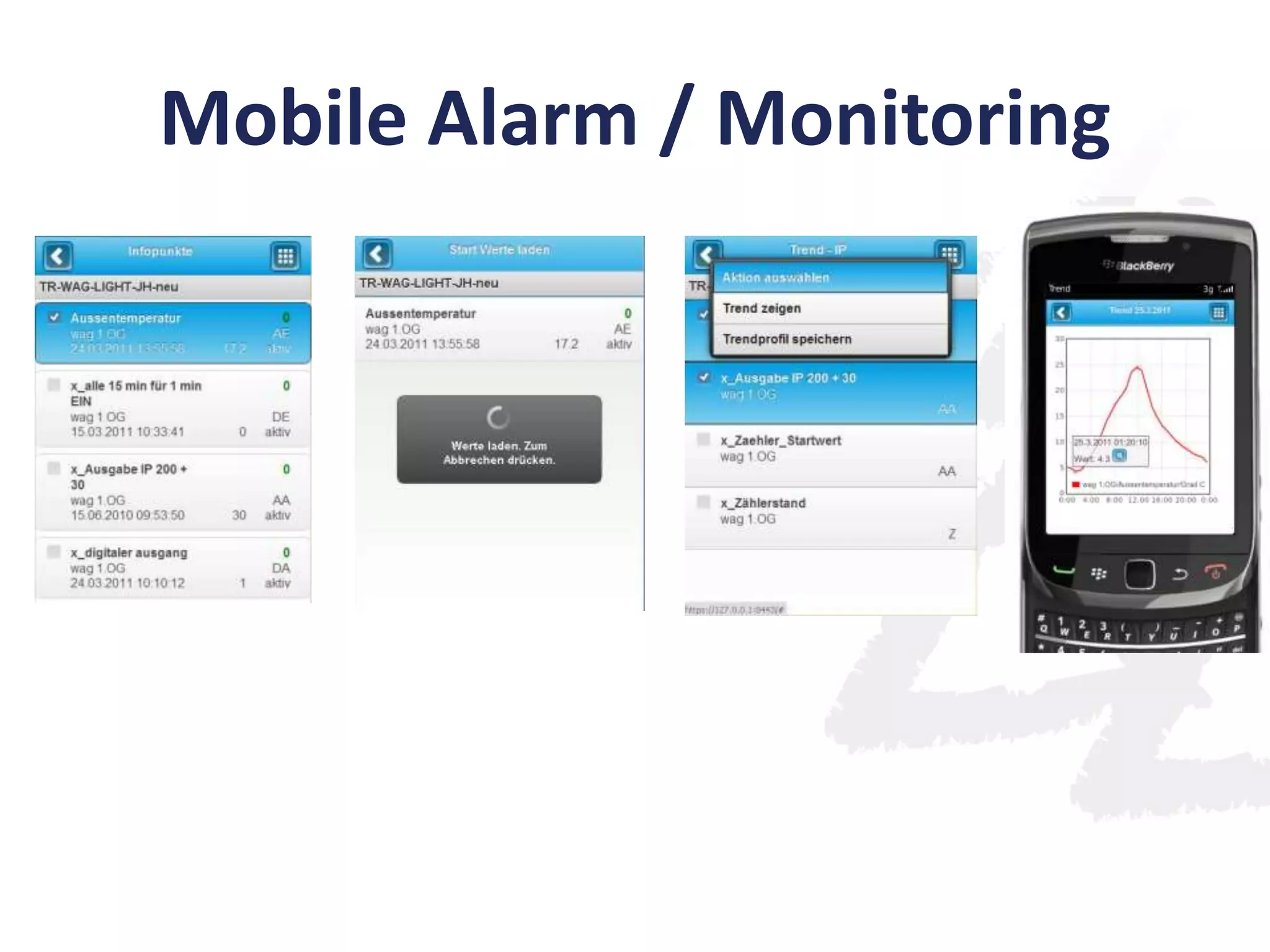
Mobile Alarm / Monitoring
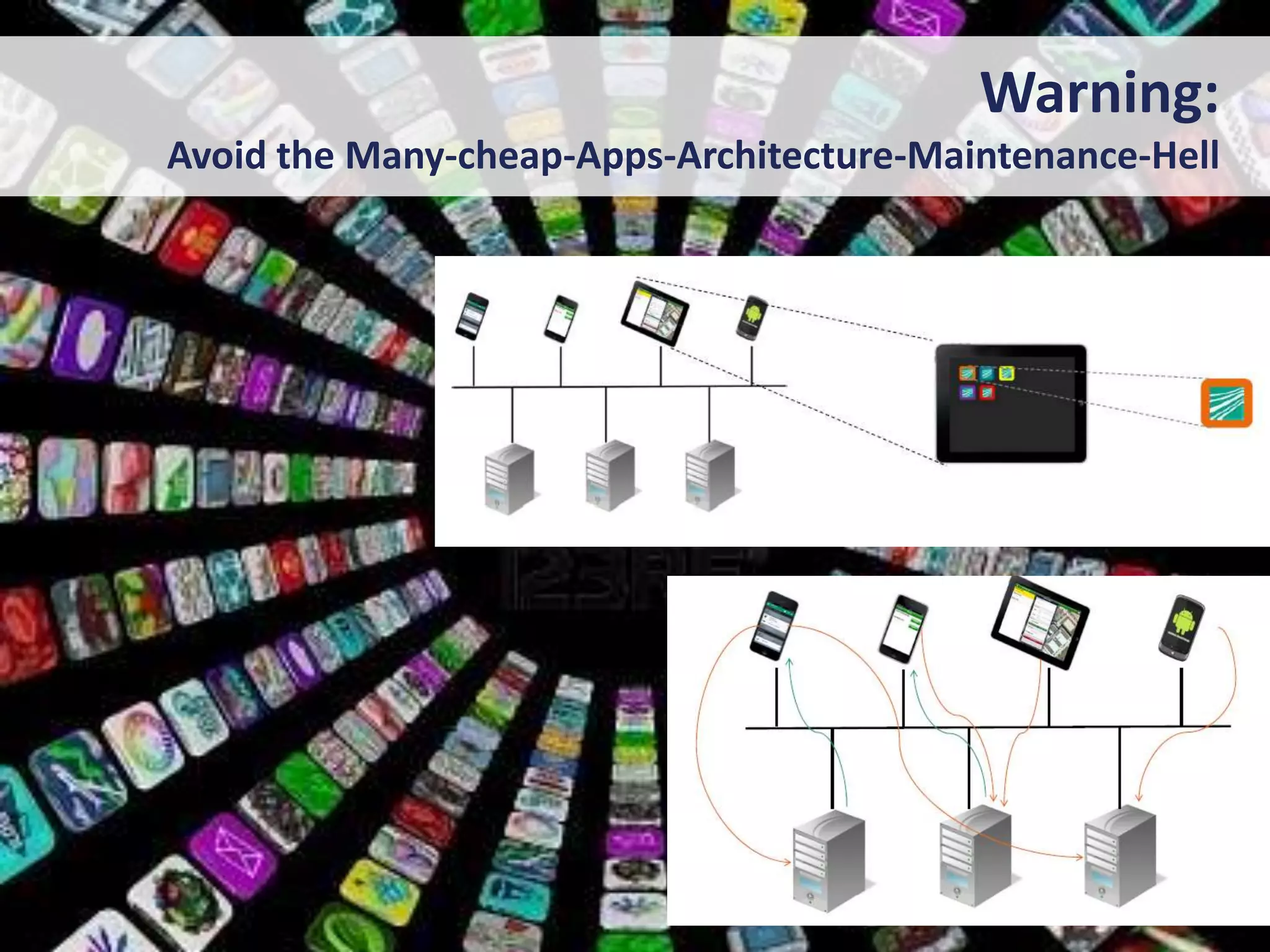
Warning:
Avoid the Many-cheap-Apps-Architecture-Maintenance-Hell
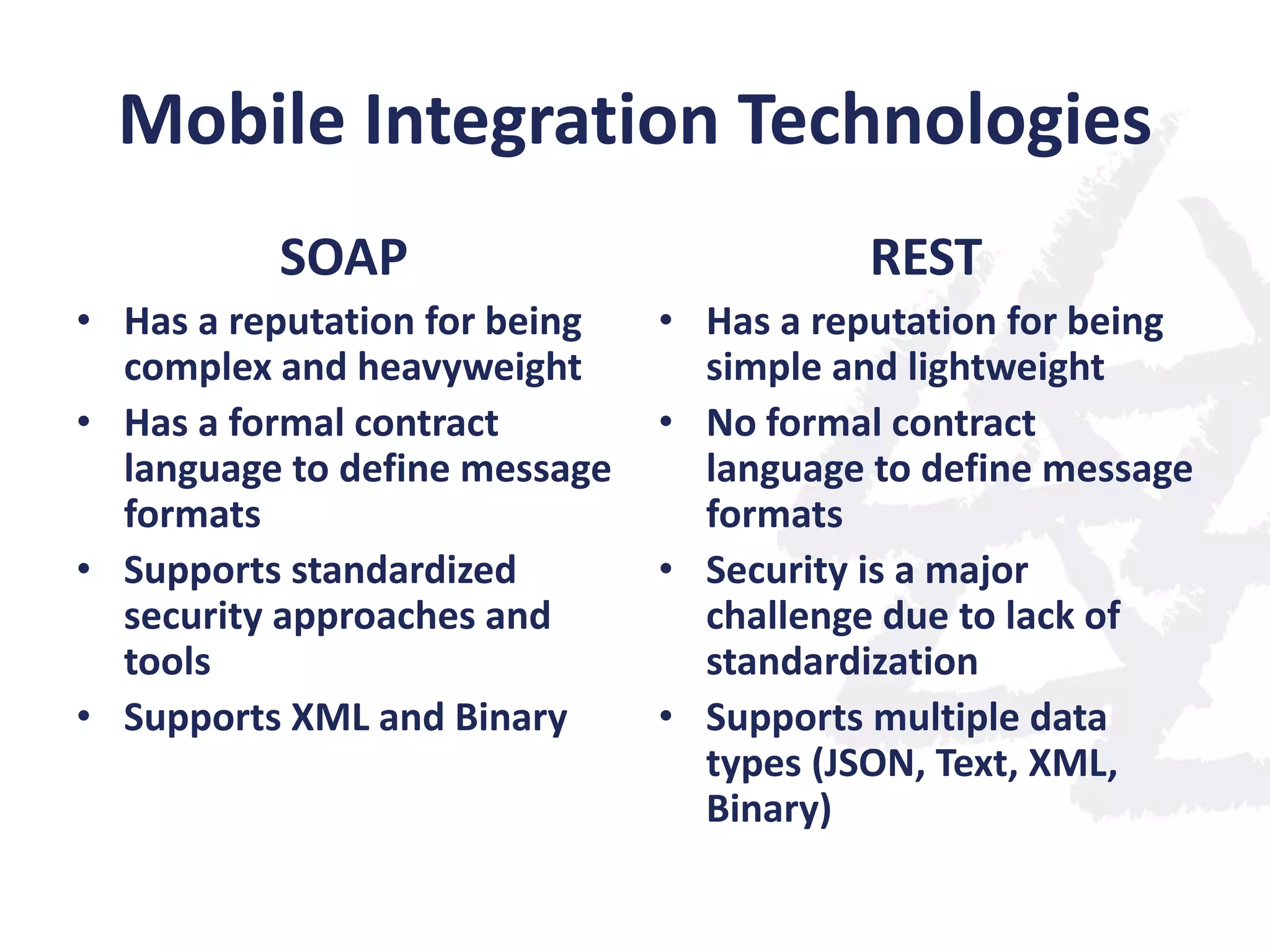
Mobile Integration Technologies
SOAP

REST

• Has a reputation for being
complex and heavyweight
• Has a formal contract
language to define message
formats
• Supports standardized
security approaches and
tools
• Supports XML and Binary

• Has a reputation for being
simple and lightweight
• No formal contract
language to define message
formats
• Security is a major
challenge due to lack of
standardization
• Supports multiple data
types (JSON, Text, XML,
Binary)
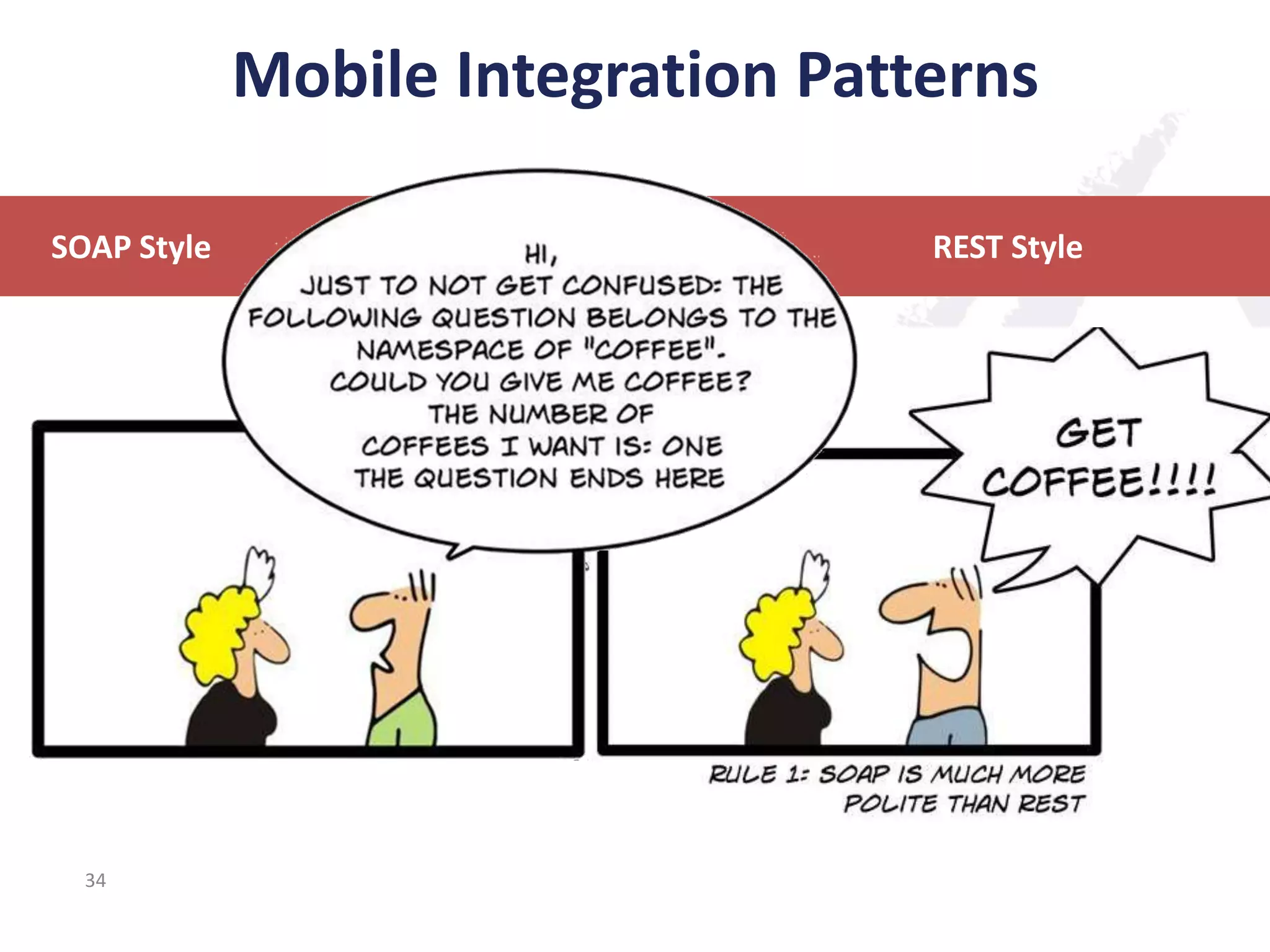
Mobile Integration Patterns
SOAP Style

34

REST Style
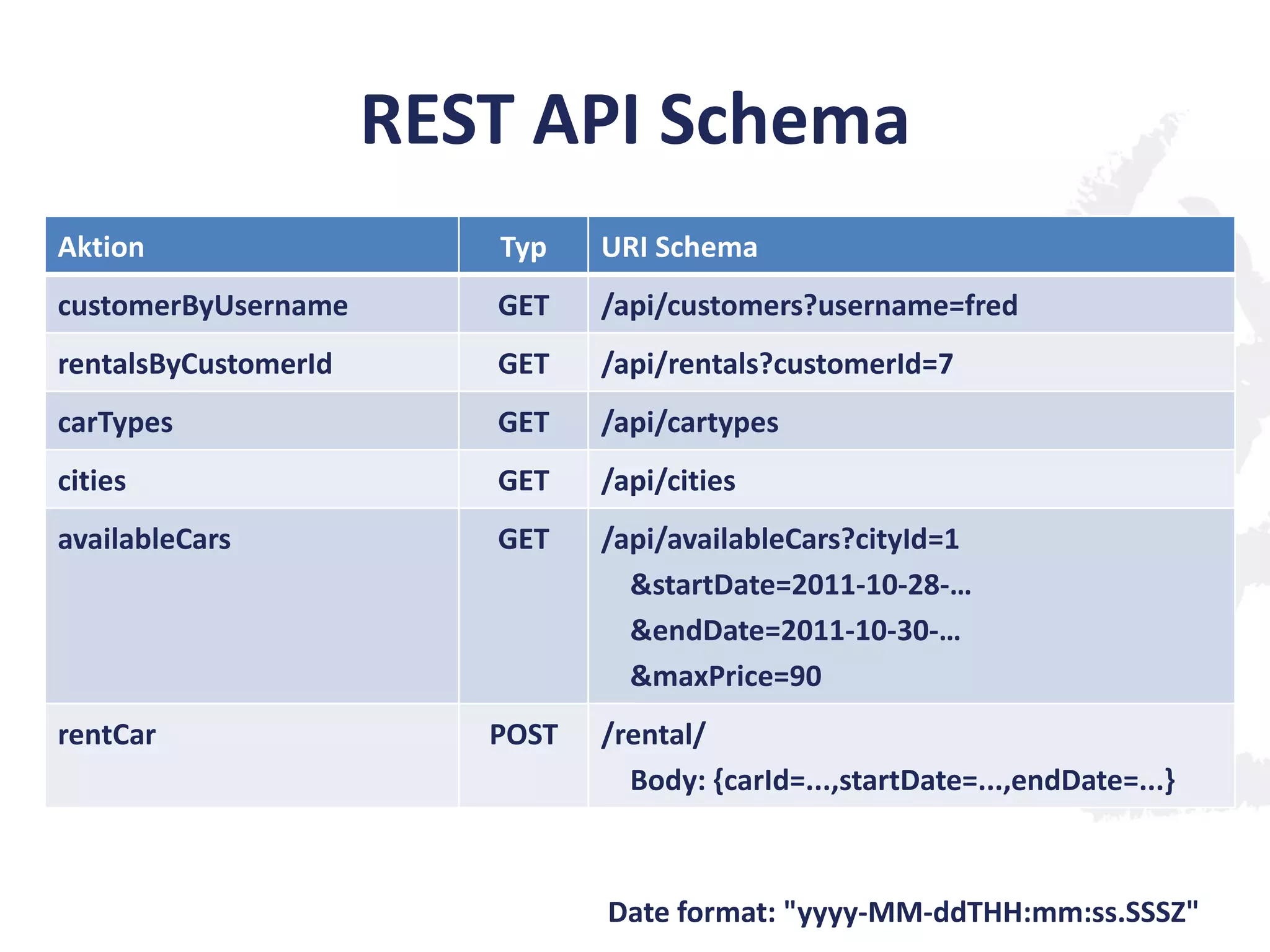
REST API Schema
Aktion

Typ

URI Schema

customerByUsername

GET

/api/customers?username=fred

rentalsByCustomerId

GET

/api/rentals?customerId=7

carTypes

GET

/api/cartypes

cities

GET

/api/cities

availableCars

GET

/api/availableCars?cityId=1
&startDate=2011-10-28-…
&endDate=2011-10-30-…
&maxPrice=90

rentCar

POST

/rental/
Body: {carId=...,startDate=...,endDate=...}

Date format: "yyyy-MM-ddTHH:mm:ss.SSSZ"
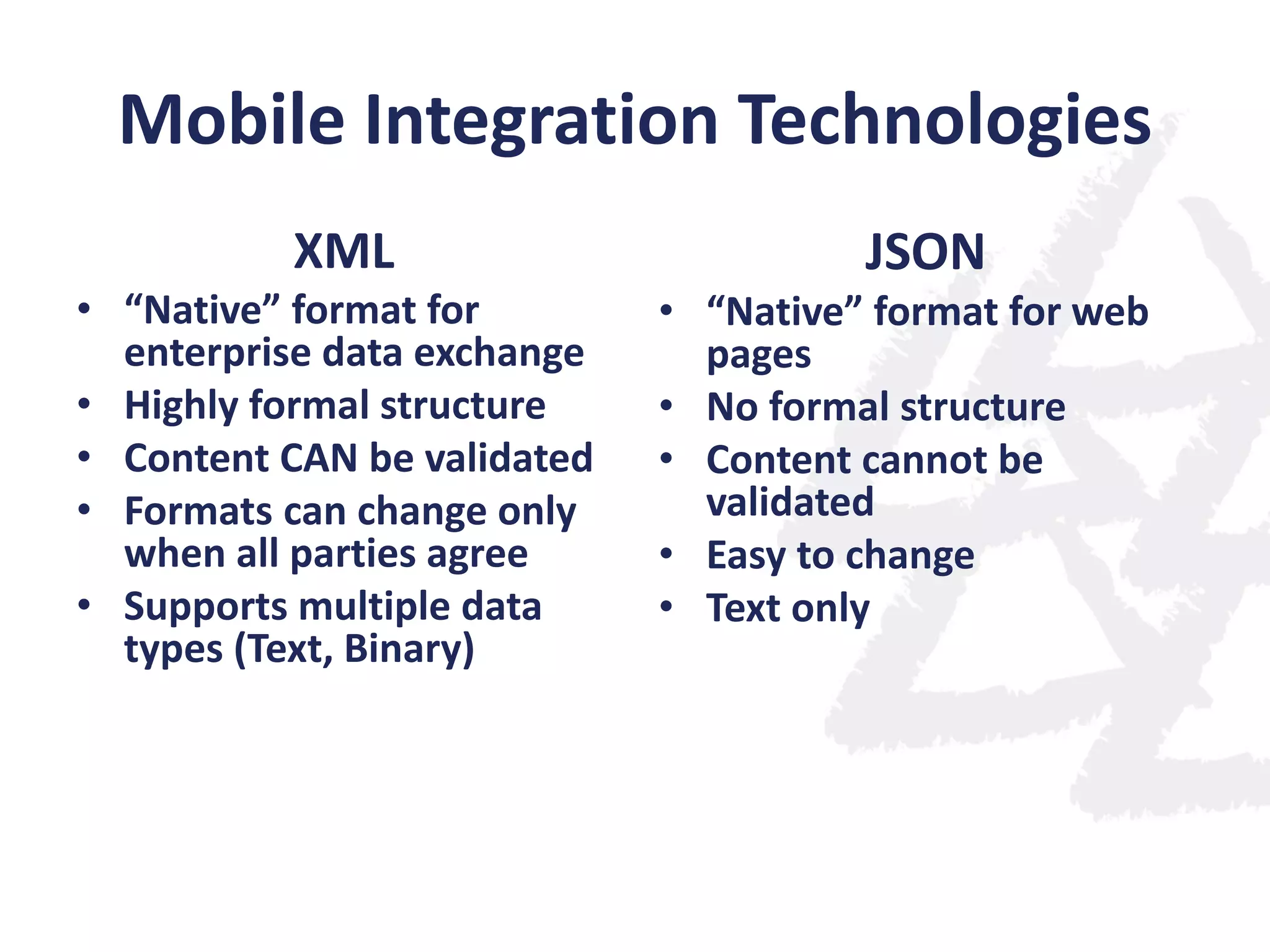
Mobile Integration Technologies
XML
• “Native” format for
enterprise data exchange
• Highly formal structure
• Content CAN be validated
• Formats can change only
when all parties agree
• Supports multiple data
types (Text, Binary)

JSON
• “Native” format for web
pages
• No formal structure
• Content cannot be
validated
• Easy to change
• Text only
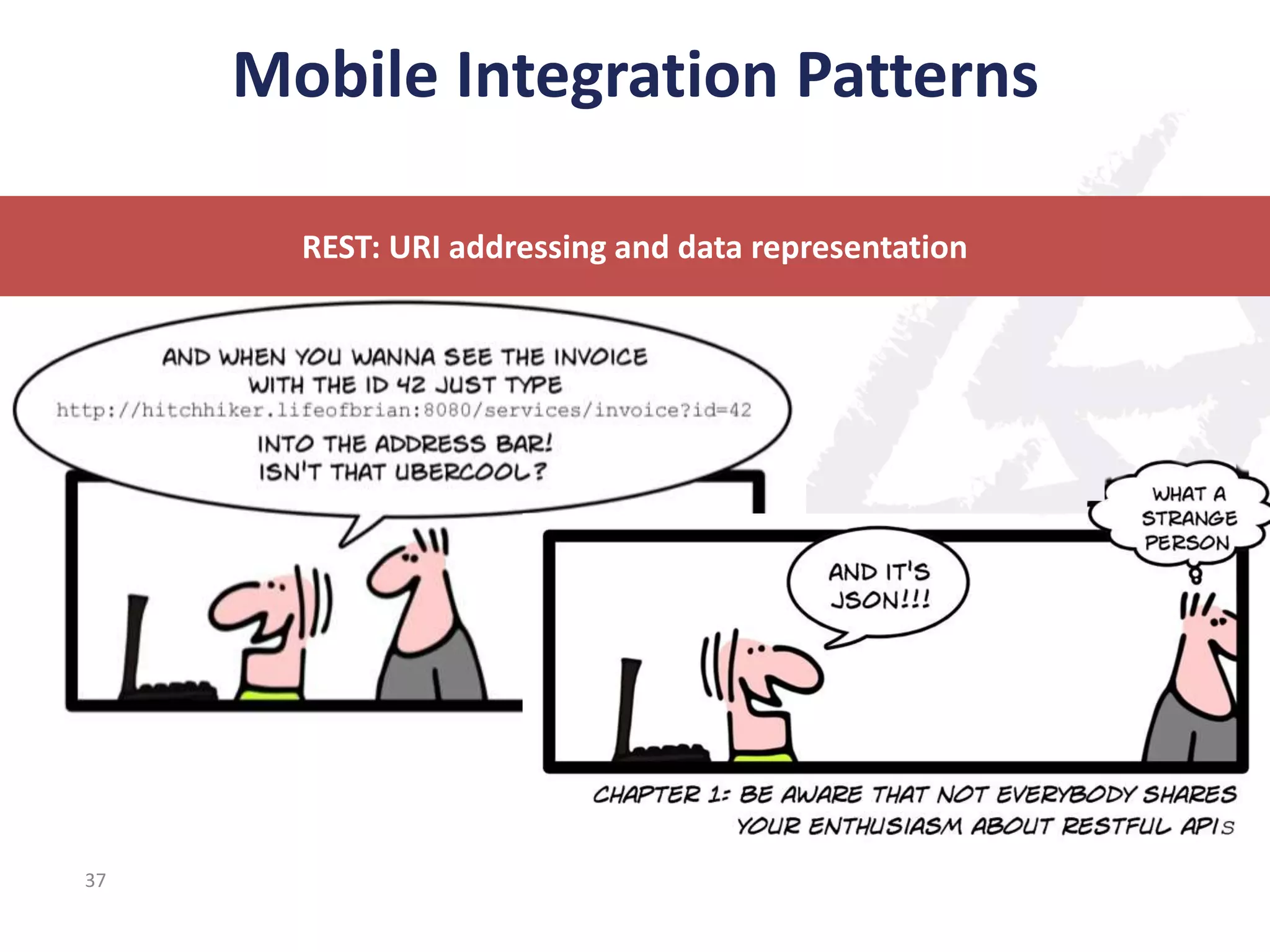
Mobile Integration Patterns
REST: URI addressing and data representation

37
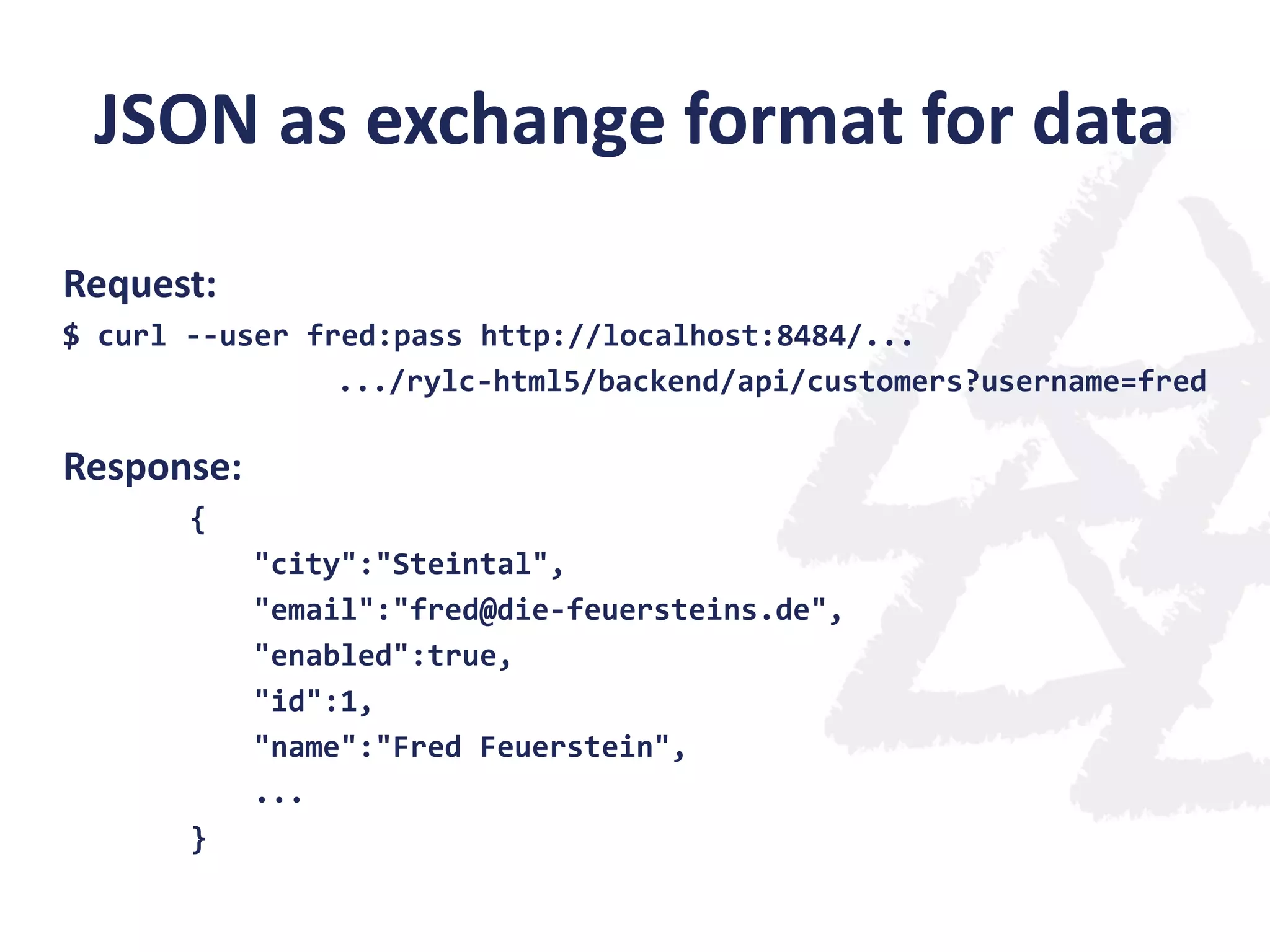
JSON as exchange format for data
Request:
$ curl --user fred:pass http://localhost:8484/...
.../rylc-html5/backend/api/customers?username=fred

Response:
{
"city":"Steintal",
"email":"fred@die-feuersteins.de",
"enabled":true,
"id":1,
"name":"Fred Feuerstein",
...
}
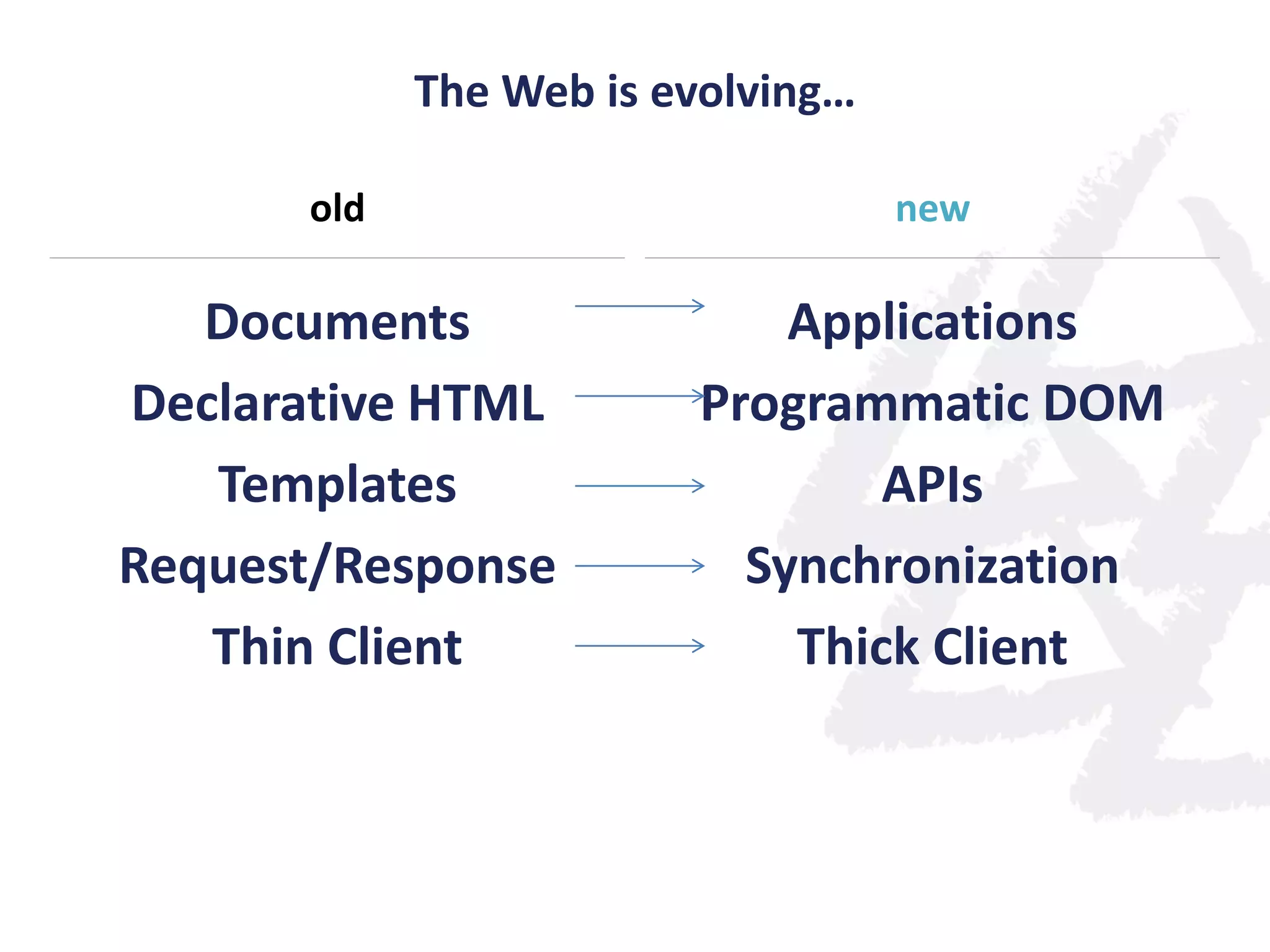
The Web is evolving…
old

new

Documents
Declarative HTML
Templates
Request/Response
Thin Client

Applications
Programmatic DOM
APIs
Synchronization
Thick Client
Digital Natives
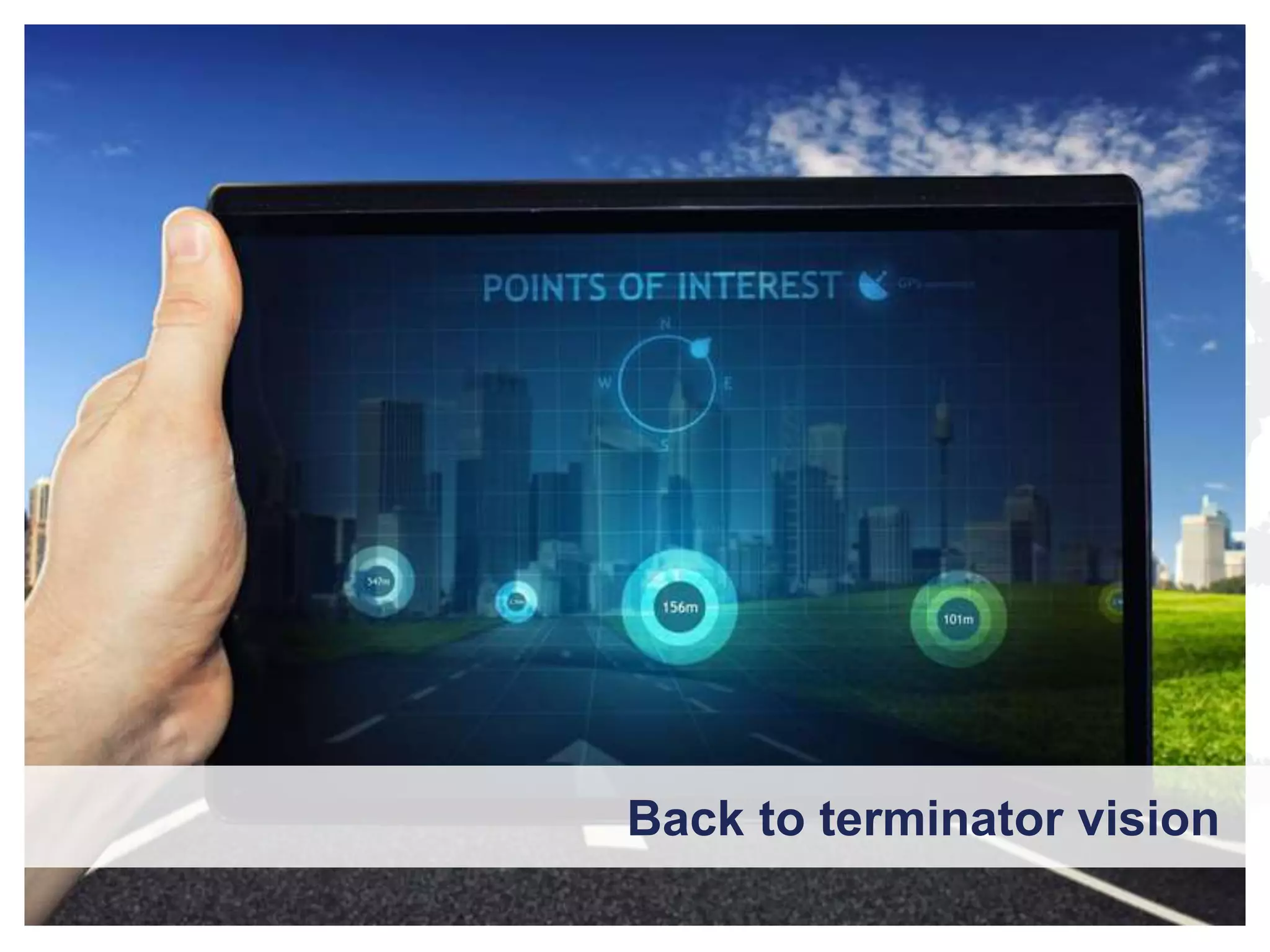
Back to terminator vision
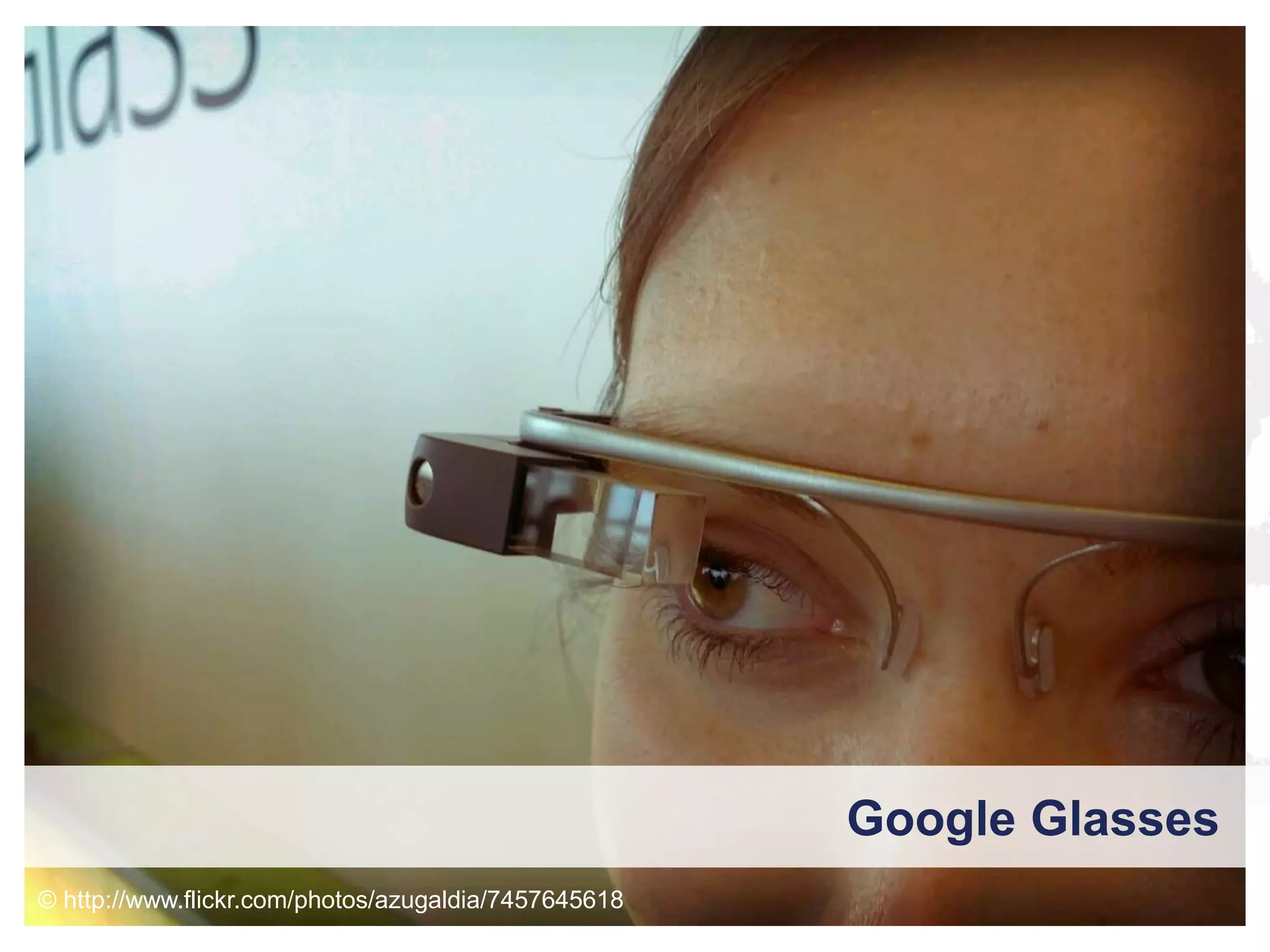
Google Glasses

Google Glasses
© http://www.flickr.com/photos/azugaldia/7457645618
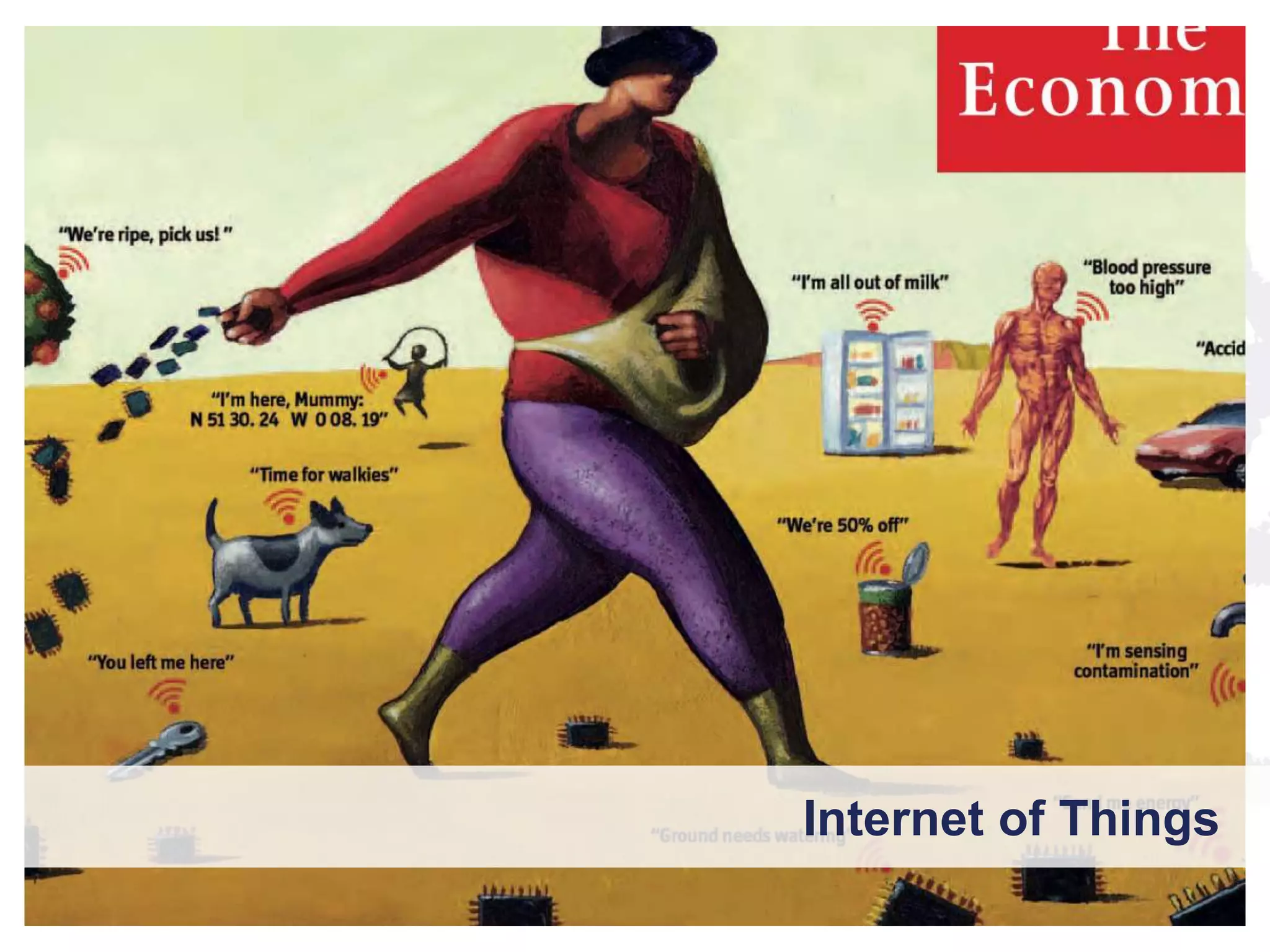
Internet of Things
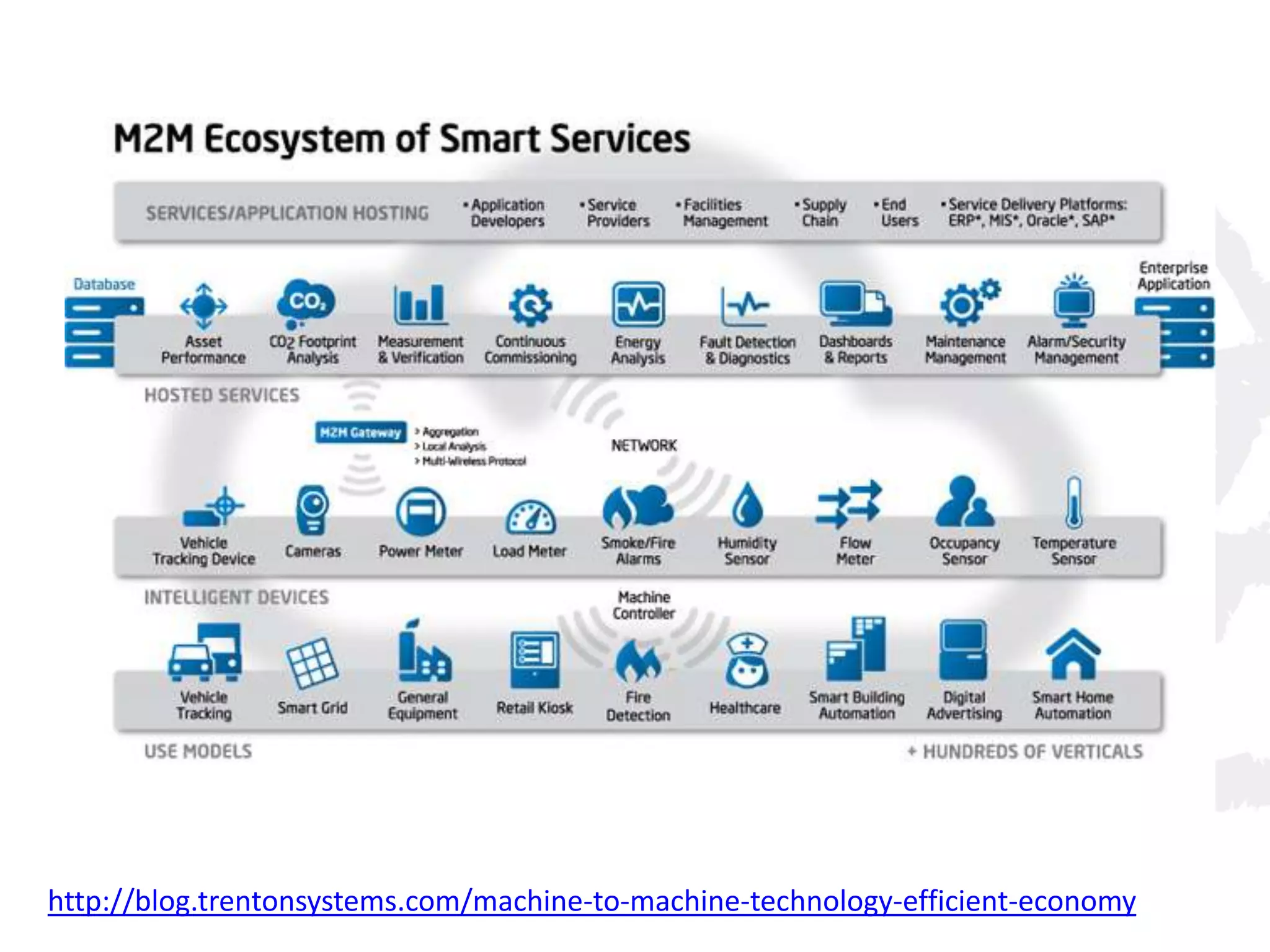
http://blog.trentonsystems.com/machine-to-machine-technology-efficient-economy
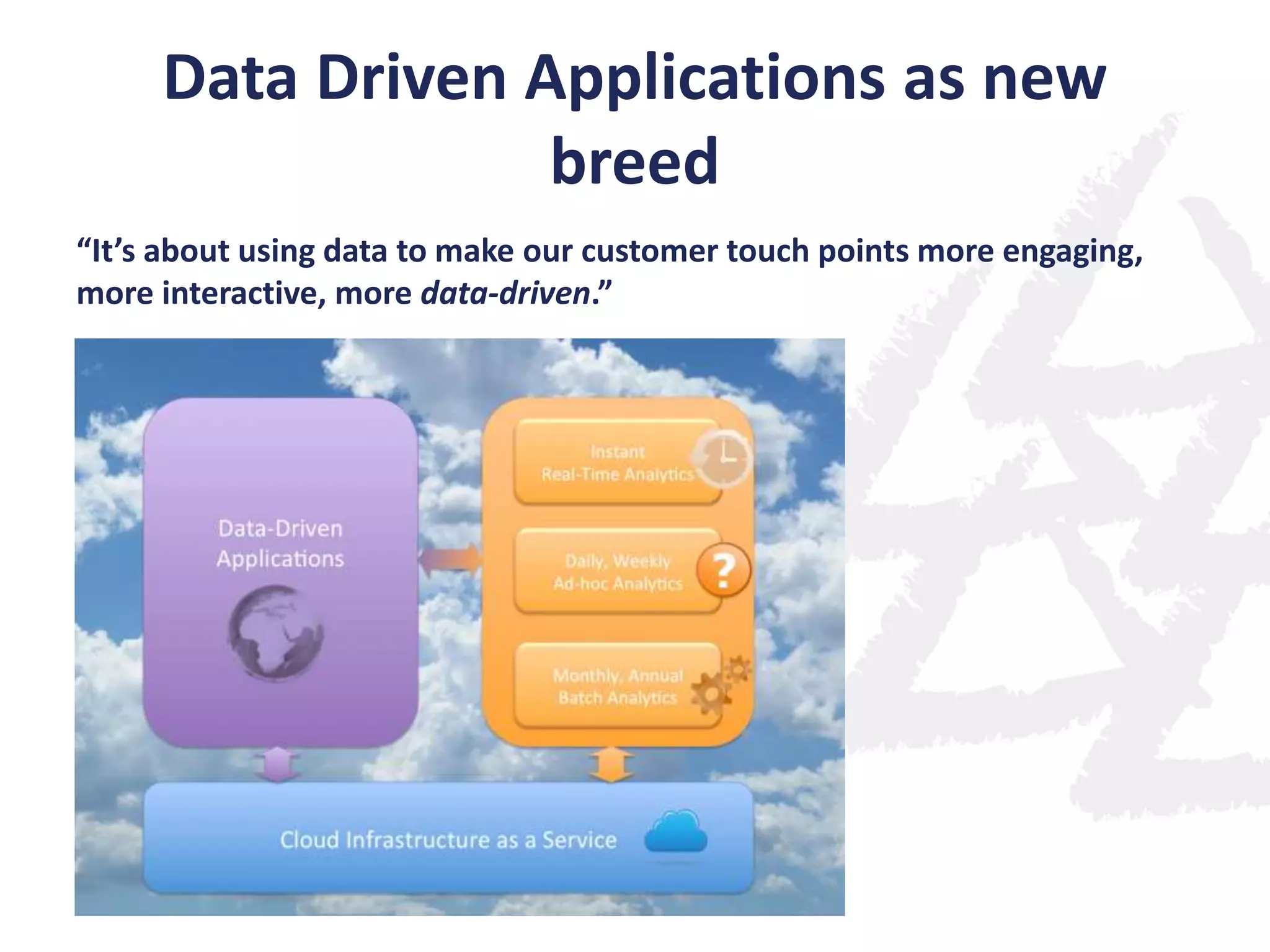
Data Driven Applications as new
breed
“It’s about using data to make our customer touch points more engaging,
more interactive, more data-driven.”
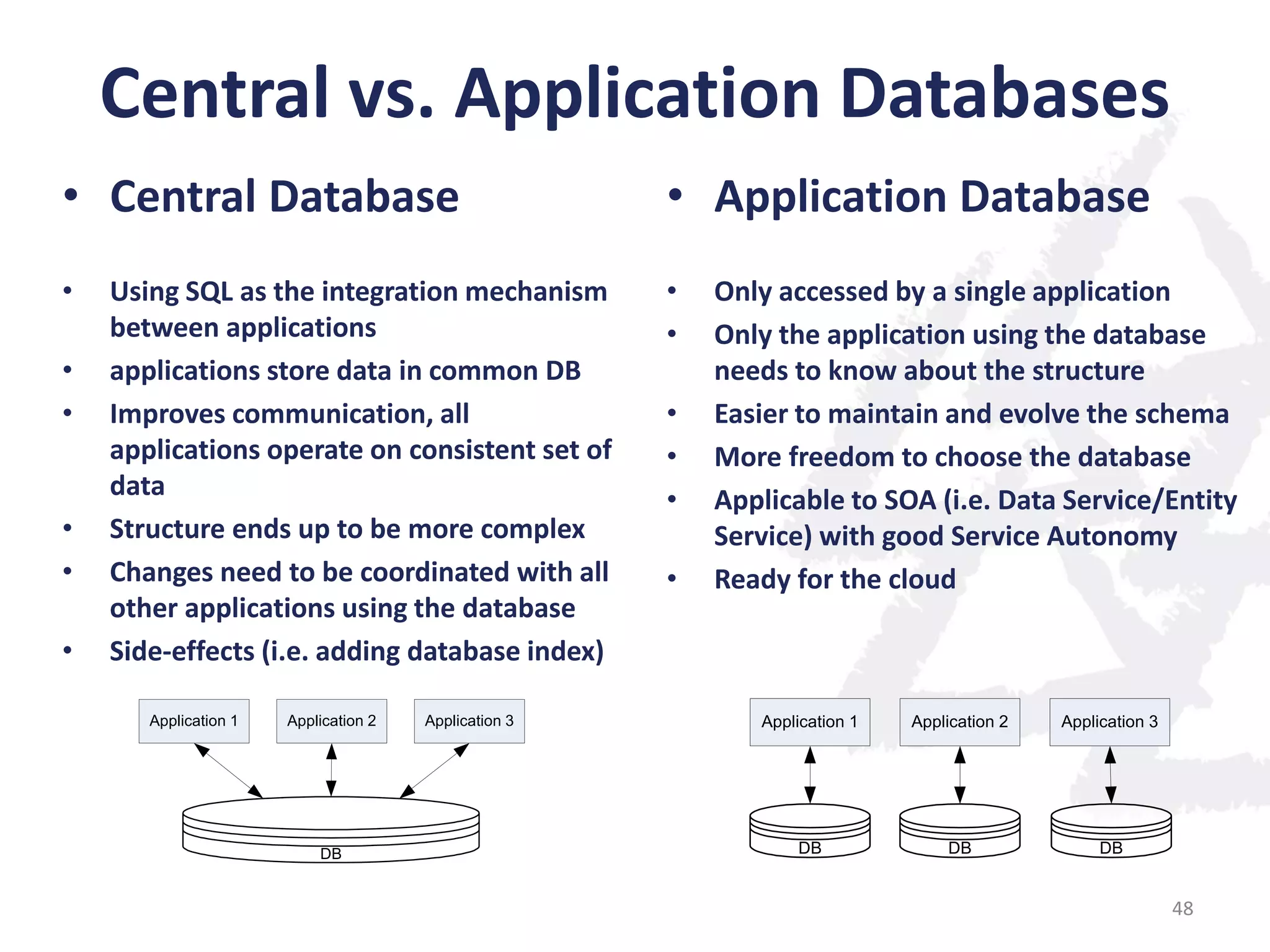
Central vs. Application Databases
• Central Database

• Application Database

•

•
•

•
•

•
•
•

Using SQL as the integration mechanism
between applications
applications store data in common DB
Improves communication, all
applications operate on consistent set of
data
Structure ends up to be more complex
Changes need to be coordinated with all
other applications using the database
Side-effects (i.e. adding database index)
Application 1

Application 2

DB

Application 3

•
•
•
•

Only accessed by a single application
Only the application using the database
needs to know about the structure
Easier to maintain and evolve the schema
More freedom to choose the database
Applicable to SOA (i.e. Data Service/Entity
Service) with good Service Autonomy
Ready for the cloud

Application 1

Application 2

Application 3

DB

DB

DB

48
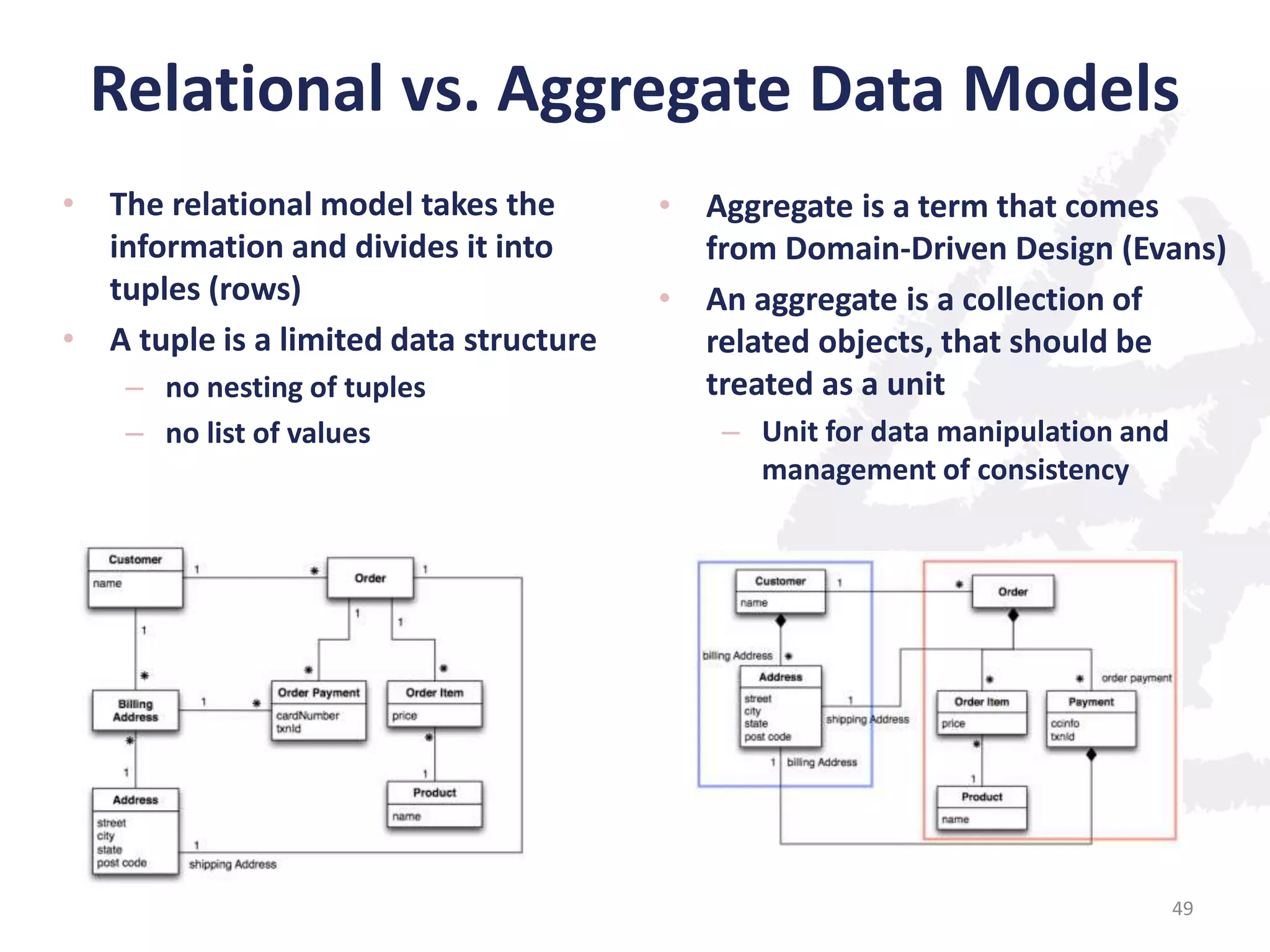
Relational vs. Aggregate Data Models
• The relational model takes the
information and divides it into
tuples (rows)
• A tuple is a limited data structure
– no nesting of tuples
– no list of values

• Aggregate is a term that comes
from Domain-Driven Design (Evans)
• An aggregate is a collection of
related objects, that should be
treated as a unit
– Unit for data manipulation and
management of consistency

49
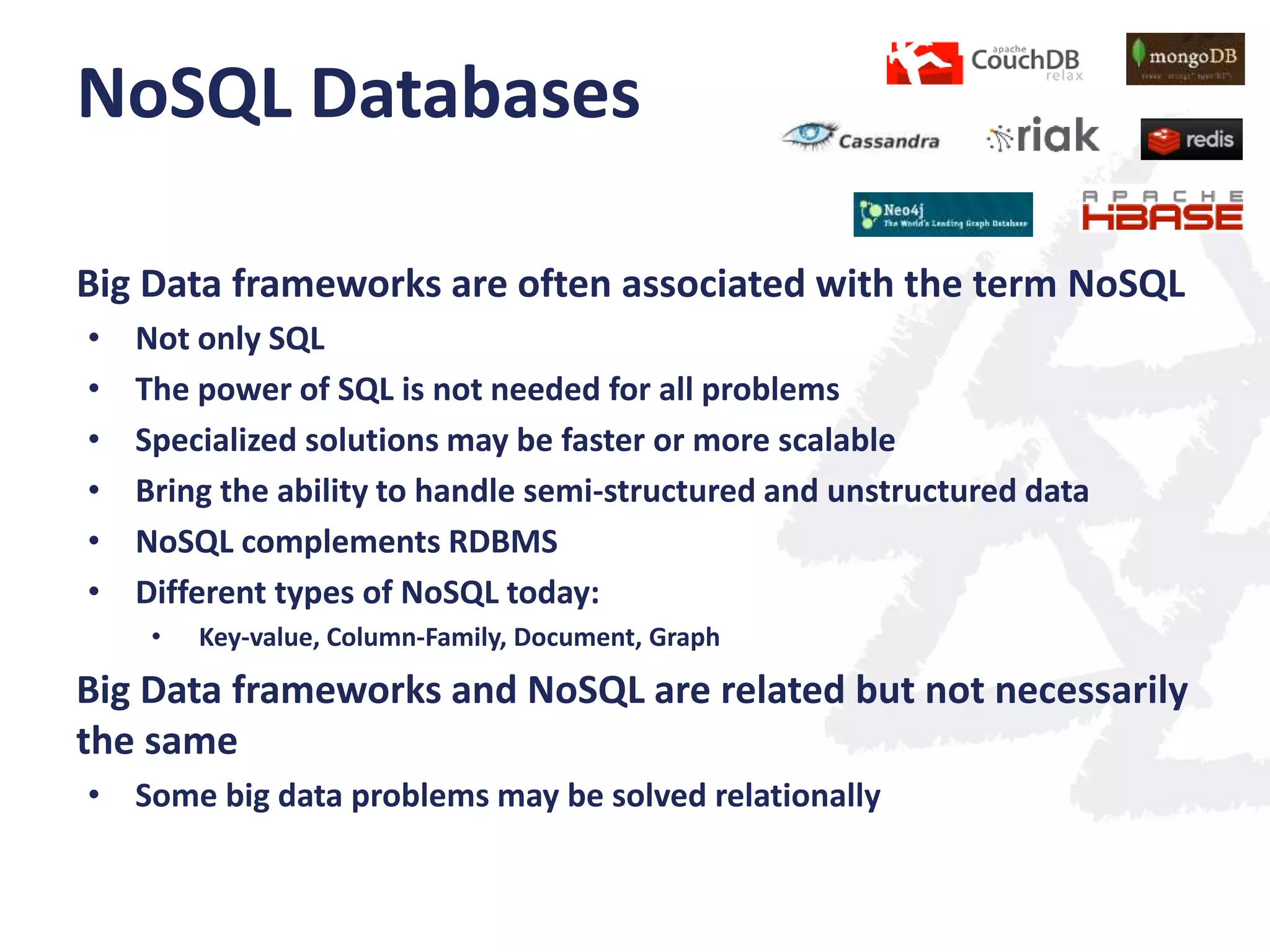
NoSQL Databases
Big Data frameworks are often associated with the term NoSQL
•
•
•
•
•
•

Not only SQL
The power of SQL is not needed for all problems
Specialized solutions may be faster or more scalable
Bring the ability to handle semi-structured and unstructured data
NoSQL complements RDBMS
Different types of NoSQL today:
•

Key-value, Column-Family, Document, Graph

Big Data frameworks and NoSQL are related but not necessarily
the same
• Some big data problems may be solved relationally
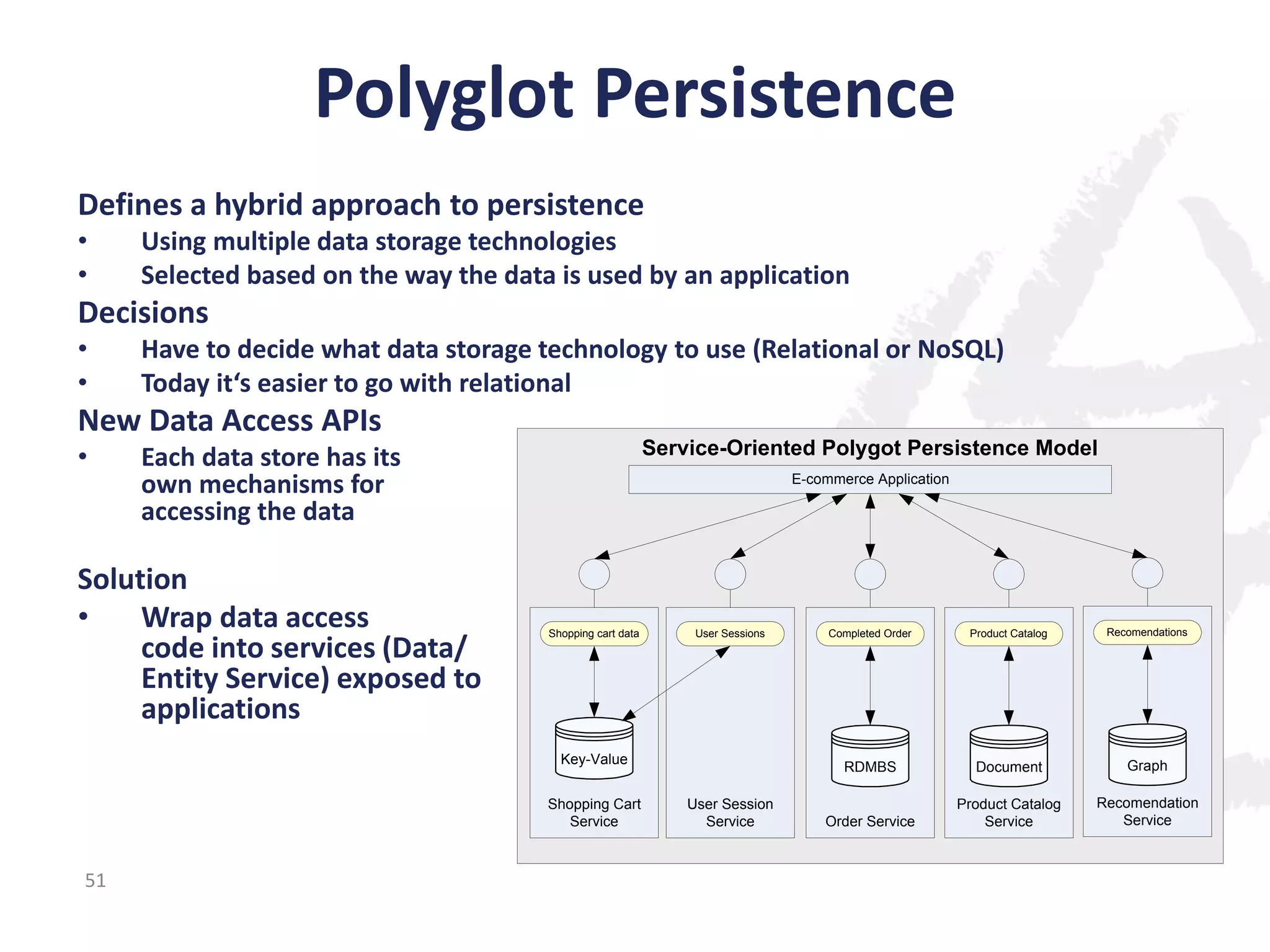
Polyglot Persistence
Defines a hybrid approach to persistence
•
•

Using multiple data storage technologies
Selected based on the way the data is used by an application

Decisions
•
•

Have to decide what data storage technology to use (Relational or NoSQL)
Today it‘s easier to go with relational

New Data Access APIs
•

Service-Oriented Polygot Persistence Model

Each data store has its
own mechanisms for
accessing the data

Solution
•
Wrap data access
code into services (Data/
Entity Service) exposed to
applications

E-commerce Application

Shopping cart data

Key-Value
Shopping Cart
Service

51

User Session
Service

Completed Order

Product Catalog

Recomendations

RDMBS

User Sessions

Document

Graph

Order Service

Product Catalog
Service

Recomendation
Service
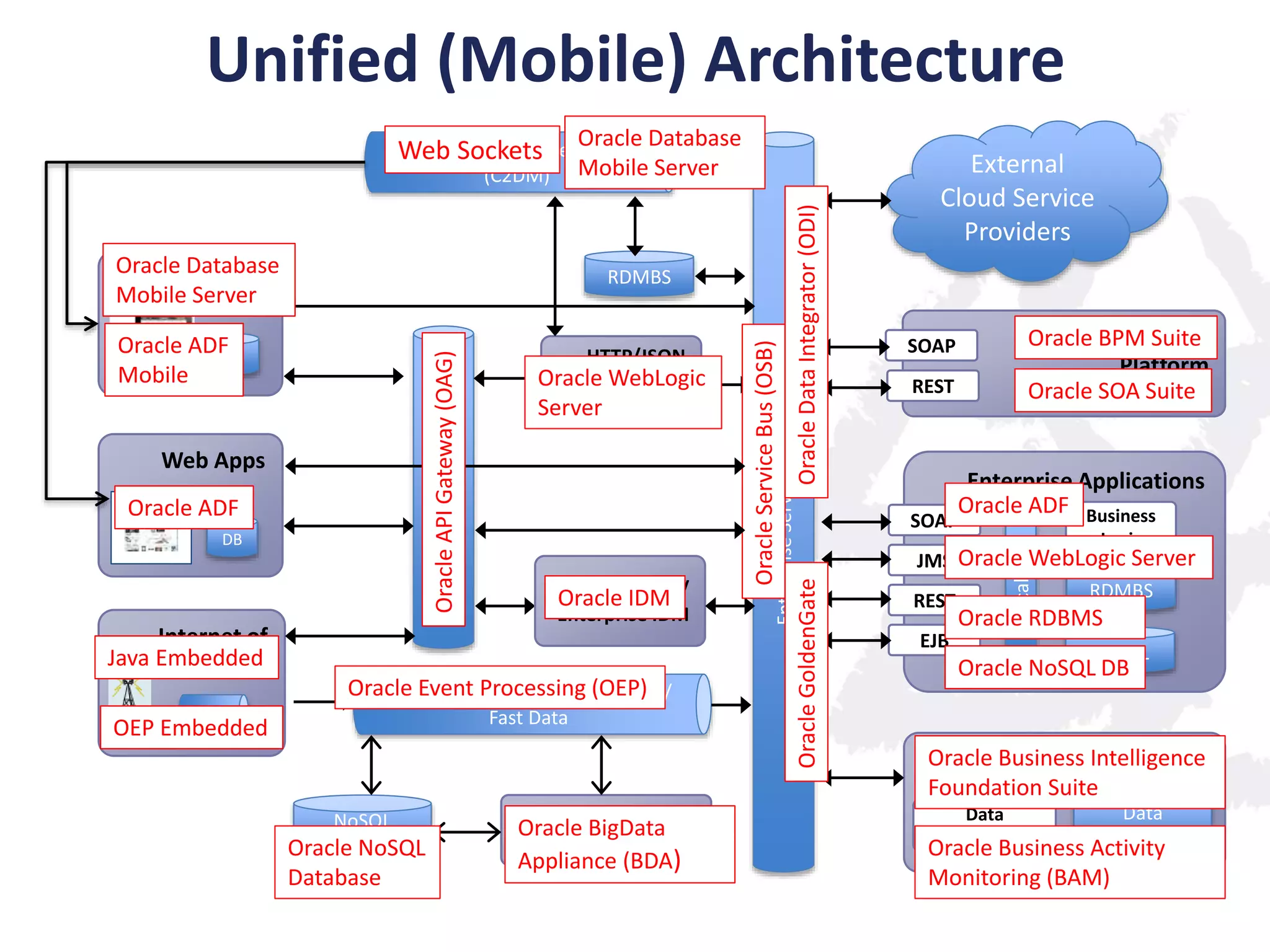
Unified (Mobile) Architecture

Web Apps
53
Oracle ADF
DB

Internet of
Java Embedded
Things

HTTP/JSON
Oracle WebLogic
Application
Server Server

LDAP
Oracle IDM /

Enterprise IDM

Oracle Event Processing (OEP) /
Complex Event Processing (CEP)

CEP

Fast Data

OEP Embedded

NoSQL
/ BigNoSQL
Oracle Data

Database

(Big) Data
Oracle BigData
Analytics
Appliance (BDA)

Enterprise Service Bus (ESB)

Service Gateway
Oracle API Gateway (OAG)

Oracle ADF
DB
Mobile

Oracle Service Bus (OSB)

RDMBS

Oracle GoldenGate

Oracle Database
Mobile Apps
Mobile Server

Oracle Data Integrator (ODI)

Mobile Server

(C2DM)

External
Cloud Service
Providers

BPM und SOA
Oracle BPM Suite
Platform
Oracle SOA Suite

SOAP
REST

Enterprise Applications
Oracle ADF Business

SOAP

Local ESB

Oracle
Cloud Sockets
Web to Device Messaging Database

Logic

JMS Oracle WebLogic Server
RDMBS
REST
EJB

Oracle RDBMS

NoSQL

Oracle NoSQL DB

Oracle Business Intelligence
Analytical Applications
Foundation Suite
Data
Integration

Data
Warehouse

Oracle Business Activity
Monitoring (BAM)
Conclusion
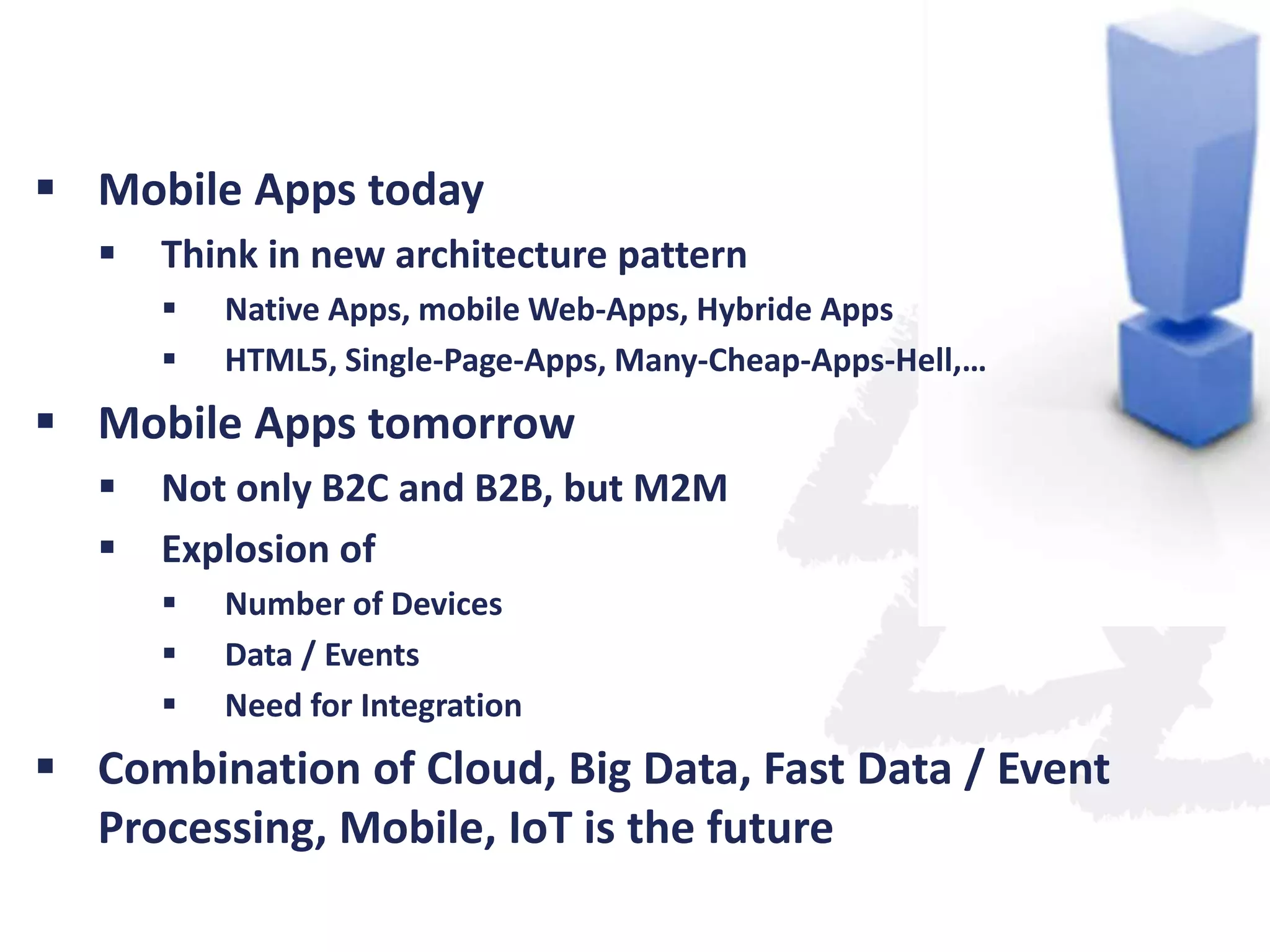
 Mobile Apps today


Think in new architecture pattern



Native Apps, mobile Web-Apps, Hybride Apps
HTML5, Single-Page-Apps, Many-Cheap-Apps-Hell,…

 Mobile Apps tomorrow



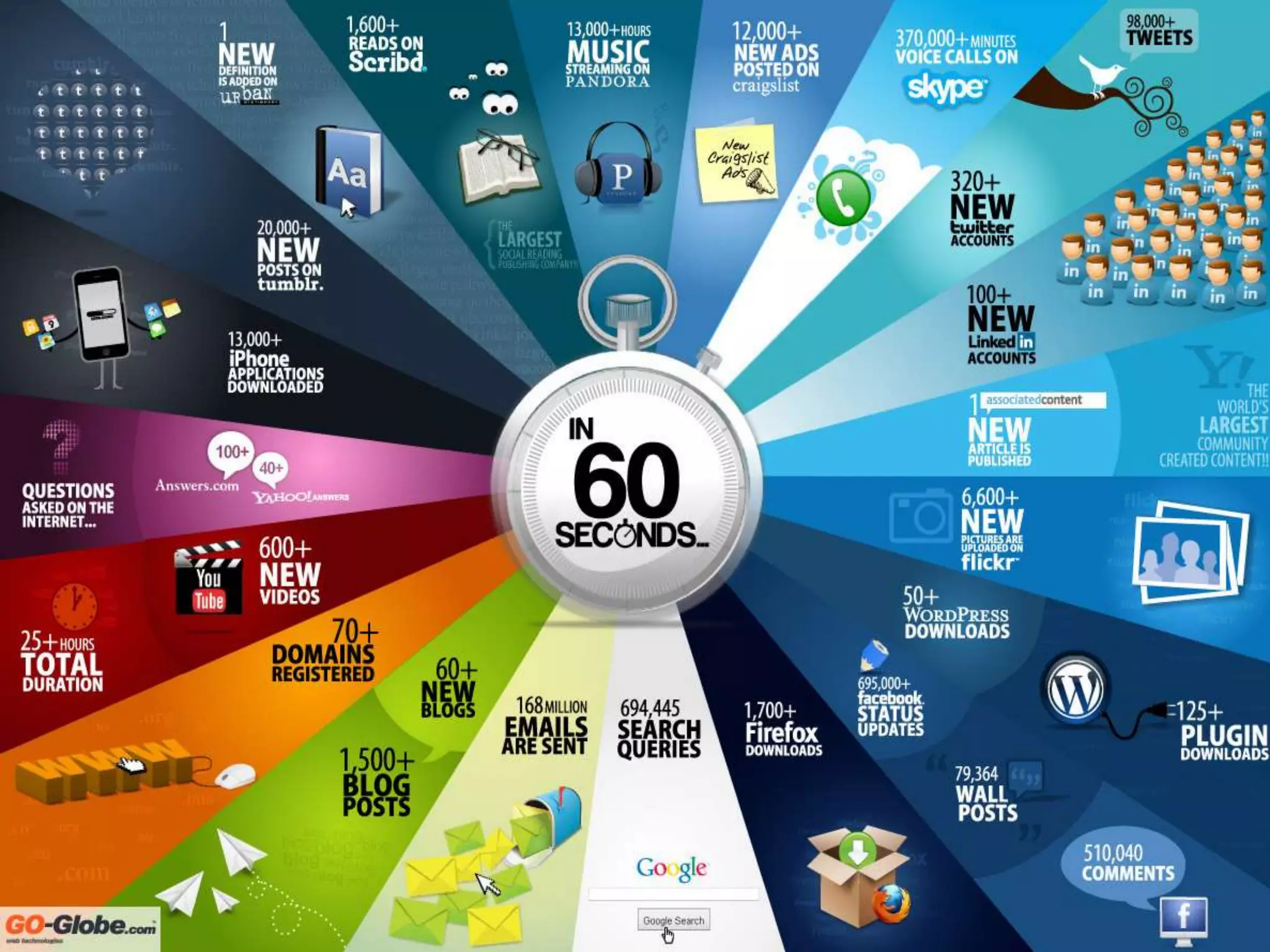
Not only B2C and B2B, but M2M
Explosion of




Number of Devices
Data / Events
Need for Integration

 Combination of Cloud, Big Data, Fast Data / Event
Processing, Mobile, IoT is the future
Oracle products fitting in this
architecture
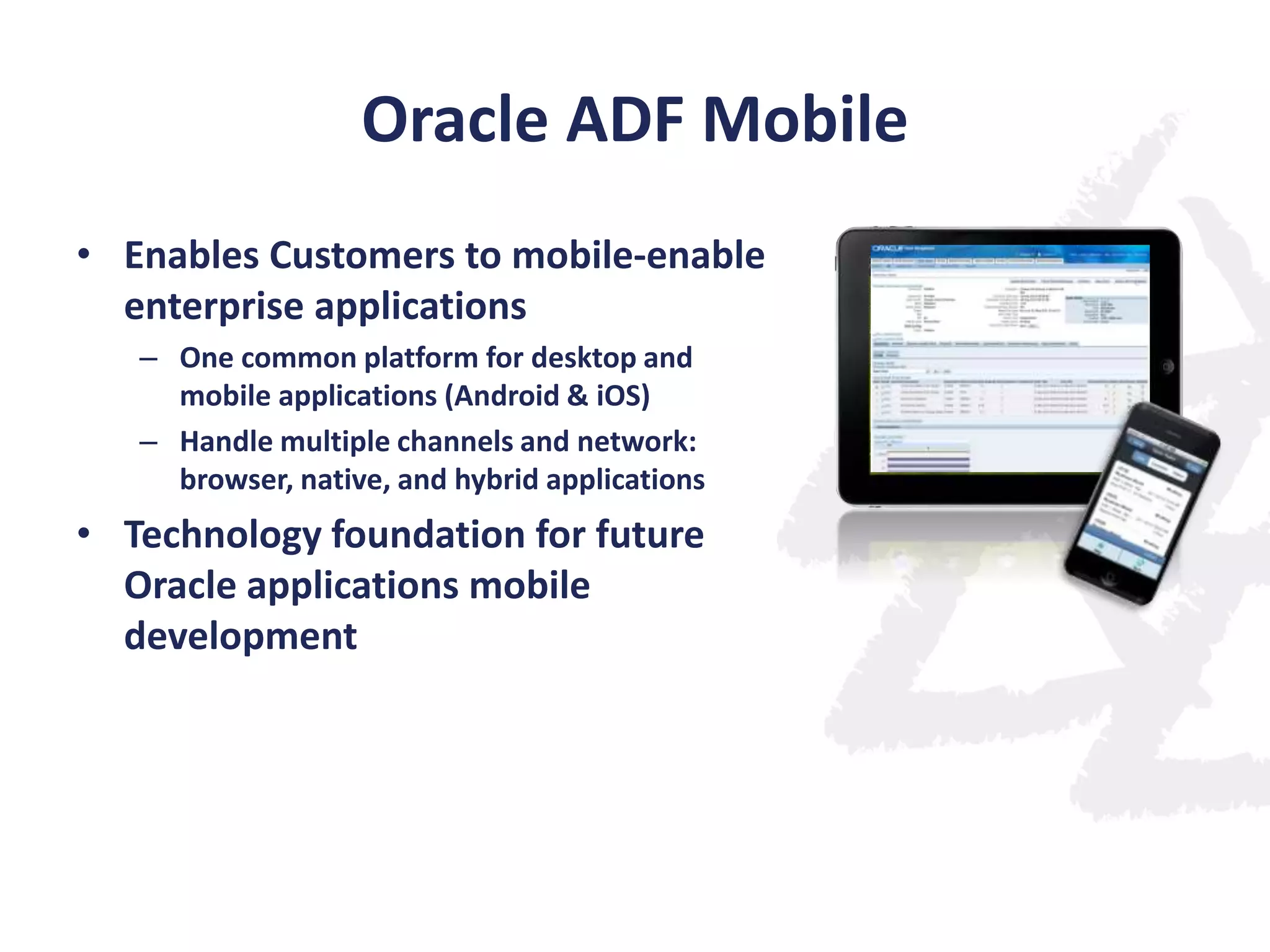
Oracle ADF Mobile
• Enables Customers to mobile-enable
enterprise applications
– One common platform for desktop and
mobile applications (Android & iOS)
– Handle multiple channels and network:
browser, native, and hybrid applications

• Technology foundation for future
Oracle applications mobile
development
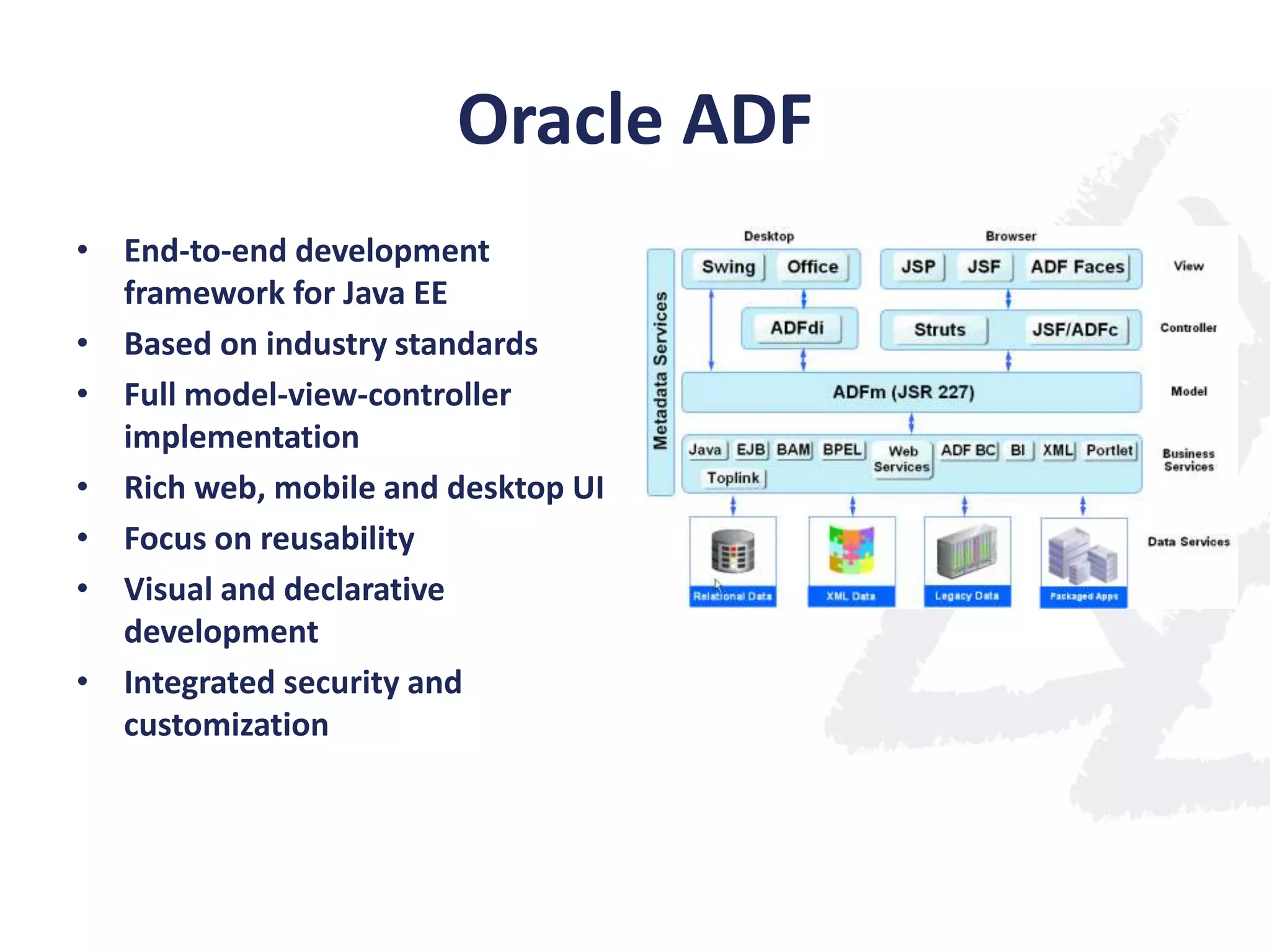
Oracle ADF
• End-to-end development
framework for Java EE
• Based on industry standards
• Full model-view-controller
implementation
• Rich web, mobile and desktop UI
• Focus on reusability
• Visual and declarative
development
• Integrated security and
customization
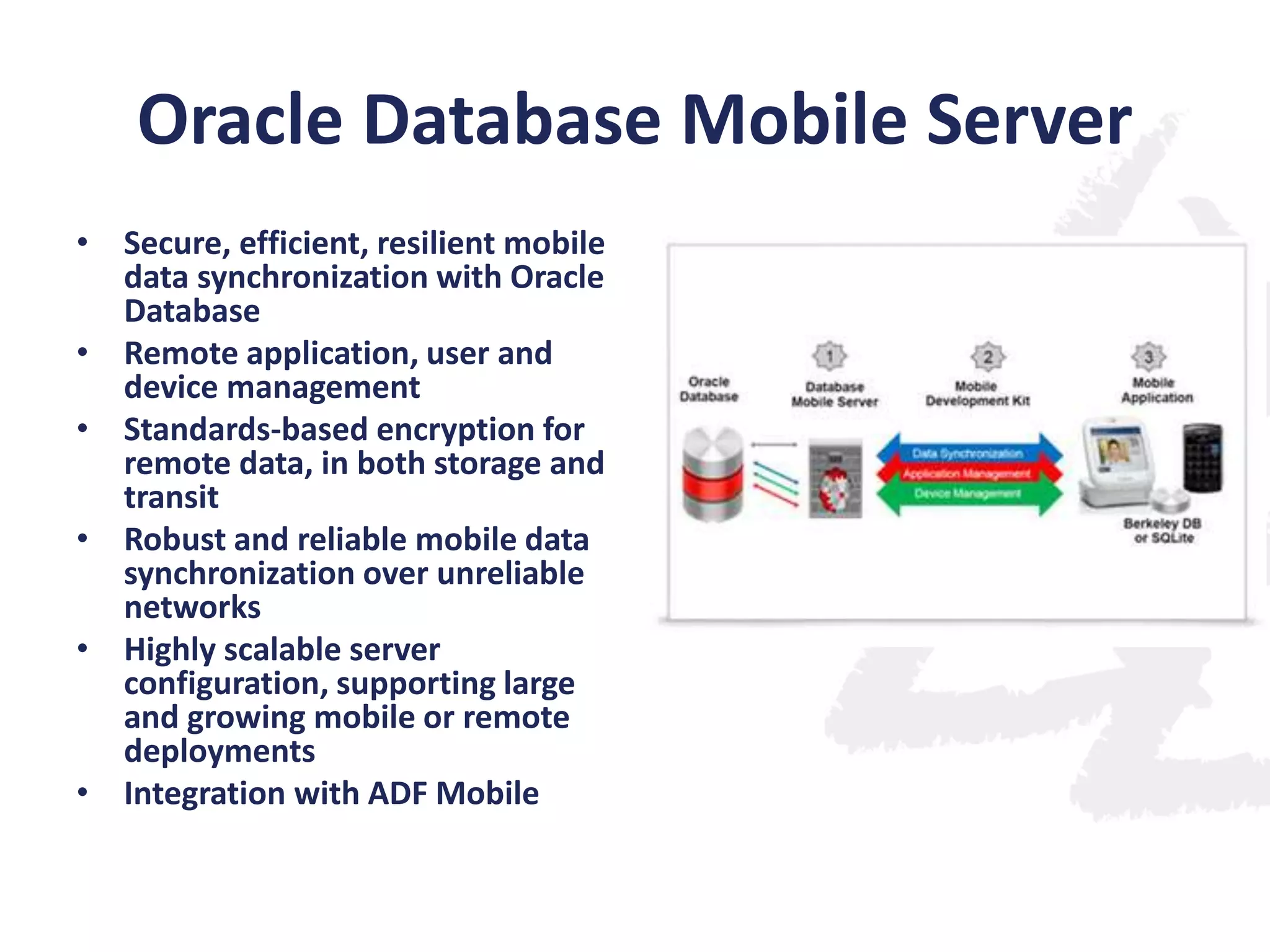
Oracle Database Mobile Server
• Secure, efficient, resilient mobile
data synchronization with Oracle
Database
• Remote application, user and
device management
• Standards-based encryption for
remote data, in both storage and
transit
• Robust and reliable mobile data
synchronization over unreliable
networks
• Highly scalable server
configuration, supporting large
and growing mobile or remote
deployments
• Integration with ADF Mobile
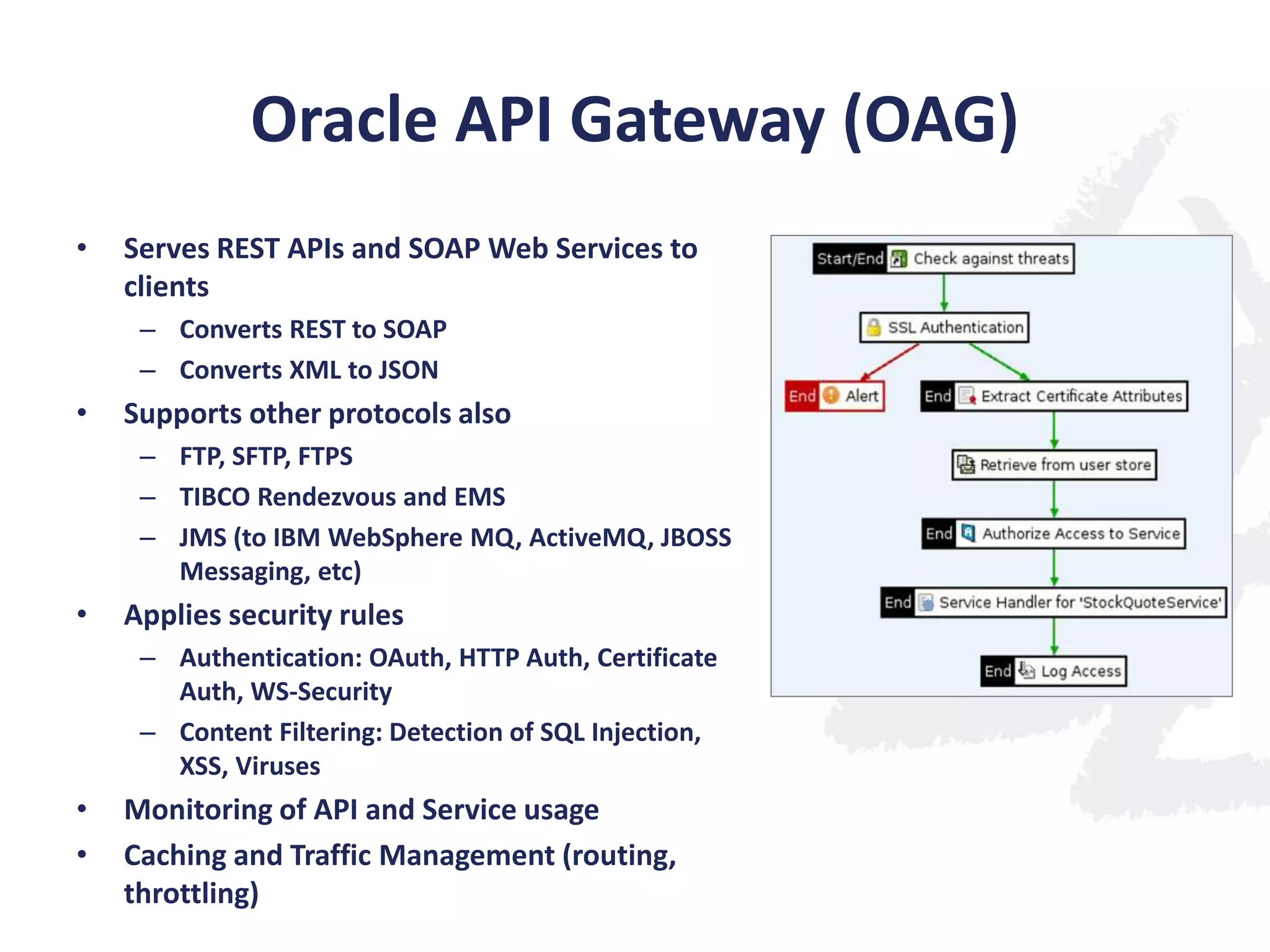
Oracle API Gateway (OAG)
•

Serves REST APIs and SOAP Web Services to
clients
– Converts REST to SOAP
– Converts XML to JSON

•

Supports other protocols also
– FTP, SFTP, FTPS
– TIBCO Rendezvous and EMS
– JMS (to IBM WebSphere MQ, ActiveMQ, JBOSS
Messaging, etc)

•

Applies security rules
– Authentication: OAuth, HTTP Auth, Certificate
Auth, WS-Security
– Content Filtering: Detection of SQL Injection,
XSS, Viruses

•
•

Monitoring of API and Service usage
Caching and Traffic Management (routing,
throttling)
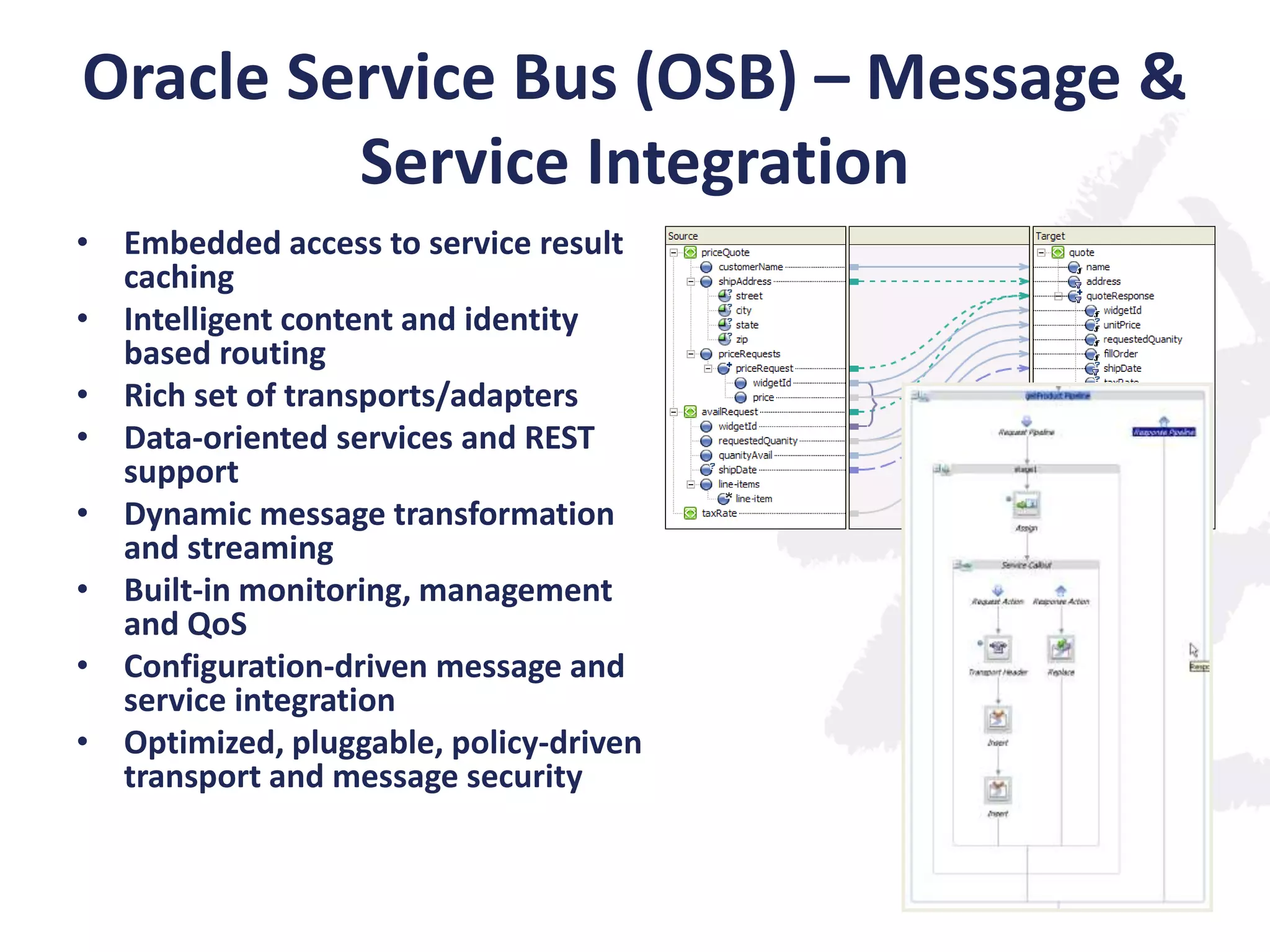
Oracle Service Bus (OSB) – Message &
Service Integration
• Embedded access to service result
caching
• Intelligent content and identity
based routing
• Rich set of transports/adapters
• Data-oriented services and REST
support
• Dynamic message transformation
and streaming
• Built-in monitoring, management
and QoS
• Configuration-driven message and
service integration
• Optimized, pluggable, policy-driven
transport and message security
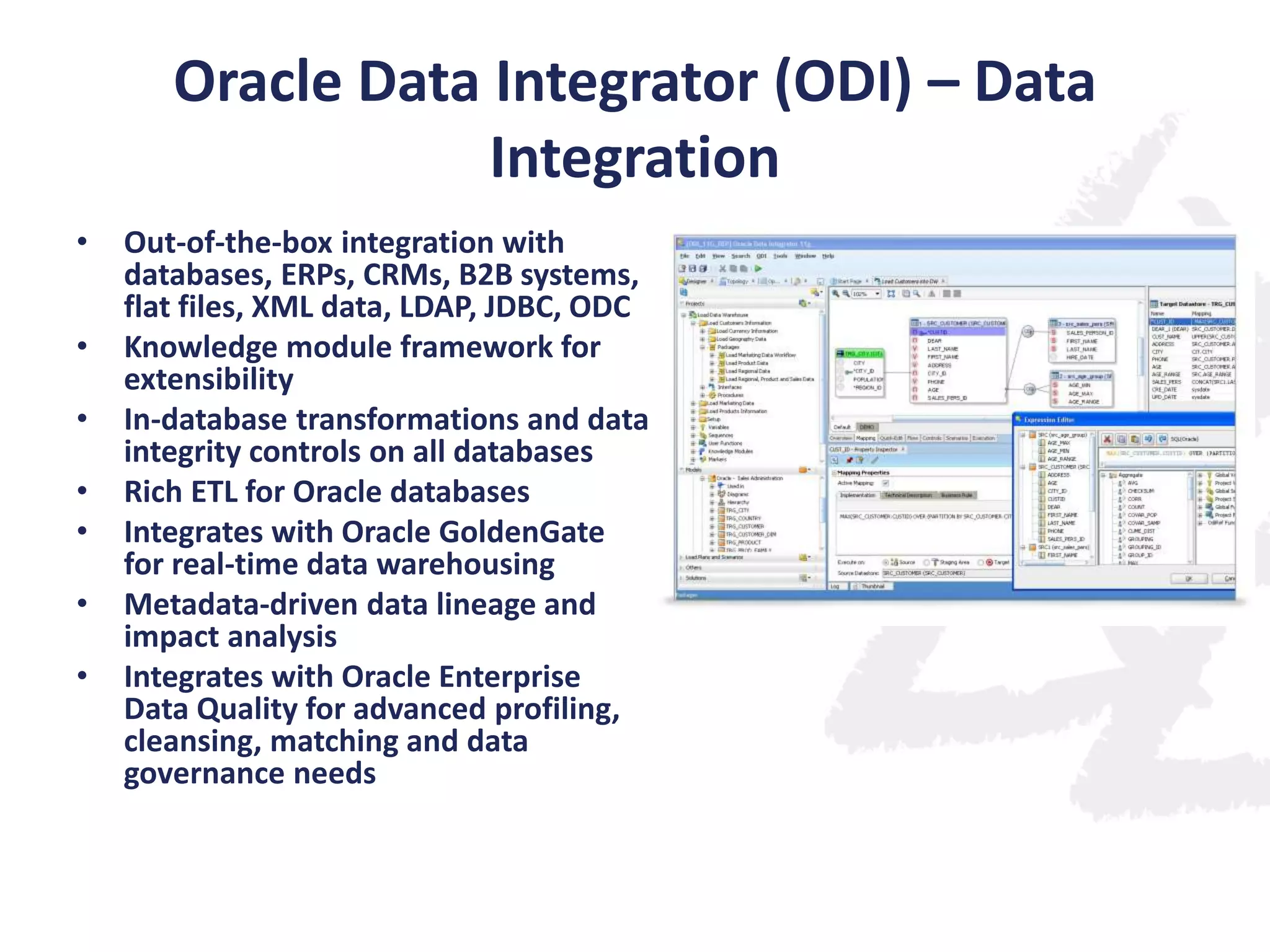
Oracle Data Integrator (ODI) – Data
Integration
•
•
•
•
•
•
•

Out-of-the-box integration with
databases, ERPs, CRMs, B2B systems,
flat files, XML data, LDAP, JDBC, ODC
Knowledge module framework for
extensibility
In-database transformations and data
integrity controls on all databases
Rich ETL for Oracle databases
Integrates with Oracle GoldenGate
for real-time data warehousing
Metadata-driven data lineage and
impact analysis
Integrates with Oracle Enterprise
Data Quality for advanced profiling,
cleansing, matching and data
governance needs
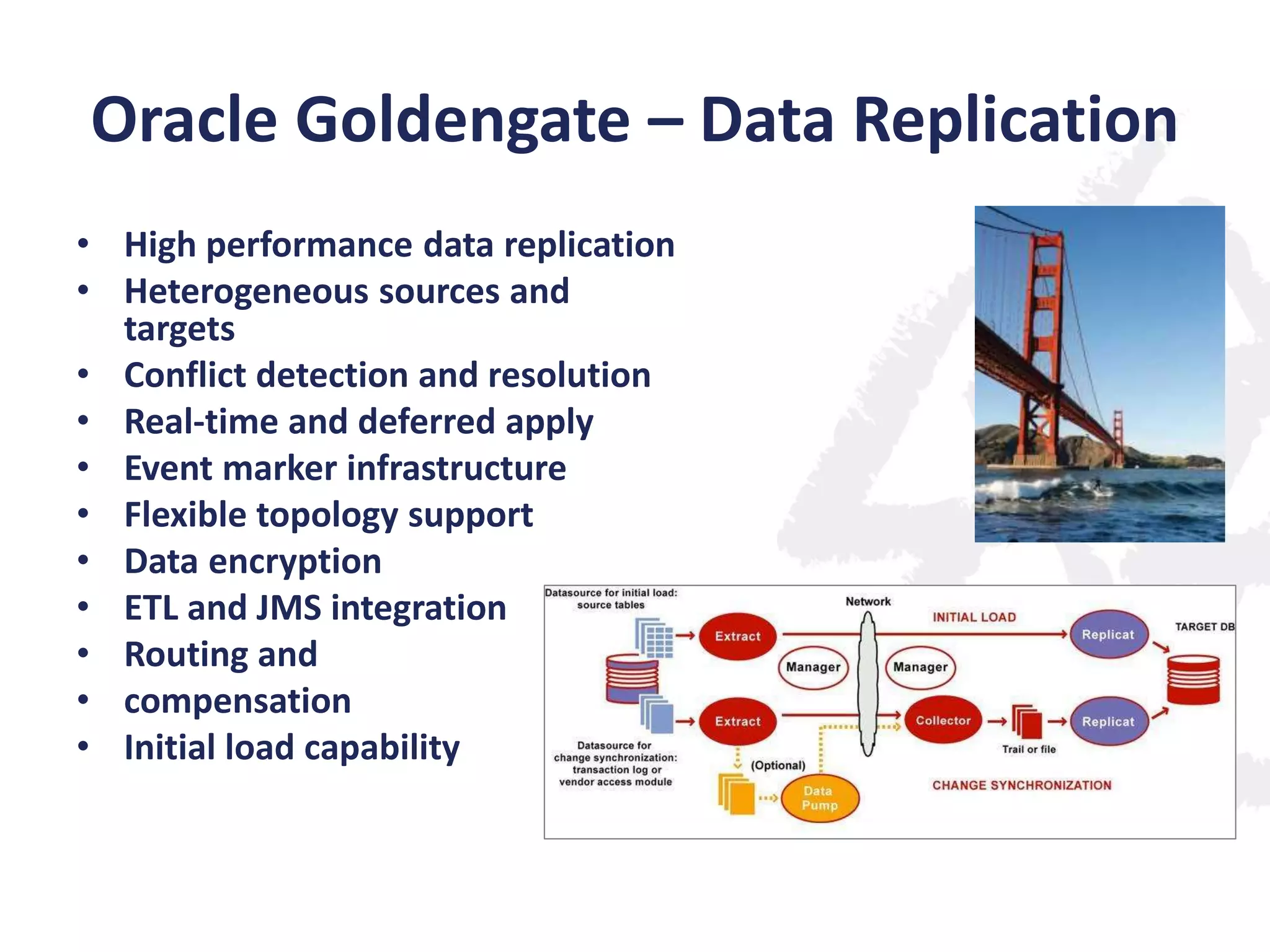
Oracle Goldengate – Data Replication
• High performance data replication
• Heterogeneous sources and
targets
• Conflict detection and resolution
• Real-time and deferred apply
• Event marker infrastructure
• Flexible topology support
• Data encryption
• ETL and JMS integration
• Routing and
• compensation
• Initial load capability
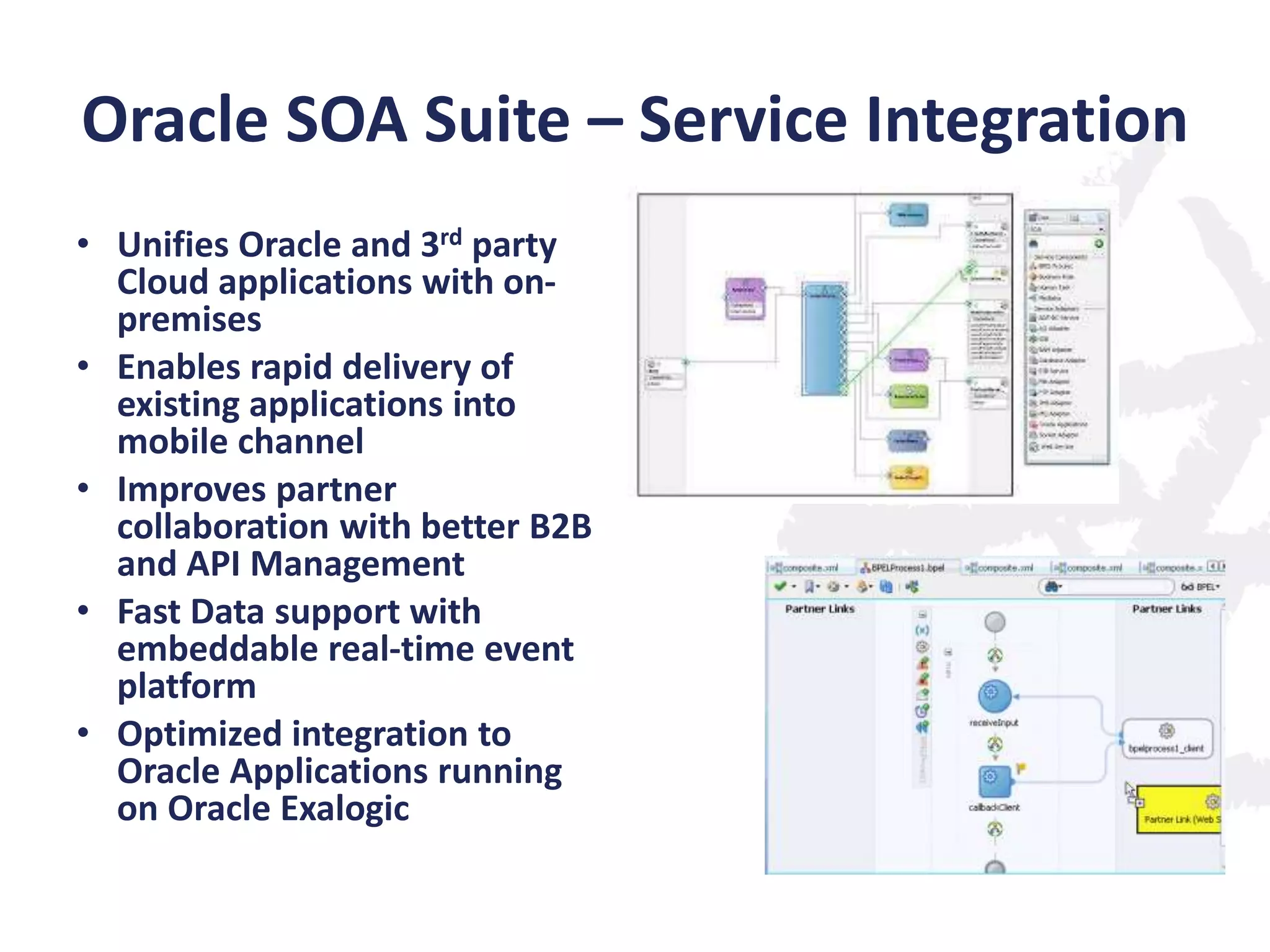
Oracle SOA Suite – Service Integration
• Unifies Oracle and 3rd party
Cloud applications with onpremises
• Enables rapid delivery of
existing applications into
mobile channel
• Improves partner
collaboration with better B2B
and API Management
• Fast Data support with
embeddable real-time event
platform
• Optimized integration to
Oracle Applications running
on Oracle Exalogic
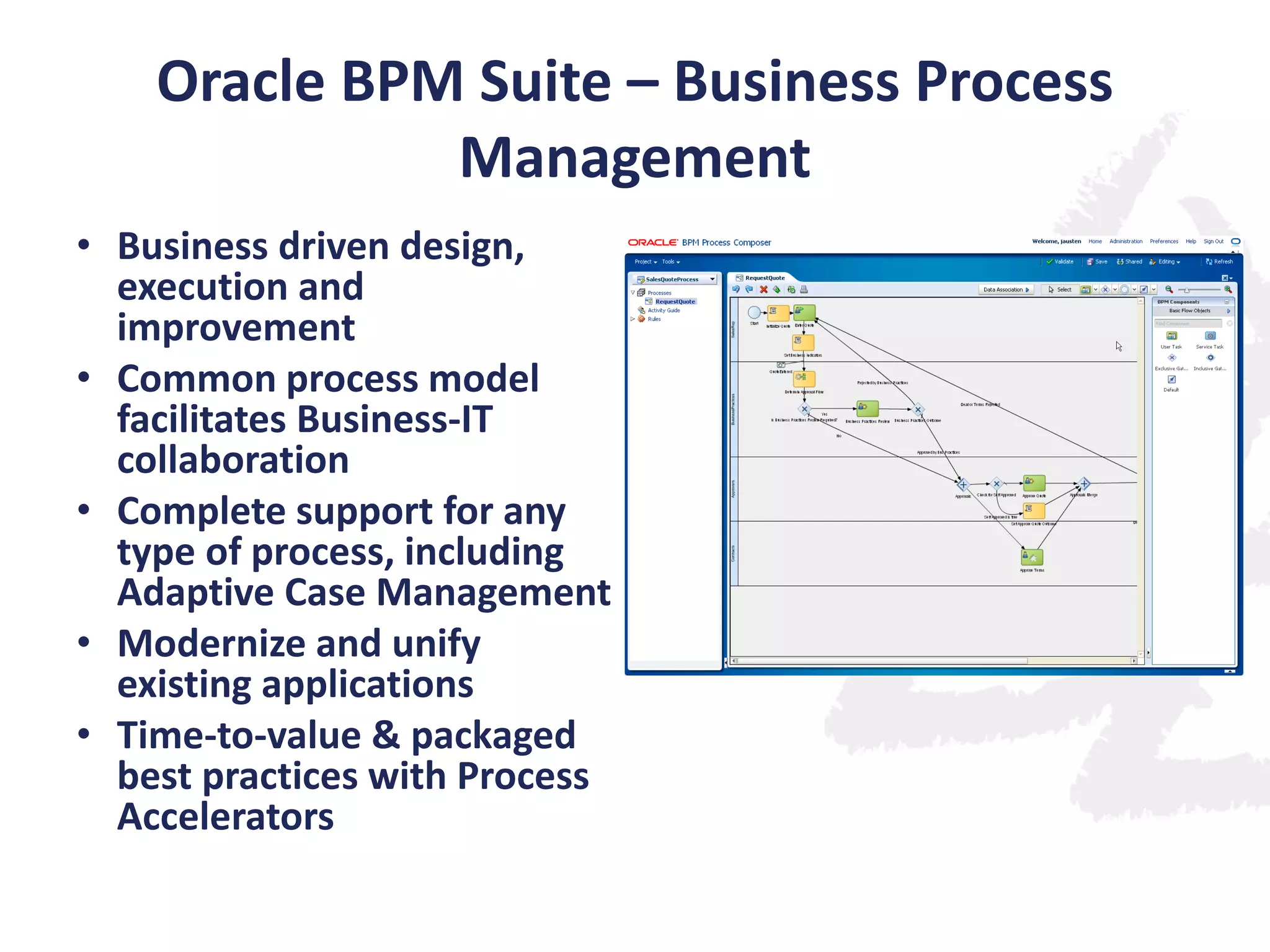
Oracle BPM Suite – Business Process
Management
• Business driven design,
execution and
improvement
• Common process model
facilitates Business-IT
collaboration
• Complete support for any
type of process, including
Adaptive Case Management
• Modernize and unify
existing applications
• Time-to-value & packaged
best practices with Process
Accelerators
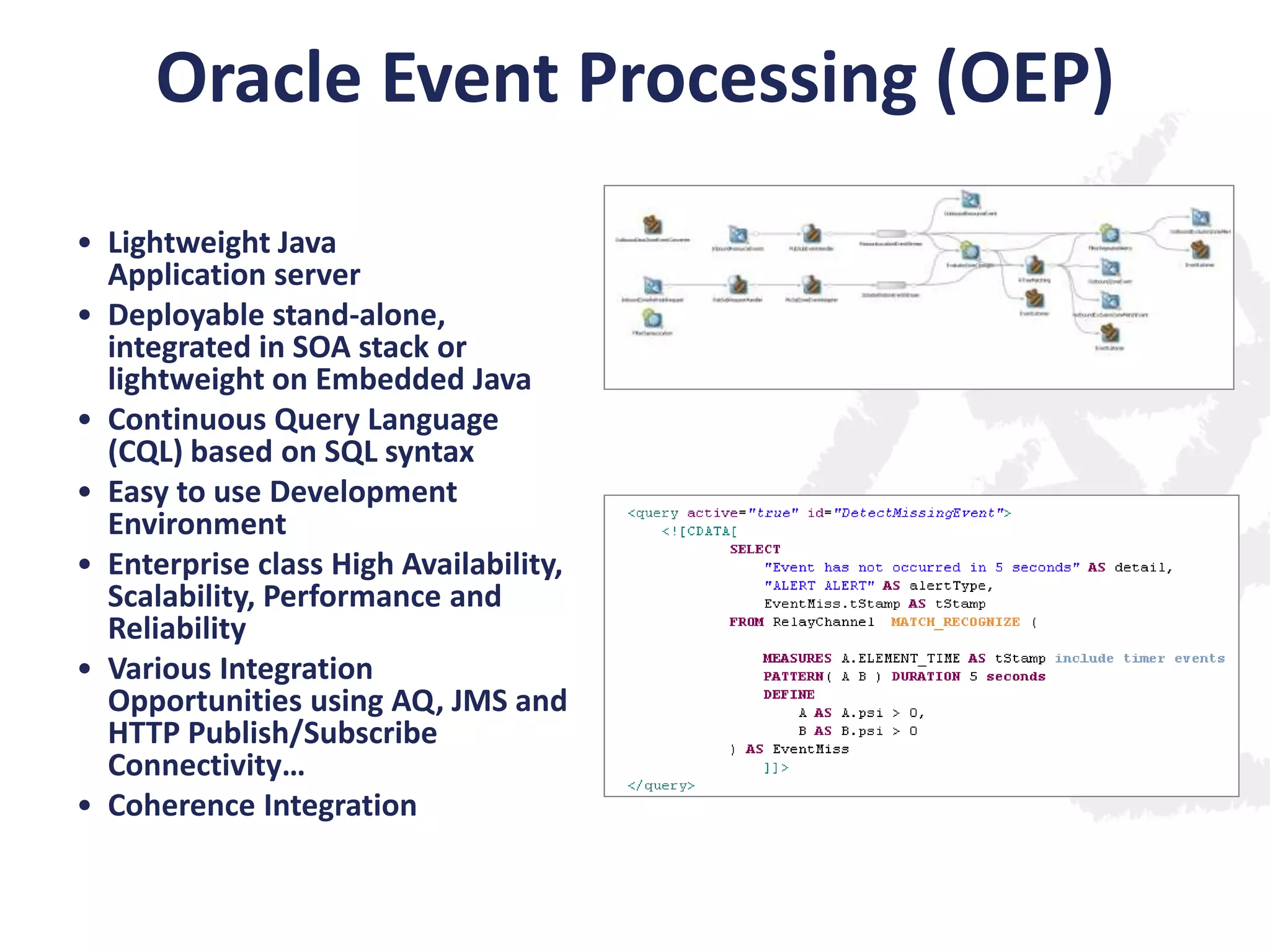
Oracle Event Processing (OEP)
• Lightweight Java
Application server
• Deployable stand-alone,
integrated in SOA stack or
lightweight on Embedded Java
• Continuous Query Language
(CQL) based on SQL syntax
• Easy to use Development
Environment
• Enterprise class High Availability,
Scalability, Performance and
Reliability
• Various Integration
Opportunities using AQ, JMS and
HTTP Publish/Subscribe
Connectivity…
• Coherence Integration
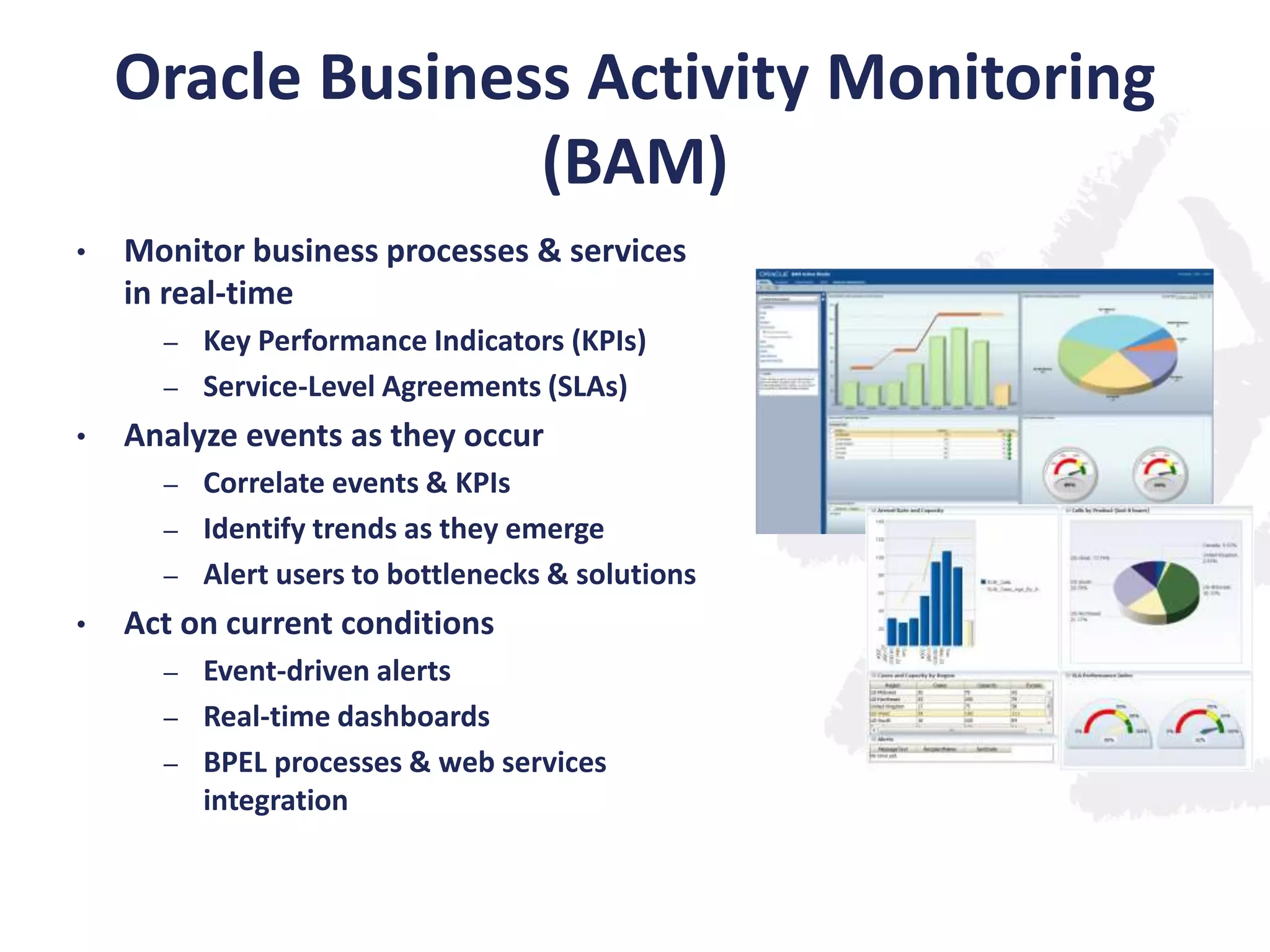
Oracle Business Activity Monitoring
(BAM)
•

Monitor business processes & services
in real-time
Key Performance Indicators (KPIs)
– Service-Level Agreements (SLAs)
–

•

Analyze events as they occur
Correlate events & KPIs
– Identify trends as they emerge
– Alert users to bottlenecks & solutions
–

•

Act on current conditions
Event-driven alerts
– Real-time dashboards
– BPEL processes & web services
integration
–
Oracle Big Data Appliance
•
•

•
•
•
•

•
•

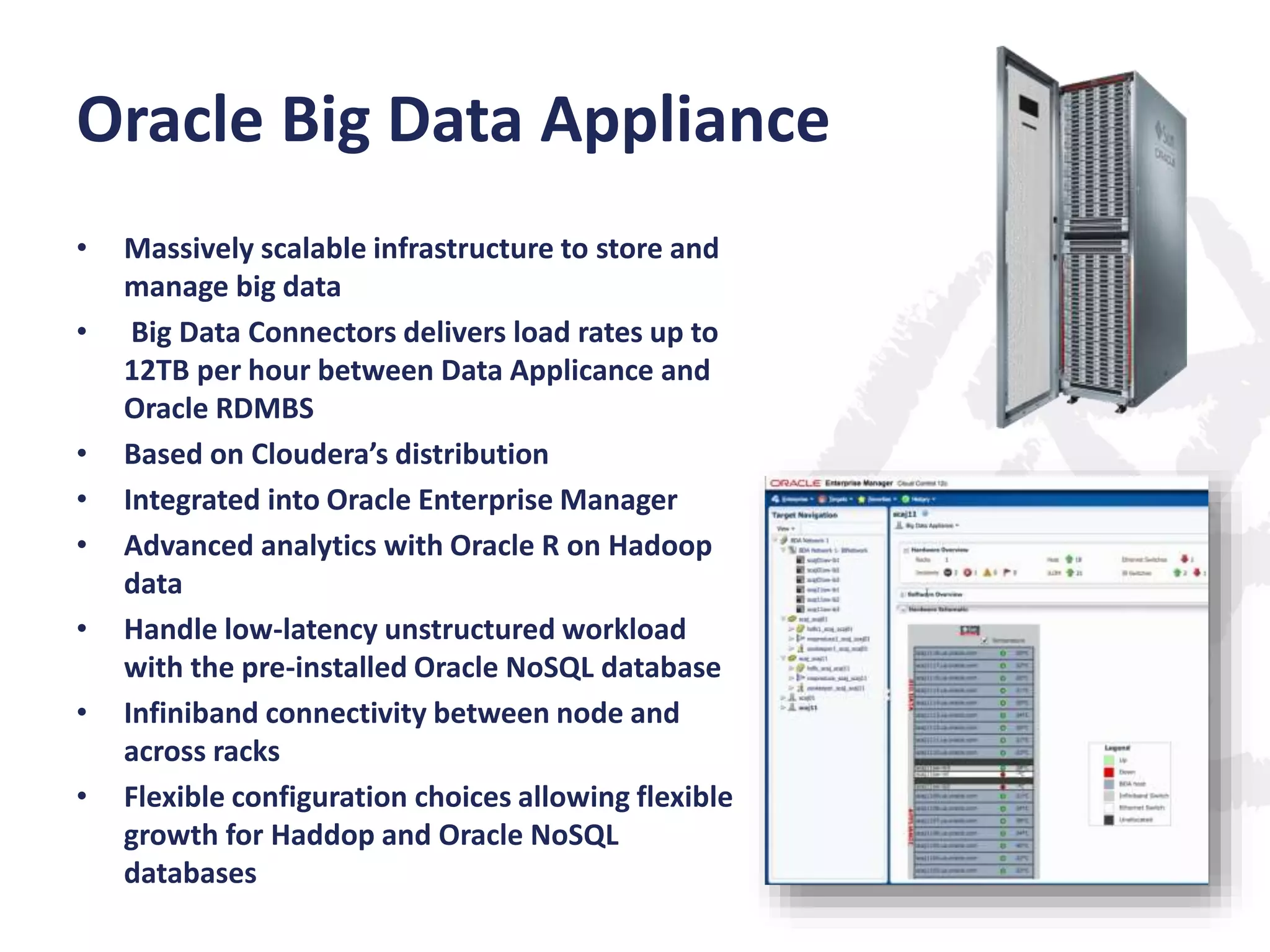
Massively scalable infrastructure to store and
manage big data
Big Data Connectors delivers load rates up to
12TB per hour between Data Applicance and
Oracle RDMBS
Based on Cloudera’s distribution
Integrated into Oracle Enterprise Manager
Advanced analytics with Oracle R on Hadoop
data
Handle low-latency unstructured workload
with the pre-installed Oracle NoSQL database
Infiniband connectivity between node and
across racks
Flexible configuration choices allowing flexible
growth for Haddop and Oracle NoSQL
databases
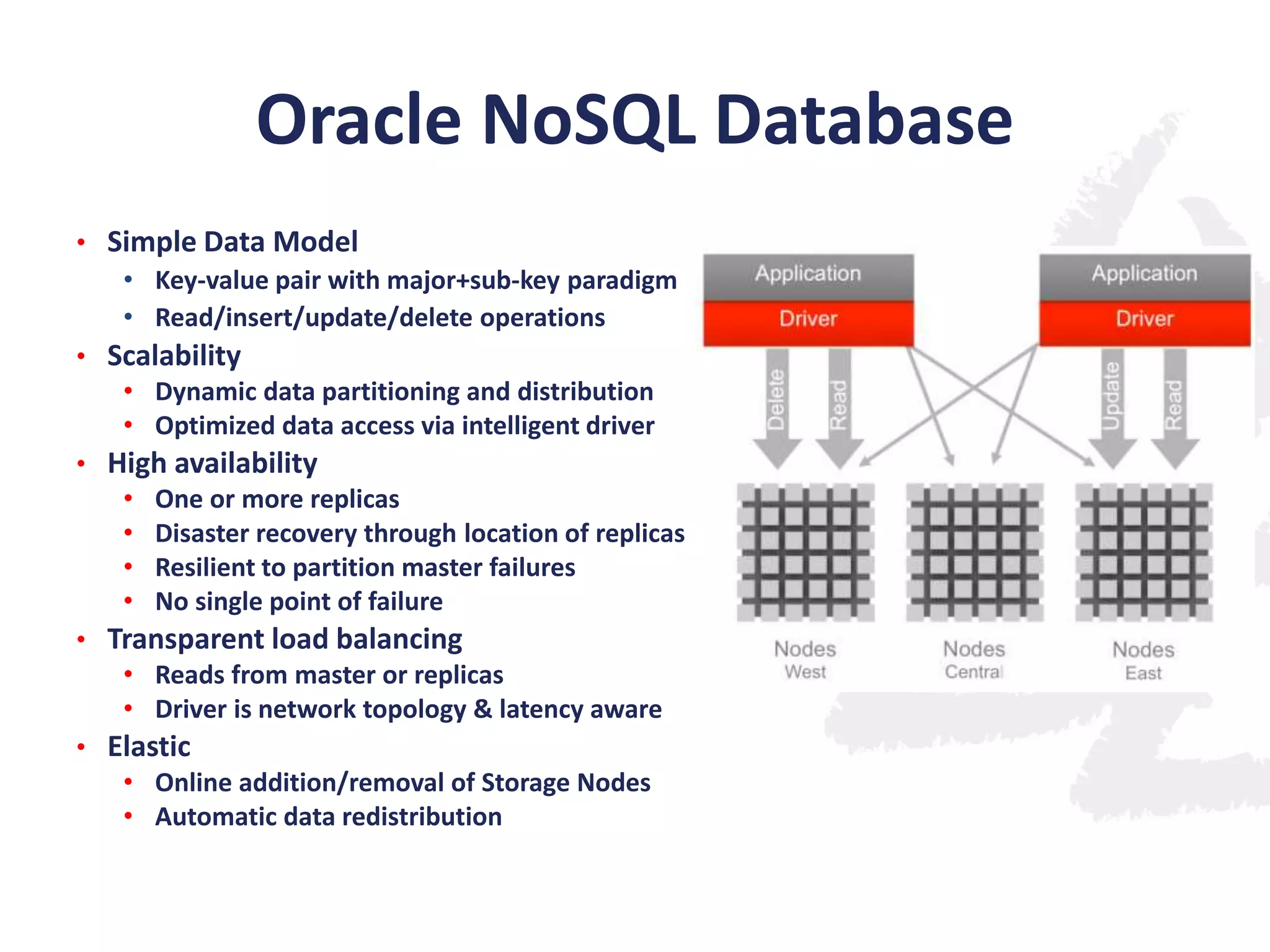
Oracle NoSQL Database
• Simple Data Model
• Key-value pair with major+sub-key paradigm
• Read/insert/update/delete operations
• Scalability
• Dynamic data partitioning and distribution
• Optimized data access via intelligent driver
• High availability
• One or more replicas
• Disaster recovery through location of replicas
• Resilient to partition master failures
• No single point of failure
• Transparent load balancing
• Reads from master or replicas
• Driver is network topology & latency aware
• Elastic
• Online addition/removal of Storage Nodes
• Automatic data redistribution
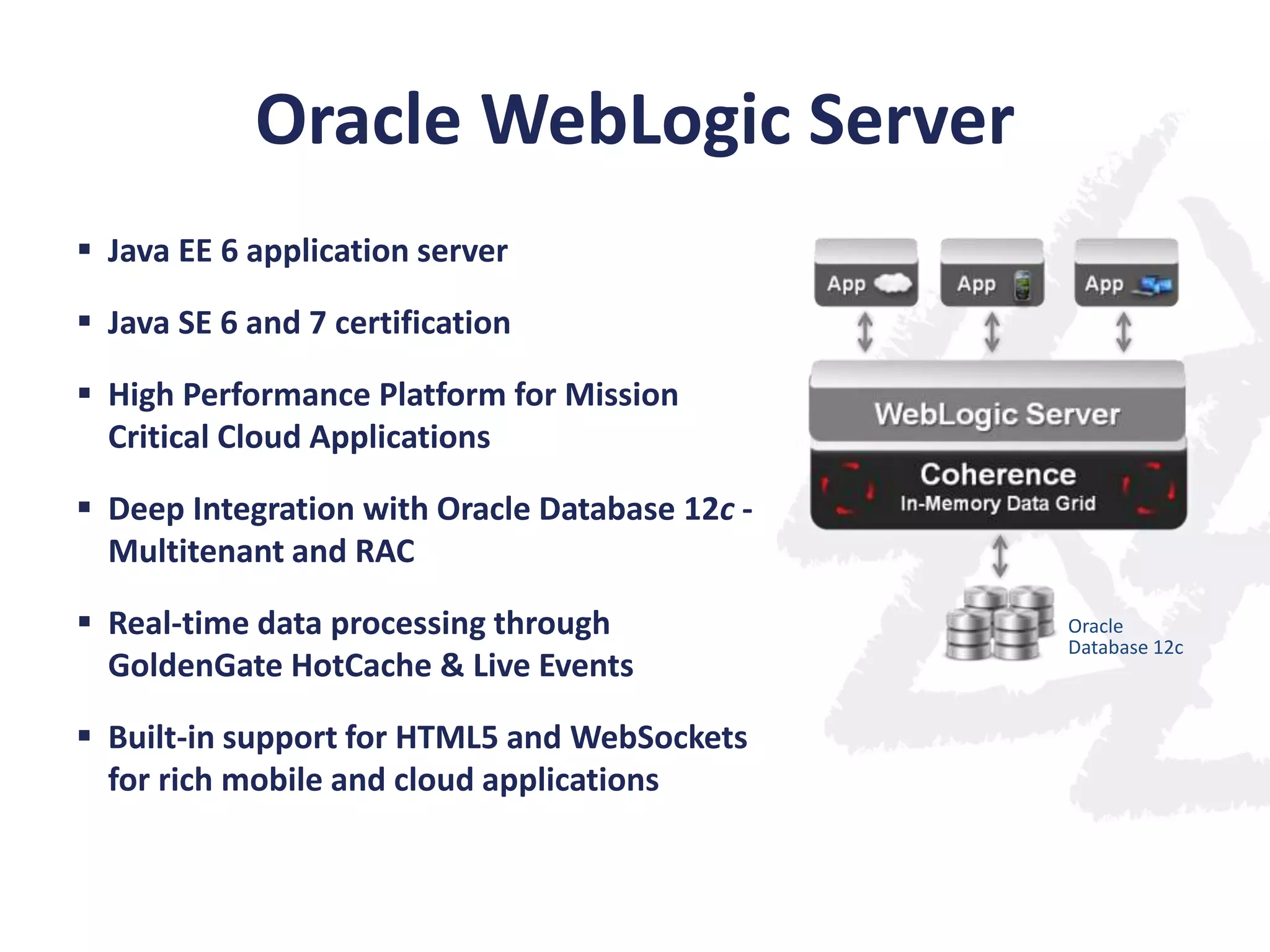
Oracle WebLogic Server
 Java EE 6 application server
 Java SE 6 and 7 certification
 High Performance Platform for Mission
Critical Cloud Applications

 Deep Integration with Oracle Database 12c Multitenant and RAC
 Real-time data processing through
GoldenGate HotCache & Live Events

 Built-in support for HTML5 and WebSockets
for rich mobile and cloud applications

Oracle
Database 12c
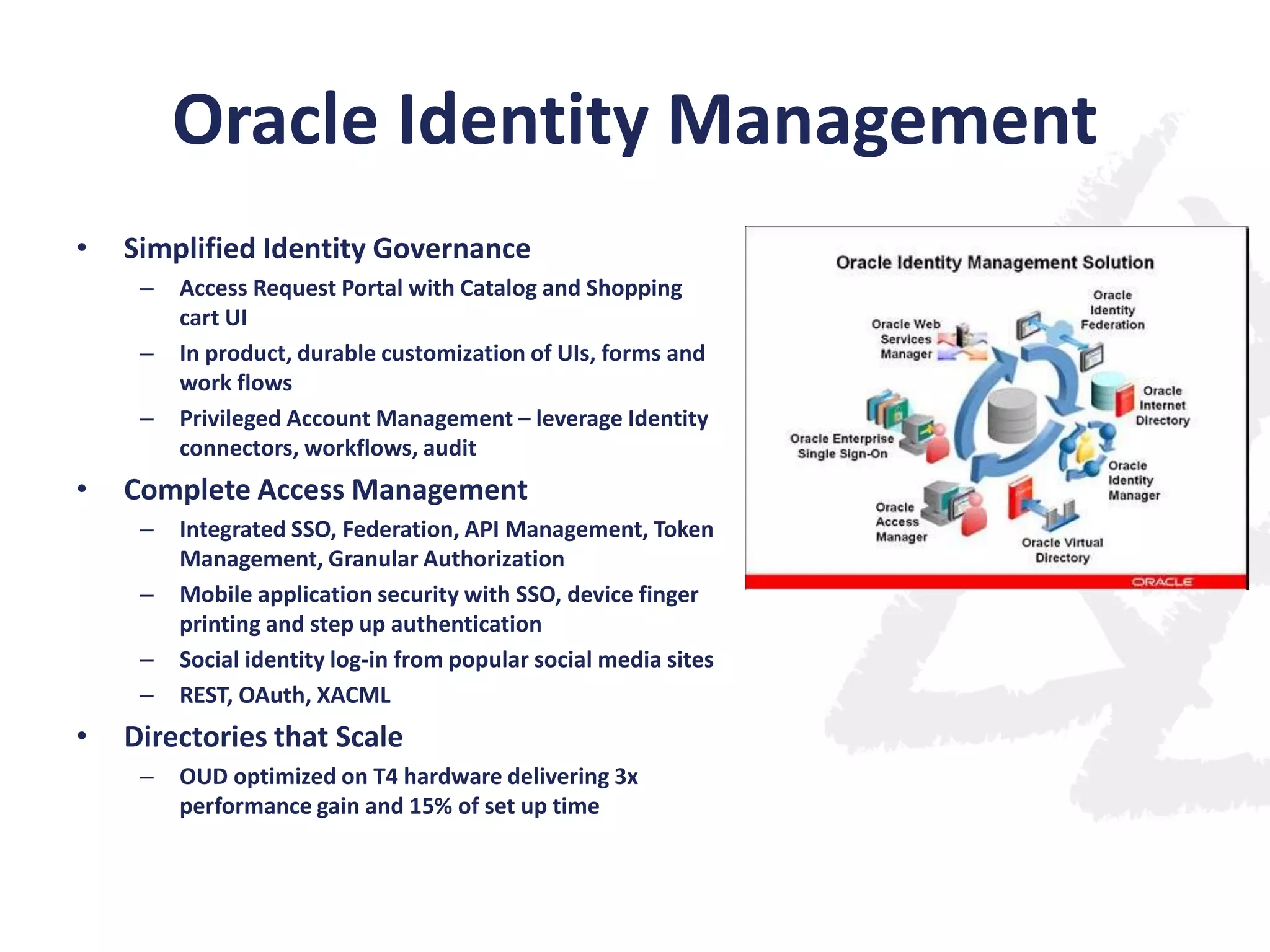
Oracle Identity Management
•

Simplified Identity Governance
–
–
–

•

Complete Access Management
–
–
–
–

•

Access Request Portal with Catalog and Shopping
cart UI
In product, durable customization of UIs, forms and
work flows
Privileged Account Management – leverage Identity
connectors, workflows, audit
Integrated SSO, Federation, API Management, Token
Management, Granular Authorization
Mobile application security with SSO, device finger
printing and step up authentication
Social identity log-in from popular social media sites
REST, OAuth, XACML

Directories that Scale
–

OUD optimized on T4 hardware delivering 3x
performance gain and 15% of set up time
Contact
Contact
Torsten Winterberg
Business Development & Innovation
OPITZ CONSULTING Deutschland GmbH
Kirchstr. 6, 51647 Gummersbach, Germany
Phone: +49 173 54 79 302
torsten.winterberg@opitz-consulting.com
@t_winterberg

Mobile Lösungen und BPM

© OPITZ CONSULTING GmbH 2011

Seite 73
Contact
Guido Schmutz
Technology Manager
Trivadis AG
Europa-Strasse 5, 8152 Glattbrugg, Schweiz
Phone: +49 173 54 79 302
guido.schmutz@trivadis.com
@gschmutz

Mobile Lösungen und BPM

© OPITZ CONSULTING GmbH 2011

Seite 74

BPM and SOA are going mobile - An architectural perspective

  • 1.
    BPM and SOAAre Going Mobile An Architectural Perspective Guido Schmutz Trivadis Torsten Winterberg OPITZ CONSULTING Deutschland GmbH DOAG, November 2013
  • 2.
    Mobile Development What doesthis mean today? An architectural point of view
  • 3.
    We need aniPhone App! 2008
  • 6.
    Cloud-Services become more andmore important Dropbox, Evernote, …
  • 7.
    We need anAndroid App! 2010
  • 10.
  • 12.
    Acceptance of AndroidVersions http://www.iphoneblog.de/2012/10/08/android-in-welcher-version/
  • 15.
    The Web: Cross-Plattform WriteOnce, run everywhere
  • 16.
    HTML5 is theevolution of web development HTML elements JavaScript HTML5 CSS
  • 20.
  • 21.
    Single Page Web-Apps UserInterface Presentation Logic REST Calls REST Backend Storage Local Storage Frontend Backend
  • 22.
  • 23.
    Start process frommobile device 1 2 3 Start process for insurance immediately 4
  • 24.
  • 25.
  • 26.
  • 27.
  • 28.
    Mobile Alarm /Monitoring
  • 29.
  • 30.
    Mobile Integration Technologies SOAP REST •Has a reputation for being complex and heavyweight • Has a formal contract language to define message formats • Supports standardized security approaches and tools • Supports XML and Binary • Has a reputation for being simple and lightweight • No formal contract language to define message formats • Security is a major challenge due to lack of standardization • Supports multiple data types (JSON, Text, XML, Binary)
  • 31.
  • 32.
    REST API Schema Aktion Typ URISchema customerByUsername GET /api/customers?username=fred rentalsByCustomerId GET /api/rentals?customerId=7 carTypes GET /api/cartypes cities GET /api/cities availableCars GET /api/availableCars?cityId=1 &startDate=2011-10-28-… &endDate=2011-10-30-… &maxPrice=90 rentCar POST /rental/ Body: {carId=...,startDate=...,endDate=...} Date format: "yyyy-MM-ddTHH:mm:ss.SSSZ"
  • 33.
    Mobile Integration Technologies XML •“Native” format for enterprise data exchange • Highly formal structure • Content CAN be validated • Formats can change only when all parties agree • Supports multiple data types (Text, Binary) JSON • “Native” format for web pages • No formal structure • Content cannot be validated • Easy to change • Text only
  • 34.
    Mobile Integration Patterns REST:URI addressing and data representation 37
  • 35.
    JSON as exchangeformat for data Request: $ curl --user fred:pass http://localhost:8484/... .../rylc-html5/backend/api/customers?username=fred Response: { "city":"Steintal", "email":"fred@die-feuersteins.de", "enabled":true, "id":1, "name":"Fred Feuerstein", ... }
  • 36.
    The Web isevolving… old new Documents Declarative HTML Templates Request/Response Thin Client Applications Programmatic DOM APIs Synchronization Thick Client
  • 37.
  • 38.
  • 39.
    Google Glasses Google Glasses ©http://www.flickr.com/photos/azugaldia/7457645618
  • 40.
  • 41.
  • 43.
    Data Driven Applicationsas new breed “It’s about using data to make our customer touch points more engaging, more interactive, more data-driven.”
  • 44.
    Central vs. ApplicationDatabases • Central Database • Application Database • • • • • • • • Using SQL as the integration mechanism between applications applications store data in common DB Improves communication, all applications operate on consistent set of data Structure ends up to be more complex Changes need to be coordinated with all other applications using the database Side-effects (i.e. adding database index) Application 1 Application 2 DB Application 3 • • • • Only accessed by a single application Only the application using the database needs to know about the structure Easier to maintain and evolve the schema More freedom to choose the database Applicable to SOA (i.e. Data Service/Entity Service) with good Service Autonomy Ready for the cloud Application 1 Application 2 Application 3 DB DB DB 48
  • 45.
    Relational vs. AggregateData Models • The relational model takes the information and divides it into tuples (rows) • A tuple is a limited data structure – no nesting of tuples – no list of values • Aggregate is a term that comes from Domain-Driven Design (Evans) • An aggregate is a collection of related objects, that should be treated as a unit – Unit for data manipulation and management of consistency 49
  • 46.
    NoSQL Databases Big Dataframeworks are often associated with the term NoSQL • • • • • • Not only SQL The power of SQL is not needed for all problems Specialized solutions may be faster or more scalable Bring the ability to handle semi-structured and unstructured data NoSQL complements RDBMS Different types of NoSQL today: • Key-value, Column-Family, Document, Graph Big Data frameworks and NoSQL are related but not necessarily the same • Some big data problems may be solved relationally
  • 47.
    Polyglot Persistence Defines ahybrid approach to persistence • • Using multiple data storage technologies Selected based on the way the data is used by an application Decisions • • Have to decide what data storage technology to use (Relational or NoSQL) Today it‘s easier to go with relational New Data Access APIs • Service-Oriented Polygot Persistence Model Each data store has its own mechanisms for accessing the data Solution • Wrap data access code into services (Data/ Entity Service) exposed to applications E-commerce Application Shopping cart data Key-Value Shopping Cart Service 51 User Session Service Completed Order Product Catalog Recomendations RDMBS User Sessions Document Graph Order Service Product Catalog Service Recomendation Service
  • 48.
    Unified (Mobile) Architecture WebApps 53 Oracle ADF DB Internet of Java Embedded Things HTTP/JSON Oracle WebLogic Application Server Server LDAP Oracle IDM / Enterprise IDM Oracle Event Processing (OEP) / Complex Event Processing (CEP) CEP Fast Data OEP Embedded NoSQL / BigNoSQL Oracle Data Database (Big) Data Oracle BigData Analytics Appliance (BDA) Enterprise Service Bus (ESB) Service Gateway Oracle API Gateway (OAG) Oracle ADF DB Mobile Oracle Service Bus (OSB) RDMBS Oracle GoldenGate Oracle Database Mobile Apps Mobile Server Oracle Data Integrator (ODI) Mobile Server (C2DM) External Cloud Service Providers BPM und SOA Oracle BPM Suite Platform Oracle SOA Suite SOAP REST Enterprise Applications Oracle ADF Business SOAP Local ESB Oracle Cloud Sockets Web to Device Messaging Database Logic JMS Oracle WebLogic Server RDMBS REST EJB Oracle RDBMS NoSQL Oracle NoSQL DB Oracle Business Intelligence Analytical Applications Foundation Suite Data Integration Data Warehouse Oracle Business Activity Monitoring (BAM)
  • 49.
  • 50.
     Mobile Appstoday  Think in new architecture pattern   Native Apps, mobile Web-Apps, Hybride Apps HTML5, Single-Page-Apps, Many-Cheap-Apps-Hell,…  Mobile Apps tomorrow   Not only B2C and B2B, but M2M Explosion of    Number of Devices Data / Events Need for Integration  Combination of Cloud, Big Data, Fast Data / Event Processing, Mobile, IoT is the future
  • 51.
    Oracle products fittingin this architecture
  • 52.
    Oracle ADF Mobile •Enables Customers to mobile-enable enterprise applications – One common platform for desktop and mobile applications (Android & iOS) – Handle multiple channels and network: browser, native, and hybrid applications • Technology foundation for future Oracle applications mobile development
  • 53.
    Oracle ADF • End-to-enddevelopment framework for Java EE • Based on industry standards • Full model-view-controller implementation • Rich web, mobile and desktop UI • Focus on reusability • Visual and declarative development • Integrated security and customization
  • 54.
    Oracle Database MobileServer • Secure, efficient, resilient mobile data synchronization with Oracle Database • Remote application, user and device management • Standards-based encryption for remote data, in both storage and transit • Robust and reliable mobile data synchronization over unreliable networks • Highly scalable server configuration, supporting large and growing mobile or remote deployments • Integration with ADF Mobile
  • 55.
    Oracle API Gateway(OAG) • Serves REST APIs and SOAP Web Services to clients – Converts REST to SOAP – Converts XML to JSON • Supports other protocols also – FTP, SFTP, FTPS – TIBCO Rendezvous and EMS – JMS (to IBM WebSphere MQ, ActiveMQ, JBOSS Messaging, etc) • Applies security rules – Authentication: OAuth, HTTP Auth, Certificate Auth, WS-Security – Content Filtering: Detection of SQL Injection, XSS, Viruses • • Monitoring of API and Service usage Caching and Traffic Management (routing, throttling)
  • 56.
    Oracle Service Bus(OSB) – Message & Service Integration • Embedded access to service result caching • Intelligent content and identity based routing • Rich set of transports/adapters • Data-oriented services and REST support • Dynamic message transformation and streaming • Built-in monitoring, management and QoS • Configuration-driven message and service integration • Optimized, pluggable, policy-driven transport and message security
  • 57.
    Oracle Data Integrator(ODI) – Data Integration • • • • • • • Out-of-the-box integration with databases, ERPs, CRMs, B2B systems, flat files, XML data, LDAP, JDBC, ODC Knowledge module framework for extensibility In-database transformations and data integrity controls on all databases Rich ETL for Oracle databases Integrates with Oracle GoldenGate for real-time data warehousing Metadata-driven data lineage and impact analysis Integrates with Oracle Enterprise Data Quality for advanced profiling, cleansing, matching and data governance needs
  • 58.
    Oracle Goldengate –Data Replication • High performance data replication • Heterogeneous sources and targets • Conflict detection and resolution • Real-time and deferred apply • Event marker infrastructure • Flexible topology support • Data encryption • ETL and JMS integration • Routing and • compensation • Initial load capability
  • 59.
    Oracle SOA Suite– Service Integration • Unifies Oracle and 3rd party Cloud applications with onpremises • Enables rapid delivery of existing applications into mobile channel • Improves partner collaboration with better B2B and API Management • Fast Data support with embeddable real-time event platform • Optimized integration to Oracle Applications running on Oracle Exalogic
  • 60.
    Oracle BPM Suite– Business Process Management • Business driven design, execution and improvement • Common process model facilitates Business-IT collaboration • Complete support for any type of process, including Adaptive Case Management • Modernize and unify existing applications • Time-to-value & packaged best practices with Process Accelerators
  • 61.
    Oracle Event Processing(OEP) • Lightweight Java Application server • Deployable stand-alone, integrated in SOA stack or lightweight on Embedded Java • Continuous Query Language (CQL) based on SQL syntax • Easy to use Development Environment • Enterprise class High Availability, Scalability, Performance and Reliability • Various Integration Opportunities using AQ, JMS and HTTP Publish/Subscribe Connectivity… • Coherence Integration
  • 62.
    Oracle Business ActivityMonitoring (BAM) • Monitor business processes & services in real-time Key Performance Indicators (KPIs) – Service-Level Agreements (SLAs) – • Analyze events as they occur Correlate events & KPIs – Identify trends as they emerge – Alert users to bottlenecks & solutions – • Act on current conditions Event-driven alerts – Real-time dashboards – BPEL processes & web services integration –
  • 63.
    Oracle Big DataAppliance • • • • • • • • Massively scalable infrastructure to store and manage big data Big Data Connectors delivers load rates up to 12TB per hour between Data Applicance and Oracle RDMBS Based on Cloudera’s distribution Integrated into Oracle Enterprise Manager Advanced analytics with Oracle R on Hadoop data Handle low-latency unstructured workload with the pre-installed Oracle NoSQL database Infiniband connectivity between node and across racks Flexible configuration choices allowing flexible growth for Haddop and Oracle NoSQL databases
  • 64.
    Oracle NoSQL Database •Simple Data Model • Key-value pair with major+sub-key paradigm • Read/insert/update/delete operations • Scalability • Dynamic data partitioning and distribution • Optimized data access via intelligent driver • High availability • One or more replicas • Disaster recovery through location of replicas • Resilient to partition master failures • No single point of failure • Transparent load balancing • Reads from master or replicas • Driver is network topology & latency aware • Elastic • Online addition/removal of Storage Nodes • Automatic data redistribution
  • 65.
    Oracle WebLogic Server Java EE 6 application server  Java SE 6 and 7 certification  High Performance Platform for Mission Critical Cloud Applications  Deep Integration with Oracle Database 12c Multitenant and RAC  Real-time data processing through GoldenGate HotCache & Live Events  Built-in support for HTML5 and WebSockets for rich mobile and cloud applications Oracle Database 12c
  • 66.
    Oracle Identity Management • SimplifiedIdentity Governance – – – • Complete Access Management – – – – • Access Request Portal with Catalog and Shopping cart UI In product, durable customization of UIs, forms and work flows Privileged Account Management – leverage Identity connectors, workflows, audit Integrated SSO, Federation, API Management, Token Management, Granular Authorization Mobile application security with SSO, device finger printing and step up authentication Social identity log-in from popular social media sites REST, OAuth, XACML Directories that Scale – OUD optimized on T4 hardware delivering 3x performance gain and 15% of set up time
  • 67.
  • 68.
    Contact Torsten Winterberg Business Development& Innovation OPITZ CONSULTING Deutschland GmbH Kirchstr. 6, 51647 Gummersbach, Germany Phone: +49 173 54 79 302 torsten.winterberg@opitz-consulting.com @t_winterberg Mobile Lösungen und BPM © OPITZ CONSULTING GmbH 2011 Seite 73
  • 69.
    Contact Guido Schmutz Technology Manager TrivadisAG Europa-Strasse 5, 8152 Glattbrugg, Schweiz Phone: +49 173 54 79 302 guido.schmutz@trivadis.com @gschmutz Mobile Lösungen und BPM © OPITZ CONSULTING GmbH 2011 Seite 74