Implementing Private Database Clouds
Real-World Experience of Database Consolidation on Scale-Out Platforms
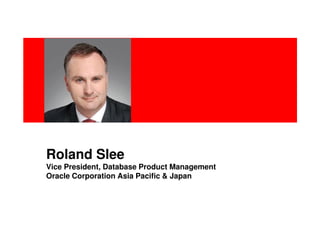
Roland Slee
Vice President, Database Product Management
Oracle Corporation Asia Pacific & Japan
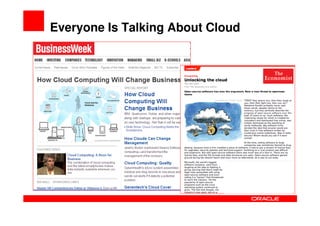
Everyone Is Talking About Cloud
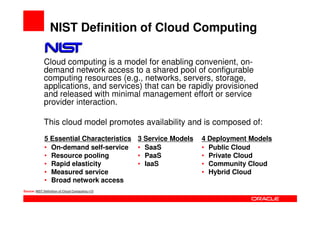
NIST Definition of Cloud Computing

             Cloud computing is a model for enabling convenient, on-
             demand network access to a shared pool of configurable
             computing resources (e.g., networks, servers, storage,
             applications, and services) that can be rapidly provisioned
             and released with minimal management effort or service
             provider interaction.

             This cloud model promotes availability and is composed of:
             5 Essential Characteristics         3 Service Models   4 Deployment Models
             • On-demand self-service            • SaaS             • Public Cloud
             • Resource pooling                  • PaaS             • Private Cloud
             • Rapid elasticity                  • IaaS             • Community Cloud
             • Measured service                                     • Hybrid Cloud
             • Broad network access
Source: NIST Definition of Cloud Computing v15
What Everyone Wants

• Mainframe-class QoS on an agile, low-cost, virtualised
  infrastructure

• Without having to devise the architecture yourself

• Without having to modify and re-test applications

• Knowing that applications will run faster and more reliably
  in the new environment
But Getting to the Cloud is Not Easy

• Many applications are not cloud enabled

• Many workloads don’t scale-out transparently

• Many organisations don’t have resources to manage the
  change
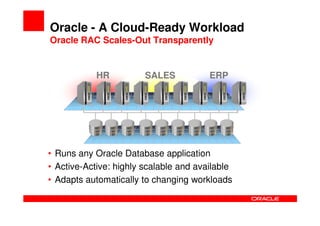
Oracle - A Cloud-Ready Workload
Oracle RAC Scales-Out Transparently


            HR          SALES           ERP


• Runs any Oracle Database application
• Active-Active: highly scalable and available
• Adapts automatically to changing workloads
“Don’t Try This At Home”

• A vendor certified and integrated configuration is best
  when you’re pushing the boundaries

• Large pool of customers running the same configuration
  enhances supportability

• Integrated Oracle software stack enhances control and
  mitigates risk
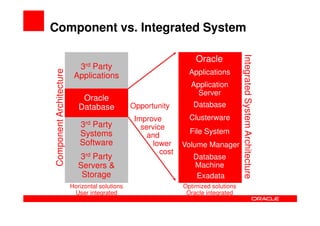
Component vs. Integrated System


                                                                                      Integrated System Architecture
                                                                                      Integrated System Architecture
                                                                    Oracle
                             3rd
                               Party
Component Architecture
                          Applications                            Applications
                                                                  Application
                                                                    Server
                             Oracle
                            Database            Opportunity        Database
                                                 Improve          Clusterware
                             3rd
                               Party               service
                            Systems                               File System
                                                     and
                            Software                   lower    Volume Manager
                                                         cost
                            3rd Party                              Database
                            Servers &                              Machine
                             Storage                                Exadata
                         Horizontal solutions                   Optimized solutions
                          User integrated                        Oracle integrated
Leading Australian Bank Implements
 Oracle Database as a Service
• Consolidates 300+ Oracle Databases onto three grids
  • Includes mission-critical, customer-facing applications


• Implements Oracle’s Maximum Availability Architecture
  • Enhances performance & reliability while reducing cost


• Increases DBA productivity
  • Small team of expert DBAs able to serve large portfolio of systems


• Implements “pay for use” model for business users
  • Business users recognise the superior economics of the solution
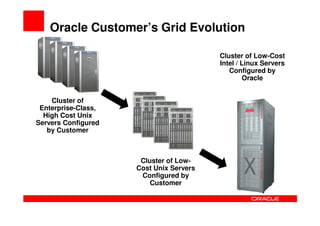
Oracle Customer’s Grid Evolution

                                         Cluster of Low-Cost
                                         Intel / Linux Servers
                                            Configured by
                                                 Oracle


    Cluster of
 Enterprise-Class,
  High Cost Unix
Servers Configured
   by Customer


                      Cluster of Low-
                     Cost Unix Servers
                      Configured by
                         Customer
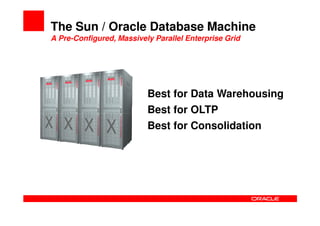
The Sun / Oracle Database Machine
A Pre-Configured, Massively Parallel Enterprise Grid


                          Best for Data Warehousing
                          Best for OLTP
                          Best for Consolidation
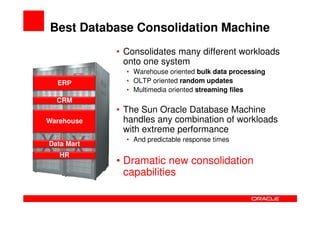
Best Database Consolidation Machine
            • Consolidates many different workloads
              onto one system
              • Warehouse oriented bulk data processing
  ERP         • OLTP oriented random updates
              • Multimedia oriented streaming files
  CRM
            • The Sun Oracle Database Machine
Warehouse     handles any combination of workloads
              with extreme performance
              • And predictable response times
Data Mart
   HR
            • Dramatic new consolidation
              capabilities
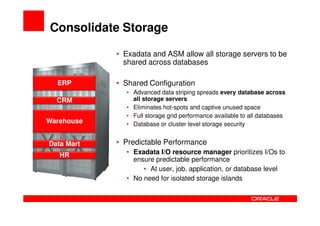
Consolidate Storage

            • Exadata and ASM allow all storage servers to be
              shared across databases

  ERP       • Shared Configuration
              • Advanced data striping spreads every database across
  CRM           all storage servers
              • Eliminates hot-spots and captive unused space
              • Full storage grid performance available to all databases
Warehouse     • Database or cluster level storage security


Data Mart   • Predictable Performance
   HR         • Exadata I/O resource manager prioritizes I/Os to
                ensure predictable performance
                   • At user, job, application, or database level
              • No need for isolated storage islands
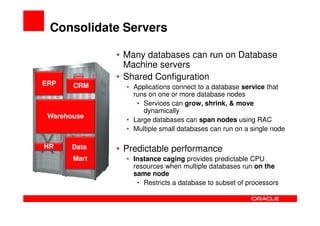
Consolidate Servers

              • Many databases can run on Database
                Machine servers
              • Shared Configuration
ERP    CRM      • Applications connect to a database service that
                  runs on one or more database nodes
                   • Services can grow, shrink, & move
                     dynamically
 Warehouse
                • Large databases can span nodes using RAC
                • Multiple small databases can run on a single node

HR     Data   • Predictable performance
       Mart     • Instance caging provides predictable CPU
                  resources when multiple databases run on the
                  same node
                   • Restricts a database to subset of processors
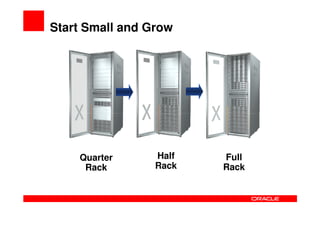
Start Small and Grow


    Quarter      Half   Full
     Rack        Rack   Rack
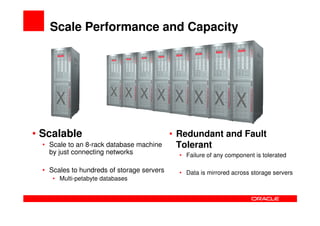
Scale Performance and Capacity


• Scalable                                  • Redundant and Fault
  • Scale to an 8-rack database machine       Tolerant
    by just connecting networks               • Failure of any component is tolerated

  • Scales to hundreds of storage servers     • Data is mirrored across storage servers
     • Multi-petabyte databases
In Conclusion

• The Oracle Database is a grid-enabled workload

• Lends itself to database consolidation on low-cost,
  industry-standard infrastructure

• Oracle now has a pre-built, optimised platform for
  database consolidation

• Real, local, customers have proven it works
Questions


            – 19 –
Implementing Private Database Clouds

Implementing Private Database Clouds

  • 1.
    Implementing Private DatabaseClouds Real-World Experience of Database Consolidation on Scale-Out Platforms
  • 2.
    Roland Slee Vice President,Database Product Management Oracle Corporation Asia Pacific & Japan
  • 3.
  • 4.
    NIST Definition ofCloud Computing Cloud computing is a model for enabling convenient, on- demand network access to a shared pool of configurable computing resources (e.g., networks, servers, storage, applications, and services) that can be rapidly provisioned and released with minimal management effort or service provider interaction. This cloud model promotes availability and is composed of: 5 Essential Characteristics 3 Service Models 4 Deployment Models • On-demand self-service • SaaS • Public Cloud • Resource pooling • PaaS • Private Cloud • Rapid elasticity • IaaS • Community Cloud • Measured service • Hybrid Cloud • Broad network access Source: NIST Definition of Cloud Computing v15
  • 5.
    What Everyone Wants •Mainframe-class QoS on an agile, low-cost, virtualised infrastructure • Without having to devise the architecture yourself • Without having to modify and re-test applications • Knowing that applications will run faster and more reliably in the new environment
  • 6.
    But Getting tothe Cloud is Not Easy • Many applications are not cloud enabled • Many workloads don’t scale-out transparently • Many organisations don’t have resources to manage the change
  • 7.
    Oracle - ACloud-Ready Workload Oracle RAC Scales-Out Transparently HR SALES ERP • Runs any Oracle Database application • Active-Active: highly scalable and available • Adapts automatically to changing workloads
  • 8.
    “Don’t Try ThisAt Home” • A vendor certified and integrated configuration is best when you’re pushing the boundaries • Large pool of customers running the same configuration enhances supportability • Integrated Oracle software stack enhances control and mitigates risk
  • 9.
    Component vs. IntegratedSystem Integrated System Architecture Integrated System Architecture Oracle 3rd Party Component Architecture Applications Applications Application Server Oracle Database Opportunity Database Improve Clusterware 3rd Party service Systems File System and Software lower Volume Manager cost 3rd Party Database Servers & Machine Storage Exadata Horizontal solutions Optimized solutions User integrated Oracle integrated
  • 10.
    Leading Australian BankImplements Oracle Database as a Service • Consolidates 300+ Oracle Databases onto three grids • Includes mission-critical, customer-facing applications • Implements Oracle’s Maximum Availability Architecture • Enhances performance & reliability while reducing cost • Increases DBA productivity • Small team of expert DBAs able to serve large portfolio of systems • Implements “pay for use” model for business users • Business users recognise the superior economics of the solution
  • 11.
    Oracle Customer’s GridEvolution Cluster of Low-Cost Intel / Linux Servers Configured by Oracle Cluster of Enterprise-Class, High Cost Unix Servers Configured by Customer Cluster of Low- Cost Unix Servers Configured by Customer
  • 12.
    The Sun /Oracle Database Machine A Pre-Configured, Massively Parallel Enterprise Grid Best for Data Warehousing Best for OLTP Best for Consolidation
  • 13.
    Best Database ConsolidationMachine • Consolidates many different workloads onto one system • Warehouse oriented bulk data processing ERP • OLTP oriented random updates • Multimedia oriented streaming files CRM • The Sun Oracle Database Machine Warehouse handles any combination of workloads with extreme performance • And predictable response times Data Mart HR • Dramatic new consolidation capabilities
  • 14.
    Consolidate Storage • Exadata and ASM allow all storage servers to be shared across databases ERP • Shared Configuration • Advanced data striping spreads every database across CRM all storage servers • Eliminates hot-spots and captive unused space • Full storage grid performance available to all databases Warehouse • Database or cluster level storage security Data Mart • Predictable Performance HR • Exadata I/O resource manager prioritizes I/Os to ensure predictable performance • At user, job, application, or database level • No need for isolated storage islands
  • 15.
    Consolidate Servers • Many databases can run on Database Machine servers • Shared Configuration ERP CRM • Applications connect to a database service that runs on one or more database nodes • Services can grow, shrink, & move dynamically Warehouse • Large databases can span nodes using RAC • Multiple small databases can run on a single node HR Data • Predictable performance Mart • Instance caging provides predictable CPU resources when multiple databases run on the same node • Restricts a database to subset of processors
  • 16.
    Start Small andGrow Quarter Half Full Rack Rack Rack
  • 17.
    Scale Performance andCapacity • Scalable • Redundant and Fault • Scale to an 8-rack database machine Tolerant by just connecting networks • Failure of any component is tolerated • Scales to hundreds of storage servers • Data is mirrored across storage servers • Multi-petabyte databases
  • 18.
    In Conclusion • TheOracle Database is a grid-enabled workload • Lends itself to database consolidation on low-cost, industry-standard infrastructure • Oracle now has a pre-built, optimised platform for database consolidation • Real, local, customers have proven it works
  • 19.
    Questions – 19 –