Bowel elimination
Dr . Hoda alkamali
Learning objectives :
On completion of this chapter the student should
be able to :
1- Describe the process of defecation
2- Name two components of a bowel elimination ,
assessment
3- List five common alterations in bowel elimination
4- Name four types of constipation
5- Identify nursing measure for treating
constipation
of Defecation (bowl
Definition
elimination )
Is the act of expelling faces (stool ) from the
body .
* A remarkable volume of water is reabsorbed in
the large intestine , causing the bowel’s content
of a residue
consolidated mass
to become a
before being eliminated
peristalsis
It is the rhythmic contractions of intestinal smooth muscle that
facilitate defecation .
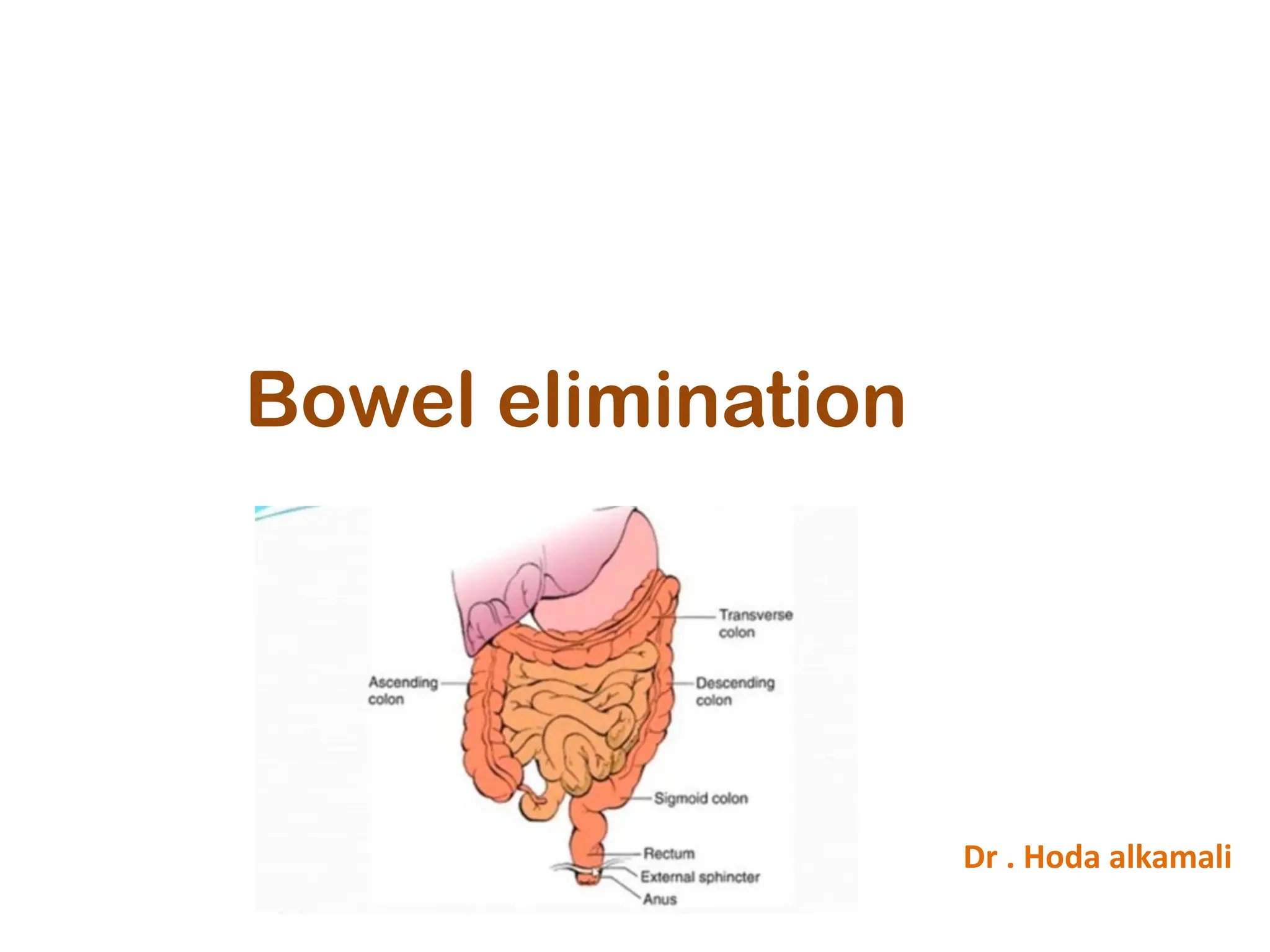
__ It moves fiber , water and nutritional wastes a long the ascending ,
transverse , descending
And sigmoid colon toward the rectum .
__ peristalsis becomes even more active during eating , it is called the
gastro colic reflex
precedes defecation it is accelerated wave like
Gasrocolic reflex
__
movement , sometimes perceived as slight abdominal cramping ,
propel stool …
peristalsis
As the rectum distends ,the person feels the
urge to defecate
Stool is eventually released when the anal
sphincter relax .
Assessment bowel elimination
assessment of bowel elimination involves collecting data
about the clients elimination pattern ( bowel habits ) and the
actual characterized of faces
Elimination pattern :
-
A
1- frequency of elimination
2- effort required to expel stool
3- elimination aids , if any used ?
Stool characteristics
-
B
_ inspecting the stool or asking the client to describe its
appearance
_ information that is particularly diagnostic include stool color ,
odor , consistency ,shape , and unusual components
_ the incidence of colorectal cancer increase with age .
Therefor advice older adults to have regular endoscopic bowel
examination after 50 years of age .
Health education regarding
bowel elimination
- Adults should identify their own patterns of
bowel regularity which can range from 3times a
day to 3 times a week .
- Daily exercise .
- Eat high fiber foods on regular basis .
- Drink 8—10 glasses of liquid a day
Common alterations in bowel
elimination
Constipation
-
1
It’s an elimination problem characterized by dry , hard
stool that is difficult to pass easily
Sings and symptoms :
- Inability to pass stool easily
- Complains of abdominal fullness or bloating
- Abdominal distention
- Complains of rectal fullness or pressure
- Pain on defecation
- decreased frequency of bowel movement
- Stool Ch- by hard or small stool
Common alterations in bowel
elimination
Constipation
-
It is classified into four distinct types :
A- primary constipation
Primary or simple constipation can be treated by nurse . It results from
lifestyle factors such as inactivity , inadequate intake of fibers ,
insufficient fluid intake , or ignoring the urge to defecate .
B- secondary constipation (R/T disease )
It is a consequence of a pathologic order such as a partial bowel
obstruction .
It usually resolves when the primary cause is treated .
C- Iatrogenic constipation
It occurs as a consequence of prolonged use of narcotic analgesia
These drugs slow peristalsis delaying transit time
Common alterations in bowel
elimination
Constipation
-
D- Pseudo constipation
Is a term use when clients believe themselves to be
constipated even through they are not diagnosed as
perceived constipation
- It may occur in people who are extremely
concerned about having a daily bowel movement
- They often overuse or abuse laxatives ,
suppositories and enemas
Common alterations in bowel
elimination
Fecal impaction
-
2
It occurs when a large , hardened mass of stool
interferes with defecation , making it impossible for
the client to pass faces voluntarily .
Causes of fecal impaction :
- Un relieved constipation
- Retained barium from an intestinal X ray
- Dehydration
- Weakness of abdominal muscles
Fecal impaction
Manifestations :
- Usually report a frequent devise to defecate but
unable to do so .
- Rectal pain may result from unsuccessful efforts to
evacuate the lower bowel .
- Some clients may pass liquid stool , which may be
misinterpreted as diarrhea .
To determine whether or not a fecal impaction is
present it may be necessary to insert a lubricated
,gloved finger into the rectum . If the rectum is
filled with a mass of stool .
Common alterations in bowel
elimination
Fecal impaction
Nursing measure for removal of impaction :
_ Some times nurses administer enemas , another intervention is to remove
the stool digitally or irrigation by rectal tube .
_ Flatulence
3
Flatulence or flatus ( an excessive accumulation of intestinal gas ) result from
a – swallowing air while eating
b – sluggish peristalsis
c_ bacterial fermentation in the bowel
When the clients are extremely uncomfortable and ambulating does not
eliminate flatus , the nurse may insert a rectal tube to help the gas escape
Common alterations in bowel
elimination
Diarrhea
-
4
_ diarrhea is the urgent passage of watery stool
and commonly is accompanied by abdominal
cramping .
- Usually diarrhea is a means of eliminating an
irritating substance such as tainted
,contaminated food or intestinal pathogens
- Simple diarrhea usually begins suddenly and
lasts for a short period
Common alterations in bowel
elimination
Diarrhea
-
Causes of diarrhea :
- Emotional stress
- Dietary food
- Laxative abuse
- Bowel disorder
Nursing management :
- Resting the bowel temporarily may relieve simple diarrhea
- Encourage the client to drink clear liquids but
avoids solid food for 12-24 hrs.
- Resumed eating begins with bland food and these low in residue such as
bananas and apple sauce
- If the diarrhea not relieved within 24hrs ,it is best to consult the physician
Common alterations in bowel
elimination
Fecal incontinence
-
5
It is the inability to control the elimination of stool .
Causes of incontinence :
- Neurologic changes or when a person can not
reach a toilet in time to eliminate .
Chronic fecal incontinence can be disturbing socially
and emotionally .
Client with chronic fecal incontinence and their
families require much support and understanding
Bowel wash ( rectal
irrigation )
Definition
It is washing out of colon with large quantities of
solution to clear colon of feces .
Bowel irrigation is defined as the procedure when
water is introduced into the bowel via the rectum
using a rectal catheter .
Rectal irrigations are the best method to clean
(wash out ) the colon of stool and to prevent “stasis
“ of stool in the colon .
Purposes
_ To prepare colon for specific surgical or
diagnostic procedure
_ To dilute and remove toxic agents that may be
present in the large intestine
_ To reduce temperature in the hyperpyrexia
and heat stroke
_ To stimulate peristalsis
_ To keep person clean in case of fecal
incontinence or constipation
Colon cleanse side effect
__ Nausea
__ Abdominal pain
__ Vomiting
__ Diarrhea
__ Loss of electrolytes
Contraindications
_ Bleeding hemorrhoids
_ Chronic diarrhea
_Intestinal obstruction
Anal fistula
_
_ Rectal surgeries ,infection
_ Massive colon carcinoma
_ painful skin lesion a round anus
Equipment
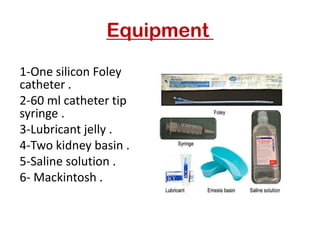
1-One silicon Foley
catheter .
2-60 ml catheter tip
syringe .
3-Lubricant jelly .
4-Two kidney basin .
5-Saline solution .
6- Mackintosh .
procedure
- Wash hands
- Prepare equipment
- Introduce your self and explain the procedure to the patient
-provide privacy
Sims’ position)
)
-Put patient in appropriate position _ lateral position
- Pour normal saline solution into a non sterile basin
- Using a 60 ml syringe , draw up 20ml of normal saline solution.
- Lubricate 2 inches (5cm ) the distal parte of the Foley .
- Gently insert the Foley into the rectum ,approximately 4-6 inches (10-15cm) ,depending on the size of
the child
- Allow the gas and stool to pass freely
- Place the syringe into the end of the silicone catheter and inject 20 ml of warm normal saline solution
into the rectum
-
-Disconnect syringe from the end of the catheter , allow the normal saline solution to drip into an
empty basin
-Repeat this process until the discarded fluid is clear
-Return equipment
-Remove gloves and wash hands
-Record
Insert flatus tube
* A rectal tube is inserted into the rectum relives the
flatulence and gaseous distention of the abdomen .
_ Prepare client as for enema .
_ Lubricate flatus tube and insert about 4-6 inches into
the anal canal while the free end is kept under the water
in the kidney tray
_ Watch the expulsion of the gas which is seen bubbling
through the water .
_ The tube is left in lace for not more than 20minutes
,longer periods leads to permanent sphincter damage .
_ Tube can be reinserted every 3-4 hrs. .

bowel elimination and irrigation nursing.pdf

  • 1.
  • 2.
    Learning objectives : Oncompletion of this chapter the student should be able to : 1- Describe the process of defecation 2- Name two components of a bowel elimination , assessment 3- List five common alterations in bowel elimination 4- Name four types of constipation 5- Identify nursing measure for treating constipation
  • 3.
    of Defecation (bowl Definition elimination) Is the act of expelling faces (stool ) from the body . * A remarkable volume of water is reabsorbed in the large intestine , causing the bowel’s content of a residue consolidated mass to become a before being eliminated
  • 4.
    peristalsis It is therhythmic contractions of intestinal smooth muscle that facilitate defecation . __ It moves fiber , water and nutritional wastes a long the ascending , transverse , descending And sigmoid colon toward the rectum . __ peristalsis becomes even more active during eating , it is called the gastro colic reflex precedes defecation it is accelerated wave like Gasrocolic reflex __ movement , sometimes perceived as slight abdominal cramping , propel stool …
  • 5.
    peristalsis As the rectumdistends ,the person feels the urge to defecate Stool is eventually released when the anal sphincter relax .
  • 6.
    Assessment bowel elimination assessmentof bowel elimination involves collecting data about the clients elimination pattern ( bowel habits ) and the actual characterized of faces Elimination pattern : - A 1- frequency of elimination 2- effort required to expel stool 3- elimination aids , if any used ? Stool characteristics - B _ inspecting the stool or asking the client to describe its appearance _ information that is particularly diagnostic include stool color , odor , consistency ,shape , and unusual components _ the incidence of colorectal cancer increase with age . Therefor advice older adults to have regular endoscopic bowel examination after 50 years of age .
  • 7.
    Health education regarding bowelelimination - Adults should identify their own patterns of bowel regularity which can range from 3times a day to 3 times a week . - Daily exercise . - Eat high fiber foods on regular basis . - Drink 8—10 glasses of liquid a day
  • 8.
    Common alterations inbowel elimination Constipation - 1 It’s an elimination problem characterized by dry , hard stool that is difficult to pass easily Sings and symptoms : - Inability to pass stool easily - Complains of abdominal fullness or bloating - Abdominal distention - Complains of rectal fullness or pressure - Pain on defecation - decreased frequency of bowel movement - Stool Ch- by hard or small stool
  • 9.
    Common alterations inbowel elimination Constipation - It is classified into four distinct types : A- primary constipation Primary or simple constipation can be treated by nurse . It results from lifestyle factors such as inactivity , inadequate intake of fibers , insufficient fluid intake , or ignoring the urge to defecate . B- secondary constipation (R/T disease ) It is a consequence of a pathologic order such as a partial bowel obstruction . It usually resolves when the primary cause is treated . C- Iatrogenic constipation It occurs as a consequence of prolonged use of narcotic analgesia These drugs slow peristalsis delaying transit time
  • 10.
    Common alterations inbowel elimination Constipation - D- Pseudo constipation Is a term use when clients believe themselves to be constipated even through they are not diagnosed as perceived constipation - It may occur in people who are extremely concerned about having a daily bowel movement - They often overuse or abuse laxatives , suppositories and enemas
  • 11.
    Common alterations inbowel elimination Fecal impaction - 2 It occurs when a large , hardened mass of stool interferes with defecation , making it impossible for the client to pass faces voluntarily . Causes of fecal impaction : - Un relieved constipation - Retained barium from an intestinal X ray - Dehydration - Weakness of abdominal muscles
  • 12.
    Fecal impaction Manifestations : -Usually report a frequent devise to defecate but unable to do so . - Rectal pain may result from unsuccessful efforts to evacuate the lower bowel . - Some clients may pass liquid stool , which may be misinterpreted as diarrhea . To determine whether or not a fecal impaction is present it may be necessary to insert a lubricated ,gloved finger into the rectum . If the rectum is filled with a mass of stool .
  • 13.
    Common alterations inbowel elimination Fecal impaction Nursing measure for removal of impaction : _ Some times nurses administer enemas , another intervention is to remove the stool digitally or irrigation by rectal tube . _ Flatulence 3 Flatulence or flatus ( an excessive accumulation of intestinal gas ) result from a – swallowing air while eating b – sluggish peristalsis c_ bacterial fermentation in the bowel When the clients are extremely uncomfortable and ambulating does not eliminate flatus , the nurse may insert a rectal tube to help the gas escape
  • 14.
    Common alterations inbowel elimination Diarrhea - 4 _ diarrhea is the urgent passage of watery stool and commonly is accompanied by abdominal cramping . - Usually diarrhea is a means of eliminating an irritating substance such as tainted ,contaminated food or intestinal pathogens - Simple diarrhea usually begins suddenly and lasts for a short period
  • 15.
    Common alterations inbowel elimination Diarrhea - Causes of diarrhea : - Emotional stress - Dietary food - Laxative abuse - Bowel disorder Nursing management : - Resting the bowel temporarily may relieve simple diarrhea - Encourage the client to drink clear liquids but avoids solid food for 12-24 hrs. - Resumed eating begins with bland food and these low in residue such as bananas and apple sauce - If the diarrhea not relieved within 24hrs ,it is best to consult the physician
  • 16.
    Common alterations inbowel elimination Fecal incontinence - 5 It is the inability to control the elimination of stool . Causes of incontinence : - Neurologic changes or when a person can not reach a toilet in time to eliminate . Chronic fecal incontinence can be disturbing socially and emotionally . Client with chronic fecal incontinence and their families require much support and understanding
  • 17.
    Bowel wash (rectal irrigation )
  • 18.
    Definition It is washingout of colon with large quantities of solution to clear colon of feces . Bowel irrigation is defined as the procedure when water is introduced into the bowel via the rectum using a rectal catheter . Rectal irrigations are the best method to clean (wash out ) the colon of stool and to prevent “stasis “ of stool in the colon .
  • 19.
    Purposes _ To preparecolon for specific surgical or diagnostic procedure _ To dilute and remove toxic agents that may be present in the large intestine _ To reduce temperature in the hyperpyrexia and heat stroke _ To stimulate peristalsis _ To keep person clean in case of fecal incontinence or constipation
  • 20.
    Colon cleanse sideeffect __ Nausea __ Abdominal pain __ Vomiting __ Diarrhea __ Loss of electrolytes
  • 21.
    Contraindications _ Bleeding hemorrhoids _Chronic diarrhea _Intestinal obstruction Anal fistula _ _ Rectal surgeries ,infection _ Massive colon carcinoma _ painful skin lesion a round anus
  • 22.
    Equipment 1-One silicon Foley catheter. 2-60 ml catheter tip syringe . 3-Lubricant jelly . 4-Two kidney basin . 5-Saline solution . 6- Mackintosh .
  • 23.
    procedure - Wash hands -Prepare equipment - Introduce your self and explain the procedure to the patient -provide privacy Sims’ position) ) -Put patient in appropriate position _ lateral position - Pour normal saline solution into a non sterile basin - Using a 60 ml syringe , draw up 20ml of normal saline solution. - Lubricate 2 inches (5cm ) the distal parte of the Foley . - Gently insert the Foley into the rectum ,approximately 4-6 inches (10-15cm) ,depending on the size of the child - Allow the gas and stool to pass freely - Place the syringe into the end of the silicone catheter and inject 20 ml of warm normal saline solution into the rectum - -Disconnect syringe from the end of the catheter , allow the normal saline solution to drip into an empty basin -Repeat this process until the discarded fluid is clear -Return equipment -Remove gloves and wash hands -Record
  • 24.
    Insert flatus tube *A rectal tube is inserted into the rectum relives the flatulence and gaseous distention of the abdomen . _ Prepare client as for enema . _ Lubricate flatus tube and insert about 4-6 inches into the anal canal while the free end is kept under the water in the kidney tray _ Watch the expulsion of the gas which is seen bubbling through the water . _ The tube is left in lace for not more than 20minutes ,longer periods leads to permanent sphincter damage . _ Tube can be reinserted every 3-4 hrs. .