Goma Karki BMS 1
Catheterization
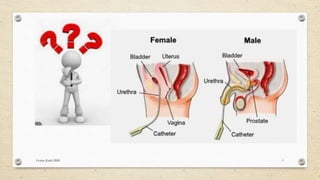
Catheterization is a process of drawing urine from the bladder by means of
an instrument called a catheter. It is inserted through the urethra under
aseptic precaution. Or,
Introducing a catheter into the urinary bladder through urethra using aseptic
technique for the purpose of emptying the bladder.
Catheters: it is a tubular instruments that are made of rubber, plastic, metal
and glass.
Goma Karki BMS 2
purposes
To relief acute or chronic retention of urine
To keep emptying the bladder in case of surgery
To obtain a clear specimen for diagnostic purpose
To determine amount of residual urine after voiding
To continue drain of urine in urinary incontinence
To measure the urinary output accurately in severe ill and needed
patients. Goma Karki BMS 3
Cont’d….
To empty the bladder before irrigation of bladder
To keep the patient clean and avoid over distension to prevent further
damage to the paralyzed muscle of the urinary bladder.
To prevent urine from passing over a wound e.g. After repair of the
perineum
To provide for intermittent or continuous bladder drainage and
irrigation. Goma Karki BMS 4
Types of catheter
Goma Karki BMS 5
Cont’d….
Condom catheter
Applying a thin condom sheath to penis for
drainage of urine without inserting a catheter
into urethra. It is used in a incontinence men
who still have complete and spontaneous
bladder emptying.
Goma Karki BMS 6
Cont’d….
Purpose
-To drain urine incase of an incontinent patient.
-to permit patient’s normal physical activity without
fear of embarrassment caused by incontinence.
Goma Karki BMS 7
Types of catheterization
1. Intermittent catheterization
2. Indwelling catheterization
1. Intermittent catheterization
Intermittent catheterization means removing urine from the bladder by
placing a tube into the bladder. This is done when a child or adult is unable
to empty her bladder on her own, when a child's bladder leaks urine, or
when very high pressures have developed in the bladder.
Goma Karki BMS 8
Purposes of intermittent catheterization
 To relieve bladder distension
 To assess for residual volume after voiding
 To obtain a sterile specimen
 To empty bladder prior to delivery or abdominal surgery
Goma Karki BMS 9
Cont’d….
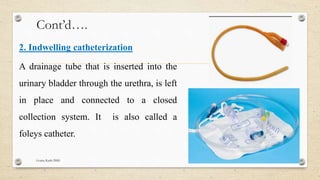
2. Indwelling catheterization
A drainage tube that is inserted into the
urinary bladder through the urethra, is left
in place and connected to a closed
collection system. It is also called a
foleys catheter.
Goma Karki BMS 10
Goma Karki BMS 11
Purposes of indwelling catheterization
To facilitate urinary elimination in incontinent patients.
To facilitate continuous bladder drainage after surgery/injury
on urinary tract or other major surgeries.
To splint urethra to promote healing after urological surgery
To relieve acute or chronic urinary retention
To prevent urine from contacting an incision after perineal
surgery.
Goma Karki BMS 12
Principles of catheterization
• Pathogenic organism are transmitted from the source to a new host
directly on by contaminated articles.
• Urinary bladder is a sterile cavity and the urinary meatus acts as a portal
of entry for pathogenic organisms
• Cleaning an area minimizes the spread of organism. Do not allow tip of
catheter to touch your hand or labia.
• A break in the integrity of the skin and mucus membrane provides ready
entrance or micro organism.
Goma Karki BMS 13
Cont’d….
• Lubrication reduces friction, never use force while introducing the
catheter.
• Systematic ways of doing saves time, energy and material. Make the
patient relaxed.
• Through knowledge of anatomy and physiology of the genitourinary
system facilitates catheterization of the urinary bladder.
• Use sterile technique during catheterization(because it leads Urinary
tract infection)
• Avoid catheterization unless ordered or need.
Goma Karki BMS 14
Cont’d….
• Catheter should be selected according to the age of the patient:
Children: 8-10Fr. women: 14-16Fr.
Male: 16-18Fr.
• Change the adhesive tape daily at different part of thigh
• Put(hang) urobag under the bed to prevent infection.
• Never elevate the urobag above the waist level to prevent infection.
Goma Karki BMS 15
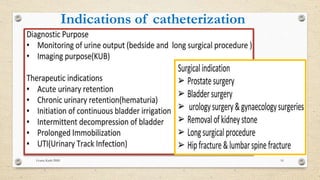
Indications of catheterization
Goma Karki BMS 16
Articles required for catheterization
A sterile tray with
-sterile gloves
-sterile drape
-small bowl
-cotton swabs
-catheter as ordered(type, size)
Goma Karki BMS 17
-kidney tray
-artery forceps
-dissecting forceps
-sterile syringe 10 or 20 ml
Cont’d….
Screen
A clean tray containing
- Disposable gloves
- mackintosh/rubber sheet
- Kidney tray
- Antiseptic solution
- Distilled water(incase of retention catheter)
- Urobag or collection bag(in case of retention catheter)
Goma Karki BMS 18
-Adhesive tape and scissors(in case of
retention catheter)
-Specimen container if required
-Water soluble lubricant(xylocaine jelly)
-Flash light or spot light
Catheterization procedure in female
• Check the order, patient’s identification and condition
• Explain procedure to patient emphasizing how he/she has to
cooperate.
• Maintain privacy
• Wash hands with soap and water
• Prepare all required equipment
• Raise bed to appropriate working level stand on right side of the
patient and shift patient closure to you
• Position patient, dorsal recumbent with knees flexed, and thighs
externally rotated.
Goma Karki BMS 19
Goma Karki BMS 20
Cont’d….
• Drape the patient in the dorsal recumbent position with draw sheet or bath
blanket.
• Place the mackintosh and draw sheet under the hip and put kidney tray in
convenient area.
• Open the catheter tray
• Wash and dry hands, wear sterile gloves
• Keep a sterile towel ready and place the perineal sheet over genital area.
Place the kidney tray to receive sterile urine specimen and sterile bottle
within reach.
• Separate labia majora with two fingers(thumb and index) of the left hand.
Goma Karki BMS 21
Cont’d….
• Using sponge forceps, take a cotton balls in the right hand
and swab the area right of the meatus, with downward stroke
once and discard it in the bin. Take another cotton ball, clean
the area left of the meatus, take the third and fourth balls and
clean directly over the meatus from top to bottom, use more
cotton balls if necessary.
• With gauze in the right hand, grasp the catheter, with 9-10
cm from the tip pinching after the outlet. Moisten the tip
with sterile glycerine or paraffin oil or water carefully, so as
not to contaminate the tip.
Goma Karki BMS 22
Cont’d….
• Insert 4-5 cm of the catheter gently into the meatus until urine
flows freely. When urine starts to flow, hold the catheter in
place with the left hand to prevent the catheter from slipping
out.
Goma Karki BMS 23
Cont’d….
• If sterile specimen is ordered, lower the
distal end of the catheter into a kidney
tray. Discard first few ml of urine, and
then collect urine into the specimen bottle.
• Collect 120-18- ml or as required. Then
direct the flow into the kidney tray.
• When urine ceases to flow, pinch the
catheter well and withdraw it gently.
Goma Karki BMS 24
Goma Karki BMS 25
• If continual drainage is
needed, attach a urinary bag
to the distal end and fix the
catheter in place.
• Push 10-15 ml distilled
water in another tip of the
catheter for fixing.
• Pull catheter outward lightly
to ascertain stability.
Cont’d….
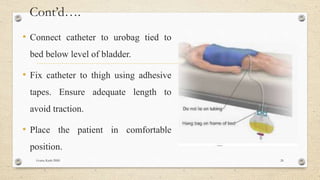
• Connect catheter to urobag tied to
bed below level of bladder.
• Fix catheter to thigh using adhesive
tapes. Ensure adequate length to
avoid traction.
• Place the patient in comfortable
position.
Goma Karki BMS 26
Cont’d….
• Collect all equipments
• Measure urine before discarding it, note color, odor, sediment etc.
• In utility room, clean equipments first with soap and water, dry and
return it to the central supply for re-sterilization.
• Record and report the following things about the procedure:
-Date and time -type of catheter used
-Amount of urine drained -Any abnormality -Signature
• Report the senior staff
Goma Karki BMS 27
Goma Karki BMS 28
Catheterization in a male patient
Goma Karki BMS 29
Explain the procedure to the
patient.
Bring the required equipment near
to the bed side.
Position the patient in supine
position.
Cover the patient’s chest with a
bath blanket.
Place the mackintosh under the
buttock and thigh.
Cont’d….
Wash hands, dry and open sterile set with aseptic technique.
Put on sterile gloves
Lubricate the catheter well about 1 inch
Retract the fore skin of the penis so that the meatus in exposed,
clean the area with antiseptic solution using forceps to hold
cleansing sponges, use one swab for each wipe.
In order to straighten the urethra, lift the penis to an angle of
about 60 degree.
Goma Karki BMS 30
Cont’d….
Insert the catheter gently for about 18 cm or until begins to flow. The
size of the catheter and length of insertion determined by individual
patient separately.
Goma Karki BMS 31
Cont’d….
If the passage seems to be obstructed, remove the catheter and
report this to the doctor, do not force. Never use metal catheter.
When urine begins to flow, advance the catheter another 1inch.
Allow the bladder empty completely as instructed.
Reposition the foreskin.
Remove the catheter slowly and gently(if it is foleys catheter,
deflate the balloon before removing).
Goma Karki BMS 32
Cont’d….
Clean and dry the patient and
leave him comfortable.
Replace the equipment in proper
place after decontamination and
cleansing.
Record and report in the patient’s
chart.
Goma Karki BMS 33
Care of patient with foleys(indwelling)
catheter
Catheter care
It is cleansing the urethral meatus,
the skin surrounding the catheter
insertion site and perineum for
patients with retention catheter
who are bed ridden.
Goma Karki BMS 34
Cont’d….
Articles:
Catheter care sate
Clean tray containing:
-warm water and soap -kidney tray
-antiseptic solution -mackintosh and draw sheets
-Normal saline -adhesive tape and scissor
-sterile gloves -prescribed medicine
Screen
Waste bin
Goma Karki BMS 35
procedure
Check order or need of catheter care
Explain procedure to patient, offer opportunity for self care if
possible.
Prepare necessary equipment and supplies and bring near to the
patient
Provide privacy
Wash hands
Position patient:
Female: dorsal recumbent position with leg flexed
Male : supine position
Goma Karki BMS 36
Cont’d….
Place mackintosh and draw sheet under patient
Drape sheet over patient exposing only perineal area.
Don clean gloves
Remove anchor tapes to free catheter tubing.
Expose the urethral meatus( with non dominant hand)
Female: gently retract labia to fully expose urethral meatus and catheter
insertion site. Maintain position of hand throughout procedure.
Male: retract foreskin if patient is not circumcised and hold penis at shaft
just below glans, maintain position of hand throughout procedure.
Goma Karki BMS 37
Cont’d….
Assess urethral meatus and surrounding tissue for
inflammation, swelling and discharge. Note amount, color,
odor and consistency of discharge. Ask patient if burning or
discomfort is felt.
Cleanse perineal tissue:
female: use clean cloth, soap and water and clean towards
anus. Cleanse catheter first and then meatus, labia minora and
majora. Be sure cleansing each side and dry area well.
Male: cleanse catheter first and then clean from urethral
meatus till glans penis is in circular motion.
Goma Karki BMS 38
Cont’d….
Reassess urethral meatus for any discharge.
Remove clean gloves and wash hands
Open sterile catheter set with aseptic technique
Don sterile gloves
Clean the perineal area with disinfectant:
female: retract labia and wipe using sterile cotton swabs dipped in
antiseptic solution from center to periphery in straight strokes from front
to back, using one cotton ball for each stroke.
Male: retract foreskin and wipe using swabs from center to periphery in
circular motion.
Goma Karki BMS 39
Cont’d….
Clean the perineal area using cotton swabs soaked in sterile
water/ normal saline.
Goma Karki BMS 40
Cont’d….
Goma Karki BMS 41
Apply antiseptic: ointment at urethral meatus and along 2.5 cm
of catheter.
Anchor catheter
Cont’d….
Place patient in safe and comfortable. Position.
Remove gloves, dispose of contaminated supplies and wash
hands.
Record and report condition of perineal tissue, the time of
procedure was performed, patient’s response and abnormalities
noted.
Goma Karki BMS 42
Contraindications of catheterization
• Traumatic urethral injury - High riding prostate
• History of urethral stricture - known bladder tumor
• Resistance to passage - infection at insertion site
• Perineal hematoma -Allergy to latex
• Blood at meatus
Goma Karki BMS 43
Complications
Goma Karki BMS 44
Goma Karki BMS 45
Goma Karki BMS 46
Goma Karki BMS 47

Urinary Catheterization(Definition, indication, types, procedure).pptx

  • 1.
  • 2.
    Catheterization Catheterization is aprocess of drawing urine from the bladder by means of an instrument called a catheter. It is inserted through the urethra under aseptic precaution. Or, Introducing a catheter into the urinary bladder through urethra using aseptic technique for the purpose of emptying the bladder. Catheters: it is a tubular instruments that are made of rubber, plastic, metal and glass. Goma Karki BMS 2
  • 3.
    purposes To relief acuteor chronic retention of urine To keep emptying the bladder in case of surgery To obtain a clear specimen for diagnostic purpose To determine amount of residual urine after voiding To continue drain of urine in urinary incontinence To measure the urinary output accurately in severe ill and needed patients. Goma Karki BMS 3
  • 4.
    Cont’d…. To empty thebladder before irrigation of bladder To keep the patient clean and avoid over distension to prevent further damage to the paralyzed muscle of the urinary bladder. To prevent urine from passing over a wound e.g. After repair of the perineum To provide for intermittent or continuous bladder drainage and irrigation. Goma Karki BMS 4
  • 5.
  • 6.
    Cont’d…. Condom catheter Applying athin condom sheath to penis for drainage of urine without inserting a catheter into urethra. It is used in a incontinence men who still have complete and spontaneous bladder emptying. Goma Karki BMS 6
  • 7.
    Cont’d…. Purpose -To drain urineincase of an incontinent patient. -to permit patient’s normal physical activity without fear of embarrassment caused by incontinence. Goma Karki BMS 7
  • 8.
    Types of catheterization 1.Intermittent catheterization 2. Indwelling catheterization 1. Intermittent catheterization Intermittent catheterization means removing urine from the bladder by placing a tube into the bladder. This is done when a child or adult is unable to empty her bladder on her own, when a child's bladder leaks urine, or when very high pressures have developed in the bladder. Goma Karki BMS 8
  • 9.
    Purposes of intermittentcatheterization  To relieve bladder distension  To assess for residual volume after voiding  To obtain a sterile specimen  To empty bladder prior to delivery or abdominal surgery Goma Karki BMS 9
  • 10.
    Cont’d…. 2. Indwelling catheterization Adrainage tube that is inserted into the urinary bladder through the urethra, is left in place and connected to a closed collection system. It is also called a foleys catheter. Goma Karki BMS 10
  • 11.
  • 12.
    Purposes of indwellingcatheterization To facilitate urinary elimination in incontinent patients. To facilitate continuous bladder drainage after surgery/injury on urinary tract or other major surgeries. To splint urethra to promote healing after urological surgery To relieve acute or chronic urinary retention To prevent urine from contacting an incision after perineal surgery. Goma Karki BMS 12
  • 13.
    Principles of catheterization •Pathogenic organism are transmitted from the source to a new host directly on by contaminated articles. • Urinary bladder is a sterile cavity and the urinary meatus acts as a portal of entry for pathogenic organisms • Cleaning an area minimizes the spread of organism. Do not allow tip of catheter to touch your hand or labia. • A break in the integrity of the skin and mucus membrane provides ready entrance or micro organism. Goma Karki BMS 13
  • 14.
    Cont’d…. • Lubrication reducesfriction, never use force while introducing the catheter. • Systematic ways of doing saves time, energy and material. Make the patient relaxed. • Through knowledge of anatomy and physiology of the genitourinary system facilitates catheterization of the urinary bladder. • Use sterile technique during catheterization(because it leads Urinary tract infection) • Avoid catheterization unless ordered or need. Goma Karki BMS 14
  • 15.
    Cont’d…. • Catheter shouldbe selected according to the age of the patient: Children: 8-10Fr. women: 14-16Fr. Male: 16-18Fr. • Change the adhesive tape daily at different part of thigh • Put(hang) urobag under the bed to prevent infection. • Never elevate the urobag above the waist level to prevent infection. Goma Karki BMS 15
  • 16.
  • 17.
    Articles required forcatheterization A sterile tray with -sterile gloves -sterile drape -small bowl -cotton swabs -catheter as ordered(type, size) Goma Karki BMS 17 -kidney tray -artery forceps -dissecting forceps -sterile syringe 10 or 20 ml
  • 18.
    Cont’d…. Screen A clean traycontaining - Disposable gloves - mackintosh/rubber sheet - Kidney tray - Antiseptic solution - Distilled water(incase of retention catheter) - Urobag or collection bag(in case of retention catheter) Goma Karki BMS 18 -Adhesive tape and scissors(in case of retention catheter) -Specimen container if required -Water soluble lubricant(xylocaine jelly) -Flash light or spot light
  • 19.
    Catheterization procedure infemale • Check the order, patient’s identification and condition • Explain procedure to patient emphasizing how he/she has to cooperate. • Maintain privacy • Wash hands with soap and water • Prepare all required equipment • Raise bed to appropriate working level stand on right side of the patient and shift patient closure to you • Position patient, dorsal recumbent with knees flexed, and thighs externally rotated. Goma Karki BMS 19
  • 20.
  • 21.
    Cont’d…. • Drape thepatient in the dorsal recumbent position with draw sheet or bath blanket. • Place the mackintosh and draw sheet under the hip and put kidney tray in convenient area. • Open the catheter tray • Wash and dry hands, wear sterile gloves • Keep a sterile towel ready and place the perineal sheet over genital area. Place the kidney tray to receive sterile urine specimen and sterile bottle within reach. • Separate labia majora with two fingers(thumb and index) of the left hand. Goma Karki BMS 21
  • 22.
    Cont’d…. • Using spongeforceps, take a cotton balls in the right hand and swab the area right of the meatus, with downward stroke once and discard it in the bin. Take another cotton ball, clean the area left of the meatus, take the third and fourth balls and clean directly over the meatus from top to bottom, use more cotton balls if necessary. • With gauze in the right hand, grasp the catheter, with 9-10 cm from the tip pinching after the outlet. Moisten the tip with sterile glycerine or paraffin oil or water carefully, so as not to contaminate the tip. Goma Karki BMS 22
  • 23.
    Cont’d…. • Insert 4-5cm of the catheter gently into the meatus until urine flows freely. When urine starts to flow, hold the catheter in place with the left hand to prevent the catheter from slipping out. Goma Karki BMS 23
  • 24.
    Cont’d…. • If sterilespecimen is ordered, lower the distal end of the catheter into a kidney tray. Discard first few ml of urine, and then collect urine into the specimen bottle. • Collect 120-18- ml or as required. Then direct the flow into the kidney tray. • When urine ceases to flow, pinch the catheter well and withdraw it gently. Goma Karki BMS 24
  • 25.
    Goma Karki BMS25 • If continual drainage is needed, attach a urinary bag to the distal end and fix the catheter in place. • Push 10-15 ml distilled water in another tip of the catheter for fixing. • Pull catheter outward lightly to ascertain stability.
  • 26.
    Cont’d…. • Connect catheterto urobag tied to bed below level of bladder. • Fix catheter to thigh using adhesive tapes. Ensure adequate length to avoid traction. • Place the patient in comfortable position. Goma Karki BMS 26
  • 27.
    Cont’d…. • Collect allequipments • Measure urine before discarding it, note color, odor, sediment etc. • In utility room, clean equipments first with soap and water, dry and return it to the central supply for re-sterilization. • Record and report the following things about the procedure: -Date and time -type of catheter used -Amount of urine drained -Any abnormality -Signature • Report the senior staff Goma Karki BMS 27
  • 28.
  • 29.
    Catheterization in amale patient Goma Karki BMS 29 Explain the procedure to the patient. Bring the required equipment near to the bed side. Position the patient in supine position. Cover the patient’s chest with a bath blanket. Place the mackintosh under the buttock and thigh.
  • 30.
    Cont’d…. Wash hands, dryand open sterile set with aseptic technique. Put on sterile gloves Lubricate the catheter well about 1 inch Retract the fore skin of the penis so that the meatus in exposed, clean the area with antiseptic solution using forceps to hold cleansing sponges, use one swab for each wipe. In order to straighten the urethra, lift the penis to an angle of about 60 degree. Goma Karki BMS 30
  • 31.
    Cont’d…. Insert the cathetergently for about 18 cm or until begins to flow. The size of the catheter and length of insertion determined by individual patient separately. Goma Karki BMS 31
  • 32.
    Cont’d…. If the passageseems to be obstructed, remove the catheter and report this to the doctor, do not force. Never use metal catheter. When urine begins to flow, advance the catheter another 1inch. Allow the bladder empty completely as instructed. Reposition the foreskin. Remove the catheter slowly and gently(if it is foleys catheter, deflate the balloon before removing). Goma Karki BMS 32
  • 33.
    Cont’d…. Clean and drythe patient and leave him comfortable. Replace the equipment in proper place after decontamination and cleansing. Record and report in the patient’s chart. Goma Karki BMS 33
  • 34.
    Care of patientwith foleys(indwelling) catheter Catheter care It is cleansing the urethral meatus, the skin surrounding the catheter insertion site and perineum for patients with retention catheter who are bed ridden. Goma Karki BMS 34
  • 35.
    Cont’d…. Articles: Catheter care sate Cleantray containing: -warm water and soap -kidney tray -antiseptic solution -mackintosh and draw sheets -Normal saline -adhesive tape and scissor -sterile gloves -prescribed medicine Screen Waste bin Goma Karki BMS 35
  • 36.
    procedure Check order orneed of catheter care Explain procedure to patient, offer opportunity for self care if possible. Prepare necessary equipment and supplies and bring near to the patient Provide privacy Wash hands Position patient: Female: dorsal recumbent position with leg flexed Male : supine position Goma Karki BMS 36
  • 37.
    Cont’d…. Place mackintosh anddraw sheet under patient Drape sheet over patient exposing only perineal area. Don clean gloves Remove anchor tapes to free catheter tubing. Expose the urethral meatus( with non dominant hand) Female: gently retract labia to fully expose urethral meatus and catheter insertion site. Maintain position of hand throughout procedure. Male: retract foreskin if patient is not circumcised and hold penis at shaft just below glans, maintain position of hand throughout procedure. Goma Karki BMS 37
  • 38.
    Cont’d…. Assess urethral meatusand surrounding tissue for inflammation, swelling and discharge. Note amount, color, odor and consistency of discharge. Ask patient if burning or discomfort is felt. Cleanse perineal tissue: female: use clean cloth, soap and water and clean towards anus. Cleanse catheter first and then meatus, labia minora and majora. Be sure cleansing each side and dry area well. Male: cleanse catheter first and then clean from urethral meatus till glans penis is in circular motion. Goma Karki BMS 38
  • 39.
    Cont’d…. Reassess urethral meatusfor any discharge. Remove clean gloves and wash hands Open sterile catheter set with aseptic technique Don sterile gloves Clean the perineal area with disinfectant: female: retract labia and wipe using sterile cotton swabs dipped in antiseptic solution from center to periphery in straight strokes from front to back, using one cotton ball for each stroke. Male: retract foreskin and wipe using swabs from center to periphery in circular motion. Goma Karki BMS 39
  • 40.
    Cont’d…. Clean the perinealarea using cotton swabs soaked in sterile water/ normal saline. Goma Karki BMS 40
  • 41.
    Cont’d…. Goma Karki BMS41 Apply antiseptic: ointment at urethral meatus and along 2.5 cm of catheter. Anchor catheter
  • 42.
    Cont’d…. Place patient insafe and comfortable. Position. Remove gloves, dispose of contaminated supplies and wash hands. Record and report condition of perineal tissue, the time of procedure was performed, patient’s response and abnormalities noted. Goma Karki BMS 42
  • 43.
    Contraindications of catheterization •Traumatic urethral injury - High riding prostate • History of urethral stricture - known bladder tumor • Resistance to passage - infection at insertion site • Perineal hematoma -Allergy to latex • Blood at meatus Goma Karki BMS 43
  • 44.
  • 45.
  • 46.
  • 47.