A land cover map of Africa at 100m using a mosaic of ALOS PALSAR  dual-polarization data   - Preliminary developments - Alexandre Bouvet, Gianfranco De Grandi European Commission DG Joint Research Centre 21027, Ispra (VA), Italy e-mail:  [email_address]
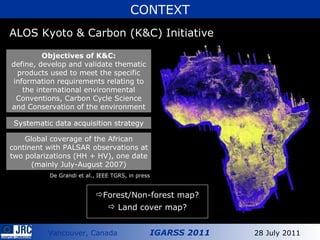
ALOS Kyoto & Carbon (K&C) Initiative CONTEXT Global coverage of the African continent with PALSAR observations at two polarizations (HH + HV), one date (mainly July-August 2007) Objectives of K&C: define, develop and validate thematic products used to meet the specific information requirements relating to the  international environmental Conventions, Carbon Cycle Science and Conservation of the environment Systematic data acquisition strategy Forest/Non-forest map? Land cover map? De Grandi et al., IEEE TGRS, in press
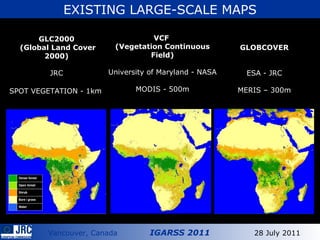
VCF  (Vegetation Continuous Field) University of Maryland - NASA MODIS - 500m GLC2000 (Global Land Cover 2000) JRC SPOT VEGETATION - 1km   GLOBCOVER ESA - JRC MERIS – 300m EXISTING LARGE-SCALE MAPS
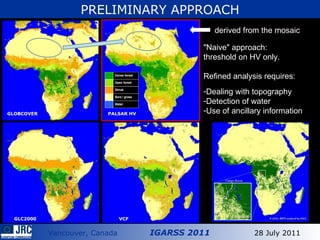
VCF GLC2000 GLOBCOVER PALSAR HV derived from the mosaic "Naive" approach:  threshold on HV only. Refined analysis requires: Dealing with topography Detection of water Use of ancillary information PRELIMINARY APPROACH
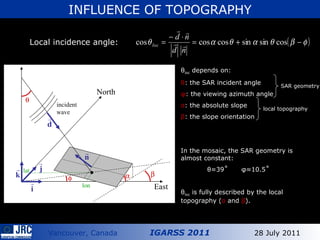
East North incident wave     lon lat INFLUENCE OF TOPOGRAPHY Local incidence angle: θ loc  depends on: θ : the SAR incident angle φ : the viewing azimuth angle α : the absolute slope β : the slope orientation In the mosaic, the SAR geometry is almost constant: θ≈ 39˚  φ≈ 10.5˚  θ loc  is fully described by the local topography ( α  and  β ). SAR geometry local topography
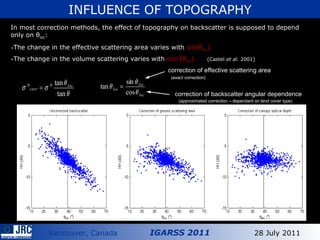
correction of effective scattering area  correction of backscatter angular dependence  (exact correction) (approximated correction – dependant on land cover type) INFLUENCE OF TOPOGRAPHY In most correction methods, the effect of topography on backscatter is supposed to depend only on  θ loc : The change in the effective scattering area varies with  sin( θ loc ) The change in the volume scattering varies with  cos n ( θ loc )   (Castel  et al.  2001)
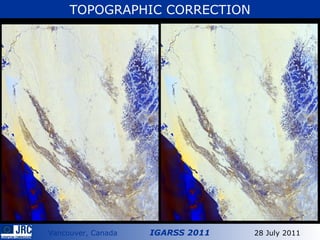
Detail Not corrected TOPOGRAPHIC CORRECTION
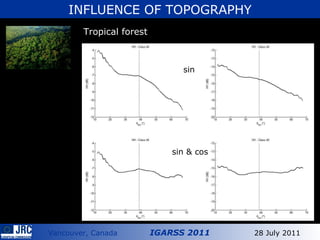
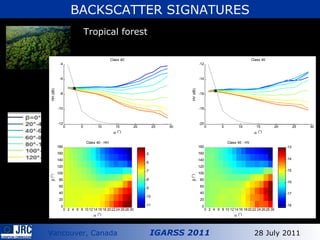
INFLUENCE OF TOPOGRAPHY Tropical forest sin sin & cos
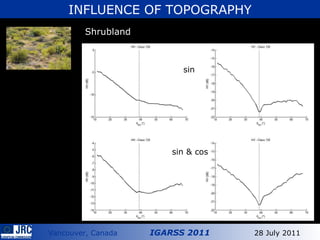
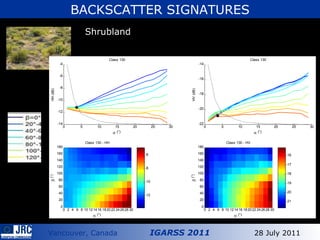
INFLUENCE OF TOPOGRAPHY Shrubland sin sin & cos
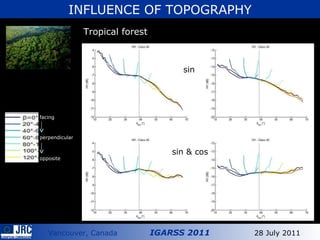
INFLUENCE OF TOPOGRAPHY Tropical forest facing perpendicular opposite sin sin & cos
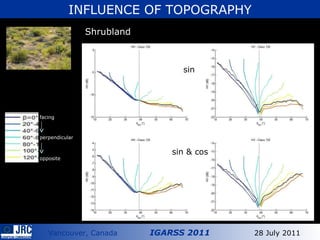
INFLUENCE OF TOPOGRAPHY Shrubland facing perpendicular opposite sin sin & cos
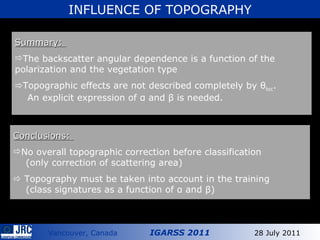
INFLUENCE OF TOPOGRAPHY Summary:  The backscatter angular dependence is a function of the polarization and the vegetation type Topographic effects are not described completely by  θ loc .  An explicit expression of  α  and  β  is needed. Conclusions:  No overall topographic correction before classification (only correction of scattering area)    Topography must be taken into account in the training (class signatures as a function of  α  and  β )
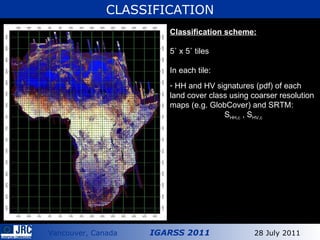
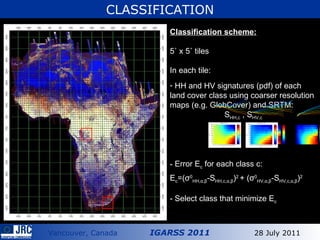
S01 E09 (Gabon) 1990 2000 Classification scheme: 5 ˚ x 5˚ tiles In each tile: HH and HV signatures (pdf) of each land cover class using coarser resolution maps (e.g. GlobCover) and SRTM:  S HH,c  ,  S HV,c CLASSIFICATION
BACKSCATTER SIGNATURES Tropical forest
BACKSCATTER SIGNATURES Shrubland
S01 E09 (Gabon) 1990 2000 Classification scheme: 5 ˚ x 5˚ tiles In each tile: HH and HV signatures (pdf) of each land cover class using coarser resolution maps (e.g. GlobCover) and SRTM:  S HH,c  ,  S HV,c Error E c  for each class c: E c =( σ 0 HH, α , β -S HH,c, α , β ) 2  +  ( σ 0 HV, α , β -S HV,c, α , β ) 2 - Select class that minimize E c   CLASSIFICATION
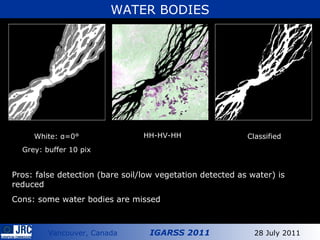
WATER BODIES HH-HV-HH White:  α =0° Grey: buffer 10 pix Classified Pros: false detection (bare soil/low vegetation detected as water) is reduced Cons: some water bodies are missed
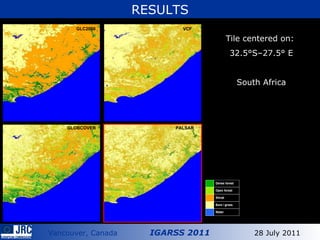
VCF GLC Tile centered on:  32.5°S–27.5° E South Africa RESULTS VCF GLC2000 GLOBCOVER PALSAR
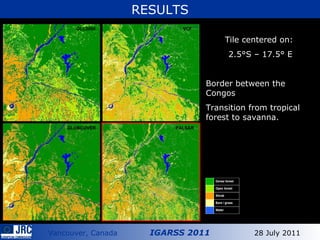
Tile centered on: 2.5°S – 17.5° E Border between the Congos Transition from tropical forest to savanna. VCF GLC GlobCover VCF GLC2000 GLOBCOVER PALSAR RESULTS
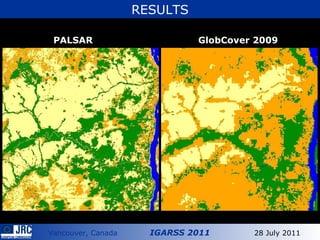
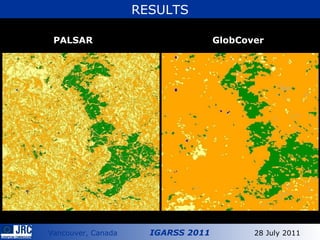
PALSAR GlobCover 2009 Central African tile Subset 1 RESULTS
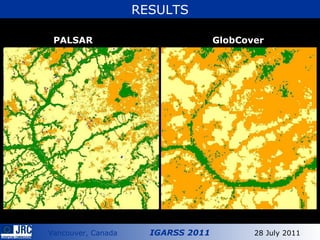
Central African tile Subset 2 RESULTS PALSAR GlobCover
PALSAR GlobCover South African tile Subset 1 RESULTS PALSAR GlobCover
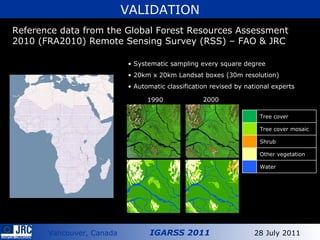
Reference data from the Global Forest Resources Assessment 2010 (FRA2010) Remote Sensing Survey (RSS) – FAO & JRC Systematic sampling every square degree 20km x 20km Landsat boxes (30m resolution ) Automatic classification revised by national experts 1990 2000 VALIDATION Tree cover Tree cover mosaic Shrub Other vegetation Water
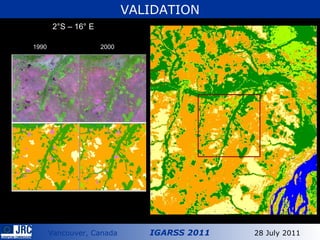
2°S – 16° E 1990 2000 VALIDATION
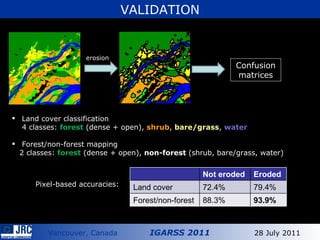
VALIDATION erosion Confusion matrices Land cover classification 4 classes:  forest  (dense + open),  shrub ,  bare/grass ,  water Forest/non-forest mapping 2 classes:  forest  (dense + open),  non-forest  (shrub, bare/grass, water) Pixel-based accuracies: Not eroded Eroded Land cover 72.4% 79.4% Forest/non-forest 88.3% 93.9%
Conclusion:  Parts of the mosaic have been transformed into land cover and forest/non-forest maps, using topographic descriptors derived from the SRTM DEM, and training from GlobCover  The produced maps are validated with a good accuracy Perspectives:  Map the whole mosaic and check accuracy Other years using archive data: 2007 to 2010 Not only in Africa (downscale the 25m global mosaics to 100m to use SRTM) From qualitative (land cover classes) to quantitative estimates of vegetation (biomass) CONCLUSION & PERSPECTIVES

Bouvet_IGARSS2011.ppt

  • 1.
    A land covermap of Africa at 100m using a mosaic of ALOS PALSAR dual-polarization data - Preliminary developments - Alexandre Bouvet, Gianfranco De Grandi European Commission DG Joint Research Centre 21027, Ispra (VA), Italy e-mail: [email_address]
  • 2.
    ALOS Kyoto &Carbon (K&C) Initiative CONTEXT Global coverage of the African continent with PALSAR observations at two polarizations (HH + HV), one date (mainly July-August 2007) Objectives of K&C: define, develop and validate thematic products used to meet the specific information requirements relating to the international environmental Conventions, Carbon Cycle Science and Conservation of the environment Systematic data acquisition strategy Forest/Non-forest map? Land cover map? De Grandi et al., IEEE TGRS, in press
  • 3.
    VCF (VegetationContinuous Field) University of Maryland - NASA MODIS - 500m GLC2000 (Global Land Cover 2000) JRC SPOT VEGETATION - 1km GLOBCOVER ESA - JRC MERIS – 300m EXISTING LARGE-SCALE MAPS
  • 4.
    VCF GLC2000 GLOBCOVERPALSAR HV derived from the mosaic "Naive" approach: threshold on HV only. Refined analysis requires: Dealing with topography Detection of water Use of ancillary information PRELIMINARY APPROACH
  • 5.
    East North incidentwave     lon lat INFLUENCE OF TOPOGRAPHY Local incidence angle: θ loc depends on: θ : the SAR incident angle φ : the viewing azimuth angle α : the absolute slope β : the slope orientation In the mosaic, the SAR geometry is almost constant: θ≈ 39˚ φ≈ 10.5˚ θ loc is fully described by the local topography ( α and β ). SAR geometry local topography
  • 6.
    correction of effectivescattering area correction of backscatter angular dependence (exact correction) (approximated correction – dependant on land cover type) INFLUENCE OF TOPOGRAPHY In most correction methods, the effect of topography on backscatter is supposed to depend only on θ loc : The change in the effective scattering area varies with sin( θ loc ) The change in the volume scattering varies with cos n ( θ loc ) (Castel et al. 2001)
  • 7.
    Detail Not correctedTOPOGRAPHIC CORRECTION
  • 8.
    INFLUENCE OF TOPOGRAPHYTropical forest sin sin & cos
  • 9.
    INFLUENCE OF TOPOGRAPHYShrubland sin sin & cos
  • 10.
    INFLUENCE OF TOPOGRAPHYTropical forest facing perpendicular opposite sin sin & cos
  • 11.
    INFLUENCE OF TOPOGRAPHYShrubland facing perpendicular opposite sin sin & cos
  • 12.
    INFLUENCE OF TOPOGRAPHYSummary: The backscatter angular dependence is a function of the polarization and the vegetation type Topographic effects are not described completely by θ loc . An explicit expression of α and β is needed. Conclusions: No overall topographic correction before classification (only correction of scattering area)  Topography must be taken into account in the training (class signatures as a function of α and β )
  • 13.
    S01 E09 (Gabon)1990 2000 Classification scheme: 5 ˚ x 5˚ tiles In each tile: HH and HV signatures (pdf) of each land cover class using coarser resolution maps (e.g. GlobCover) and SRTM: S HH,c , S HV,c CLASSIFICATION
  • 14.
  • 15.
  • 16.
    S01 E09 (Gabon)1990 2000 Classification scheme: 5 ˚ x 5˚ tiles In each tile: HH and HV signatures (pdf) of each land cover class using coarser resolution maps (e.g. GlobCover) and SRTM: S HH,c , S HV,c Error E c for each class c: E c =( σ 0 HH, α , β -S HH,c, α , β ) 2 + ( σ 0 HV, α , β -S HV,c, α , β ) 2 - Select class that minimize E c CLASSIFICATION
  • 17.
    WATER BODIES HH-HV-HHWhite: α =0° Grey: buffer 10 pix Classified Pros: false detection (bare soil/low vegetation detected as water) is reduced Cons: some water bodies are missed
  • 18.
    VCF GLC Tilecentered on: 32.5°S–27.5° E South Africa RESULTS VCF GLC2000 GLOBCOVER PALSAR
  • 19.
    Tile centered on:2.5°S – 17.5° E Border between the Congos Transition from tropical forest to savanna. VCF GLC GlobCover VCF GLC2000 GLOBCOVER PALSAR RESULTS
  • 20.
    PALSAR GlobCover 2009Central African tile Subset 1 RESULTS
  • 21.
    Central African tileSubset 2 RESULTS PALSAR GlobCover
  • 22.
    PALSAR GlobCover SouthAfrican tile Subset 1 RESULTS PALSAR GlobCover
  • 23.
    Reference data fromthe Global Forest Resources Assessment 2010 (FRA2010) Remote Sensing Survey (RSS) – FAO & JRC Systematic sampling every square degree 20km x 20km Landsat boxes (30m resolution ) Automatic classification revised by national experts 1990 2000 VALIDATION Tree cover Tree cover mosaic Shrub Other vegetation Water
  • 24.
    2°S – 16°E 1990 2000 VALIDATION
  • 25.
    VALIDATION erosion Confusionmatrices Land cover classification 4 classes: forest (dense + open), shrub , bare/grass , water Forest/non-forest mapping 2 classes: forest (dense + open), non-forest (shrub, bare/grass, water) Pixel-based accuracies: Not eroded Eroded Land cover 72.4% 79.4% Forest/non-forest 88.3% 93.9%
  • 26.
    Conclusion: Partsof the mosaic have been transformed into land cover and forest/non-forest maps, using topographic descriptors derived from the SRTM DEM, and training from GlobCover The produced maps are validated with a good accuracy Perspectives: Map the whole mosaic and check accuracy Other years using archive data: 2007 to 2010 Not only in Africa (downscale the 25m global mosaics to 100m to use SRTM) From qualitative (land cover classes) to quantitative estimates of vegetation (biomass) CONCLUSION & PERSPECTIVES