Project co-funded by European Union funds (ERDF, IPA)
Cluster Mapping Synthesis Report
Phytopharmaceutical Industry
Cross-clustering partnership for boosting eco-innovation
by developing a joint bio-based value-added network for the Danube Region
interreg-danube.eu/danubiovalnet
twitter.com/danu_bioval
Cluster Mapping Synthesis Report/Phytopharmaceutical Industry 2
Project co-funded by European Union funds (ERDF, IPA)
This report has been produced within the frame of the DanuBioValNet project (Activity
3.2 Cluster Mapping, Deliverable 3.2.1), funded by the Danube Region INTERREG
Programme of the European Commission. It was prepared by Dr. Gerd Meier zu Köcker
(ClusterAgentur BW) and Mateja Dermastia (Anteja ECG – Poly4emi).
This report was drafted with input gathered from all project partners over the second
phase of the project implementation (July – December 2017). The authors would like
to thank all partners for their contributions and significant efforts, especially Benedikt
Sedlmayr (VDI/VDE-IT).
Disclaimer
The information and perspectives set out in this Report are those of the authors and do
not necessarily reflect the official opinion of the European Commission or the project
partners’ regions. Neither the European Commission institutions and bodies nor any
person acting on their behalf may be held responsible for the use that may be made
of the information contained therein. Reproduction is authorised, provided the source
is acknowledged, unless otherwise stated. For use/reproduction of third party material
specified as such, permission must be obtained from the copyright.
For further information about the DanuBioValNet project, you will find a short descrip-
tion at the end of the document. To learn more and to download additional resources
please refer to the project website http://www.interreg-danube.eu/approved-projects/
danubiovalnet.
The information is provided without assuming any legal responsibility for correctness or
completeness. The data presented in the report are based on the information given by
the project partners.
© DanuBioValNet, 2017
Cluster Mapping Synthesis Report/Phytopharmaceutical Industry 3
Project co-funded by European Union funds (ERDF, IPA)
Contents
Introduction........................................................................................................................................................................................4
The Cluster Mapping Approach.............................................................................................................................4
Composition of the Phytopharmaceutical Sector...................................................................... 5
Overview...................................................................................................................................................................................................6
Employment.......................................................................................................................................................................................8
Enterprises.............................................................................................................................................................................................9
Regional Specialisation..................................................................................................................................................... 11
Summary................................................................................................................................................................................................12
The DanuBioValNet Project..........................................................................................................................................12
APPENDIX I......................................................................................................................................................................................... 14
APPENDIX II....................................................................................................................................................................................... 16
Cluster Mapping Synthesis Report/Phytopharmaceutical Industry 4
Project co-funded by European Union funds (ERDF, IPA)
Phytopharmaceuticals are herbal medicines
whose efficacy is down to one or several plant
substances or active ingredients. They have been
used for treating diseases since time immemo-
rial. This traditional knowledge is still the basis for
many medicinal products made from plants or
parts thereof1
.
Globally, herbal medicine has been considered
an important alternative to modern allopathic
medicine. Although the herbal medicines are very
popular in the society, only few medicinal herbs
have been scientifically evaluated for their poten-
tial in medical treatment. In most countries, the
herbal drugs are poorly regulated and are often
neither registered nor controlled by the health
authorities.
Herbal medicine products include herbs, herbal
materials, herbal preparations, and finished herbal
products that contain parts of plants, other plant
materials, or combinations thereof as active ingre-
dients2
. Herbs include crude plant material, for
example, leaves, flowers, fruit, seed, and stems.
Herbal materials include, in addition to herbs, fresh
juices, gums, fixed oils, essential oils, resins, and
dry powders of herbs. Herbal preparations are the
basis for finished herbal products and may include
comminuted or powdered herbal materials, or
extracts, tinctures, and fatty oils of herbal mate-
rials. Finished herbal products consist of herbal
preparations made from one or more herbs.
Since the end of the 20th century, plant-based
drugs regained popularity due to the often serious
effects of synthetic drug substances. The phar-
maceutical industry and academic institutions
have made considerable contributions to the
progress in medicinal plant research. Even though
plant-based remedies have special legal status in
many countries, they can be considered equal to
synthetic drugs in terms of their quality, safety and
efficacy standards. The special status of botanical
medicines is due to their complex composition
and the resulting challenges for analytical meth-
odologies and activities tests3
.
In Europe, for the marketing approval4
, the herbal
preparations are classified in three categories as
follows:
•	Traditional medicinal use provisions (“traditional
use”) accepted on the basis of sufficient safety
data and plausible efficacy
•	Well-established medicinal use provisions (“well-
established use”) demonstrated with the provi-
sion of scientific literature establishing that the
active substances of the medicinal products have
been in well-established medicinal use within
the European Union for at least 10 years, with
recognized efficacy and an acceptable level of
safety a product can be classified under
•	Safety and efficacy data from the company's own
development (“stand alone”) or a combination of
own studies and bibliographic data
The DanuBioValNet project is aiming at estab-
lishing bio-based industry networks across the
Danube Region. A better understanding of the
phytopharmaceutical cluster landscape is essen-
tial to initiate transnational cooperation of clusters
to foster bioeconomy and eco-innovations and in
order to lead to a strengthening of the regional
economies.
For purposes of the DanuBioValNet5
project, data
collection and cluster mapping of the phytophar-
maceutical industry have been defined as “health-
related products derived from plant sources”.
While some definitions may specify a minimum
number of bioactive phytochemical compounds,
the DanuBioValNet interest is an understanding
of the value-added activities associated with
producing pharmaceutical and cosmeceutical
agents of plant origin. These include bio-active
ingredients for pharmaceutical grade medicines,
natural herbal medicines, cosmetics, cosmeceuti-
cals, nutraceuticals, nutritional supplements and
similar health-related natural products. It is under-
stood that varying degrees of regulatory compli-
ance applies in accordance with the nature of the
phytochemical compounds, their applications,
safety profile and health claims.
INTRODUCTION
1) “Phytopharmaceuticals – fighting disease with natural substances”, https://www.gesundheitsindustrie-bw.de/en/article/
dossier/phytopharmaceuticals-fighting-disease-with-natural-substances/.
2) World Health Organization General Guidelines for Methodologies on Research and Evaluation of Traditional Medicine.
2000. http://www.whqlibdoc.who.int/hq/2000/WHO_EDM_TRM_2000.1.pdf.
3) Wichtl, Max (ed.), 2004, Herbal Drug and Phytopharmaceuticals – a Handbook for Practice on a Scientific Basis,
Medpharm Scientific Publishers, Stuttgart.
4) European Medicines Agency Herbal Medicinal Products, http://www.ema.europa.eu/ema/index.jsp?curl=pages/regula-
tion/general/general_content_000208.jsp#.
5) http://www.interreg-danube.eu/approved-projects/danubiovalnet
Cluster Mapping Synthesis Report/Phytopharmaceutical Industry 5
Project co-funded by European Union funds (ERDF, IPA)
6) Christian Ketels (2017), Cluster Mapping as Tool for Development, Havard Business School, http://www.hbs.edu/faculty/Publication%20Files/
Cluster%20Mapping%20as%20a%20Tool%20for%20Development%20_%20report_ISC%20WP%20version%2010-10-17_c46d2cf1-41ed-
43c0-bfd8-932957a4ceda.pdf.
7) Employment is usually the only variable available on plant level, the rest are for the firm as a whole.
8) European Cluster Observatory, 2016.
9) The analysis covers all EU-28 countries (comprising 276 NUTS-2 regions) as well as Albania, Bosnia and Herzegovina, Iceland, FYROM,
Kosovo (regarding the political status of which no claims are implied), Montenegro, Norway, Serbia, and Switzerland, by applying the NUTS
(Nomenclature of Territorial Units for Statistics) standard for the subdivisions of countries for statistical purposes.
The Cluster Mapping Approach
Clusters can be understood as regional concentra-
tions of economic activities in related industries
connected through local linkages and spill-overs,
have long been known to be a feature of market
economy6
. Cluster organisations can help firms
to better engage with other local actors within
their cluster and to organise collective actions to
strengthen the local context. Moreover, they can
reduce the transaction costs for firms, especially
SMEs, in building linkages to firms and collabora-
tion partners in other locations.
Clusters have a distinct geographic dimension,
reflecting the dynamics of local spill-overs. They are
also deeply embedded in a broader geographic
context: they serve markets elsewhere and are
connected to other clusters with complemen-
tary strengths in regional, interregional or global
value chains. This mirrors the role of location for
firms: while local conditions provide the unique
context for building distinct capabilities and stra-
tegic positions, national and international linkages
are critical to access other markets, suppliers, and
collaboration partner.
Cluster mapping describes the process of meas-
uring the presence of cluster actors in a given
region across defined sector-specific value chains.
Cluster mapping, especially in Emerging Industries
like Phytopharmaceutical, is of high relevance to
better understand the key competences of the
cluster actors as well as to review to what extent
the respective value chain is properly covered.
This report provides the first perspective on
Phytopharmaceutical clusters across the Danube
Region. One key novelty is the introduction of
firm-level data to supplement the statistical data
from national and EU statistical offices. This firm-
based data significantly increases the robustness
of the data, especially in countries like Germany
that collect regional data through samples rather
than reporting by all firms. It also enables perfor-
mance of individual firms to be tracked over time,
gaining more granular insights into patterns of
entrepreneurship.
The report is based on a new dataset that is
compiled specifically for analysing detailed
patterns of cluster evolution. The core of the
dataset is the firm- and plant-level data sources
from the Orbis Historical dataset supplied by
Bureau van Dijk (June 2016 release). This dataset
provides detailed data on the economic perfor-
mance of firms. It allows the usage of data of firms’
turnover, wage bill, capital, materials and employ-
ment7
, totalling more than 1 billion data points.
The coverage is very good in most countries in
Europe, and especially for larger limited liability
companies. However significant gaps were still
present.
In this report strong clusters are being determined
by giving a “Cluster Star” for each region being
identified to belong to the top 20 % of European
regions in the following dimensions:
•	Specialisation, measured by the relative size of
regionalemploymentinthePhytopharmaceutical
sector reflected in its location quotient (LQ). This
relative measure indicates how much stronger
a region is in the Phytopharmaceutical sector
than it would be expected, given its overall size,
compared to the average employment size in the
Phytopharmaceutical sector across all regions
•	Absolute size, measured by the number of
employees and establishments. This measure
is based on the observation that the number of
linkages within a cluster is growing exponen-
tially with the number of participants. Only when
economic activity in the Phytopharmaceutical
sector moves beyond a threshold of critical mass
do cluster effects become significant.
•	Productivity, measured by the wages paid in
a Phytopharmaceutical cluster (adjusted for
local cost levels). This measure reflects not only
what is being done in a region, but how well it is
being done, influenced by the strength of cluster
effects. Wages are also influenced by the struc-
ture of labour markets and other factors but are
strongly correlated with productivity.
•	Dynamism, measured by a simple average of
measures on employment growth and the
presence of fast-growing new firms (gazelles).
This measure aims to capture whether a
Phytopharmaceutical cluster continues to benefit
from strong cluster effects in its development or
not. The cluster may be hindered in its growth
because it has already reached a level where
costs or other factors, such as industry-specific
growth trends8
, are greater than the benefits.
The notion of regions is applied in this report by
using data for specific administrative regions,
generally at the so-called NUTS 2 level. For this
report, 252 European regions have been regarded,9
each with its own profile and economic perfor-
mance. These regions are used as a pragmatic
choice because they are likely to encompass the
“economically relevant” regions; there is data avail-
able, and in most cases there is some level of
government that can take action for this specific
region.
Cluster Mapping Synthesis Report/Phytopharmaceutical Industry 6
Project co-funded by European Union funds (ERDF, IPA)
In a next step, all partners and related cluster
managers did a detailed mapping of their phytop-
harmaceutical cluster initiatives and clusters in
their region according to the pre-defined Value
Chain10
. For this purpose the members of the iden-
tified cluster initiatives and clusters were grouped
byprojectpartnersandclustermanagersaccording
to the specific nodes of the Phytopharmaceutical
Value Chain they operate in. In those cases, where
no cluster initiatives existed, key cluster actors
were identified and grouped.
In a third step, the specific NACE industry clas-
sifications11
for all members or cluster actors
were identified as part of the cluster mapping
exercises, that allowed to produce a reliable
picture Phytopharmaceutical industry. The
Phytopharmaceutical industry composition
illustrated in Figure 2 is based on the inten-
sive work of the project partners and related
cluster managers and is based on more than 300
companies and their related NACE classifications
identified. The size of the different boxes (NACE
classifications) is proportional to number of enter-
prises. As Figure 2 illustrates the biggest share
of enterprises (about 18 %) operate in the sector
“Manufacturing of basic pharmaceutical products”
(NACE Code C21.10). 6 % of the enterprises deal
with “Growing of spices, aromatic, drug and phar-
maceutical crops” (NACE Code A1.28).
It has to be mentioned that the current NACE
Code classification cannot sufficiently distin-
guish between the Phytopharmaceutical and the
Pharmaceutical sector. Thus, some overlapping
between both sectors is likely to exist.
Figure 1: Value Chain for Phytopharmaceutical Sector (source: DanuBioValNet)
Figure 2: Phytopharmaceutical industry composition based on NACE industry classification 2008
	 (source: DanuBioValNet)
10) Further details of the individucal cluster mapping exercises are given in the regional cluster mapping fact sheets avail-
able on the DabuBioValNet website (interreg-danube.eu/danubiovalnet)
11) according to NACE Rev. 2 2008; Eurostat – Methodologies and Working Papers (2008), ISSN 1977-0375
Methodology to Define the Composition of the
phytopharmaceutical Sector
The operationalisation of the Phytopharmaceutical
sector was developed within the DanuBioValNet
project by an active involvement of the partners
and cluster managers. This became necessary
since the composition of this sector was unknown
before. In a first step, the characteristic Value Chain
for the Phytopharmaceutical sector was been
jointly developed with the partners (Figure 1). The
first node can be “cultivation” in case the raw mate-
rials can be cultivated. Or, the node can be defined
by “collected”, in case the raw material has to be
collected in the wild. However, all the following
nodes of the Value Chain remain the same.
Cluster Mapping Synthesis Report/Phytopharmaceutical Industry 7
Project co-funded by European Union funds (ERDF, IPA)
Danube Region Europe
Level in 2014
Change since
2008
Level in 2014
Change since
2008
Employment 1,529,292 1.4 % 5,100,742 0.7%
Establishments 535,517 33.0% 1,249,705 16.2%
Average Wage (EUR) 20,197 -3.2% 30,787 2.9%
Gazelle Employment 24,676 1.7% 87,023 -0,2%
Region No Star 1 Star 2 Stars 3 Stars 4 Stars
Danube 18 20 22 3 0
Rest of Europe 132 73 26 1 0
Table 1: Basic facts of Phytopharmaceutical industry in the Danube Region compared to Europe
Table 2: Comparison of Cluster Stars between the Danube Region and Europe.
The Danube Region12
is well positioned in this sector
since 25 regions have at least two or more Cluster
Stars (39.7 % of all Danube Regions). Furthermore,
48 % of all European regions with two or more
Cluster Stars are located in the Danube Region.
12) 63 Member Regions, no data for Ukraine (4 NUTS-2-Regions) and Moldavia (1 NUTS-2-Region)
oVERVIEW
The Phytopharmaceutical industry in the Danube
Region employs more than 1.5 million workforces
and provides 30 % of all sector-specific jobs in
Europe. Furthermore, almost half of all firms
operating in this sector are based in the Danube
Region (42.9 %), which demonstrates the strong
role of the Region compared to Europe. Around
25.000 new jobs have been created by young, high
growing companies (by so called Gazelles). Higher
dynamics in terms of increased number of firms
compared to all Europe can be found, whereas
growth in term of employment and productivity
was lower.
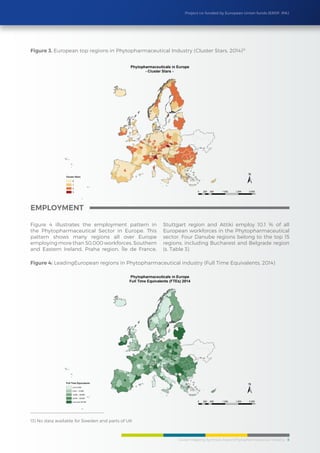
Figure 3 profiles all European regions according
to the Cluster Stars in the Phytopharmaceutical
industry. The strong regions are spread rather
across Europe with the largest concentrations
in Bulgaria, Czech Republic, Germany, France,
Romania and Slovenia, whereas the strongest
once are located in the Czech Republic and Italy
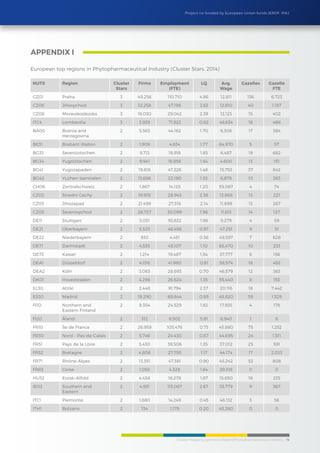
(Lombardy). More details are given in Appendix I.
Cluster Mapping Synthesis Report/Phytopharmaceutical Industry 8
Project co-funded by European Union funds (ERDF, IPA)
Figure 4 illustrates the employment pattern in
the Phytopharmaceutical Sector in Europe. This
pattern shows many regions all over Europe
employing more than 50,000 workforces. Southern
and Eastern Ireland, Praha region, Île de France,
Stuttgart region and Attiki employ 10.1 % of all
European workforces in the Phytopharmaceutical
sector. Four Danube regions belong to the top 15
regions, including Bucharest and Belgrade region
(s. Table 3).
employment
Figure 4: LeadingEuropean regions in Phytopharmaceutical industry (Full Time Equivalents, 2014)
13) No data available for Sweden and parts of UK
Figure 3. European top regions in Phytopharmaceutical Industry (Cluster Stars, 2014)13
Cluster Mapping Synthesis Report/Phytopharmaceutical Industry 9
Project co-funded by European Union funds (ERDF, IPA)
Comparing the enterprise pattern across Europe
(Figure 5), similarly strong national patterns as
in the leading clusters map in Figure 2 can be
found. The Czech Republic, France, Romania, and
Spain host most enterprises. Especially the Czech
Republic can be considered to be very strong in
this regard since almost 10 % of all enterprises in
the Phytopharmaceutical sector are located in this
country (s. Table 4) producing phytopharmaceu-
tical products like herbal essences and extracts
for pharmacy, cosmetics and food industry; wide
range of hemp products for bio-food shops, pet-
shops, and restaurants, whereby partially the raw
materials are sold too. However, many other Danue
Regions are comparable strong in this regard, too.
Table 4 illustrates the top regions in terms of
number of enterprises. Praha region is the only
region that is among the top 5 in both, number of
employees and number of enterprises. This can be
explained by the significantly different sizes of the
companies across the regions. Whereas enterprises
in Southern and Eastern Ireland, Stuttgart or
Athens region employ more than 25 Full Time
Equivalents on average (FTE), comparable lower
figures can be found in Romania (3,1 FTE), Bulgaria
(1,8 FTE), the Czech Republic (1,7 FTE), Austria (3,1
FTE) or Slovenia (4,2 FTE).
Enterprises
Figure 5: Leading European regions in Phytopharmaceutical industry (Enterprises, 2014)
NUTS Region Employment (FTE) NUTS Region Employment (FTE)
IE02 Southern and
Eastern Ireland
113,067 ITC4 Lombardy 71,923
CZ01 Praha 110,710 ES30 Madrid 69,844
FR10 Île de France 105,476 LV00 Latvija 59,403
DE11 Stuttgart 93,632 PL22 Slaskie 59,158
EL30 Attiki 91,794 PL41 Wielkopolskie 56,149
RO32 Bucuresti - Ilfov 79,012 LT00 Lietuva 55,627
PL12 Mazowieckie 76,233 HU10 Kozep-
Magyarorszag
54,871
ES51 Cataluña 75,513
Table 3: Top 15 European regions with highest number of employment in the Phytopharmaceutical
sector (Full Time Equivalents, 2014)
Cluster Mapping Synthesis Report/Phytopharmaceutical Industry 10
Project co-funded by European Union funds (ERDF, IPA)
Firm-level data has been used to also identify
so-called “Gazelles”14
. Due to the novelty of this
data source and differences in coverage across
countries, the results have to be interpreted with
caution. In particular, it seems likely that country-
specific rules and regulations, for example on
taxation, have an important influence on the pres-
ence of new business formation that is not directly
linked to the overall dynamism of the economy.
However, the reader might consider these data to
be interesting.
There are more than 958 Gazelles in the
Phytopharmaceutical sector in the Danube Region
employing 24,837 workers. Regions like Praha or
Île de France are, again, under the top 5 regions
(Table 5). But also other regions from the Czech
Republic, Romania and Bulgaria have a significant
number of Gazelles.
Figure 6: Leading European regions in Phytopharmaceutical industry (Gazelles, 2014)
14) Gazelles are defined here as companies less than 5 years old that have grown their employment at least 10% annually
over a period of three years
NUTS Region Enterprises NUTS Region Enterprises
CZ01 Praha 49,256 CZ07 Stredni Morava 19,083
CZ06 Jihovychod 32,258 RO21 Nord-Est 18,487
FR10 Île de France 26,959 ES30 Madrid 18,290
CZ05 Severovychod 26,727 CZ08 Moravskoslezsko 18,030
ES51 Cataluña 24,270 RO32 Bucuresti - Ilfov 17,602
CZ03 Jihozapad 21,499 RO31 Sud - Muntenia 16,845
CZ02 Stredni Cechy 19,935 FR82 Provence-Alpes-
Côte d'Azur
16,542
BG41 Yugozapaden 19,618
Table 4: Top 15 European regions with highest number of enterprises operating in the
Phytopharmaceutical sector (Enterprises, 2014)
Cluster Mapping Synthesis Report/Phytopharmaceutical Industry 11
Project co-funded by European Union funds (ERDF, IPA)
NUTS Region Enterprises NUTS Region Enterprises
CZ01
Praha 136 CZ06 Jihovychod 40
FR10 Île de France 75 HU10 Kozep-
Magyarorszag
38
ES61 Andalucía 71 BG41 Yugozapaden 37
ES30 Madrid 59 RO32 Bucuresti - Ilfov 36
FR71 Rhône-Alpes 53 RO22 Sud-Est 35
LV00 Latvija 51 RO42 Vest 35
ES51 Cataluña 47 RO21 Nord-Est 34
ES52 Valencia 43
Table 5: Top 15 European regions with highest number of enterprises operating in the
Phytopharmaceutical sector (Gazelles, 2014)
Measuring regional specialisation of the
Phytopharmaceutical industry can provide inter-
esting insights to what extent a region is stronger
than would be expected in this sector given its
overall size, compared to the average employ-
ment size in the Phytopharmaceutical sector
across all regions. Regional Specialisation can be
measured by the Location Quotient (LQ). Figure 7
shows to what European regions are specialised
in the Phytopharmaceutical industry. It illustrates
that the Danube Region seems to be compa-
rable strong in this regard. Many Danube regions
reveal LQ values over 1, which means they are more
specialised than others.
regional specialisation
Figure 7: Leading European regions in Phytopharmaceutical industry (Specialisation, 2014)
Cluster Mapping Synthesis Report/Phytopharmaceutical Industry 12
Project co-funded by European Union funds (ERDF, IPA)
NUTS Region Enterprises NUTS Region Enterprises
FI20 Åland 5.81 LV00 Latvija 2.31
CZ01 Praha 4.86 PT18 Alentejo 2.18
IE02 Southern and Eastern
Ireland
2.67 EL41 Voreio Aigaio 2.15
CZ06 Jihovychod 2.63 CZ03 Jihozapad 2.14
MK00 The former Yugoslav
Republic of Macedonia
2.52 CZ04 Severozapad 2.04
RO32 Bucuresti - Ilfov 2.41 RO21 Nord-Est 2.04
RS11 Belgrade 2.41 RO31 Sud - Muntenia 2.00
CZ08 Moravskoslezsko 2.39 SI04 Zahodna Slovenija 2.00
CZ02 Stredni Cechy 2.38 RO41 Sud-Vest Oltenia 2.00
EL30 Attiki 2.37 DE11 Stuttgart 2.00
KV00 Kosovo 2.32
Table 6: Top European regions with highest level of Specialisation in the Phytopharmaceutical sector
(Location Quotient, 2014)
The previous results have shown that the Danube
Region has developed to become a hot spot
in the field of Phytopharma. Besides European
frontrunner regions, like Praha region, many
others show strong indicators in terms employ-
ment, number of enterprises, fast growing firms
(Gazelles), or terms of regional specialisation. 50 %
of all European regions with two or more Cluster
Stars are located in the Danube Region. 44 % of
all European workers in the Phytopharmaceutical
industry are employed by enterprises coming from
this region. All these figures provide good evidence
for the economic strength of the Danube Region.
Table 7 (s. Appendix) provides more information
about the strongest regions in this sector. Despite
of the significant industrial agglomerations in
the Phytopharmaceutical sector in the Danube
Region shown by this report, only a small number
of cluster initiatives exist. They can be character-
ised to be comparable small in terms of size and
young in terms of cluster management experi-
ence. In Appendix II the most relevant cluster initi-
atives are listed.
The DanuBioValNet project is aiming at estab-
lishing bio-based industry networks across the
Danube Region. The emerging transnational coop-
eration of clusters will foster bioeconomy and eco-
innovations and lead to a strengthening of the
regional economies.
Consequently, with this project the partners
pursue a strong strategic orientation beyond the
immediate and medium-term economic objective
of strengthening the regional economy. It is the
strategic goal to establish cross-border strategic
partnerships, particularly in developing regions,
with the help of powerful cluster organisations. In
this way, project results will be sustained beyond
an immediate effect and the creation of strategic
investments, especially in emerging industries such
as the bio industry, will be enabled and facilitated.
This will be achieved mainly by newly emerging
or transforming value-added chains, which are
increasingly being transnationally established and
further developed as a result of the increasing
internationalisation of value-added processes.
In this way, long-term economic effects are
achieved, based on a network of agile clusters,
which prepare the investment approaches in a
targeted manner and implement them with high
efficiency. One example of the present project is
the establishment of bio-refineries in the regions,
which can form a strategic technological back-
bone of a successful independent bio-industry.
summary
The DanuBioValNet Project
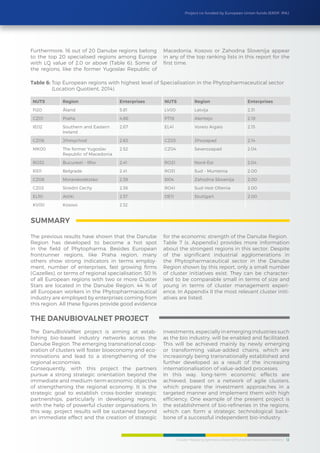
Furthermore, 16 out of 20 Danube regions belong
to the top 20 specialised regions among Europe
with LQ value of 2.0 or above (Table 6). Some of
the regions, like the former Yugoslav Republic of
Macedonia, Kosovo or Zahodna Slovenija appear
in any of the top ranking lists in this report for the
first time.
Cluster Mapping Synthesis Report/Phytopharmaceutical Industry 13
Project co-funded by European Union funds (ERDF, IPA)
The partners intend to develop and implement
a long-term, industry-driven roadmap for such
collaboration along the entire value chain based
on cluster partnerships for these processes. With
the project, a pilot function of the implementa-
tion is taken over and the prerequisite for creating
a blueprint for similar and similar cross-national
cooperation, also in other industries, is created.
For achieving these tasks, 17 project partners from
10 countries have joined forces. The project will
pave the way from an economy based on fossil
resources towards an economy using renewable
resources. The striving of the partners to minimise
greenhouse gases and resource-saving as well as
resource-efficient utilisation of available biomass
will result in synergistic effects. These effects will
improve the sustainability, regional development
through diversification of the local economy and
will also positively affect the workforce.
The development of new bio-based value chains
from primary production to consumer markets
needs to be done by connecting enterprises from
different regions and industries. But due to a
missing holistic transnational approach, Danube
actors in bio-based industry still operate discon-
nected and cannot properly benefit from the
potential. Therefore, the aim of this project is to
develop new methods, strategies and tools to
connect enterprises transnationally.
Clusters as the strong representatives of a group
of industries that are closely linked by common
products, markets, technologies and interests are
chosen to organise and bear the industry coop-
eration and creation of new value chains, because
they are performant and sustainable partners and
guarantee the upgradeability in the dimension
industry, sciences and also politics.
One of the planned outputs of this project will be
the development of a Joint Bio-based Industry
Cluster Policy Strategy (JBCS) to describe the
procedure and to make it actionable and reusable.
Furthermore, a bundle of new methods and tools
to support clusters for transnational working will
be developed and joint into a strategy. They will be
tested in three pilot actions where it is planned to
create new bio-based value chains in the Danube
Region.
The main target groups are on the one hand the
policy – four Ministries are involved –, on the other
hand clusters and their SMEs – nine cluster organi-
sations are involved. The policy level will benefit
from the JBCS, which can be used as a political
framework.
The clusters and SMEs will benefit from the new
innovative tools and methods developed for trans-
national cross-clustering. Successfully established
new bio-based value chains in the pilot actions
can motivate other clusters and SMEs to test this
newly developed approach in the future.
The following partners commit to the implemen-
tation of the cluster partnership and transnational
cooperation:
Role Official Name in English Acronym Country
LP BIOPRO Baden-Württemberg GmbH BIOPRO Germany
ERDF PP1 ClusterAgentur Baden-Württemberg CA BW Germany
ERDF PP2 Anteja ECG ANT Slovenia
ERDF PP3 PROUNION PU Slovakia
ERDF PP4 Romanian Cluster Association CLUSTERO Romania
ERDF PP5 Association of Business Clusters ABC Bulgaria
ERDF PP6 National Cluster Association – CZ NCA Czech Republic
ERDF PP7 Business Upper Austria – OÖ Wirtschaftsagentur GmbH -
Upper Austrian Food Cluster UAFC Austria
ERDF PP8 Ministry of Economy ME Romania
ERDF PP9 Ministry of Economy, Entrepreneurship and Crafts MEC Croatia
ERDF PP10 Ministry of Education, Science and Sport MIZS Slovenia
ERDF PP11 Croatian Wood Cluster CWC Croatia
ERDF PP12 Institute for Economic Forecasting IPE Romania
ERDF PP13 Business Upper Austria – OÖ Wirtschaftsagentur GmbH
– Cleantech-Cluster BizUp Austria
IPA PP1 Innovation Center of Faculty of Mechanical Engineering ICME Serbia
ASP1 Montenegro Vine Cluster MVC Montenegro
ASP2 Ministry of Economic Affairs, Labour and Housing
Baden-Württemberg
WM Germany
LP = Lead Partner, PP = Project Partner, IPA = Instrument for Pre-Accession, ASP = Associated Strategic Partner,
ERDF = European Regional Development Fund
Cluster Mapping Synthesis Report/Phytopharmaceutical Industry 14
Project co-funded by European Union funds (ERDF, IPA)
APPENDIX I
European top regions in Phytopharmaceutical Industry (Cluster Stars, 2014)
NUTS Region Cluster
Stars
Firms Employment
(FTE)
LQ Avg.
Wage
Gazelles Gazelle
FTE
CZ01 Praha 3 49,256 110,710 4.86 12,811 136 6,723
CZ06 Jihovychod 3 32,258 47,198 2.63 12,810 40 1,187
CZ08 Moravskoslezsko 3 18,030 29,042 2.39 12,123 15 402
ITC4 Lombardia 3 3,939 71,923 0.82 48,634 18 466
BA00 Bosnia and
Herzegovina
2 5,563 44,162 1.70 6,308 17 384
BE31 Brabant Wallon 2 1,909 4,834 1.77 84,970 5 57
BG33 Severoiztochen 2 9,713 18,918 1.85 6,487 19 682
BG34 Yugoiztochen 2 9,941 16,956 1.54 4,600 13 151
BG41 Yugozapaden 2 19,618 47,326 1.48 15,753 37 642
BG42 Yuzhen tsentralen 2 13,686 22,190 1.53 6,878 10 263
CH06 Zentralschweiz 2 1,867 14,125 1.20 55,067 4 74
CZ02 Stredni Cechy 2 19,935 28,943 2.38 12,866 13 221
CZ03 Jihozapad 2 21,499 27,316 2.14 11,899 13 267
CZ05 Severovychod 2 26,727 30,099 1.96 11,613 14 127
DE11 Stuttgart 2 3,051 93,632 1.98 9,279 4 59
DE21 Oberbayern 2 5,525 48,456 0.97 47,251 9 51
DE22 Niederbayern 2 930 4,451 0.36 49,597 7 628
DE71 Darmstadt 2 4,535 45,107 1.10 65,470 10 233
DE73 Kassel 2 1,214 19,487 1.54 37,777 6 156
DEA1 Düsseldorf 2 4,018 41,980 0.81 58,574 18 482
DEA2 Köln 2 3,063 28,693 0.70 46,579 12 363
DK01 Hovedstaden 2 4,296 26,624 1.35 55,440 8 153
EL30 Attiki 2 2,448 91,794 2.37 20,116 18 7,442
ES30 Madrid 2 18,290 69,844 0.89 48,820 59 1,529
FI1D Northern and
Eastern Finland
2 8,354 24,529 1.83 17,935 4 178
FI20 Åland 2 312 6,502 5.81 6,940 1 8
FR10 Île de France 2 26,959 105,476 0.73 45,880 75 1,252
FR30 Nord - Pas-de-Calais 2 5,746 24,430 0.87 44,695 24 1,511
FR51 Pays de la Loire 2 5,430 39,506 1.35 37,012 25 591
FR52 Bretagne 2 4,808 27,793 1.17 44,174 17 2,033
FR71 Rhône-Alpes 2 13,351 47,381 0.90 45,242 53 808
FR83 Corse 2 1,058 4,328 1.64 29,318 0 0
HU32 Eszak-Alfold 2 4,458 18,278 1.87 15,650 18 235
IE02 Southern and
Eastern
2 4,931 113,067 2.67 33,779 9 367
ITC1 Piemonte 2 1,680 14,249 0.45 46,132 3 56
ITH1 Bolzano 2 134 1,179 0.20 45,260 0 0
Cluster Mapping Synthesis Report/Phytopharmaceutical Industry 15
Project co-funded by European Union funds (ERDF, IPA)
NUTS Region Cluster
Stars
Firms Employment
(FTE)
LQ Avg.
Wage
Gazelles Gazelle
FTE
LT00 Lietuva 2 4,750 55,627 1.63 14,246 18 9,985
LV00 Latvija 2 15,269 59,403 2.31 7,113 51 2,145
NO06 Trøndelag 2 467 8,771 1.83 36,235 1 7
PL21 Malopolskie 2 7,231 52,318 1.75 11,866 5 113
PL41 Wielkopolskie 2 8,320 56,149 1.76 14,318 21 658
RO11 Nord-Vest 2 12,561 37,034 1.55 7,865 24 486
RO12 Centru 2 12,054 40,757 1.78 9,821 31 492
RO21 Nord-Est 2 18,487 48,738 2.04 6,164 34 533
RO22 Sud-Est 2 15,996 36,774 1.76 6,990 35 674
RO31 Sud - Muntenia 2 16,845 44,971 2.00 7,538 34 525
RO32 Bucuresti - Ilfov 2 17,602 79,012 2.41 17,135 36 704
RO41 Sud-Vest Oltenia 2 9,628 28,028 1.99 6,473 24 458
RO42 Vest 2 9,572 31,424 1.61 9,068 35 428
RS11 Belgrade 2 3,922 50,611 2.41 12,424 24 519
SI04 Zahodna Slovenija 2 4,382 16,997 2.00 35,880 25 401
UKE1 E Riding and N Lincs 2 604 17,069 1.69 25,292 1 1
Project co-funded by European Union funds (ERDF, IPA)
16
APPENDIX II
Selected cluster Initiative in the Phytopharmaceutical Sector
Name Country
Number of cluster
actors
Established
Bulgarian National Association Essential oils,
Perfumery and cosmetics (bnaeopc) Bulgaria 27 1999
Hrvatski Klaster Croatia N. A. N. A.
Orlicko Agrocultural Cluster Czech Republic 15 2016
CzechBio Czech Republic 31 2009
IND-AGRO-POL Romania 10
HERBAL PHARMANET Serbia 16 2012
Bioeconomy Cluster Slovakia 16 2015
Hemp Cluster Slovakia 25 2015
The Cluster Mapping Synthesis Report was prepared by:
Dr. Gerd Meier zu Köcker (ClusterAgentur BW)
Mateja Dermastia (Anteja ECG – Poly4emi)
ClusterAgentur Baden-Württemberg
im Haus der Wirtschaft
Willi-Bleicher-Straße 19
70174 Stuttgart, Germany
www.clusterportal-bw.de
Anteja ECG d.o.o.
Lambergarjeva 8
Ljubljana, Slovenia
www.anteja-ecg.com
www.interreg-danube.
eu/approved-projects/
danubiovalnet

Cluster Mapping Phytopharmaceutical Industry

  • 1.
    Project co-funded byEuropean Union funds (ERDF, IPA) Cluster Mapping Synthesis Report Phytopharmaceutical Industry Cross-clustering partnership for boosting eco-innovation by developing a joint bio-based value-added network for the Danube Region interreg-danube.eu/danubiovalnet twitter.com/danu_bioval
  • 2.
    Cluster Mapping SynthesisReport/Phytopharmaceutical Industry 2 Project co-funded by European Union funds (ERDF, IPA) This report has been produced within the frame of the DanuBioValNet project (Activity 3.2 Cluster Mapping, Deliverable 3.2.1), funded by the Danube Region INTERREG Programme of the European Commission. It was prepared by Dr. Gerd Meier zu Köcker (ClusterAgentur BW) and Mateja Dermastia (Anteja ECG – Poly4emi). This report was drafted with input gathered from all project partners over the second phase of the project implementation (July – December 2017). The authors would like to thank all partners for their contributions and significant efforts, especially Benedikt Sedlmayr (VDI/VDE-IT). Disclaimer The information and perspectives set out in this Report are those of the authors and do not necessarily reflect the official opinion of the European Commission or the project partners’ regions. Neither the European Commission institutions and bodies nor any person acting on their behalf may be held responsible for the use that may be made of the information contained therein. Reproduction is authorised, provided the source is acknowledged, unless otherwise stated. For use/reproduction of third party material specified as such, permission must be obtained from the copyright. For further information about the DanuBioValNet project, you will find a short descrip- tion at the end of the document. To learn more and to download additional resources please refer to the project website http://www.interreg-danube.eu/approved-projects/ danubiovalnet. The information is provided without assuming any legal responsibility for correctness or completeness. The data presented in the report are based on the information given by the project partners. © DanuBioValNet, 2017
  • 3.
    Cluster Mapping SynthesisReport/Phytopharmaceutical Industry 3 Project co-funded by European Union funds (ERDF, IPA) Contents Introduction........................................................................................................................................................................................4 The Cluster Mapping Approach.............................................................................................................................4 Composition of the Phytopharmaceutical Sector...................................................................... 5 Overview...................................................................................................................................................................................................6 Employment.......................................................................................................................................................................................8 Enterprises.............................................................................................................................................................................................9 Regional Specialisation..................................................................................................................................................... 11 Summary................................................................................................................................................................................................12 The DanuBioValNet Project..........................................................................................................................................12 APPENDIX I......................................................................................................................................................................................... 14 APPENDIX II....................................................................................................................................................................................... 16
  • 4.
    Cluster Mapping SynthesisReport/Phytopharmaceutical Industry 4 Project co-funded by European Union funds (ERDF, IPA) Phytopharmaceuticals are herbal medicines whose efficacy is down to one or several plant substances or active ingredients. They have been used for treating diseases since time immemo- rial. This traditional knowledge is still the basis for many medicinal products made from plants or parts thereof1 . Globally, herbal medicine has been considered an important alternative to modern allopathic medicine. Although the herbal medicines are very popular in the society, only few medicinal herbs have been scientifically evaluated for their poten- tial in medical treatment. In most countries, the herbal drugs are poorly regulated and are often neither registered nor controlled by the health authorities. Herbal medicine products include herbs, herbal materials, herbal preparations, and finished herbal products that contain parts of plants, other plant materials, or combinations thereof as active ingre- dients2 . Herbs include crude plant material, for example, leaves, flowers, fruit, seed, and stems. Herbal materials include, in addition to herbs, fresh juices, gums, fixed oils, essential oils, resins, and dry powders of herbs. Herbal preparations are the basis for finished herbal products and may include comminuted or powdered herbal materials, or extracts, tinctures, and fatty oils of herbal mate- rials. Finished herbal products consist of herbal preparations made from one or more herbs. Since the end of the 20th century, plant-based drugs regained popularity due to the often serious effects of synthetic drug substances. The phar- maceutical industry and academic institutions have made considerable contributions to the progress in medicinal plant research. Even though plant-based remedies have special legal status in many countries, they can be considered equal to synthetic drugs in terms of their quality, safety and efficacy standards. The special status of botanical medicines is due to their complex composition and the resulting challenges for analytical meth- odologies and activities tests3 . In Europe, for the marketing approval4 , the herbal preparations are classified in three categories as follows: • Traditional medicinal use provisions (“traditional use”) accepted on the basis of sufficient safety data and plausible efficacy • Well-established medicinal use provisions (“well- established use”) demonstrated with the provi- sion of scientific literature establishing that the active substances of the medicinal products have been in well-established medicinal use within the European Union for at least 10 years, with recognized efficacy and an acceptable level of safety a product can be classified under • Safety and efficacy data from the company's own development (“stand alone”) or a combination of own studies and bibliographic data The DanuBioValNet project is aiming at estab- lishing bio-based industry networks across the Danube Region. A better understanding of the phytopharmaceutical cluster landscape is essen- tial to initiate transnational cooperation of clusters to foster bioeconomy and eco-innovations and in order to lead to a strengthening of the regional economies. For purposes of the DanuBioValNet5 project, data collection and cluster mapping of the phytophar- maceutical industry have been defined as “health- related products derived from plant sources”. While some definitions may specify a minimum number of bioactive phytochemical compounds, the DanuBioValNet interest is an understanding of the value-added activities associated with producing pharmaceutical and cosmeceutical agents of plant origin. These include bio-active ingredients for pharmaceutical grade medicines, natural herbal medicines, cosmetics, cosmeceuti- cals, nutraceuticals, nutritional supplements and similar health-related natural products. It is under- stood that varying degrees of regulatory compli- ance applies in accordance with the nature of the phytochemical compounds, their applications, safety profile and health claims. INTRODUCTION 1) “Phytopharmaceuticals – fighting disease with natural substances”, https://www.gesundheitsindustrie-bw.de/en/article/ dossier/phytopharmaceuticals-fighting-disease-with-natural-substances/. 2) World Health Organization General Guidelines for Methodologies on Research and Evaluation of Traditional Medicine. 2000. http://www.whqlibdoc.who.int/hq/2000/WHO_EDM_TRM_2000.1.pdf. 3) Wichtl, Max (ed.), 2004, Herbal Drug and Phytopharmaceuticals – a Handbook for Practice on a Scientific Basis, Medpharm Scientific Publishers, Stuttgart. 4) European Medicines Agency Herbal Medicinal Products, http://www.ema.europa.eu/ema/index.jsp?curl=pages/regula- tion/general/general_content_000208.jsp#. 5) http://www.interreg-danube.eu/approved-projects/danubiovalnet
  • 5.
    Cluster Mapping SynthesisReport/Phytopharmaceutical Industry 5 Project co-funded by European Union funds (ERDF, IPA) 6) Christian Ketels (2017), Cluster Mapping as Tool for Development, Havard Business School, http://www.hbs.edu/faculty/Publication%20Files/ Cluster%20Mapping%20as%20a%20Tool%20for%20Development%20_%20report_ISC%20WP%20version%2010-10-17_c46d2cf1-41ed- 43c0-bfd8-932957a4ceda.pdf. 7) Employment is usually the only variable available on plant level, the rest are for the firm as a whole. 8) European Cluster Observatory, 2016. 9) The analysis covers all EU-28 countries (comprising 276 NUTS-2 regions) as well as Albania, Bosnia and Herzegovina, Iceland, FYROM, Kosovo (regarding the political status of which no claims are implied), Montenegro, Norway, Serbia, and Switzerland, by applying the NUTS (Nomenclature of Territorial Units for Statistics) standard for the subdivisions of countries for statistical purposes. The Cluster Mapping Approach Clusters can be understood as regional concentra- tions of economic activities in related industries connected through local linkages and spill-overs, have long been known to be a feature of market economy6 . Cluster organisations can help firms to better engage with other local actors within their cluster and to organise collective actions to strengthen the local context. Moreover, they can reduce the transaction costs for firms, especially SMEs, in building linkages to firms and collabora- tion partners in other locations. Clusters have a distinct geographic dimension, reflecting the dynamics of local spill-overs. They are also deeply embedded in a broader geographic context: they serve markets elsewhere and are connected to other clusters with complemen- tary strengths in regional, interregional or global value chains. This mirrors the role of location for firms: while local conditions provide the unique context for building distinct capabilities and stra- tegic positions, national and international linkages are critical to access other markets, suppliers, and collaboration partner. Cluster mapping describes the process of meas- uring the presence of cluster actors in a given region across defined sector-specific value chains. Cluster mapping, especially in Emerging Industries like Phytopharmaceutical, is of high relevance to better understand the key competences of the cluster actors as well as to review to what extent the respective value chain is properly covered. This report provides the first perspective on Phytopharmaceutical clusters across the Danube Region. One key novelty is the introduction of firm-level data to supplement the statistical data from national and EU statistical offices. This firm- based data significantly increases the robustness of the data, especially in countries like Germany that collect regional data through samples rather than reporting by all firms. It also enables perfor- mance of individual firms to be tracked over time, gaining more granular insights into patterns of entrepreneurship. The report is based on a new dataset that is compiled specifically for analysing detailed patterns of cluster evolution. The core of the dataset is the firm- and plant-level data sources from the Orbis Historical dataset supplied by Bureau van Dijk (June 2016 release). This dataset provides detailed data on the economic perfor- mance of firms. It allows the usage of data of firms’ turnover, wage bill, capital, materials and employ- ment7 , totalling more than 1 billion data points. The coverage is very good in most countries in Europe, and especially for larger limited liability companies. However significant gaps were still present. In this report strong clusters are being determined by giving a “Cluster Star” for each region being identified to belong to the top 20 % of European regions in the following dimensions: • Specialisation, measured by the relative size of regionalemploymentinthePhytopharmaceutical sector reflected in its location quotient (LQ). This relative measure indicates how much stronger a region is in the Phytopharmaceutical sector than it would be expected, given its overall size, compared to the average employment size in the Phytopharmaceutical sector across all regions • Absolute size, measured by the number of employees and establishments. This measure is based on the observation that the number of linkages within a cluster is growing exponen- tially with the number of participants. Only when economic activity in the Phytopharmaceutical sector moves beyond a threshold of critical mass do cluster effects become significant. • Productivity, measured by the wages paid in a Phytopharmaceutical cluster (adjusted for local cost levels). This measure reflects not only what is being done in a region, but how well it is being done, influenced by the strength of cluster effects. Wages are also influenced by the struc- ture of labour markets and other factors but are strongly correlated with productivity. • Dynamism, measured by a simple average of measures on employment growth and the presence of fast-growing new firms (gazelles). This measure aims to capture whether a Phytopharmaceutical cluster continues to benefit from strong cluster effects in its development or not. The cluster may be hindered in its growth because it has already reached a level where costs or other factors, such as industry-specific growth trends8 , are greater than the benefits. The notion of regions is applied in this report by using data for specific administrative regions, generally at the so-called NUTS 2 level. For this report, 252 European regions have been regarded,9 each with its own profile and economic perfor- mance. These regions are used as a pragmatic choice because they are likely to encompass the “economically relevant” regions; there is data avail- able, and in most cases there is some level of government that can take action for this specific region.
  • 6.
    Cluster Mapping SynthesisReport/Phytopharmaceutical Industry 6 Project co-funded by European Union funds (ERDF, IPA) In a next step, all partners and related cluster managers did a detailed mapping of their phytop- harmaceutical cluster initiatives and clusters in their region according to the pre-defined Value Chain10 . For this purpose the members of the iden- tified cluster initiatives and clusters were grouped byprojectpartnersandclustermanagersaccording to the specific nodes of the Phytopharmaceutical Value Chain they operate in. In those cases, where no cluster initiatives existed, key cluster actors were identified and grouped. In a third step, the specific NACE industry clas- sifications11 for all members or cluster actors were identified as part of the cluster mapping exercises, that allowed to produce a reliable picture Phytopharmaceutical industry. The Phytopharmaceutical industry composition illustrated in Figure 2 is based on the inten- sive work of the project partners and related cluster managers and is based on more than 300 companies and their related NACE classifications identified. The size of the different boxes (NACE classifications) is proportional to number of enter- prises. As Figure 2 illustrates the biggest share of enterprises (about 18 %) operate in the sector “Manufacturing of basic pharmaceutical products” (NACE Code C21.10). 6 % of the enterprises deal with “Growing of spices, aromatic, drug and phar- maceutical crops” (NACE Code A1.28). It has to be mentioned that the current NACE Code classification cannot sufficiently distin- guish between the Phytopharmaceutical and the Pharmaceutical sector. Thus, some overlapping between both sectors is likely to exist. Figure 1: Value Chain for Phytopharmaceutical Sector (source: DanuBioValNet) Figure 2: Phytopharmaceutical industry composition based on NACE industry classification 2008 (source: DanuBioValNet) 10) Further details of the individucal cluster mapping exercises are given in the regional cluster mapping fact sheets avail- able on the DabuBioValNet website (interreg-danube.eu/danubiovalnet) 11) according to NACE Rev. 2 2008; Eurostat – Methodologies and Working Papers (2008), ISSN 1977-0375 Methodology to Define the Composition of the phytopharmaceutical Sector The operationalisation of the Phytopharmaceutical sector was developed within the DanuBioValNet project by an active involvement of the partners and cluster managers. This became necessary since the composition of this sector was unknown before. In a first step, the characteristic Value Chain for the Phytopharmaceutical sector was been jointly developed with the partners (Figure 1). The first node can be “cultivation” in case the raw mate- rials can be cultivated. Or, the node can be defined by “collected”, in case the raw material has to be collected in the wild. However, all the following nodes of the Value Chain remain the same.
  • 7.
    Cluster Mapping SynthesisReport/Phytopharmaceutical Industry 7 Project co-funded by European Union funds (ERDF, IPA) Danube Region Europe Level in 2014 Change since 2008 Level in 2014 Change since 2008 Employment 1,529,292 1.4 % 5,100,742 0.7% Establishments 535,517 33.0% 1,249,705 16.2% Average Wage (EUR) 20,197 -3.2% 30,787 2.9% Gazelle Employment 24,676 1.7% 87,023 -0,2% Region No Star 1 Star 2 Stars 3 Stars 4 Stars Danube 18 20 22 3 0 Rest of Europe 132 73 26 1 0 Table 1: Basic facts of Phytopharmaceutical industry in the Danube Region compared to Europe Table 2: Comparison of Cluster Stars between the Danube Region and Europe. The Danube Region12 is well positioned in this sector since 25 regions have at least two or more Cluster Stars (39.7 % of all Danube Regions). Furthermore, 48 % of all European regions with two or more Cluster Stars are located in the Danube Region. 12) 63 Member Regions, no data for Ukraine (4 NUTS-2-Regions) and Moldavia (1 NUTS-2-Region) oVERVIEW The Phytopharmaceutical industry in the Danube Region employs more than 1.5 million workforces and provides 30 % of all sector-specific jobs in Europe. Furthermore, almost half of all firms operating in this sector are based in the Danube Region (42.9 %), which demonstrates the strong role of the Region compared to Europe. Around 25.000 new jobs have been created by young, high growing companies (by so called Gazelles). Higher dynamics in terms of increased number of firms compared to all Europe can be found, whereas growth in term of employment and productivity was lower. Figure 3 profiles all European regions according to the Cluster Stars in the Phytopharmaceutical industry. The strong regions are spread rather across Europe with the largest concentrations in Bulgaria, Czech Republic, Germany, France, Romania and Slovenia, whereas the strongest once are located in the Czech Republic and Italy (Lombardy). More details are given in Appendix I.
  • 8.
    Cluster Mapping SynthesisReport/Phytopharmaceutical Industry 8 Project co-funded by European Union funds (ERDF, IPA) Figure 4 illustrates the employment pattern in the Phytopharmaceutical Sector in Europe. This pattern shows many regions all over Europe employing more than 50,000 workforces. Southern and Eastern Ireland, Praha region, Île de France, Stuttgart region and Attiki employ 10.1 % of all European workforces in the Phytopharmaceutical sector. Four Danube regions belong to the top 15 regions, including Bucharest and Belgrade region (s. Table 3). employment Figure 4: LeadingEuropean regions in Phytopharmaceutical industry (Full Time Equivalents, 2014) 13) No data available for Sweden and parts of UK Figure 3. European top regions in Phytopharmaceutical Industry (Cluster Stars, 2014)13
  • 9.
    Cluster Mapping SynthesisReport/Phytopharmaceutical Industry 9 Project co-funded by European Union funds (ERDF, IPA) Comparing the enterprise pattern across Europe (Figure 5), similarly strong national patterns as in the leading clusters map in Figure 2 can be found. The Czech Republic, France, Romania, and Spain host most enterprises. Especially the Czech Republic can be considered to be very strong in this regard since almost 10 % of all enterprises in the Phytopharmaceutical sector are located in this country (s. Table 4) producing phytopharmaceu- tical products like herbal essences and extracts for pharmacy, cosmetics and food industry; wide range of hemp products for bio-food shops, pet- shops, and restaurants, whereby partially the raw materials are sold too. However, many other Danue Regions are comparable strong in this regard, too. Table 4 illustrates the top regions in terms of number of enterprises. Praha region is the only region that is among the top 5 in both, number of employees and number of enterprises. This can be explained by the significantly different sizes of the companies across the regions. Whereas enterprises in Southern and Eastern Ireland, Stuttgart or Athens region employ more than 25 Full Time Equivalents on average (FTE), comparable lower figures can be found in Romania (3,1 FTE), Bulgaria (1,8 FTE), the Czech Republic (1,7 FTE), Austria (3,1 FTE) or Slovenia (4,2 FTE). Enterprises Figure 5: Leading European regions in Phytopharmaceutical industry (Enterprises, 2014) NUTS Region Employment (FTE) NUTS Region Employment (FTE) IE02 Southern and Eastern Ireland 113,067 ITC4 Lombardy 71,923 CZ01 Praha 110,710 ES30 Madrid 69,844 FR10 Île de France 105,476 LV00 Latvija 59,403 DE11 Stuttgart 93,632 PL22 Slaskie 59,158 EL30 Attiki 91,794 PL41 Wielkopolskie 56,149 RO32 Bucuresti - Ilfov 79,012 LT00 Lietuva 55,627 PL12 Mazowieckie 76,233 HU10 Kozep- Magyarorszag 54,871 ES51 Cataluña 75,513 Table 3: Top 15 European regions with highest number of employment in the Phytopharmaceutical sector (Full Time Equivalents, 2014)
  • 10.
    Cluster Mapping SynthesisReport/Phytopharmaceutical Industry 10 Project co-funded by European Union funds (ERDF, IPA) Firm-level data has been used to also identify so-called “Gazelles”14 . Due to the novelty of this data source and differences in coverage across countries, the results have to be interpreted with caution. In particular, it seems likely that country- specific rules and regulations, for example on taxation, have an important influence on the pres- ence of new business formation that is not directly linked to the overall dynamism of the economy. However, the reader might consider these data to be interesting. There are more than 958 Gazelles in the Phytopharmaceutical sector in the Danube Region employing 24,837 workers. Regions like Praha or Île de France are, again, under the top 5 regions (Table 5). But also other regions from the Czech Republic, Romania and Bulgaria have a significant number of Gazelles. Figure 6: Leading European regions in Phytopharmaceutical industry (Gazelles, 2014) 14) Gazelles are defined here as companies less than 5 years old that have grown their employment at least 10% annually over a period of three years NUTS Region Enterprises NUTS Region Enterprises CZ01 Praha 49,256 CZ07 Stredni Morava 19,083 CZ06 Jihovychod 32,258 RO21 Nord-Est 18,487 FR10 Île de France 26,959 ES30 Madrid 18,290 CZ05 Severovychod 26,727 CZ08 Moravskoslezsko 18,030 ES51 Cataluña 24,270 RO32 Bucuresti - Ilfov 17,602 CZ03 Jihozapad 21,499 RO31 Sud - Muntenia 16,845 CZ02 Stredni Cechy 19,935 FR82 Provence-Alpes- Côte d'Azur 16,542 BG41 Yugozapaden 19,618 Table 4: Top 15 European regions with highest number of enterprises operating in the Phytopharmaceutical sector (Enterprises, 2014)
  • 11.
    Cluster Mapping SynthesisReport/Phytopharmaceutical Industry 11 Project co-funded by European Union funds (ERDF, IPA) NUTS Region Enterprises NUTS Region Enterprises CZ01 Praha 136 CZ06 Jihovychod 40 FR10 Île de France 75 HU10 Kozep- Magyarorszag 38 ES61 Andalucía 71 BG41 Yugozapaden 37 ES30 Madrid 59 RO32 Bucuresti - Ilfov 36 FR71 Rhône-Alpes 53 RO22 Sud-Est 35 LV00 Latvija 51 RO42 Vest 35 ES51 Cataluña 47 RO21 Nord-Est 34 ES52 Valencia 43 Table 5: Top 15 European regions with highest number of enterprises operating in the Phytopharmaceutical sector (Gazelles, 2014) Measuring regional specialisation of the Phytopharmaceutical industry can provide inter- esting insights to what extent a region is stronger than would be expected in this sector given its overall size, compared to the average employ- ment size in the Phytopharmaceutical sector across all regions. Regional Specialisation can be measured by the Location Quotient (LQ). Figure 7 shows to what European regions are specialised in the Phytopharmaceutical industry. It illustrates that the Danube Region seems to be compa- rable strong in this regard. Many Danube regions reveal LQ values over 1, which means they are more specialised than others. regional specialisation Figure 7: Leading European regions in Phytopharmaceutical industry (Specialisation, 2014)
  • 12.
    Cluster Mapping SynthesisReport/Phytopharmaceutical Industry 12 Project co-funded by European Union funds (ERDF, IPA) NUTS Region Enterprises NUTS Region Enterprises FI20 Åland 5.81 LV00 Latvija 2.31 CZ01 Praha 4.86 PT18 Alentejo 2.18 IE02 Southern and Eastern Ireland 2.67 EL41 Voreio Aigaio 2.15 CZ06 Jihovychod 2.63 CZ03 Jihozapad 2.14 MK00 The former Yugoslav Republic of Macedonia 2.52 CZ04 Severozapad 2.04 RO32 Bucuresti - Ilfov 2.41 RO21 Nord-Est 2.04 RS11 Belgrade 2.41 RO31 Sud - Muntenia 2.00 CZ08 Moravskoslezsko 2.39 SI04 Zahodna Slovenija 2.00 CZ02 Stredni Cechy 2.38 RO41 Sud-Vest Oltenia 2.00 EL30 Attiki 2.37 DE11 Stuttgart 2.00 KV00 Kosovo 2.32 Table 6: Top European regions with highest level of Specialisation in the Phytopharmaceutical sector (Location Quotient, 2014) The previous results have shown that the Danube Region has developed to become a hot spot in the field of Phytopharma. Besides European frontrunner regions, like Praha region, many others show strong indicators in terms employ- ment, number of enterprises, fast growing firms (Gazelles), or terms of regional specialisation. 50 % of all European regions with two or more Cluster Stars are located in the Danube Region. 44 % of all European workers in the Phytopharmaceutical industry are employed by enterprises coming from this region. All these figures provide good evidence for the economic strength of the Danube Region. Table 7 (s. Appendix) provides more information about the strongest regions in this sector. Despite of the significant industrial agglomerations in the Phytopharmaceutical sector in the Danube Region shown by this report, only a small number of cluster initiatives exist. They can be character- ised to be comparable small in terms of size and young in terms of cluster management experi- ence. In Appendix II the most relevant cluster initi- atives are listed. The DanuBioValNet project is aiming at estab- lishing bio-based industry networks across the Danube Region. The emerging transnational coop- eration of clusters will foster bioeconomy and eco- innovations and lead to a strengthening of the regional economies. Consequently, with this project the partners pursue a strong strategic orientation beyond the immediate and medium-term economic objective of strengthening the regional economy. It is the strategic goal to establish cross-border strategic partnerships, particularly in developing regions, with the help of powerful cluster organisations. In this way, project results will be sustained beyond an immediate effect and the creation of strategic investments, especially in emerging industries such as the bio industry, will be enabled and facilitated. This will be achieved mainly by newly emerging or transforming value-added chains, which are increasingly being transnationally established and further developed as a result of the increasing internationalisation of value-added processes. In this way, long-term economic effects are achieved, based on a network of agile clusters, which prepare the investment approaches in a targeted manner and implement them with high efficiency. One example of the present project is the establishment of bio-refineries in the regions, which can form a strategic technological back- bone of a successful independent bio-industry. summary The DanuBioValNet Project Furthermore, 16 out of 20 Danube regions belong to the top 20 specialised regions among Europe with LQ value of 2.0 or above (Table 6). Some of the regions, like the former Yugoslav Republic of Macedonia, Kosovo or Zahodna Slovenija appear in any of the top ranking lists in this report for the first time.
  • 13.
    Cluster Mapping SynthesisReport/Phytopharmaceutical Industry 13 Project co-funded by European Union funds (ERDF, IPA) The partners intend to develop and implement a long-term, industry-driven roadmap for such collaboration along the entire value chain based on cluster partnerships for these processes. With the project, a pilot function of the implementa- tion is taken over and the prerequisite for creating a blueprint for similar and similar cross-national cooperation, also in other industries, is created. For achieving these tasks, 17 project partners from 10 countries have joined forces. The project will pave the way from an economy based on fossil resources towards an economy using renewable resources. The striving of the partners to minimise greenhouse gases and resource-saving as well as resource-efficient utilisation of available biomass will result in synergistic effects. These effects will improve the sustainability, regional development through diversification of the local economy and will also positively affect the workforce. The development of new bio-based value chains from primary production to consumer markets needs to be done by connecting enterprises from different regions and industries. But due to a missing holistic transnational approach, Danube actors in bio-based industry still operate discon- nected and cannot properly benefit from the potential. Therefore, the aim of this project is to develop new methods, strategies and tools to connect enterprises transnationally. Clusters as the strong representatives of a group of industries that are closely linked by common products, markets, technologies and interests are chosen to organise and bear the industry coop- eration and creation of new value chains, because they are performant and sustainable partners and guarantee the upgradeability in the dimension industry, sciences and also politics. One of the planned outputs of this project will be the development of a Joint Bio-based Industry Cluster Policy Strategy (JBCS) to describe the procedure and to make it actionable and reusable. Furthermore, a bundle of new methods and tools to support clusters for transnational working will be developed and joint into a strategy. They will be tested in three pilot actions where it is planned to create new bio-based value chains in the Danube Region. The main target groups are on the one hand the policy – four Ministries are involved –, on the other hand clusters and their SMEs – nine cluster organi- sations are involved. The policy level will benefit from the JBCS, which can be used as a political framework. The clusters and SMEs will benefit from the new innovative tools and methods developed for trans- national cross-clustering. Successfully established new bio-based value chains in the pilot actions can motivate other clusters and SMEs to test this newly developed approach in the future. The following partners commit to the implemen- tation of the cluster partnership and transnational cooperation: Role Official Name in English Acronym Country LP BIOPRO Baden-Württemberg GmbH BIOPRO Germany ERDF PP1 ClusterAgentur Baden-Württemberg CA BW Germany ERDF PP2 Anteja ECG ANT Slovenia ERDF PP3 PROUNION PU Slovakia ERDF PP4 Romanian Cluster Association CLUSTERO Romania ERDF PP5 Association of Business Clusters ABC Bulgaria ERDF PP6 National Cluster Association – CZ NCA Czech Republic ERDF PP7 Business Upper Austria – OÖ Wirtschaftsagentur GmbH - Upper Austrian Food Cluster UAFC Austria ERDF PP8 Ministry of Economy ME Romania ERDF PP9 Ministry of Economy, Entrepreneurship and Crafts MEC Croatia ERDF PP10 Ministry of Education, Science and Sport MIZS Slovenia ERDF PP11 Croatian Wood Cluster CWC Croatia ERDF PP12 Institute for Economic Forecasting IPE Romania ERDF PP13 Business Upper Austria – OÖ Wirtschaftsagentur GmbH – Cleantech-Cluster BizUp Austria IPA PP1 Innovation Center of Faculty of Mechanical Engineering ICME Serbia ASP1 Montenegro Vine Cluster MVC Montenegro ASP2 Ministry of Economic Affairs, Labour and Housing Baden-Württemberg WM Germany LP = Lead Partner, PP = Project Partner, IPA = Instrument for Pre-Accession, ASP = Associated Strategic Partner, ERDF = European Regional Development Fund
  • 14.
    Cluster Mapping SynthesisReport/Phytopharmaceutical Industry 14 Project co-funded by European Union funds (ERDF, IPA) APPENDIX I European top regions in Phytopharmaceutical Industry (Cluster Stars, 2014) NUTS Region Cluster Stars Firms Employment (FTE) LQ Avg. Wage Gazelles Gazelle FTE CZ01 Praha 3 49,256 110,710 4.86 12,811 136 6,723 CZ06 Jihovychod 3 32,258 47,198 2.63 12,810 40 1,187 CZ08 Moravskoslezsko 3 18,030 29,042 2.39 12,123 15 402 ITC4 Lombardia 3 3,939 71,923 0.82 48,634 18 466 BA00 Bosnia and Herzegovina 2 5,563 44,162 1.70 6,308 17 384 BE31 Brabant Wallon 2 1,909 4,834 1.77 84,970 5 57 BG33 Severoiztochen 2 9,713 18,918 1.85 6,487 19 682 BG34 Yugoiztochen 2 9,941 16,956 1.54 4,600 13 151 BG41 Yugozapaden 2 19,618 47,326 1.48 15,753 37 642 BG42 Yuzhen tsentralen 2 13,686 22,190 1.53 6,878 10 263 CH06 Zentralschweiz 2 1,867 14,125 1.20 55,067 4 74 CZ02 Stredni Cechy 2 19,935 28,943 2.38 12,866 13 221 CZ03 Jihozapad 2 21,499 27,316 2.14 11,899 13 267 CZ05 Severovychod 2 26,727 30,099 1.96 11,613 14 127 DE11 Stuttgart 2 3,051 93,632 1.98 9,279 4 59 DE21 Oberbayern 2 5,525 48,456 0.97 47,251 9 51 DE22 Niederbayern 2 930 4,451 0.36 49,597 7 628 DE71 Darmstadt 2 4,535 45,107 1.10 65,470 10 233 DE73 Kassel 2 1,214 19,487 1.54 37,777 6 156 DEA1 Düsseldorf 2 4,018 41,980 0.81 58,574 18 482 DEA2 Köln 2 3,063 28,693 0.70 46,579 12 363 DK01 Hovedstaden 2 4,296 26,624 1.35 55,440 8 153 EL30 Attiki 2 2,448 91,794 2.37 20,116 18 7,442 ES30 Madrid 2 18,290 69,844 0.89 48,820 59 1,529 FI1D Northern and Eastern Finland 2 8,354 24,529 1.83 17,935 4 178 FI20 Åland 2 312 6,502 5.81 6,940 1 8 FR10 Île de France 2 26,959 105,476 0.73 45,880 75 1,252 FR30 Nord - Pas-de-Calais 2 5,746 24,430 0.87 44,695 24 1,511 FR51 Pays de la Loire 2 5,430 39,506 1.35 37,012 25 591 FR52 Bretagne 2 4,808 27,793 1.17 44,174 17 2,033 FR71 Rhône-Alpes 2 13,351 47,381 0.90 45,242 53 808 FR83 Corse 2 1,058 4,328 1.64 29,318 0 0 HU32 Eszak-Alfold 2 4,458 18,278 1.87 15,650 18 235 IE02 Southern and Eastern 2 4,931 113,067 2.67 33,779 9 367 ITC1 Piemonte 2 1,680 14,249 0.45 46,132 3 56 ITH1 Bolzano 2 134 1,179 0.20 45,260 0 0
  • 15.
    Cluster Mapping SynthesisReport/Phytopharmaceutical Industry 15 Project co-funded by European Union funds (ERDF, IPA) NUTS Region Cluster Stars Firms Employment (FTE) LQ Avg. Wage Gazelles Gazelle FTE LT00 Lietuva 2 4,750 55,627 1.63 14,246 18 9,985 LV00 Latvija 2 15,269 59,403 2.31 7,113 51 2,145 NO06 Trøndelag 2 467 8,771 1.83 36,235 1 7 PL21 Malopolskie 2 7,231 52,318 1.75 11,866 5 113 PL41 Wielkopolskie 2 8,320 56,149 1.76 14,318 21 658 RO11 Nord-Vest 2 12,561 37,034 1.55 7,865 24 486 RO12 Centru 2 12,054 40,757 1.78 9,821 31 492 RO21 Nord-Est 2 18,487 48,738 2.04 6,164 34 533 RO22 Sud-Est 2 15,996 36,774 1.76 6,990 35 674 RO31 Sud - Muntenia 2 16,845 44,971 2.00 7,538 34 525 RO32 Bucuresti - Ilfov 2 17,602 79,012 2.41 17,135 36 704 RO41 Sud-Vest Oltenia 2 9,628 28,028 1.99 6,473 24 458 RO42 Vest 2 9,572 31,424 1.61 9,068 35 428 RS11 Belgrade 2 3,922 50,611 2.41 12,424 24 519 SI04 Zahodna Slovenija 2 4,382 16,997 2.00 35,880 25 401 UKE1 E Riding and N Lincs 2 604 17,069 1.69 25,292 1 1
  • 16.
    Project co-funded byEuropean Union funds (ERDF, IPA) 16 APPENDIX II Selected cluster Initiative in the Phytopharmaceutical Sector Name Country Number of cluster actors Established Bulgarian National Association Essential oils, Perfumery and cosmetics (bnaeopc) Bulgaria 27 1999 Hrvatski Klaster Croatia N. A. N. A. Orlicko Agrocultural Cluster Czech Republic 15 2016 CzechBio Czech Republic 31 2009 IND-AGRO-POL Romania 10 HERBAL PHARMANET Serbia 16 2012 Bioeconomy Cluster Slovakia 16 2015 Hemp Cluster Slovakia 25 2015 The Cluster Mapping Synthesis Report was prepared by: Dr. Gerd Meier zu Köcker (ClusterAgentur BW) Mateja Dermastia (Anteja ECG – Poly4emi) ClusterAgentur Baden-Württemberg im Haus der Wirtschaft Willi-Bleicher-Straße 19 70174 Stuttgart, Germany www.clusterportal-bw.de Anteja ECG d.o.o. Lambergarjeva 8 Ljubljana, Slovenia www.anteja-ecg.com www.interreg-danube. eu/approved-projects/ danubiovalnet