Project co-funded by European Union funds (ERDF, IPA)
Cluster Mapping Synthesis Report
Bio-based Packaging
Cross-clustering partnership for boosting eco-innovation
by developing a joint bio-based value-added network for the Danube Region
interreg-danube.eu/danubiovalnet
twitter.com/danu_bioval
Cluster Mapping Synthesis Report/BioBased Packaging 2
Project co-funded by European Union funds (ERDF, IPA)
This report has been produced within the frame of the DanuBioValNet project (Activity
3.2 Cluster Mapping, Deliverable 3.2.1), funded by the Danube Region INTERREG
Programme of the European Commission. It was prepared by Dr. Gerd Meier zu Köcker
(ClusterAgentur Baden-Württemberg), Kim Neugebauer (VDI/VDE-IT) and Benedikt
Sedlmayr (VDI/VDE-IT).
This report was drafted with input gathered from all project partners over the second
phase of the project implementation (July – December 2017). The authors would like to
thank all partners for their contributions and significant efforts, especially Sergiy Protsiv
(Stanford University, US) and Michael Nerger (VDI/VDE-IT).
Disclaimer
The information and perspectives set out in this Report are those of the authors and do
not necessarily reflect the official opinion of the European Commission or the project
partners’ regions. Neither the European Commission institutions and bodies nor any
person acting on their behalf may be held responsible for the use that may be made
of the information contained therein. Reproduction is authorised, provided the source
is acknowledged, unless otherwise stated. For use/reproduction of third party material
specified as such, permission must be obtained from the copyright.
For further information about the DanuBioValNet project, you will find a short descrip-
tion at the end of the document. To learn more and to download additional resources
please refer to the project website http://www.interreg-danube.eu/approved-projects/
danubiovalnet.
The information is provided without assuming any legal responsibility for correctness or
completeness. The data presented in the report are based on the information given by
the project partners.
© DanuBioValNet, 2017
Cluster Mapping Synthesis Report/BioBased Packaging 3
Project co-funded by European Union funds (ERDF, IPA)
Contents
Introduction........................................................................................................................................................................................4
The Cluster Mapping Approach.............................................................................................................................4
Composition of the Bio-based Packaging Sector........................................................................ 5
Overview...................................................................................................................................................................................................6
Employment.......................................................................................................................................................................................8
Enterprises.............................................................................................................................................................................................9
Regional Specialisation..................................................................................................................................................... 11
Summary................................................................................................................................................................................................12
The DanuBioValNet Project..........................................................................................................................................12
APPENDIX I......................................................................................................................................................................................... 14
APPENDIX II....................................................................................................................................................................................... 16
Cluster Mapping Synthesis Report/BioBased Packaging 4
Project co-funded by European Union funds (ERDF, IPA)
Bio-based packaging materials can be defined
like „materials derived from renewable sources“. In
addition such materials recognised as biodegrad-
able according to the standards outlined in related
EU Standards can be also understood a bio-based
materials1
.
By the 1970s petroleum-based materials, had to
a large extent, replaced those materials derived
from natural resources. But this trend is about
to change again since recent developments are
raising the prospects that natural based resources
will be a major contributor to the production of
industrial products. Significant steps forward have
been made over the recent past in terms of new
products, material and processes that will bring
down costs and optimize performance of bio-
based packaging materials. At the same time envi-
ronmental concerns are high on the policy agenda
of industrial countries and public debates are
intensifying the interest in agricultural and forestry
resources as alternative feedstocks. However, the
biggest challenge remains the development
of new markets and costs and performance
competitive bio-based packaging materials. A
high potental market for such materials is the
food packaging, a highly comparative areas with
increasing demands from the market side.
There are many national and multinational
initiatives that further fuel the demand for new
bio-based packaging material. Among others,
compostability, which is a very appealing property
when the packaging meets its end of useful like, is
a key fuctional behaviour to successfully reach the
goal of Circulare Economy.
In the following as short summary is give about
the mostly used bio-based materials and their
possible packaging applications. These include
both relatively old materiasl s such as paper, board
and wood as well as the much newer bio-based
plastics.
Paper and board-based packaging is very popular,
particularly among consumers. This is one reason
why paper and board are among the most widely
used packaging materials in the world, including in
Europe. Paper and board are bio-based (in Europe
from sustainably managed woods, with PEFC or
FSC mark), recyclable, biodegradable and suitable
for thermal recycling (incineration). Apart from its
application in paper and board, wood is mainly
used for transportation in the form of pallets and
crates. The big advantage of wooden pallets is that
they are sturdy, easy to repair and have a long life.
Renewables can be used to make bio-based plas-
tics that are identical to petrochemical plastics.
Well-known examples are bio-PE and bio-PET.
These bio-based plastics are also referred to
as ‘drop-in ’ plastics. The advantage of both
bio-PE and bio-PET is that these materials can
be processed via the conventional recycling
routes. The strong surge in the use of bio-based
packaging is largely attributable to bio-PE and
bio-PET. Other more recent bio-based plastics are
PLA (polylactic acid), starch blends and PHAs
(Polyhydroxalkanoates). Besides being a chief
component of paper, cellulose is also used to
make products such as cellophane (film), viscose
(fibres) and cellulose derivatives such as cellulose
acetate. Cellophane is widely used as a packaging
material for e.g. confectionery and floral bouquets.
INTRODUCTION
1) Claus J. Weber (eds), 2000, Bio-based Packaging Materials, The Royal Veterinary and Agricultural University, ISBN
87-90504-07-0
2) Christian Ketels (2017), Cluster Mapping as Tool for Development, Havard Business School, http://www.hbs.edu/faculty/
Publication%20Files/Cluster%20Mapping%20as%20a%20Tool%20for%20Development%20_%20report_ISC%20
WP%20version%2010-10-17_c46d2cf1-41ed-43c0-bfd8-932957a4ceda.pdf
The Cluster Mapping Approach
Clusters can be understood as regional concentra-
tions of economic activities in related industries
connected through local linkages and spill-overs,
have long been known to be a feature of market
economy2
. Cluster organisations can help firms
to better engage with other local actors within
their cluster and to organise collective action to
strengthen the local context. And they can reduce
the transaction costs for firms, especially SMEs, in
building linkages to firms and collaboration part-
ners in other locations.
Clusters have a distinct geographic dimension,
reflecting the dynamics of local spill-overs. They are
also deeply embedded in a broader geographic
context: they serve markets elsewhere and are
connected to other clusters with complemen-
tary strengths in regional, interregional or global
value chains. This mirrors the role of location for
firms: while local conditions provide the unique
context for building distinct capabilities and stra-
tegic positions, national and international linkages
are critical to access other markets, suppliers, and
collaboration partner.
Cluster mapping describes the process of meas-
uring the presence of cluster actors in a given
region across defined sector-specific value chains.
Cluster Mapping Synthesis Report/BioBased Packaging 5
Project co-funded by European Union funds (ERDF, IPA)
Cluster mapping, especially in Emerging Industries
like Bio-based packaging, is of high relevance to
better understand the key competences of the
cluster actors as well as to review to what extent
the respective value chain is properly covered.
This report provides the first perspective on
Bio-based Packaging clusters across the Danube
Region. One key novelty is the introduction of
firm-level data to supplement the statistical data
from national and EU statistical offices. This firm-
based data significantly increases the robustness
of the data, especially in countries like Germany
that collect regional data through samples rather
than reporting by all firms. It also enables perfor-
mance of individual firms to be tracked over time,
gaining more granular insights into patterns of
entrepreneurship.
The report is based on a new dataset that is
compiled specifically for analysing detailed
patterns of cluster evolution. The core of the
dataset is the firm- and plant-level data sources
from the Orbis Historical dataset supplied by
Bureau van Dijk (June 2016 release). This dataset
provides detailed data on the economic perfor-
mance of firms. It allows to use data of firms’
turnover, wage bill, capital, materials and employ-
ment3
totalling more than 1 billion data points. The
coverage is very good in most countries in Europe,
and especially for larger limited liability compa-
nies, however significant gaps were still present.
In this report strong clusters are been identified by
giving a “Cluster Star” for each region being identi-
fied to belong to the top 20 % of European regions
in the following dimensions:
•	Specialisation, measured by the relative size of
regional employment in the Bio-based pack-
aging sector reflected in its location quotient
(LQ). This relative measure indicates how much
stronger a region is in the Bio-based Packaging
sector than would be expected given its overall
size, compared to the average employment size
in the Bio-based packaging sector across all
regions
•	Absolute size, measured by the number of
employees and establishments. This measure
is based on the observation that the number of
linkages within a cluster is growing exponen-
tially with the number of participants. Only when
economic activity in the Bio-based Packaging
sector moves beyond a threshold of critical mass
do cluster effects become significant.
•	Productivity, measured by the wages paid in a
Bio-based packaging cluster (adjusted for local
cost levels). This measure reflects not only what
is being done in a region, but how well it is
being done, influenced by the strength of cluster
effects. Wages are also influenced by the struc-
ture of labour markets and other factors but are
strongly correlated with productivity.
•	Dynamism, measured by a simple average of
measures on employment growth and the pres-
ence of fast-growing new firms (gazelles). This
measure aims to capture whether a Bio-based
packaging cluster continues to benefit from
strong cluster effects in its development, or not.
The cluster may be hindered in its growth because
it has already reached a level where costs are
greater than the benefits or other factors such as
industry-specific growth trends4
.
The notion of regions is applied in this report by
using data for specific administrative regions,
generally at the so-called NUTS 2 level. For this
report, 252 European regions have been regarded,5
each with its own profile and economic perfor-
mance. These regions are used as a pragmatic
choice because they are likely to encompass the
‘economically relevant’ regions, there is data avail-
able, and in most cases there is some level of
government that can take action for this specific
region.
3) Employment is usually the only variable available on plant level, the rest are for the firm as a whole.
4) European Cluster Observatory 2016
5) The analysis covers all EU-28 countries (comprising 276 NUTS-2 regions) as well as Albania, Bosnia and Herzegovina,
Iceland, FYROM, Kosovo (regarding the political status of which no claims are implied), Montenegro, Norway, Serbia, and
Switzerland, by applying the NUTS (Nomenclature of Territorial Units for Statistics) standard for the subdivisions of coun-
tries for statistical purposes.
Methodology to Define the Composition of the Bio-based
Packaging Sector
The operationalisation of the Bio-based Packaging
sector was developed within the DanuBioValNet
project by an active involvement of the partners
and cluster managers. This became necessary
since the composition of this sector was unknown
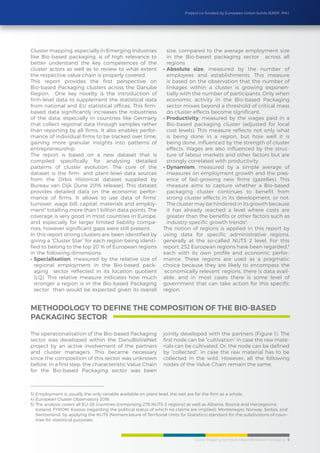
before. In a first step, the characteristic Value Chain
for the Bio-based Packaging sector was been
jointly developed with the partners (Figure 1). The
first node can be “cultivation” in case the raw mate-
rials can be cultivated. Or, the node can be defined
by “collected”, in case the raw material has to be
collected in the wild. However, all the following
nodes of the Value Chain remain the same.
Cluster Mapping Synthesis Report/BioBased Packaging 6
Project co-funded by European Union funds (ERDF, IPA)
In a next step, all partners and related cluster
managers did a detailed mapping of their
Bio-based Packaging cluster initiatives and clus-
ters in their region according to the pre-defined
Value Chain6
. For this purpose the members of
the identified cluster initiatives and clusters were
grouped by project partners and cluster managers
according to the specific nodes of the Bio-based
Packaging Value Chain they operate in. In those
cases, where no cluster initiatives existed, key
cluster actors were identified and grouped.
In a third step, the specific NACE industry classi-
fications7
for all members or cluster actors were
identified as part of the cluster mapping exercises,
that allowed to produce a reliable picture of the
Bio-based Packaging industry. The Bio-based
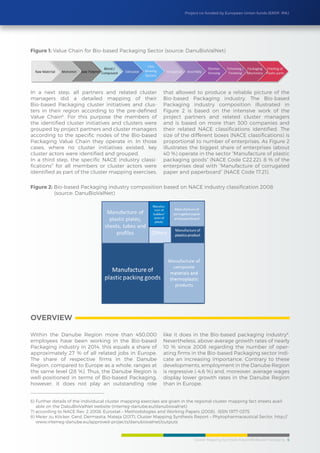
Packaging industry composition illustrated in
Figure 2 is based on the intensive work of the
project partners and related cluster managers
and is based on more than 300 companies and
their related NACE classifications identified. The
size of the different boxes (NACE classifications) is
proportional to number of enterprises. As Figure 2
illustrates the biggest share of enterprises (about
40 %) operate in the sector “Manufacture of plastic
packaging goods” (NACE Code C22.22). 8 % of the
enterprises deal with “Manufacture of corrugated
paper and paperboard” (NACE Code 17.21).
Figure 1: Value Chain for Bio-based Packaging Sector (source: DanuBioValNet)
Figure 2: Bio-based Packaging industry composition based on NACE industry classification 2008
	 (source: DanuBioValNet)
6) Further details of the individucal cluster mapping exercises are given in the regional cluster mapping fact sheets avail-
able on the DabuBioValNet website (interreg-danube.eu/danubiovalnet)
7) according to NACE Rev. 2 2008; Eurostat – Methodologies and Working Papers (2008), ISSN 1977-0375
8) Meier zu Köcker, Gerd, Dermastia, Mateja (2017), Cluster Mapping Synthesis Report – Phytopharmaceutical Sector, http://
www.interreg-danube.eu/approved-projects/danubiovalnet/outputs
oVERVIEW
Within the Danube Region more than 450,000
employees have been working in the Bio-based
Packaging industry in 2014, this equals a share of
approximately 27 % of all related jobs in Europe.
The share of respective firms in the Danube
Region, compared to Europe as a whole, ranges at
the same level (28 %). Thus, the Danube Region is
well-positioned in terms of Bio-based Packaging,
however, it does not play an outstanding role
like it does in the Bio-based packaging industry8
.
Nevertheless, above-average growth rates of nearly
10 % since 2008 regarding the number of oper-
ating firms in the Bio-based Packaging sector indi-
cate an increasing importance. Contrary to these
developments, employment in the Danube Region
is regressive (-4,6 %) and, moreover, average wages
display lower growth rates in the Danube Region
than in Europe.
Cluster Mapping Synthesis Report/BioBased Packaging 7
Project co-funded by European Union funds (ERDF, IPA)
Danube Region9
Europe10
Level in 2014
Change since
2008
Level in 2014
Change since
2008
Employment 457,746 -4.6 % 1,711,734 -4.4 %
Establishments 38,844 9.7 % 136,383 5.7 %
Average Wage (EUR) 23,975 3.4 % 36,872 6.6 %
Gazelle Employment11
8,473 No data 24,264 No data
Region No Star 1 Star 2 Stars 3 Stars 4 Stars
Danube 14 (22.2 %) 24 (38.1 %) 10 (15.9 %) 15 (23.8 %) 0
Rest of Europe 135 (58.4 %) 55 (23.8 %) 27 (11.7 %) 13 (5.6 %) 1 (0.4 %)
Table 1: Basic facts on Bio-based Packaging industries in the Danube Region compared to Europe
Table 2: Comparison of Cluster Stars between the Danube Region and Europe.
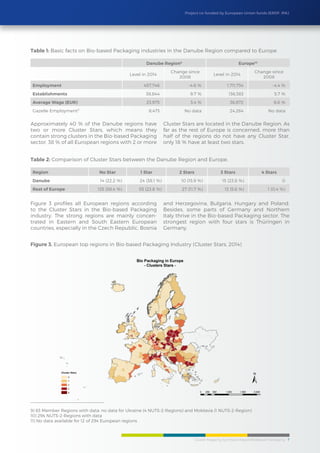
Figure 3. European top regions in Bio-based Packaging Industry (Cluster Stars, 2014)
Approximately 40 % of the Danube regions have
two or more Cluster Stars, which means they
contain strong clusters in the Bio-based Packaging
sector. 38 % of all European regions with 2 or more
Cluster Stars are located in the Danube Region. As
far as the rest of Europe is concerned, more than
half of the regions do not have any Cluster Star,
only 18 % have at least two stars.
Figure 3 profiles all European regions according
to the Cluster Stars in the Bio-based Packaging
industry. The strong regions are mainly concen-
trated in Eastern and South Eastern European
countries, especially in the Czech Republic, Bosnia
and Herzegovina, Bulgaria, Hungary and Poland.
Besides, some parts of Germany and Northern
Italy thrive in the Bio-based Packaging sector. The
strongest region with four stars is Thüringen in
Germany.
9) 63 Member Regions with data; no data for Ukraine (4 NUTS-2-Regions) and Moldavia (1 NUTS-2-Region)
10) 294 NUTS-2-Regions with data
11) No data available for 12 of 294 European regions
Cluster Mapping Synthesis Report/BioBased Packaging 8
Project co-funded by European Union funds (ERDF, IPA)
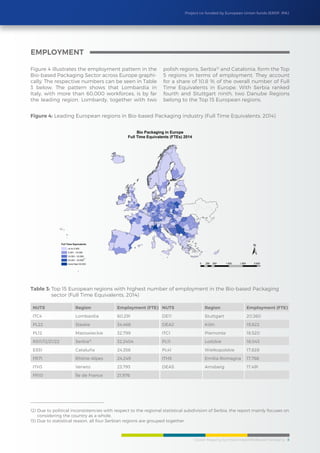
Figure 4 illustrates the employment pattern in the
Bio-based Packaging Sector across Europe graphi-
cally. The respective numbers can be seen in Table
3 below. The pattern shows that Lombardia in
Italy, with more than 60,000 workforces, is by far
the leading region. Lombardy, together with two
polish regions, Serbia12
and Catalonia, form the Top
5 regions in terms of employment. They account
for a share of 10.8 % of the overall number of Full
Time Equivalents in Europe. With Serbia ranked
fourth and Stuttgart ninth, two Danube Regions
belong to the Top 15 European regions.
employment
Figure 4: Leading European regions in Bio-based Packaging industry (Full Time Equivalents, 2014)
12) Due to political inconsistencies with respect to the regional statistical subdivision of Serbia, the report mainly focuses on
considering the country as a whole.
13) Due to statistical reason, all four Serbian regions are grouped together
NUTS Region Employment (FTE) NUTS Region Employment (FTE)
ITC4 Lombardia 60,291 DE11 Stuttgart 20,360
PL22 Slaskie 34,468 DEA2 Köln 19,822
PL12 Mazowieckie 32,799 ITC1 Piemonte 18,520
RS11/12/21/22 Serbia13
32,2404 PL11 Lodzkie 18,043
ES51 Cataluña 24,358 PL41 Wielkopolskie 17,828
FR71 Rhône-Alpes 24,249 ITH5 Emilia-Romagna 17,766
ITH3 Veneto 23,793 DEA5 Arnsberg 17,491
FR10 Île de France 21,976
Table 3: Top 15 European regions with highest number of employment in the Bio-based Packaging
sector (Full Time Equivalents, 2014)
Cluster Mapping Synthesis Report/BioBased Packaging 9
Project co-funded by European Union funds (ERDF, IPA)
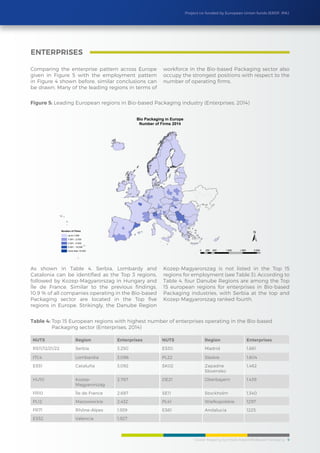
Comparing the enterprise pattern across Europe
given in Figure 5 with the employment pattern
in Figure 4 shown before, similar conclusions can
be drawn. Many of the leading regions in terms of
workforce in the Bio-based Packaging sector also
occupy the strongest positions with respect to the
number of operating firms.
As shown in Table 4, Serbia, Lombardy and
Catalonia can be identified as the Top 3 regions,
followed by Kozep-Magyarorszag in Hungary and
Île de France. Similar to the previous findings,
10.9 % of all companies operating in the Bio-based
Packaging sector are located in the Top five
regions in Europe. Strikingly, the Danube Region
Kozep-Magyarorszag is not listed in the Top 15
regions for employment (see Table 3). According to
Table 4, four Danube Regions are among the Top
15 european regions for enterprises in Bio-based
Packaging industries, with Serbia at the top and
Kozep-Magyarorszag ranked fourth.
Enterprises
Figure 5: Leading European regions in Bio-based Packaging industry (Enterprises, 2014)
NUTS Region Enterprises NUTS Region Enterprises
RS11/12/21/22 Serbia 3,250 ES30 Madrid 1,661
ITC4 Lombardia 3,096 PL22 Slaskie 1,604
ES51 Cataluña 3,092 SK02 Zapadne
Slovensko
1,462
HU10 Kozep-
Magyarorszag
2,787 DE21 Oberbayern 1,439
FR10 Île de France 2,687 SE11 Stockholm 1,340
PL12 Mazowieckie 2,432 PL41 Wielkopolskie 1297
FR71 Rhône-Alpes 1,939 ES61 Andalucía 1225
ES52 Valencia 1,927
Table 4: Top 15 European regions with highest number of enterprises operating in the Bio-based
Packaging sector (Enterprises, 2014)
Cluster Mapping Synthesis Report/BioBased Packaging 10
Project co-funded by European Union funds (ERDF, IPA)
Firm-level data was used to also identify so-called
‘Gazelles’14
. Due to the novelty of this data source
and differences in coverage across countries, the
results have to be interpreted with caution. In
particular, it seems likely that country-specific rules
and regulations, for example on taxation, have an
important influence on the presence of new busi-
ness formation that is not directly linked to the
overall dynamism of the economy. However, the
reader might consider these data to be interesting.
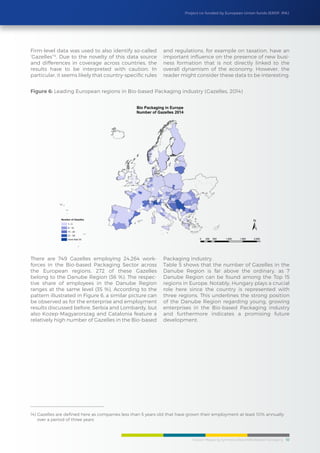
There are 749 Gazelles employing 24,264 work-
forces in the Bio-based Packaging Sector across
the European regions. 272 of these Gazelles
belong to the Danube Region (36 %). The respec-
tive share of employees in the Danube Region
ranges at the same level (35 %). According to the
pattern illustrated in Figure 6, a similar picture can
be observed as for the enterprise and employment
results discussed before. Serbia and Lombardy, but
also Kozep-Magyarorszag and Catalonia feature a
relatively high number of Gazelles in the Bio-based
Packaging industry.
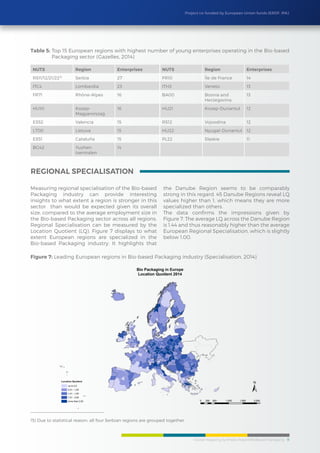
Table 5 shows that the number of Gazelles in the
Danube Region is far above the ordinary, as 7
Danube Region can be found among the Top 15
regions in Europe. Notably, Hungary plays a crucial
role here since the country is represented with
three regions. This underlines the strong position
of the Danube Region regarding young, growing
enterprises in the Bio-based Packaging industry
and furthermore indicates a promising future
development.
Figure 6: Leading European regions in Bio-based Packaging industry (Gazelles, 2014)
14) Gazelles are defined here as companies less than 5 years old that have grown their employment at least 10% annually
over a period of three years
Cluster Mapping Synthesis Report/BioBased Packaging 11
Project co-funded by European Union funds (ERDF, IPA)
NUTS Region Enterprises NUTS Region Enterprises
RS11/12/21/2215
Serbia 27 FR10 Île de France 14
ITC4 Lombardia 23 ITH3 Veneto 13
FR71 Rhône-Alpes 16 BA00 Bosnia and
Herzegovina
13
HU10 Kozep-
Magyarorszag
16 HU21 Kozep-Dunantul 12
ES52 Valencia 15 RS12 Vojvodina 12
LT00 Lietuva 15 HU22 Nyugat-Dunantul 12
ES51 Cataluña 15 PL22 Slaskie 11
BG42 Yuzhen
tsentralen
14
Table 5: Top 15 European regions with highest number of young enterprises operating in the Bio-based
Packaging sector (Gazelles, 2014)
15) Due to statistical reason, all four Serbian regions are grouped together
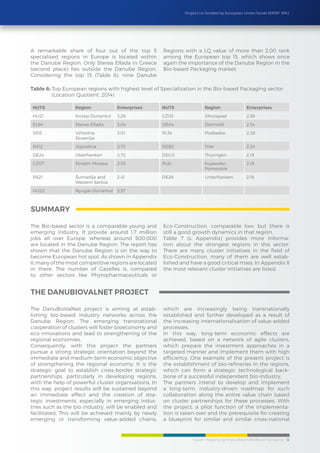
Measuring regional specialisation of the Bio-based
Packaging industry can provide interesting
insights to what extent a region is stronger in this
sector than would be expected given its overall
size, compared to the average employment size in
the Bio-based Packaging sector across all regions.
Regional Specialisation can be measured by the
Location Quotient (LQ). Figure 7 displays to what
extent European regions are specialized in the
Bio-based Packaging industry. It highlights that
the Danube Region seems to be comparably
strong in this regard. 45 Danube Regions reveal LQ
values higher than 1, which means they are more
specialized than others.
The data confirms the impressions given by
Figure 7. The average LQ across the Danube Region
is 1.44 and thus reasonably higher than the average
European Regional Specialisation, which is slightly
below 1.00.
regional specialisation
Figure 7: Leading European regions in Bio-based Packaging industry (Specialisation, 2014)
Cluster Mapping Synthesis Report/BioBased Packaging 12
Project co-funded by European Union funds (ERDF, IPA)
NUTS Region Enterprises NUTS Region Enterprises
HU21 Kozep-Dunantul 3,26 CZ03 Jihozapad 2.36
EL64 Sterea Ellada 3,04 DEA4 Detmold 2.34
SI03 Vzhodna
Slovenija
3.01 PL34 Podlaskie 2.28
RS12 Vojvodina 2.73 DEB2 Trier 2.24
DE24 Oberfranken 2.72 DEG0 Thüringen 2.19
CZ07 Stredni Morava 2.55 PL61 Kujawsko-
Pomorskie
2.18
RS21 Šumadija and
Western Serbia
2.41 DE26 Unterfranken 2.16
HU22 Nyugat-Dunantul 2.37
Table 6: Top European regions with highest level of Specialization in the Bio-based Packaging sector
(Location Quotient, 2014)
A remarkable share of four out of the top 5
specialised regions in Europe is located within
the Danube Region. Only Sterea Ellada in Greece
(second place) lies outside the Danube Region.
Considering the top 15 (Table 6), nine Danube
Regions with a LQ value of more than 2.00 rank
among the European top 15, which shows once
again the importance of the Danube Region in the
Bio-based Packaging market.
The Bio-based sector is a comparable young and
emerging industry. It provide around 1,7 million
jobs all over Europe, whereas around 500.000
are located in the Danube Region. The report has
shown that the Danube Region is on the way to
become European hot spot. As shown in Appendix
II, many of the most competitive regions are located
in there. The number of Gazelles is, compared
to other sectors like Phytopharmaceuticals or
Eco-Construction, comparable low, but there is
still a good growth dynamics in that region.
Table 7 (s. Appendix) provides more informa-
tion about the strongest regions in this sector.
There are many cluster initiatives in the field of
Eco-Construction, many of them are well estab-
lished and have a good critical mass. In Appendix II
the most relevant cluster initiatives are listed.
The DanuBioValNet project is aiming at estab-
lishing bio-based industry networks across the
Danube Region. The emerging transnational
cooperation of clusters will foster bioeconomy and
eco-innovations and lead to strengthening of the
regional economies.
Consequently, with this project the partners
pursue a strong strategic orientation beyond the
immediate and medium-term economic objective
of strengthening the regional economy. It is the
strategic goal to establish cross-border strategic
partnerships, particularly in developing regions,
with the help of powerful cluster organisations. In
this way, project results will be sustained beyond
an immediate effect and the creation of stra-
tegic investments, especially in emerging indus-
tries such as the bio industry, will be enabled and
facilitated. This will be achieved mainly by newly
emerging or transforming value-added chains,
which are increasingly being transnationally
established and further developed as a result of
the increasing internationalisation of value-added
processes.
In this way, long-term economic effects are
achieved, based on a network of agile clusters,
which prepare the investment approaches in a
targeted manner and implement them with high
efficiency. One example of the present project is
the establishment of bio-refineries in the regions,
which can form a strategic technological back-
bone of a successful independent bio-industry.
The partners intend to develop and implement
a long-term, industry-driven roadmap for such
collaboration along the entire value chain based
on cluster partnerships for these processes. With
the project, a pilot function of the implementa-
tion is taken over and the prerequisite for creating
a blueprint for similar and similar cross-national
summary
The DanuBioValNet Project
Cluster Mapping Synthesis Report/BioBased Packaging 13
Project co-funded by European Union funds (ERDF, IPA)
cooperation, also in other industries, is created.
For achieving these tasks, 17 project partners from
10 countries have joined forces. The project will
pave the way from an economy based on fossil
resources towards an economy using renewable
resources. The striving of the partners to minimise
greenhouse gases and resource-saving as well as
resource-efficient utilisation of available biomass
will result in synergistic effects. These effects will
improve the sustainability, regional development
through diversification of the local economy and
will also positively affect the workforce.
The development of new bio-based value chains
from primary production to consumer markets
needs to be done by connecting enterprises from
different regions and industries. But due to a
missing holistic transnational approach, Danube
actors in bio-based industry still operate discon-
nected and cannot properly benefit from the
potential. Therefore, the aim of this project is to
develop new methods, strategies and tools to
connect enterprises transnationally.
Clusters as the strong representatives of a group
of industries that are closely linked by common
products, markets, technologies and interests are
chosen to organise and bear the industry coop-
eration and creation of new value chains, because
they are performant and sustainable partners and
guarantee the upgradeability in the dimension
industry, sciences and also politics.
One of the planned outputs of this project will be
the development of a Joint Bio-based Industry
Cluster Policy Strategy (JBCS) to describe the
procedure and to make it actionable and reusable.
Furthermore, a bundle of new methods and tools
to support clusters for transnational working will
be developed and joint into a strategy. They will be
tested in three pilot actions where it is planned to
create new bio-based value chains in the Danube
Region.
The main target groups are on the one hand the
policy – four Ministries are involved –, on the other
hand clusters and their SMEs – nine cluster organi-
sations are involved. The policy level will benefit
from the JBCS, which can be used as a political
framework.
The clusters and SMEs will benefit from the new
innovative tools and methods developed for trans-
national cross-clustering. Successfully established
new bio-based value chains in the pilot actions
can motivate other clusters and SMEs to test this
newly developed approach in the future.
The following partners commit to the implemen-
tation of the cluster partnership and transnational
cooperation:
Role Official Name in English Acronym Country
LP BIOPRO Baden-Württemberg GmbH BIOPRO Germany
ERDF PP1 ClusterAgentur Baden-Württemberg CA BW Germany
ERDF PP2 Anteja ECG ANT Slovenia
ERDF PP3 PROUNION PU Slovakia
ERDF PP4 Romanian Cluster Association CLUSTERO Romania
ERDF PP5 Association of Business Clusters ABC Bulgaria
ERDF PP6 National Cluster Association – CZ NCA Czech Republic
ERDF PP7 Business Upper Austria – OÖ Wirtschaftsagentur GmbH
– Upper Austrian Food Cluster UAFC Austria
ERDF PP8 Ministry of Economy ME Romania
ERDF PP9 Ministry of Economy, Entrepreneurship and Crafts MEC Croatia
ERDF PP10 Ministry of Education, Science and Sport MIZS Slovenia
ERDF PP11 Croatian Wood Cluster CWC Croatia
ERDF PP12 Institute for Economic Forecasting IPE Romania
ERDF PP13 Business Upper Austria – OÖ Wirtschaftsagentur GmbH
– Cleantech-Cluster BizUp Austria
IPA PP1 Innovation Center of Faculty of Mechanical Engineering ICME Serbia
ASP1 Montenegro Vine Cluster MVC Montenegro
ASP2 Ministry of Economic Affairs, Labour and Housing
Baden-Württemberg
WM Germany
LP = Lead Partner, PP = Project Partner, IPA = Instrument for Pre-Accession, ASP = Associated Strategic Partner,
ERDF = European Regional Development Fund
Cluster Mapping Synthesis Report/BioBased Packaging 14
Project co-funded by European Union funds (ERDF, IPA)
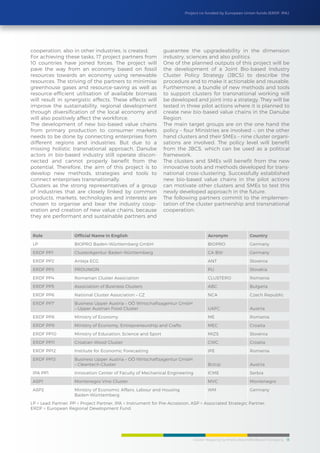
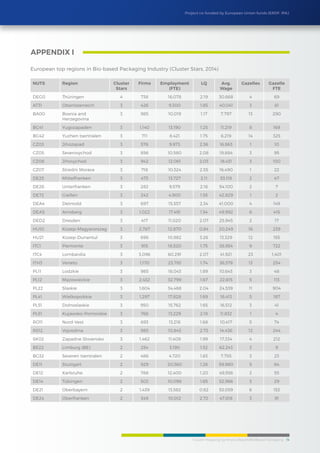
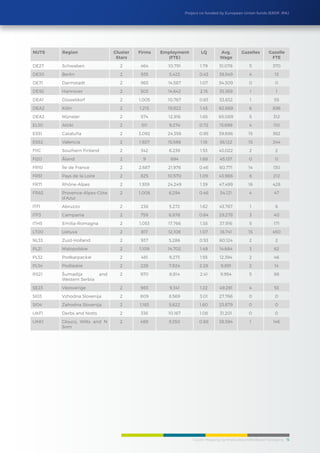
APPENDIX I
European top regions in Bio-based Packaging Industry (Cluster Stars, 2014)
NUTS Region Cluster
Stars
Firms Employment
(FTE)
LQ Avg.
Wage
Gazelles Gazelle
FTE
DEG0 Thüringen 4 738 16,078 2.19 30,668 4 69
AT31 Oberösterreich 3 426 9,300 1.85 40,041 3 81
BA00 Bosnia and
Herzegovina
3 985 10,019 1.17 7,797 13 290
BG41 Yugozapaden 3 1,140 13,190 1.25 11,219 8 169
BG42 Yuzhen tsentralen 3 711 8,421 1.75 6,219 14 325
CZ03 Jihozapad 3 576 9,973 2.36 16,863 1 10
CZ05 Severovychod 3 856 10,580 2.08 19,884 3 95
CZ06 Jihovychod 3 942 12,061 2.03 18,431 3 100
CZ07 Stredni Morava 3 718 10,324 2.55 16,490 1 22
DE25 Mittelfranken 3 473 13,727 2.11 53,118 2 47
DE26 Unterfranken 3 282 9,579 2.16 54,100 2 7
DE72 Gießen 3 242 4,900 1.55 42,829 1 2
DEA4 Detmold 3 697 15,557 2.34 41,000 4 149
DEA5 Arnsberg 3 1,022 17,491 1.54 49,992 6 415
DED2 Dresden 3 417 11,020 2.07 25,945 2 17
HU10 Kozep-Magyarorszag 3 2,787 12,870 0.84 20,249 16 239
HU21 Kozep-Dunantul 3 698 10,982 3.26 13,329 12 155
ITC1 Piemonte 3 915 18,520 1.75 38,954 9 722
ITC4 Lombardia 3 3,096 60,291 2.07 41,921 23 1,401
ITH3 Veneto 3 1,170 23,793 1.74 36,379 13 254
PL11 Lodzkie 3 985 18,043 1.89 10,643 3 48
PL12 Mazowieckie 3 2,432 32,799 1.67 22,615 5 113
PL22 Slaskie 3 1,604 34,468 2.04 24,539 11 904
PL41 Wielkopolskie 3 1,297 17,828 1.69 16,413 5 187
PL51 Dolnoslaskie 3 950 15,762 1.65 16,512 3 41
PL61 Kujawsko-Pomorskie 3 766 13,229 2.18 11,832 1 4
RO11 Nord-Vest 3 693 13,216 1.68 10,417 5 74
RS12 Vojvodina 3 985 10,843 2.73 14,436 12 244
SK02 Zapadne Slovensko 3 1,462 11,409 1.99 17,334 4 212
BE22 Limburg (BE) 2 254 3,190 1.52 62,243 3 9
BG32 Severen tsentralen 2 486 4,720 1.63 7,755 3 23
DE11 Stuttgart 2 929 20,360 1.26 59,980 5 64
DE12 Karlsruhe 2 788 12,400 1.20 49,556 2 55
DE14 Tübingen 2 502 10,098 1.65 52,986 3 29
DE21 Oberbayern 2 1,439 13,582 0.82 53,059 6 153
DE24 Oberfranken 2 349 10,012 2.72 47,818 3 91
Cluster Mapping Synthesis Report/BioBased Packaging 15
Project co-funded by European Union funds (ERDF, IPA)
NUTS Region Cluster
Stars
Firms Employment
(FTE)
LQ Avg.
Wage
Gazelles Gazelle
FTE
DE27 Schwaben 2 464 10,791 1.79 51,078 5 370
DE30 Berlin 2 935 5,423 0.43 39,549 4 13
DE71 Darmstadt 2 965 14,587 1.07 54,309 0 0
DE92 Hannover 2 503 14,642 2.15 35,369 1 1
DEA1 Düsseldorf 2 1,005 10,767 0.63 53,832 1 55
DEA2 Köln 2 1,215 19,822 1.45 62,869 6 896
DEA3 Münster 2 574 12,916 1.65 65,089 5 312
EL30 Attiki 2 511 9,274 0.72 15,699 4 110
ES51 Cataluña 2 3,092 24,358 0.95 39,886 15 362
ES52 Valencia 2 1,927 15,586 1.18 36,122 15 244
FI1C Southern Finland 2 342 6,239 1.53 43,022 2 2
FI20 Åland 2 9 694 1.88 45,137 0 0
FR10 Île de France 2 2,687 21,976 0.46 60,771 14 130
FR51 Pays de la Loire 2 825 10,570 1.09 43,988 6 212
FR71 Rhône-Alpes 2 1,939 24,249 1.39 47,499 16 428
FR82 Provence-Alpes-Côte
d’Azur
2 1,008 6,294 0.46 54,121 4 47
ITF1 Abruzzo 2 238 5,272 1.62 43,767 1 6
ITF3 Campania 2 759 6,878 0.64 29,278 3 40
ITH5 Emilia-Romagna 2 1,053 17,766 1.38 37,916 5 171
LT00 Lietuva 2 817 12,108 1.07 18,741 15 450
NL33 Zuid-Holland 2 937 5,286 0.53 60,124 2 2
PL21 Malopolskie 2 1,109 14,702 1.49 14,684 3 62
PL32 Podkarpackie 2 481 9,273 1.55 12,394 2 46
PL34 Podlaskie 2 228 7,824 2.28 9,891 2 14
RS21 Šumadija and
Western Serbia
2 970 8,814 2.41 9,954 5 88
SE23 Västsverige 2 983 9,341 1.22 49,281 4 53
SI03 Vzhodna Slovenija 2 809 8,569 3.01 27,766 0 0
SI04 Zahodna Slovenija 2 1,183 5,622 1.60 23,879 0 0
UKF1 Derbs and Notts 2 336 10,167 1.08 31,201 0 0
UKK1 Gloucs, Wilts and N
Som
2 488 9,350 0.88 38,594 1 146
Project co-funded by European Union funds (ERDF, IPA)
16
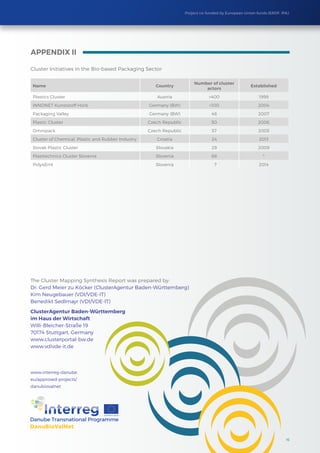
APPENDIX II
Cluster Initiatives in the Bio-based Packaging Sector
Name Country
Number of cluster
actors
Established
Plastics Cluster Austria 400 1999
INNONET Kunststoff Horb Germany (BW) 100 2004
Packaging Valley Germany (BW) 48 2007
Plastic Cluster Czech Republic 50 2006
Omnipack Czech Republic 57 2005
Cluster of Chemical, Plastic and Rubber Industry Croatia 24 2013
Slovak Plastic Cluster Slovakia 29 2009
Plasttechnics Cluster Slovenia Slovenia 68 *
Poly4EmI Slovenia 7 2014
The Cluster Mapping Synthesis Report was prepared by:
Dr. Gerd Meier zu Köcker (ClusterAgentur Baden-Württemberg)
Kim Neugebauer (VDI/VDE-IT)
Benedikt Sedlmayr (VDI/VDE-IT)
ClusterAgentur Baden-Württemberg
im Haus der Wirtschaft
Willi-Bleicher-Straße 19
70174 Stuttgart, Germany
www.clusterportal-bw.de
www.vdivde-it.de
www.interreg-danube.
eu/approved-projects/
danubiovalnet

Cluster Mapping Bio-Packaging

  • 1.
    Project co-funded byEuropean Union funds (ERDF, IPA) Cluster Mapping Synthesis Report Bio-based Packaging Cross-clustering partnership for boosting eco-innovation by developing a joint bio-based value-added network for the Danube Region interreg-danube.eu/danubiovalnet twitter.com/danu_bioval
  • 2.
    Cluster Mapping SynthesisReport/BioBased Packaging 2 Project co-funded by European Union funds (ERDF, IPA) This report has been produced within the frame of the DanuBioValNet project (Activity 3.2 Cluster Mapping, Deliverable 3.2.1), funded by the Danube Region INTERREG Programme of the European Commission. It was prepared by Dr. Gerd Meier zu Köcker (ClusterAgentur Baden-Württemberg), Kim Neugebauer (VDI/VDE-IT) and Benedikt Sedlmayr (VDI/VDE-IT). This report was drafted with input gathered from all project partners over the second phase of the project implementation (July – December 2017). The authors would like to thank all partners for their contributions and significant efforts, especially Sergiy Protsiv (Stanford University, US) and Michael Nerger (VDI/VDE-IT). Disclaimer The information and perspectives set out in this Report are those of the authors and do not necessarily reflect the official opinion of the European Commission or the project partners’ regions. Neither the European Commission institutions and bodies nor any person acting on their behalf may be held responsible for the use that may be made of the information contained therein. Reproduction is authorised, provided the source is acknowledged, unless otherwise stated. For use/reproduction of third party material specified as such, permission must be obtained from the copyright. For further information about the DanuBioValNet project, you will find a short descrip- tion at the end of the document. To learn more and to download additional resources please refer to the project website http://www.interreg-danube.eu/approved-projects/ danubiovalnet. The information is provided without assuming any legal responsibility for correctness or completeness. The data presented in the report are based on the information given by the project partners. © DanuBioValNet, 2017
  • 3.
    Cluster Mapping SynthesisReport/BioBased Packaging 3 Project co-funded by European Union funds (ERDF, IPA) Contents Introduction........................................................................................................................................................................................4 The Cluster Mapping Approach.............................................................................................................................4 Composition of the Bio-based Packaging Sector........................................................................ 5 Overview...................................................................................................................................................................................................6 Employment.......................................................................................................................................................................................8 Enterprises.............................................................................................................................................................................................9 Regional Specialisation..................................................................................................................................................... 11 Summary................................................................................................................................................................................................12 The DanuBioValNet Project..........................................................................................................................................12 APPENDIX I......................................................................................................................................................................................... 14 APPENDIX II....................................................................................................................................................................................... 16
  • 4.
    Cluster Mapping SynthesisReport/BioBased Packaging 4 Project co-funded by European Union funds (ERDF, IPA) Bio-based packaging materials can be defined like „materials derived from renewable sources“. In addition such materials recognised as biodegrad- able according to the standards outlined in related EU Standards can be also understood a bio-based materials1 . By the 1970s petroleum-based materials, had to a large extent, replaced those materials derived from natural resources. But this trend is about to change again since recent developments are raising the prospects that natural based resources will be a major contributor to the production of industrial products. Significant steps forward have been made over the recent past in terms of new products, material and processes that will bring down costs and optimize performance of bio- based packaging materials. At the same time envi- ronmental concerns are high on the policy agenda of industrial countries and public debates are intensifying the interest in agricultural and forestry resources as alternative feedstocks. However, the biggest challenge remains the development of new markets and costs and performance competitive bio-based packaging materials. A high potental market for such materials is the food packaging, a highly comparative areas with increasing demands from the market side. There are many national and multinational initiatives that further fuel the demand for new bio-based packaging material. Among others, compostability, which is a very appealing property when the packaging meets its end of useful like, is a key fuctional behaviour to successfully reach the goal of Circulare Economy. In the following as short summary is give about the mostly used bio-based materials and their possible packaging applications. These include both relatively old materiasl s such as paper, board and wood as well as the much newer bio-based plastics. Paper and board-based packaging is very popular, particularly among consumers. This is one reason why paper and board are among the most widely used packaging materials in the world, including in Europe. Paper and board are bio-based (in Europe from sustainably managed woods, with PEFC or FSC mark), recyclable, biodegradable and suitable for thermal recycling (incineration). Apart from its application in paper and board, wood is mainly used for transportation in the form of pallets and crates. The big advantage of wooden pallets is that they are sturdy, easy to repair and have a long life. Renewables can be used to make bio-based plas- tics that are identical to petrochemical plastics. Well-known examples are bio-PE and bio-PET. These bio-based plastics are also referred to as ‘drop-in ’ plastics. The advantage of both bio-PE and bio-PET is that these materials can be processed via the conventional recycling routes. The strong surge in the use of bio-based packaging is largely attributable to bio-PE and bio-PET. Other more recent bio-based plastics are PLA (polylactic acid), starch blends and PHAs (Polyhydroxalkanoates). Besides being a chief component of paper, cellulose is also used to make products such as cellophane (film), viscose (fibres) and cellulose derivatives such as cellulose acetate. Cellophane is widely used as a packaging material for e.g. confectionery and floral bouquets. INTRODUCTION 1) Claus J. Weber (eds), 2000, Bio-based Packaging Materials, The Royal Veterinary and Agricultural University, ISBN 87-90504-07-0 2) Christian Ketels (2017), Cluster Mapping as Tool for Development, Havard Business School, http://www.hbs.edu/faculty/ Publication%20Files/Cluster%20Mapping%20as%20a%20Tool%20for%20Development%20_%20report_ISC%20 WP%20version%2010-10-17_c46d2cf1-41ed-43c0-bfd8-932957a4ceda.pdf The Cluster Mapping Approach Clusters can be understood as regional concentra- tions of economic activities in related industries connected through local linkages and spill-overs, have long been known to be a feature of market economy2 . Cluster organisations can help firms to better engage with other local actors within their cluster and to organise collective action to strengthen the local context. And they can reduce the transaction costs for firms, especially SMEs, in building linkages to firms and collaboration part- ners in other locations. Clusters have a distinct geographic dimension, reflecting the dynamics of local spill-overs. They are also deeply embedded in a broader geographic context: they serve markets elsewhere and are connected to other clusters with complemen- tary strengths in regional, interregional or global value chains. This mirrors the role of location for firms: while local conditions provide the unique context for building distinct capabilities and stra- tegic positions, national and international linkages are critical to access other markets, suppliers, and collaboration partner. Cluster mapping describes the process of meas- uring the presence of cluster actors in a given region across defined sector-specific value chains.
  • 5.
    Cluster Mapping SynthesisReport/BioBased Packaging 5 Project co-funded by European Union funds (ERDF, IPA) Cluster mapping, especially in Emerging Industries like Bio-based packaging, is of high relevance to better understand the key competences of the cluster actors as well as to review to what extent the respective value chain is properly covered. This report provides the first perspective on Bio-based Packaging clusters across the Danube Region. One key novelty is the introduction of firm-level data to supplement the statistical data from national and EU statistical offices. This firm- based data significantly increases the robustness of the data, especially in countries like Germany that collect regional data through samples rather than reporting by all firms. It also enables perfor- mance of individual firms to be tracked over time, gaining more granular insights into patterns of entrepreneurship. The report is based on a new dataset that is compiled specifically for analysing detailed patterns of cluster evolution. The core of the dataset is the firm- and plant-level data sources from the Orbis Historical dataset supplied by Bureau van Dijk (June 2016 release). This dataset provides detailed data on the economic perfor- mance of firms. It allows to use data of firms’ turnover, wage bill, capital, materials and employ- ment3 totalling more than 1 billion data points. The coverage is very good in most countries in Europe, and especially for larger limited liability compa- nies, however significant gaps were still present. In this report strong clusters are been identified by giving a “Cluster Star” for each region being identi- fied to belong to the top 20 % of European regions in the following dimensions: • Specialisation, measured by the relative size of regional employment in the Bio-based pack- aging sector reflected in its location quotient (LQ). This relative measure indicates how much stronger a region is in the Bio-based Packaging sector than would be expected given its overall size, compared to the average employment size in the Bio-based packaging sector across all regions • Absolute size, measured by the number of employees and establishments. This measure is based on the observation that the number of linkages within a cluster is growing exponen- tially with the number of participants. Only when economic activity in the Bio-based Packaging sector moves beyond a threshold of critical mass do cluster effects become significant. • Productivity, measured by the wages paid in a Bio-based packaging cluster (adjusted for local cost levels). This measure reflects not only what is being done in a region, but how well it is being done, influenced by the strength of cluster effects. Wages are also influenced by the struc- ture of labour markets and other factors but are strongly correlated with productivity. • Dynamism, measured by a simple average of measures on employment growth and the pres- ence of fast-growing new firms (gazelles). This measure aims to capture whether a Bio-based packaging cluster continues to benefit from strong cluster effects in its development, or not. The cluster may be hindered in its growth because it has already reached a level where costs are greater than the benefits or other factors such as industry-specific growth trends4 . The notion of regions is applied in this report by using data for specific administrative regions, generally at the so-called NUTS 2 level. For this report, 252 European regions have been regarded,5 each with its own profile and economic perfor- mance. These regions are used as a pragmatic choice because they are likely to encompass the ‘economically relevant’ regions, there is data avail- able, and in most cases there is some level of government that can take action for this specific region. 3) Employment is usually the only variable available on plant level, the rest are for the firm as a whole. 4) European Cluster Observatory 2016 5) The analysis covers all EU-28 countries (comprising 276 NUTS-2 regions) as well as Albania, Bosnia and Herzegovina, Iceland, FYROM, Kosovo (regarding the political status of which no claims are implied), Montenegro, Norway, Serbia, and Switzerland, by applying the NUTS (Nomenclature of Territorial Units for Statistics) standard for the subdivisions of coun- tries for statistical purposes. Methodology to Define the Composition of the Bio-based Packaging Sector The operationalisation of the Bio-based Packaging sector was developed within the DanuBioValNet project by an active involvement of the partners and cluster managers. This became necessary since the composition of this sector was unknown before. In a first step, the characteristic Value Chain for the Bio-based Packaging sector was been jointly developed with the partners (Figure 1). The first node can be “cultivation” in case the raw mate- rials can be cultivated. Or, the node can be defined by “collected”, in case the raw material has to be collected in the wild. However, all the following nodes of the Value Chain remain the same.
  • 6.
    Cluster Mapping SynthesisReport/BioBased Packaging 6 Project co-funded by European Union funds (ERDF, IPA) In a next step, all partners and related cluster managers did a detailed mapping of their Bio-based Packaging cluster initiatives and clus- ters in their region according to the pre-defined Value Chain6 . For this purpose the members of the identified cluster initiatives and clusters were grouped by project partners and cluster managers according to the specific nodes of the Bio-based Packaging Value Chain they operate in. In those cases, where no cluster initiatives existed, key cluster actors were identified and grouped. In a third step, the specific NACE industry classi- fications7 for all members or cluster actors were identified as part of the cluster mapping exercises, that allowed to produce a reliable picture of the Bio-based Packaging industry. The Bio-based Packaging industry composition illustrated in Figure 2 is based on the intensive work of the project partners and related cluster managers and is based on more than 300 companies and their related NACE classifications identified. The size of the different boxes (NACE classifications) is proportional to number of enterprises. As Figure 2 illustrates the biggest share of enterprises (about 40 %) operate in the sector “Manufacture of plastic packaging goods” (NACE Code C22.22). 8 % of the enterprises deal with “Manufacture of corrugated paper and paperboard” (NACE Code 17.21). Figure 1: Value Chain for Bio-based Packaging Sector (source: DanuBioValNet) Figure 2: Bio-based Packaging industry composition based on NACE industry classification 2008 (source: DanuBioValNet) 6) Further details of the individucal cluster mapping exercises are given in the regional cluster mapping fact sheets avail- able on the DabuBioValNet website (interreg-danube.eu/danubiovalnet) 7) according to NACE Rev. 2 2008; Eurostat – Methodologies and Working Papers (2008), ISSN 1977-0375 8) Meier zu Köcker, Gerd, Dermastia, Mateja (2017), Cluster Mapping Synthesis Report – Phytopharmaceutical Sector, http:// www.interreg-danube.eu/approved-projects/danubiovalnet/outputs oVERVIEW Within the Danube Region more than 450,000 employees have been working in the Bio-based Packaging industry in 2014, this equals a share of approximately 27 % of all related jobs in Europe. The share of respective firms in the Danube Region, compared to Europe as a whole, ranges at the same level (28 %). Thus, the Danube Region is well-positioned in terms of Bio-based Packaging, however, it does not play an outstanding role like it does in the Bio-based packaging industry8 . Nevertheless, above-average growth rates of nearly 10 % since 2008 regarding the number of oper- ating firms in the Bio-based Packaging sector indi- cate an increasing importance. Contrary to these developments, employment in the Danube Region is regressive (-4,6 %) and, moreover, average wages display lower growth rates in the Danube Region than in Europe.
  • 7.
    Cluster Mapping SynthesisReport/BioBased Packaging 7 Project co-funded by European Union funds (ERDF, IPA) Danube Region9 Europe10 Level in 2014 Change since 2008 Level in 2014 Change since 2008 Employment 457,746 -4.6 % 1,711,734 -4.4 % Establishments 38,844 9.7 % 136,383 5.7 % Average Wage (EUR) 23,975 3.4 % 36,872 6.6 % Gazelle Employment11 8,473 No data 24,264 No data Region No Star 1 Star 2 Stars 3 Stars 4 Stars Danube 14 (22.2 %) 24 (38.1 %) 10 (15.9 %) 15 (23.8 %) 0 Rest of Europe 135 (58.4 %) 55 (23.8 %) 27 (11.7 %) 13 (5.6 %) 1 (0.4 %) Table 1: Basic facts on Bio-based Packaging industries in the Danube Region compared to Europe Table 2: Comparison of Cluster Stars between the Danube Region and Europe. Figure 3. European top regions in Bio-based Packaging Industry (Cluster Stars, 2014) Approximately 40 % of the Danube regions have two or more Cluster Stars, which means they contain strong clusters in the Bio-based Packaging sector. 38 % of all European regions with 2 or more Cluster Stars are located in the Danube Region. As far as the rest of Europe is concerned, more than half of the regions do not have any Cluster Star, only 18 % have at least two stars. Figure 3 profiles all European regions according to the Cluster Stars in the Bio-based Packaging industry. The strong regions are mainly concen- trated in Eastern and South Eastern European countries, especially in the Czech Republic, Bosnia and Herzegovina, Bulgaria, Hungary and Poland. Besides, some parts of Germany and Northern Italy thrive in the Bio-based Packaging sector. The strongest region with four stars is Thüringen in Germany. 9) 63 Member Regions with data; no data for Ukraine (4 NUTS-2-Regions) and Moldavia (1 NUTS-2-Region) 10) 294 NUTS-2-Regions with data 11) No data available for 12 of 294 European regions
  • 8.
    Cluster Mapping SynthesisReport/BioBased Packaging 8 Project co-funded by European Union funds (ERDF, IPA) Figure 4 illustrates the employment pattern in the Bio-based Packaging Sector across Europe graphi- cally. The respective numbers can be seen in Table 3 below. The pattern shows that Lombardia in Italy, with more than 60,000 workforces, is by far the leading region. Lombardy, together with two polish regions, Serbia12 and Catalonia, form the Top 5 regions in terms of employment. They account for a share of 10.8 % of the overall number of Full Time Equivalents in Europe. With Serbia ranked fourth and Stuttgart ninth, two Danube Regions belong to the Top 15 European regions. employment Figure 4: Leading European regions in Bio-based Packaging industry (Full Time Equivalents, 2014) 12) Due to political inconsistencies with respect to the regional statistical subdivision of Serbia, the report mainly focuses on considering the country as a whole. 13) Due to statistical reason, all four Serbian regions are grouped together NUTS Region Employment (FTE) NUTS Region Employment (FTE) ITC4 Lombardia 60,291 DE11 Stuttgart 20,360 PL22 Slaskie 34,468 DEA2 Köln 19,822 PL12 Mazowieckie 32,799 ITC1 Piemonte 18,520 RS11/12/21/22 Serbia13 32,2404 PL11 Lodzkie 18,043 ES51 Cataluña 24,358 PL41 Wielkopolskie 17,828 FR71 Rhône-Alpes 24,249 ITH5 Emilia-Romagna 17,766 ITH3 Veneto 23,793 DEA5 Arnsberg 17,491 FR10 Île de France 21,976 Table 3: Top 15 European regions with highest number of employment in the Bio-based Packaging sector (Full Time Equivalents, 2014)
  • 9.
    Cluster Mapping SynthesisReport/BioBased Packaging 9 Project co-funded by European Union funds (ERDF, IPA) Comparing the enterprise pattern across Europe given in Figure 5 with the employment pattern in Figure 4 shown before, similar conclusions can be drawn. Many of the leading regions in terms of workforce in the Bio-based Packaging sector also occupy the strongest positions with respect to the number of operating firms. As shown in Table 4, Serbia, Lombardy and Catalonia can be identified as the Top 3 regions, followed by Kozep-Magyarorszag in Hungary and Île de France. Similar to the previous findings, 10.9 % of all companies operating in the Bio-based Packaging sector are located in the Top five regions in Europe. Strikingly, the Danube Region Kozep-Magyarorszag is not listed in the Top 15 regions for employment (see Table 3). According to Table 4, four Danube Regions are among the Top 15 european regions for enterprises in Bio-based Packaging industries, with Serbia at the top and Kozep-Magyarorszag ranked fourth. Enterprises Figure 5: Leading European regions in Bio-based Packaging industry (Enterprises, 2014) NUTS Region Enterprises NUTS Region Enterprises RS11/12/21/22 Serbia 3,250 ES30 Madrid 1,661 ITC4 Lombardia 3,096 PL22 Slaskie 1,604 ES51 Cataluña 3,092 SK02 Zapadne Slovensko 1,462 HU10 Kozep- Magyarorszag 2,787 DE21 Oberbayern 1,439 FR10 Île de France 2,687 SE11 Stockholm 1,340 PL12 Mazowieckie 2,432 PL41 Wielkopolskie 1297 FR71 Rhône-Alpes 1,939 ES61 Andalucía 1225 ES52 Valencia 1,927 Table 4: Top 15 European regions with highest number of enterprises operating in the Bio-based Packaging sector (Enterprises, 2014)
  • 10.
    Cluster Mapping SynthesisReport/BioBased Packaging 10 Project co-funded by European Union funds (ERDF, IPA) Firm-level data was used to also identify so-called ‘Gazelles’14 . Due to the novelty of this data source and differences in coverage across countries, the results have to be interpreted with caution. In particular, it seems likely that country-specific rules and regulations, for example on taxation, have an important influence on the presence of new busi- ness formation that is not directly linked to the overall dynamism of the economy. However, the reader might consider these data to be interesting. There are 749 Gazelles employing 24,264 work- forces in the Bio-based Packaging Sector across the European regions. 272 of these Gazelles belong to the Danube Region (36 %). The respec- tive share of employees in the Danube Region ranges at the same level (35 %). According to the pattern illustrated in Figure 6, a similar picture can be observed as for the enterprise and employment results discussed before. Serbia and Lombardy, but also Kozep-Magyarorszag and Catalonia feature a relatively high number of Gazelles in the Bio-based Packaging industry. Table 5 shows that the number of Gazelles in the Danube Region is far above the ordinary, as 7 Danube Region can be found among the Top 15 regions in Europe. Notably, Hungary plays a crucial role here since the country is represented with three regions. This underlines the strong position of the Danube Region regarding young, growing enterprises in the Bio-based Packaging industry and furthermore indicates a promising future development. Figure 6: Leading European regions in Bio-based Packaging industry (Gazelles, 2014) 14) Gazelles are defined here as companies less than 5 years old that have grown their employment at least 10% annually over a period of three years
  • 11.
    Cluster Mapping SynthesisReport/BioBased Packaging 11 Project co-funded by European Union funds (ERDF, IPA) NUTS Region Enterprises NUTS Region Enterprises RS11/12/21/2215 Serbia 27 FR10 Île de France 14 ITC4 Lombardia 23 ITH3 Veneto 13 FR71 Rhône-Alpes 16 BA00 Bosnia and Herzegovina 13 HU10 Kozep- Magyarorszag 16 HU21 Kozep-Dunantul 12 ES52 Valencia 15 RS12 Vojvodina 12 LT00 Lietuva 15 HU22 Nyugat-Dunantul 12 ES51 Cataluña 15 PL22 Slaskie 11 BG42 Yuzhen tsentralen 14 Table 5: Top 15 European regions with highest number of young enterprises operating in the Bio-based Packaging sector (Gazelles, 2014) 15) Due to statistical reason, all four Serbian regions are grouped together Measuring regional specialisation of the Bio-based Packaging industry can provide interesting insights to what extent a region is stronger in this sector than would be expected given its overall size, compared to the average employment size in the Bio-based Packaging sector across all regions. Regional Specialisation can be measured by the Location Quotient (LQ). Figure 7 displays to what extent European regions are specialized in the Bio-based Packaging industry. It highlights that the Danube Region seems to be comparably strong in this regard. 45 Danube Regions reveal LQ values higher than 1, which means they are more specialized than others. The data confirms the impressions given by Figure 7. The average LQ across the Danube Region is 1.44 and thus reasonably higher than the average European Regional Specialisation, which is slightly below 1.00. regional specialisation Figure 7: Leading European regions in Bio-based Packaging industry (Specialisation, 2014)
  • 12.
    Cluster Mapping SynthesisReport/BioBased Packaging 12 Project co-funded by European Union funds (ERDF, IPA) NUTS Region Enterprises NUTS Region Enterprises HU21 Kozep-Dunantul 3,26 CZ03 Jihozapad 2.36 EL64 Sterea Ellada 3,04 DEA4 Detmold 2.34 SI03 Vzhodna Slovenija 3.01 PL34 Podlaskie 2.28 RS12 Vojvodina 2.73 DEB2 Trier 2.24 DE24 Oberfranken 2.72 DEG0 Thüringen 2.19 CZ07 Stredni Morava 2.55 PL61 Kujawsko- Pomorskie 2.18 RS21 Šumadija and Western Serbia 2.41 DE26 Unterfranken 2.16 HU22 Nyugat-Dunantul 2.37 Table 6: Top European regions with highest level of Specialization in the Bio-based Packaging sector (Location Quotient, 2014) A remarkable share of four out of the top 5 specialised regions in Europe is located within the Danube Region. Only Sterea Ellada in Greece (second place) lies outside the Danube Region. Considering the top 15 (Table 6), nine Danube Regions with a LQ value of more than 2.00 rank among the European top 15, which shows once again the importance of the Danube Region in the Bio-based Packaging market. The Bio-based sector is a comparable young and emerging industry. It provide around 1,7 million jobs all over Europe, whereas around 500.000 are located in the Danube Region. The report has shown that the Danube Region is on the way to become European hot spot. As shown in Appendix II, many of the most competitive regions are located in there. The number of Gazelles is, compared to other sectors like Phytopharmaceuticals or Eco-Construction, comparable low, but there is still a good growth dynamics in that region. Table 7 (s. Appendix) provides more informa- tion about the strongest regions in this sector. There are many cluster initiatives in the field of Eco-Construction, many of them are well estab- lished and have a good critical mass. In Appendix II the most relevant cluster initiatives are listed. The DanuBioValNet project is aiming at estab- lishing bio-based industry networks across the Danube Region. The emerging transnational cooperation of clusters will foster bioeconomy and eco-innovations and lead to strengthening of the regional economies. Consequently, with this project the partners pursue a strong strategic orientation beyond the immediate and medium-term economic objective of strengthening the regional economy. It is the strategic goal to establish cross-border strategic partnerships, particularly in developing regions, with the help of powerful cluster organisations. In this way, project results will be sustained beyond an immediate effect and the creation of stra- tegic investments, especially in emerging indus- tries such as the bio industry, will be enabled and facilitated. This will be achieved mainly by newly emerging or transforming value-added chains, which are increasingly being transnationally established and further developed as a result of the increasing internationalisation of value-added processes. In this way, long-term economic effects are achieved, based on a network of agile clusters, which prepare the investment approaches in a targeted manner and implement them with high efficiency. One example of the present project is the establishment of bio-refineries in the regions, which can form a strategic technological back- bone of a successful independent bio-industry. The partners intend to develop and implement a long-term, industry-driven roadmap for such collaboration along the entire value chain based on cluster partnerships for these processes. With the project, a pilot function of the implementa- tion is taken over and the prerequisite for creating a blueprint for similar and similar cross-national summary The DanuBioValNet Project
  • 13.
    Cluster Mapping SynthesisReport/BioBased Packaging 13 Project co-funded by European Union funds (ERDF, IPA) cooperation, also in other industries, is created. For achieving these tasks, 17 project partners from 10 countries have joined forces. The project will pave the way from an economy based on fossil resources towards an economy using renewable resources. The striving of the partners to minimise greenhouse gases and resource-saving as well as resource-efficient utilisation of available biomass will result in synergistic effects. These effects will improve the sustainability, regional development through diversification of the local economy and will also positively affect the workforce. The development of new bio-based value chains from primary production to consumer markets needs to be done by connecting enterprises from different regions and industries. But due to a missing holistic transnational approach, Danube actors in bio-based industry still operate discon- nected and cannot properly benefit from the potential. Therefore, the aim of this project is to develop new methods, strategies and tools to connect enterprises transnationally. Clusters as the strong representatives of a group of industries that are closely linked by common products, markets, technologies and interests are chosen to organise and bear the industry coop- eration and creation of new value chains, because they are performant and sustainable partners and guarantee the upgradeability in the dimension industry, sciences and also politics. One of the planned outputs of this project will be the development of a Joint Bio-based Industry Cluster Policy Strategy (JBCS) to describe the procedure and to make it actionable and reusable. Furthermore, a bundle of new methods and tools to support clusters for transnational working will be developed and joint into a strategy. They will be tested in three pilot actions where it is planned to create new bio-based value chains in the Danube Region. The main target groups are on the one hand the policy – four Ministries are involved –, on the other hand clusters and their SMEs – nine cluster organi- sations are involved. The policy level will benefit from the JBCS, which can be used as a political framework. The clusters and SMEs will benefit from the new innovative tools and methods developed for trans- national cross-clustering. Successfully established new bio-based value chains in the pilot actions can motivate other clusters and SMEs to test this newly developed approach in the future. The following partners commit to the implemen- tation of the cluster partnership and transnational cooperation: Role Official Name in English Acronym Country LP BIOPRO Baden-Württemberg GmbH BIOPRO Germany ERDF PP1 ClusterAgentur Baden-Württemberg CA BW Germany ERDF PP2 Anteja ECG ANT Slovenia ERDF PP3 PROUNION PU Slovakia ERDF PP4 Romanian Cluster Association CLUSTERO Romania ERDF PP5 Association of Business Clusters ABC Bulgaria ERDF PP6 National Cluster Association – CZ NCA Czech Republic ERDF PP7 Business Upper Austria – OÖ Wirtschaftsagentur GmbH – Upper Austrian Food Cluster UAFC Austria ERDF PP8 Ministry of Economy ME Romania ERDF PP9 Ministry of Economy, Entrepreneurship and Crafts MEC Croatia ERDF PP10 Ministry of Education, Science and Sport MIZS Slovenia ERDF PP11 Croatian Wood Cluster CWC Croatia ERDF PP12 Institute for Economic Forecasting IPE Romania ERDF PP13 Business Upper Austria – OÖ Wirtschaftsagentur GmbH – Cleantech-Cluster BizUp Austria IPA PP1 Innovation Center of Faculty of Mechanical Engineering ICME Serbia ASP1 Montenegro Vine Cluster MVC Montenegro ASP2 Ministry of Economic Affairs, Labour and Housing Baden-Württemberg WM Germany LP = Lead Partner, PP = Project Partner, IPA = Instrument for Pre-Accession, ASP = Associated Strategic Partner, ERDF = European Regional Development Fund
  • 14.
    Cluster Mapping SynthesisReport/BioBased Packaging 14 Project co-funded by European Union funds (ERDF, IPA) APPENDIX I European top regions in Bio-based Packaging Industry (Cluster Stars, 2014) NUTS Region Cluster Stars Firms Employment (FTE) LQ Avg. Wage Gazelles Gazelle FTE DEG0 Thüringen 4 738 16,078 2.19 30,668 4 69 AT31 Oberösterreich 3 426 9,300 1.85 40,041 3 81 BA00 Bosnia and Herzegovina 3 985 10,019 1.17 7,797 13 290 BG41 Yugozapaden 3 1,140 13,190 1.25 11,219 8 169 BG42 Yuzhen tsentralen 3 711 8,421 1.75 6,219 14 325 CZ03 Jihozapad 3 576 9,973 2.36 16,863 1 10 CZ05 Severovychod 3 856 10,580 2.08 19,884 3 95 CZ06 Jihovychod 3 942 12,061 2.03 18,431 3 100 CZ07 Stredni Morava 3 718 10,324 2.55 16,490 1 22 DE25 Mittelfranken 3 473 13,727 2.11 53,118 2 47 DE26 Unterfranken 3 282 9,579 2.16 54,100 2 7 DE72 Gießen 3 242 4,900 1.55 42,829 1 2 DEA4 Detmold 3 697 15,557 2.34 41,000 4 149 DEA5 Arnsberg 3 1,022 17,491 1.54 49,992 6 415 DED2 Dresden 3 417 11,020 2.07 25,945 2 17 HU10 Kozep-Magyarorszag 3 2,787 12,870 0.84 20,249 16 239 HU21 Kozep-Dunantul 3 698 10,982 3.26 13,329 12 155 ITC1 Piemonte 3 915 18,520 1.75 38,954 9 722 ITC4 Lombardia 3 3,096 60,291 2.07 41,921 23 1,401 ITH3 Veneto 3 1,170 23,793 1.74 36,379 13 254 PL11 Lodzkie 3 985 18,043 1.89 10,643 3 48 PL12 Mazowieckie 3 2,432 32,799 1.67 22,615 5 113 PL22 Slaskie 3 1,604 34,468 2.04 24,539 11 904 PL41 Wielkopolskie 3 1,297 17,828 1.69 16,413 5 187 PL51 Dolnoslaskie 3 950 15,762 1.65 16,512 3 41 PL61 Kujawsko-Pomorskie 3 766 13,229 2.18 11,832 1 4 RO11 Nord-Vest 3 693 13,216 1.68 10,417 5 74 RS12 Vojvodina 3 985 10,843 2.73 14,436 12 244 SK02 Zapadne Slovensko 3 1,462 11,409 1.99 17,334 4 212 BE22 Limburg (BE) 2 254 3,190 1.52 62,243 3 9 BG32 Severen tsentralen 2 486 4,720 1.63 7,755 3 23 DE11 Stuttgart 2 929 20,360 1.26 59,980 5 64 DE12 Karlsruhe 2 788 12,400 1.20 49,556 2 55 DE14 Tübingen 2 502 10,098 1.65 52,986 3 29 DE21 Oberbayern 2 1,439 13,582 0.82 53,059 6 153 DE24 Oberfranken 2 349 10,012 2.72 47,818 3 91
  • 15.
    Cluster Mapping SynthesisReport/BioBased Packaging 15 Project co-funded by European Union funds (ERDF, IPA) NUTS Region Cluster Stars Firms Employment (FTE) LQ Avg. Wage Gazelles Gazelle FTE DE27 Schwaben 2 464 10,791 1.79 51,078 5 370 DE30 Berlin 2 935 5,423 0.43 39,549 4 13 DE71 Darmstadt 2 965 14,587 1.07 54,309 0 0 DE92 Hannover 2 503 14,642 2.15 35,369 1 1 DEA1 Düsseldorf 2 1,005 10,767 0.63 53,832 1 55 DEA2 Köln 2 1,215 19,822 1.45 62,869 6 896 DEA3 Münster 2 574 12,916 1.65 65,089 5 312 EL30 Attiki 2 511 9,274 0.72 15,699 4 110 ES51 Cataluña 2 3,092 24,358 0.95 39,886 15 362 ES52 Valencia 2 1,927 15,586 1.18 36,122 15 244 FI1C Southern Finland 2 342 6,239 1.53 43,022 2 2 FI20 Åland 2 9 694 1.88 45,137 0 0 FR10 Île de France 2 2,687 21,976 0.46 60,771 14 130 FR51 Pays de la Loire 2 825 10,570 1.09 43,988 6 212 FR71 Rhône-Alpes 2 1,939 24,249 1.39 47,499 16 428 FR82 Provence-Alpes-Côte d’Azur 2 1,008 6,294 0.46 54,121 4 47 ITF1 Abruzzo 2 238 5,272 1.62 43,767 1 6 ITF3 Campania 2 759 6,878 0.64 29,278 3 40 ITH5 Emilia-Romagna 2 1,053 17,766 1.38 37,916 5 171 LT00 Lietuva 2 817 12,108 1.07 18,741 15 450 NL33 Zuid-Holland 2 937 5,286 0.53 60,124 2 2 PL21 Malopolskie 2 1,109 14,702 1.49 14,684 3 62 PL32 Podkarpackie 2 481 9,273 1.55 12,394 2 46 PL34 Podlaskie 2 228 7,824 2.28 9,891 2 14 RS21 Šumadija and Western Serbia 2 970 8,814 2.41 9,954 5 88 SE23 Västsverige 2 983 9,341 1.22 49,281 4 53 SI03 Vzhodna Slovenija 2 809 8,569 3.01 27,766 0 0 SI04 Zahodna Slovenija 2 1,183 5,622 1.60 23,879 0 0 UKF1 Derbs and Notts 2 336 10,167 1.08 31,201 0 0 UKK1 Gloucs, Wilts and N Som 2 488 9,350 0.88 38,594 1 146
  • 16.
    Project co-funded byEuropean Union funds (ERDF, IPA) 16 APPENDIX II Cluster Initiatives in the Bio-based Packaging Sector Name Country Number of cluster actors Established Plastics Cluster Austria 400 1999 INNONET Kunststoff Horb Germany (BW) 100 2004 Packaging Valley Germany (BW) 48 2007 Plastic Cluster Czech Republic 50 2006 Omnipack Czech Republic 57 2005 Cluster of Chemical, Plastic and Rubber Industry Croatia 24 2013 Slovak Plastic Cluster Slovakia 29 2009 Plasttechnics Cluster Slovenia Slovenia 68 * Poly4EmI Slovenia 7 2014 The Cluster Mapping Synthesis Report was prepared by: Dr. Gerd Meier zu Köcker (ClusterAgentur Baden-Württemberg) Kim Neugebauer (VDI/VDE-IT) Benedikt Sedlmayr (VDI/VDE-IT) ClusterAgentur Baden-Württemberg im Haus der Wirtschaft Willi-Bleicher-Straße 19 70174 Stuttgart, Germany www.clusterportal-bw.de www.vdivde-it.de www.interreg-danube. eu/approved-projects/ danubiovalnet