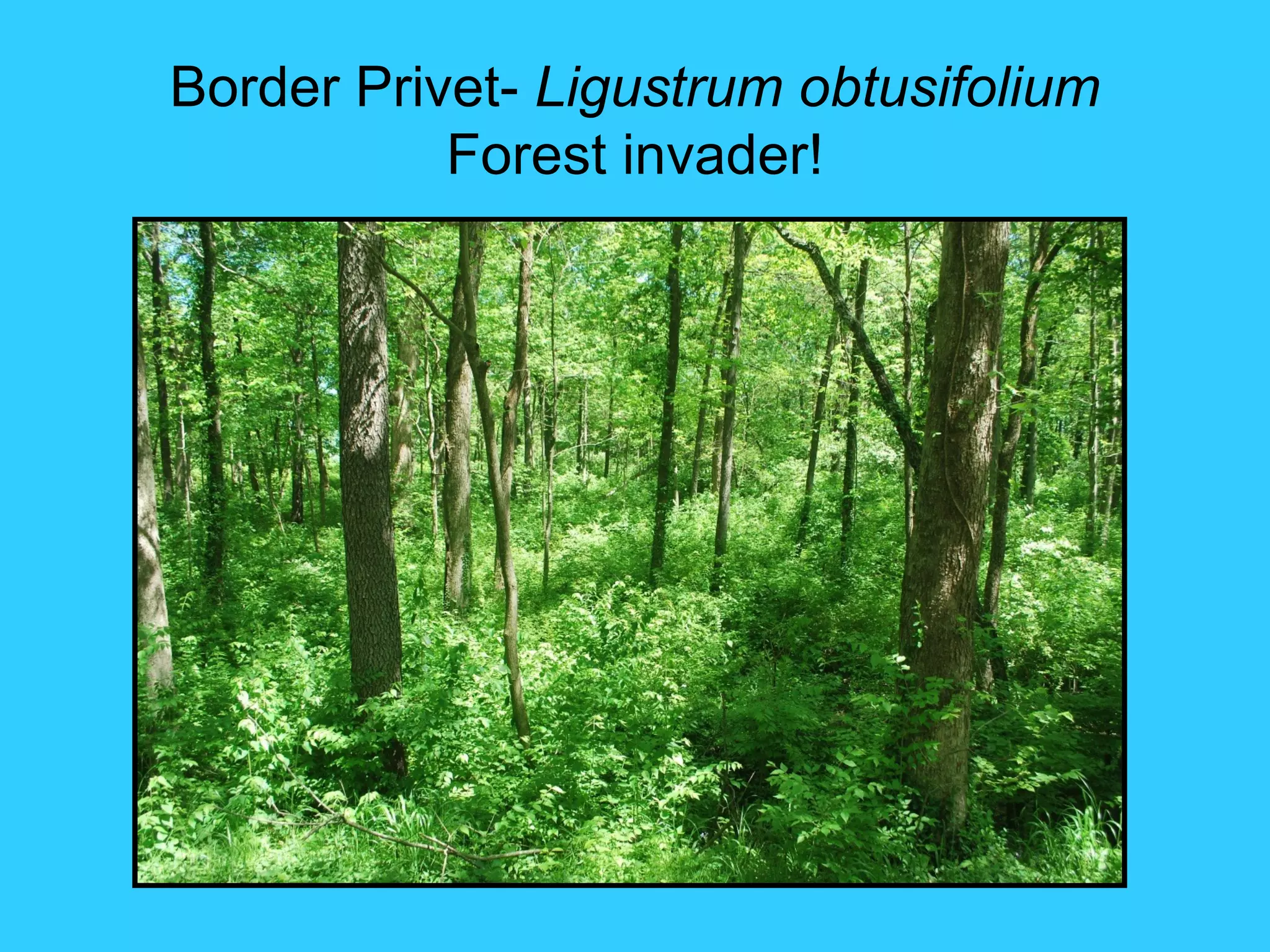
Border Privet- Ligustrum obtusifolium
           Forest invader!
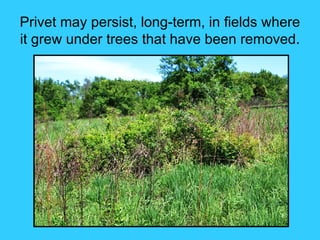
Privet may persist, long-term, in fields where
it grew under trees that have been removed.
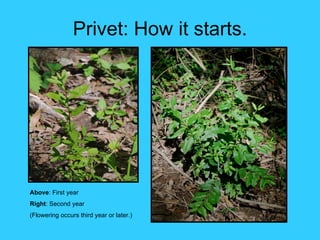
Privet: How it starts.


Above: First year
Right: Second year
(Flowering occurs third year or later.)
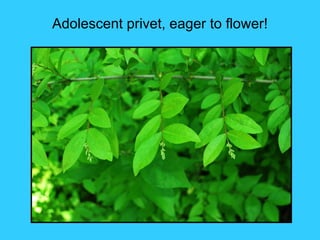
Adolescent privet, eager to flower!
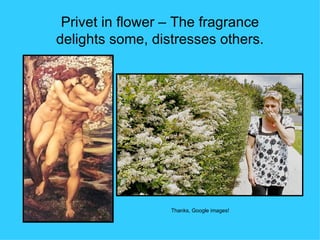
Privet in flower – The fragrance
delights some, distresses others.


                  Thanks, Google images!
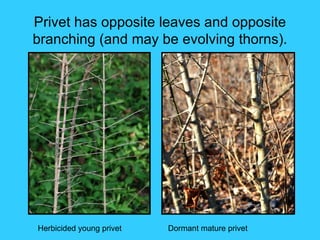
Privet has opposite leaves and opposite
branching (and may be evolving thorns).


Herbicided young privet   Dormant mature privet
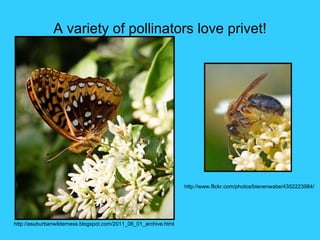
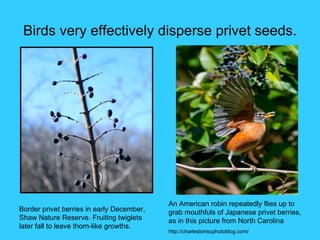
A variety of pollinators love privet!


                                                                  http://www.flickr.com/photos/bienenwabe/4352223984/


http://asuburbanwilderness.blogspot.com/2011_06_01_archive.html
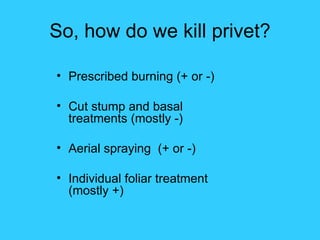
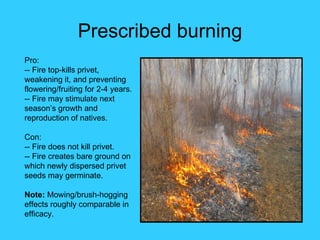
Birds very effectively disperse privet seeds.


                                           An American robin repeatedly flies up to
Border privet berries in early December,   grab mouthfuls of Japanese privet berries,
Shaw Nature Reserve. Fruiting twiglets     as in this picture from North Carolina
later fall to leave thorn-like growths.
                                           http://charlestonscphotoblog.com/
So, how do we kill privet?

• Prescribed burning (+ or -)

• Cut stump and basal
  treatments (mostly -)

• Aerial spraying (+ or -)

• Individual foliar treatment
  (mostly +)
Prescribed burning
Pro:
-- Fire top-kills privet,
weakening it, and preventing
flowering/fruiting for 2-4 years.
-- Fire may stimulate next
season’s growth and
reproduction of natives.

Con:
-- Fire does not kill privet.
-- Fire creates bare ground on
which newly dispersed privet
seeds may germinate.

Note: Mowing/brush-hogging
effects roughly comparable in
efficacy.
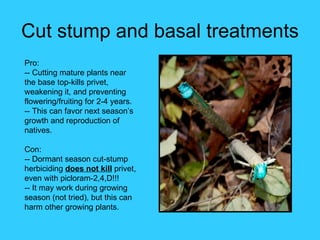
Cut stump and basal treatments
Pro:
-- Cutting mature plants near
the base top-kills privet,
weakening it, and preventing
flowering/fruiting for 2-4 years.
-- This can favor next season’s
growth and reproduction of
natives.

Con:
-- Dormant season cut-stump
herbiciding does not kill privet,
even with picloram-2,4,D!!!
-- It may work during growing
season (not tried), but this can
harm other growing plants.
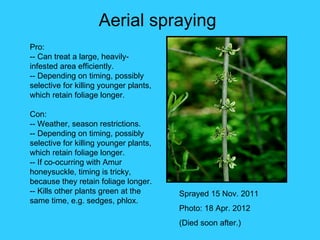
Aerial spraying
Pro:
-- Can treat a large, heavily-
infested area efficiently.
-- Depending on timing, possibly
selective for killing younger plants,
which retain foliage longer.

Con:
-- Weather, season restrictions.
-- Depending on timing, possibly
selective for killing younger plants,
which retain foliage longer.
-- If co-ocurring with Amur
honeysuckle, timing is tricky,
because they retain foliage longer.
-- Kills other plants green at the      Sprayed 15 Nov. 2011
same time, e.g. sedges, phlox.
                                        Photo: 18 Apr. 2012
                                        (Died soon after.)
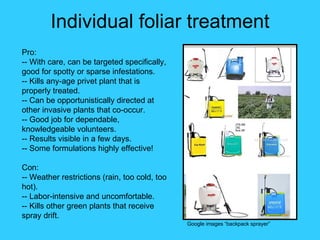
Individual foliar treatment
Pro:
-- With care, can be targeted specifically,
good for spotty or sparse infestations.
-- Kills any-age privet plant that is
properly treated.
-- Can be opportunistically directed at
other invasive plants that co-occur.
-- Good job for dependable,
knowledgeable volunteers.
-- Results visible in a few days.
-- Some formulations highly effective!

Con:
-- Weather restrictions (rain, too cold, too
hot).
-- Labor-intensive and uncomfortable.
-- Kills other green plants that receive
spray drift.
                                               Google images “backpack sprayer”
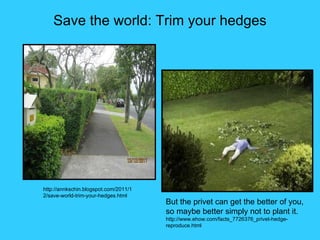
Save the world: Trim your hedges


http://annkschin.blogspot.com/2011/1
2/save-world-trim-your-hedges.html
                                       But the privet can get the better of you,
                                       so maybe better simply not to plant it.
                                       http://www.ehow.com/facts_7726376_privet-hedge-
                                       reproduce.html
Seriously, though . . .
• Hand pulling or using a brush-wrench are effective
  but labor-intensive, and hard on the back.
• Prescribed fire or brush-hogging on a 2-3 year
  interval will control flowering/fruiting. Hot fire may
  kill seedlings and very small saplings outright.
• The only thing that seems effectively to kill privet is
  growing-season foliar herbicide treatments.
   – Backpack spraying, 4-5% glyphosate
   – Backpack spraying, 2% glyphosate + 0.5% triclopyr
   – Aerial spraying, large droplets, 12% glyphosate +
     appropriate surfactant (about 0.75 gallons of
     concentrate/acre)
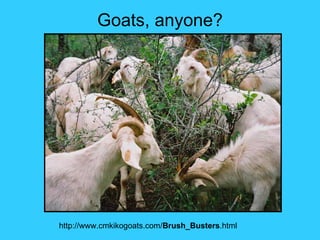
Goats, anyone?


http://www.cmkikogoats.com/Brush_Busters.html

Border Privet: Forest Invader!

  • 1.
    Border Privet- Ligustrumobtusifolium Forest invader!
  • 2.
    Privet may persist,long-term, in fields where it grew under trees that have been removed.
  • 4.
    Privet: How itstarts. Above: First year Right: Second year (Flowering occurs third year or later.)
  • 5.
  • 6.
    Privet in flower– The fragrance delights some, distresses others. Thanks, Google images!
  • 7.
    Privet has oppositeleaves and opposite branching (and may be evolving thorns). Herbicided young privet Dormant mature privet
  • 8.
    A variety ofpollinators love privet! http://www.flickr.com/photos/bienenwabe/4352223984/ http://asuburbanwilderness.blogspot.com/2011_06_01_archive.html
  • 9.
    Birds very effectivelydisperse privet seeds. An American robin repeatedly flies up to Border privet berries in early December, grab mouthfuls of Japanese privet berries, Shaw Nature Reserve. Fruiting twiglets as in this picture from North Carolina later fall to leave thorn-like growths. http://charlestonscphotoblog.com/
  • 10.
    So, how dowe kill privet? • Prescribed burning (+ or -) • Cut stump and basal treatments (mostly -) • Aerial spraying (+ or -) • Individual foliar treatment (mostly +)
  • 11.
    Prescribed burning Pro: -- Firetop-kills privet, weakening it, and preventing flowering/fruiting for 2-4 years. -- Fire may stimulate next season’s growth and reproduction of natives. Con: -- Fire does not kill privet. -- Fire creates bare ground on which newly dispersed privet seeds may germinate. Note: Mowing/brush-hogging effects roughly comparable in efficacy.
  • 12.
    Cut stump andbasal treatments Pro: -- Cutting mature plants near the base top-kills privet, weakening it, and preventing flowering/fruiting for 2-4 years. -- This can favor next season’s growth and reproduction of natives. Con: -- Dormant season cut-stump herbiciding does not kill privet, even with picloram-2,4,D!!! -- It may work during growing season (not tried), but this can harm other growing plants.
  • 13.
    Aerial spraying Pro: -- Cantreat a large, heavily- infested area efficiently. -- Depending on timing, possibly selective for killing younger plants, which retain foliage longer. Con: -- Weather, season restrictions. -- Depending on timing, possibly selective for killing younger plants, which retain foliage longer. -- If co-ocurring with Amur honeysuckle, timing is tricky, because they retain foliage longer. -- Kills other plants green at the Sprayed 15 Nov. 2011 same time, e.g. sedges, phlox. Photo: 18 Apr. 2012 (Died soon after.)
  • 14.
    Individual foliar treatment Pro: --With care, can be targeted specifically, good for spotty or sparse infestations. -- Kills any-age privet plant that is properly treated. -- Can be opportunistically directed at other invasive plants that co-occur. -- Good job for dependable, knowledgeable volunteers. -- Results visible in a few days. -- Some formulations highly effective! Con: -- Weather restrictions (rain, too cold, too hot). -- Labor-intensive and uncomfortable. -- Kills other green plants that receive spray drift. Google images “backpack sprayer”
  • 15.
    Save the world:Trim your hedges http://annkschin.blogspot.com/2011/1 2/save-world-trim-your-hedges.html But the privet can get the better of you, so maybe better simply not to plant it. http://www.ehow.com/facts_7726376_privet-hedge- reproduce.html
  • 16.
    Seriously, though .. . • Hand pulling or using a brush-wrench are effective but labor-intensive, and hard on the back. • Prescribed fire or brush-hogging on a 2-3 year interval will control flowering/fruiting. Hot fire may kill seedlings and very small saplings outright. • The only thing that seems effectively to kill privet is growing-season foliar herbicide treatments. – Backpack spraying, 4-5% glyphosate – Backpack spraying, 2% glyphosate + 0.5% triclopyr – Aerial spraying, large droplets, 12% glyphosate + appropriate surfactant (about 0.75 gallons of concentrate/acre)
  • 17.