The Bordeaux
Vineyard
WORKSHOP
WORKSHOP
The Bordeaux
Vineyard
• An ancient vineyard
• 1152 : wedding of Alienor of Aquitaine with Henri Plantagenet
strong commercial links with England, the golden age of claret !
• 15th century: Aquitaine returns under the French crown
end of the trade with England
• 17th century: Holland, Hanse and Brittany are the main markets
for Bordeaux wines
A historical summary
2
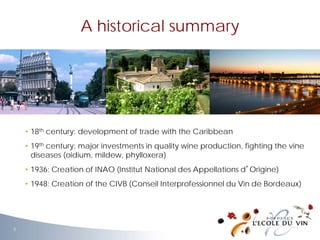
• 18th century: development of trade with the Caribbean
• 19th century: major investments in quality wine production, fighting the vine
diseases (oidium, mildew, phylloxera)
• 1936: Creation of INAO (Institut National des Appellations d’Origine)
• 1948: Creation of the CIVB (Conseil Interprofessionnel du Vin de Bordeaux)
A historical summary
3
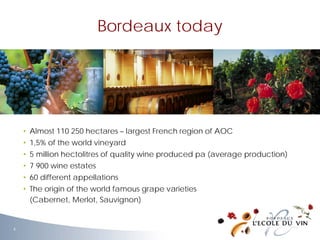
• Almost 110 250 hectares – largest French region of AOC
• 1,5% of the world vineyard
• 5 million hectolitres of quality wine produced pa (average production)
• 7 900 wine estates
• 60 different appellations
• The origin of the world famous grape varieties
Bordeaux today
(Cabernet, Merlot, Sauvignon)
4
Crédits photographies :
© CIVB © Ralf Kabelitz © Laurent Renault © Nath Photos © chiyacat © mr.lightning © Yuri Arcurs © Bata Zivanovic © benamalice
5
The Bordeaux vineyard
Champagne
33 100
Bourgogne
27 800
Beaujolais
18 600
Vallée
du Rhône
76 300
Provence
27 000
Bergerac
12 000
Vallée de
la Loire
51 800
Sud-Ouest
20 000
Languedoc
35 500
Roussillon
8 000
BORDEAUX
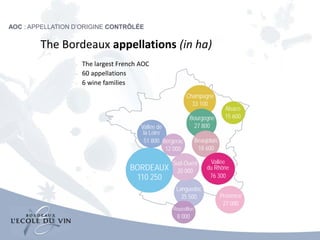
110 250
Alsace
15 600
The Bordeaux appellations (in ha)
 The largest French AOC
 60 appellations
 6 wine families
AOC : APPELLATION D’ORIGINE CONTRÔLÉE
7
How to taste
Bordeaux wines
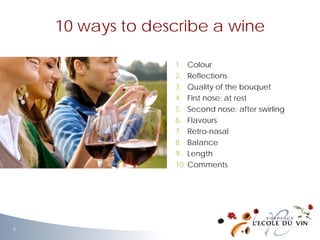
1. Colour
2. Reflections
3. Quality of the bouquet
4. First nose: at rest
5. Second nose: after swirling
6. Flavours
7. Retro-nasal
8. Balance
9. Length
10. Comments
10 ways to describe a wine
8
Senses and sensations
9
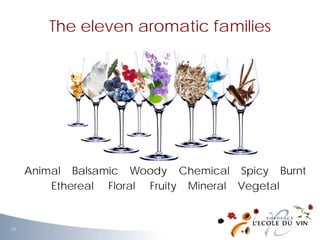
Animal Balsamic Woody Chemical Spicy Burnt
Ethereal Floral Fruity Mineral Vegetal
The eleven aromatic families
10
Vanilla, grilled and toasted notes: Wines aged in oak barrels
A few typical aromas
of Bordeaux wines
RED WINES
(Cabernet dominated)
• Green pepper (young)
• Blackcurrant
• Spices
• Leather
• Prunes
WHITE WINES
• Lemon
• Grapefruit
• Box hedge
• Tropical fruit
• Acacia flower
RED WINES
(Merlot dominated)
• Red fruits
• Violet
• Animal
• Liquorice
• Truffle
SWEET WHITE WINES
• Acacia flower
• Quince
• Marmalade
• Honey
• Tobacco
ROSÉ/CLAIRETS
• Raspberry
• Red currant
• Cherry
• Strawberry
• Iris
11
Balance in red wine
12
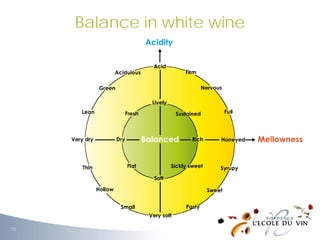
Balance in white wine
13
14
The Bordeaux
wines
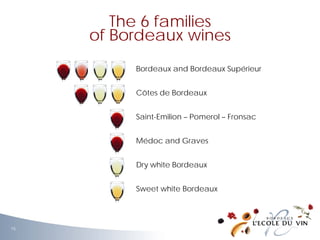
Bordeaux and Bordeaux Supérieur
Côtes de Bordeaux
Saint-Emilion – Pomerol – Fronsac
Médoc and Graves
Dry white Bordeaux
Sweet white Bordeaux
The 6 families
of Bordeaux wines
15
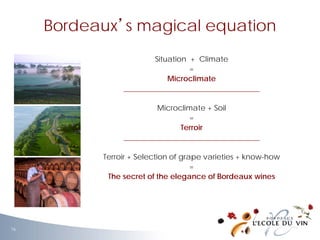
Situation + Climate
=
Microclimate
____________________________________
Microclimate + Soil
=
Terroir
____________________________________
Terroir + Selection of grape varieties + know-how
=
The secret of the elegance of Bordeaux wines
Bordeaux’s magical equation
16
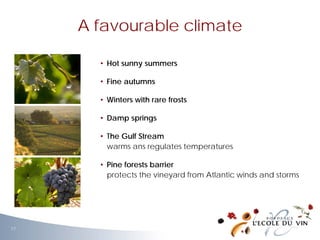
• Hot sunny summers
• Fine autumns
• Winters with rare frosts
• Damp springs
• The Gulf Stream
warms ans regulates temperatures
• Pine forests barrier
protects the vineyard from Atlantic winds and storms
A favourable climate
17
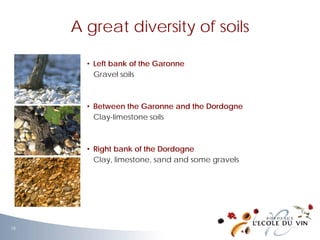
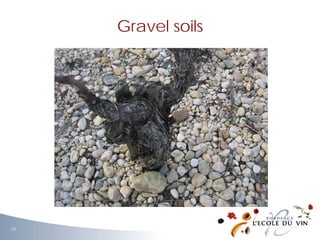
• Left bank of the Garonne
Gravel soils
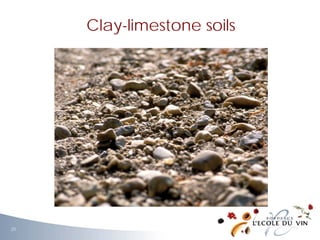
• Between the Garonne and the Dordogne
Clay-limestone soils
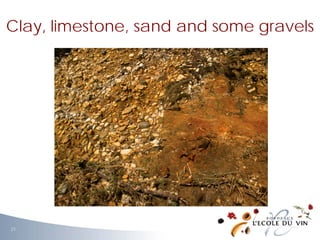
• Right bank of the Dordogne
Clay, limestone, sand and some gravels
A great diversity of soils
18
Gravel soils
19
Clay-limestone soils
20
Clay, limestone, sand and some gravels
21
Characteristics
of the red grape varieties
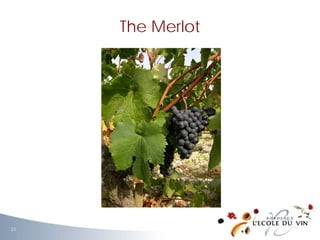
MERLOT
• Early ripening
• High degree of alcohol
• Supple and round
• Aromatic (red fruits)
• Rapid aromatic evolution
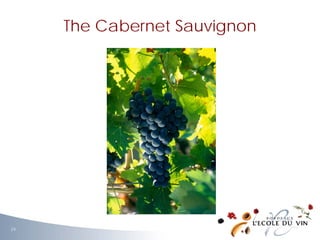
CABERNET SAUVIGNON
• Late ripening
• Tannic
• Aromatic young wines (black fruits)
• Apt for ageing
CABERNET FRANC
• High degree of alcohol
• Elegant tannins and aromas
PETIT VERDOT, MALBEC, CARMENÈRE
22
The Merlot
23
The Cabernet Sauvignon
24
The Cabernet Franc
25
Muscadelle
7 %
Sauvignon
34 %
Other
whites
4 %
Sémillon
55 %
Characteristics
of the white grape varieties
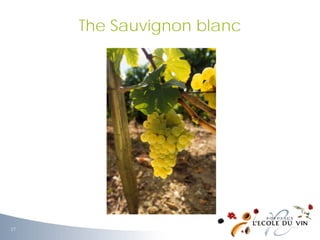
SAUVIGNON
• High degree of alcohol
• Pale colour
• Aromatic richness (gooseberry, citrus)
• Crisp acidity
SÉMILLON
• Golden colour
• Elegant
• Unctuous
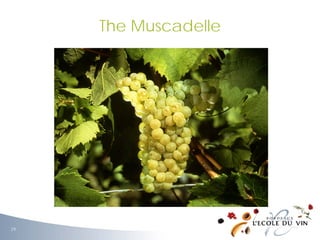
MUSCADELLE
• Powerful Muscat and floral aromas
• Light acidity
• Round
COLOMBARD, UGNI BLANC
26
The Sauvignon blanc
27
The Sémillon
28
The Muscadelle
29
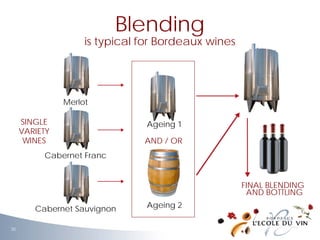
Merlot
Cabernet Franc
Cabernet Sauvignon
SINGLE
VARIETY
WINES
Ageing 1
Ageing 2
FINAL BLENDING
AND BOTTLING
AND / OR
Blending
is typical for Bordeaux wines
30
31
Food and
wine matching
1. Match the strength of the food and the wine
2. The complexity of th food and the wine
3. Flavour traditional regional marriages
4. Experiment with the dominant flavours in the food and the wine
Reinforce-eg: the acidity of sorrel / the acidity of an Entre-Deux-Mers
Contrast-eg: acid / bitterness of Roquefort / sweetness of a Sauternes
Accompany-eg: bitterness of chocolat / supple red Bordeaux with light tannins
The 4 rules of
food and wine matching
Light food Light wine
Strong food Powerful wine
Simple food Simple wine
Complex food Complex wine
32
• The Classified Growths of Bordeaux represent at most 3 to 5%
• 95% of Bordeaux wines are for everyday and every budget
• The ageing potential depends upon the style of the wine,
its quality, the vintage, the terroir, the wine making techniques...
Purchasing and storage advice
33
Crédits photographies :
© CIVB © Ralf Kabelitz © Laurent Renault © Nath Photos © chiyacat © mr.lightning © Yuri Arcurs © Bata Zivanovic © benamalice

Bordeaux IFBC 2014

  • 1.
  • 2.
    • An ancientvineyard • 1152 : wedding of Alienor of Aquitaine with Henri Plantagenet strong commercial links with England, the golden age of claret ! • 15th century: Aquitaine returns under the French crown end of the trade with England • 17th century: Holland, Hanse and Brittany are the main markets for Bordeaux wines A historical summary 2
  • 3.
    • 18th century:development of trade with the Caribbean • 19th century: major investments in quality wine production, fighting the vine diseases (oidium, mildew, phylloxera) • 1936: Creation of INAO (Institut National des Appellations d’Origine) • 1948: Creation of the CIVB (Conseil Interprofessionnel du Vin de Bordeaux) A historical summary 3
  • 4.
    • Almost 110250 hectares – largest French region of AOC • 1,5% of the world vineyard • 5 million hectolitres of quality wine produced pa (average production) • 7 900 wine estates • 60 different appellations • The origin of the world famous grape varieties Bordeaux today (Cabernet, Merlot, Sauvignon) 4
  • 5.
    Crédits photographies : ©CIVB © Ralf Kabelitz © Laurent Renault © Nath Photos © chiyacat © mr.lightning © Yuri Arcurs © Bata Zivanovic © benamalice 5 The Bordeaux vineyard
  • 6.
    Champagne 33 100 Bourgogne 27 800 Beaujolais 18600 Vallée du Rhône 76 300 Provence 27 000 Bergerac 12 000 Vallée de la Loire 51 800 Sud-Ouest 20 000 Languedoc 35 500 Roussillon 8 000 BORDEAUX 110 250 Alsace 15 600 The Bordeaux appellations (in ha)  The largest French AOC  60 appellations  6 wine families AOC : APPELLATION D’ORIGINE CONTRÔLÉE
  • 7.
  • 8.
    1. Colour 2. Reflections 3.Quality of the bouquet 4. First nose: at rest 5. Second nose: after swirling 6. Flavours 7. Retro-nasal 8. Balance 9. Length 10. Comments 10 ways to describe a wine 8
  • 9.
  • 10.
    Animal Balsamic WoodyChemical Spicy Burnt Ethereal Floral Fruity Mineral Vegetal The eleven aromatic families 10
  • 11.
    Vanilla, grilled andtoasted notes: Wines aged in oak barrels A few typical aromas of Bordeaux wines RED WINES (Cabernet dominated) • Green pepper (young) • Blackcurrant • Spices • Leather • Prunes WHITE WINES • Lemon • Grapefruit • Box hedge • Tropical fruit • Acacia flower RED WINES (Merlot dominated) • Red fruits • Violet • Animal • Liquorice • Truffle SWEET WHITE WINES • Acacia flower • Quince • Marmalade • Honey • Tobacco ROSÉ/CLAIRETS • Raspberry • Red currant • Cherry • Strawberry • Iris 11
  • 12.
  • 13.
  • 14.
  • 15.
    Bordeaux and BordeauxSupérieur Côtes de Bordeaux Saint-Emilion – Pomerol – Fronsac Médoc and Graves Dry white Bordeaux Sweet white Bordeaux The 6 families of Bordeaux wines 15
  • 16.
    Situation + Climate = Microclimate ____________________________________ Microclimate+ Soil = Terroir ____________________________________ Terroir + Selection of grape varieties + know-how = The secret of the elegance of Bordeaux wines Bordeaux’s magical equation 16
  • 17.
    • Hot sunnysummers • Fine autumns • Winters with rare frosts • Damp springs • The Gulf Stream warms ans regulates temperatures • Pine forests barrier protects the vineyard from Atlantic winds and storms A favourable climate 17
  • 18.
    • Left bankof the Garonne Gravel soils • Between the Garonne and the Dordogne Clay-limestone soils • Right bank of the Dordogne Clay, limestone, sand and some gravels A great diversity of soils 18
  • 19.
  • 20.
  • 21.
    Clay, limestone, sandand some gravels 21
  • 22.
    Characteristics of the redgrape varieties MERLOT • Early ripening • High degree of alcohol • Supple and round • Aromatic (red fruits) • Rapid aromatic evolution CABERNET SAUVIGNON • Late ripening • Tannic • Aromatic young wines (black fruits) • Apt for ageing CABERNET FRANC • High degree of alcohol • Elegant tannins and aromas PETIT VERDOT, MALBEC, CARMENÈRE 22
  • 23.
  • 24.
  • 25.
  • 26.
    Muscadelle 7 % Sauvignon 34 % Other whites 4% Sémillon 55 % Characteristics of the white grape varieties SAUVIGNON • High degree of alcohol • Pale colour • Aromatic richness (gooseberry, citrus) • Crisp acidity SÉMILLON • Golden colour • Elegant • Unctuous MUSCADELLE • Powerful Muscat and floral aromas • Light acidity • Round COLOMBARD, UGNI BLANC 26
  • 27.
  • 28.
  • 29.
  • 30.
    Merlot Cabernet Franc Cabernet Sauvignon SINGLE VARIETY WINES Ageing1 Ageing 2 FINAL BLENDING AND BOTTLING AND / OR Blending is typical for Bordeaux wines 30
  • 31.
  • 32.
    1. Match thestrength of the food and the wine 2. The complexity of th food and the wine 3. Flavour traditional regional marriages 4. Experiment with the dominant flavours in the food and the wine Reinforce-eg: the acidity of sorrel / the acidity of an Entre-Deux-Mers Contrast-eg: acid / bitterness of Roquefort / sweetness of a Sauternes Accompany-eg: bitterness of chocolat / supple red Bordeaux with light tannins The 4 rules of food and wine matching Light food Light wine Strong food Powerful wine Simple food Simple wine Complex food Complex wine 32
  • 33.
    • The ClassifiedGrowths of Bordeaux represent at most 3 to 5% • 95% of Bordeaux wines are for everyday and every budget • The ageing potential depends upon the style of the wine, its quality, the vintage, the terroir, the wine making techniques... Purchasing and storage advice 33
  • 34.
    Crédits photographies : ©CIVB © Ralf Kabelitz © Laurent Renault © Nath Photos © chiyacat © mr.lightning © Yuri Arcurs © Bata Zivanovic © benamalice