Bordeaux PrimerThis is a basic run down of things you should be comfortable with moving forward onto some of the videos I will post, as well as a second Bordeaux Intermediate level presentation that will be posted very soon.
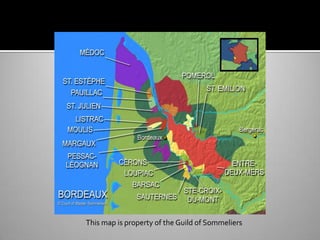
This mapisproperty of the Guild of Sommeliers
The Basic Run Down:Cabernet Sauvignon, Cabernet Franc, Merlot, Malbec, & Petit Verdot are the main red varietals.Sauvignon Blanc, Semillon and Muscadelle are the main white varietals.The greatsoil (gravel, sandstone and clay), perfectclimate (influenced by the Gironde estuary, the Garonne and Dordogne Rivers) and hundreds of years of experience in fine wine production makesthisregion second to none in the wine world.
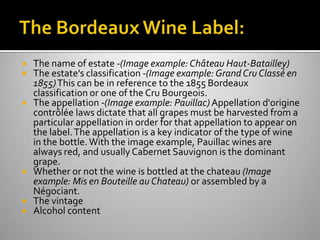
The Bordeaux Wine Label:The name of estate -(Image example: Château Haut-Batailley)The estate's classification -(Image example: Grand Cru Classé en 1855) This can be in reference to the 1855 Bordeaux classification or one of the Cru Bourgeois.The appellation -(Image example: Pauillac) Appellation d'originecontrôlée laws dictate that all grapes must be harvested from a particular appellation in order for that appellation to appear on the label. The appellation is a key indicator of the type of wine in the bottle. With the image example, Pauillac wines are always red, and usually Cabernet Sauvignon is the dominant grape.Whether or not the wine is bottled at the chateau (Image example: Mis en Bouteille au Chateau) or assembled by a Négociant.The vintageAlcohol content
Classifications:The 1855 classification ranked the top Château from the Medoc, Sauternes and BarsacIn 1955, the Château of St. ÉmilionwereclassifiedIn 1953, and revised in 1959, the Château of Graves wereclassified
1855 Classification:The first growths are:Château Lafite-Rothschild, in the appellation PauillacChâteau Margaux, in the appellation MargauxChâteau Latour, in the appellation PauillacChâteau Haut-Brion, in the appellation Péssac-LegonanChâteau Mouton Rothschild, in the appellation Pauillac, promoted from second to first growth in 1973.(This should be common knowledge, and it never hurts to know what the ‘second’ wine of the Chateau is!)
Point of Interest:Where is the almighty Château Petrus in all of this? Pomerol, where Petrus (and Le Pin) hail from, were never officially ranked like the Medoc or St. EmillionThis area is extremely small, and production levels can be a fraction of it’s left bank counterpartsFor testing purposes, you should have a few Pomerol wines in your pocket! There is a lot more to Pomerol than Petrus and Le Pin!
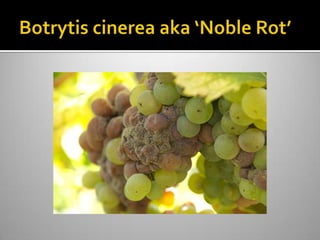
The ‘sweetness’ of Bordeaux:Sauternes is a French dessert wine from the Sauternes region of the Graves section in Bordeaux. Sauternes is made from Sémillon, Sauvignon Blanc, and Muscadelle grapes that have been affected by Botrytis cinerea, also known as noble rot. This causes the grapes to become partially raisinated, resulting in concentrated and distinctively flavored wines. Sauternes is one of the few wine regions where infection with noble rot is a frequent occurrence, due to its climate. Even so, production is a hit-or-miss proposition, with widely varying harvests from vintage to vintage. Wines from Sauternes, especially the Premier Cru Supérieur estate Château d'Yquem, can be very expensive, due largely to the very high cost of production.
Botrytis cinerea aka ‘Noble Rot’
Another glance at the Map of Bordeaux:
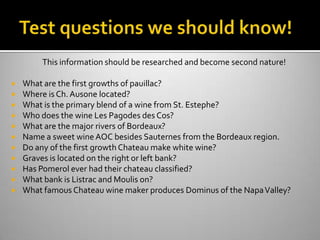
Test questions weshould know!This information shouldberesearched and become second nature!What are the first growths of pauillac?Whereis Ch. Ausone located?Whatis the primary blend of a wine from St. Estephe?Whodoes the wine Les Pagodes des Cos?What are the major rivers of Bordeaux?Name a sweet wine AOC besides Sauternes from the Bordeaux region.Do any of the first growthChateaumake white wine?Graves islocated on the right or leftbank?Has Pomerol everhadtheirchateauclassified?WhatbankisListrac and Moulis on?WhatfamousChateau wine maker producesDominus of the Napa Valley?

Bordeaux

  • 1.
    Bordeaux PrimerThis isa basic run down of things you should be comfortable with moving forward onto some of the videos I will post, as well as a second Bordeaux Intermediate level presentation that will be posted very soon.
  • 2.
    This mapisproperty ofthe Guild of Sommeliers
  • 3.
    This mapisproperty ofthe Guild of Sommeliers
  • 4.
    The Basic RunDown:Cabernet Sauvignon, Cabernet Franc, Merlot, Malbec, & Petit Verdot are the main red varietals.Sauvignon Blanc, Semillon and Muscadelle are the main white varietals.The greatsoil (gravel, sandstone and clay), perfectclimate (influenced by the Gironde estuary, the Garonne and Dordogne Rivers) and hundreds of years of experience in fine wine production makesthisregion second to none in the wine world.
  • 5.
    The Bordeaux WineLabel:The name of estate -(Image example: Château Haut-Batailley)The estate's classification -(Image example: Grand Cru Classé en 1855) This can be in reference to the 1855 Bordeaux classification or one of the Cru Bourgeois.The appellation -(Image example: Pauillac) Appellation d'originecontrôlée laws dictate that all grapes must be harvested from a particular appellation in order for that appellation to appear on the label. The appellation is a key indicator of the type of wine in the bottle. With the image example, Pauillac wines are always red, and usually Cabernet Sauvignon is the dominant grape.Whether or not the wine is bottled at the chateau (Image example: Mis en Bouteille au Chateau) or assembled by a Négociant.The vintageAlcohol content
  • 6.
    Classifications:The 1855 classificationranked the top Château from the Medoc, Sauternes and BarsacIn 1955, the Château of St. ÉmilionwereclassifiedIn 1953, and revised in 1959, the Château of Graves wereclassified
  • 7.
    1855 Classification:The firstgrowths are:Château Lafite-Rothschild, in the appellation PauillacChâteau Margaux, in the appellation MargauxChâteau Latour, in the appellation PauillacChâteau Haut-Brion, in the appellation Péssac-LegonanChâteau Mouton Rothschild, in the appellation Pauillac, promoted from second to first growth in 1973.(This should be common knowledge, and it never hurts to know what the ‘second’ wine of the Chateau is!)
  • 8.
    Point of Interest:Whereis the almighty Château Petrus in all of this? Pomerol, where Petrus (and Le Pin) hail from, were never officially ranked like the Medoc or St. EmillionThis area is extremely small, and production levels can be a fraction of it’s left bank counterpartsFor testing purposes, you should have a few Pomerol wines in your pocket! There is a lot more to Pomerol than Petrus and Le Pin!
  • 9.
    The ‘sweetness’ ofBordeaux:Sauternes is a French dessert wine from the Sauternes region of the Graves section in Bordeaux. Sauternes is made from Sémillon, Sauvignon Blanc, and Muscadelle grapes that have been affected by Botrytis cinerea, also known as noble rot. This causes the grapes to become partially raisinated, resulting in concentrated and distinctively flavored wines. Sauternes is one of the few wine regions where infection with noble rot is a frequent occurrence, due to its climate. Even so, production is a hit-or-miss proposition, with widely varying harvests from vintage to vintage. Wines from Sauternes, especially the Premier Cru Supérieur estate Château d'Yquem, can be very expensive, due largely to the very high cost of production.
  • 10.
    Botrytis cinerea aka‘Noble Rot’
  • 11.
    Another glance atthe Map of Bordeaux:
  • 12.
    Test questions weshouldknow!This information shouldberesearched and become second nature!What are the first growths of pauillac?Whereis Ch. Ausone located?Whatis the primary blend of a wine from St. Estephe?Whodoes the wine Les Pagodes des Cos?What are the major rivers of Bordeaux?Name a sweet wine AOC besides Sauternes from the Bordeaux region.Do any of the first growthChateaumake white wine?Graves islocated on the right or leftbank?Has Pomerol everhadtheirchateauclassified?WhatbankisListrac and Moulis on?WhatfamousChateau wine maker producesDominus of the Napa Valley?