5 week
 Wine Course
   Red Nose Wine
Clonmel Business Park
www.rednosewine.com
Last Week
•   Introduction
•   What is Wine
•   Dry versus Sweet
•   How to Taste Wine
•   The Palate
•   The Jelly Bean Test
•   The first 2 grapes discussed & tasted
Wine Regions
• Where do they make wine?
• Old World vs New World
• Europe
  – France – Italy – Spain
• New World
  – Australia – Chile – New Zealand
• Argentina – Germany – California
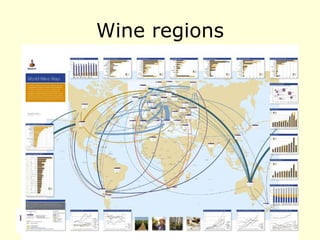
Wine regions
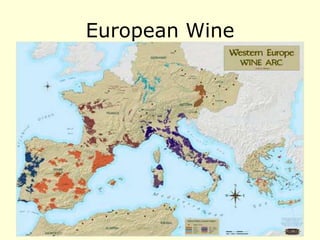
European Wine
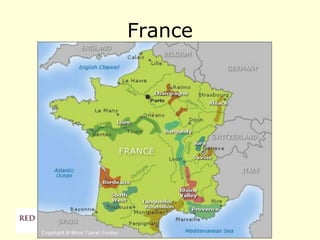
France
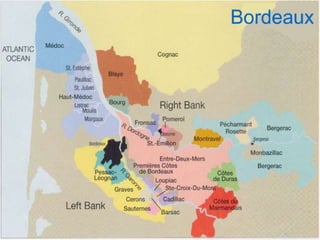
Bordeaux
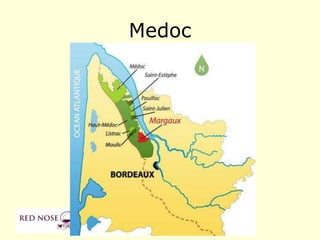
Medoc
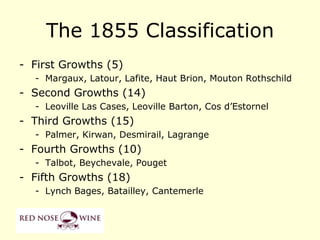
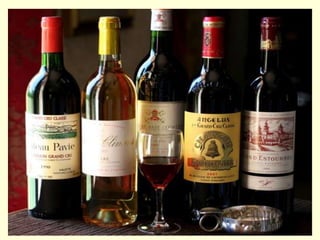
The 1855 Classification
- First Growths (5)
  - Margaux, Latour, Lafite, Haut Brion, Mouton Rothschild
- Second Growths (14)
  - Leoville Las Cases, Leoville Barton, Cos d‟Estornel
- Third Growths (15)
  - Palmer, Kirwan, Desmirail, Lagrange
- Fourth Growths (10)
  - Talbot, Beychevale, Pouget
- Fifth Growths (18)
  - Lynch Bages, Batailley, Cantemerle
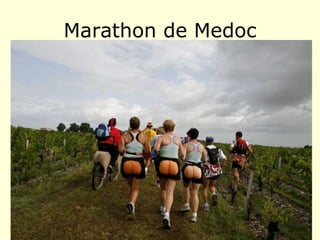
Marathon de Medoc
Burgundy
All roads lead to Burgundy
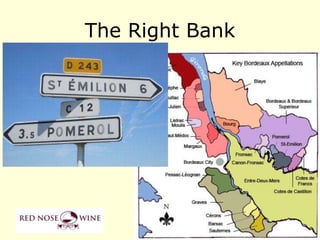
The Right Bank
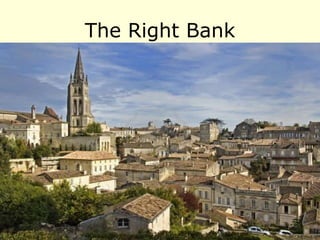
The Right Bank
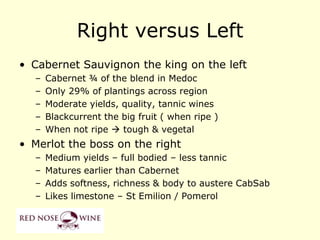
Right versus Left
• Cabernet Sauvignon the king on the left
  –   Cabernet ¾ of the blend in Medoc
  –   Only 29% of plantings across region
  –   Moderate yields, quality, tannic wines
  –   Blackcurrent the big fruit ( when ripe )
  –   When not ripe  tough & vegetal
• Merlot the boss on the right
  –   Medium yields – full bodied – less tannic
  –   Matures earlier than Cabernet
  –   Adds softness, richness & body to austere CabSab
  –   Likes limestone – St Emilion / Pomerol
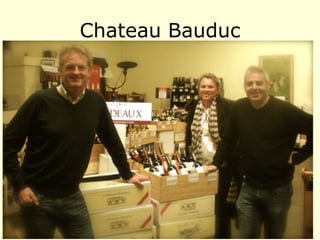
Chateau Bauduc
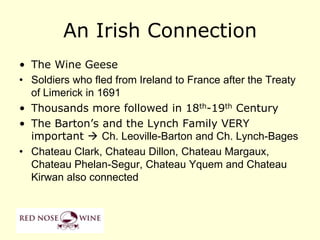
An Irish Connection
• The Wine Geese
• Soldiers who fled from Ireland to France after the Treaty
  of Limerick in 1691
• Thousands more followed in 18th-19th Century
• The Barton‟s and the Lynch Family VERY
  important  Ch. Leoville-Barton and Ch. Lynch-Bages
• Chateau Clark, Chateau Dillon, Chateau Margaux,
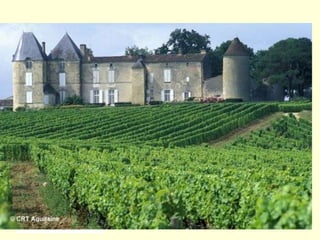
  Chateau Phelan-Segur, Chateau Yquem and Chateau
  Kirwan also connected
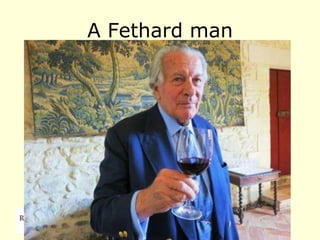
A Fethard man
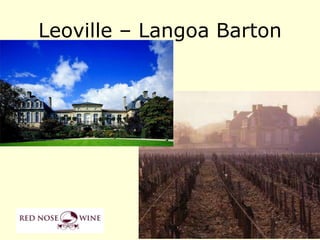
Leoville – Langoa Barton
All roads lead to Burgundy
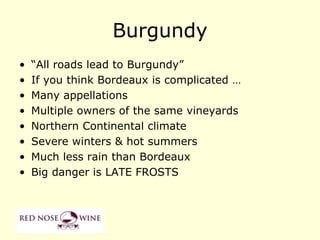
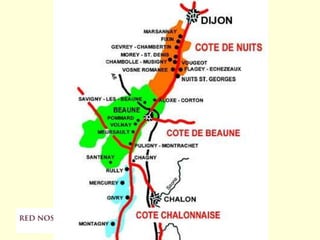
Burgundy
•   “All roads lead to Burgundy”
•   If you think Bordeaux is complicated …
•   Many appellations
•   Multiple owners of the same vineyards
•   Northern Continental climate
•   Severe winters & hot summers
•   Much less rain than Bordeaux
•   Big danger is LATE FROSTS
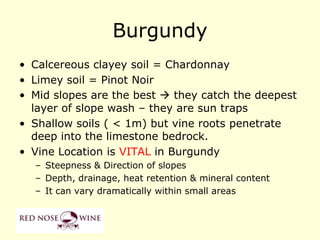
Burgundy
• Calcereous clayey soil = Chardonnay
• Limey soil = Pinot Noir
• Mid slopes are the best  they catch the deepest
  layer of slope wash – they are sun traps
• Shallow soils ( < 1m) but vine roots penetrate
  deep into the limestone bedrock.
• Vine Location is VITAL in Burgundy
  – Steepness & Direction of slopes
  – Depth, drainage, heat retention & mineral content
  – It can vary dramatically within small areas
Burgundy
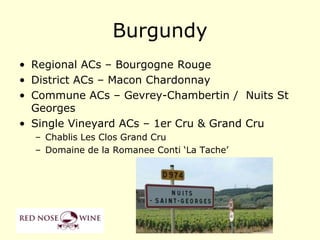
• Regional ACs – Bourgogne Rouge
• District ACs – Macon Chardonnay
• Commune ACs – Gevrey-Chambertin / Nuits St
  Georges
• Single Vineyard ACs – 1er Cru & Grand Cru
  – Chablis Les Clos Grand Cru
  – Domaine de la Romanee Conti „La Tache‟
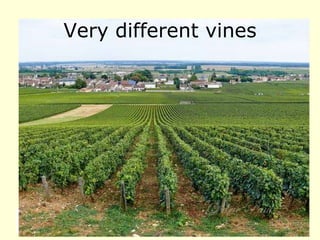
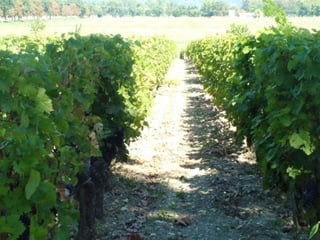
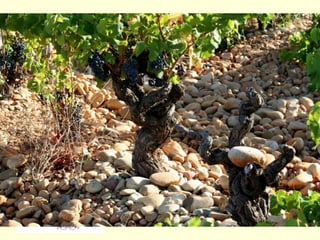
Very different vines
Some more quotes
"The First Duty of wine is to be Red...the second is to be a Burgundy" --
Harry Waugh

The Irish believe that fairies are extremely fond of good wine. The proof
of the assertion is that in the olden days royalty would leave a keg of
wine out for them at night. Sure enough, it was always gone in the
morning. 
- Irish Folklore

“I only drink champagne when I'm happy and when I'm sad.
Sometimes I
drink it when I'm alone.
When I have company I consider it obligatory.
I
trifle with it if I'm not in a hurry and drink it when I am, otherwise I never
touch the stuff unless I am thirsty.” Lily Bollinger
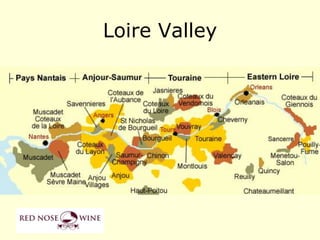
Loire Valley
The Loire
Sauvignon Blanc
 Sancerre, Pouilly Fume, Touraine
Chenin Blanc
 Anjou, Vouvray
Melon de Bourgogne
 Muscadet
Cabernet Franc
 Chinon, Bourgueil
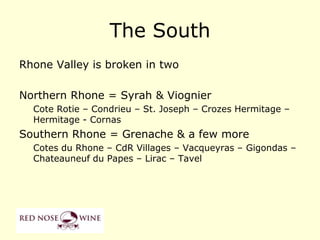
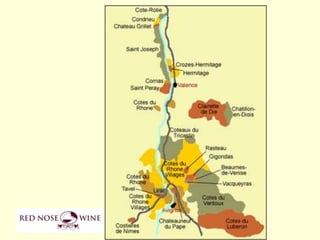
The South
Rhone Valley is broken in two

Northern Rhone = Syrah & Viognier
  Cote Rotie – Condrieu – St. Joseph – Crozes Hermitage –
  Hermitage - Cornas
Southern Rhone = Grenache & a few more
  Cotes du Rhone – CdR Villages – Vacqueyras – Gigondas –
  Chateauneuf du Papes – Lirac – Tavel
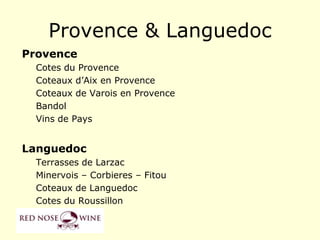
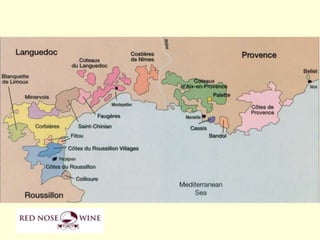
Provence & Languedoc
Provence
  Cotes du Provence
  Coteaux d‟Aix en Provence
  Coteaux de Varois en Provence
  Bandol
  Vins de Pays


Languedoc
  Terrasses de Larzac
  Minervois – Corbieres – Fitou
  Coteaux de Languedoc
  Cotes du Roussillon
Wines to taste
• White – Sauvignon Blanc
  – Chateau Bauduc 2011, Bordeaux, France
     • Pale, green tinged hue. Crisp and fresh on the nose.
     • Citrus and pear notes with a faint herbal nuance. Ripe and round
       on attack then long, clean, dry finish.
     • Attractive apéritif style white.
  – The Ned 2011, Marlborough, New Zealand
     • Packed with herbaceous notes, underpinned with a striking hint of
       citrus.
     • The cold nights have particularly cemented its intense flavours.
       Forever fresh.
     • A single vineyard wine
     • Decanter just awarded it International Trophy for „Best in Show
       Sauvignon Blanc” in price point.
Wines to taste
• Red – Merlot ( kind of )
   – Chateau Bauduc Clos de Quinze 2009, Bordeaux, France
      • Blend of Merlot and Cabernet Sauvignon
      • classic Bordeaux - an elegant structure, supple tannins, a medium
        to full body
      • a whiff of cedar with ripe dark fruit.

   – Santa Alicia Gran Reserva Merlot, Maipo Valley, Chile
      • Concentrated, ripe and balanced
      • Lots of plum and chocolate flavours. This wine was made with the
        best selection of grapes and great care.
      • Aged in French oak for 12 months, and aged in bottle for a further
        8 months before release.
What‟s in a Grape ?
• White – Sauvignon Blanc

•   Bordeaux, Loire Valley, New Zealand, Chile
•   Cool climates on poor soil
•   Green / Herbaceous flavours
•   Gooseberries, green pepper, grass, passion fruit
•   In warmer climates  less aromatic / peachey
•   Add oak for more body  Pouilly Fume
•   Sancerre, Marlborough are classic regions also
What‟s in a Grape ?
• Red – Merlot
• Bordeaux, Chile, California, Sth of France
• Two styles in Merlot
• International Style
  –   Grapes harvested as late as possible
  –   Max possible intense purple colour
  –   Blackberry / plum fruit & Soft velvet tannins
  –   Toasty new oak flavours
• Classic Bordeaux Style
  – Earlier harvest / lighter body / low alcohol
  – Higher acidity / more red fruit characters

Red nose wine course wk 2 2012

  • 1.
    5 week WineCourse Red Nose Wine Clonmel Business Park www.rednosewine.com
  • 2.
    Last Week • Introduction • What is Wine • Dry versus Sweet • How to Taste Wine • The Palate • The Jelly Bean Test • The first 2 grapes discussed & tasted
  • 3.
    Wine Regions • Wheredo they make wine? • Old World vs New World • Europe – France – Italy – Spain • New World – Australia – Chile – New Zealand • Argentina – Germany – California
  • 4.
  • 5.
  • 6.
  • 7.
  • 8.
  • 9.
    The 1855 Classification -First Growths (5) - Margaux, Latour, Lafite, Haut Brion, Mouton Rothschild - Second Growths (14) - Leoville Las Cases, Leoville Barton, Cos d‟Estornel - Third Growths (15) - Palmer, Kirwan, Desmirail, Lagrange - Fourth Growths (10) - Talbot, Beychevale, Pouget - Fifth Growths (18) - Lynch Bages, Batailley, Cantemerle
  • 10.
  • 11.
  • 12.
  • 13.
  • 14.
    Right versus Left •Cabernet Sauvignon the king on the left – Cabernet ¾ of the blend in Medoc – Only 29% of plantings across region – Moderate yields, quality, tannic wines – Blackcurrent the big fruit ( when ripe ) – When not ripe  tough & vegetal • Merlot the boss on the right – Medium yields – full bodied – less tannic – Matures earlier than Cabernet – Adds softness, richness & body to austere CabSab – Likes limestone – St Emilion / Pomerol
  • 15.
  • 16.
    An Irish Connection •The Wine Geese • Soldiers who fled from Ireland to France after the Treaty of Limerick in 1691 • Thousands more followed in 18th-19th Century • The Barton‟s and the Lynch Family VERY important  Ch. Leoville-Barton and Ch. Lynch-Bages • Chateau Clark, Chateau Dillon, Chateau Margaux, Chateau Phelan-Segur, Chateau Yquem and Chateau Kirwan also connected
  • 17.
  • 18.
    Leoville – LangoaBarton All roads lead to Burgundy
  • 19.
    Burgundy • “All roads lead to Burgundy” • If you think Bordeaux is complicated … • Many appellations • Multiple owners of the same vineyards • Northern Continental climate • Severe winters & hot summers • Much less rain than Bordeaux • Big danger is LATE FROSTS
  • 21.
    Burgundy • Calcereous clayeysoil = Chardonnay • Limey soil = Pinot Noir • Mid slopes are the best  they catch the deepest layer of slope wash – they are sun traps • Shallow soils ( < 1m) but vine roots penetrate deep into the limestone bedrock. • Vine Location is VITAL in Burgundy – Steepness & Direction of slopes – Depth, drainage, heat retention & mineral content – It can vary dramatically within small areas
  • 22.
    Burgundy • Regional ACs– Bourgogne Rouge • District ACs – Macon Chardonnay • Commune ACs – Gevrey-Chambertin / Nuits St Georges • Single Vineyard ACs – 1er Cru & Grand Cru – Chablis Les Clos Grand Cru – Domaine de la Romanee Conti „La Tache‟
  • 23.
  • 25.
  • 26.
  • 27.
    Some more quotes "TheFirst Duty of wine is to be Red...the second is to be a Burgundy" -- Harry Waugh The Irish believe that fairies are extremely fond of good wine. The proof of the assertion is that in the olden days royalty would leave a keg of wine out for them at night. Sure enough, it was always gone in the morning. 
- Irish Folklore “I only drink champagne when I'm happy and when I'm sad.
Sometimes I drink it when I'm alone.
When I have company I consider it obligatory.
I trifle with it if I'm not in a hurry and drink it when I am, otherwise I never touch the stuff unless I am thirsty.” Lily Bollinger
  • 28.
  • 29.
    The Loire Sauvignon Blanc Sancerre, Pouilly Fume, Touraine Chenin Blanc Anjou, Vouvray Melon de Bourgogne Muscadet Cabernet Franc Chinon, Bourgueil
  • 30.
    The South Rhone Valleyis broken in two Northern Rhone = Syrah & Viognier Cote Rotie – Condrieu – St. Joseph – Crozes Hermitage – Hermitage - Cornas Southern Rhone = Grenache & a few more Cotes du Rhone – CdR Villages – Vacqueyras – Gigondas – Chateauneuf du Papes – Lirac – Tavel
  • 32.
    Provence & Languedoc Provence Cotes du Provence Coteaux d‟Aix en Provence Coteaux de Varois en Provence Bandol Vins de Pays Languedoc Terrasses de Larzac Minervois – Corbieres – Fitou Coteaux de Languedoc Cotes du Roussillon
  • 34.
    Wines to taste •White – Sauvignon Blanc – Chateau Bauduc 2011, Bordeaux, France • Pale, green tinged hue. Crisp and fresh on the nose. • Citrus and pear notes with a faint herbal nuance. Ripe and round on attack then long, clean, dry finish. • Attractive apéritif style white. – The Ned 2011, Marlborough, New Zealand • Packed with herbaceous notes, underpinned with a striking hint of citrus. • The cold nights have particularly cemented its intense flavours. Forever fresh. • A single vineyard wine • Decanter just awarded it International Trophy for „Best in Show Sauvignon Blanc” in price point.
  • 35.
    Wines to taste •Red – Merlot ( kind of ) – Chateau Bauduc Clos de Quinze 2009, Bordeaux, France • Blend of Merlot and Cabernet Sauvignon • classic Bordeaux - an elegant structure, supple tannins, a medium to full body • a whiff of cedar with ripe dark fruit. – Santa Alicia Gran Reserva Merlot, Maipo Valley, Chile • Concentrated, ripe and balanced • Lots of plum and chocolate flavours. This wine was made with the best selection of grapes and great care. • Aged in French oak for 12 months, and aged in bottle for a further 8 months before release.
  • 36.
    What‟s in aGrape ? • White – Sauvignon Blanc • Bordeaux, Loire Valley, New Zealand, Chile • Cool climates on poor soil • Green / Herbaceous flavours • Gooseberries, green pepper, grass, passion fruit • In warmer climates  less aromatic / peachey • Add oak for more body  Pouilly Fume • Sancerre, Marlborough are classic regions also
  • 37.
    What‟s in aGrape ? • Red – Merlot • Bordeaux, Chile, California, Sth of France • Two styles in Merlot • International Style – Grapes harvested as late as possible – Max possible intense purple colour – Blackberry / plum fruit & Soft velvet tannins – Toasty new oak flavours • Classic Bordeaux Style – Earlier harvest / lighter body / low alcohol – Higher acidity / more red fruit characters