BOOLEAN ALGEBRA
Boolean Algebra
 The basis for Boolean algebra:
 Boolean algebra is the algebra of binary values.
 we refer to these values as 0 and 1
 although we could also refer to them as true and false
 the basic Boolean algebra operations are
 AND, OR, NOT.
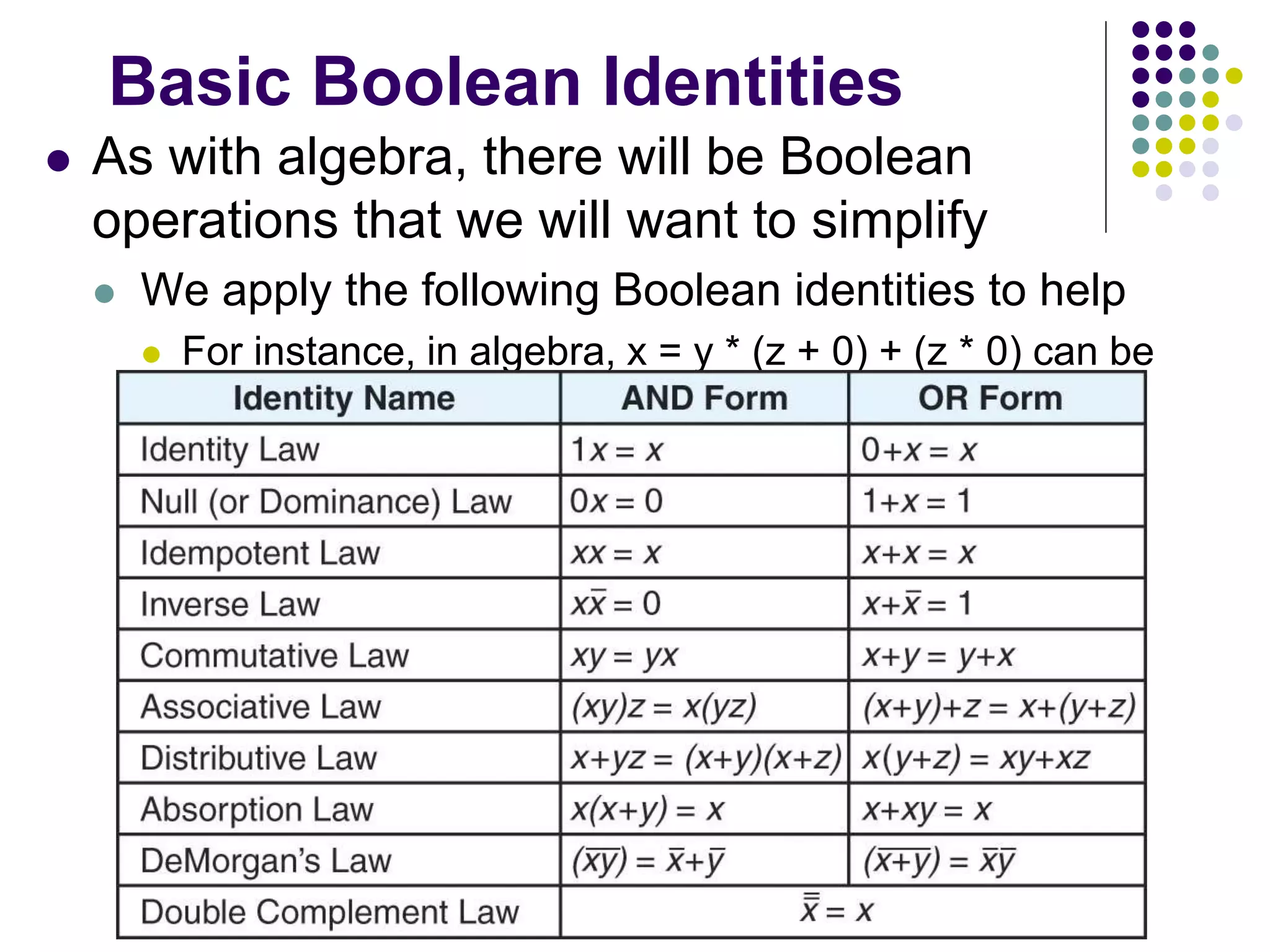
Basic Boolean Identities
 As with algebra, there will be Boolean
operations that we will want to simplify
 We apply the following Boolean identities to help
 For instance, in algebra, x = y * (z + 0) + (z * 0) can be
simplified to just x = y * z
Terminology
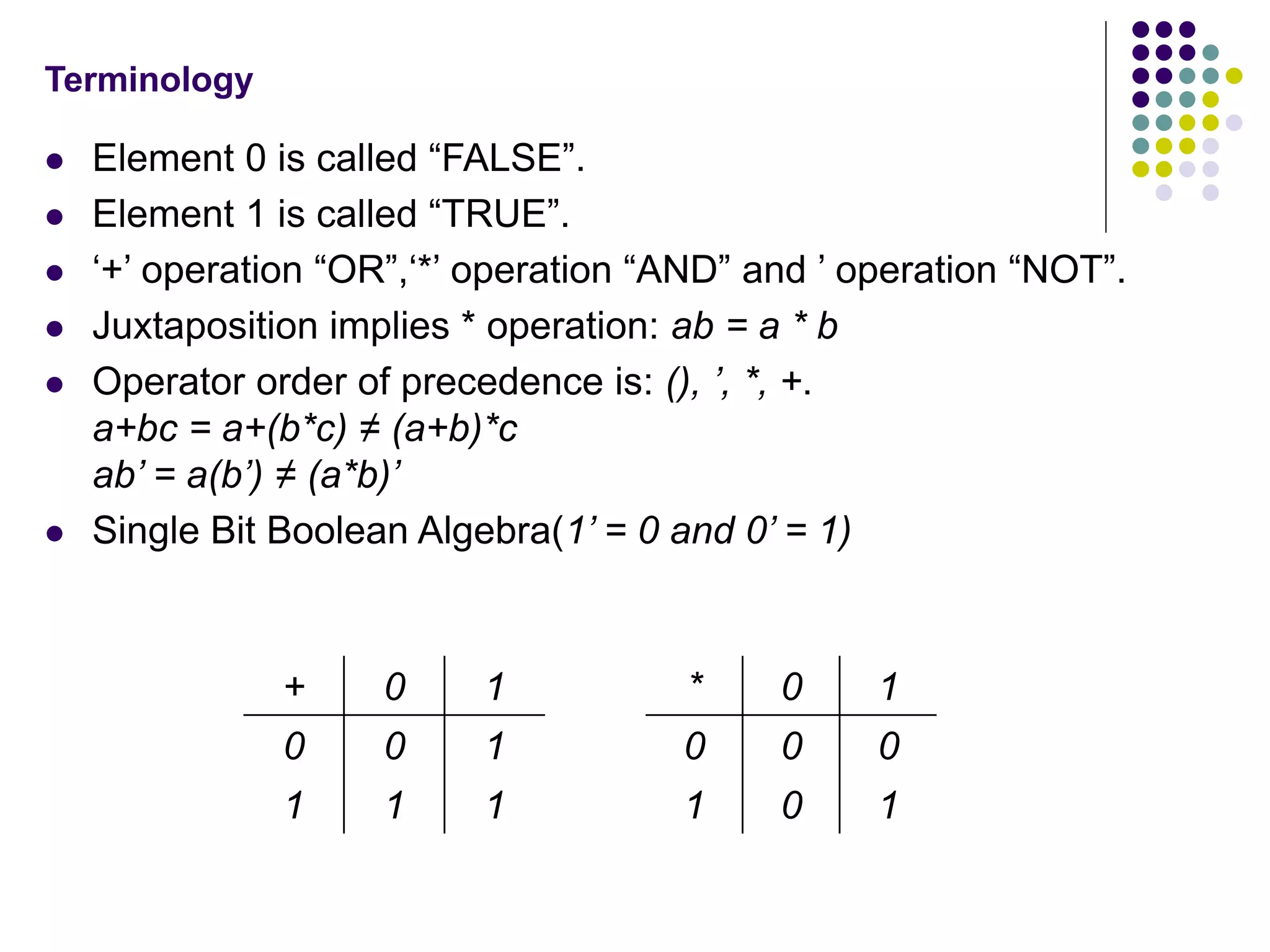
 Element 0 is called “FALSE”.
 Element 1 is called “TRUE”.
 ‘+’ operation “OR”,‘*’ operation “AND” and ’ operation “NOT”.
 Juxtaposition implies * operation: ab = a * b
 Operator order of precedence is: (), ’, *, +.
a+bc = a+(b*c) ≠ (a+b)*c
ab’ = a(b’) ≠ (a*b)’
 Single Bit Boolean Algebra(1’ = 0 and 0’ = 1)
+ 0 1
0 0 1
1 1 1
* 0 1
0 0 0
1 0 1
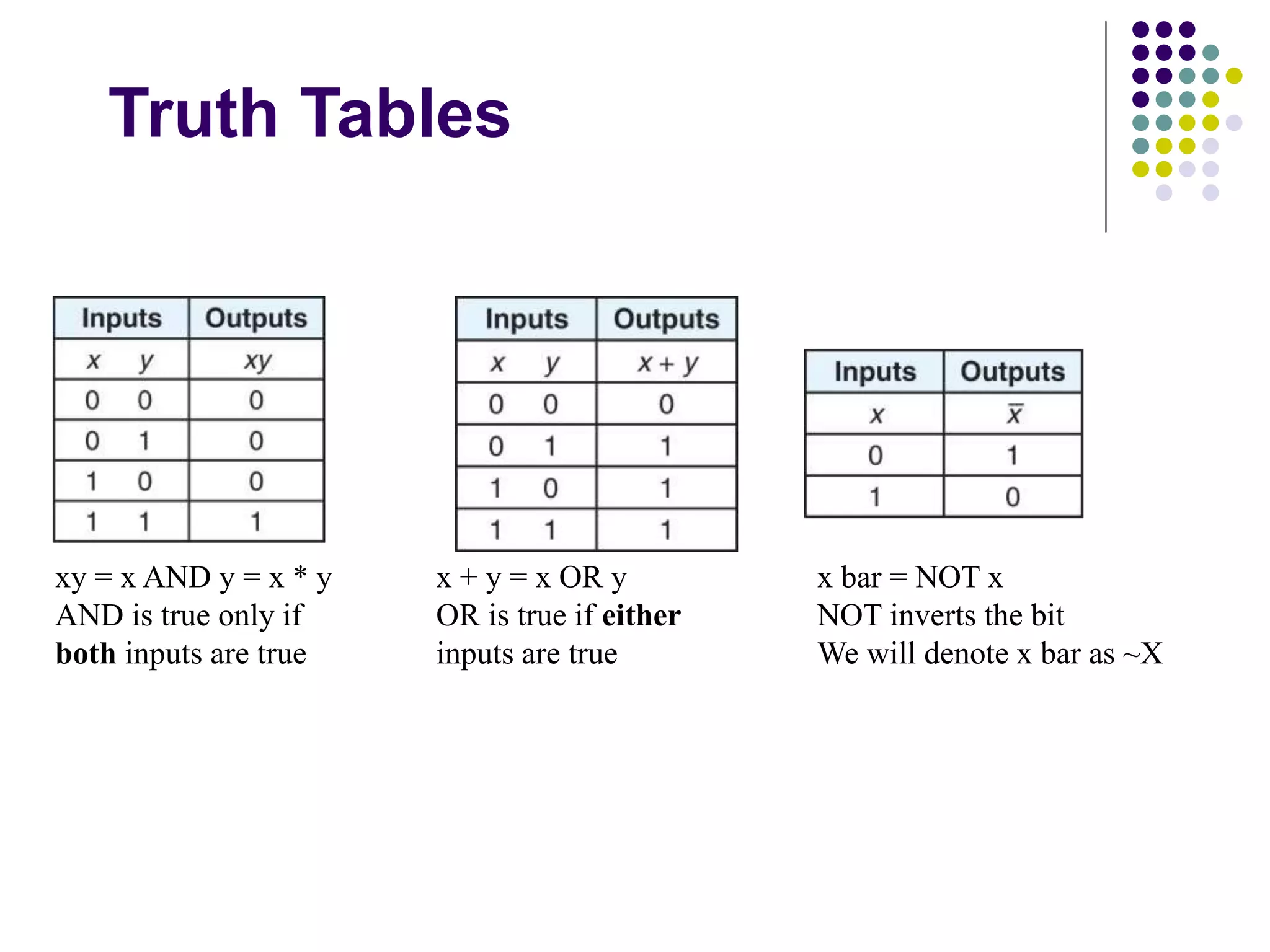
Truth Tables
xy = x AND y = x * y x + y = x OR y x bar = NOT x
AND is true only if OR is true if either NOT inverts the bit
both inputs are true inputs are true We will denote x bar as ~X
Boolean Functions and
Expressions
Definition: Let B = {0, 1}. The variable x is called
a Boolean variable if it assumes values only from
B.
A function from Bn, the set {(x1, x2, …, xn) |xiB,
1  i  n}, to B is called a Boolean function of
degree n.
Boolean functions can be represented using
expressions made up from the variables and
Boolean operations.
Boolean Functions and
Expressions
The Boolean expressions in the variables x1,
x2, …, xn are defined recursively as follows:
 0, 1, x1, x2, …, xn are Boolean expressions.
 If E1 and E2 are Boolean expressions, then (-
E1),
(E1E2), and (E1 + E2) are Boolean expressions.
Each Boolean expression represents a Boolean
function. The values of this function are obtained
by substituting 0 and 1 for the variables in the
expression.
Boolean Expressions
 We form Boolean expressions out of Boolean
operations on Boolean variables or Boolean values
 So, like algebraic expressions, we can create more
complex Boolean expressions as we might need
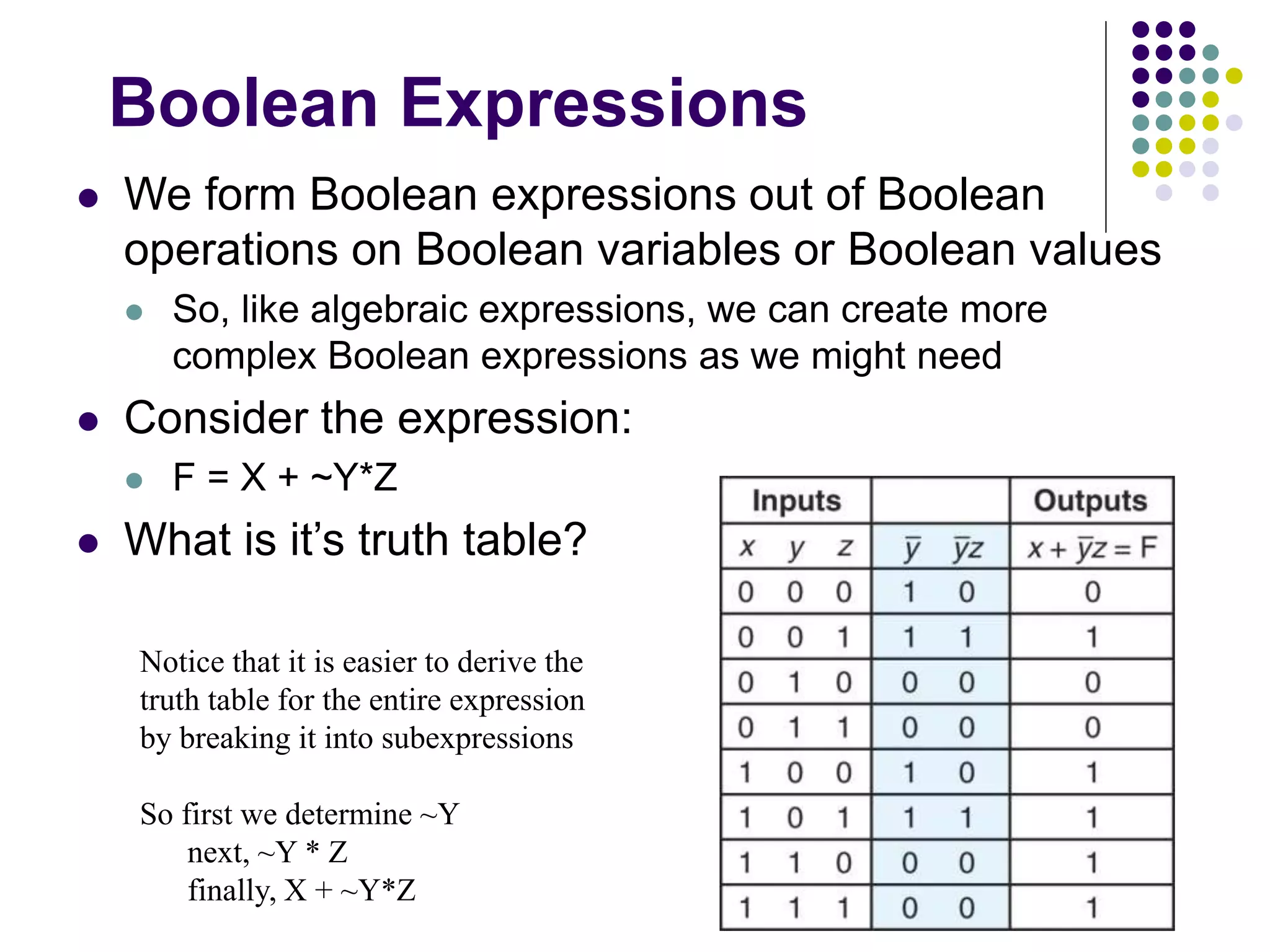
 Consider the expression:
 F = X + ~Y*Z
 What is it’s truth table?
Notice that it is easier to derive the
truth table for the entire expression
by breaking it into subexpressions
So first we determine ~Y
next, ~Y * Z
finally, X + ~Y*Z
Boolean Functions and
Expressions
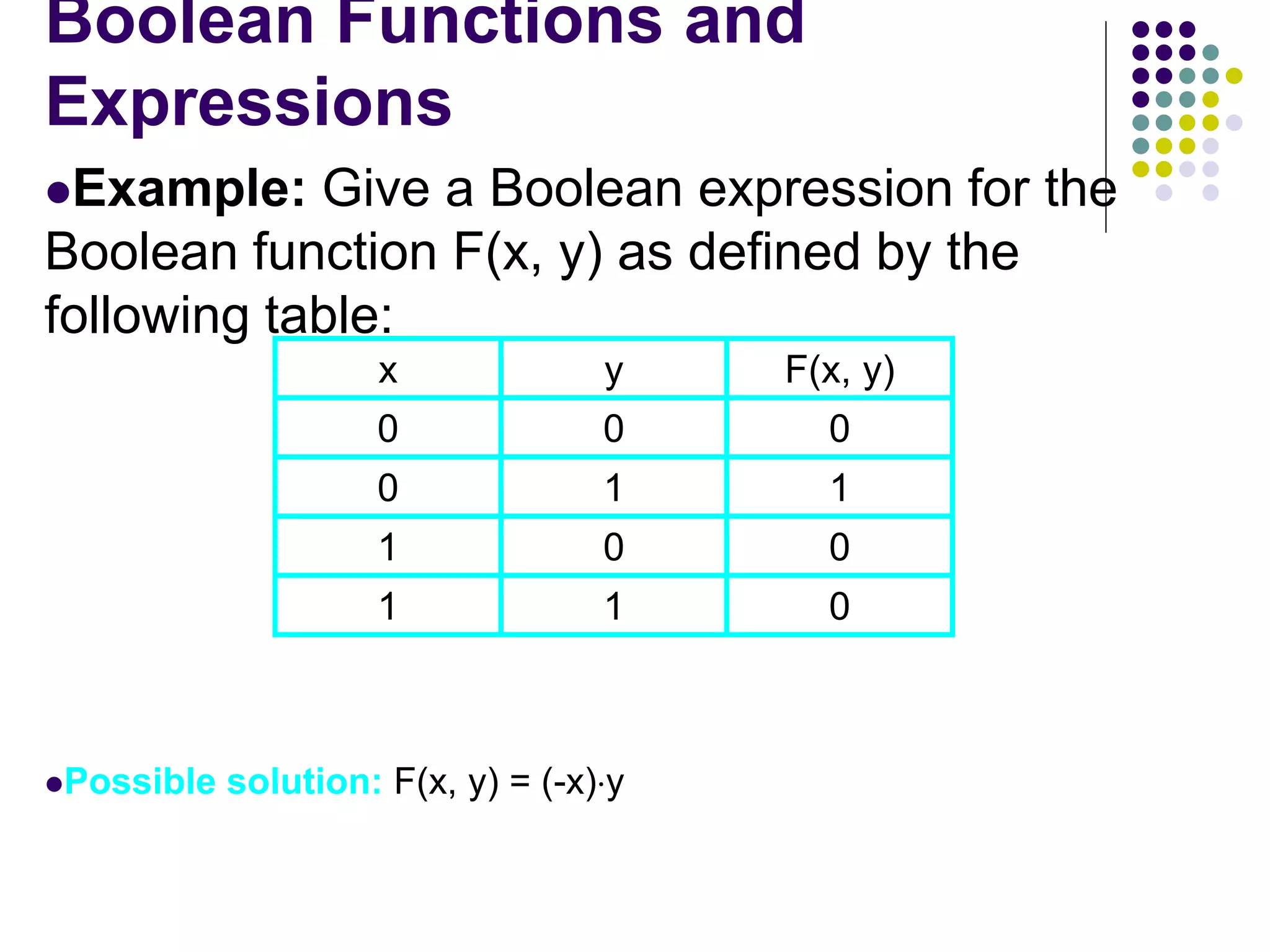
Example: Give a Boolean expression for the
Boolean function F(x, y) as defined by the
following table:
x y F(x, y)
0 0 0
0 1 1
1 0 0
1 1 0
Possible solution: F(x, y) = (-x)y
Boolean Functions and
Expressions
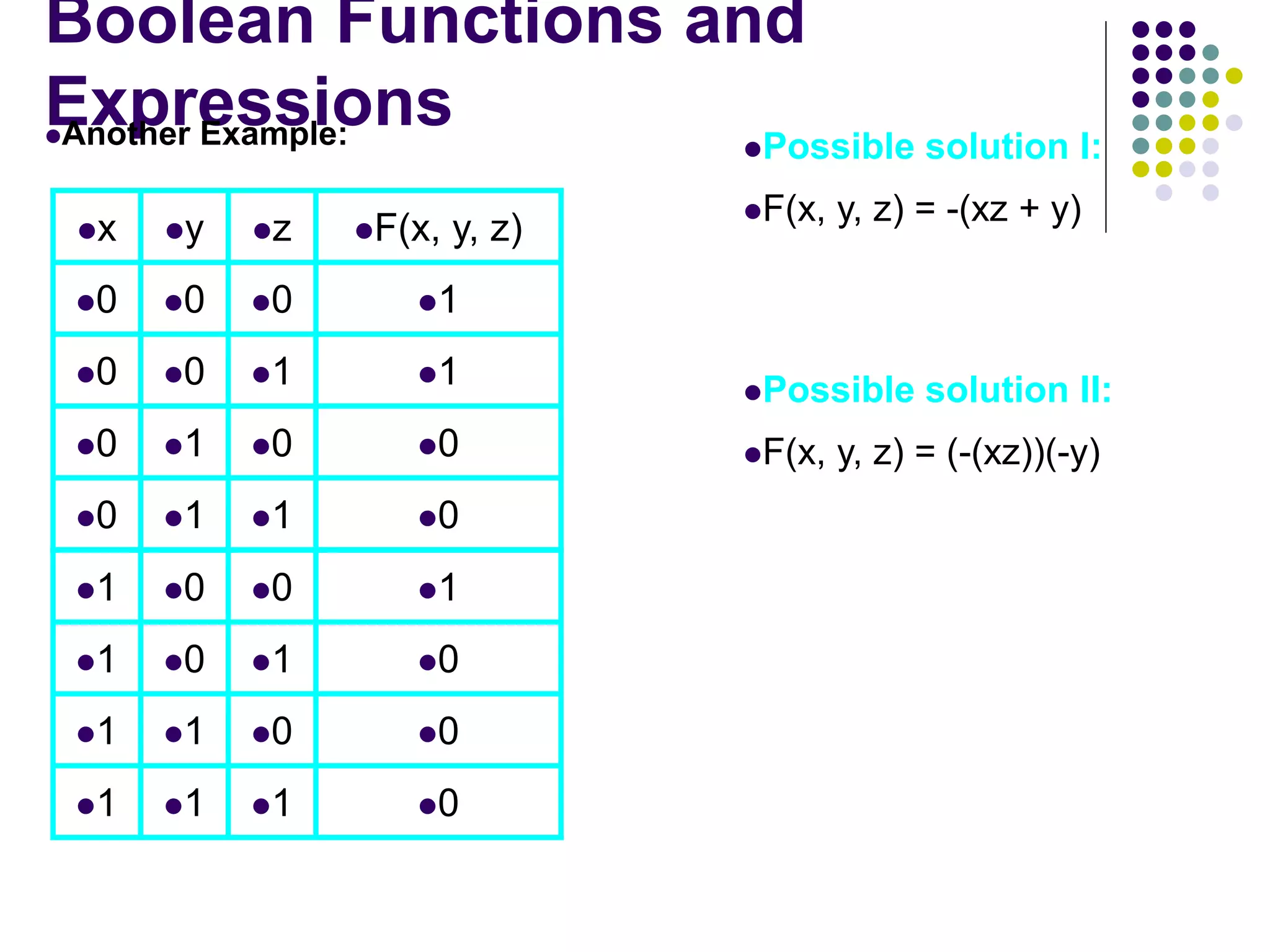
Another Example: Possible solution I:
F(x, y, z) = -(xz + y)
0
0
1
1
F(x, y, z)
1
0
1
0
z
0
0
1
0
1
0
0
0
y
x
0
0
0
1
1
0
1
0
1
1
1
1
0
1
0
1
Possible solution II:
F(x, y, z) = (-(xz))(-y)
Duality
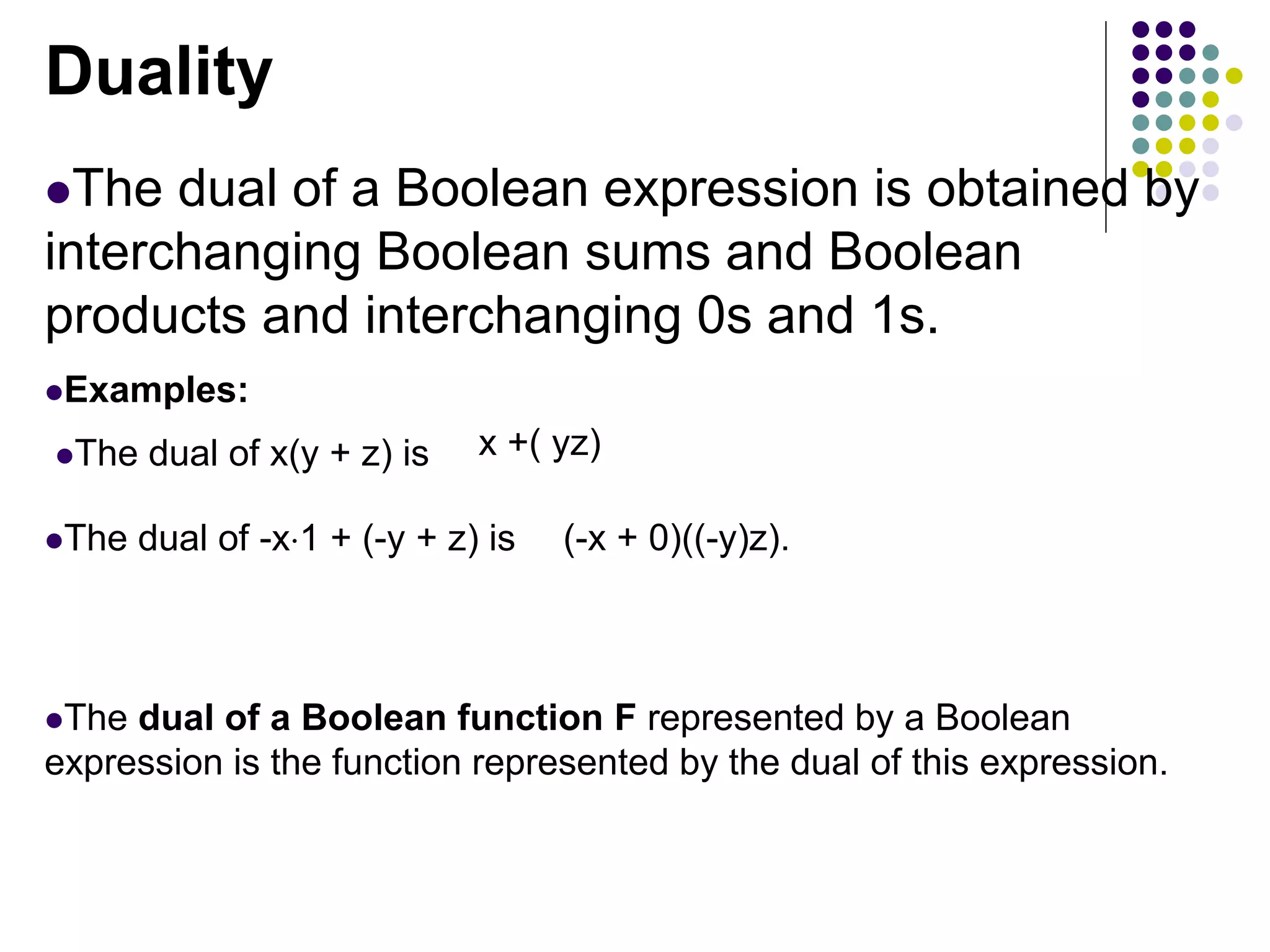
The dual of a Boolean expression is obtained by
interchanging Boolean sums and Boolean
products and interchanging 0s and 1s.
Examples:
The dual of x(y + z) is x +( yz)
The dual of -x1 + (-y + z) is (-x + 0)((-y)z).
The dual of a Boolean function F represented by a Boolean
expression is the function represented by the dual of this expression.
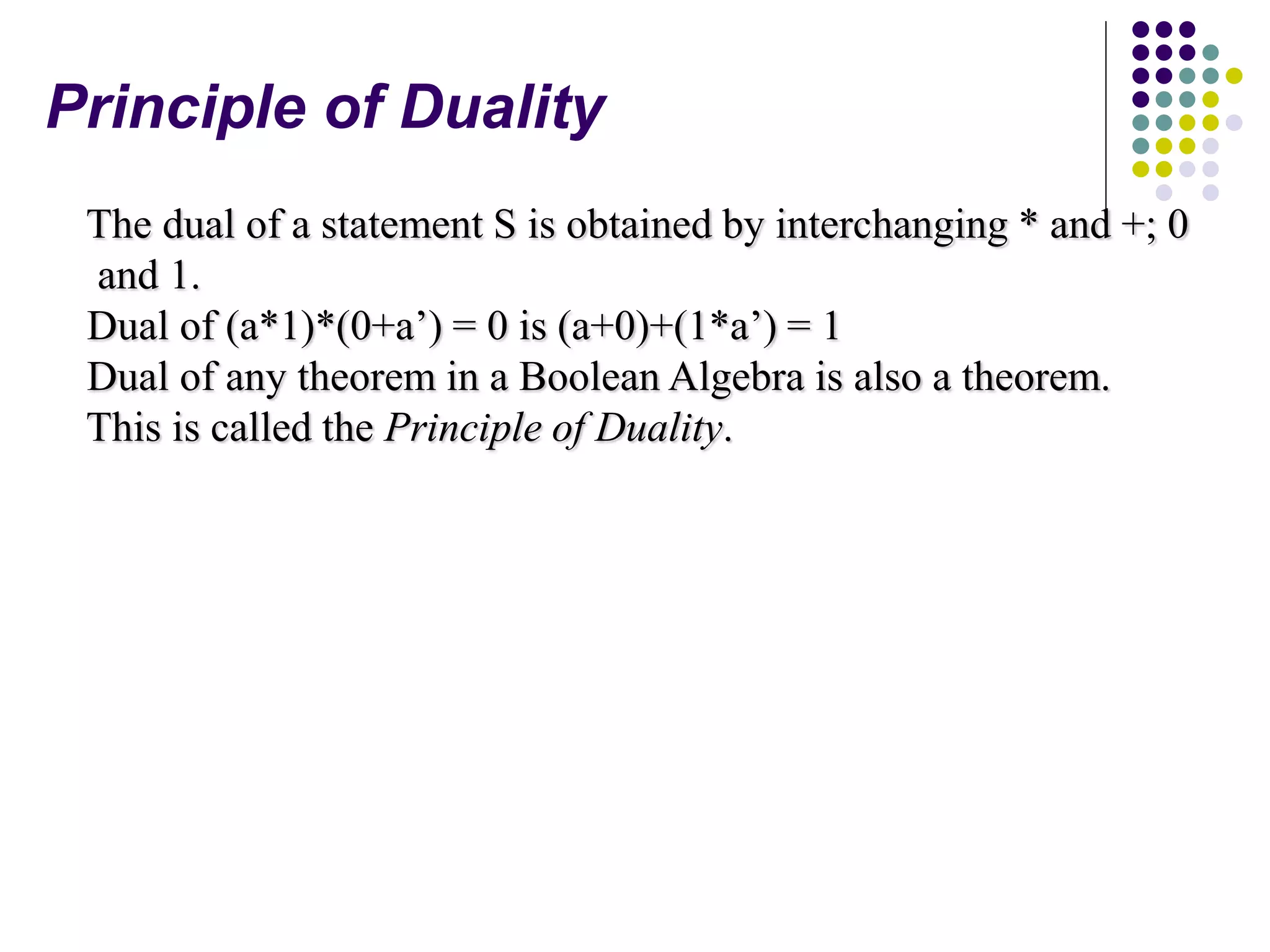
The dual of a statement S is obtained by interchanging * and +; 0
and 1.
Dual of (a*1)*(0+a’) = 0 is (a+0)+(1*a’) = 1
Dual of any theorem in a Boolean Algebra is also a theorem.
This is called the Principle of Duality.
Principle of Duality
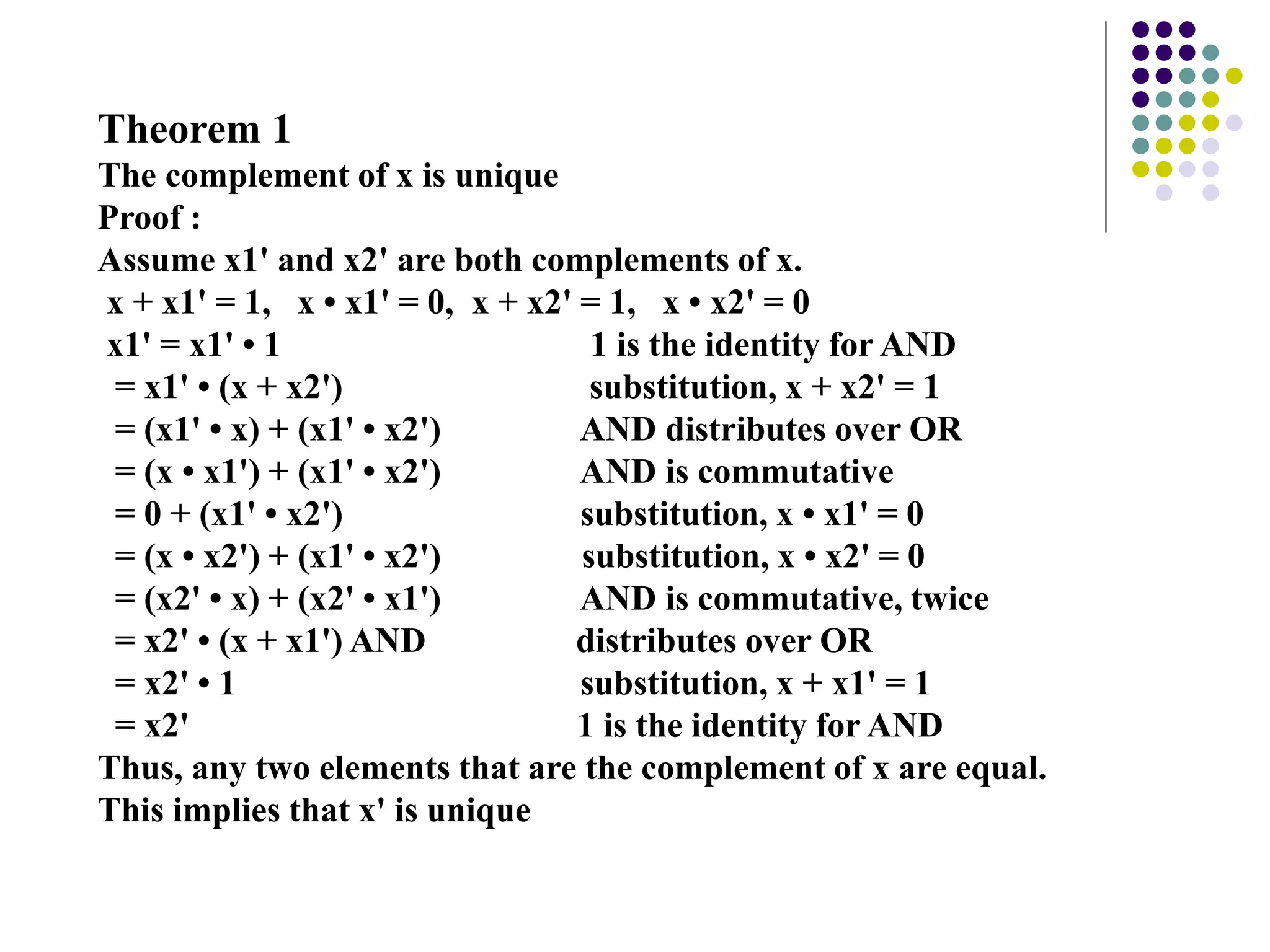
Theorem 1
The complement of x is unique
Proof :
Assume x1' and x2' are both complements of x.
x + x1' = 1, x • x1' = 0, x + x2' = 1, x • x2' = 0
x1' = x1' • 1 1 is the identity for AND
= x1' • (x + x2') substitution, x + x2' = 1
= (x1' • x) + (x1' • x2') AND distributes over OR
= (x • x1') + (x1' • x2') AND is commutative
= 0 + (x1' • x2') substitution, x • x1' = 0
= (x • x2') + (x1' • x2') substitution, x • x2' = 0
= (x2' • x) + (x2' • x1') AND is commutative, twice
= x2' • (x + x1') AND distributes over OR
= x2' • 1 substitution, x + x1' = 1
= x2' 1 is the identity for AND
Thus, any two elements that are the complement of x are equal.
This implies that x' is unique
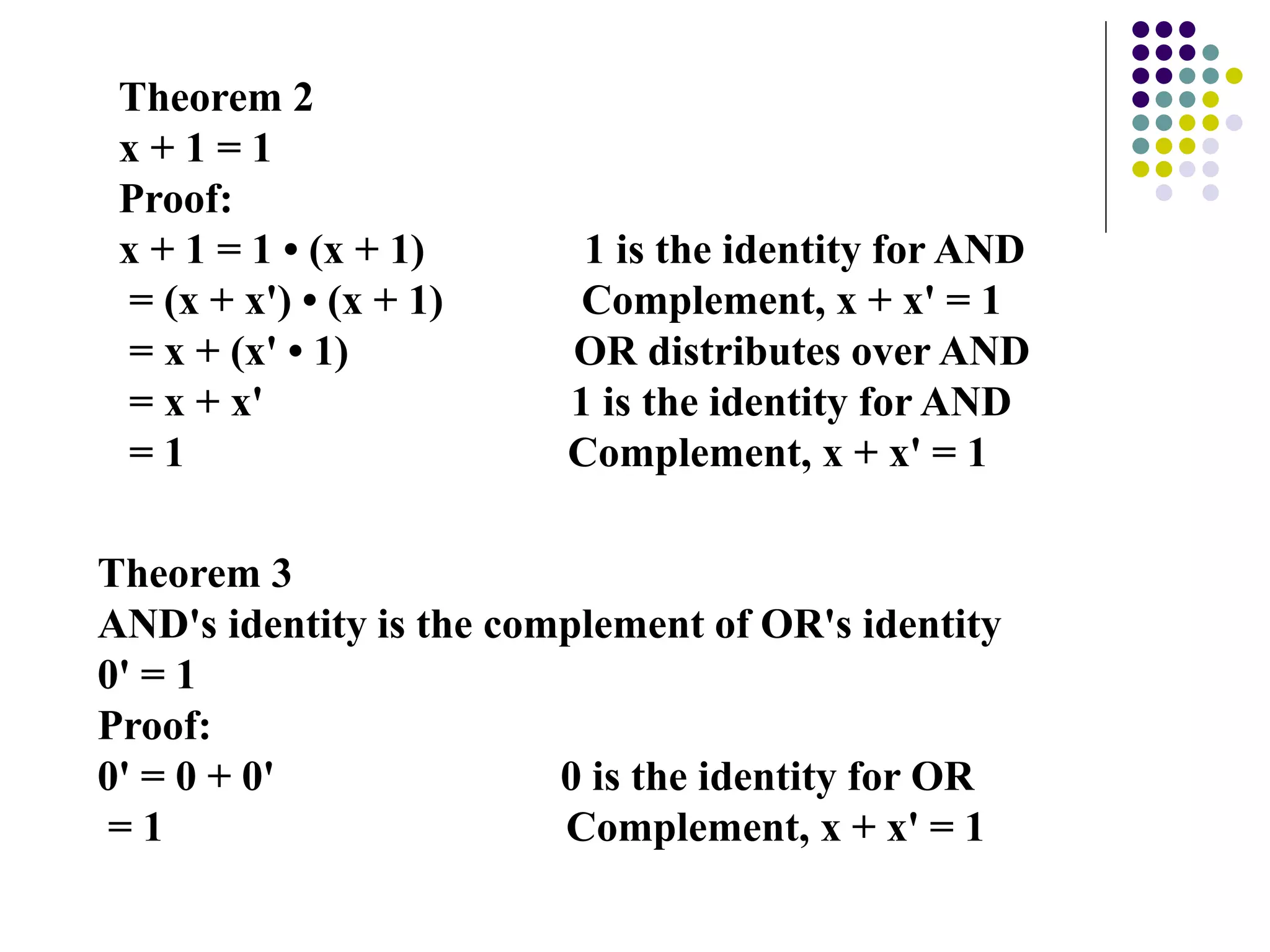
Theorem 2
x + 1 = 1
Proof:
x + 1 = 1 • (x + 1) 1 is the identity for AND
= (x + x') • (x + 1) Complement, x + x' = 1
= x + (x' • 1) OR distributes over AND
= x + x' 1 is the identity for AND
= 1 Complement, x + x' = 1
Theorem 3
AND's identity is the complement of OR's identity
0' = 1
Proof:
0' = 0 + 0' 0 is the identity for OR
= 1 Complement, x + x' = 1
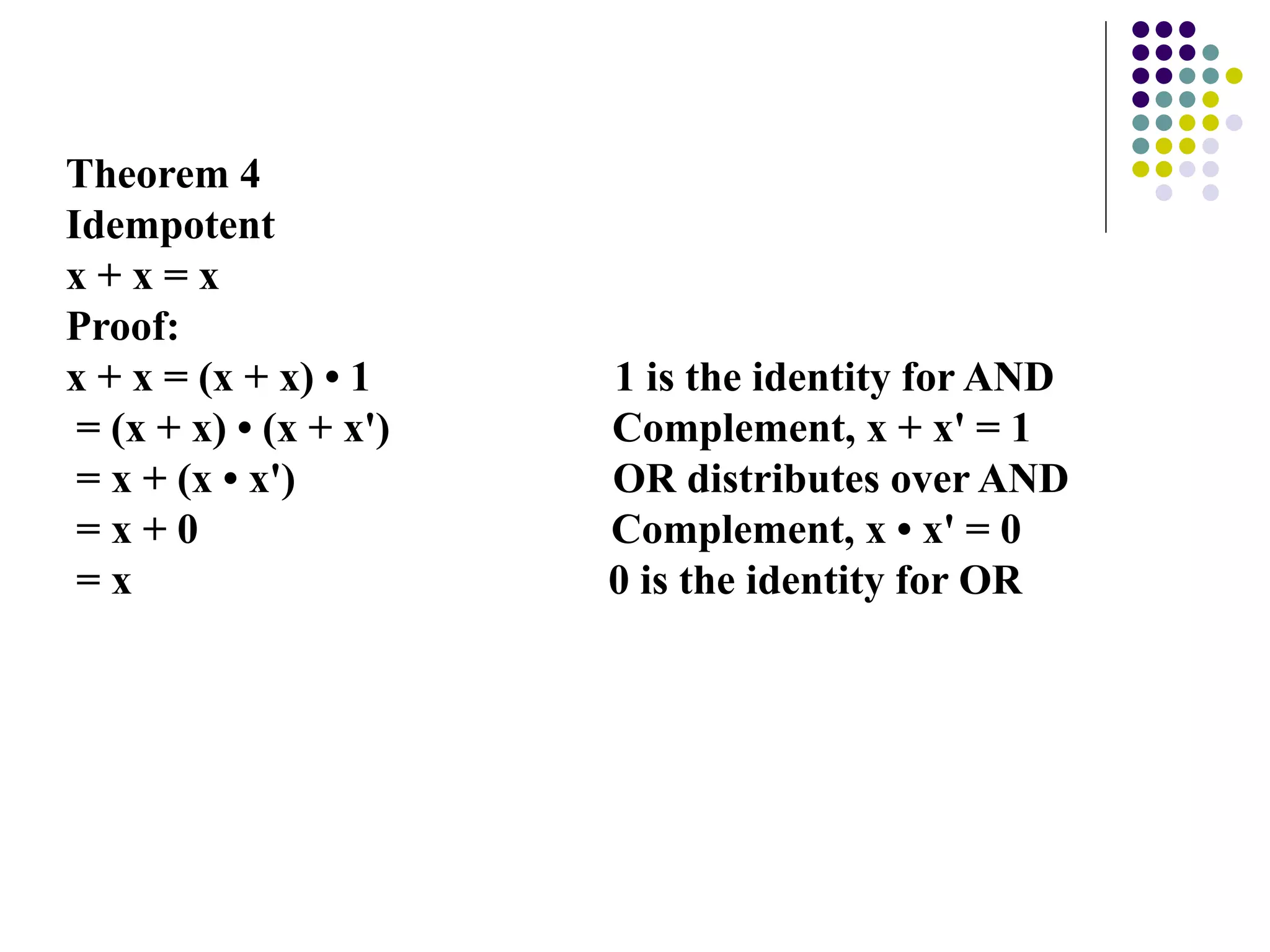
Theorem 4
Idempotent
x + x = x
Proof:
x + x = (x + x) • 1 1 is the identity for AND
= (x + x) • (x + x') Complement, x + x' = 1
= x + (x • x') OR distributes over AND
= x + 0 Complement, x • x' = 0
= x 0 is the identity for OR
Theorem 5
Involution
(x')' = x
Proof:
Let x' be the complement of x and (x')' be the complement of x'.
x + x' = 1, xx' = 0, x' + (x')' = 1, and x'(x')' = 0
(x')' = (x')' + 0 0 is the identity for OR
= (x')' + xx' Substitution, xx' = 0
= [(x')' + x][(x')' + x'] OR distributes over AND
= [x + (x')'][x' + (x')'] OR is commutative (P3), twice
= [x + (x')'] • 1 Substitution, x' + (x')' = 1
= [x + (x')'][x + x'] Substitution, x + x' = 1
= x + [(x')' • x'] OR distributes over AND
= x + [x' • (x')'] AND is commutative
= x + 0 Substitution, x'(x')' = 0
= x 0 is the identity for OR
Theorem 6
Absorption
x + xy = x
Proof:
x + xy = (x • 1) + xy 1 is the identity for AND
= x(1 + y) AND distributes over OR
= x(y + 1) OR is commutative
= x • 1 x + 1 = 1 (Thm 2-1)
= x 1 is the identity for AND
Theorem 7
x + x'y = x + y
Proof:
x + x'y = (x + x') (x + y) OR distributes over AND
= 1 • (x + y) Complement x + x' = 1
= x + y 1 is the identity for AND
Theorem 8
DeMorgan's Law 1
(x + y)' = x' y'
Proof:
By Theorem 1 (complements are unique) and Postulate P9 (complement), for every x in a Boolean
algebra there is a unique x' such that
x + x' = 1 and x • x' = 0
So it is sufficient to show that x'y' is the complement of x + y. We'll do this by showing that (x + y)
+
(x'y') = 1 and (x + y) • (x'y') = 0
(x + y) + (x'y') = [(x + y) + x'] [(x + y) + y'] OR distributes over AND
= [(y + x) + x'] [(x + y) + y'] OR is commutative
= [y + (x + x')] [x + (y + y')] OR is associative,twice
= (y + 1)(x + 1) Complement, x + x' = 1, twice
= 1 • 1 x + 1 = 1 (Thm 2-1), twice
= 1 Idempotent, x • x = x (Thm 4-2)
Also,
(x + y)(x'y') = (x'y')(x + y) AND is commutative
= [(x'y')x] + [(x'y')y] AND distributes over OR
= [(y'x')x] + [(x'y')y] AND is commutative
= [y'(x'x)] + [x'(y'y)] AND is associative (Thm 8-2),twice
= [y'(xx')] + [x'(yy')] AND is commutative, twice
= [y' • 0] + [x' • 0] Complement, x • x' = 0, twice
= 0 + 0 x • 0 = 0 (Thm 2-2), twice
= 0 Idempotent, x + x = x (Thm 4-1)
Prove x + yz = (x + y)(x + z)
x + yz = (x + y)(x + z)
= xx + xz + xy + yz
= x + xz + xy + yz
= x (1 + z + y) + yz
= x (1) + yz
= x + yz
Prove (x + y) · (x + y') = x
x = (x + y) · (x + y')
= xx + xy + xy' + yy'
= x + xy + xy' + yy'
= x + xy + xy' + 0
= x (1 + y + y')
= x (1)
= x

BOOLEAN ALGEBRA.ppt

  • 1.
  • 2.
    Boolean Algebra  Thebasis for Boolean algebra:  Boolean algebra is the algebra of binary values.  we refer to these values as 0 and 1  although we could also refer to them as true and false  the basic Boolean algebra operations are  AND, OR, NOT.
  • 3.
    Basic Boolean Identities As with algebra, there will be Boolean operations that we will want to simplify  We apply the following Boolean identities to help  For instance, in algebra, x = y * (z + 0) + (z * 0) can be simplified to just x = y * z
  • 5.
    Terminology  Element 0is called “FALSE”.  Element 1 is called “TRUE”.  ‘+’ operation “OR”,‘*’ operation “AND” and ’ operation “NOT”.  Juxtaposition implies * operation: ab = a * b  Operator order of precedence is: (), ’, *, +. a+bc = a+(b*c) ≠ (a+b)*c ab’ = a(b’) ≠ (a*b)’  Single Bit Boolean Algebra(1’ = 0 and 0’ = 1) + 0 1 0 0 1 1 1 1 * 0 1 0 0 0 1 0 1
  • 6.
    Truth Tables xy =x AND y = x * y x + y = x OR y x bar = NOT x AND is true only if OR is true if either NOT inverts the bit both inputs are true inputs are true We will denote x bar as ~X
  • 7.
    Boolean Functions and Expressions Definition:Let B = {0, 1}. The variable x is called a Boolean variable if it assumes values only from B. A function from Bn, the set {(x1, x2, …, xn) |xiB, 1  i  n}, to B is called a Boolean function of degree n. Boolean functions can be represented using expressions made up from the variables and Boolean operations.
  • 8.
    Boolean Functions and Expressions TheBoolean expressions in the variables x1, x2, …, xn are defined recursively as follows:  0, 1, x1, x2, …, xn are Boolean expressions.  If E1 and E2 are Boolean expressions, then (- E1), (E1E2), and (E1 + E2) are Boolean expressions. Each Boolean expression represents a Boolean function. The values of this function are obtained by substituting 0 and 1 for the variables in the expression.
  • 9.
    Boolean Expressions  Weform Boolean expressions out of Boolean operations on Boolean variables or Boolean values  So, like algebraic expressions, we can create more complex Boolean expressions as we might need  Consider the expression:  F = X + ~Y*Z  What is it’s truth table? Notice that it is easier to derive the truth table for the entire expression by breaking it into subexpressions So first we determine ~Y next, ~Y * Z finally, X + ~Y*Z
  • 10.
    Boolean Functions and Expressions Example:Give a Boolean expression for the Boolean function F(x, y) as defined by the following table: x y F(x, y) 0 0 0 0 1 1 1 0 0 1 1 0 Possible solution: F(x, y) = (-x)y
  • 11.
    Boolean Functions and Expressions AnotherExample: Possible solution I: F(x, y, z) = -(xz + y) 0 0 1 1 F(x, y, z) 1 0 1 0 z 0 0 1 0 1 0 0 0 y x 0 0 0 1 1 0 1 0 1 1 1 1 0 1 0 1 Possible solution II: F(x, y, z) = (-(xz))(-y)
  • 12.
    Duality The dual ofa Boolean expression is obtained by interchanging Boolean sums and Boolean products and interchanging 0s and 1s. Examples: The dual of x(y + z) is x +( yz) The dual of -x1 + (-y + z) is (-x + 0)((-y)z). The dual of a Boolean function F represented by a Boolean expression is the function represented by the dual of this expression.
  • 13.
    The dual ofa statement S is obtained by interchanging * and +; 0 and 1. Dual of (a*1)*(0+a’) = 0 is (a+0)+(1*a’) = 1 Dual of any theorem in a Boolean Algebra is also a theorem. This is called the Principle of Duality. Principle of Duality
  • 14.
    Theorem 1 The complementof x is unique Proof : Assume x1' and x2' are both complements of x. x + x1' = 1, x • x1' = 0, x + x2' = 1, x • x2' = 0 x1' = x1' • 1 1 is the identity for AND = x1' • (x + x2') substitution, x + x2' = 1 = (x1' • x) + (x1' • x2') AND distributes over OR = (x • x1') + (x1' • x2') AND is commutative = 0 + (x1' • x2') substitution, x • x1' = 0 = (x • x2') + (x1' • x2') substitution, x • x2' = 0 = (x2' • x) + (x2' • x1') AND is commutative, twice = x2' • (x + x1') AND distributes over OR = x2' • 1 substitution, x + x1' = 1 = x2' 1 is the identity for AND Thus, any two elements that are the complement of x are equal. This implies that x' is unique
  • 15.
    Theorem 2 x +1 = 1 Proof: x + 1 = 1 • (x + 1) 1 is the identity for AND = (x + x') • (x + 1) Complement, x + x' = 1 = x + (x' • 1) OR distributes over AND = x + x' 1 is the identity for AND = 1 Complement, x + x' = 1 Theorem 3 AND's identity is the complement of OR's identity 0' = 1 Proof: 0' = 0 + 0' 0 is the identity for OR = 1 Complement, x + x' = 1
  • 16.
    Theorem 4 Idempotent x +x = x Proof: x + x = (x + x) • 1 1 is the identity for AND = (x + x) • (x + x') Complement, x + x' = 1 = x + (x • x') OR distributes over AND = x + 0 Complement, x • x' = 0 = x 0 is the identity for OR
  • 17.
    Theorem 5 Involution (x')' =x Proof: Let x' be the complement of x and (x')' be the complement of x'. x + x' = 1, xx' = 0, x' + (x')' = 1, and x'(x')' = 0 (x')' = (x')' + 0 0 is the identity for OR = (x')' + xx' Substitution, xx' = 0 = [(x')' + x][(x')' + x'] OR distributes over AND = [x + (x')'][x' + (x')'] OR is commutative (P3), twice = [x + (x')'] • 1 Substitution, x' + (x')' = 1 = [x + (x')'][x + x'] Substitution, x + x' = 1 = x + [(x')' • x'] OR distributes over AND = x + [x' • (x')'] AND is commutative = x + 0 Substitution, x'(x')' = 0 = x 0 is the identity for OR
  • 18.
    Theorem 6 Absorption x +xy = x Proof: x + xy = (x • 1) + xy 1 is the identity for AND = x(1 + y) AND distributes over OR = x(y + 1) OR is commutative = x • 1 x + 1 = 1 (Thm 2-1) = x 1 is the identity for AND Theorem 7 x + x'y = x + y Proof: x + x'y = (x + x') (x + y) OR distributes over AND = 1 • (x + y) Complement x + x' = 1 = x + y 1 is the identity for AND
  • 19.
    Theorem 8 DeMorgan's Law1 (x + y)' = x' y' Proof: By Theorem 1 (complements are unique) and Postulate P9 (complement), for every x in a Boolean algebra there is a unique x' such that x + x' = 1 and x • x' = 0 So it is sufficient to show that x'y' is the complement of x + y. We'll do this by showing that (x + y) + (x'y') = 1 and (x + y) • (x'y') = 0 (x + y) + (x'y') = [(x + y) + x'] [(x + y) + y'] OR distributes over AND = [(y + x) + x'] [(x + y) + y'] OR is commutative = [y + (x + x')] [x + (y + y')] OR is associative,twice = (y + 1)(x + 1) Complement, x + x' = 1, twice = 1 • 1 x + 1 = 1 (Thm 2-1), twice = 1 Idempotent, x • x = x (Thm 4-2) Also, (x + y)(x'y') = (x'y')(x + y) AND is commutative = [(x'y')x] + [(x'y')y] AND distributes over OR = [(y'x')x] + [(x'y')y] AND is commutative = [y'(x'x)] + [x'(y'y)] AND is associative (Thm 8-2),twice = [y'(xx')] + [x'(yy')] AND is commutative, twice = [y' • 0] + [x' • 0] Complement, x • x' = 0, twice = 0 + 0 x • 0 = 0 (Thm 2-2), twice = 0 Idempotent, x + x = x (Thm 4-1)
  • 20.
    Prove x +yz = (x + y)(x + z) x + yz = (x + y)(x + z) = xx + xz + xy + yz = x + xz + xy + yz = x (1 + z + y) + yz = x (1) + yz = x + yz Prove (x + y) · (x + y') = x x = (x + y) · (x + y') = xx + xy + xy' + yy' = x + xy + xy' + yy' = x + xy + xy' + 0 = x (1 + y + y') = x (1) = x