LOGIC GATES
Formal logic:In formal logic, a statement
(proposition) is a declarative sentence that is either
true(1) or false (0).
It is easier to communicate with computers using
formal logic.
• Boolean variable: Takes only two values – either
true (1) or false (0).
They are used as basic units of formal logic.
3.
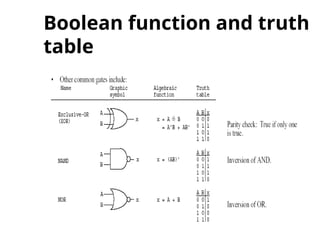
Boolean function andlogic
diagram
• Boolean function: Mapping from Boolean
variables to a Boolean value.
• Truth table:
Represents relationship between a Boolean
function and its binary variables.
It enumerates all possible combinations of
arguments and the corresponding function
values.
4.
Boolean function andlogic
diagram
• Boolean algebra: Deals with binary
variables and logic operations
operating on those variables.
• Logic diagram: Composed of graphic
symbols for logic gates. A simple
circuit sketch that represents inputs
and outputs of Boolean functions.
5.
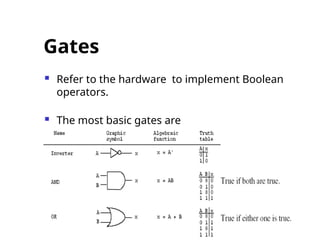
Gates
Refer tothe hardware to implement Boolean
operators.
The most basic gates are
BASIC IDENTITIES OF
BOOLEANALGEBRA
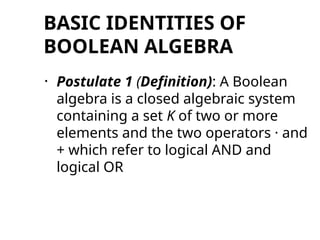
• Postulate 1 (Definition): A Boolean
algebra is a closed algebraic system
containing a set K of two or more
elements and the two operators · and
+ which refer to logical AND and
logical OR
8.
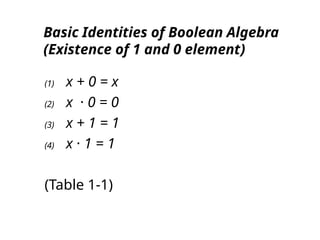
Basic Identities ofBoolean Algebra
(Existence of 1 and 0 element)
(1) x + 0 = x
(2) x · 0 = 0
(3) x + 1 = 1
(4) x · 1 = 1
(Table 1-1)
9.
Basic Identities ofBoolean Algebra
(Existence of complement)
(5) x + x = x
(6) x · x = x
(7) x + x’ = x
(8) x · x’ = 0
10.
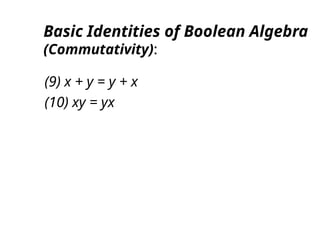
Basic Identities ofBoolean Algebra
(Commutativity):
(9) x + y = y + x
(10) xy = yx
11.
Basic Identities ofBoolean Algebra
(Associativity):
(11) x + ( y + z ) = ( x + y ) + z
(12) x (yz) = (xy) z
12.
Basic Identities ofBoolean Algebra
(Distributivity):
(13) x ( y + z ) = xy + xz
(14) x + yz = ( x + y )( x + z)
Function Minimization usingBoolean
Algebra
Examples:
(a) a + ab = a(1+b)=a
(b) a(a + b) = a.a +ab=a+ab=a(1+b)=a.
(c) a + a'b = (a + a')(a + b)=1(a + b) =a+b
(d) a(a' + b) = a. a' +ab=0+ab=ab
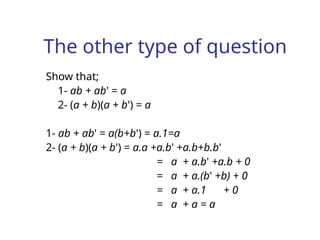
The other typeof question
Show that;
1- ab + ab' = a
2- (a + b)(a + b') = a
1- ab + ab' = a(b+b') = a.1=a
2- (a + b)(a + b') = a.a +a.b' +a.b+b.b'
= a + a.b' +a.b + 0
= a + a.(b' +b) + 0
= a + a.1 + 0
= a + a = a
18.
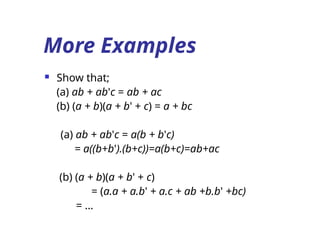
More Examples
Showthat;
(a) ab + ab'c = ab + ac
(b) (a + b)(a + b' + c) = a + bc
(a) ab + ab'c = a(b + b'c)
= a((b+b').(b+c))=a(b+c)=ab+ac
(b) (a + b)(a + b' + c)
= (a.a + a.b' + a.c + ab +b.b' +bc)
= …
19.
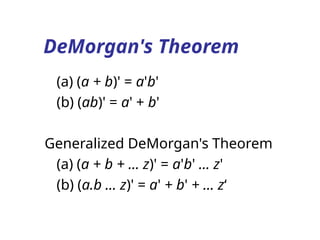
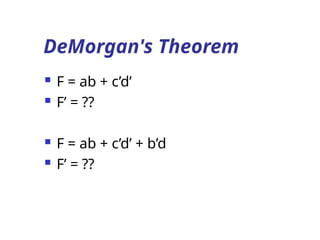
DeMorgan's Theorem
(a) (a+ b)' = a'b'
(b) (ab)' = a' + b'
Generalized DeMorgan's Theorem
(a) (a + b + … z)' = a'b' … z'
(b) (a.b … z)' = a' + b' + … z‘
More DeMorgan's example
Showthat: (a(b + z(x + a')))' =a' + b' (z' + x')
(a(b + z(x + a')))' = a' + (b + z(x + a'))'
= a' + b' (z(x + a'))'
= a' + b' (z' + (x + a')')
= a' + b' (z' + x'(a')')
= a' + b' (z' + x'a)
=a‘+b' z' + b'x'a
=(a‘+ b'x'a) + b' z'
=(a‘+ b'x‘)(a +a‘) + b' z'
= a‘+ b'x‘+ b' z‘
= a' + b' (z' + x')
23.
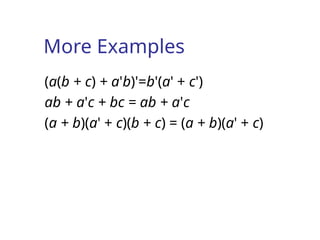
More Examples
(a(b +c) + a'b)'=b'(a' + c')
ab + a'c + bc = ab + a'c
(a + b)(a' + c)(b + c) = (a + b)(a' + c)