Dr Nadiah Alenaizan
Liturature Review
REU
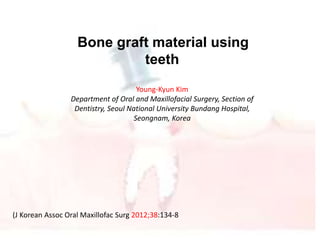
Bone graft material using
teeth
Young-Kyun Kim
Department of Oral and Maxillofacial Surgery, Section of
Dentistry, Seoul National University Bundang Hospital,
Seongnam, Korea
(J Korean Assoc Oral Maxillofac Surg 2012;38:134-8
Introduction
Teeth are known as a composite of organic and
inorganic components consisting of minerals of
the calcium phosphate range, collagen, and
other organic elements.
• The minerals of teeth have biological calcium
phosphate of 5 phases (hydroxyapatite,
tricalcium phosphate, octacalcium phos-
phate, amorphous calcium phosphate [TCP],
and brushite).
• It is assumed that good bony remodeling can
be made when calcium phosphate is put into a
living system.
Introduction
The chemical compositions of teeth and bone are
very similar.
• Enamel is 96% inorganic ingredients and 4%
organic ingredients and water.
•
• Dentin has a 65% : 35% ratio, whereas
cementum has the ratio of 45-50% : 50-55%
• Alveolar bone is made up of 65% inorganic
ingredients and 35% organic ingredients.
• Tooth dentin and cementum contain a number
of bone growth factors including type I collagen
and bone morphogenic protein (BMP).
• Type I collagen accounts for 90%, with the rest
consisting of noncollagenous proteins,
Why bone graft materials using teeth are
considered to be potentially useful in clinics
?
• Non-colagenous protein (BMP), Can perform
the role of promoting bone resorption and
bone formation..
Osteoinduction of Teeth
• Dentin matrix has long been proven to be
osteoinductive and rich in BMP.
• Organic component accounts for about 20%
of dentin weight and mostly consists of type I
collagen.
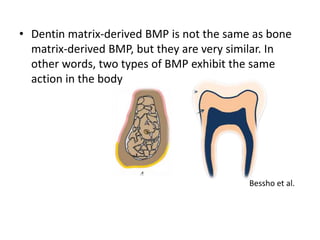
• Dentin matrix-derived BMP is not the same as bone
matrix-derived BMP, but they are very similar. In
other words, two types of BMP exhibit the same
action in the body
Bessho et al.
• Murata et al. suggested that demineralized
dentin matrix (DDM) are unique, absorbable
matrix with osteoinductivity, and should be an
effective graft material as carrier of BMP-2
and a scaffold for bone-forming cells for bone
engineering.
Osteoconduction and Biocompatibility
of Bone Graft Material Using Teeth
Toothash has proven to be an osteoconductive bone
graft material with excellent biocompatibility. It has
been introduced as toothash or particulate dentin in
overseas academic journals.
• Kim SY,et.al. Park SS,et.al , Kim WB, et.al
Development and clinical application of
autogenous tooth bone graft material
Teeth extracted from Human……..Dental Waste !!
Impacted third molar …Nerve injury… partial odontectomy
….(based on long observation )..remaining root and osseous
tissue were united without any complication.
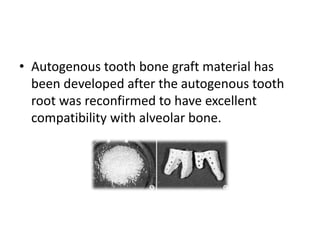
• Autogenous tooth bone graft material has
been developed after the autogenous tooth
root was reconfirmed to have excellent
compatibility with alveolar bone.
Why? the demineralized dentin matrix (DDM) of
the extracted teeth from a person is consider as
a safe material
because there is little immune rejection
response
• If dentin and cementum which make up most
of the teeth are used as bone graft materials,
good bony remodeling by osteoconduction
can be expected because the main minerals of
bone tissue are low-crystalline apatite.
Many authors have published case reports and
clinical studies:
On sinus bone graft, ridge augmentation,
guided bone regeneration, socket preservation
Results:
Toothhashes have proven to be useful materials
for hard tissue defect restoration.
• There have been reports that DDM by itself
can play the role of carrier of exogenous BMP
and growth factors as well as have an
osteoinductive effect.
• Excellent bone healing effect can be expected
if the organic component of internal teeth is
released slowly through an appropriate
demineralization process and stem cells,
growth factors, and BMP are seeded inside
the teeth.
Conclusion
Conclusion
• The safety of autogenous tooth bone graft
material has been established. Moreover, it is
a useful material that can substitute free
autogenous bone graft, showing bone healing
via excellent osteoinduction and
osteoconduction because it contains both
organic and inorganic components.
Conclusion
• Nowadays, research on osteoinductive and
osteoconductive bone graft material using
homogenous and xenogeneous tooth,
development of ideal scaffold to convey stem
cells and growth factors, endodontic
treatment and tooth restorative material are
being conducted actively. The author expects
a huge achievements to be made soon.(2012)
•The End *

Bone graft material using teeth (article) copy

  • 1.
  • 2.
    Bone graft materialusing teeth Young-Kyun Kim Department of Oral and Maxillofacial Surgery, Section of Dentistry, Seoul National University Bundang Hospital, Seongnam, Korea (J Korean Assoc Oral Maxillofac Surg 2012;38:134-8
  • 3.
    Introduction Teeth are knownas a composite of organic and inorganic components consisting of minerals of the calcium phosphate range, collagen, and other organic elements.
  • 4.
    • The mineralsof teeth have biological calcium phosphate of 5 phases (hydroxyapatite, tricalcium phosphate, octacalcium phos- phate, amorphous calcium phosphate [TCP], and brushite). • It is assumed that good bony remodeling can be made when calcium phosphate is put into a living system. Introduction
  • 5.
    The chemical compositionsof teeth and bone are very similar. • Enamel is 96% inorganic ingredients and 4% organic ingredients and water. • • Dentin has a 65% : 35% ratio, whereas cementum has the ratio of 45-50% : 50-55% • Alveolar bone is made up of 65% inorganic ingredients and 35% organic ingredients.
  • 6.
    • Tooth dentinand cementum contain a number of bone growth factors including type I collagen and bone morphogenic protein (BMP). • Type I collagen accounts for 90%, with the rest consisting of noncollagenous proteins,
  • 7.
    Why bone graftmaterials using teeth are considered to be potentially useful in clinics ? • Non-colagenous protein (BMP), Can perform the role of promoting bone resorption and bone formation..
  • 8.
    Osteoinduction of Teeth •Dentin matrix has long been proven to be osteoinductive and rich in BMP. • Organic component accounts for about 20% of dentin weight and mostly consists of type I collagen.
  • 9.
    • Dentin matrix-derivedBMP is not the same as bone matrix-derived BMP, but they are very similar. In other words, two types of BMP exhibit the same action in the body Bessho et al.
  • 10.
    • Murata etal. suggested that demineralized dentin matrix (DDM) are unique, absorbable matrix with osteoinductivity, and should be an effective graft material as carrier of BMP-2 and a scaffold for bone-forming cells for bone engineering.
  • 11.
    Osteoconduction and Biocompatibility ofBone Graft Material Using Teeth Toothash has proven to be an osteoconductive bone graft material with excellent biocompatibility. It has been introduced as toothash or particulate dentin in overseas academic journals. • Kim SY,et.al. Park SS,et.al , Kim WB, et.al
  • 12.
    Development and clinicalapplication of autogenous tooth bone graft material Teeth extracted from Human……..Dental Waste !! Impacted third molar …Nerve injury… partial odontectomy ….(based on long observation )..remaining root and osseous tissue were united without any complication.
  • 13.
    • Autogenous toothbone graft material has been developed after the autogenous tooth root was reconfirmed to have excellent compatibility with alveolar bone.
  • 14.
    Why? the demineralizeddentin matrix (DDM) of the extracted teeth from a person is consider as a safe material because there is little immune rejection response
  • 15.
    • If dentinand cementum which make up most of the teeth are used as bone graft materials, good bony remodeling by osteoconduction can be expected because the main minerals of bone tissue are low-crystalline apatite.
  • 16.
    Many authors havepublished case reports and clinical studies: On sinus bone graft, ridge augmentation, guided bone regeneration, socket preservation Results: Toothhashes have proven to be useful materials for hard tissue defect restoration.
  • 17.
    • There havebeen reports that DDM by itself can play the role of carrier of exogenous BMP and growth factors as well as have an osteoinductive effect.
  • 18.
    • Excellent bonehealing effect can be expected if the organic component of internal teeth is released slowly through an appropriate demineralization process and stem cells, growth factors, and BMP are seeded inside the teeth.
  • 19.
  • 20.
    Conclusion • The safetyof autogenous tooth bone graft material has been established. Moreover, it is a useful material that can substitute free autogenous bone graft, showing bone healing via excellent osteoinduction and osteoconduction because it contains both organic and inorganic components.
  • 21.
    Conclusion • Nowadays, researchon osteoinductive and osteoconductive bone graft material using homogenous and xenogeneous tooth, development of ideal scaffold to convey stem cells and growth factors, endodontic treatment and tooth restorative material are being conducted actively. The author expects a huge achievements to be made soon.(2012)
  • 22.