BY
Dr. ARUN CHANDRAN R
COMPOSITION & FUNCTIONS OF
BONE MARROW
INTRODUCTION
• Also called as Myeloid tissue.
• Constitutes around 4% of the total body mass of humans.
• A highly vascular, soft and flexible connective tissue within
medullary cavities of bones which serve as the primary site of
hematopoiesis.
• In adult humans , bone marrow is primarily located in the center
of most bones ( ribs, vertebrae, sternum and bones of the pelvis. )
• Primary source of pluripotent stem cells that give rise to all
hemopoietic cells.
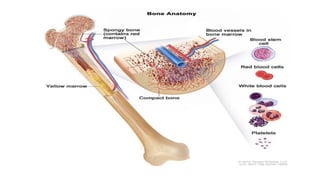
There are two types of bone marrow.
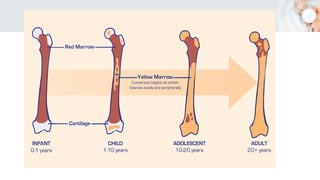
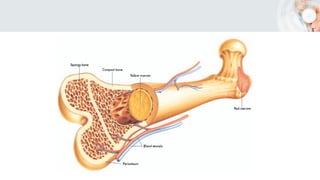
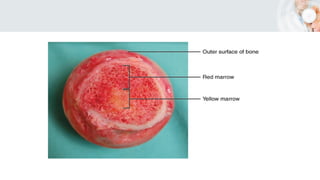
•They are medulla ossium rubra (red marrow), which consists
mainly of hematopoietic tissue, and
• Medulla ossium flava (yellow marrow), which is mainly made up
of fat cells.
•Red blood cells, platelets and most white blood cells arise in red
marrow.
•Both types of bone marrow contain numerous blood vessels and
capillaries.
•In adults red bone marrow is found only in the vertebrae, hips,
sternum, ribs, skull and at the ends of the long bones of the arms
ad leg.
•Red Bone Marrow consists of a delicate, highly vascular fibrous
tissue containing stem cells, which differentiate into various
blood cells.
•Stem cells become precursors or blast cells.
•Produce about 6 billion cells per kg of body weight.
HISTOLOGY OF BONE MARROW:
•Consists of stromal & Hemopoietic tissue
STROMA:
Consists of
1. A network of sinuses , arising from cortical capillaries at the
endosteum
2. Adipocytes (fibroblasts): Can undergo lipogenesis and get
transformed into fat cells.
3. Extra cellular Matrix
Stromal cells are the source of growth factors & cytokines.
HISTOLOGY OF BONE MARROW:
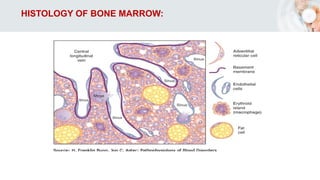
•Structure of bone marrow constitutes of hemopoietic tissue
islands and adipose tissues surrounded by vascular sinuses
within a meshwork of trabecular bone.
HISTOLOGY OF BONE MARROW:
The bone marrow is composed of both cellular and non-cellular
components and structurally be divided into
vascular and non-vascular regions.
The non-vascular section of bone marrow is composed of
 Hemopoietic cells of various lineages and maturity, (packed
between fat cells, thin bands of bony tissue , collagen fibers,
fibroblasts and dendritic cells.)
This is where hematopoiesis takes place.
HISTOLOGY OF BONE MARROW:
•The vascular section contains blood vessels that supply
the bone with nutrients and transport blood stem cells and
formed mature blood cells away into circulation.
• Hemopoietic cells cluster around the vascular sinuses where
they mature, before they eventually are discharged into the
blood.
•Lymphocytes are found surrounding the small radial arteries,
whereas most immature myeloid precursors are found deep in the
parenchyma.
FUNCTIONS OF BONE MARROW:
1. Red bone marrow is involved in Haemopoeisis
2. Bone marrow gives rise to all of the lymphoid cells that
migrate to the thymus and mature into T cells.
3. B cells mature in the bone marrow.
4. Platelets which are formed in the bone marrow.
5. Yellow marrow is involved in the storage of fat.
6. Contributes to the destruction of RBC, along with liver and
spleen.
7. Yellow marrow can be converted into red marrow under
conditions like severe blood loss or fever.
BY
Dr. ARUN CHANDRAN R
JAUNDICE
DEFINITION:
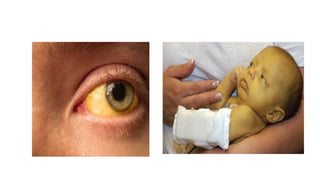
• Condition characterized by yellow discoloration of the skin,
mucous membrane and deeper tissues due to increased
bilirubin level of blood.
• Jaune in French means yellow.
• Normal Serum bilirubin level 0.5 to 1.5 mg/dl
• When bilirubin levels exceeds 2 mg/dl , it is termed Jaundice.
TYPES OF JAUNDICE
1. PREHEPATIC / HEMOLYTIC JAUNDICE
2. HEPATIC/ HEPATOCELLULAR JAUNDICE
3. POSTHEPATIC / OBSTRUCTIIVE JAUNDICE.
BONE MARROW anatomy and physiology .pptx

BONE MARROW anatomy and physiology .pptx

  • 1.
    BY Dr. ARUN CHANDRANR COMPOSITION & FUNCTIONS OF BONE MARROW
  • 2.
    INTRODUCTION • Also calledas Myeloid tissue. • Constitutes around 4% of the total body mass of humans. • A highly vascular, soft and flexible connective tissue within medullary cavities of bones which serve as the primary site of hematopoiesis. • In adult humans , bone marrow is primarily located in the center of most bones ( ribs, vertebrae, sternum and bones of the pelvis. ) • Primary source of pluripotent stem cells that give rise to all hemopoietic cells.
  • 4.
    There are twotypes of bone marrow. •They are medulla ossium rubra (red marrow), which consists mainly of hematopoietic tissue, and • Medulla ossium flava (yellow marrow), which is mainly made up of fat cells. •Red blood cells, platelets and most white blood cells arise in red marrow. •Both types of bone marrow contain numerous blood vessels and capillaries.
  • 8.
    •In adults redbone marrow is found only in the vertebrae, hips, sternum, ribs, skull and at the ends of the long bones of the arms ad leg. •Red Bone Marrow consists of a delicate, highly vascular fibrous tissue containing stem cells, which differentiate into various blood cells. •Stem cells become precursors or blast cells. •Produce about 6 billion cells per kg of body weight.
  • 9.
    HISTOLOGY OF BONEMARROW: •Consists of stromal & Hemopoietic tissue STROMA: Consists of 1. A network of sinuses , arising from cortical capillaries at the endosteum 2. Adipocytes (fibroblasts): Can undergo lipogenesis and get transformed into fat cells. 3. Extra cellular Matrix Stromal cells are the source of growth factors & cytokines.
  • 10.
    HISTOLOGY OF BONEMARROW: •Structure of bone marrow constitutes of hemopoietic tissue islands and adipose tissues surrounded by vascular sinuses within a meshwork of trabecular bone.
  • 11.
  • 12.
    HISTOLOGY OF BONEMARROW: The bone marrow is composed of both cellular and non-cellular components and structurally be divided into vascular and non-vascular regions. The non-vascular section of bone marrow is composed of  Hemopoietic cells of various lineages and maturity, (packed between fat cells, thin bands of bony tissue , collagen fibers, fibroblasts and dendritic cells.) This is where hematopoiesis takes place.
  • 13.
    HISTOLOGY OF BONEMARROW: •The vascular section contains blood vessels that supply the bone with nutrients and transport blood stem cells and formed mature blood cells away into circulation. • Hemopoietic cells cluster around the vascular sinuses where they mature, before they eventually are discharged into the blood. •Lymphocytes are found surrounding the small radial arteries, whereas most immature myeloid precursors are found deep in the parenchyma.
  • 14.
    FUNCTIONS OF BONEMARROW: 1. Red bone marrow is involved in Haemopoeisis 2. Bone marrow gives rise to all of the lymphoid cells that migrate to the thymus and mature into T cells. 3. B cells mature in the bone marrow. 4. Platelets which are formed in the bone marrow. 5. Yellow marrow is involved in the storage of fat. 6. Contributes to the destruction of RBC, along with liver and spleen. 7. Yellow marrow can be converted into red marrow under conditions like severe blood loss or fever.
  • 16.
  • 17.
    DEFINITION: • Condition characterizedby yellow discoloration of the skin, mucous membrane and deeper tissues due to increased bilirubin level of blood. • Jaune in French means yellow. • Normal Serum bilirubin level 0.5 to 1.5 mg/dl • When bilirubin levels exceeds 2 mg/dl , it is termed Jaundice.
  • 19.
    TYPES OF JAUNDICE 1.PREHEPATIC / HEMOLYTIC JAUNDICE 2. HEPATIC/ HEPATOCELLULAR JAUNDICE 3. POSTHEPATIC / OBSTRUCTIIVE JAUNDICE.