Chapter 12
The Bond Market
Copyright ©2015 Pearson Education, Ltd. All rights reserved. 12-2
Chapter Preview
In this chapter, we focus on longer-term
securities: bonds. Bonds are like money
market instruments, but they have maturities
that exceed one year. These include Treasury
bonds, corporate bonds, mortgages, and the
like.
Copyright ©2015 Pearson Education, Ltd. All rights reserved. 12-3
Chapter Preview
• Purpose of the Capital
Market
• Capital Market
Participants
• Capital Market Trading
• Types of Bonds
• Treasury Notes and
Bonds
• Municipal Bonds
• Corporate Bonds
• Financial Guarantees for
Bonds
• Current Yield
Calculation
• Finding the Value of
Coupon Bonds
• Investing in Bonds
Copyright ©2015 Pearson Education, Ltd. All rights reserved. 12-4
Purpose of the Capital Market
• Original maturity is greater than one year,
typically for long-term financing or
investments
• Best known capital market securities:
─ Stocks and bonds
Copyright ©2015 Pearson Education, Ltd. All rights reserved. 12-5
Capital Market Participants
• Primary issuers of securities:
─ Federal and local governments: debt issuers
─ Corporations: equity and debt issuers
• Largest purchasers of securities:
─ You and me
Copyright ©2015 Pearson Education, Ltd. All rights reserved. 12-6
Capital Market Trading
1. Primary market for initial sale (IPO)
2. Secondary market
─ Over-the-counter
─ Organized exchanges (i.e., NYSE)
Copyright ©2015 Pearson Education, Ltd. All rights reserved. 12-7
Types of Bonds
• Bonds are securities that represent debt
owed by the issuer to the investor, and
typically have specified payments on specific
dates.
• Types of bonds we will examine include
long-term government bonds (T-bonds),
municipal bonds, and corporate bonds.
Copyright ©2015 Pearson Education, Ltd. All rights reserved. 12-8
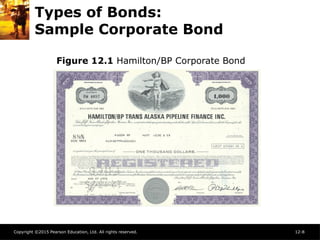
Types of Bonds:
Sample Corporate Bond
Figure 12.1 Hamilton/BP Corporate Bond
Copyright ©2015 Pearson Education, Ltd. All rights reserved. 12-9
Treasury Notes and Bonds
• The U.S. Treasury issues notes and bonds to
finance its operations.
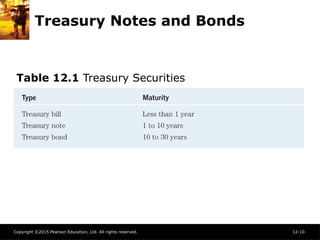
• The following table summarizes the maturity
differences among the various Treasury
securities.
Copyright ©2015 Pearson Education, Ltd. All rights reserved. 12-10
Treasury Notes and Bonds
Table 12.1 Treasury Securities
Copyright ©2015 Pearson Education, Ltd. All rights reserved. 12-11
Treasury Bond Interest Rates
• No default risk since the Treasury can print
money to payoff the debt
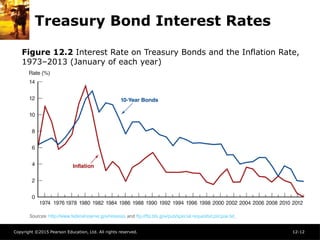
• Very low interest rates, often considered the
risk-free rate (although inflation risk is still
present)
Copyright ©2015 Pearson Education, Ltd. All rights reserved. 12-12
Treasury Bond Interest Rates
Figure 12.2 Interest Rate on Treasury Bonds and the Inflation Rate,
1973–2013 (January of each year)
Copyright ©2015 Pearson Education, Ltd. All rights reserved. 12-13
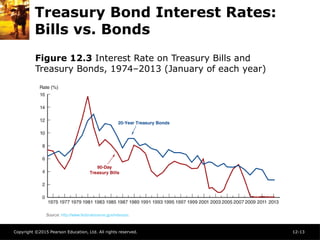
Treasury Bond Interest Rates:
Bills vs. Bonds
Figure 12.3 Interest Rate on Treasury Bills and
Treasury Bonds, 1974–2013 (January of each year)
Copyright ©2015 Pearson Education, Ltd. All rights reserved. 12-14
Treasury Bonds:
Recent Innovation
• Treasury Inflation-Indexed Securities:
the principal amount is tied to the current
rate of inflation to protect investor
purchasing power
• Treasury STRIPS: the coupon and principal
payments are “stripped” from a T-Bond and
sold as individual zero-coupon bonds.
Copyright ©2015 Pearson Education, Ltd. All rights reserved. 12-15
Treasury Bonds: Agency Debt
• Although not technically Treasury securities,
agency bonds are issued by government-
sponsored entities, such as GNMA, FNMA,
and FHLMC.
• The debt has an “implicit” guarantee that
the U.S. government will not let the
debt default. This “guarantee” was clear
during the 2008 bailout…
Copyright ©2015 Pearson Education, Ltd. All rights reserved. 12-16
The 2007–2009 Financial Crisis:
Bailout of Fannie and Freddie
• Both Fannie and Freddie managed their
political situation effectively, allowing them
to engage in risky activities, despite
concerns raised.
• By 2008, the two had purchased or
guaranteed over $5 trillion in mortgages or
mortgage-backed securities.
Copyright ©2015 Pearson Education, Ltd. All rights reserved. 12-17
The 2007–2009 Financial Crisis:
Bailout of Fannie and Freddie
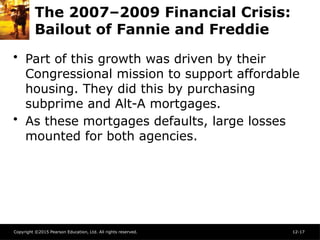
• Part of this growth was driven by their
Congressional mission to support affordable
housing. They did this by purchasing
subprime and Alt-A mortgages.
• As these mortgages defaults, large losses
mounted for both agencies.
Copyright ©2015 Pearson Education, Ltd. All rights reserved. 12-18
The 2007–2009 Financial Crisis:
Bailout of Fannie and Freddie
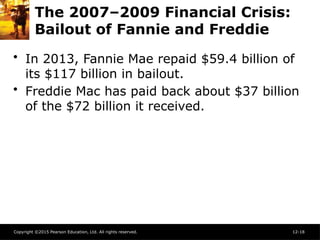
• In 2013, Fannie Mae repaid $59.4 billion of
its $117 billion in bailout.
• Freddie Mac has paid back about $37 billion
of the $72 billion it received.
Copyright ©2015 Pearson Education, Ltd. All rights reserved. 12-19
Municipal Bonds
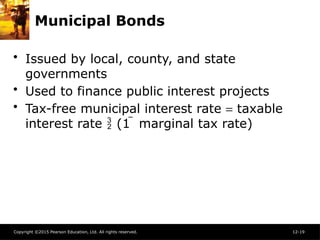
• Issued by local, county, and state
governments
• Used to finance public interest projects
• Tax-free municipal interest rate = taxable
interest rate  (1  marginal tax rate)
Copyright ©2015 Pearson Education, Ltd. All rights reserved. 12-20
Municipal Bonds: Example
Copyright ©2015 Pearson Education, Ltd. All rights reserved. 12-21
Municipal Bonds: Example
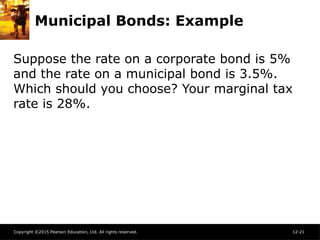
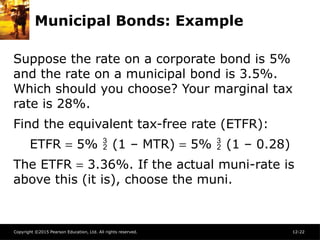
Suppose the rate on a corporate bond is 5%
and the rate on a municipal bond is 3.5%.
Which should you choose? Your marginal tax
rate is 28%.
Copyright ©2015 Pearson Education, Ltd. All rights reserved. 12-22
Municipal Bonds: Example
Suppose the rate on a corporate bond is 5%
and the rate on a municipal bond is 3.5%.
Which should you choose? Your marginal tax
rate is 28%.
Find the equivalent tax-free rate (ETFR):
ETFR = 5%  (1 – MTR) = 5%  (1 – 0.28)
The ETFR = 3.36%. If the actual muni-rate is
above this (it is), choose the muni.
Copyright ©2015 Pearson Education, Ltd. All rights reserved. 12-23
Municipal Bonds
• Two types
─ General obligation bonds
─ Revenue bonds
• NOT default-free (e.g., Orange County
California)
─ Defaults in 1990 amounted to $1.4 billion in this
market
Copyright ©2015 Pearson Education, Ltd. All rights reserved. 12-24
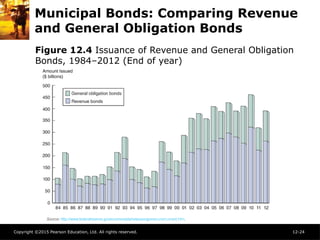
Municipal Bonds: Comparing Revenue
and General Obligation Bonds
Figure 12.4 Issuance of Revenue and General Obligation
Bonds, 1984–2012 (End of year)
Copyright ©2015 Pearson Education, Ltd. All rights reserved. 12-25
Corporate Bonds
• Typically have a face value of $1,000,
although some have a face value of $5,000
or $10,000
• Pay interest semi-annually
Copyright ©2015 Pearson Education, Ltd. All rights reserved. 12-26
Corporate Bonds
• Cannot be redeemed anytime the issuer
wishes, unless a specific clause states this
(call option).
• Degree of risk varies with each bond, even
from the same issuer. Following suite, the
required interest rate varies with level
of risk.
Copyright ©2015 Pearson Education, Ltd. All rights reserved. 12-27
Corporate Bonds
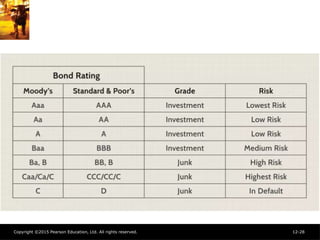
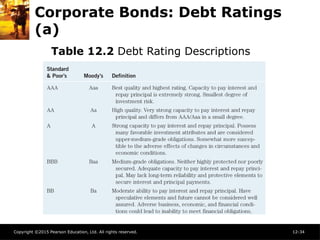
• The degree of risk ranges from low-risk
(AAA) to higher risk (BBB). Any bonds rated
below BBB are considered sub-investment
grade debt.
Copyright ©2015 Pearson Education, Ltd. All rights reserved. 12-28
Copyright ©2015 Pearson Education, Ltd. All rights reserved. 12-29
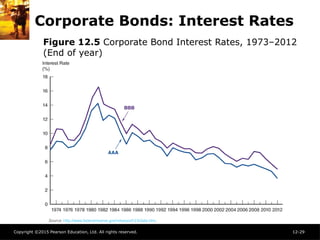
Corporate Bonds: Interest Rates
Figure 12.5 Corporate Bond Interest Rates, 1973–2012
(End of year)
Copyright ©2015 Pearson Education, Ltd. All rights reserved. 12-30
Characteristics of Corporate
Bonds
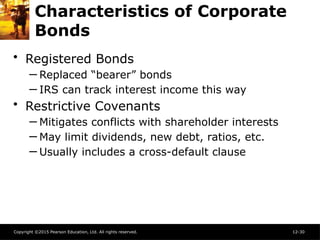
• Registered Bonds
─ Replaced “bearer” bonds
─ IRS can track interest income this way
• Restrictive Covenants
─ Mitigates conflicts with shareholder interests
─ May limit dividends, new debt, ratios, etc.
─ Usually includes a cross-default clause
Copyright ©2015 Pearson Education, Ltd. All rights reserved. 12-31
Characteristics of Corporate
Bonds
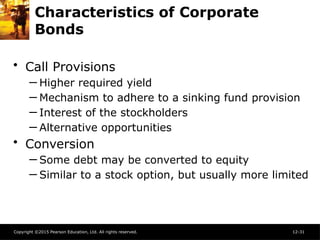
• Call Provisions
─ Higher required yield
─ Mechanism to adhere to a sinking fund provision
─ Interest of the stockholders
─ Alternative opportunities
• Conversion
─ Some debt may be converted to equity
─ Similar to a stock option, but usually more limited
Copyright ©2015 Pearson Education, Ltd. All rights reserved. 12-32
Corporate Bonds: Characteristics
of Corporate Bonds
• Secured Bonds
─ Mortgage bonds
─ Equipment trust certificates
• Unsecured Bonds
─ Debentures
─ Subordinated debentures
─ Variable-rate bonds
Copyright ©2015 Pearson Education, Ltd. All rights reserved. 12-33
Corporate Bonds: Characteristics
of Corporate Bonds
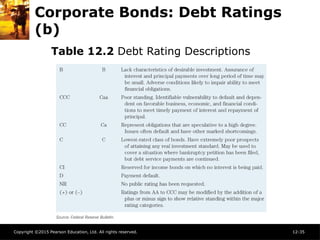
• Junk Bonds
─ Debt that is rated below BBB
─ Often, trusts and insurance companies are not
permitted to invest in junk debt
─ Michael Milken developed this market in the mid-
1980s, although he was subsequently convicted
of insider trading
Copyright ©2015 Pearson Education, Ltd. All rights reserved. 12-34
Corporate Bonds: Debt Ratings
(a)
Table 12.2 Debt Rating Descriptions
Copyright ©2015 Pearson Education, Ltd. All rights reserved. 12-35
Corporate Bonds: Debt Ratings
(b)
Table 12.2 Debt Rating Descriptions
Copyright ©2015 Pearson Education, Ltd. All rights reserved. 12-36
Financial Guarantees for Bonds
• Some debt issuers purchase financial
guarantees to lower the risk of their debt.
• The guarantee provides for timely payment
of interest and principal, and are usually
backed by large insurance companies.
Copyright ©2015 Pearson Education, Ltd. All rights reserved. 12-37
Financial Guarantees for Bonds
• As it turns out, not all guarantees actually
make sense!
─ In 1995, JPMorgan created the credit default
swap (CDS), a type of insurance on bonds.
─ In 2000, Congress removed CDSs from any
oversight.
─ By 2008, the CDS market was over $62 trillion!
─ 2008 losses on mortgages lead to huge payouts
on this insurance.
Copyright ©2015 Pearson Education, Ltd. All rights reserved. 12-38
Bond Yield Calculations
• Bond yields are quoted using a variety of
conventions, depending on both the type of
issue and the market.
• We will examine the current yield calculation
that is commonly used for
long-term debt.
Copyright ©2015 Pearson Education, Ltd. All rights reserved. 12-39
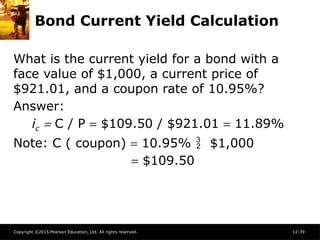
Bond Current Yield Calculation
What is the current yield for a bond with a
face value of $1,000, a current price of
$921.01, and a coupon rate of 10.95%?
Answer:
ic = C / P = $109.50 / $921.01 = 11.89%
Note: C ( coupon) = 10.95%  $1,000
= $109.50
Copyright ©2015 Pearson Education, Ltd. All rights reserved. 12-40
Finding the Value of Coupon
Bonds
• Bond pricing is, in theory, no different than
pricing any set of known cash flows.
• Once the cash flows have been identified,
they should be discounted to time zero at an
appropriate discount rate.
Copyright ©2015 Pearson Education, Ltd. All rights reserved. 12-41
Finding the Value of Coupon
Bonds
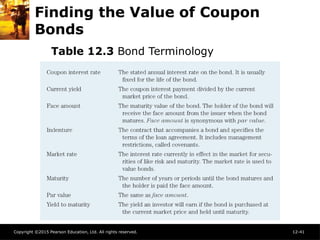
Table 12.3 Bond Terminology
Copyright ©2015 Pearson Education, Ltd. All rights reserved. 12-42
Finding the Value of Coupon
Bonds
Let’s use a simple example to illustrate the
bond pricing idea.
What is the price of two-year, 10% coupon
bond (semi-annual coupon payments) with a
face value of $1,000 and a required rate of
12%?
Copyright ©2015 Pearson Education, Ltd. All rights reserved. 12-43
Finding the Value of Coupon
Bonds
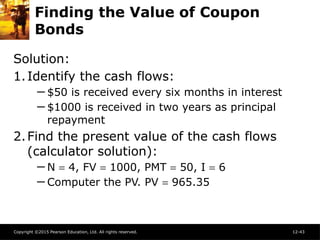
Solution:
1.Identify the cash flows:
─ $50 is received every six months in interest
─ $1000 is received in two years as principal
repayment
2.Find the present value of the cash flows
(calculator solution):
─ N = 4, FV = 1000, PMT = 50, I = 6
─ Computer the PV. PV = 965.35
Copyright ©2015 Pearson Education, Ltd. All rights reserved. 12-44
Investing in Bonds
• Bonds are the most popular alternative to
stocks for long-term investing.
• Even though the bonds of a corporation are
less risky than its equity, investors still have
risk: price risk and interest rate risk, which
were covered in chapter 3
Copyright ©2015 Pearson Education, Ltd. All rights reserved. 12-45
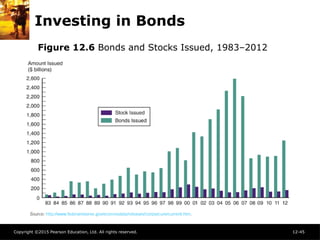
Investing in Bonds
Figure 12.6 Bonds and Stocks Issued, 1983–2012
Copyright ©2015 Pearson Education, Ltd. All rights reserved. 12-46
Chapter Summary
• Purpose of the Capital Market: provide
financing for long-term capital assets
• Capital Market Participants: governments
and corporations issue bond, and we
buy them
• Capital Market Trading: primary and
secondary markets exist for most securities
of governments and corporations
Copyright ©2015 Pearson Education, Ltd. All rights reserved. 12-47
Chapter Summary (cont.)
• Types of Bonds: includes Treasury,
municipal, and corporate bonds
• Treasury Notes and Bonds: issued and
backed by the full faith and credit of the
U.S. Federal government
• Municipal Bonds: issued by state and local
governments, tax-exempt, defaultable.
Copyright ©2015 Pearson Education, Ltd. All rights reserved. 12-48
Chapter Summary (cont.)
• Corporate Bonds: issued by corporations
and have a wide range of features and risk
• Financial Guarantees for Bonds: bond
“insurance” should the issuer default
• Bond Current Yield Calculation: how to
calculation the current yield for a bond
Copyright ©2015 Pearson Education, Ltd. All rights reserved. 12-49
Chapter Summary (cont.)
• Finding the Value of Coupon Bonds:
determining the cash flows and discounting
back to the present at an appropriate
discount rate
• Investing in Bonds: most popular alternative
to investing in the stock market for long-
term investments

Chapter 12: Bond Market and institutions

  • 1.
  • 2.
    Copyright ©2015 PearsonEducation, Ltd. All rights reserved. 12-2 Chapter Preview In this chapter, we focus on longer-term securities: bonds. Bonds are like money market instruments, but they have maturities that exceed one year. These include Treasury bonds, corporate bonds, mortgages, and the like.
  • 3.
    Copyright ©2015 PearsonEducation, Ltd. All rights reserved. 12-3 Chapter Preview • Purpose of the Capital Market • Capital Market Participants • Capital Market Trading • Types of Bonds • Treasury Notes and Bonds • Municipal Bonds • Corporate Bonds • Financial Guarantees for Bonds • Current Yield Calculation • Finding the Value of Coupon Bonds • Investing in Bonds
  • 4.
    Copyright ©2015 PearsonEducation, Ltd. All rights reserved. 12-4 Purpose of the Capital Market • Original maturity is greater than one year, typically for long-term financing or investments • Best known capital market securities: ─ Stocks and bonds
  • 5.
    Copyright ©2015 PearsonEducation, Ltd. All rights reserved. 12-5 Capital Market Participants • Primary issuers of securities: ─ Federal and local governments: debt issuers ─ Corporations: equity and debt issuers • Largest purchasers of securities: ─ You and me
  • 6.
    Copyright ©2015 PearsonEducation, Ltd. All rights reserved. 12-6 Capital Market Trading 1. Primary market for initial sale (IPO) 2. Secondary market ─ Over-the-counter ─ Organized exchanges (i.e., NYSE)
  • 7.
    Copyright ©2015 PearsonEducation, Ltd. All rights reserved. 12-7 Types of Bonds • Bonds are securities that represent debt owed by the issuer to the investor, and typically have specified payments on specific dates. • Types of bonds we will examine include long-term government bonds (T-bonds), municipal bonds, and corporate bonds.
  • 8.
    Copyright ©2015 PearsonEducation, Ltd. All rights reserved. 12-8 Types of Bonds: Sample Corporate Bond Figure 12.1 Hamilton/BP Corporate Bond
  • 9.
    Copyright ©2015 PearsonEducation, Ltd. All rights reserved. 12-9 Treasury Notes and Bonds • The U.S. Treasury issues notes and bonds to finance its operations. • The following table summarizes the maturity differences among the various Treasury securities.
  • 10.
    Copyright ©2015 PearsonEducation, Ltd. All rights reserved. 12-10 Treasury Notes and Bonds Table 12.1 Treasury Securities
  • 11.
    Copyright ©2015 PearsonEducation, Ltd. All rights reserved. 12-11 Treasury Bond Interest Rates • No default risk since the Treasury can print money to payoff the debt • Very low interest rates, often considered the risk-free rate (although inflation risk is still present)
  • 12.
    Copyright ©2015 PearsonEducation, Ltd. All rights reserved. 12-12 Treasury Bond Interest Rates Figure 12.2 Interest Rate on Treasury Bonds and the Inflation Rate, 1973–2013 (January of each year)
  • 13.
    Copyright ©2015 PearsonEducation, Ltd. All rights reserved. 12-13 Treasury Bond Interest Rates: Bills vs. Bonds Figure 12.3 Interest Rate on Treasury Bills and Treasury Bonds, 1974–2013 (January of each year)
  • 14.
    Copyright ©2015 PearsonEducation, Ltd. All rights reserved. 12-14 Treasury Bonds: Recent Innovation • Treasury Inflation-Indexed Securities: the principal amount is tied to the current rate of inflation to protect investor purchasing power • Treasury STRIPS: the coupon and principal payments are “stripped” from a T-Bond and sold as individual zero-coupon bonds.
  • 15.
    Copyright ©2015 PearsonEducation, Ltd. All rights reserved. 12-15 Treasury Bonds: Agency Debt • Although not technically Treasury securities, agency bonds are issued by government- sponsored entities, such as GNMA, FNMA, and FHLMC. • The debt has an “implicit” guarantee that the U.S. government will not let the debt default. This “guarantee” was clear during the 2008 bailout…
  • 16.
    Copyright ©2015 PearsonEducation, Ltd. All rights reserved. 12-16 The 2007–2009 Financial Crisis: Bailout of Fannie and Freddie • Both Fannie and Freddie managed their political situation effectively, allowing them to engage in risky activities, despite concerns raised. • By 2008, the two had purchased or guaranteed over $5 trillion in mortgages or mortgage-backed securities.
  • 17.
    Copyright ©2015 PearsonEducation, Ltd. All rights reserved. 12-17 The 2007–2009 Financial Crisis: Bailout of Fannie and Freddie • Part of this growth was driven by their Congressional mission to support affordable housing. They did this by purchasing subprime and Alt-A mortgages. • As these mortgages defaults, large losses mounted for both agencies.
  • 18.
    Copyright ©2015 PearsonEducation, Ltd. All rights reserved. 12-18 The 2007–2009 Financial Crisis: Bailout of Fannie and Freddie • In 2013, Fannie Mae repaid $59.4 billion of its $117 billion in bailout. • Freddie Mac has paid back about $37 billion of the $72 billion it received.
  • 19.
    Copyright ©2015 PearsonEducation, Ltd. All rights reserved. 12-19 Municipal Bonds • Issued by local, county, and state governments • Used to finance public interest projects • Tax-free municipal interest rate = taxable interest rate  (1  marginal tax rate)
  • 20.
    Copyright ©2015 PearsonEducation, Ltd. All rights reserved. 12-20 Municipal Bonds: Example
  • 21.
    Copyright ©2015 PearsonEducation, Ltd. All rights reserved. 12-21 Municipal Bonds: Example Suppose the rate on a corporate bond is 5% and the rate on a municipal bond is 3.5%. Which should you choose? Your marginal tax rate is 28%.
  • 22.
    Copyright ©2015 PearsonEducation, Ltd. All rights reserved. 12-22 Municipal Bonds: Example Suppose the rate on a corporate bond is 5% and the rate on a municipal bond is 3.5%. Which should you choose? Your marginal tax rate is 28%. Find the equivalent tax-free rate (ETFR): ETFR = 5%  (1 – MTR) = 5%  (1 – 0.28) The ETFR = 3.36%. If the actual muni-rate is above this (it is), choose the muni.
  • 23.
    Copyright ©2015 PearsonEducation, Ltd. All rights reserved. 12-23 Municipal Bonds • Two types ─ General obligation bonds ─ Revenue bonds • NOT default-free (e.g., Orange County California) ─ Defaults in 1990 amounted to $1.4 billion in this market
  • 24.
    Copyright ©2015 PearsonEducation, Ltd. All rights reserved. 12-24 Municipal Bonds: Comparing Revenue and General Obligation Bonds Figure 12.4 Issuance of Revenue and General Obligation Bonds, 1984–2012 (End of year)
  • 25.
    Copyright ©2015 PearsonEducation, Ltd. All rights reserved. 12-25 Corporate Bonds • Typically have a face value of $1,000, although some have a face value of $5,000 or $10,000 • Pay interest semi-annually
  • 26.
    Copyright ©2015 PearsonEducation, Ltd. All rights reserved. 12-26 Corporate Bonds • Cannot be redeemed anytime the issuer wishes, unless a specific clause states this (call option). • Degree of risk varies with each bond, even from the same issuer. Following suite, the required interest rate varies with level of risk.
  • 27.
    Copyright ©2015 PearsonEducation, Ltd. All rights reserved. 12-27 Corporate Bonds • The degree of risk ranges from low-risk (AAA) to higher risk (BBB). Any bonds rated below BBB are considered sub-investment grade debt.
  • 28.
    Copyright ©2015 PearsonEducation, Ltd. All rights reserved. 12-28
  • 29.
    Copyright ©2015 PearsonEducation, Ltd. All rights reserved. 12-29 Corporate Bonds: Interest Rates Figure 12.5 Corporate Bond Interest Rates, 1973–2012 (End of year)
  • 30.
    Copyright ©2015 PearsonEducation, Ltd. All rights reserved. 12-30 Characteristics of Corporate Bonds • Registered Bonds ─ Replaced “bearer” bonds ─ IRS can track interest income this way • Restrictive Covenants ─ Mitigates conflicts with shareholder interests ─ May limit dividends, new debt, ratios, etc. ─ Usually includes a cross-default clause
  • 31.
    Copyright ©2015 PearsonEducation, Ltd. All rights reserved. 12-31 Characteristics of Corporate Bonds • Call Provisions ─ Higher required yield ─ Mechanism to adhere to a sinking fund provision ─ Interest of the stockholders ─ Alternative opportunities • Conversion ─ Some debt may be converted to equity ─ Similar to a stock option, but usually more limited
  • 32.
    Copyright ©2015 PearsonEducation, Ltd. All rights reserved. 12-32 Corporate Bonds: Characteristics of Corporate Bonds • Secured Bonds ─ Mortgage bonds ─ Equipment trust certificates • Unsecured Bonds ─ Debentures ─ Subordinated debentures ─ Variable-rate bonds
  • 33.
    Copyright ©2015 PearsonEducation, Ltd. All rights reserved. 12-33 Corporate Bonds: Characteristics of Corporate Bonds • Junk Bonds ─ Debt that is rated below BBB ─ Often, trusts and insurance companies are not permitted to invest in junk debt ─ Michael Milken developed this market in the mid- 1980s, although he was subsequently convicted of insider trading
  • 34.
    Copyright ©2015 PearsonEducation, Ltd. All rights reserved. 12-34 Corporate Bonds: Debt Ratings (a) Table 12.2 Debt Rating Descriptions
  • 35.
    Copyright ©2015 PearsonEducation, Ltd. All rights reserved. 12-35 Corporate Bonds: Debt Ratings (b) Table 12.2 Debt Rating Descriptions
  • 36.
    Copyright ©2015 PearsonEducation, Ltd. All rights reserved. 12-36 Financial Guarantees for Bonds • Some debt issuers purchase financial guarantees to lower the risk of their debt. • The guarantee provides for timely payment of interest and principal, and are usually backed by large insurance companies.
  • 37.
    Copyright ©2015 PearsonEducation, Ltd. All rights reserved. 12-37 Financial Guarantees for Bonds • As it turns out, not all guarantees actually make sense! ─ In 1995, JPMorgan created the credit default swap (CDS), a type of insurance on bonds. ─ In 2000, Congress removed CDSs from any oversight. ─ By 2008, the CDS market was over $62 trillion! ─ 2008 losses on mortgages lead to huge payouts on this insurance.
  • 38.
    Copyright ©2015 PearsonEducation, Ltd. All rights reserved. 12-38 Bond Yield Calculations • Bond yields are quoted using a variety of conventions, depending on both the type of issue and the market. • We will examine the current yield calculation that is commonly used for long-term debt.
  • 39.
    Copyright ©2015 PearsonEducation, Ltd. All rights reserved. 12-39 Bond Current Yield Calculation What is the current yield for a bond with a face value of $1,000, a current price of $921.01, and a coupon rate of 10.95%? Answer: ic = C / P = $109.50 / $921.01 = 11.89% Note: C ( coupon) = 10.95%  $1,000 = $109.50
  • 40.
    Copyright ©2015 PearsonEducation, Ltd. All rights reserved. 12-40 Finding the Value of Coupon Bonds • Bond pricing is, in theory, no different than pricing any set of known cash flows. • Once the cash flows have been identified, they should be discounted to time zero at an appropriate discount rate.
  • 41.
    Copyright ©2015 PearsonEducation, Ltd. All rights reserved. 12-41 Finding the Value of Coupon Bonds Table 12.3 Bond Terminology
  • 42.
    Copyright ©2015 PearsonEducation, Ltd. All rights reserved. 12-42 Finding the Value of Coupon Bonds Let’s use a simple example to illustrate the bond pricing idea. What is the price of two-year, 10% coupon bond (semi-annual coupon payments) with a face value of $1,000 and a required rate of 12%?
  • 43.
    Copyright ©2015 PearsonEducation, Ltd. All rights reserved. 12-43 Finding the Value of Coupon Bonds Solution: 1.Identify the cash flows: ─ $50 is received every six months in interest ─ $1000 is received in two years as principal repayment 2.Find the present value of the cash flows (calculator solution): ─ N = 4, FV = 1000, PMT = 50, I = 6 ─ Computer the PV. PV = 965.35
  • 44.
    Copyright ©2015 PearsonEducation, Ltd. All rights reserved. 12-44 Investing in Bonds • Bonds are the most popular alternative to stocks for long-term investing. • Even though the bonds of a corporation are less risky than its equity, investors still have risk: price risk and interest rate risk, which were covered in chapter 3
  • 45.
    Copyright ©2015 PearsonEducation, Ltd. All rights reserved. 12-45 Investing in Bonds Figure 12.6 Bonds and Stocks Issued, 1983–2012
  • 46.
    Copyright ©2015 PearsonEducation, Ltd. All rights reserved. 12-46 Chapter Summary • Purpose of the Capital Market: provide financing for long-term capital assets • Capital Market Participants: governments and corporations issue bond, and we buy them • Capital Market Trading: primary and secondary markets exist for most securities of governments and corporations
  • 47.
    Copyright ©2015 PearsonEducation, Ltd. All rights reserved. 12-47 Chapter Summary (cont.) • Types of Bonds: includes Treasury, municipal, and corporate bonds • Treasury Notes and Bonds: issued and backed by the full faith and credit of the U.S. Federal government • Municipal Bonds: issued by state and local governments, tax-exempt, defaultable.
  • 48.
    Copyright ©2015 PearsonEducation, Ltd. All rights reserved. 12-48 Chapter Summary (cont.) • Corporate Bonds: issued by corporations and have a wide range of features and risk • Financial Guarantees for Bonds: bond “insurance” should the issuer default • Bond Current Yield Calculation: how to calculation the current yield for a bond
  • 49.
    Copyright ©2015 PearsonEducation, Ltd. All rights reserved. 12-49 Chapter Summary (cont.) • Finding the Value of Coupon Bonds: determining the cash flows and discounting back to the present at an appropriate discount rate • Investing in Bonds: most popular alternative to investing in the stock market for long- term investments