EVOLUTION OF DIRECT
BONDING IN ORTHODONTICS
www.indiandentalacademy.com
CONTENTS
 Introduction
 History
 Bonding Adhesives
 Advantages and disadvantages
 Bonding procedure
 Bonding to crowns and restorations
 Bond failures
 Rebonding
 Recycling
 Conclusion
 Bibliography
www.indiandentalacademy.com
INTRODUCTION
Orthodontics is a dynamically growing science. It is
constantly undergoing development and is evolving
through the discovery of newer techniques and materials
and improvements over the older ones.
Bonding of brackets, eliminating the need for bands
was a dream for many years before becoming a routine
clinical procedure.
One of the most important events in orthodontics
appliance was the introduction of direct Bonding. This was
the result of the pioneering work by Buonocore in the
1950’s and since steady stream of materials has been
developed for this purpose.
www.indiandentalacademy.com
The bonding of orthodontic attachments to the etched enamel surface of
teeth is a well-established clinical procedure. There are at present two
techniques for the placement of orthodontic attachments.
The first is called the direct technique. The second method of bracket
placement is the indirect technique.
In an investigation, that examined the preference of 2000 operators for
either the direct or the indirect technique of bonding, Gore lick found
that the ratio of direct to indirect as 13:1.
Direct bonding is the procedure where the operator directly places the
brackets onto the enamel surface. GEORGE NEWMAN first
demonstrated this technique. He is considered as the pioneer of direct
bonding in orthodontics.
Indirect bonding - Silverman first described this technique. This is a 2
stage procedure 1st stage is performed in the laboratory. Where the
brackets are located and attached to a plaster model of the patient’s
teeth.
In the 2nd stage, the Brackets in their position are transferred by means
of a tray to the patient’s mouth where they are attached to the etched
enamel of the teeth.
www.indiandentalacademy.com
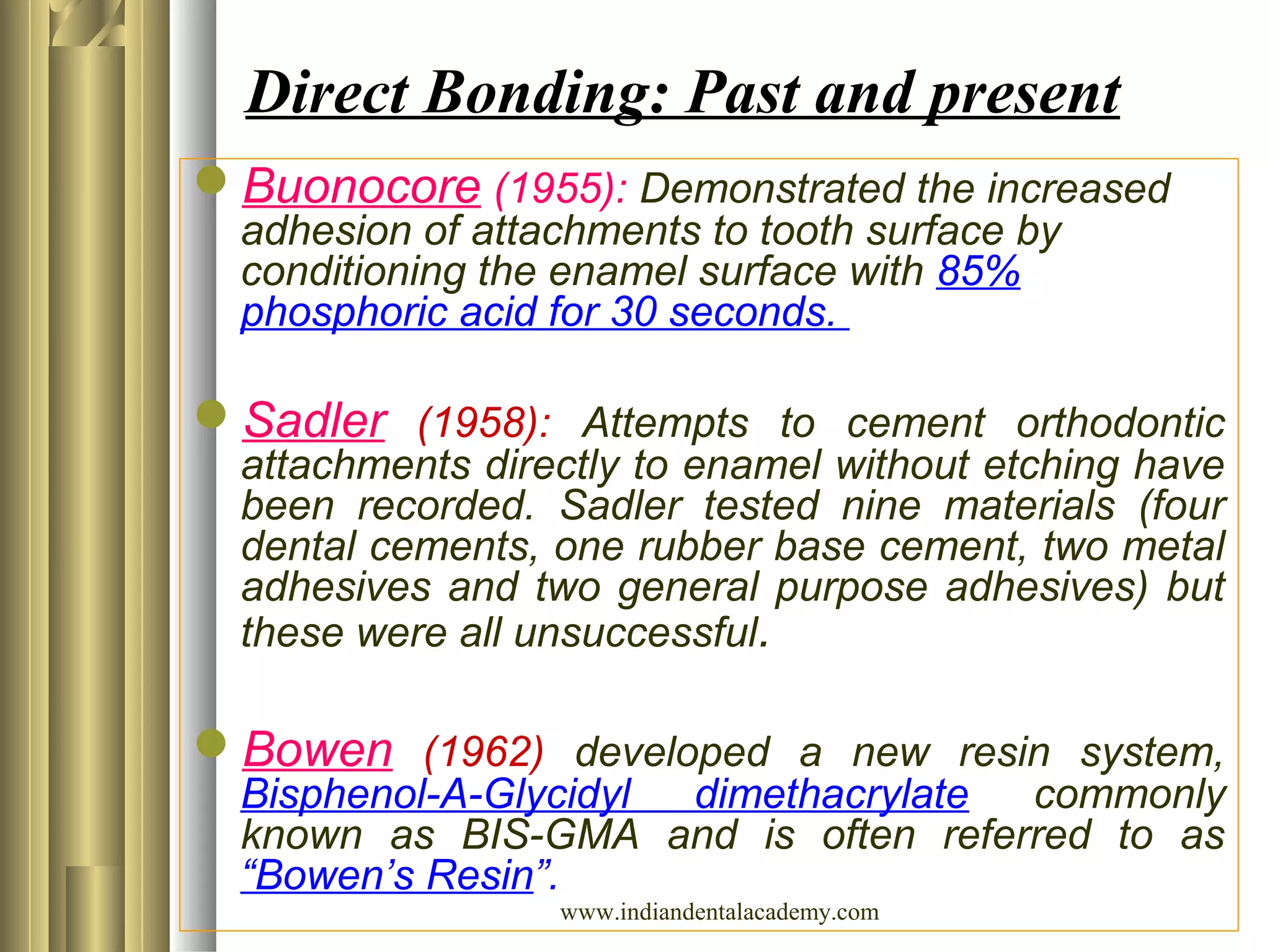
Buonocore (1955): Demonstrated the increased
adhesion of attachments to tooth surface by
conditioning the enamel surface with 85%
phosphoric acid for 30 seconds.
Sadler (1958): Attempts to cement orthodontic
attachments directly to enamel without etching have
been recorded. Sadler tested nine materials (four
dental cements, one rubber base cement, two metal
adhesives and two general purpose adhesives) but
these were all unsuccessful.
Bowen (1962) developed a new resin system,
Bisphenol-A-Glycidyl dimethacrylate commonly
known as BIS-GMA and is often referred to as
“Bowen’s Resin”.
Direct Bonding: Past and present
www.indiandentalacademy.com
 Newman(1965) was the first to bond orthodontic attachments
to teeth by means of an epoxy resin. He used a mixture
consisting of equal parts of low molecular weight epoxy liquid
and a high molecular weight solid epoxy with a polyamide
curing agent.
 Cueto(1966), his experiment was done to see if it was feasible
to attach a bracket directly to tooth enamel without the use of
orthodontic bands. The adhesive consisted of a liquid
monomer, methyl-2-cyanoacrylate, and a silicate filler.
 Mitchel(1967), had failures with an epoxy resin but described a
successful, although limited, clinical trial using black copper
cement and gold direct attachments.
 Buonocore etal(1968), showed that enhanced bonding to acid
conditioned surfaces were due to the presence of “prism like”
tags and also observed poor bonding with unconditioned
enamel surfaces.
 Smith(1968), introduced Zinc polyacrylate and bracket bonding
with cement was reported.
www.indiandentalacademy.com
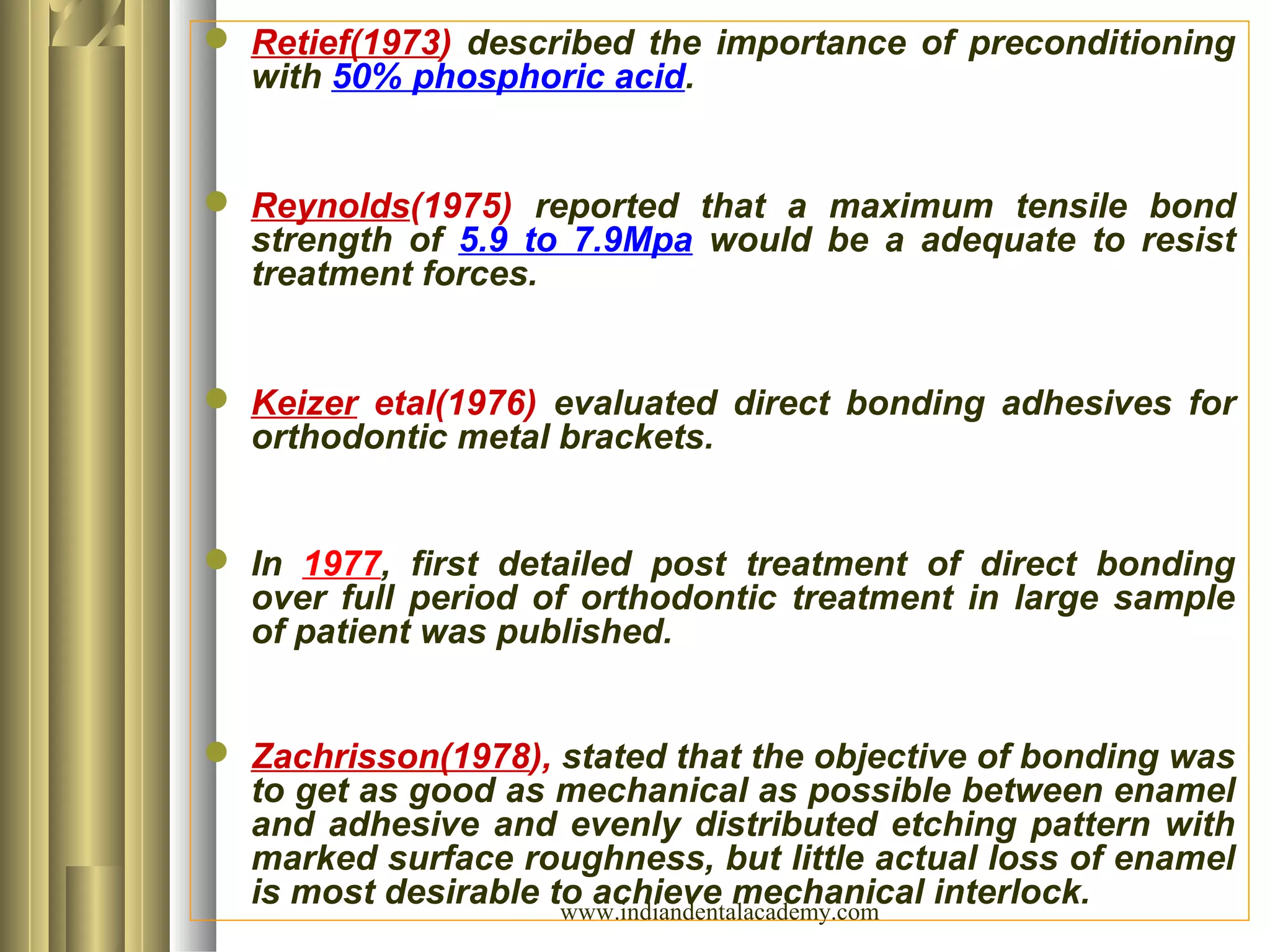
 Retief(1973) described the importance of preconditioning
with 50% phosphoric acid.
 Reynolds(1975) reported that a maximum tensile bond
strength of 5.9 to 7.9Mpa would be a adequate to resist
treatment forces.
 Keizer etal(1976) evaluated direct bonding adhesives for
orthodontic metal brackets.
 In 1977, first detailed post treatment of direct bonding
over full period of orthodontic treatment in large sample
of patient was published.
 Zachrisson(1978), stated that the objective of bonding was
to get as good as mechanical as possible between enamel
and adhesive and evenly distributed etching pattern with
marked surface roughness, but little actual loss of enamel
is most desirable to achieve mechanical interlock.www.indiandentalacademy.com
Tavas etal(1979) introduced the concept of light
activated composites. They demonstrated that the bond
strength of brackets bonded with this was comparable
with two chemically cured adhesives.
 In 1986 White, described bonding orthodontic brackets
to enamel with GIC who also emphasized the need for
moisture control during the early stages of bonding
using GIC.
Although important improvements in bonding have been
made in the last 30 years, the requirements of an ideal
bonding system are quite similar to those indicated by
Buonocore. www.indiandentalacademy.com
1. Teeth that receive heavy intermittent forces against the
attachments. Ex: Upper first molar, which receives extra oral force
through the headgear. The bands rather than bonded attachments
better resist the twisting and shearing forces when a face bow is
inserted and removed from the attachment.
2. Teeth that need both labial and lingual attachments. It is easier to
place a band with welded labial and lingual attachments than go
through two bonding procedures. These banded lingual attachments
are less likely to be swallowed or aspirated if it comes loose.
3. Teeth with short clinical crowns
4. Teeth surfaces that are incompatible with successful bonding
teeth that have been restored in amalgam or metal are impossible to
bond. Porcelain restorations are difficult; a coupling agent is
needed to enforce adhesion.
Banding preferred to bonding
www.indiandentalacademy.com
BANDING - W.E. Magill – 1871
Negative factors
- 1. Time and skill
- 2. Impacted / partially erupted teeth
- 3. Decalcification / discoloration
- 4. Gingival irritation
- 5. Closure of band spaces
- 6. Unaesthetic
- 7. Placement of separators is painfulwww.indiandentalacademy.com
Advantages of bonding
 Esthetics
 Faster and simpler
 Less patient discomfort
 Arch length not increased
 No band space closure
 Partially erupted or fractured teeth can be controlled
 Lingual orthodontics
 Interproximal enamel reduction and composite build up possible
 Bond artificial tooth surface
 Caries risk eliminated
 Bracket may be recycled
 More hygienic www.indiandentalacademy.com
DISADVANTAGES OF BONDING:-
 A bonded bracket has a weaker
attachment than a cemented band.
 Some bonding adhesives are not
sufficiently strong.
 Better access for cleaning does not
necessarily guarantee better oral
hygiene and improved gingival
condition, especially if excess
adhesive extends beyond the
bracket base.
 The protection against interproximal
caries provided by well-contoured
cemented bands is absent.
 Rebonding a loose bracket requires
more preparation than re-cementing
a loose band.
 Debonding is more time consuming
than debanding because removal of
adhesive is more difficult than
removal of cement.
www.indiandentalacademy.com
BONDING:
Ideal requirements of a Good adhesive:
•It should not have any toxic effects
•It must be of low viscosity so that it penetrates the enamel surface.
•It must have excellent inherent strength and dimensionally stable.
•It must have minimal expansion and water absorption.
•The operator should have the option of being able to bond directly
or indirectly
•The material should be stain resistant
•Sufficient working time before setting occurs
www.indiandentalacademy.com
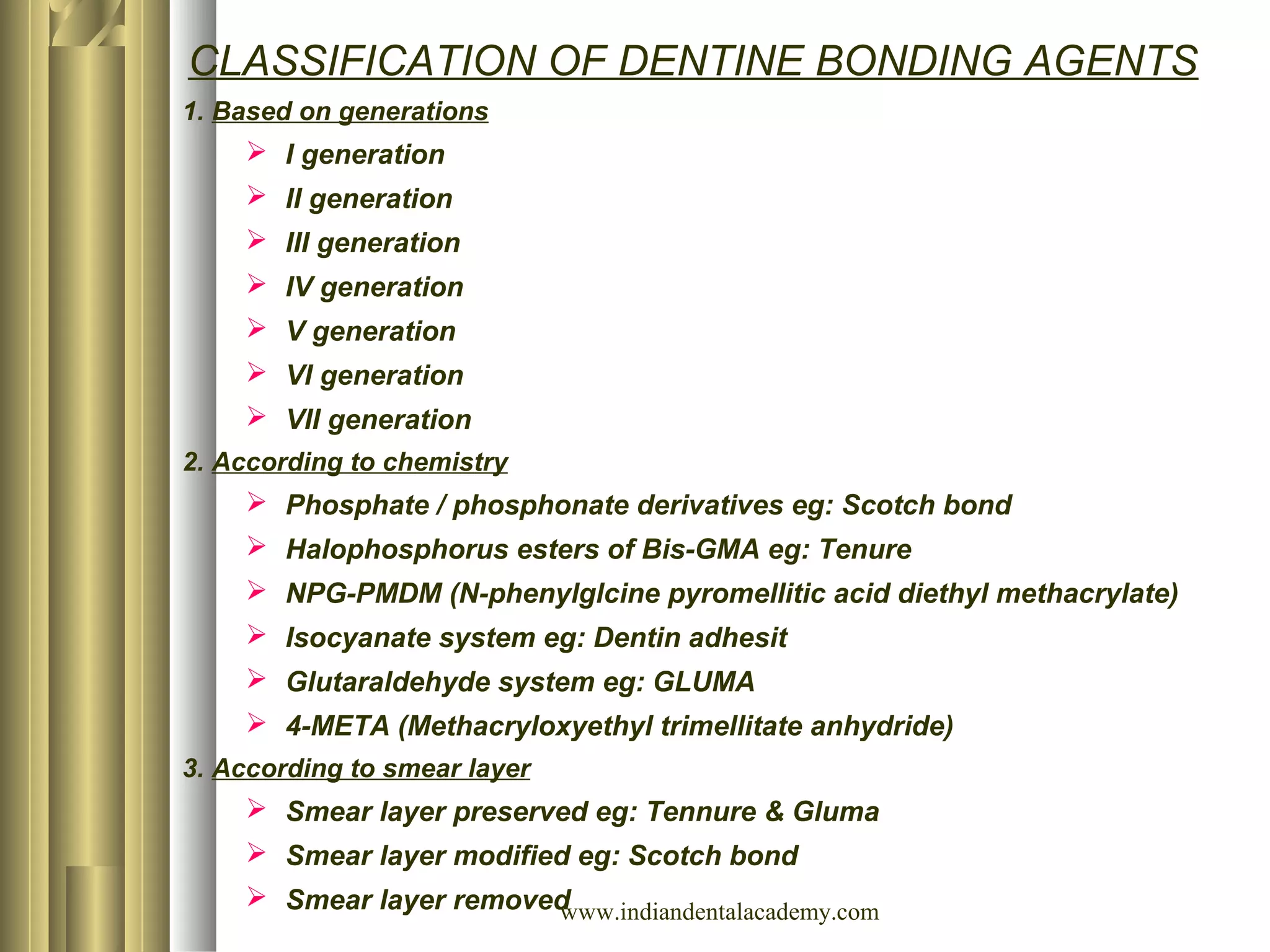
CLASSIFICATION OF DENTINE BONDING AGENTS
1. Based on generations
 I generation
 II generation
 III generation
 IV generation
 V generation
 VI generation
 VII generation
2. According to chemistry
 Phosphate / phosphonate derivatives eg: Scotch bond
 Halophosphorus esters of Bis-GMA eg: Tenure
 NPG-PMDM (N-phenylglcine pyromellitic acid diethyl methacrylate)
 Isocyanate system eg: Dentin adhesit
 Glutaraldehyde system eg: GLUMA
 4-META (Methacryloxyethyl trimellitate anhydride)
3. According to smear layer
 Smear layer preserved eg: Tennure & Gluma
 Smear layer modified eg: Scotch bond
 Smear layer removedwww.indiandentalacademy.com
FIRST GENERATION
DEVELOPMENT OF BONDING AGENTS
BUONOCOREBUONOCORE (1956(1956)) –– Demonstrated the use of aDemonstrated the use of a
Glycerophosphoric acid dimethacrylate –Glycerophosphoric acid dimethacrylate –
containing resin, would bond to acid etchingcontaining resin, would bond to acid etching
dentin.dentin.
BOWENBOWEN (1965(1965)) -- tried N – phenylglycine and glycidyltried N – phenylglycine and glycidyl
methacrylate .methacrylate .
Bonding occurred due to the interaction of thisBonding occurred due to the interaction of this
bifunctional resin with the calcium ions ofbifunctional resin with the calcium ions of
hydroxyapatite.hydroxyapatite.
Drawback – Poor bond strength (1 to 3 MPa ).Drawback – Poor bond strength (1 to 3 MPa ).
www.indiandentalacademy.com
SECOND GENERATION
In the late 1970’s the second generation system
were introduced.
Incorporated halophosphorous esters of unfilled
resins such as bisphenol – A glycidal methacrelate
or bis – GMA, or hydroxyethyl methacrylate, or
HEMA.
Bonded to dentine through an ionic bond to calcium
by chlorophosphate groups.
Weak bond strength, but significant improvement
over first generation.
Scotch Bond (3M Dental ), Clearfil (Kuraray Co.
Japan)
www.indiandentalacademy.com
THIRD GENERATION
 The primer contains hydrophilic resin monomers which include
hydroxyethyl trimellitate anhydride, or 4–META, and biphenyl
dimethacrylate or BPDM.
 The primers contain a hydrophilic group that infiltrates smear
layer, modifying it and promoting adhesion to dentin.
 The phosphate primer modifies the smear layer by softening
and cures, forming a hard surface. Following, the unfilled resin
adhesive is applied, attaching cured primer to the composite
resin.
 Drawback – Bonding to smear layer - covered dentine was not
very successful.
 Mirage bond, Scotch bond 2, Prisma Universal bond 2 and 3.
www.indiandentalacademy.com
FOURTH GENERATION
 The use of the total etch technique is one of the main
characteristics of fourth generation bonding system,
here complete removal of the smear layer is achieved.
 The Total etch technique permits the etching of enamel
and dentine simultaneously using 40% phosphoric acid
for 15 to 20 seconds.
 The application of hydrophilic primer solution can
infiltrate collagen network forming the hybrid layer.
According to Nakabayashi (1982) the hybrid layer is
defined as “the structure formed in dental hard tissues
by demineralization of the surface and subsurface,
followed by infiltration of monomer and subsequent
polymerization”.
 All bound -2 (BISCO), Scotch bond Multipurpose (3M).
www.indiandentalacademy.com
FIFTH GENERATION
 Consist of two different types of adhesive materials
the so called “one bottle” systems and the self
etching primer bonding system.
 ONE BOTTLE SYSTEMS combined the primer and
adhesives into one solution to be applied after
etching. Total etching was done with 35-37%
phosphoric acid for 15 to 20seconds.
 SELF ETCHING PRIMER was developed by
Watanabe and Nakabayashi. It is a aqueous solution
of 20% phenyl – P in 30% HEMA.
 Adv – The combination of etching and priming steps
reduce the working time.
 Single bond (3M), One step (BISCO)www.indiandentalacademy.com
SIXTH GENERATION
 Recently several bonding system were developed and these
systems are characterized by the possibility to achieve the proper
bond to enamel and dentine using only one solution. These are
called one - step bonding.
 Unfortunately, the first evaluations of these new system showed
a sufficient bond to a conditioned dentin while the bond with
enamel was less effective.
 This may be due to systems are composed of an acidic solution
cannot be kept in place, must be refreshed continuously.
SEVENTH GENERATION
The trend in the latest generation of dental bonding systems i reduce
the number of components and clinical placement steps.
The introduction of i Bond, a single – bottle adhesive system, is the
latest to new generation materials and combines etchant, adhesive
and desensitizer one component.www.indiandentalacademy.com
CLASSIFICATION OF ORTHODONTIC
ADHESIVE SYSTEMS
 Based upon the polymerization initiation mechanism:
1. CHEMICALLY ACTIVATE
2. LIGHT CURED
3. DUAL CURED
4. THERMOCURED
www.indiandentalacademy.com
Chemically Activated orthodontic Adhesive systems
 Chemically activated orthodontic adhesives employ
benzoyl peroxide as an initiator, which is activated by a
tertiary aromatic amine such as dimethyl – p- toludine or
dihydroxyethyl – p toludine.
 Initiation occurs from mixing of the paste and liquid
components and free radicals are formed by a multi step
process.
TWO - PHASE ( TWO PASTE) Adhesive Systems
ONE - PHASE (NO - MIX) Adhesive systems
www.indiandentalacademy.com
TWO - PHASE
Two paste (Adhesive Systems)
 Were the first to be tried by orthodontist in the early days
of bonding.
 Application involves mixing the paste and liquid
components.
DisadvantagesDisadvantages
 Time consuming
 Increased exposure to air induces oxygen inhibition.
 Mixing introduces defects in the form of air entrapment
and formation of voids.
 Concise (3M).
www.indiandentalacademy.com
 Application of liquid component on enamel and bracket
base
 No mixing required..
 Here homogenous polymerization pattern occur due to
sandwich technique involved in diffusion of liquid
component into paste during application.
 Enamel and bracket sides of adhesive are more
polymerized relative to middle zones.
 Efficient application, limited time requirements.
Not recommended in applications where the adhesive
thickness is increased, as in molar tubes.
 System 1(Ormco)
 Rely - a – Bond( reliance)
 Unite (3M)
ONE - PHASE (NO - MIX) Adhesive systemsONE - PHASE (NO - MIX) Adhesive systems
www.indiandentalacademy.com
Visible Light cured
 Polymerization initiation by exposure to light curing source
 Permits increased working time for optimal bracket placement.
 Photoactivation from the incisal and cervical edges is suggested.
 Degree of cure of stainless steel brackets bonded with light –
cured adhesives is comparable to degree of cure of adhesive
bonded to transparent aesthetic brackets.
 Bond strength has been studied extensively and supports their
use.
 Available since the 1980s.
 Good alternatives to two phase systems.
 Significantly more time demanding than one phase systems.
 Most manufactures have marketed LC adhesives.
www.indiandentalacademy.com
Dual – Cured
Initiation is achieved by exposure to light.
Reaction proceeds following a chemically –
cured pattern.
Combines disadvantages of handling of both
light – cured and chemically cured materials.
The most time consuming applications.
Increased degree of cure and bond strength.
Ideal candidates - bonding molar tubes.
www.indiandentalacademy.com
Self etching primer
 An acidic primer combines the etchant with the primer in
one application, Contains both acid (Phenyl – p) and the
primer (HEMA and dimethacrylate).
Liquid begins to etch as soon as it is applied
Saves time
www.indiandentalacademy.com
Procedure for self etch primer
www.indiandentalacademy.com
Self Etch Primer - studies
 Rueggeberg et al (2000) - promt L-Pop w/o acid etch
produce = bond strength as conventional bracket
placement
 Hitmi (2000)- no signi. diff b/w promt L-Pop & 37%
phosphoric acid
 Bergeron et al (2000)- resin enamel bond strength of
diff self etching primer including promt L-Pop, was
similar to or better than multistep
Fritz et al(2001)- bonding with 3 self etching
primer(Clearfil SE Bond,Clearfil Liner Bond 2V&
Novabond)was = phos acid
Bishara et al(2001)- self etching primer prod a signi lower,
but clinic acceptable, SBS compared to acid etch when
Transbond XT composite usedwww.indiandentalacademy.com
Moisture insensitive primers (MIP)
 MOISTURE - ACTIVE
 MOISTURE – RESISTANT
MOISTURE - ACTIVE
 An aqueous solution of methacrylate functionalised polyalkenoic
acid copolymer & hydroxyethyl – methacrylate.
Generally available as a primer formulation.
 Requires the presence of water for initiating the setting reaction
and will therefore fail in dry environment.
Moisture – Resistant
Primer compatible with the use of adhesives.
Application of primer on wet enamel surface.
Transbond MIP (3M).
THERMOCURED
•Initiation occurs through exposure to heat.
•Not intended for direct bonding.
•Polymerization initiator system restricts their use to indirect bonding.
•Superior properties.
www.indiandentalacademy.com
Hydrophilic Primer ( MIP )
S.J. Little Wood et al JO 2006
Compared the bond strength of bracket bonded
with hydrophilic primer with conventional
primer
Bond strength (6.43) was lower than
conventional primer (8.71)
Bracket bonded with hydrophilic primer were
3.96 times more at risk of failure.
www.indiandentalacademy.com
The steps involved are :
•CLEANING
•ENAMEL CONDITIONING
•SEALING
•BONDING
Bonding Procedure
www.indiandentalacademy.com
CLEANING
 Cleaning of the teeth with pumice will remove plaque and the
organic pellicle.
 This requires rotary instruments, either a rubber cup or a
polishing brush. A bristle brush cleans more effectively but care
must be taken to avoid traumatizing the gingival margin and
initiating bleeding.
 Studies have shown enamel loss due to prophylaxis. Mark
Daniel etal ( AJO 1980) showed that 10.7µm of enamel loss
during initial prophylaxis with bristle brush was greater than the
5.0µm lost when a rubber cup as used and the difference was
statistically significant.
 Pumice or a prophylactic paste is often used to clean the
enamel surface. Either does not affect bond strength.www.indiandentalacademy.com
Isolation and moisture control:
Salivary control and maintenance of a dry working fluid
are mandatory pre-requisites of a bonding procedure.
Moisture control refers to excluding sulcular fluid,
saliva, and gingival bleeding from the operating field.
Advantages of isolation:
Maintenance of a dry clean operating field
Access and visibility
Improved properties of dental materials
Protection of the patient and operator
Operating efficiency
www.indiandentalacademy.com
Aids used for moisture control
• Rubber dam
• Mouth props
• Retraction cords
• Saliva ejectors and high volume evacuators
• salivary duct obstructers
• Cotton or gauze rolls, or absorbant paper pads
• Anti sialogogues
• Lip expanders, cheek retractors
• Tongue guards with bite blocks
Both tab. & injectable solns :
Banthine, pro- Banthine &Atropine sulfate
Excellent & rapid saliva flow restriction
When indicated Banthine tab (50mg/45kg body wt) in
water, 15 minutes before bonding will provide
good results. www.indiandentalacademy.com
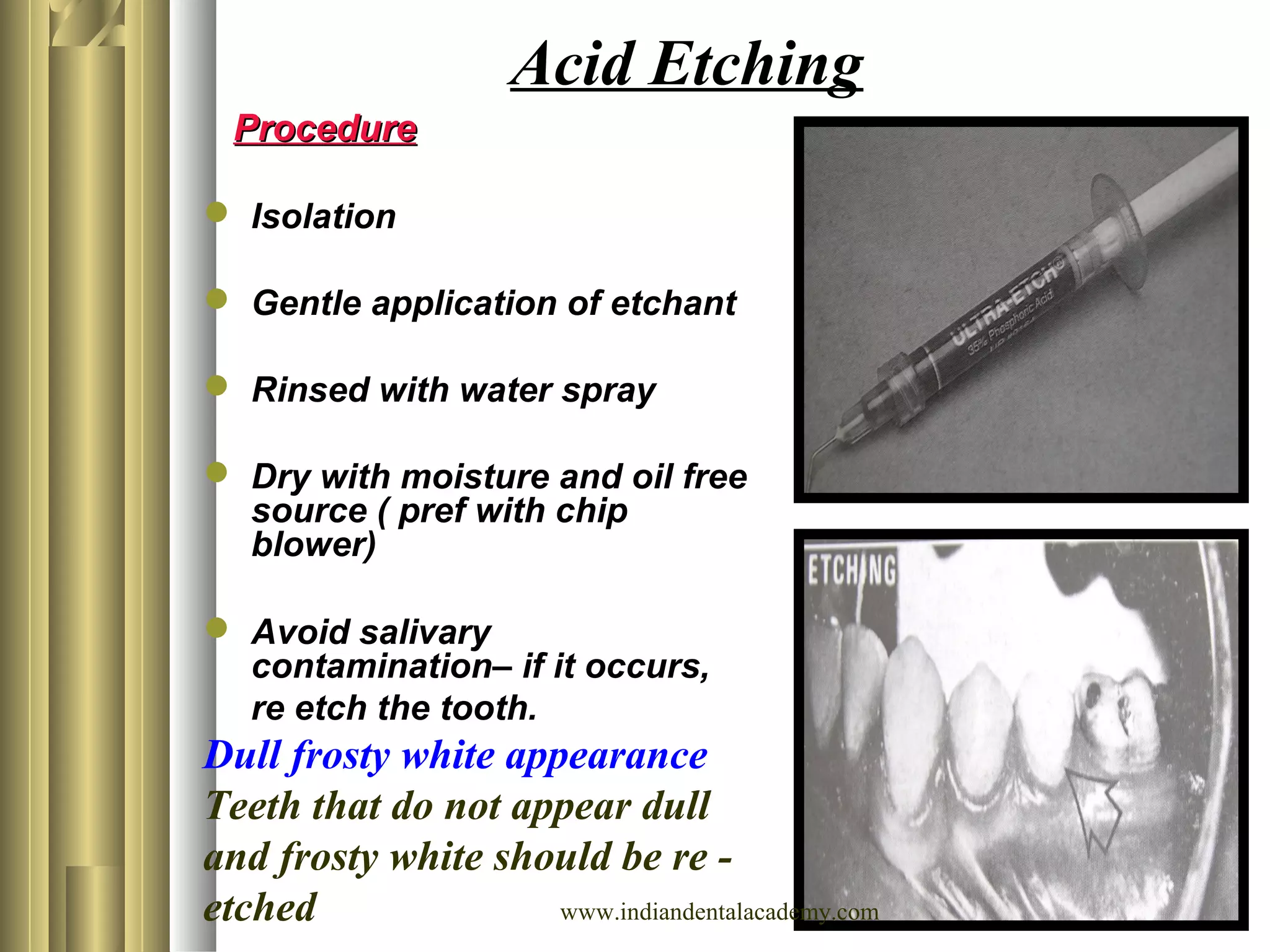
Acid Etching
ProcedureProcedure
 Isolation
 Gentle application of etchant
 Rinsed with water spray
 Dry with moisture and oil free
source ( pref with chip
blower)
 Avoid salivary
contamination– if it occurs,
re etch the tooth.
Dull frosty white appearance
Teeth that do not appear dull
and frosty white should be re -
etched www.indiandentalacademy.com
ETCHING
 After the operative field has been isolated, the teeth to be
bonded are dried.
 The conditioning solution or gel (usually 37% phosphoric acid)
is then lightly applied over the enamel surface with a foam
pellet or brush for 15 to 60 sec.
 When etching solutions are used, the surface must be kept
moist by repeated applications. To avoid damaging delicate
enamel rods, care must be taken not to rub the liquid onto the
teeth.
 At the end of the etching period the etchant is rinsed off the
teeth with abundant water spray.
 Salivary contamination of the etched surface must not be
allowed. ( If it occurs rinse with water spray or re-etch for a
few seconds; the patient must not rinse).
www.indiandentalacademy.com
Rationale of etching
 Removes about 3-10
microns of enamel
surface
 Etching also increases
the wet ability and surface
area of the enamel
substrate.
 Resin tag penetrate upto
the depth of 80 um or
more
Gwinnet, Matsui and
Buonocore & others
Primary attachment
mechanism of resin is
“resin tags”.
Micromechanical bond
www.indiandentalacademy.com
Exposure of enamel to conditioning
solutions produces three Basic patterns.
 TYPE I – Prism core
material is preferentially
removed leaving the prisms
periphery intact. (HONEY
COMB APPEARANCE)
 TYPE II – Peripheral
regions of the prism are
dissolved leaving the cores
relatively intact
(COBBLESTONE APPEARANCE).
 TYPE III – Surface loss
occurs without exposing
underlying prisms.
www.indiandentalacademy.com
Factors affecting bonding to ideally etched surface
Patient Operator
-salivary contamination - oil / water via spray
-contact with lips and - rubbing /touching tongue
etched surface
-exhalation vapor
Alternative acids for etching :
• - 10% Phosphoric acid
• - 10% Maleic acid
• - 2.5%Nitric acid
• - Polyacrylic acid
Most widely used is 30 – 50% ( 37%) phosphoric acidwww.indiandentalacademy.com
Bond strength with various etching times
Wang et al AJO-DO July 1991
 Compared the tensile bond strength at various etching
times 15, 30, 60, 90, 120secs
 37% Phosphoric acid
 TBS was not statistically different for 15, 30, 60, 90secs
 TBS decreased – 120secs
 Amount of enamel fragments increased in proportion to
the length of the etching times
 Optimal etching time should be 15secs
www.indiandentalacademy.com
Variations in acid-etch patterns with different
acids and etch times
Alastair Gardner, Ross Hobson, AJO 2001
Compared the enamel etch patterns produced by
37% phosphoric acid and 2.5% Nitric acid for 15,
30 & 60 secs
Concluded
- 37% phosphoric acid > 2.5% nitric acid for all
three applications
-optimum time for applying 37% phosphoric acid is
30 sec
www.indiandentalacademy.com
Alternatives to acid etching
 Crystal growth
 Sand blasting / Air abrasion
 Laser etching
AIR ABRASION
Air Abrasion, also referred to as micro-etching, is a technique in which
particles of aluminum oxide are propelled against the surface of
enamel by high air pressure, causing abrasion of the surface.
Some manufactures of commercial units have suggested that air
abrasion could eliminate acid etching; however, bond strengths to air-
abraded enamel are only about 50% of those to acid-etched enamel.
Air abrasion of metal brackets or bands is an effective technique for
improving bond strength.
It could be an alternative to pumicing the teeth before etching.
www.indiandentalacademy.com
CRYSTAL-GROWING SOLUTIONS
 Crystal bonding involves application to enamel of a polyacrylic acid
solution containing sulfate ions, which causes growth of calcium sulfate
dihydrate crystals on the enamel surface. These crystals in turn retain
the adhesive.
 Potential advantages of crystal bonding include easier debonding, less
residual adhesive left on the tooth and less damage to enamel.
 Since crystal bonding produces bond strengths of 60 – 80% of the bond
strength obtained with acid etching, it is not yet considered a practical
technique.
 Maijer R, Smith Dc ( J Biomed Mater 1979): Found that crystal growing
solutions provided retention similar to those after etching with
phosphoric acid with less risk of enamel damage at debonding.
•One drop of viscous liquid placed on tooth surface
•Left undisturbed for 30 sec
•No mechanical agitation
•Rinsed for 20 sec
•Forceful water spray to be avoided as it will break crystals
•Dull whitish deposit
•Bracket bonded in usual way.www.indiandentalacademy.com
Crystal growth
1st
demonstrated by Smith & Cartz
Maijer & Smith 1979
Polyacrylic acid + sulfate ion long needle shaped
crystalline deposit CALCIUM SULPHATE DIHYDRATE
www.indiandentalacademy.com
LASER ETCHING
 The application of laser energy to an enamel surface causes
localized melting.
MECHANISM
 Removal of enamel (etching) results primarily from the micro-
explosion of entrapped water in the enamel.
 In addition, there may be some melting of the hydroxyapatite
crystals.
 Laser etching of enamel by a neodymium-yttrium-aluminum
garnet (Nd:YAG) laser typically produced lower bond strengths
than does acid etching.
 Satisfactory in vitro bond strengths were obtained in one study
only when the Nd:YAG laser was used for 12 seconds at maximum
power
 Studies of CO2 laser etching of enamel have shown that bond
strengths of 10 Mpa can be obtained reliably.
 The thermal effects of laser etching on the enamel substructure
require further research.www.indiandentalacademy.com
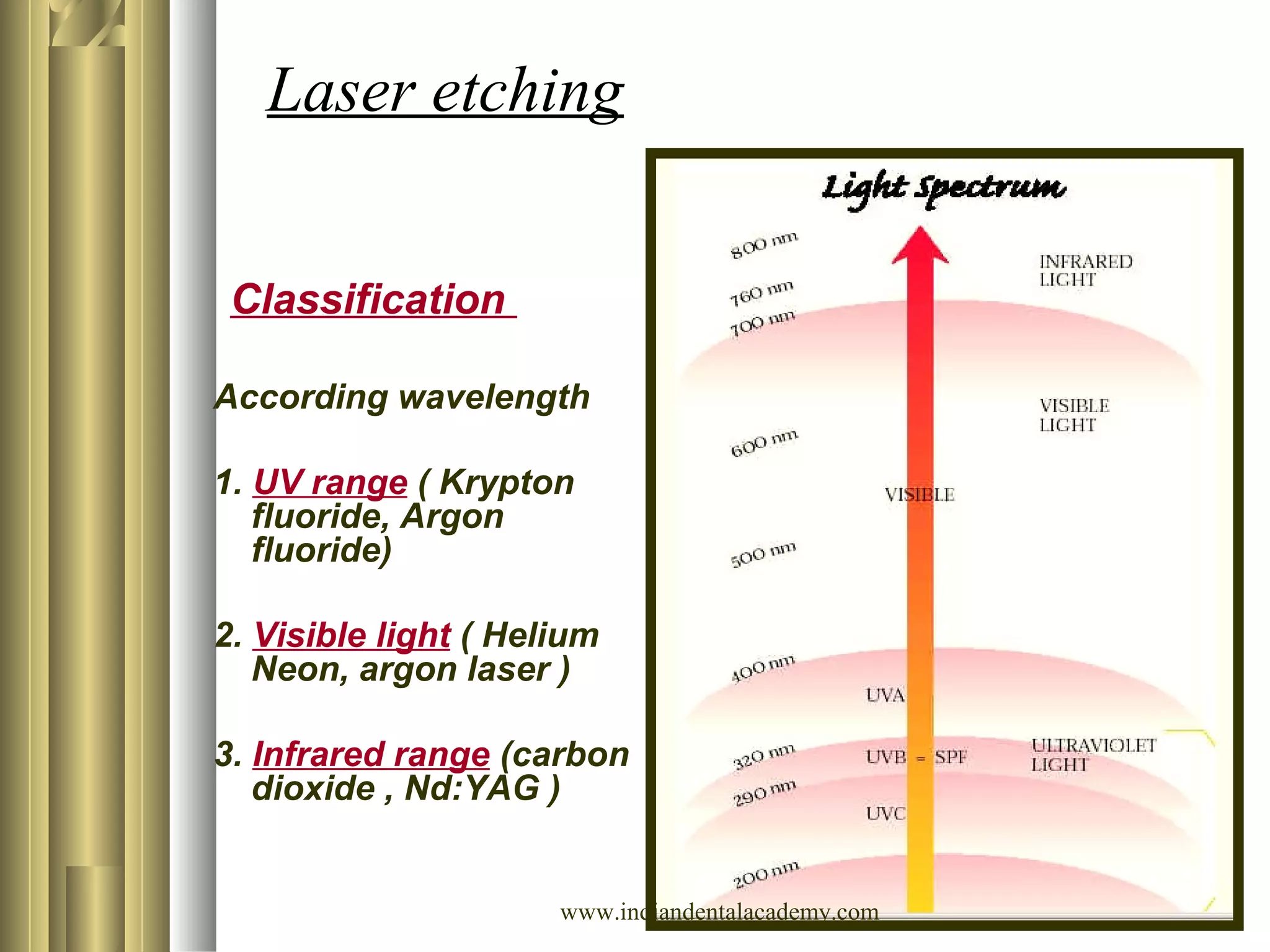
Laser etching
Classification
According wavelength
1. UV range ( Krypton
fluoride, Argon
fluoride)
2. Visible light ( Helium
Neon, argon laser )
3. Infrared range (carbon
dioxide , Nd:YAG )
www.indiandentalacademy.com
Laser etching of enamel for direct bonding
Von Fraunhofer 1993, No.1 AO
 Phosphoric acid – 30 sec.
 4 power settings on the laser etching unit were used: 80mJ,
1W, 2W and 3W.
 Melting and ablation of enamel surface (roughness)
Results
 Acceptable shear bond strength,(0.6kg/mm), could be
achieved at laser power settings of 1 to 3W but not at the
lowest setting (80 mJ).
 Shear bond strengths lower than acid etching.
Aim – to compare tensile & shear bond strength obtained
by acid etching & krypton flouride excimer laser-
(440MJ/cms, 460 and 480)
Optimum bond strength achieved with 460 & 480
TBS - highest with 460 then480 & acid etching
SBS- highest with 480
both Least with 440
Dr. Francis 2001
www.indiandentalacademy.com
Acid etching in primary teeth
STUDIES:
 SILVERSTONE:- 120 sec etch necessary to establish proper
enamel porosity
 MUELLER(1977):- By increasing the etch time an increase in
tag formation was seen
 NORDENVELL et al :- Compared primary Young & mature
perm. Teeth using var. etch times b/w 15-60 sec. found that
15 sec gave greatest surface irreg. in primary teeth.
 REDFORD:- etch time of 15 sec with 38% phos acid was
adequate for primary teeth.
Preferred procedure for deciduous teeth
According to Zachrisson recommended procedure for
conditioning deciduous teeth is to sand blast with 50 μm
aluminum oxide for 3 seconds to remove some outermost
aprismatic enamel and then etch for 30 seconds with
Ultra-Etch 35% phosphoric acid gel.
www.indiandentalacademy.com
•Fracture and cracking of enamel upon debonding
•Increased surface porosity – possible staining.
•Loss of acquired fluoride in outer 10µm of enamel
surface.
•Loss of enamel during etching.
•Resin tags retained in enamel – possible discoloration of
resin.
•Rougher surface if over-etched.
Possible iatrogenic effects of acid etching of enamel
Maijer & Smith 1986 AJO-DO
Loss of enamel caused by etching
10-20 um lost - acid etch
6-50 um lost - after debonding
www.indiandentalacademy.com
SEALING
VARIOUS CONCEPTS
•Necessary to achieve proper bond strength
•Resistance to micro leakage
•Both reasons
•Not needed at all
After the teeth are completely dry and frosty white, a thin layer of
sealant may be painted over the entire etched enamel surface.
Sealant is best applied with a small foam pellet or brush with a single
gingivoincisal stroke on each tooth.
The sealant coating should be thin and even, because excess sealant
may induce bracket drift.
Bracket placement should be started immediately after all etched
surfaces are coated with sealant.
www.indiandentalacademy.com
Sealing
Sealer / Primer / Intermediate resin
Low viscosity resin which is applied prior to bonding
Sealants 2 types :
1.light cured
2.chemically cured
CEEN & GWINNETT
•Light cured sealant protect the enamel adjacent to the
brackets from dissolution & subsurface lesions
•Chemically cured polymerize poorly & have low
resistance to abrasion
www.indiandentalacademy.com
Evaluation of sealant in Orthodontic bonding
Wei Nan Wang et al AJO 1998
 Evaluated the TBS with & without use of sealant
 No statistically significant difference in the bond
strength of the two evaluated groups
 The distributions of debonding interface between
groups were similar and also had no statistical
difference.
 Sealant in the two-paste self polymerize bonding
system for enhanced strength is unnecessary.
www.indiandentalacademy.com
Bonding
POSITIONING
Proper vertical and horizontal positioning
(ex-Using placement scaler with parallel edges)
FITTING
Bracket firmly pushed
towards the tooth
surface with one point
contact
REMOVAL OF EXCESS
•Gingival irritation
•Plaque build up
•Better esthetics
•Prevents staining and
discoloration www.indiandentalacademy.com
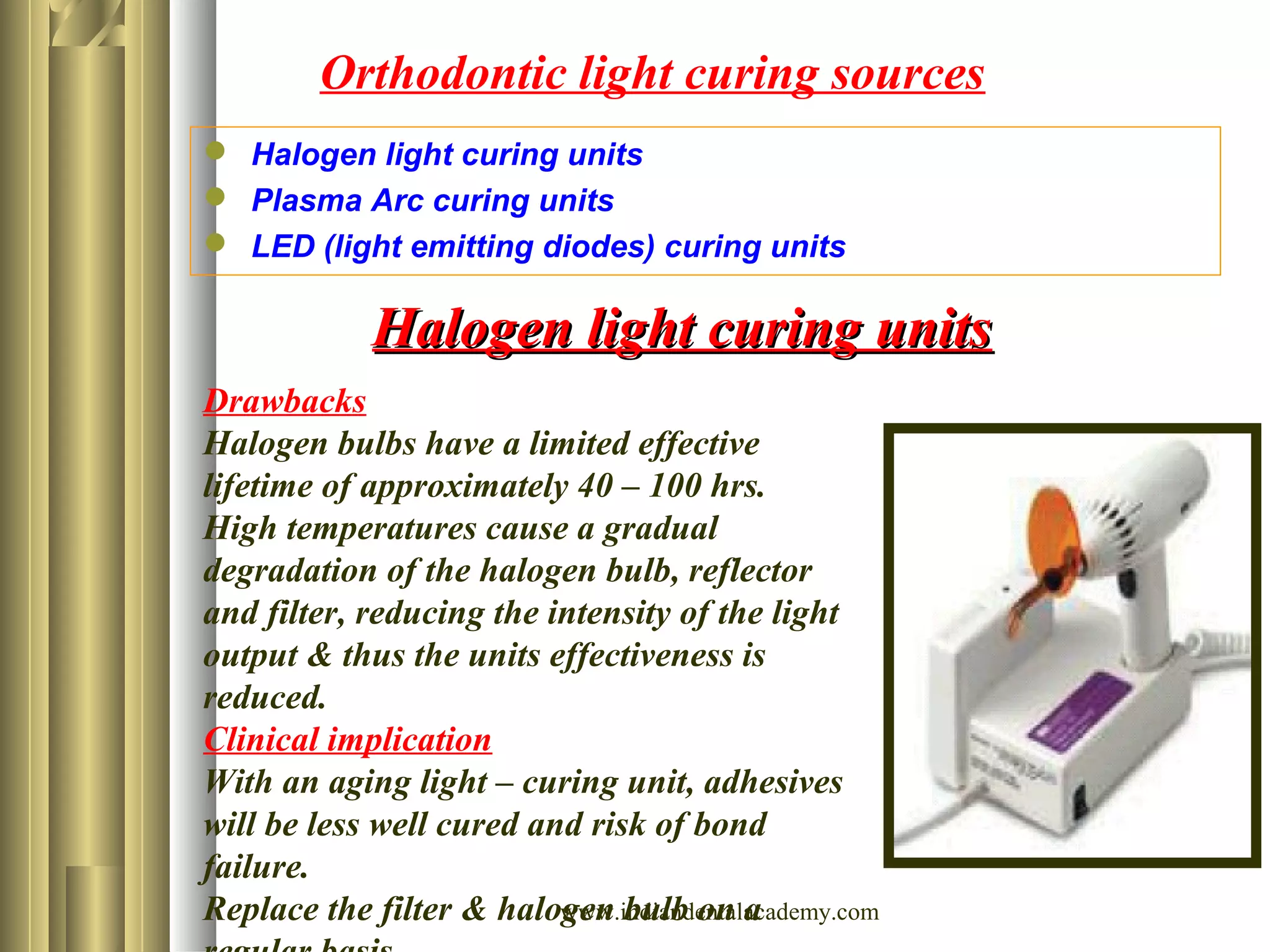
Orthodontic light curing sources
 Halogen light curing units
 Plasma Arc curing units
 LED (light emitting diodes) curing units
Drawbacks
Halogen bulbs have a limited effective
lifetime of approximately 40 – 100 hrs.
High temperatures cause a gradual
degradation of the halogen bulb, reflector
and filter, reducing the intensity of the light
output & thus the units effectiveness is
reduced.
Clinical implication
With an aging light – curing unit, adhesives
will be less well cured and risk of bond
failure.
Replace the filter & halogen bulb on a
Halogen light curing unitsHalogen light curing units
www.indiandentalacademy.com
Plasma Arc curing units
Advantages
 Overall time reduction – 2 min for whole arch.
 Immediate bond strength appears to be very high.
 No enamel damage on debonding.
 Rebonding bracket- easy.
Disadvantages
•Light emitted from plasma arc device is so powerful that both the
operator & assistant should wear protective glasses.
•Additional cost of curing light.
www.indiandentalacademy.com
LED (Light emitting diodes)LED (Light emitting diodes)
Are semi - conducting materials that transform current into light of
a specific wavelength.
First suggested by
Mills (Br. Dent J 1995)
First reported by
Fujibayashi et al (Dent. Jap 1998)
www.indiandentalacademy.com
ADVANTAGES
•Much smaller & lighter than conventional
bulbs.
•Offer high shock resistance, as there is no
filament to be damaged and their relatively low
power consumption makes them suitable for
portable use in cordless devices.
•LEDs have lifetimes of more than 10,000 hours
and experience little degradation of light output
over this time – a distinct advantage over halogen
bulbs.
•Require no filters to produce blue light. The
spectral output of these LEDs falls mainly within
the absorption spectrum of the camphoroquinone
photoinitiatior of most dental composites.
•Depth of cure – significantly greater than halogen
light
Disadvantages
•Their batteries must
be recharged.
•They cost more than
do conventional
halogen lights.
•They offer a
relatively low
intensity.•Their technology is
new to orthodontics,
and the concept still
is evolving.
•Their curing time is
slower than plasma
arc curing lights and
some enhanced
halogen lights.www.indiandentalacademy.com
SELF CURE V/S LIGHT CURE:
1. SELF CURE:
Polymerization starts immediately on mixing.
Operator cannot manipulate the setting time.
Air bubbles that arise during mixing can result in
decreased bond strength.
II. LIGHT CURE:
Compared to UV light, visible light has deeper curing
capabilities and is more effective through enamel.
It is a single paste system.
Brackets can be positioned accurately.
Excess material can be removed prior to polymerization.www.indiandentalacademy.com
Mills et al ( BJO 2002)
Compared light source containing LED to Halogen units
Concluded – LED curing units cured composites to
significantly greater depths when tested at 40 & 60 sec
William Dunn & Louis Taloumis
AJO sep 2005
Compared the shear bond strength of orthodontic brackets
bonded to teeth with conventional halogen light and LED
curing units .
No diff in bond strength of orthodontic brackets bonded to
teeth with conventional halogen light and LED curing
units .
Polymerization of resin cement with LED curing unit
www.indiandentalacademy.com
Pre primed brackets
These are brackets which already have the
bonding material coated on their bases so that
they have to be just dipped in the sealant solution
and placed on the etched and prepared tooth
surface.
The advantages of these pre-primed brackets are
• Consistent quality of the adhesive
• Reduced flash
• Adequate bond strength
• They ensure infection control
• They can be used in direct and indirect bonding
techniques and both metal and ceramic brackets
are available in this manner.www.indiandentalacademy.com
Comparison of shear bond strength precoated
and uncoated Brackets
SAMIR E.BISHARA,
MARCOSLEN
LEIGH VON WALD
Study was conducted :
 To determine whether any change in the composition would
affect the shear bond strength
 To determine the site of bond failure when precoated and
uncoated ceramic and metal brackets were used.
Conclusion :
 Precoated ceramic brackets showed similar shear
bond strength.
 Precoated metal brackets showed significantly lower
shear bond strength.
www.indiandentalacademy.com
Etching of the ceramic surface with hydrofluoric acid
Was introduced in the early 1980s for bonding porcelain
laminate veneers.. A commonly used hydrofluoric acid
product has a concentration of 9.6% in gel form and is
placed on the ceramic for two to four minutes.
Other available commercial products use 4% acidulated
phosphate fluoride containing 1.43% hydrofluoric acid in
gel form for two minutes. Acid etching of ceramic surface
is recommended when maximum bond strength is
required.
The scope of orthodontics has expanded over the past two
decades to include more adult patients, and it is expected
that many of these people will have restorations placed on
their teeth. Although banding is always an alternative for
the teeth that have restorations, bonding is desirable in
aesthetic areas.
www.indiandentalacademy.com
The protocol for optimal bonding to ceramic
surfaces is as follows:
 (1) The glaze is first removed by sandblasting, using 50 µm
Al2O3 for two to four seconds.
 (2) The ceramic surface is then etched for two minutes, using
9.6% hydrofluoric acid in gel form.
 (3) Subsequently, two to three coatings of a silane coupling
agent are applied to the etched surface, followed by drying.
 (4) Two layers of unfilled resin are then applied to form a thin
coating.
 (5) Finally, the bracket is bonded to the prepared ceramic
surface, using a highly filled Bis-GMA resin .
www.indiandentalacademy.com
 BONDING TO CASTING ALLOYS
Proper surface preparation and special adhesives are
required for acceptable bonding to casting alloys.
Although roughening the alloy surface with a stone
increases the bond strength to brackets, intraoral
sandblasters provide better results.
In recent years, adhesives that chemically bond to metal
surfaces have been developed. It is believed that 4-META
forms a hydrogen bond with hydroxyl groups found on the
prepared surface of the metal.
The commercial products Super-Bond C&B (Sun Medical,
Kyoto, Japan) and C&B Metabond (Parkell, Farmingdale,
NY, USA) combine 4-META (4 methacryloxyethyltrimethyl
anhydride) with tributylborane monomer and a polymer
powder.
www.indiandentalacademy.com
BONDING TO AMALGAM
 Sandblasting the surface of the amalgam restoration,
followed by use of the adhesives, 4-=META, 10MDP(10-
methacryloyloxydecyl dihydrogenphosphate)/Bis-GMA,
and intermediate resins, improves bonding to dental
amalgam. However, the bond strength achieved is at best
about half that for resin composite to etched enamel.
 Sandblasting the dental amalgam surface produces
significantly better bonding than that achieved with a
polished dental amalgam surface.
 However, when compared to roughening with a diamond
bur, sandblasting of dental amalgam surfaces did not
produce better bonding.
In vitro studies have shown that brackets bonded to
sandblasted gold alloys using these 4-META adhesives
attain the bond strength values to acid-etched enamel. It
has been found that these adhesives bond better to base
metal alloys than to gold alloys.
www.indiandentalacademy.com
Divided into two categories depending upon site of failures
1. Adhesive – enamel bond failures
2. Adhesive – bracket bond failures
Possible causes of Adhesive – enamel Bond failures
1.Contamination of etched enamel by saliva, moisture or oil
from water line.
2.Insufficient rinsing of etchant from tooth before bonding.
3.Inadequate drying of enamel surface precludes penetration
of resin.
4.Over – etching demineralizes enamel, reduces depth of
resin tags penetration, and removes excessive amounts of
enamel.
5.Faulty bonding materials, materials with expired date.
www.indiandentalacademy.com
Possible Causes of Adhesive – bracket bond failures:
 Excessive force exerted on bracket from occlusion or
excessive from appliance.
 Movement of bracket during initial setting of adhesive.
 Contaminated bracket mesh (oil from hands, glove
powder or rebonded bracket).
 Adhesive not buttered into base firmly.
 Activator not placed on bracket in paste primer system.
 Inadequate cure of light cured resin composite.
Avoid bond failures….
•Increases treatment time
•Additional cost in materials
•Unexpected additional visits by patients.www.indiandentalacademy.com
www.indiandentalacademy.com
RECYCLING
 Several methods of recycling debonded attachments for
repeat use, either by commercial companies or by
duplicated procedure in the office, are available.
 The main goal of the recycling process is to remove the
adhesive from the bracket completely without damaging
or weakening the delicate bracket backing or distorting
the dimensions of the bracket slot.
 Commercial processes employ heat ( about 450º C ), to
burn off resin, followed by electropolishing to remove
the oxide buildup (e.g. Esmadent) or they use solvent
stripping combined with high frequency vibrations and
only flash electropolishing (e.g., Ortho – Cycle).
 The electropolishing is needed for removal of any
tarnish or oxide formed during the elimination of the
adhesive from the clogged pad.
www.indiandentalacademy.com
Recycling of ceramic brackets
Djeng et al (Jco 1990),
 Composite resin remaining on the bracket base is
removed by holding the bracket with a pair of tweezers
and heating it in a mini torch until it turns cherry red .
 On cooling, the residual composite resin will turn chalky
white and flaky. It can easily be removed by gently
tapping the bracket on a table top or by lightly scraping
the base with a wax knife this produces a clean surface.
 The bracket is allowed to cool for 5 minutes until it
reaches room temperatures.
 It is dried with compressed air to remove any possible
residue. It is rinsed in 100% isopropyl alcohol at pure
acetone and allowed to air dry.
www.indiandentalacademy.com
•Bonded brackets that become loose during
treatment consume much chair time, are poor
publicity for the office, and are a nuisance to
the orthodontist..
•The best way to avoid loose brackets is to adhere
strictly to the rules for good bonding technique.
•The loose bracket is removed from the archwire.
Any adhesive remaining on the tooth surface is
removed with TC bur. The adhesive remaining
on the loose bracket is treated by sandblasting.www.indiandentalacademy.com
• Until all visible material is removed from theUntil all visible material is removed from the
base. The tooth is then etched with Ultraetch 35%base. The tooth is then etched with Ultraetch 35%
phosphoric acid gel for 15 to 30 seconds.phosphoric acid gel for 15 to 30 seconds.
• On inspection, the enamel surface may not beOn inspection, the enamel surface may not be
uniformly frosty because areas are likely stilluniformly frosty because areas are likely still
retaining resin. The phosphoric acid will re-etchretaining resin. The phosphoric acid will re-etch
any exposed enamel and remove the pellicle onany exposed enamel and remove the pellicle on
any exposed resin.any exposed resin.
• Sonis AL (AJO 1996)Sonis AL (AJO 1996) found out that the bondfound out that the bond
strength of sandblasted rebonded brackets isstrength of sandblasted rebonded brackets is
comparable to the success rate of new brackets.comparable to the success rate of new brackets.
www.indiandentalacademy.com
Classification of studies on orthodontic bonding evaluation –
According to testing environment:
 In vitro tests – failure mode of systems evaluated are determined by
microscopic examination.
 In vivo - failure rate of brackets during full course of treatment with the
bracket type and failure site frequency being the parameters examined.
 Ex-vivo - utilizing finite element analysis modeling of the stress
distributions in the components of the enamel adhesive bracket system.
According to mode of loading application:-
•Shear- method is popular due to the relative simplicity of the
experimental configuration and increased reliability of simulating
intraoral debonding that occurs during treatment.
•Tension- Many investigation find these loading modes less
relevant to clinical practice.
•Torsion- Many investigation find these loading modes less relevant
to clinical practice. www.indiandentalacademy.com
Orthodontic bonding has found to be more practical, andOrthodontic bonding has found to be more practical, and
beneficial.beneficial.
Successful bonding in orthodontics requires carefulSuccessful bonding in orthodontics requires careful
attention to three components of the system: the toothattention to three components of the system: the tooth
surface and its preparation, the design of the attachmentsurface and its preparation, the design of the attachment
base, and the bonding material itself.base, and the bonding material itself.
The future of bonding is promising. Product developmentThe future of bonding is promising. Product development
in terms of adhesives, brackets, and technical details isin terms of adhesives, brackets, and technical details is
continually occurring at a rapid rate. It is necessary forcontinually occurring at a rapid rate. It is necessary for
the orthodontist to update and stay oriented.the orthodontist to update and stay oriented.
CONCLUSIONCONCLUSION
www.indiandentalacademy.com
Bibliography:-
• Graber Vanarsdall: Orthodontics current principle and
technique. 4rd edition, Pg-579-606.
• William A Brantley and Theodore Eliades: Orthodontic
materials , Pg-189.200.
• Theodore M.Robersons,Harald O. Heymann, Edward J.
Swift: Sturdevant’s Art & Science of Operative
Dentistry ,4th edition, Pg-177-206,303
• Kenneth J Anusavice: Phillips Science of Dental
Materials. 10th edition Pg-273-310.
• Air abrasion tech vs conventional acid etching tech.-
AJO-DO Jan 2000- Wandela L. et al
www.indiandentalacademy.com
•Laser etching of enamel for direct bonding- AO,1993 no.1-
Von Fraunhofer et al
•crystal growth on outer enamel surface- AJO-DO March
1986- Maijer & Smith
•Bond strength with various etching times on young perm
teeth- AJO-DO Jul 1991- Wang & Chau Lu
•Lab.& clinical evaluation of self etching primer JCO Jan
2001- Robert A. Miller
•Variation in acid etch patterns with diff acids & etch time
AJO-DO Jul 2001- Alastair Gardner et al
www.indiandentalacademy.com
•Clinical evaluation of bond failure rates with a
new self etching primer- JCO Dec 2005- Shadow
Asgari et al
•Rapid curing of bonding with xenon plasma arc
light - AJO-DO Jun 2006- Oesterle, Sheldon,
Newman et al
•Evaluation of sealant in ortho bonding- AJO-DO
Sep 1998- Wei Nan Wang
•Bond strength comparison of MIP- AJO-DO Sep
2002- Shane & Timothy
www.indiandentalacademy.com

Bondin

  • 1.
    EVOLUTION OF DIRECT BONDINGIN ORTHODONTICS www.indiandentalacademy.com
  • 2.
    CONTENTS  Introduction  History Bonding Adhesives  Advantages and disadvantages  Bonding procedure  Bonding to crowns and restorations  Bond failures  Rebonding  Recycling  Conclusion  Bibliography www.indiandentalacademy.com
  • 3.
    INTRODUCTION Orthodontics is adynamically growing science. It is constantly undergoing development and is evolving through the discovery of newer techniques and materials and improvements over the older ones. Bonding of brackets, eliminating the need for bands was a dream for many years before becoming a routine clinical procedure. One of the most important events in orthodontics appliance was the introduction of direct Bonding. This was the result of the pioneering work by Buonocore in the 1950’s and since steady stream of materials has been developed for this purpose. www.indiandentalacademy.com
  • 4.
    The bonding oforthodontic attachments to the etched enamel surface of teeth is a well-established clinical procedure. There are at present two techniques for the placement of orthodontic attachments. The first is called the direct technique. The second method of bracket placement is the indirect technique. In an investigation, that examined the preference of 2000 operators for either the direct or the indirect technique of bonding, Gore lick found that the ratio of direct to indirect as 13:1. Direct bonding is the procedure where the operator directly places the brackets onto the enamel surface. GEORGE NEWMAN first demonstrated this technique. He is considered as the pioneer of direct bonding in orthodontics. Indirect bonding - Silverman first described this technique. This is a 2 stage procedure 1st stage is performed in the laboratory. Where the brackets are located and attached to a plaster model of the patient’s teeth. In the 2nd stage, the Brackets in their position are transferred by means of a tray to the patient’s mouth where they are attached to the etched enamel of the teeth. www.indiandentalacademy.com
  • 5.
  • 6.
    Buonocore (1955): Demonstratedthe increased adhesion of attachments to tooth surface by conditioning the enamel surface with 85% phosphoric acid for 30 seconds. Sadler (1958): Attempts to cement orthodontic attachments directly to enamel without etching have been recorded. Sadler tested nine materials (four dental cements, one rubber base cement, two metal adhesives and two general purpose adhesives) but these were all unsuccessful. Bowen (1962) developed a new resin system, Bisphenol-A-Glycidyl dimethacrylate commonly known as BIS-GMA and is often referred to as “Bowen’s Resin”. Direct Bonding: Past and present www.indiandentalacademy.com
  • 7.
     Newman(1965) wasthe first to bond orthodontic attachments to teeth by means of an epoxy resin. He used a mixture consisting of equal parts of low molecular weight epoxy liquid and a high molecular weight solid epoxy with a polyamide curing agent.  Cueto(1966), his experiment was done to see if it was feasible to attach a bracket directly to tooth enamel without the use of orthodontic bands. The adhesive consisted of a liquid monomer, methyl-2-cyanoacrylate, and a silicate filler.  Mitchel(1967), had failures with an epoxy resin but described a successful, although limited, clinical trial using black copper cement and gold direct attachments.  Buonocore etal(1968), showed that enhanced bonding to acid conditioned surfaces were due to the presence of “prism like” tags and also observed poor bonding with unconditioned enamel surfaces.  Smith(1968), introduced Zinc polyacrylate and bracket bonding with cement was reported. www.indiandentalacademy.com
  • 8.
     Retief(1973) describedthe importance of preconditioning with 50% phosphoric acid.  Reynolds(1975) reported that a maximum tensile bond strength of 5.9 to 7.9Mpa would be a adequate to resist treatment forces.  Keizer etal(1976) evaluated direct bonding adhesives for orthodontic metal brackets.  In 1977, first detailed post treatment of direct bonding over full period of orthodontic treatment in large sample of patient was published.  Zachrisson(1978), stated that the objective of bonding was to get as good as mechanical as possible between enamel and adhesive and evenly distributed etching pattern with marked surface roughness, but little actual loss of enamel is most desirable to achieve mechanical interlock.www.indiandentalacademy.com
  • 9.
    Tavas etal(1979) introducedthe concept of light activated composites. They demonstrated that the bond strength of brackets bonded with this was comparable with two chemically cured adhesives.  In 1986 White, described bonding orthodontic brackets to enamel with GIC who also emphasized the need for moisture control during the early stages of bonding using GIC. Although important improvements in bonding have been made in the last 30 years, the requirements of an ideal bonding system are quite similar to those indicated by Buonocore. www.indiandentalacademy.com
  • 10.
    1. Teeth thatreceive heavy intermittent forces against the attachments. Ex: Upper first molar, which receives extra oral force through the headgear. The bands rather than bonded attachments better resist the twisting and shearing forces when a face bow is inserted and removed from the attachment. 2. Teeth that need both labial and lingual attachments. It is easier to place a band with welded labial and lingual attachments than go through two bonding procedures. These banded lingual attachments are less likely to be swallowed or aspirated if it comes loose. 3. Teeth with short clinical crowns 4. Teeth surfaces that are incompatible with successful bonding teeth that have been restored in amalgam or metal are impossible to bond. Porcelain restorations are difficult; a coupling agent is needed to enforce adhesion. Banding preferred to bonding www.indiandentalacademy.com
  • 11.
    BANDING - W.E.Magill – 1871 Negative factors - 1. Time and skill - 2. Impacted / partially erupted teeth - 3. Decalcification / discoloration - 4. Gingival irritation - 5. Closure of band spaces - 6. Unaesthetic - 7. Placement of separators is painfulwww.indiandentalacademy.com
  • 12.
    Advantages of bonding Esthetics  Faster and simpler  Less patient discomfort  Arch length not increased  No band space closure  Partially erupted or fractured teeth can be controlled  Lingual orthodontics  Interproximal enamel reduction and composite build up possible  Bond artificial tooth surface  Caries risk eliminated  Bracket may be recycled  More hygienic www.indiandentalacademy.com
  • 13.
    DISADVANTAGES OF BONDING:- A bonded bracket has a weaker attachment than a cemented band.  Some bonding adhesives are not sufficiently strong.  Better access for cleaning does not necessarily guarantee better oral hygiene and improved gingival condition, especially if excess adhesive extends beyond the bracket base.  The protection against interproximal caries provided by well-contoured cemented bands is absent.  Rebonding a loose bracket requires more preparation than re-cementing a loose band.  Debonding is more time consuming than debanding because removal of adhesive is more difficult than removal of cement. www.indiandentalacademy.com
  • 14.
    BONDING: Ideal requirements ofa Good adhesive: •It should not have any toxic effects •It must be of low viscosity so that it penetrates the enamel surface. •It must have excellent inherent strength and dimensionally stable. •It must have minimal expansion and water absorption. •The operator should have the option of being able to bond directly or indirectly •The material should be stain resistant •Sufficient working time before setting occurs www.indiandentalacademy.com
  • 15.
    CLASSIFICATION OF DENTINEBONDING AGENTS 1. Based on generations  I generation  II generation  III generation  IV generation  V generation  VI generation  VII generation 2. According to chemistry  Phosphate / phosphonate derivatives eg: Scotch bond  Halophosphorus esters of Bis-GMA eg: Tenure  NPG-PMDM (N-phenylglcine pyromellitic acid diethyl methacrylate)  Isocyanate system eg: Dentin adhesit  Glutaraldehyde system eg: GLUMA  4-META (Methacryloxyethyl trimellitate anhydride) 3. According to smear layer  Smear layer preserved eg: Tennure & Gluma  Smear layer modified eg: Scotch bond  Smear layer removedwww.indiandentalacademy.com
  • 16.
    FIRST GENERATION DEVELOPMENT OFBONDING AGENTS BUONOCOREBUONOCORE (1956(1956)) –– Demonstrated the use of aDemonstrated the use of a Glycerophosphoric acid dimethacrylate –Glycerophosphoric acid dimethacrylate – containing resin, would bond to acid etchingcontaining resin, would bond to acid etching dentin.dentin. BOWENBOWEN (1965(1965)) -- tried N – phenylglycine and glycidyltried N – phenylglycine and glycidyl methacrylate .methacrylate . Bonding occurred due to the interaction of thisBonding occurred due to the interaction of this bifunctional resin with the calcium ions ofbifunctional resin with the calcium ions of hydroxyapatite.hydroxyapatite. Drawback – Poor bond strength (1 to 3 MPa ).Drawback – Poor bond strength (1 to 3 MPa ). www.indiandentalacademy.com
  • 17.
    SECOND GENERATION In thelate 1970’s the second generation system were introduced. Incorporated halophosphorous esters of unfilled resins such as bisphenol – A glycidal methacrelate or bis – GMA, or hydroxyethyl methacrylate, or HEMA. Bonded to dentine through an ionic bond to calcium by chlorophosphate groups. Weak bond strength, but significant improvement over first generation. Scotch Bond (3M Dental ), Clearfil (Kuraray Co. Japan) www.indiandentalacademy.com
  • 18.
    THIRD GENERATION  Theprimer contains hydrophilic resin monomers which include hydroxyethyl trimellitate anhydride, or 4–META, and biphenyl dimethacrylate or BPDM.  The primers contain a hydrophilic group that infiltrates smear layer, modifying it and promoting adhesion to dentin.  The phosphate primer modifies the smear layer by softening and cures, forming a hard surface. Following, the unfilled resin adhesive is applied, attaching cured primer to the composite resin.  Drawback – Bonding to smear layer - covered dentine was not very successful.  Mirage bond, Scotch bond 2, Prisma Universal bond 2 and 3. www.indiandentalacademy.com
  • 19.
    FOURTH GENERATION  Theuse of the total etch technique is one of the main characteristics of fourth generation bonding system, here complete removal of the smear layer is achieved.  The Total etch technique permits the etching of enamel and dentine simultaneously using 40% phosphoric acid for 15 to 20 seconds.  The application of hydrophilic primer solution can infiltrate collagen network forming the hybrid layer. According to Nakabayashi (1982) the hybrid layer is defined as “the structure formed in dental hard tissues by demineralization of the surface and subsurface, followed by infiltration of monomer and subsequent polymerization”.  All bound -2 (BISCO), Scotch bond Multipurpose (3M). www.indiandentalacademy.com
  • 20.
    FIFTH GENERATION  Consistof two different types of adhesive materials the so called “one bottle” systems and the self etching primer bonding system.  ONE BOTTLE SYSTEMS combined the primer and adhesives into one solution to be applied after etching. Total etching was done with 35-37% phosphoric acid for 15 to 20seconds.  SELF ETCHING PRIMER was developed by Watanabe and Nakabayashi. It is a aqueous solution of 20% phenyl – P in 30% HEMA.  Adv – The combination of etching and priming steps reduce the working time.  Single bond (3M), One step (BISCO)www.indiandentalacademy.com
  • 21.
    SIXTH GENERATION  Recentlyseveral bonding system were developed and these systems are characterized by the possibility to achieve the proper bond to enamel and dentine using only one solution. These are called one - step bonding.  Unfortunately, the first evaluations of these new system showed a sufficient bond to a conditioned dentin while the bond with enamel was less effective.  This may be due to systems are composed of an acidic solution cannot be kept in place, must be refreshed continuously. SEVENTH GENERATION The trend in the latest generation of dental bonding systems i reduce the number of components and clinical placement steps. The introduction of i Bond, a single – bottle adhesive system, is the latest to new generation materials and combines etchant, adhesive and desensitizer one component.www.indiandentalacademy.com
  • 22.
    CLASSIFICATION OF ORTHODONTIC ADHESIVESYSTEMS  Based upon the polymerization initiation mechanism: 1. CHEMICALLY ACTIVATE 2. LIGHT CURED 3. DUAL CURED 4. THERMOCURED www.indiandentalacademy.com
  • 23.
    Chemically Activated orthodonticAdhesive systems  Chemically activated orthodontic adhesives employ benzoyl peroxide as an initiator, which is activated by a tertiary aromatic amine such as dimethyl – p- toludine or dihydroxyethyl – p toludine.  Initiation occurs from mixing of the paste and liquid components and free radicals are formed by a multi step process. TWO - PHASE ( TWO PASTE) Adhesive Systems ONE - PHASE (NO - MIX) Adhesive systems www.indiandentalacademy.com
  • 24.
    TWO - PHASE Twopaste (Adhesive Systems)  Were the first to be tried by orthodontist in the early days of bonding.  Application involves mixing the paste and liquid components. DisadvantagesDisadvantages  Time consuming  Increased exposure to air induces oxygen inhibition.  Mixing introduces defects in the form of air entrapment and formation of voids.  Concise (3M). www.indiandentalacademy.com
  • 25.
     Application ofliquid component on enamel and bracket base  No mixing required..  Here homogenous polymerization pattern occur due to sandwich technique involved in diffusion of liquid component into paste during application.  Enamel and bracket sides of adhesive are more polymerized relative to middle zones.  Efficient application, limited time requirements. Not recommended in applications where the adhesive thickness is increased, as in molar tubes.  System 1(Ormco)  Rely - a – Bond( reliance)  Unite (3M) ONE - PHASE (NO - MIX) Adhesive systemsONE - PHASE (NO - MIX) Adhesive systems www.indiandentalacademy.com
  • 26.
    Visible Light cured Polymerization initiation by exposure to light curing source  Permits increased working time for optimal bracket placement.  Photoactivation from the incisal and cervical edges is suggested.  Degree of cure of stainless steel brackets bonded with light – cured adhesives is comparable to degree of cure of adhesive bonded to transparent aesthetic brackets.  Bond strength has been studied extensively and supports their use.  Available since the 1980s.  Good alternatives to two phase systems.  Significantly more time demanding than one phase systems.  Most manufactures have marketed LC adhesives. www.indiandentalacademy.com
  • 27.
    Dual – Cured Initiationis achieved by exposure to light. Reaction proceeds following a chemically – cured pattern. Combines disadvantages of handling of both light – cured and chemically cured materials. The most time consuming applications. Increased degree of cure and bond strength. Ideal candidates - bonding molar tubes. www.indiandentalacademy.com
  • 28.
    Self etching primer An acidic primer combines the etchant with the primer in one application, Contains both acid (Phenyl – p) and the primer (HEMA and dimethacrylate). Liquid begins to etch as soon as it is applied Saves time www.indiandentalacademy.com
  • 29.
    Procedure for selfetch primer www.indiandentalacademy.com
  • 30.
    Self Etch Primer- studies  Rueggeberg et al (2000) - promt L-Pop w/o acid etch produce = bond strength as conventional bracket placement  Hitmi (2000)- no signi. diff b/w promt L-Pop & 37% phosphoric acid  Bergeron et al (2000)- resin enamel bond strength of diff self etching primer including promt L-Pop, was similar to or better than multistep Fritz et al(2001)- bonding with 3 self etching primer(Clearfil SE Bond,Clearfil Liner Bond 2V& Novabond)was = phos acid Bishara et al(2001)- self etching primer prod a signi lower, but clinic acceptable, SBS compared to acid etch when Transbond XT composite usedwww.indiandentalacademy.com
  • 31.
    Moisture insensitive primers(MIP)  MOISTURE - ACTIVE  MOISTURE – RESISTANT MOISTURE - ACTIVE  An aqueous solution of methacrylate functionalised polyalkenoic acid copolymer & hydroxyethyl – methacrylate. Generally available as a primer formulation.  Requires the presence of water for initiating the setting reaction and will therefore fail in dry environment. Moisture – Resistant Primer compatible with the use of adhesives. Application of primer on wet enamel surface. Transbond MIP (3M). THERMOCURED •Initiation occurs through exposure to heat. •Not intended for direct bonding. •Polymerization initiator system restricts their use to indirect bonding. •Superior properties. www.indiandentalacademy.com
  • 32.
    Hydrophilic Primer (MIP ) S.J. Little Wood et al JO 2006 Compared the bond strength of bracket bonded with hydrophilic primer with conventional primer Bond strength (6.43) was lower than conventional primer (8.71) Bracket bonded with hydrophilic primer were 3.96 times more at risk of failure. www.indiandentalacademy.com
  • 33.
    The steps involvedare : •CLEANING •ENAMEL CONDITIONING •SEALING •BONDING Bonding Procedure www.indiandentalacademy.com
  • 34.
    CLEANING  Cleaning ofthe teeth with pumice will remove plaque and the organic pellicle.  This requires rotary instruments, either a rubber cup or a polishing brush. A bristle brush cleans more effectively but care must be taken to avoid traumatizing the gingival margin and initiating bleeding.  Studies have shown enamel loss due to prophylaxis. Mark Daniel etal ( AJO 1980) showed that 10.7µm of enamel loss during initial prophylaxis with bristle brush was greater than the 5.0µm lost when a rubber cup as used and the difference was statistically significant.  Pumice or a prophylactic paste is often used to clean the enamel surface. Either does not affect bond strength.www.indiandentalacademy.com
  • 35.
    Isolation and moisturecontrol: Salivary control and maintenance of a dry working fluid are mandatory pre-requisites of a bonding procedure. Moisture control refers to excluding sulcular fluid, saliva, and gingival bleeding from the operating field. Advantages of isolation: Maintenance of a dry clean operating field Access and visibility Improved properties of dental materials Protection of the patient and operator Operating efficiency www.indiandentalacademy.com
  • 36.
    Aids used formoisture control • Rubber dam • Mouth props • Retraction cords • Saliva ejectors and high volume evacuators • salivary duct obstructers • Cotton or gauze rolls, or absorbant paper pads • Anti sialogogues • Lip expanders, cheek retractors • Tongue guards with bite blocks Both tab. & injectable solns : Banthine, pro- Banthine &Atropine sulfate Excellent & rapid saliva flow restriction When indicated Banthine tab (50mg/45kg body wt) in water, 15 minutes before bonding will provide good results. www.indiandentalacademy.com
  • 37.
    Acid Etching ProcedureProcedure  Isolation Gentle application of etchant  Rinsed with water spray  Dry with moisture and oil free source ( pref with chip blower)  Avoid salivary contamination– if it occurs, re etch the tooth. Dull frosty white appearance Teeth that do not appear dull and frosty white should be re - etched www.indiandentalacademy.com
  • 38.
    ETCHING  After theoperative field has been isolated, the teeth to be bonded are dried.  The conditioning solution or gel (usually 37% phosphoric acid) is then lightly applied over the enamel surface with a foam pellet or brush for 15 to 60 sec.  When etching solutions are used, the surface must be kept moist by repeated applications. To avoid damaging delicate enamel rods, care must be taken not to rub the liquid onto the teeth.  At the end of the etching period the etchant is rinsed off the teeth with abundant water spray.  Salivary contamination of the etched surface must not be allowed. ( If it occurs rinse with water spray or re-etch for a few seconds; the patient must not rinse). www.indiandentalacademy.com
  • 39.
    Rationale of etching Removes about 3-10 microns of enamel surface  Etching also increases the wet ability and surface area of the enamel substrate.  Resin tag penetrate upto the depth of 80 um or more Gwinnet, Matsui and Buonocore & others Primary attachment mechanism of resin is “resin tags”. Micromechanical bond www.indiandentalacademy.com
  • 40.
    Exposure of enamelto conditioning solutions produces three Basic patterns.  TYPE I – Prism core material is preferentially removed leaving the prisms periphery intact. (HONEY COMB APPEARANCE)  TYPE II – Peripheral regions of the prism are dissolved leaving the cores relatively intact (COBBLESTONE APPEARANCE).  TYPE III – Surface loss occurs without exposing underlying prisms. www.indiandentalacademy.com
  • 41.
    Factors affecting bondingto ideally etched surface Patient Operator -salivary contamination - oil / water via spray -contact with lips and - rubbing /touching tongue etched surface -exhalation vapor Alternative acids for etching : • - 10% Phosphoric acid • - 10% Maleic acid • - 2.5%Nitric acid • - Polyacrylic acid Most widely used is 30 – 50% ( 37%) phosphoric acidwww.indiandentalacademy.com
  • 42.
    Bond strength withvarious etching times Wang et al AJO-DO July 1991  Compared the tensile bond strength at various etching times 15, 30, 60, 90, 120secs  37% Phosphoric acid  TBS was not statistically different for 15, 30, 60, 90secs  TBS decreased – 120secs  Amount of enamel fragments increased in proportion to the length of the etching times  Optimal etching time should be 15secs www.indiandentalacademy.com
  • 43.
    Variations in acid-etchpatterns with different acids and etch times Alastair Gardner, Ross Hobson, AJO 2001 Compared the enamel etch patterns produced by 37% phosphoric acid and 2.5% Nitric acid for 15, 30 & 60 secs Concluded - 37% phosphoric acid > 2.5% nitric acid for all three applications -optimum time for applying 37% phosphoric acid is 30 sec www.indiandentalacademy.com
  • 44.
    Alternatives to acidetching  Crystal growth  Sand blasting / Air abrasion  Laser etching AIR ABRASION Air Abrasion, also referred to as micro-etching, is a technique in which particles of aluminum oxide are propelled against the surface of enamel by high air pressure, causing abrasion of the surface. Some manufactures of commercial units have suggested that air abrasion could eliminate acid etching; however, bond strengths to air- abraded enamel are only about 50% of those to acid-etched enamel. Air abrasion of metal brackets or bands is an effective technique for improving bond strength. It could be an alternative to pumicing the teeth before etching. www.indiandentalacademy.com
  • 45.
    CRYSTAL-GROWING SOLUTIONS  Crystalbonding involves application to enamel of a polyacrylic acid solution containing sulfate ions, which causes growth of calcium sulfate dihydrate crystals on the enamel surface. These crystals in turn retain the adhesive.  Potential advantages of crystal bonding include easier debonding, less residual adhesive left on the tooth and less damage to enamel.  Since crystal bonding produces bond strengths of 60 – 80% of the bond strength obtained with acid etching, it is not yet considered a practical technique.  Maijer R, Smith Dc ( J Biomed Mater 1979): Found that crystal growing solutions provided retention similar to those after etching with phosphoric acid with less risk of enamel damage at debonding. •One drop of viscous liquid placed on tooth surface •Left undisturbed for 30 sec •No mechanical agitation •Rinsed for 20 sec •Forceful water spray to be avoided as it will break crystals •Dull whitish deposit •Bracket bonded in usual way.www.indiandentalacademy.com
  • 46.
    Crystal growth 1st demonstrated bySmith & Cartz Maijer & Smith 1979 Polyacrylic acid + sulfate ion long needle shaped crystalline deposit CALCIUM SULPHATE DIHYDRATE www.indiandentalacademy.com
  • 47.
    LASER ETCHING  Theapplication of laser energy to an enamel surface causes localized melting. MECHANISM  Removal of enamel (etching) results primarily from the micro- explosion of entrapped water in the enamel.  In addition, there may be some melting of the hydroxyapatite crystals.  Laser etching of enamel by a neodymium-yttrium-aluminum garnet (Nd:YAG) laser typically produced lower bond strengths than does acid etching.  Satisfactory in vitro bond strengths were obtained in one study only when the Nd:YAG laser was used for 12 seconds at maximum power  Studies of CO2 laser etching of enamel have shown that bond strengths of 10 Mpa can be obtained reliably.  The thermal effects of laser etching on the enamel substructure require further research.www.indiandentalacademy.com
  • 48.
    Laser etching Classification According wavelength 1.UV range ( Krypton fluoride, Argon fluoride) 2. Visible light ( Helium Neon, argon laser ) 3. Infrared range (carbon dioxide , Nd:YAG ) www.indiandentalacademy.com
  • 49.
    Laser etching ofenamel for direct bonding Von Fraunhofer 1993, No.1 AO  Phosphoric acid – 30 sec.  4 power settings on the laser etching unit were used: 80mJ, 1W, 2W and 3W.  Melting and ablation of enamel surface (roughness) Results  Acceptable shear bond strength,(0.6kg/mm), could be achieved at laser power settings of 1 to 3W but not at the lowest setting (80 mJ).  Shear bond strengths lower than acid etching. Aim – to compare tensile & shear bond strength obtained by acid etching & krypton flouride excimer laser- (440MJ/cms, 460 and 480) Optimum bond strength achieved with 460 & 480 TBS - highest with 460 then480 & acid etching SBS- highest with 480 both Least with 440 Dr. Francis 2001 www.indiandentalacademy.com
  • 50.
    Acid etching inprimary teeth STUDIES:  SILVERSTONE:- 120 sec etch necessary to establish proper enamel porosity  MUELLER(1977):- By increasing the etch time an increase in tag formation was seen  NORDENVELL et al :- Compared primary Young & mature perm. Teeth using var. etch times b/w 15-60 sec. found that 15 sec gave greatest surface irreg. in primary teeth.  REDFORD:- etch time of 15 sec with 38% phos acid was adequate for primary teeth. Preferred procedure for deciduous teeth According to Zachrisson recommended procedure for conditioning deciduous teeth is to sand blast with 50 μm aluminum oxide for 3 seconds to remove some outermost aprismatic enamel and then etch for 30 seconds with Ultra-Etch 35% phosphoric acid gel. www.indiandentalacademy.com
  • 51.
    •Fracture and crackingof enamel upon debonding •Increased surface porosity – possible staining. •Loss of acquired fluoride in outer 10µm of enamel surface. •Loss of enamel during etching. •Resin tags retained in enamel – possible discoloration of resin. •Rougher surface if over-etched. Possible iatrogenic effects of acid etching of enamel Maijer & Smith 1986 AJO-DO Loss of enamel caused by etching 10-20 um lost - acid etch 6-50 um lost - after debonding www.indiandentalacademy.com
  • 52.
    SEALING VARIOUS CONCEPTS •Necessary toachieve proper bond strength •Resistance to micro leakage •Both reasons •Not needed at all After the teeth are completely dry and frosty white, a thin layer of sealant may be painted over the entire etched enamel surface. Sealant is best applied with a small foam pellet or brush with a single gingivoincisal stroke on each tooth. The sealant coating should be thin and even, because excess sealant may induce bracket drift. Bracket placement should be started immediately after all etched surfaces are coated with sealant. www.indiandentalacademy.com
  • 53.
    Sealing Sealer / Primer/ Intermediate resin Low viscosity resin which is applied prior to bonding Sealants 2 types : 1.light cured 2.chemically cured CEEN & GWINNETT •Light cured sealant protect the enamel adjacent to the brackets from dissolution & subsurface lesions •Chemically cured polymerize poorly & have low resistance to abrasion www.indiandentalacademy.com
  • 54.
    Evaluation of sealantin Orthodontic bonding Wei Nan Wang et al AJO 1998  Evaluated the TBS with & without use of sealant  No statistically significant difference in the bond strength of the two evaluated groups  The distributions of debonding interface between groups were similar and also had no statistical difference.  Sealant in the two-paste self polymerize bonding system for enhanced strength is unnecessary. www.indiandentalacademy.com
  • 55.
    Bonding POSITIONING Proper vertical andhorizontal positioning (ex-Using placement scaler with parallel edges) FITTING Bracket firmly pushed towards the tooth surface with one point contact REMOVAL OF EXCESS •Gingival irritation •Plaque build up •Better esthetics •Prevents staining and discoloration www.indiandentalacademy.com
  • 56.
    Orthodontic light curingsources  Halogen light curing units  Plasma Arc curing units  LED (light emitting diodes) curing units Drawbacks Halogen bulbs have a limited effective lifetime of approximately 40 – 100 hrs. High temperatures cause a gradual degradation of the halogen bulb, reflector and filter, reducing the intensity of the light output & thus the units effectiveness is reduced. Clinical implication With an aging light – curing unit, adhesives will be less well cured and risk of bond failure. Replace the filter & halogen bulb on a Halogen light curing unitsHalogen light curing units www.indiandentalacademy.com
  • 57.
    Plasma Arc curingunits Advantages  Overall time reduction – 2 min for whole arch.  Immediate bond strength appears to be very high.  No enamel damage on debonding.  Rebonding bracket- easy. Disadvantages •Light emitted from plasma arc device is so powerful that both the operator & assistant should wear protective glasses. •Additional cost of curing light. www.indiandentalacademy.com
  • 58.
    LED (Light emittingdiodes)LED (Light emitting diodes) Are semi - conducting materials that transform current into light of a specific wavelength. First suggested by Mills (Br. Dent J 1995) First reported by Fujibayashi et al (Dent. Jap 1998) www.indiandentalacademy.com
  • 59.
    ADVANTAGES •Much smaller &lighter than conventional bulbs. •Offer high shock resistance, as there is no filament to be damaged and their relatively low power consumption makes them suitable for portable use in cordless devices. •LEDs have lifetimes of more than 10,000 hours and experience little degradation of light output over this time – a distinct advantage over halogen bulbs. •Require no filters to produce blue light. The spectral output of these LEDs falls mainly within the absorption spectrum of the camphoroquinone photoinitiatior of most dental composites. •Depth of cure – significantly greater than halogen light Disadvantages •Their batteries must be recharged. •They cost more than do conventional halogen lights. •They offer a relatively low intensity.•Their technology is new to orthodontics, and the concept still is evolving. •Their curing time is slower than plasma arc curing lights and some enhanced halogen lights.www.indiandentalacademy.com
  • 60.
    SELF CURE V/SLIGHT CURE: 1. SELF CURE: Polymerization starts immediately on mixing. Operator cannot manipulate the setting time. Air bubbles that arise during mixing can result in decreased bond strength. II. LIGHT CURE: Compared to UV light, visible light has deeper curing capabilities and is more effective through enamel. It is a single paste system. Brackets can be positioned accurately. Excess material can be removed prior to polymerization.www.indiandentalacademy.com
  • 61.
    Mills et al( BJO 2002) Compared light source containing LED to Halogen units Concluded – LED curing units cured composites to significantly greater depths when tested at 40 & 60 sec William Dunn & Louis Taloumis AJO sep 2005 Compared the shear bond strength of orthodontic brackets bonded to teeth with conventional halogen light and LED curing units . No diff in bond strength of orthodontic brackets bonded to teeth with conventional halogen light and LED curing units . Polymerization of resin cement with LED curing unit www.indiandentalacademy.com
  • 62.
    Pre primed brackets Theseare brackets which already have the bonding material coated on their bases so that they have to be just dipped in the sealant solution and placed on the etched and prepared tooth surface. The advantages of these pre-primed brackets are • Consistent quality of the adhesive • Reduced flash • Adequate bond strength • They ensure infection control • They can be used in direct and indirect bonding techniques and both metal and ceramic brackets are available in this manner.www.indiandentalacademy.com
  • 63.
    Comparison of shearbond strength precoated and uncoated Brackets SAMIR E.BISHARA, MARCOSLEN LEIGH VON WALD Study was conducted :  To determine whether any change in the composition would affect the shear bond strength  To determine the site of bond failure when precoated and uncoated ceramic and metal brackets were used. Conclusion :  Precoated ceramic brackets showed similar shear bond strength.  Precoated metal brackets showed significantly lower shear bond strength. www.indiandentalacademy.com
  • 64.
  • 65.
    Etching of theceramic surface with hydrofluoric acid Was introduced in the early 1980s for bonding porcelain laminate veneers.. A commonly used hydrofluoric acid product has a concentration of 9.6% in gel form and is placed on the ceramic for two to four minutes. Other available commercial products use 4% acidulated phosphate fluoride containing 1.43% hydrofluoric acid in gel form for two minutes. Acid etching of ceramic surface is recommended when maximum bond strength is required. The scope of orthodontics has expanded over the past two decades to include more adult patients, and it is expected that many of these people will have restorations placed on their teeth. Although banding is always an alternative for the teeth that have restorations, bonding is desirable in aesthetic areas. www.indiandentalacademy.com
  • 66.
    The protocol foroptimal bonding to ceramic surfaces is as follows:  (1) The glaze is first removed by sandblasting, using 50 µm Al2O3 for two to four seconds.  (2) The ceramic surface is then etched for two minutes, using 9.6% hydrofluoric acid in gel form.  (3) Subsequently, two to three coatings of a silane coupling agent are applied to the etched surface, followed by drying.  (4) Two layers of unfilled resin are then applied to form a thin coating.  (5) Finally, the bracket is bonded to the prepared ceramic surface, using a highly filled Bis-GMA resin . www.indiandentalacademy.com
  • 67.
     BONDING TOCASTING ALLOYS Proper surface preparation and special adhesives are required for acceptable bonding to casting alloys. Although roughening the alloy surface with a stone increases the bond strength to brackets, intraoral sandblasters provide better results. In recent years, adhesives that chemically bond to metal surfaces have been developed. It is believed that 4-META forms a hydrogen bond with hydroxyl groups found on the prepared surface of the metal. The commercial products Super-Bond C&B (Sun Medical, Kyoto, Japan) and C&B Metabond (Parkell, Farmingdale, NY, USA) combine 4-META (4 methacryloxyethyltrimethyl anhydride) with tributylborane monomer and a polymer powder. www.indiandentalacademy.com
  • 68.
    BONDING TO AMALGAM Sandblasting the surface of the amalgam restoration, followed by use of the adhesives, 4-=META, 10MDP(10- methacryloyloxydecyl dihydrogenphosphate)/Bis-GMA, and intermediate resins, improves bonding to dental amalgam. However, the bond strength achieved is at best about half that for resin composite to etched enamel.  Sandblasting the dental amalgam surface produces significantly better bonding than that achieved with a polished dental amalgam surface.  However, when compared to roughening with a diamond bur, sandblasting of dental amalgam surfaces did not produce better bonding. In vitro studies have shown that brackets bonded to sandblasted gold alloys using these 4-META adhesives attain the bond strength values to acid-etched enamel. It has been found that these adhesives bond better to base metal alloys than to gold alloys. www.indiandentalacademy.com
  • 69.
  • 70.
    Divided into twocategories depending upon site of failures 1. Adhesive – enamel bond failures 2. Adhesive – bracket bond failures Possible causes of Adhesive – enamel Bond failures 1.Contamination of etched enamel by saliva, moisture or oil from water line. 2.Insufficient rinsing of etchant from tooth before bonding. 3.Inadequate drying of enamel surface precludes penetration of resin. 4.Over – etching demineralizes enamel, reduces depth of resin tags penetration, and removes excessive amounts of enamel. 5.Faulty bonding materials, materials with expired date. www.indiandentalacademy.com
  • 71.
    Possible Causes ofAdhesive – bracket bond failures:  Excessive force exerted on bracket from occlusion or excessive from appliance.  Movement of bracket during initial setting of adhesive.  Contaminated bracket mesh (oil from hands, glove powder or rebonded bracket).  Adhesive not buttered into base firmly.  Activator not placed on bracket in paste primer system.  Inadequate cure of light cured resin composite. Avoid bond failures…. •Increases treatment time •Additional cost in materials •Unexpected additional visits by patients.www.indiandentalacademy.com
  • 72.
  • 73.
    RECYCLING  Several methodsof recycling debonded attachments for repeat use, either by commercial companies or by duplicated procedure in the office, are available.  The main goal of the recycling process is to remove the adhesive from the bracket completely without damaging or weakening the delicate bracket backing or distorting the dimensions of the bracket slot.  Commercial processes employ heat ( about 450º C ), to burn off resin, followed by electropolishing to remove the oxide buildup (e.g. Esmadent) or they use solvent stripping combined with high frequency vibrations and only flash electropolishing (e.g., Ortho – Cycle).  The electropolishing is needed for removal of any tarnish or oxide formed during the elimination of the adhesive from the clogged pad. www.indiandentalacademy.com
  • 74.
    Recycling of ceramicbrackets Djeng et al (Jco 1990),  Composite resin remaining on the bracket base is removed by holding the bracket with a pair of tweezers and heating it in a mini torch until it turns cherry red .  On cooling, the residual composite resin will turn chalky white and flaky. It can easily be removed by gently tapping the bracket on a table top or by lightly scraping the base with a wax knife this produces a clean surface.  The bracket is allowed to cool for 5 minutes until it reaches room temperatures.  It is dried with compressed air to remove any possible residue. It is rinsed in 100% isopropyl alcohol at pure acetone and allowed to air dry. www.indiandentalacademy.com
  • 75.
  • 76.
    •Bonded brackets thatbecome loose during treatment consume much chair time, are poor publicity for the office, and are a nuisance to the orthodontist.. •The best way to avoid loose brackets is to adhere strictly to the rules for good bonding technique. •The loose bracket is removed from the archwire. Any adhesive remaining on the tooth surface is removed with TC bur. The adhesive remaining on the loose bracket is treated by sandblasting.www.indiandentalacademy.com
  • 77.
    • Until allvisible material is removed from theUntil all visible material is removed from the base. The tooth is then etched with Ultraetch 35%base. The tooth is then etched with Ultraetch 35% phosphoric acid gel for 15 to 30 seconds.phosphoric acid gel for 15 to 30 seconds. • On inspection, the enamel surface may not beOn inspection, the enamel surface may not be uniformly frosty because areas are likely stilluniformly frosty because areas are likely still retaining resin. The phosphoric acid will re-etchretaining resin. The phosphoric acid will re-etch any exposed enamel and remove the pellicle onany exposed enamel and remove the pellicle on any exposed resin.any exposed resin. • Sonis AL (AJO 1996)Sonis AL (AJO 1996) found out that the bondfound out that the bond strength of sandblasted rebonded brackets isstrength of sandblasted rebonded brackets is comparable to the success rate of new brackets.comparable to the success rate of new brackets. www.indiandentalacademy.com
  • 78.
    Classification of studieson orthodontic bonding evaluation – According to testing environment:  In vitro tests – failure mode of systems evaluated are determined by microscopic examination.  In vivo - failure rate of brackets during full course of treatment with the bracket type and failure site frequency being the parameters examined.  Ex-vivo - utilizing finite element analysis modeling of the stress distributions in the components of the enamel adhesive bracket system. According to mode of loading application:- •Shear- method is popular due to the relative simplicity of the experimental configuration and increased reliability of simulating intraoral debonding that occurs during treatment. •Tension- Many investigation find these loading modes less relevant to clinical practice. •Torsion- Many investigation find these loading modes less relevant to clinical practice. www.indiandentalacademy.com
  • 79.
    Orthodontic bonding hasfound to be more practical, andOrthodontic bonding has found to be more practical, and beneficial.beneficial. Successful bonding in orthodontics requires carefulSuccessful bonding in orthodontics requires careful attention to three components of the system: the toothattention to three components of the system: the tooth surface and its preparation, the design of the attachmentsurface and its preparation, the design of the attachment base, and the bonding material itself.base, and the bonding material itself. The future of bonding is promising. Product developmentThe future of bonding is promising. Product development in terms of adhesives, brackets, and technical details isin terms of adhesives, brackets, and technical details is continually occurring at a rapid rate. It is necessary forcontinually occurring at a rapid rate. It is necessary for the orthodontist to update and stay oriented.the orthodontist to update and stay oriented. CONCLUSIONCONCLUSION www.indiandentalacademy.com
  • 80.
    Bibliography:- • Graber Vanarsdall:Orthodontics current principle and technique. 4rd edition, Pg-579-606. • William A Brantley and Theodore Eliades: Orthodontic materials , Pg-189.200. • Theodore M.Robersons,Harald O. Heymann, Edward J. Swift: Sturdevant’s Art & Science of Operative Dentistry ,4th edition, Pg-177-206,303 • Kenneth J Anusavice: Phillips Science of Dental Materials. 10th edition Pg-273-310. • Air abrasion tech vs conventional acid etching tech.- AJO-DO Jan 2000- Wandela L. et al www.indiandentalacademy.com
  • 81.
    •Laser etching ofenamel for direct bonding- AO,1993 no.1- Von Fraunhofer et al •crystal growth on outer enamel surface- AJO-DO March 1986- Maijer & Smith •Bond strength with various etching times on young perm teeth- AJO-DO Jul 1991- Wang & Chau Lu •Lab.& clinical evaluation of self etching primer JCO Jan 2001- Robert A. Miller •Variation in acid etch patterns with diff acids & etch time AJO-DO Jul 2001- Alastair Gardner et al www.indiandentalacademy.com
  • 82.
    •Clinical evaluation ofbond failure rates with a new self etching primer- JCO Dec 2005- Shadow Asgari et al •Rapid curing of bonding with xenon plasma arc light - AJO-DO Jun 2006- Oesterle, Sheldon, Newman et al •Evaluation of sealant in ortho bonding- AJO-DO Sep 1998- Wei Nan Wang •Bond strength comparison of MIP- AJO-DO Sep 2002- Shane & Timothy www.indiandentalacademy.com