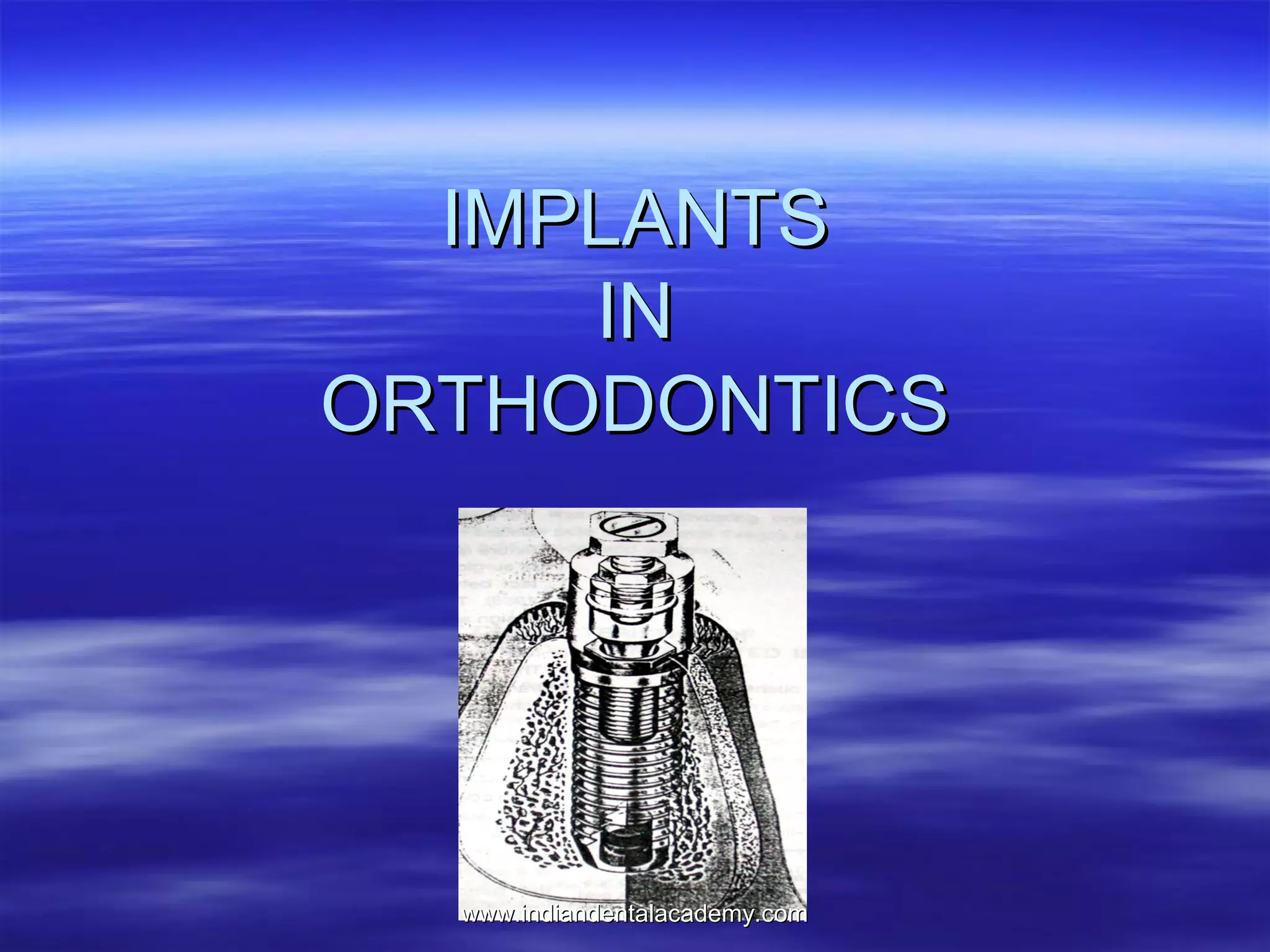





IMPLANTS
IN
ORTHODONTICS

www.indiandentalacademy.com
INDIAN DENTAL ACADEMY
Leader in continuing dental education
www.indiandentalacademy.com

www.indiandentalacademy.com
 Introduction
 Classification of Implants
 Material used for Implants
 Osseointegration
 Use of Implants in Orthodontics

www.indiandentalacademy.com
 Linkow- Father of oral Implantology.

 Implants are defined as alloplastic
devices which are surgically inserted into
or onto the jaw bone-Boucher.

www.indiandentalacademy.com
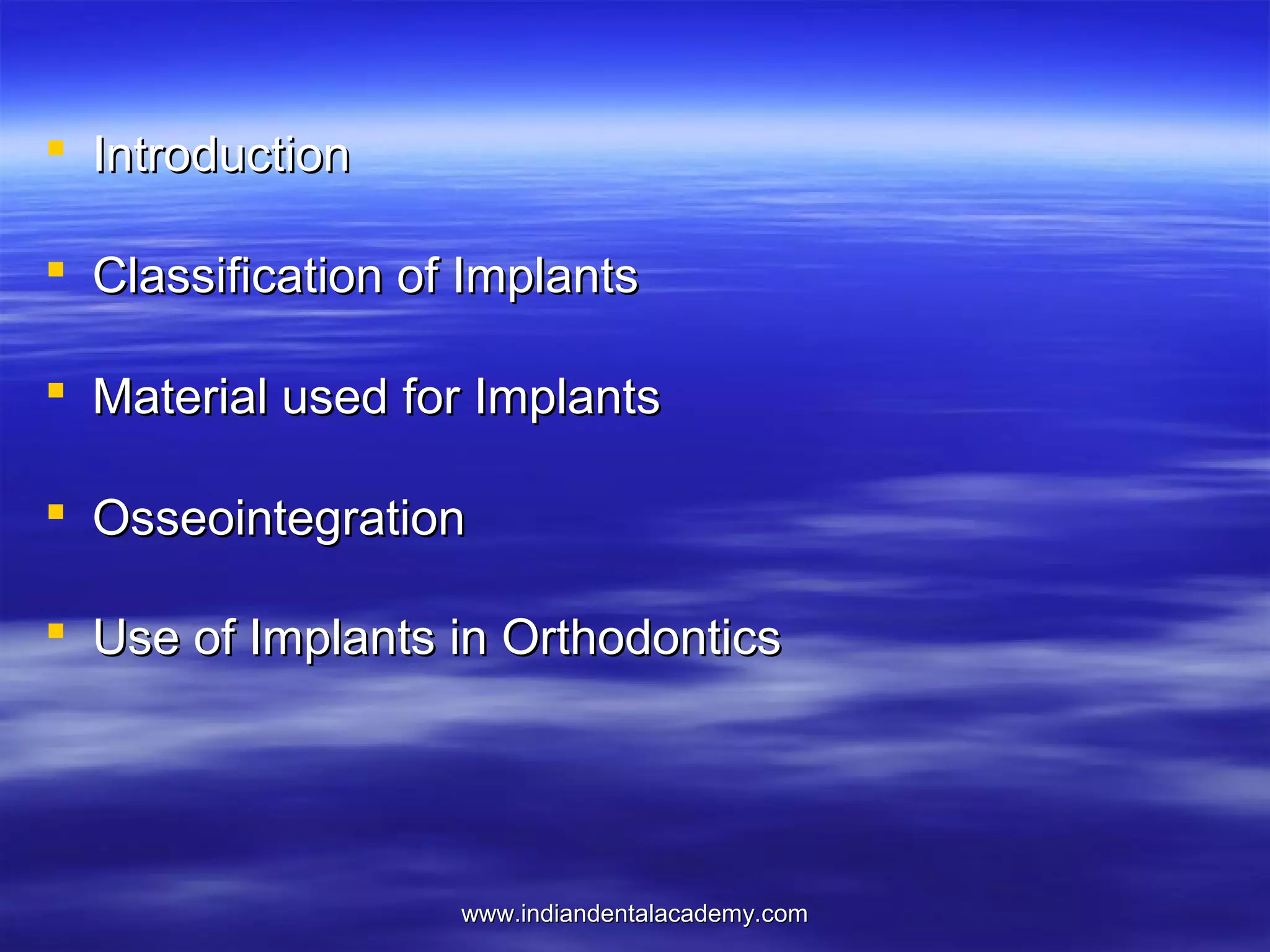
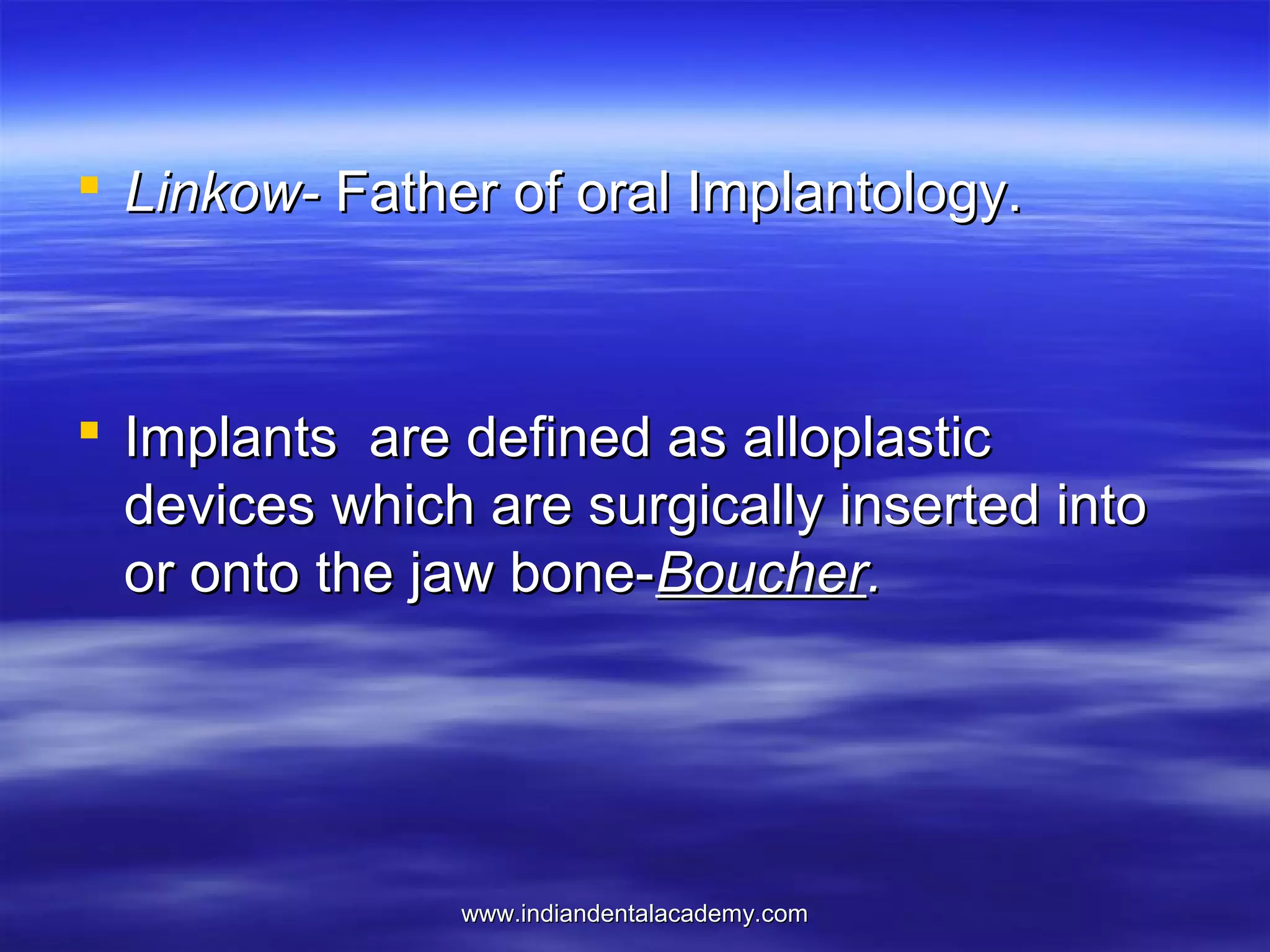
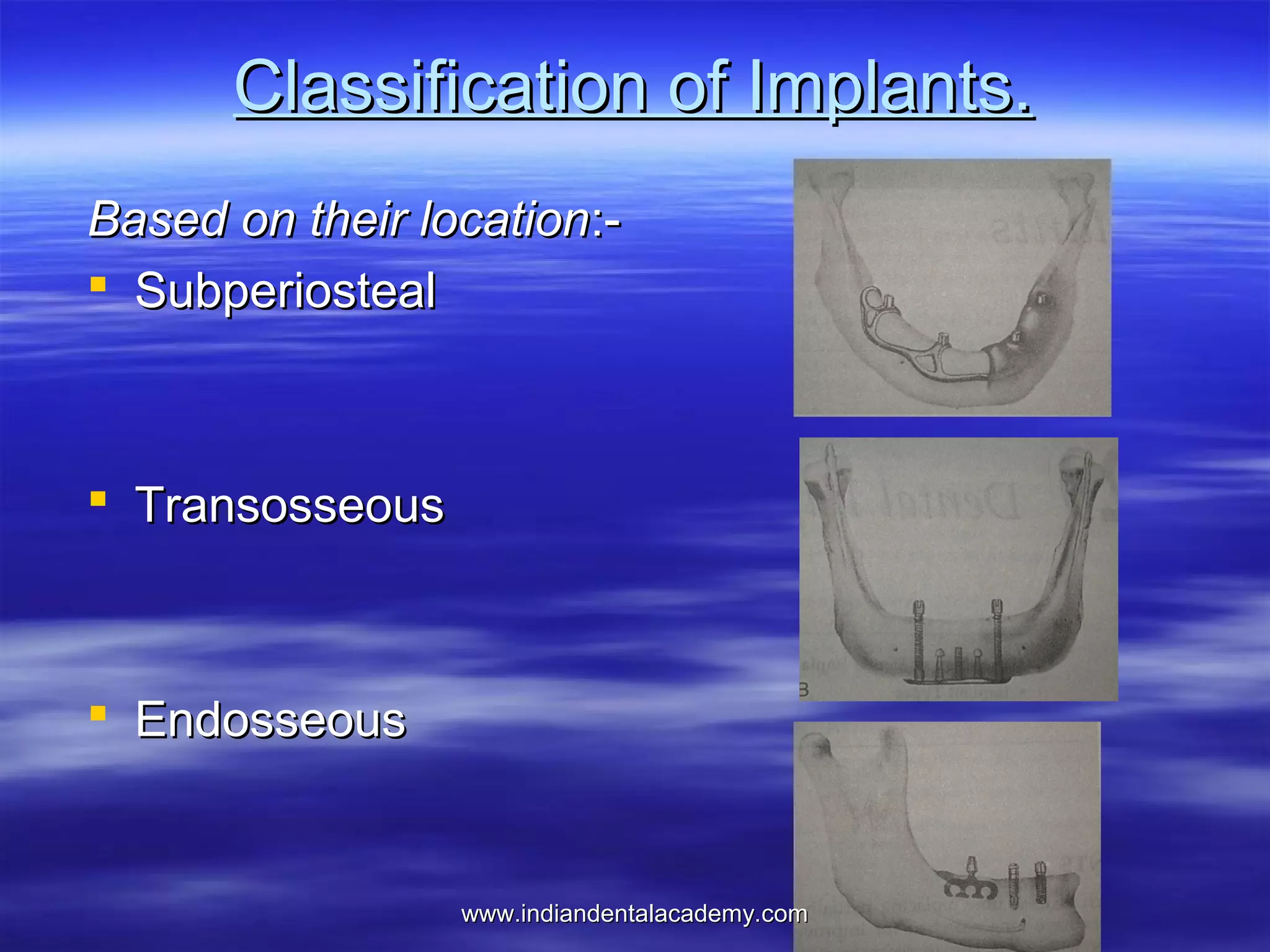
Classification of Implants.
Based on their location: Subperiosteal

 Transosseous

 Endosseous

www.indiandentalacademy.com
Classification of Implants
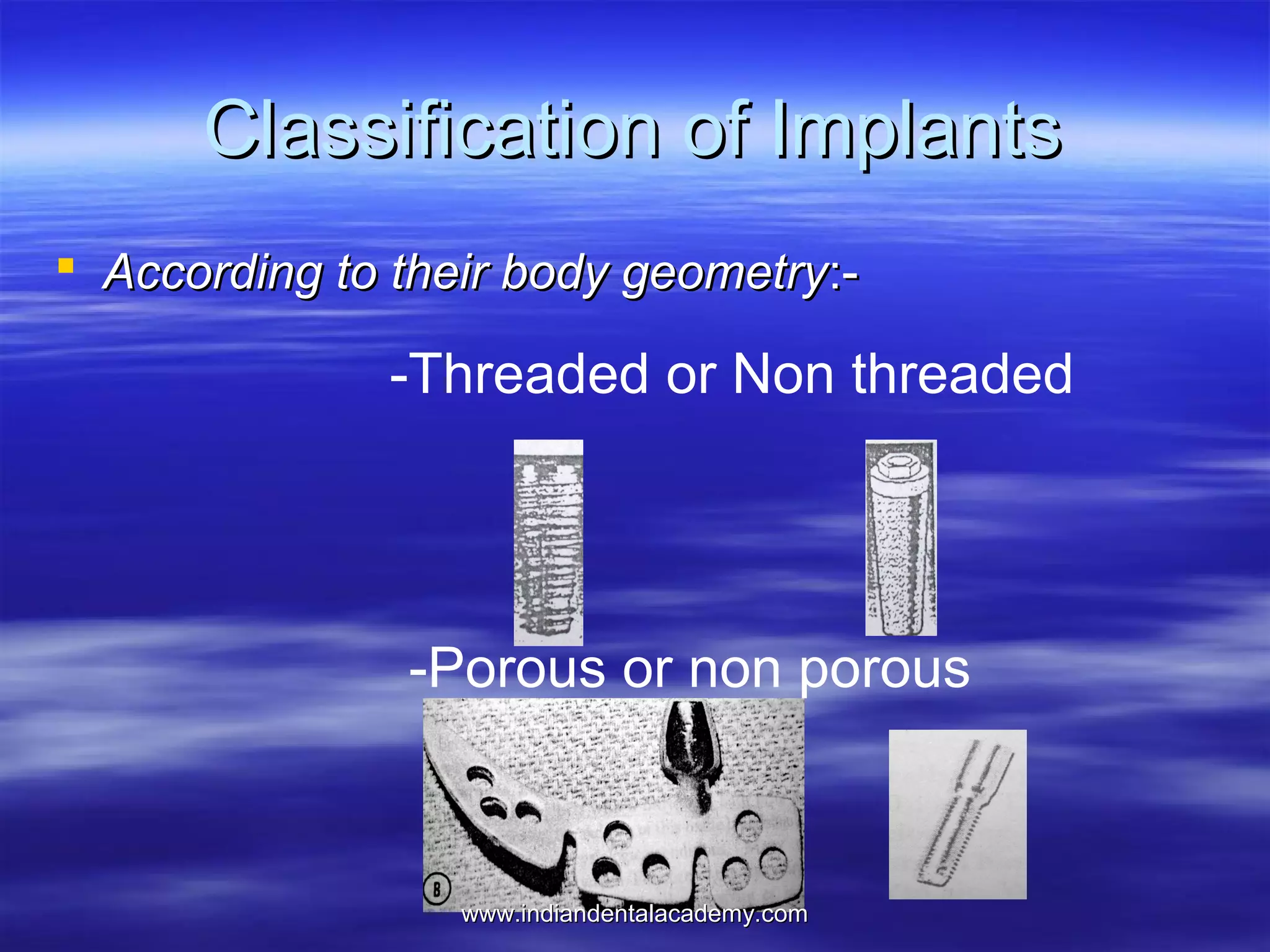
 According to their body geometry:-

-Threaded or Non threaded

-Porous or non porous

www.indiandentalacademy.com
Materials used for Implants
 In 16 &17th century –Ivory dental implants .
 20th century-Metal Implant devices.
 1940 &1960’s-CoCrMo subperiosteal &
titanium blade implants.

www.indiandentalacademy.com
 1970’s-Non metal biomaterials

 1982-Branemark Implant.

www.indiandentalacademy.com
 Stainless steel:-18% Cr & 8% Ni
-surface passivation is required
-subjected to crevice & pitting corrosion.

 Cobalt-Chromium-Molybdenum Alloy :-used in fabrication of custom designs
such as subperiosteal frames.
www.indiandentalacademy.com
 Titanium:-exist in 3 forms
-Alpha
-Beta
-Alpha-Beta phase (most commonly used).
Ti-6Al-4V
 Modulus of elasticity is equal to bone.

www.indiandentalacademy.com
 Titanium:“Passivity”.
•

Metal with surface coatings
Hydroxyapatite

Tricalcium phosphate.

www.indiandentalacademy.com
 Ceramics:Bioglass-contain oxides of Ca, Na, Si.
 Polymers & Composites.
 Other Implant Materials like Gold,
Palladium, Tantalum, Platinum, Zirconium.
www.indiandentalacademy.com
OSSEOINTEGRATION.
 Term & concept of Osseointegration
-Branemark.
“An intimate structural contact at the implant
surface and adjacent vital bone devoid of
any intervening fibrous tissue.”
www.indiandentalacademy.com
Evolution of the concept of
osseointegration
 Vital microscopic studies of the rabbit fibulatitanium chambered microscopes.
 Series of experiments:-Titanium fixtures for immobilization of autologous
bone grafts.
- Tooth implants studies for healing & anchorage
stability.
www.indiandentalacademy.com
 Study done on dogs to find out the load
bearing capacity of implants.

Optical titanium chambers were implanted in
humans-to assess the tissue reactions of
titanium implants.

www.indiandentalacademy.com
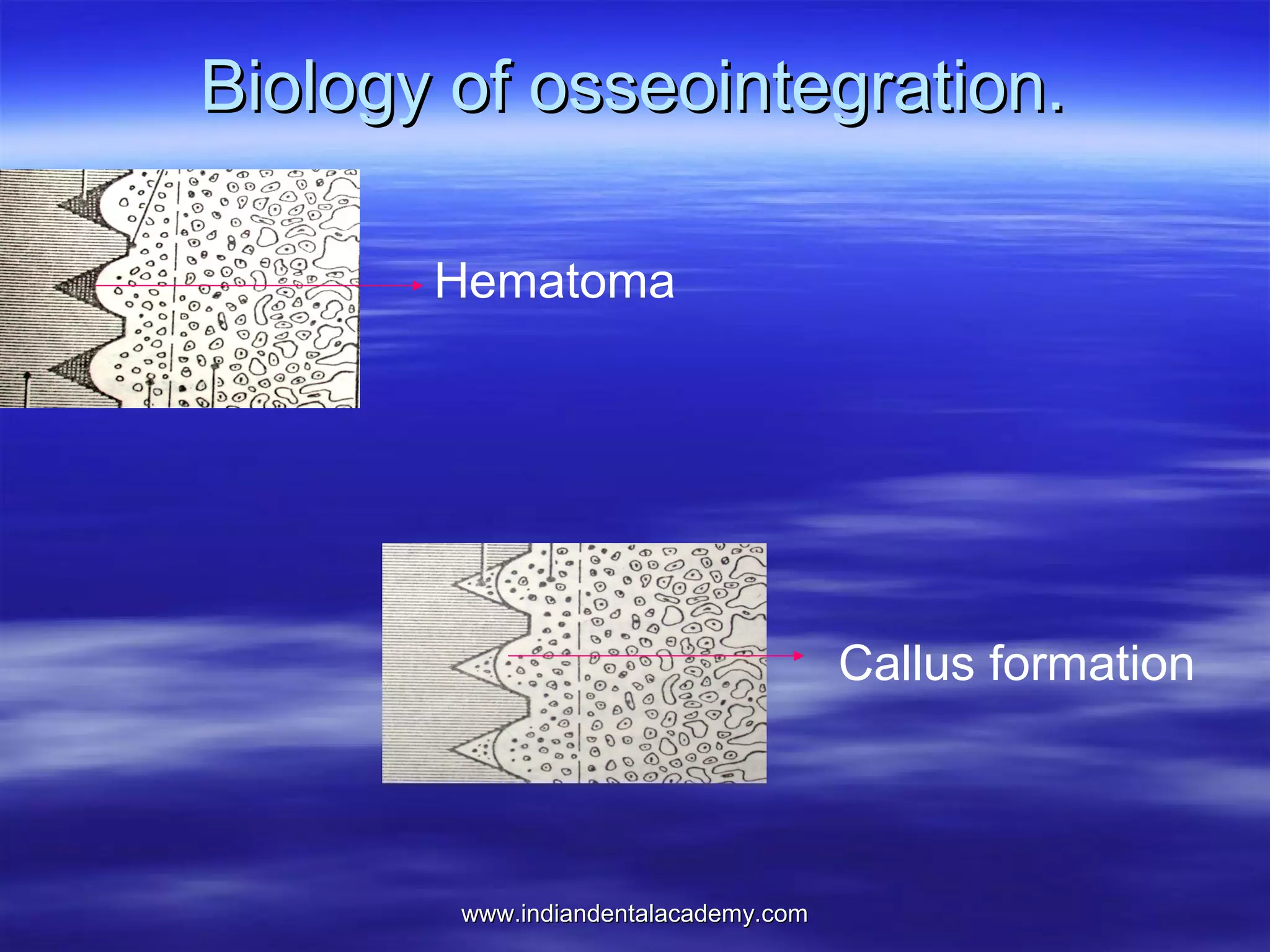
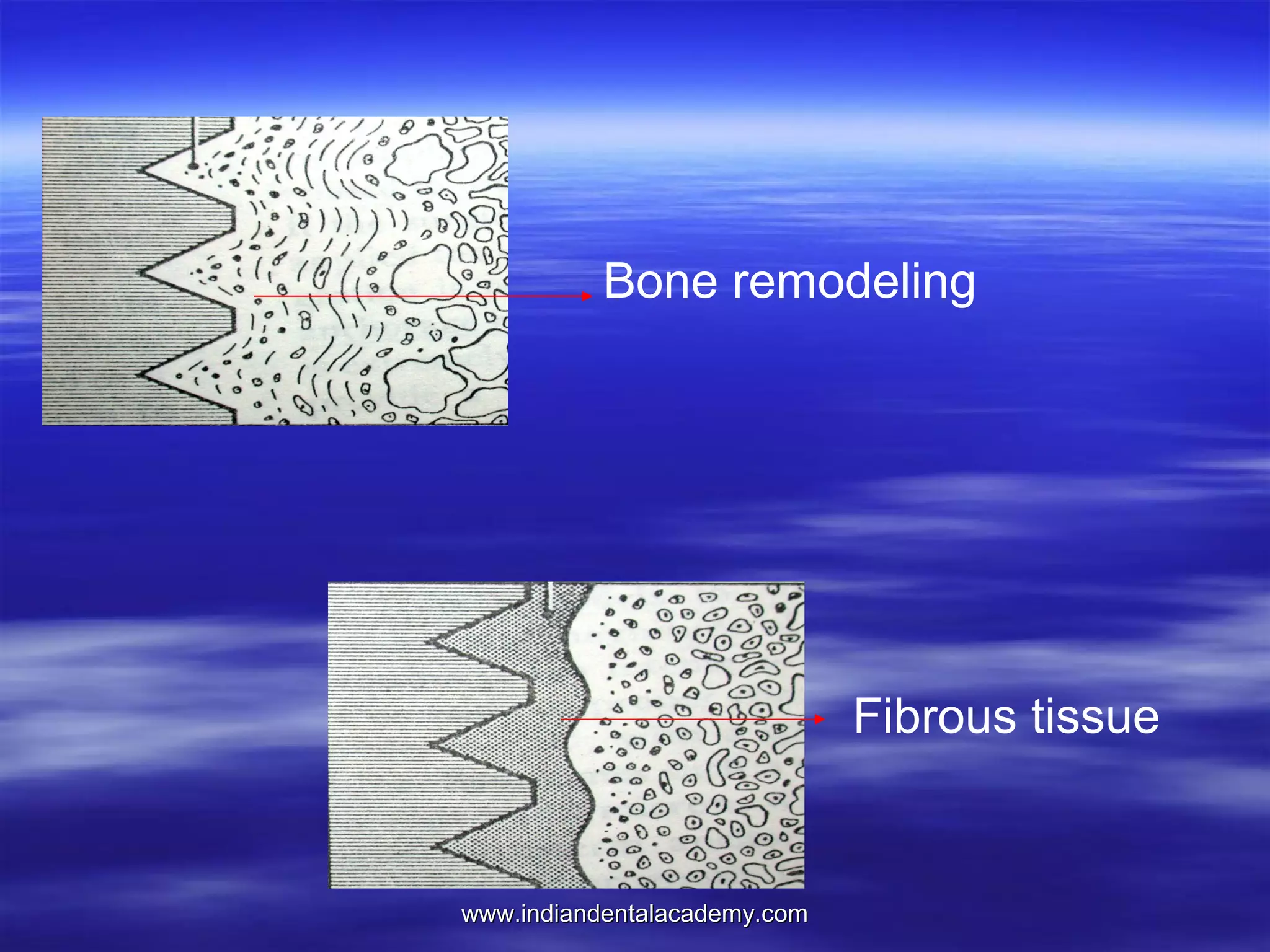
Biology of osseointegration.
Hematoma

Callus formation

www.indiandentalacademy.com
Bone remodeling

Fibrous tissue

www.indiandentalacademy.com
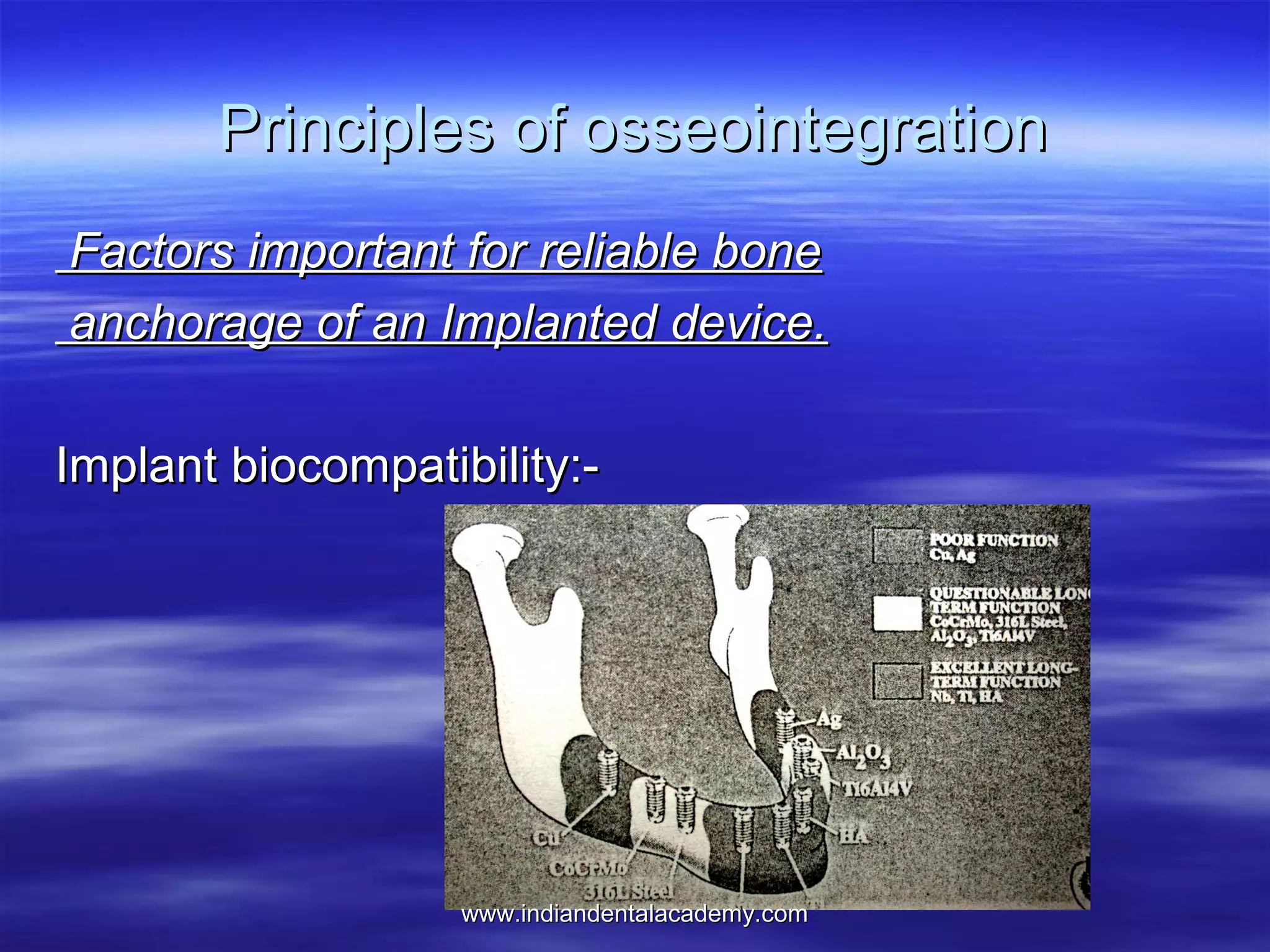
Principles of osseointegration
Factors important for reliable bone
anchorage of an Implanted device.
Implant biocompatibility:-

www.indiandentalacademy.com
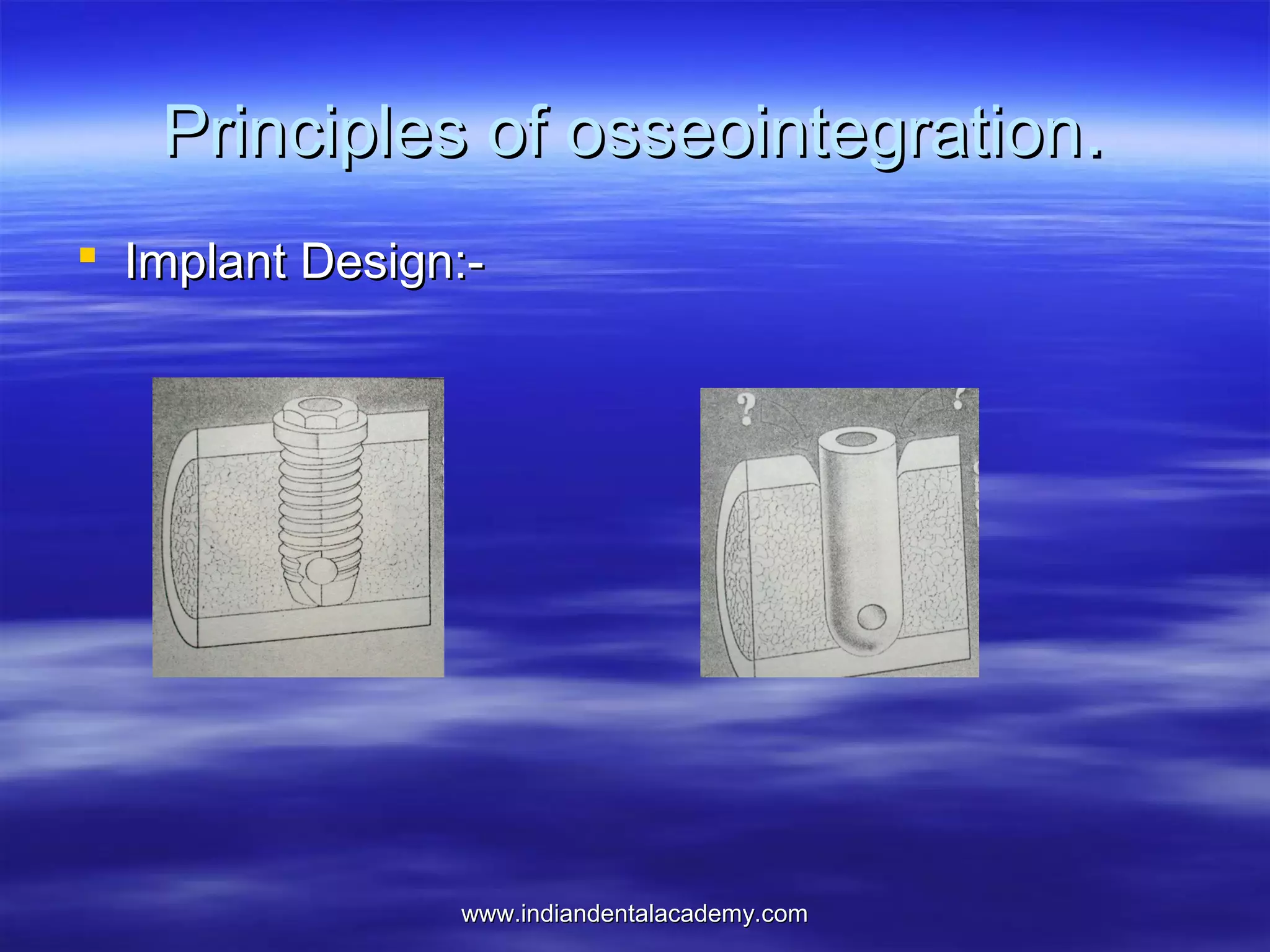
Principles of osseointegration.
 Implant Design:-

www.indiandentalacademy.com


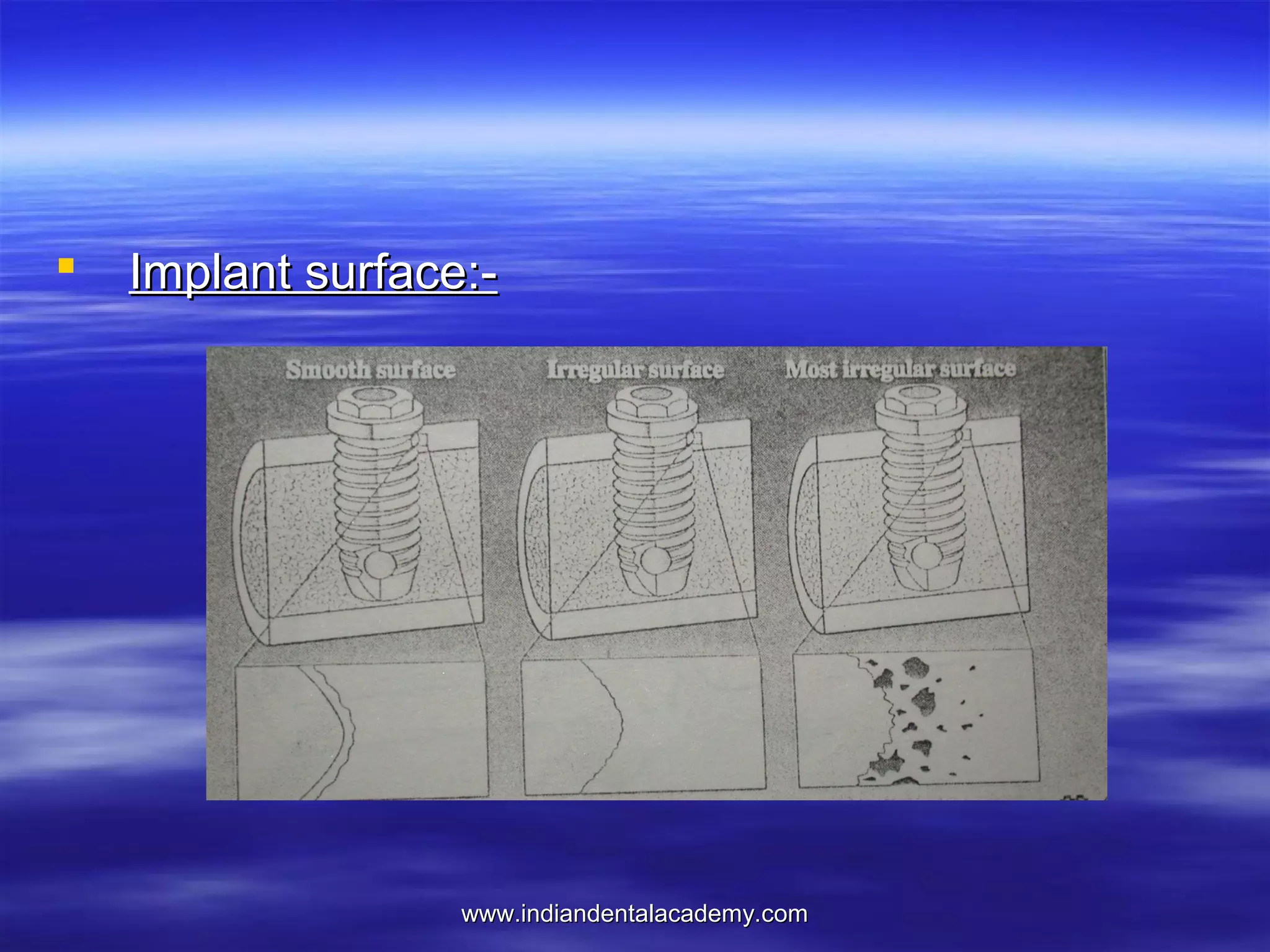
Implant surface:-

www.indiandentalacademy.com
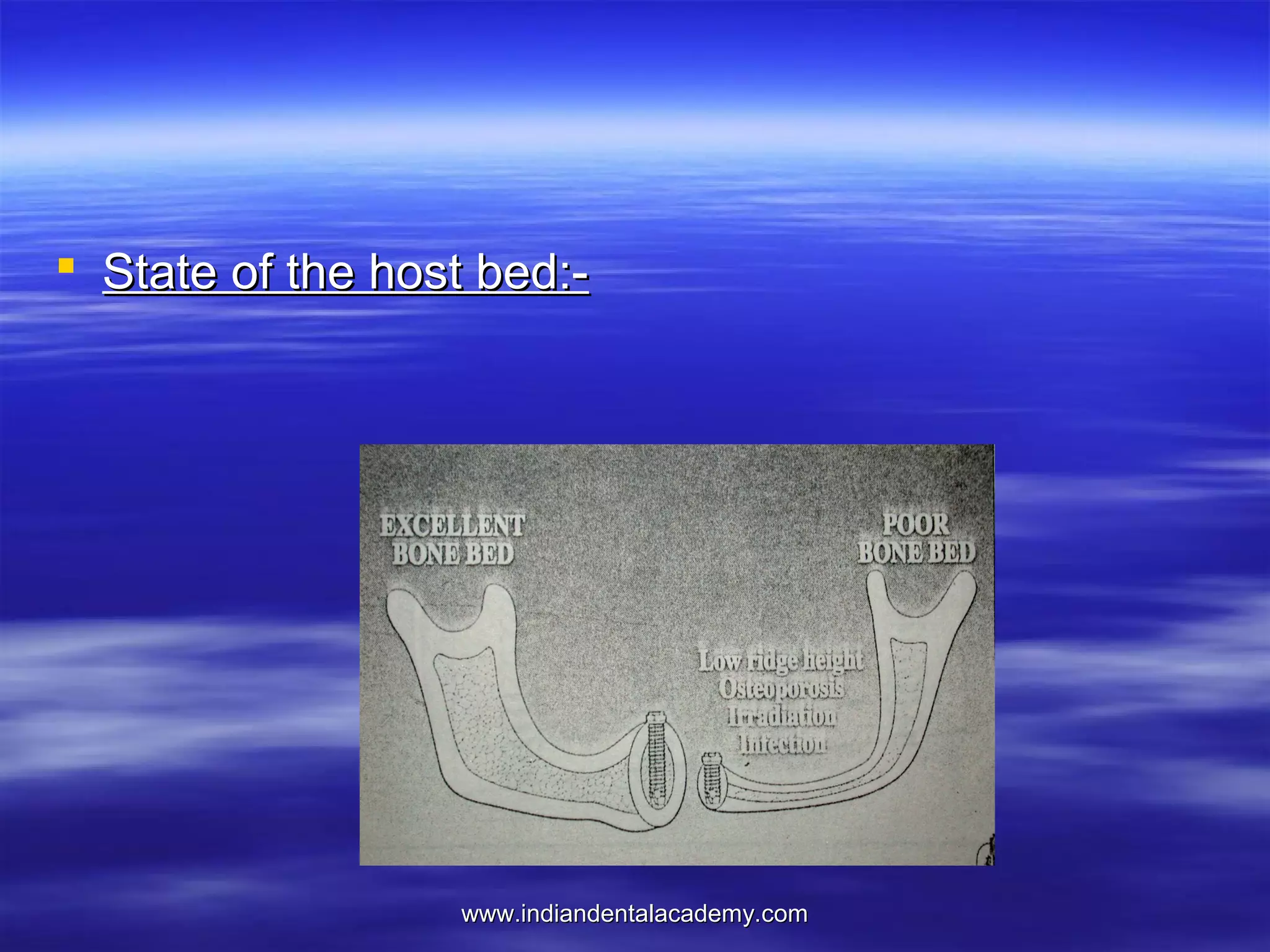
 State of the host bed:-

www.indiandentalacademy.com
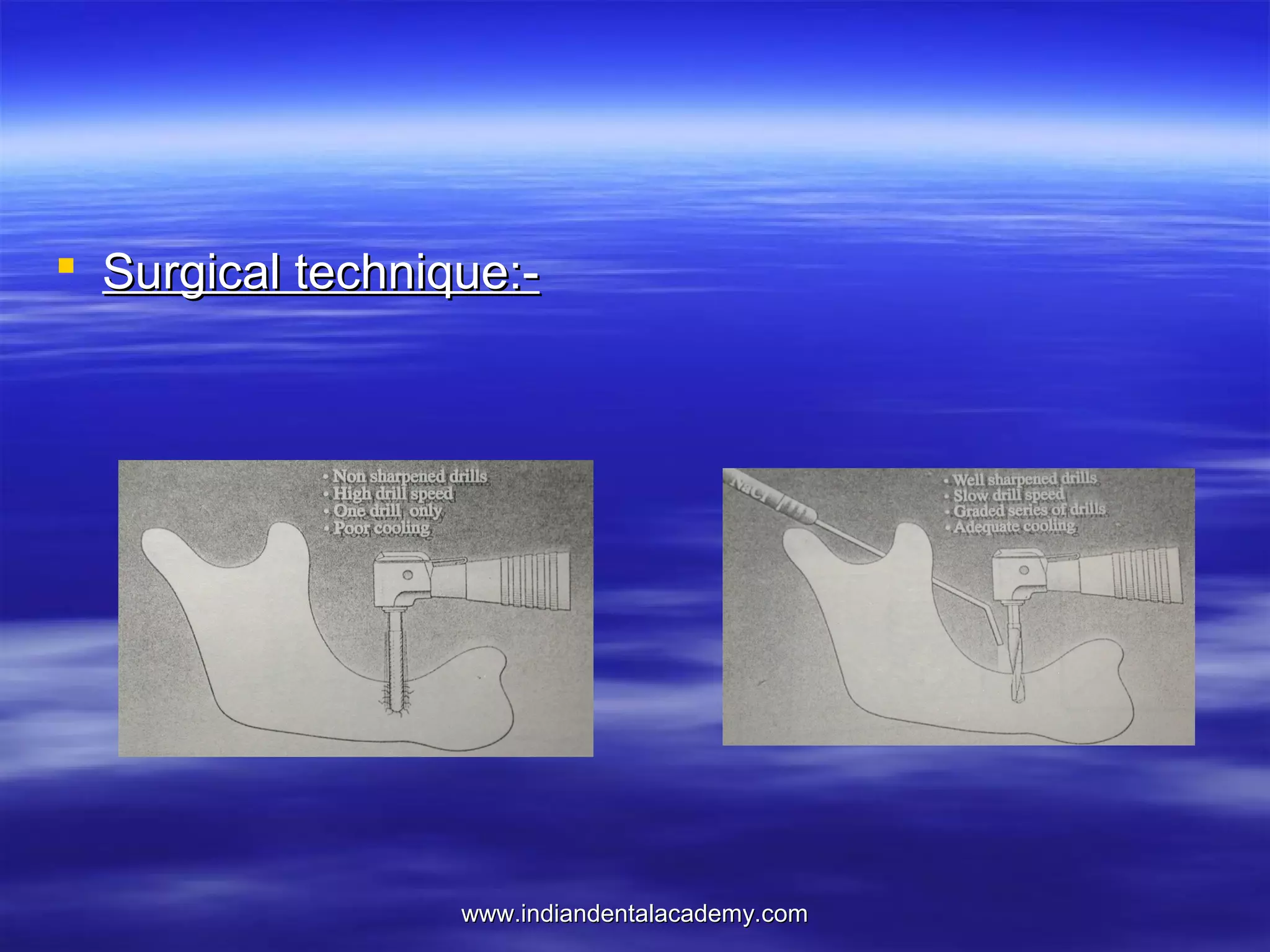
 Surgical technique:-

www.indiandentalacademy.com
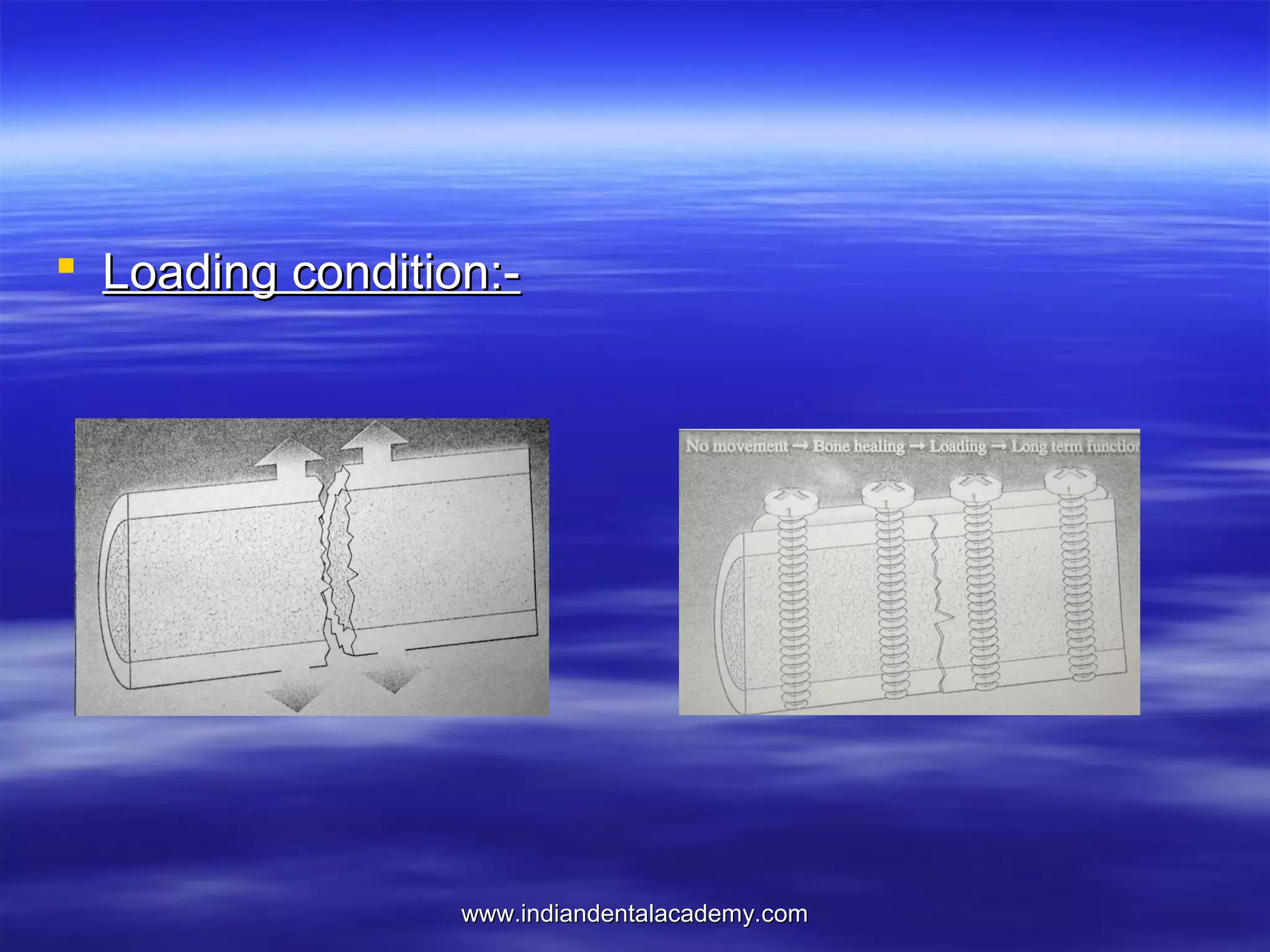
 Loading condition:-

www.indiandentalacademy.com
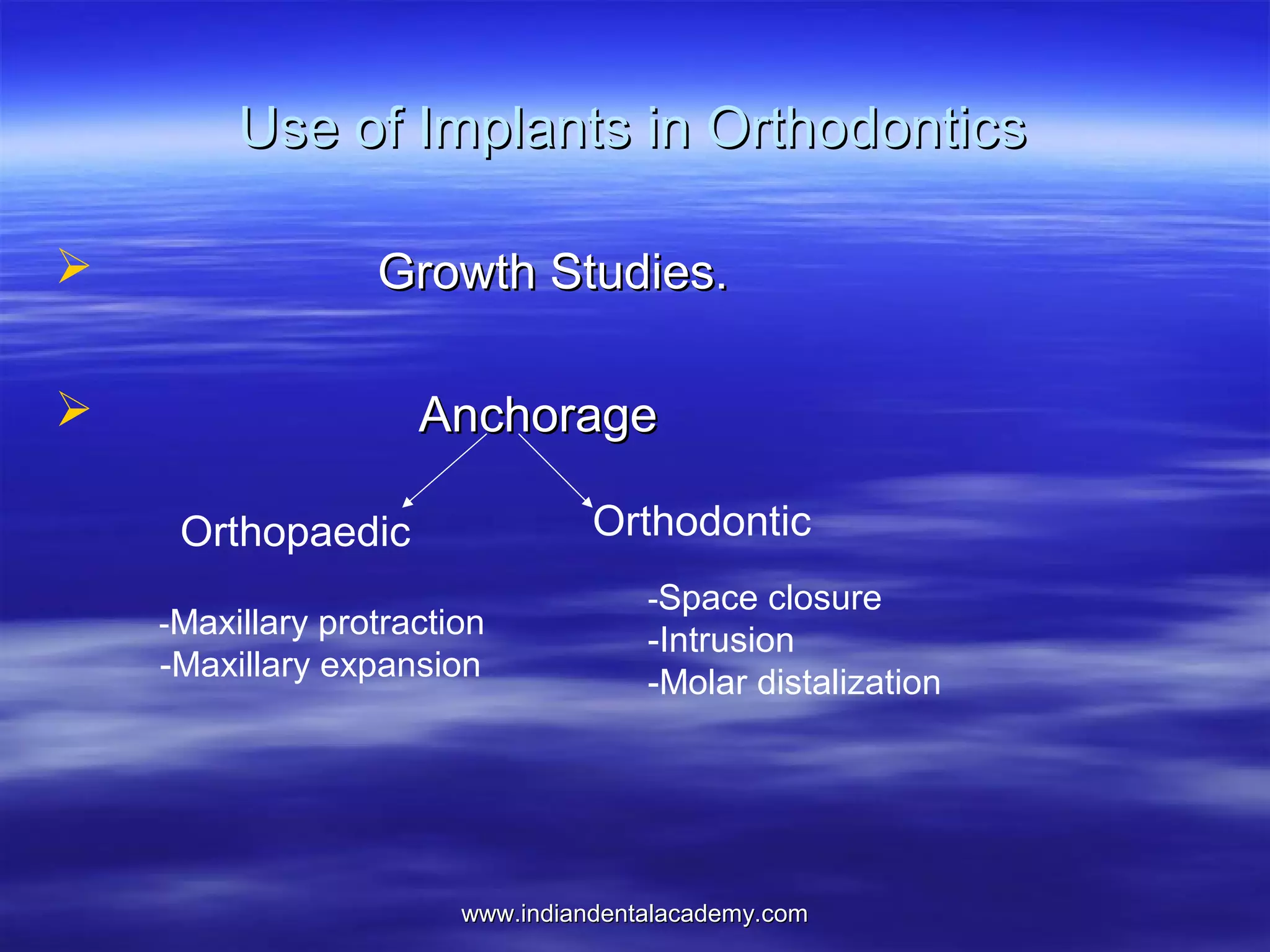
Use of Implants in Orthodontics


Growth Studies.



Anchorage
Orthodontic

Orthopaedic
-Maxillary protraction

-Maxillary expansion

-Space closure

-Intrusion
-Molar distalization

www.indiandentalacademy.com
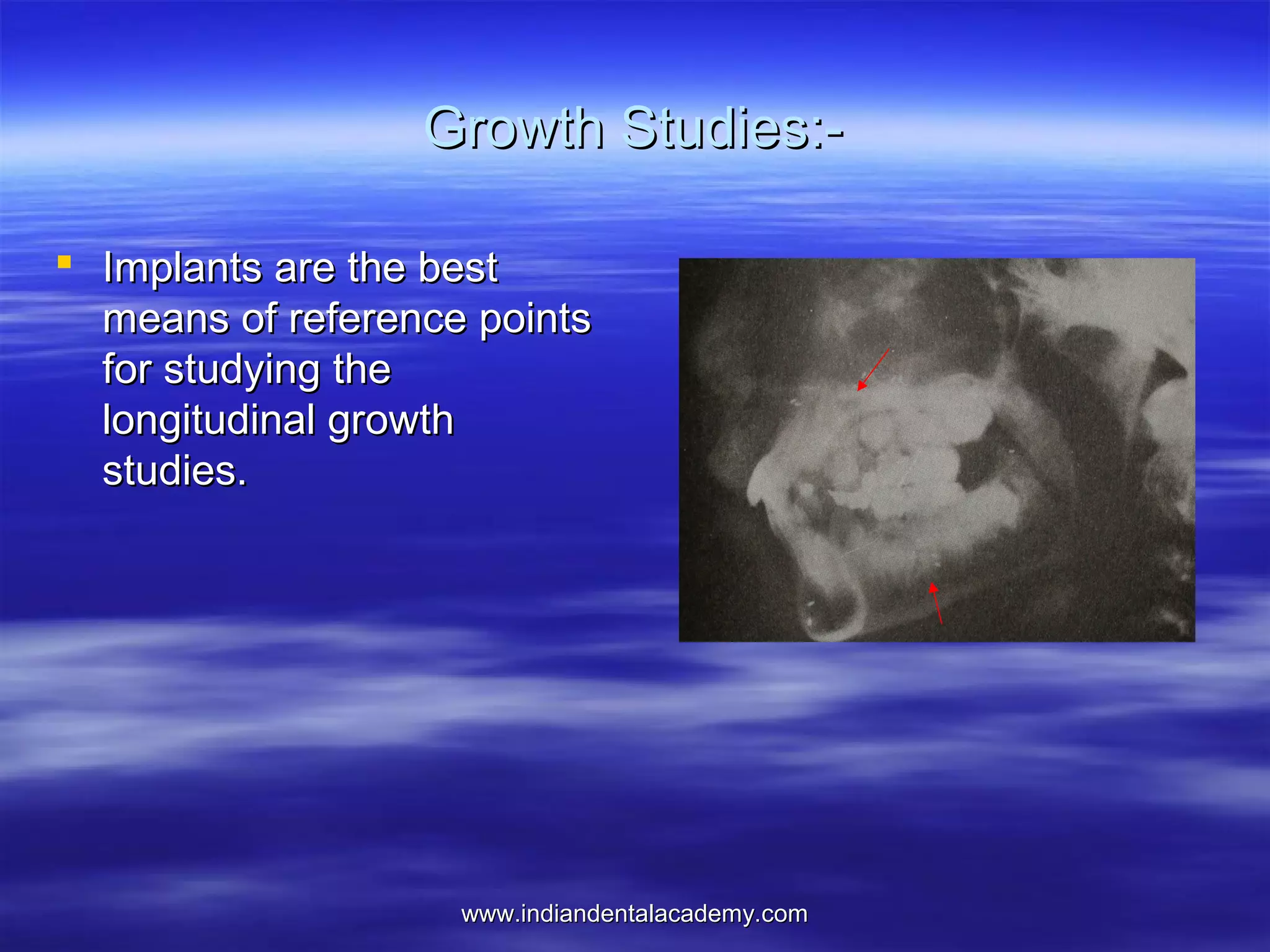
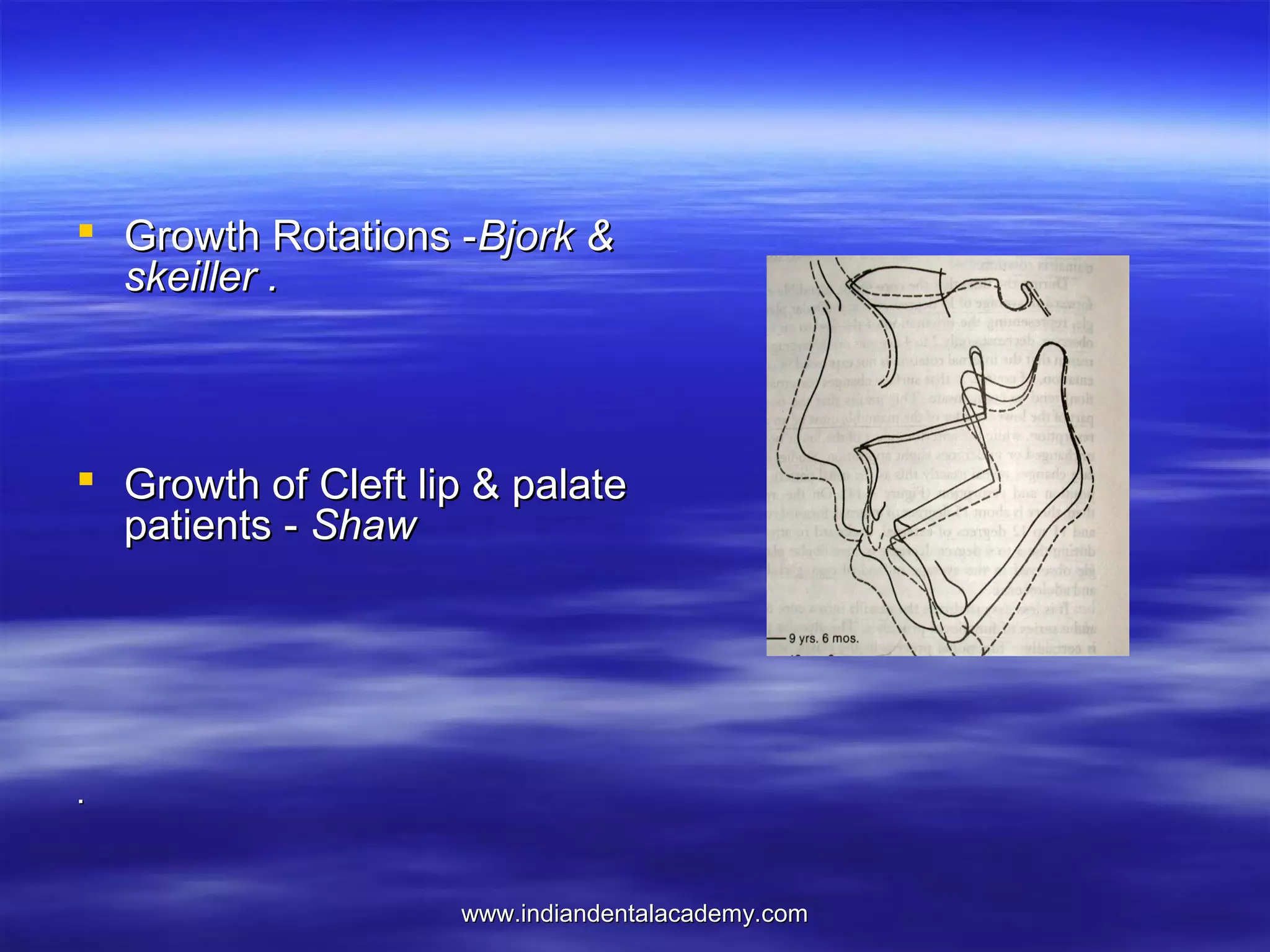
Growth Studies: Implants are the best
means of reference points
for studying the
longitudinal growth
studies.

www.indiandentalacademy.com
 Growth Rotations -Bjork &
skeiller .

 Growth of Cleft lip & palate
patients - Shaw

.

www.indiandentalacademy.com
ANCHORAGE:

Orthopeadic correction-

Two methods for obtaining the Skeletal anchorage:

Intentionally Ankylosed teeth.



Endosseous Implants.

www.indiandentalacademy.com
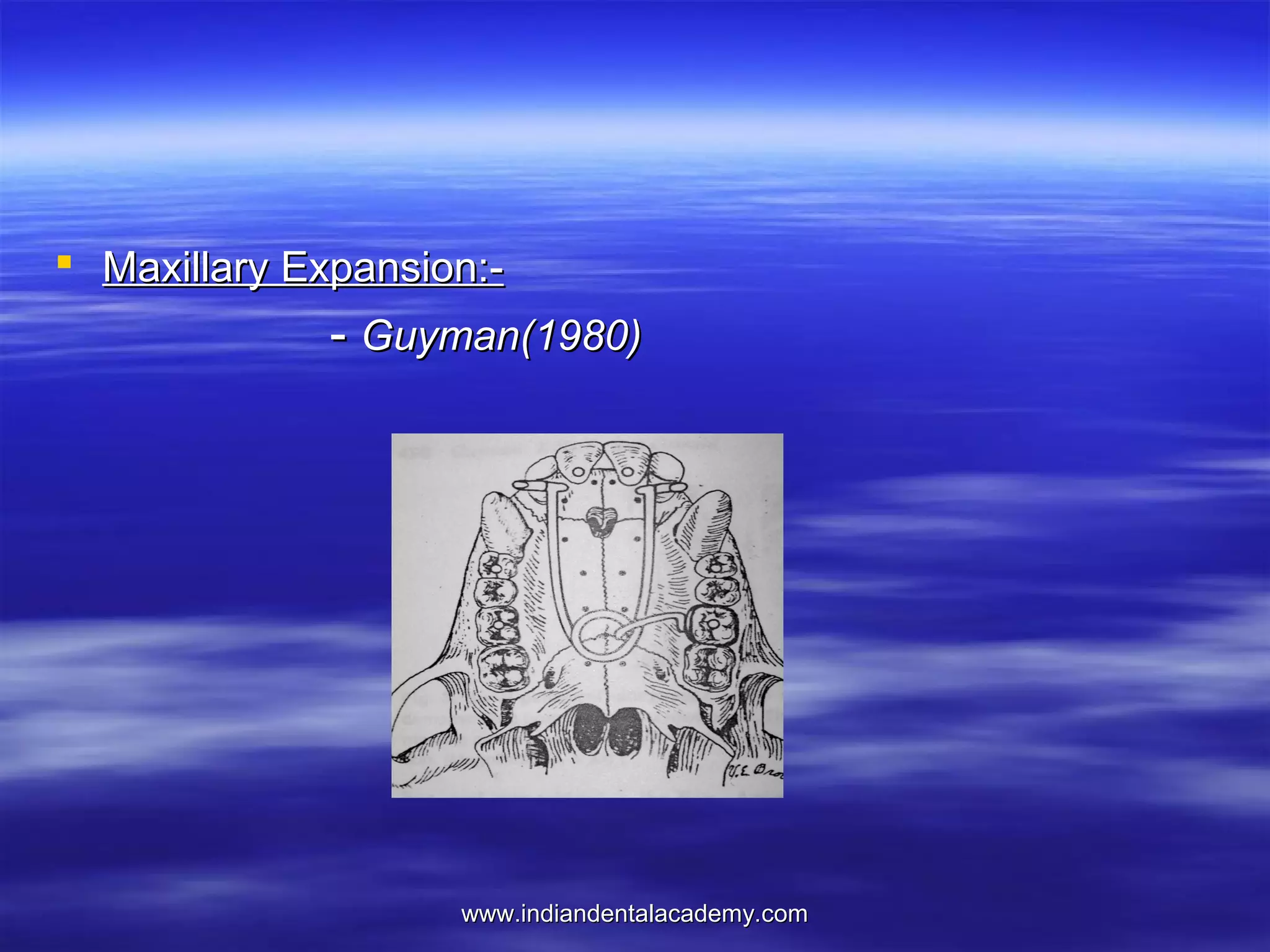
 Maxillary Expansion:-

- Guyman(1980)

www.indiandentalacademy.com
Linkow-pioneer in the use of Implants in
Orthodontics.
 Pt’s with one or more missing teeth.
 Loss of teeth during the course of orthodontic
treatment.
 Pt’s with CL-II malocclusion & missing lower
posterior teeth.
 Periodontally compromised teeth.

www.indiandentalacademy.com
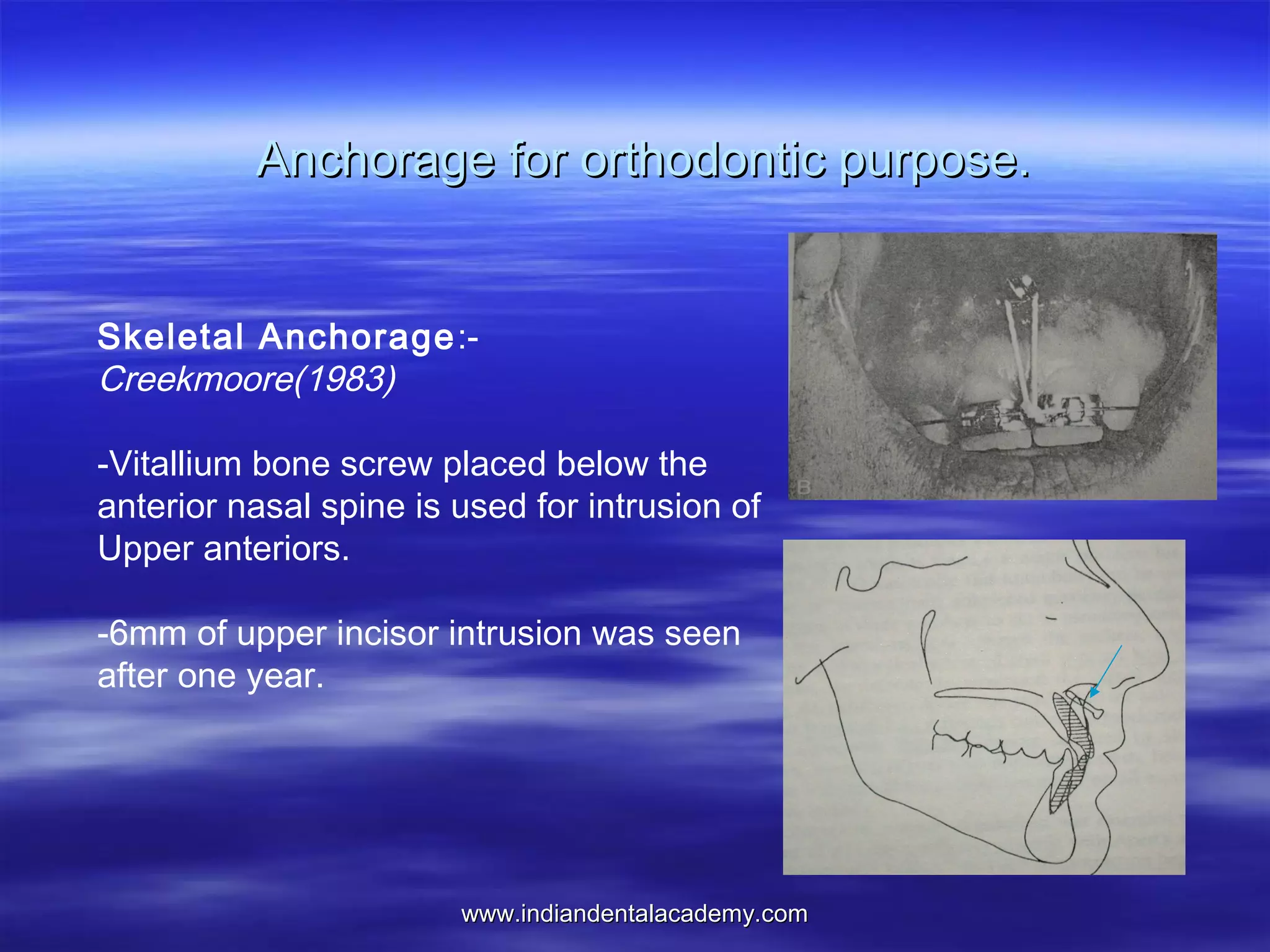
Anchorage for orthodontic purpose.
Skeletal Anchorage :Creekmoore(1983)
-Vitallium bone screw placed below the
anterior nasal spine is used for intrusion of
Upper anteriors.
-6mm of upper incisor intrusion was seen
after one year.

www.indiandentalacademy.com
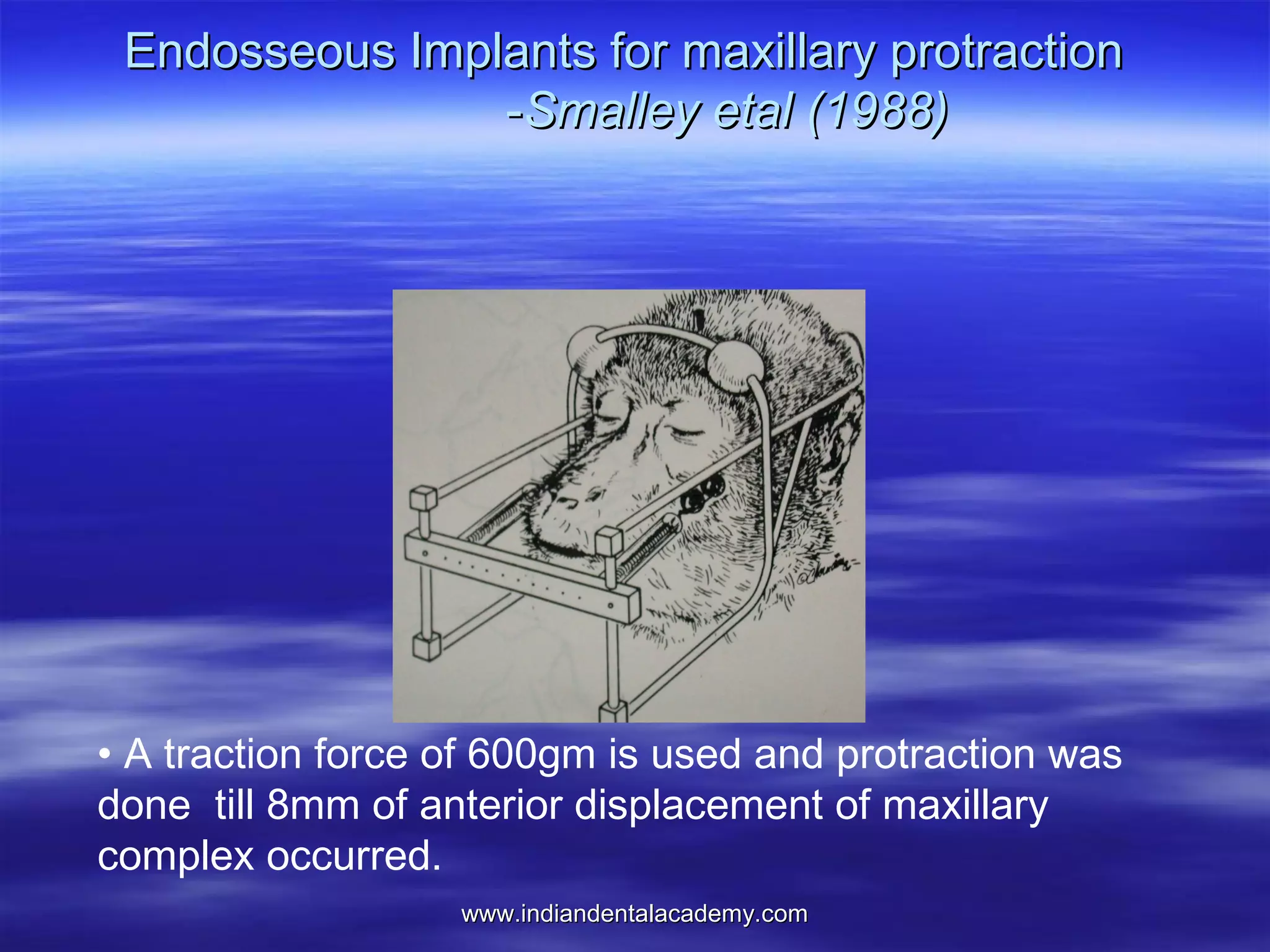
Endosseous Implants for maxillary protraction
-Smalley etal (1988)

• A traction force of 600gm is used and protraction was
done till 8mm of anterior displacement of maxillary
complex occurred.
www.indiandentalacademy.com
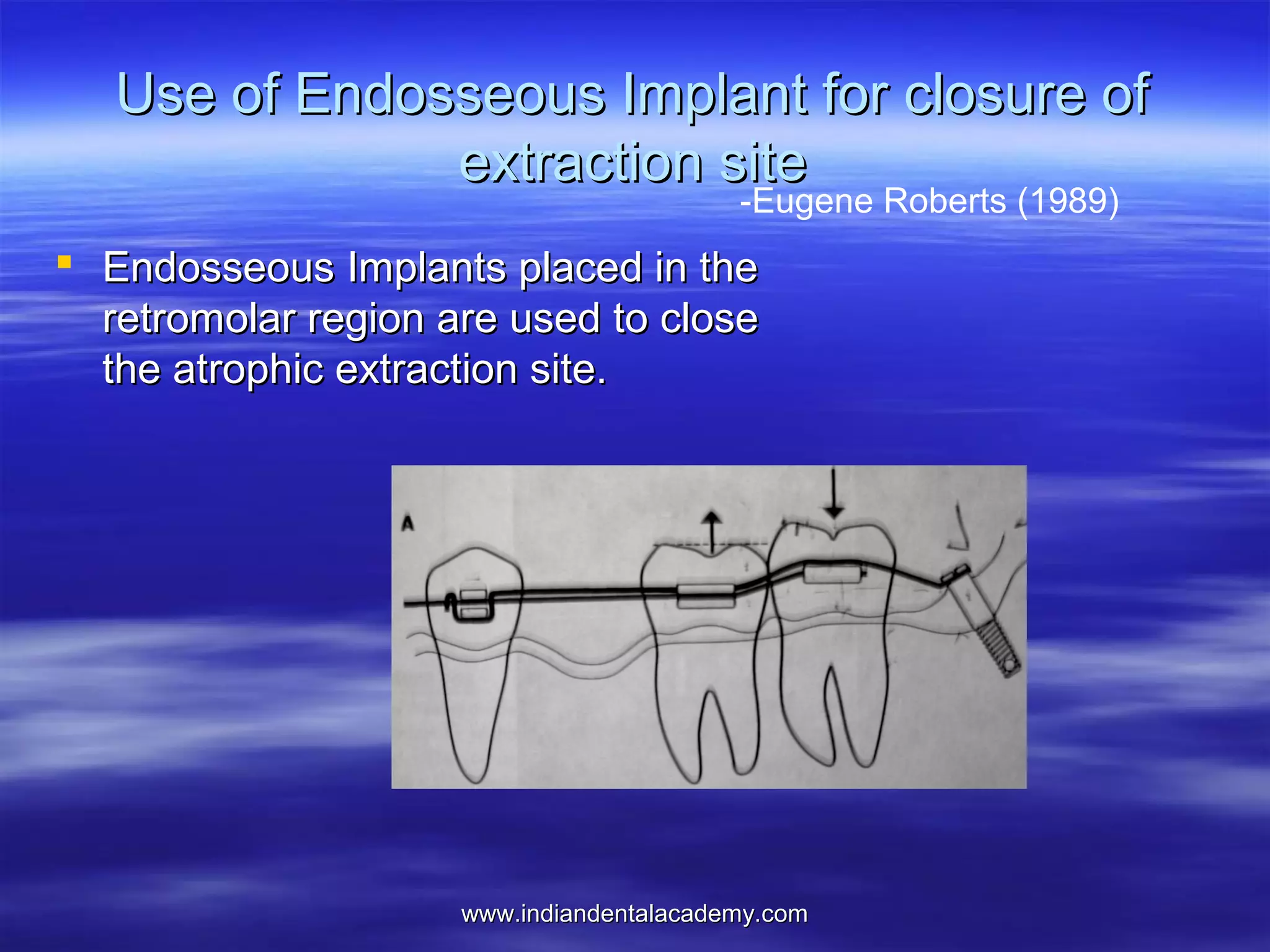
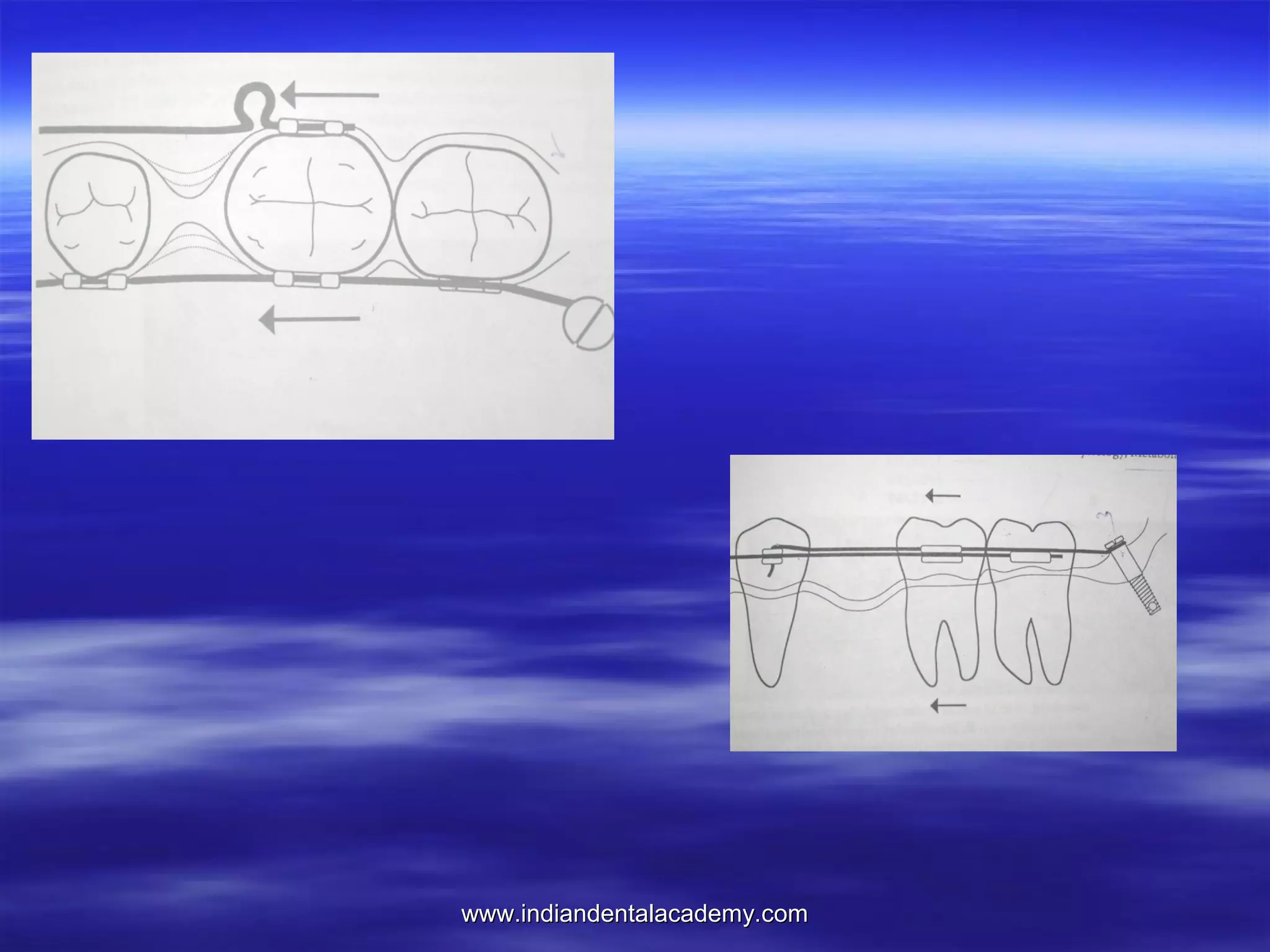
Use of Endosseous Implant for closure of
extraction site
-Eugene Roberts (1989)

 Endosseous Implants placed in the
retromolar region are used to close
the atrophic extraction site.

www.indiandentalacademy.com
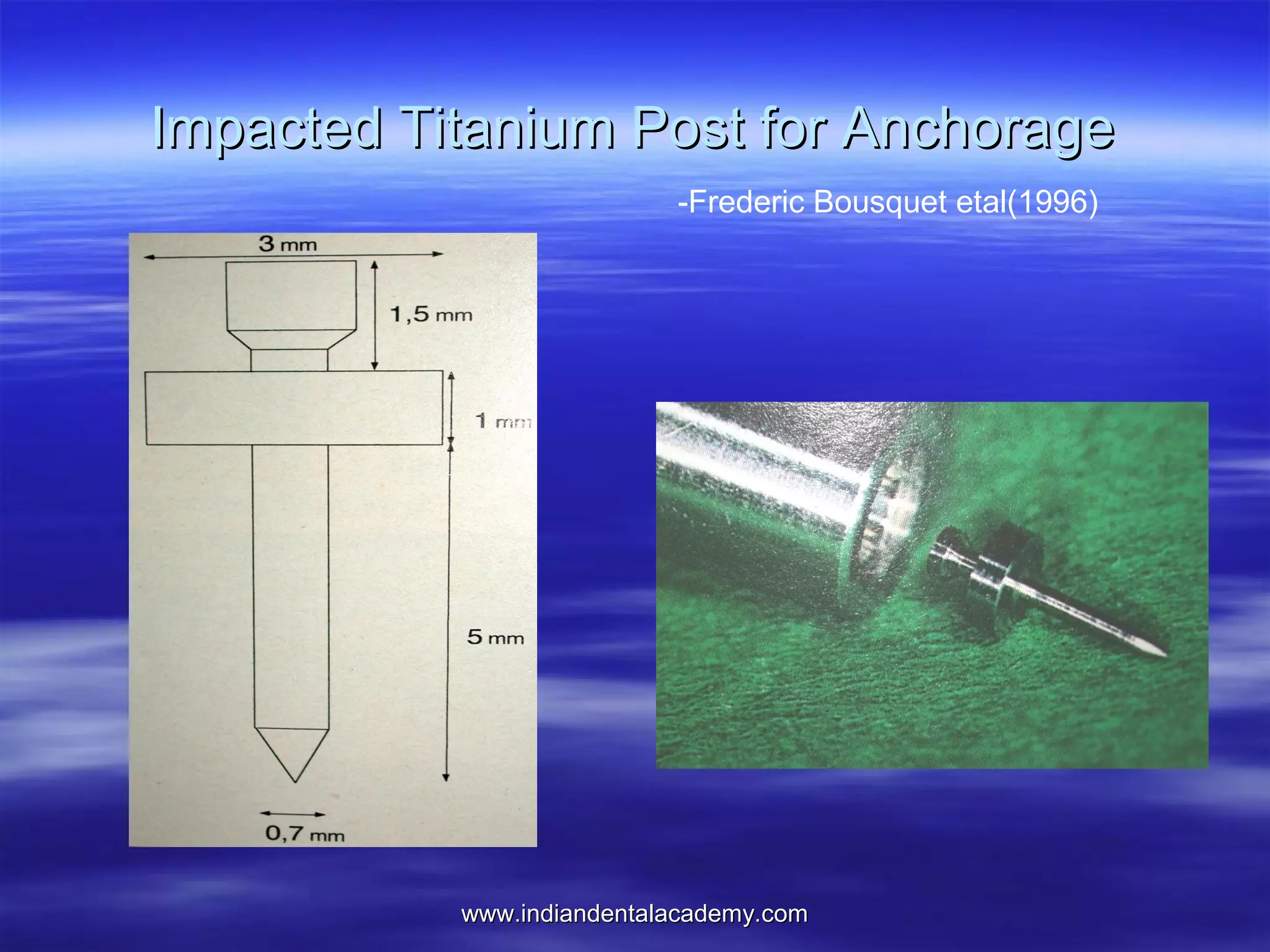
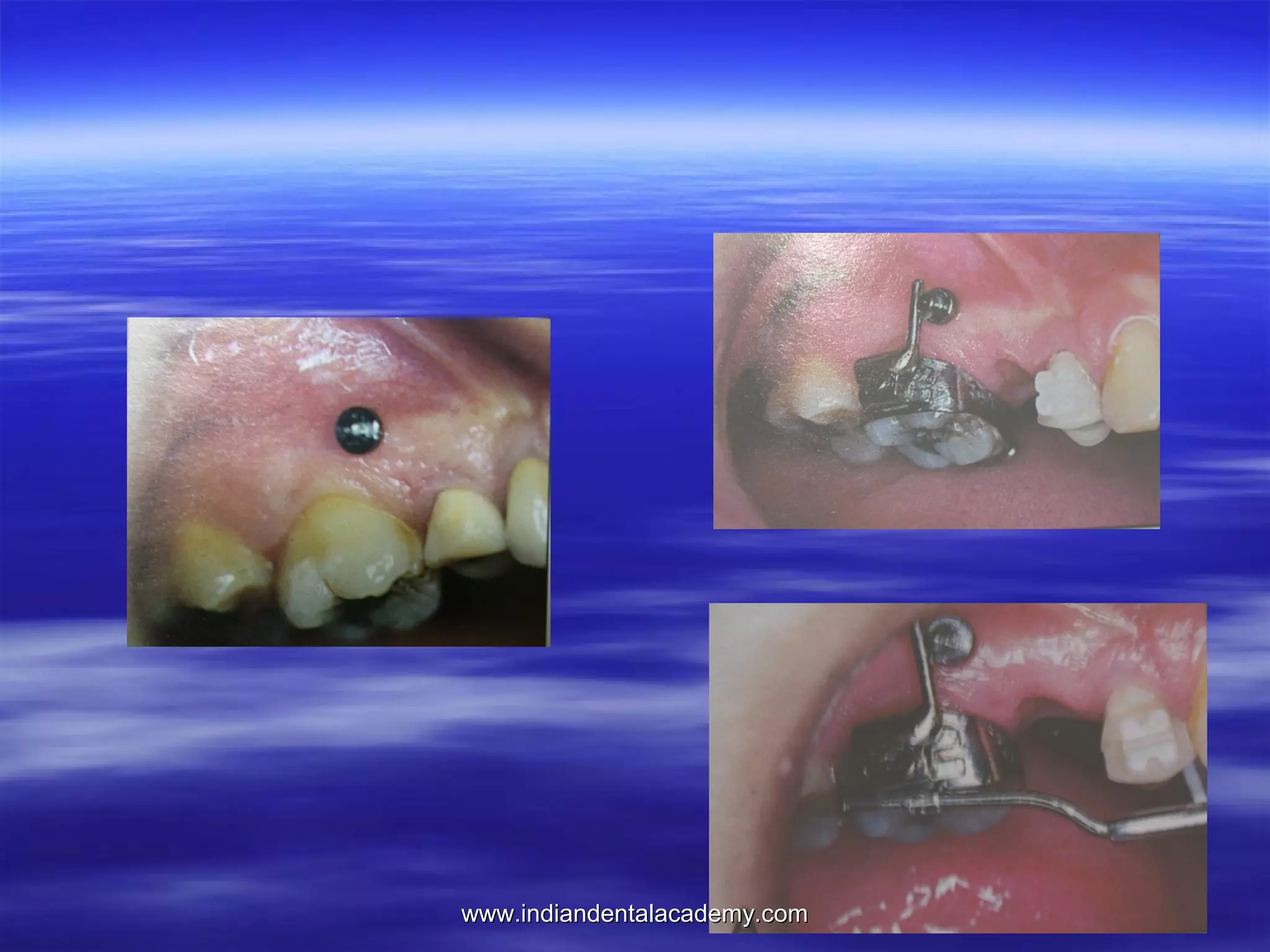
Impacted Titanium Post for Anchorage
-Frederic Bousquet etal(1996)

www.indiandentalacademy.com
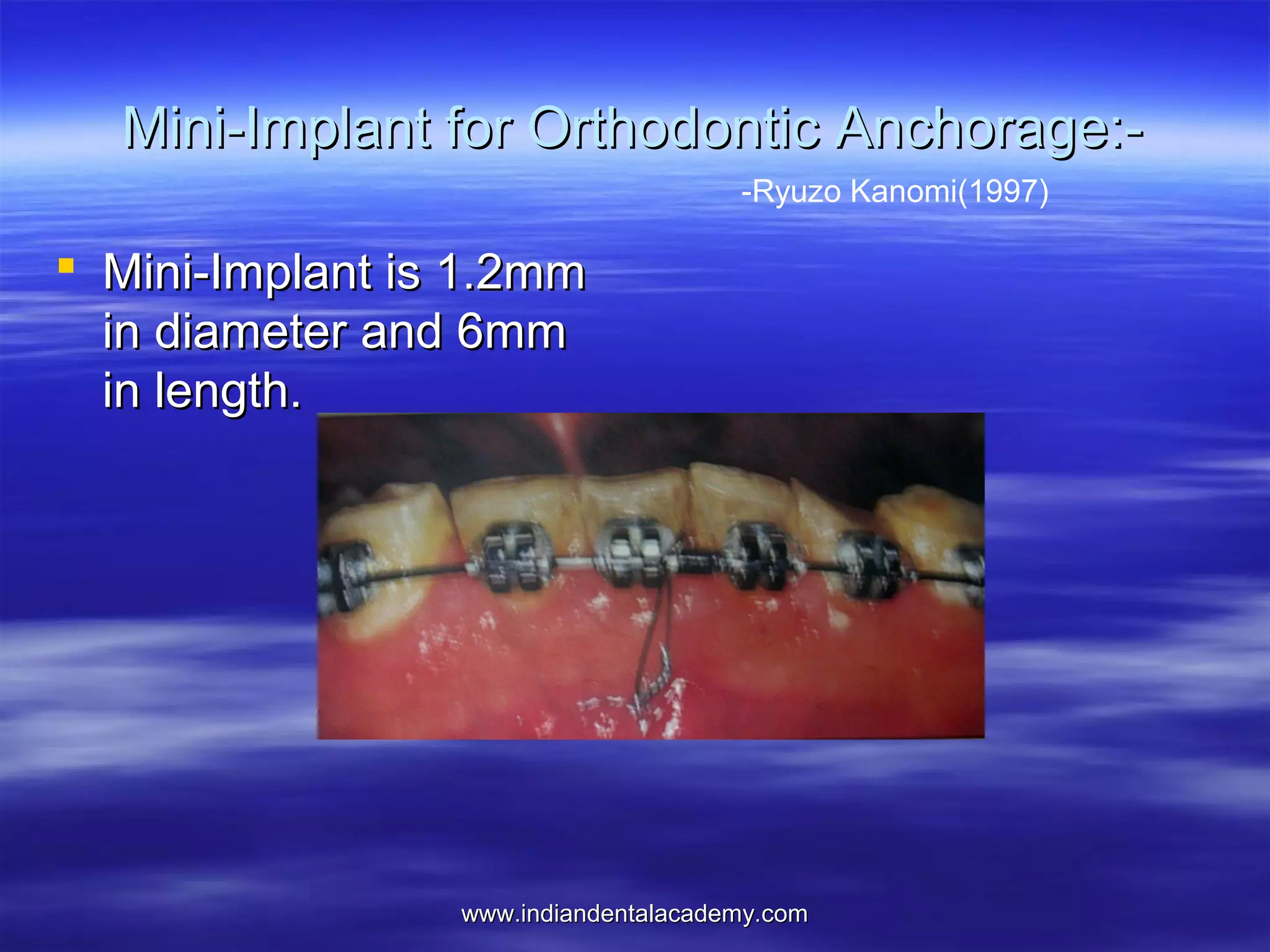
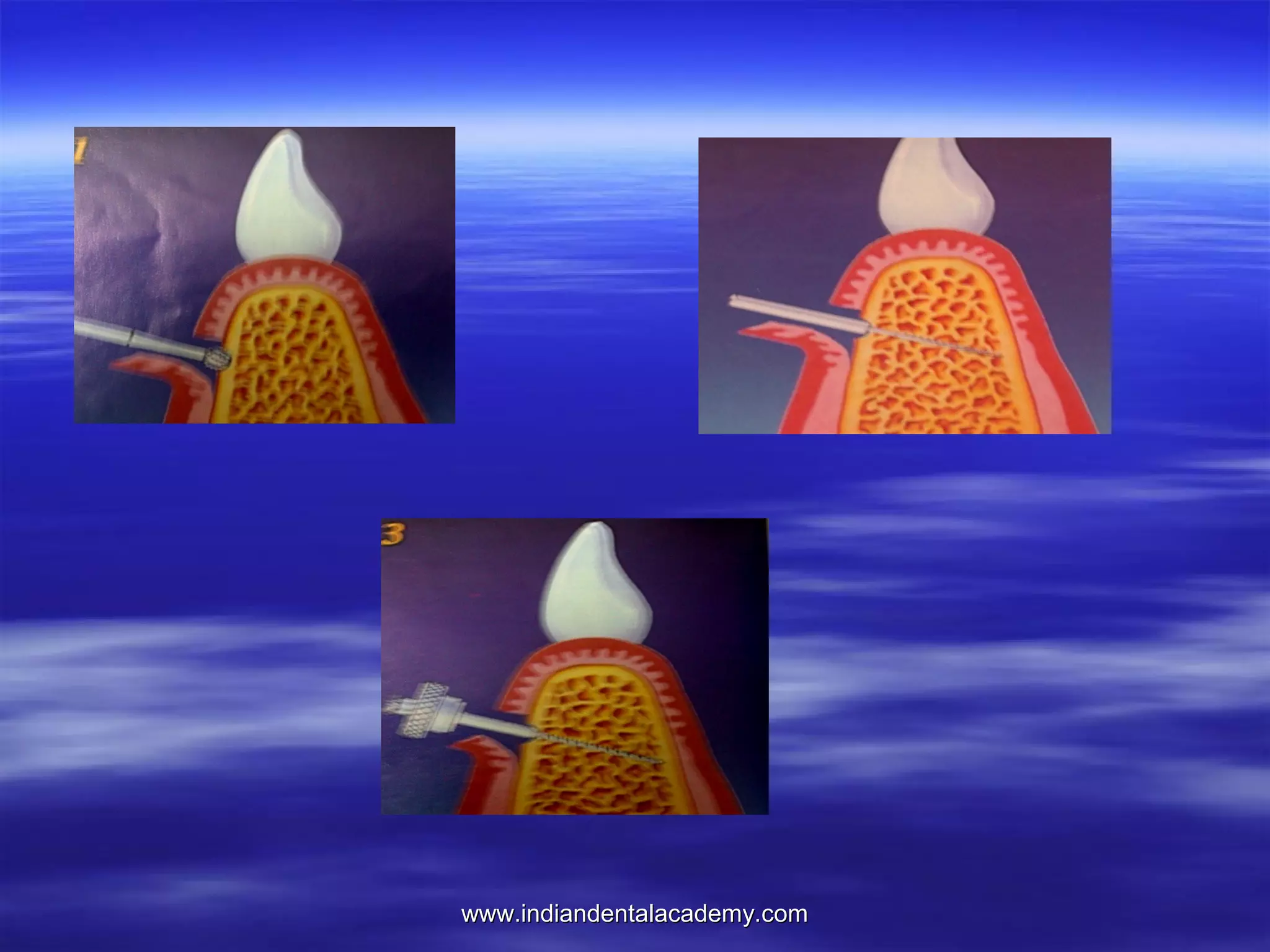
Mini-Implant for Orthodontic Anchorage:-Ryuzo Kanomi(1997)

 Mini-Implant is 1.2mm
in diameter and 6mm
in length.

www.indiandentalacademy.com
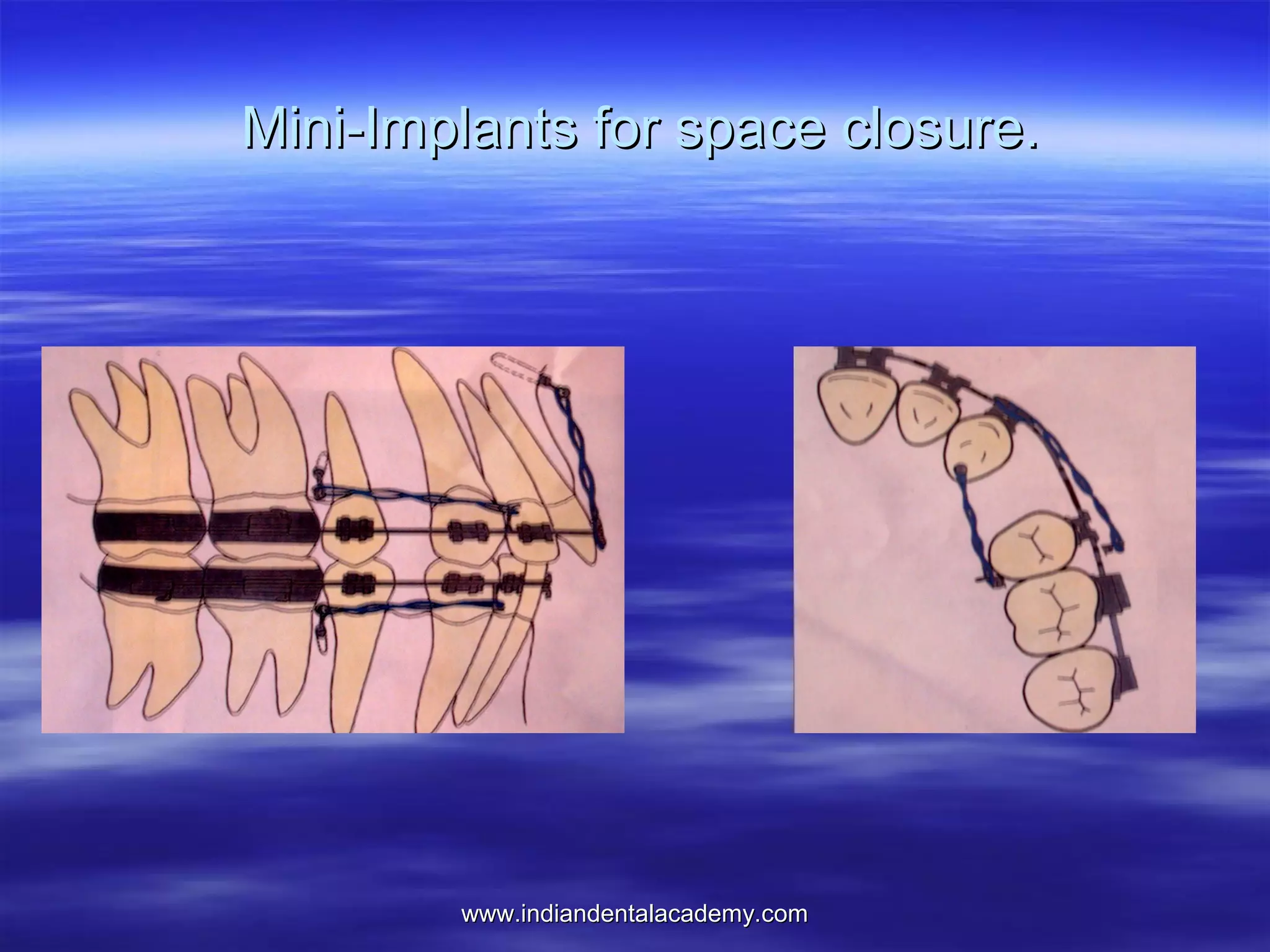
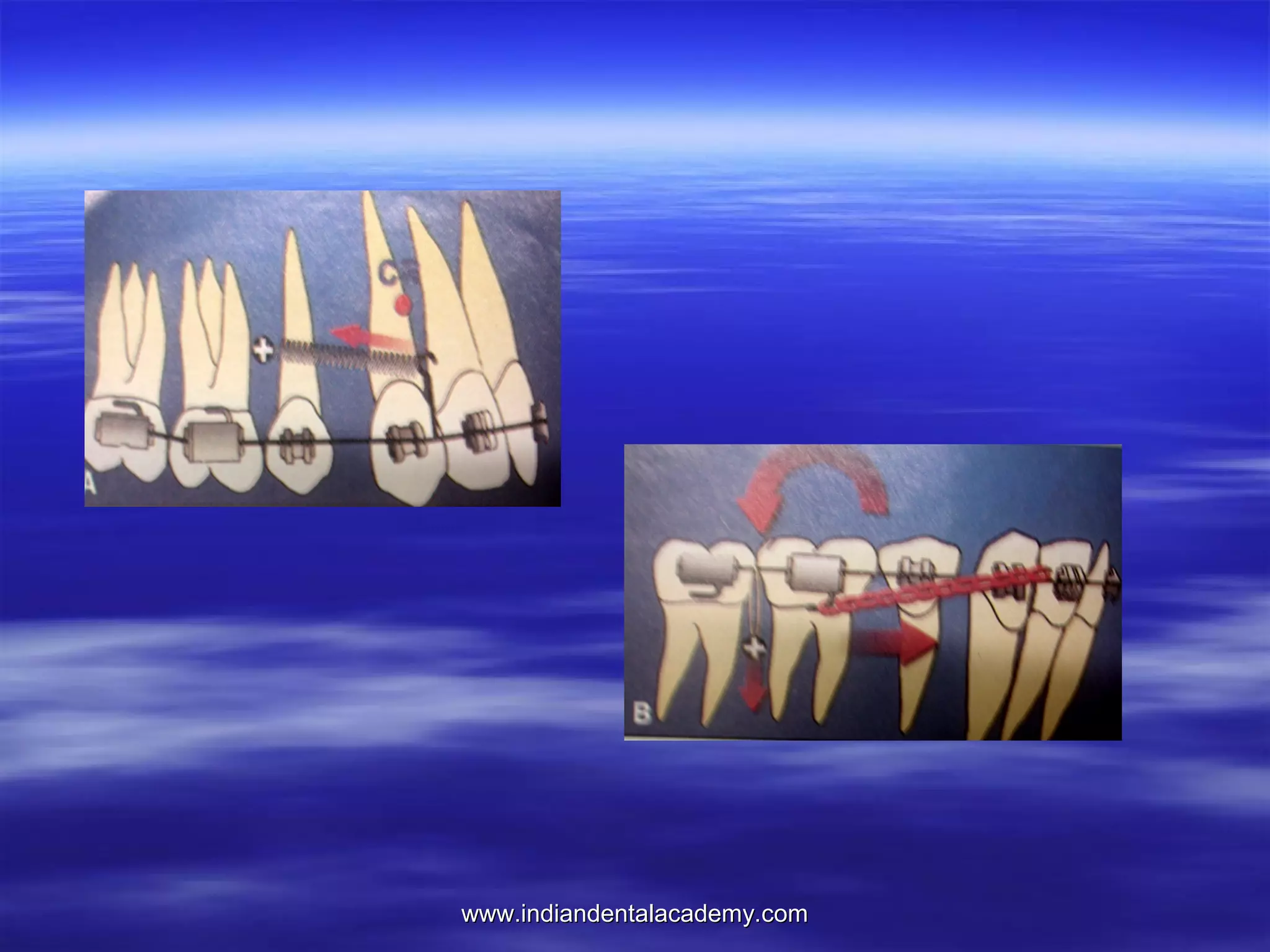
Mini-Implants for space closure.

www.indiandentalacademy.com
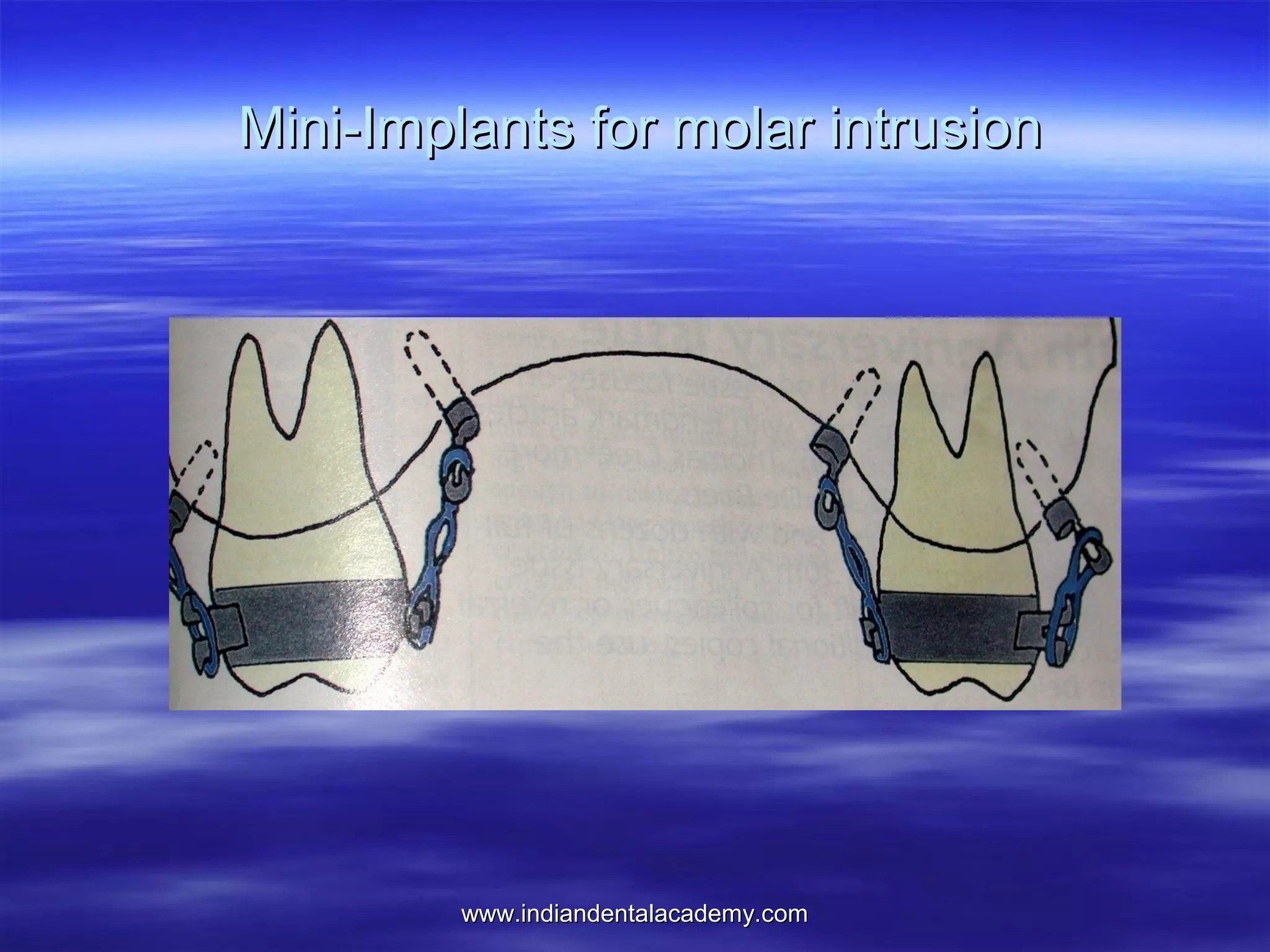
Mini-Implants for molar intrusion

www.indiandentalacademy.com
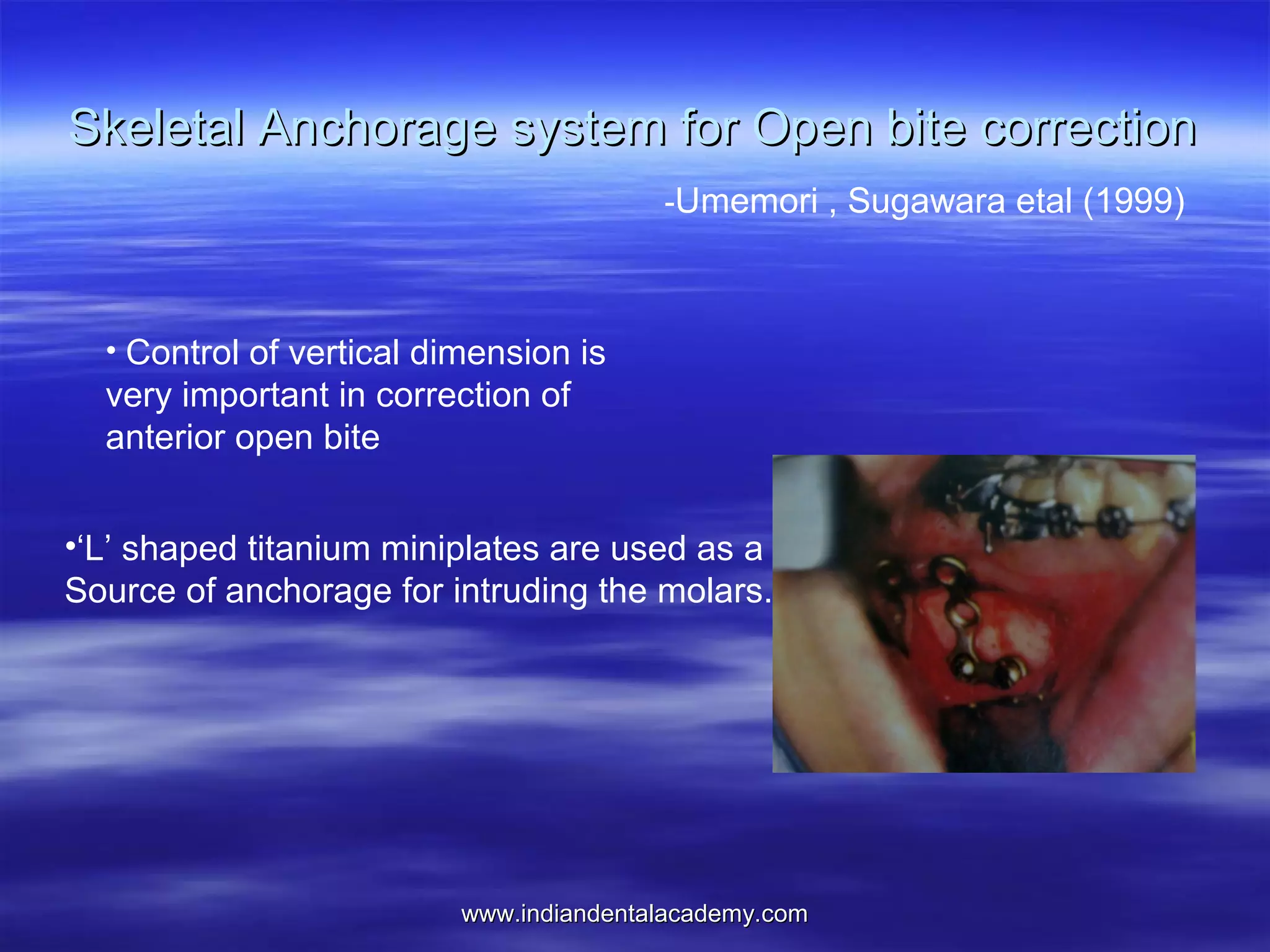
Skeletal Anchorage system for Open bite correction
-Umemori , Sugawara etal (1999)

• Control of vertical dimension is

very important in correction of
anterior open bite
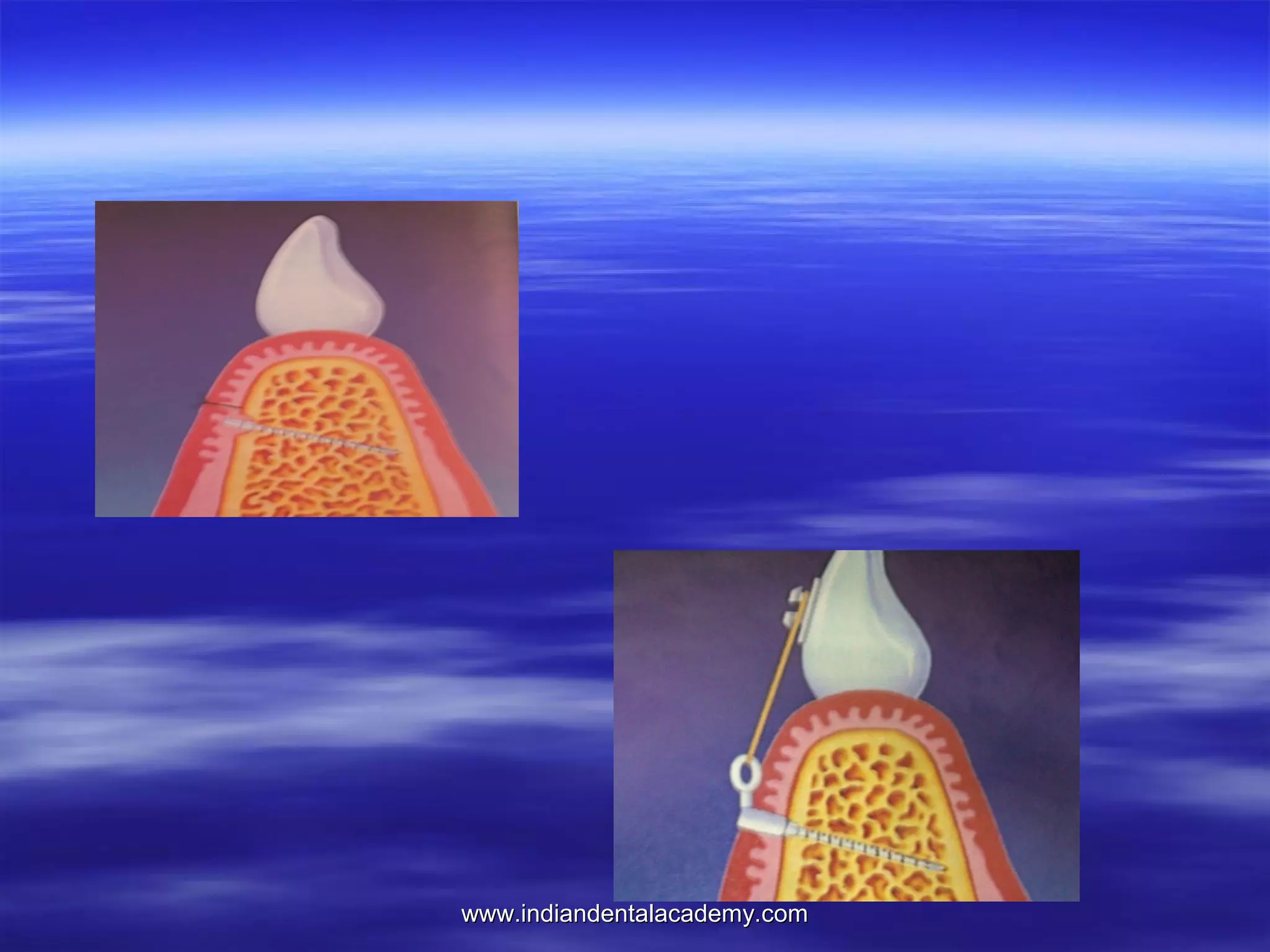
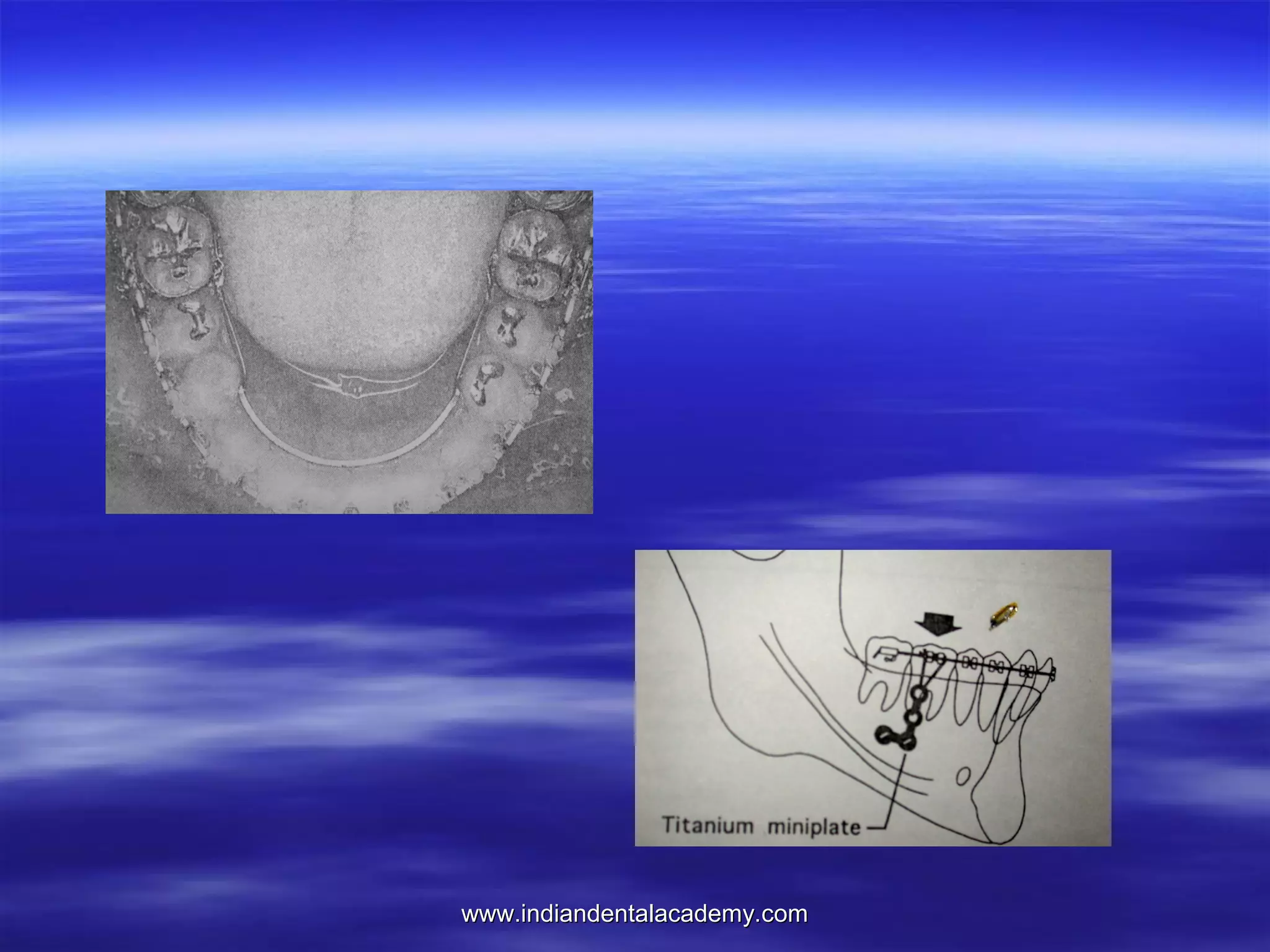
•‘L’ shaped titanium miniplates are used as a
Source of anchorage for intruding the molars.

www.indiandentalacademy.com
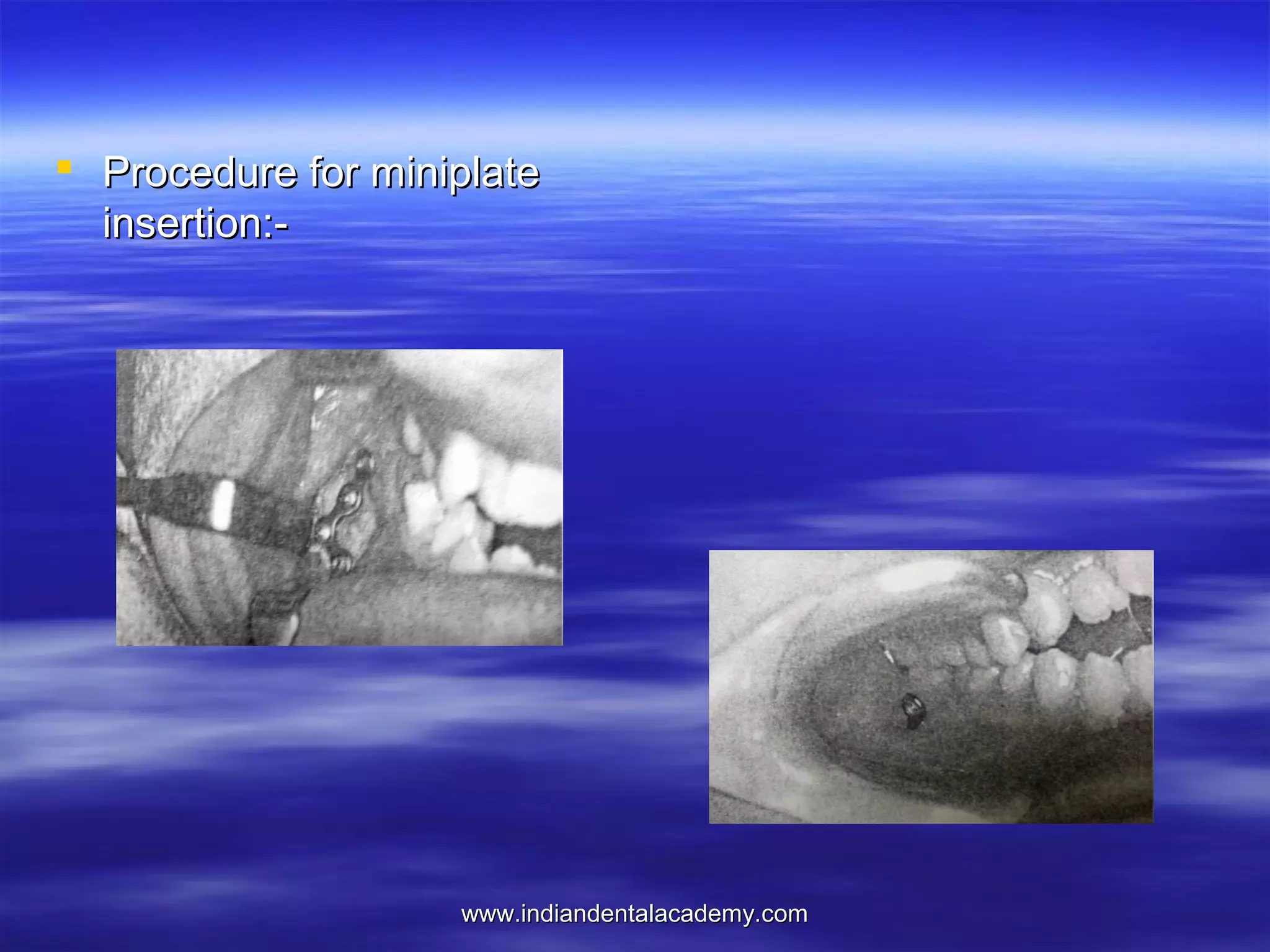
 Procedure for miniplate
insertion:-

www.indiandentalacademy.com
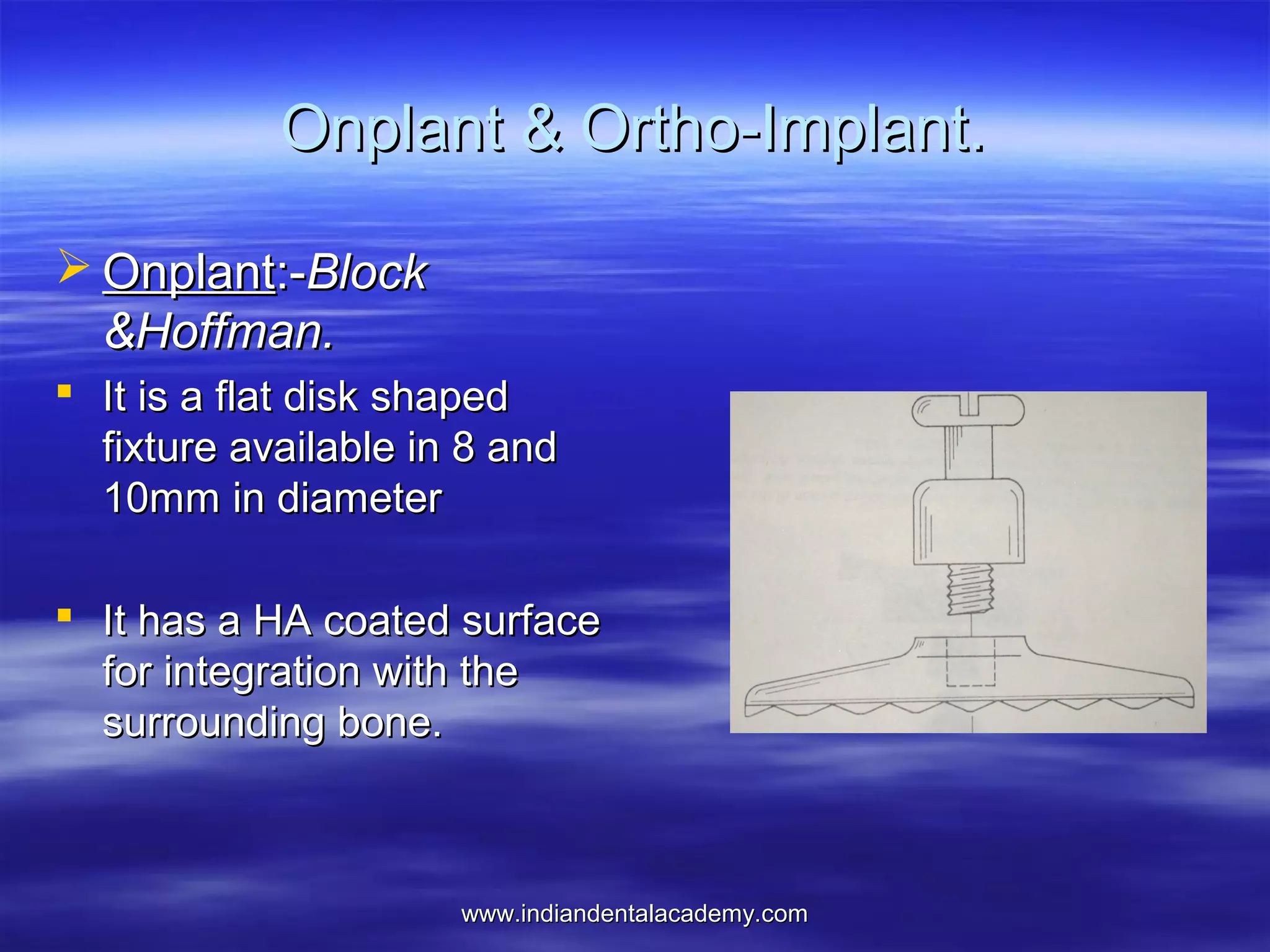
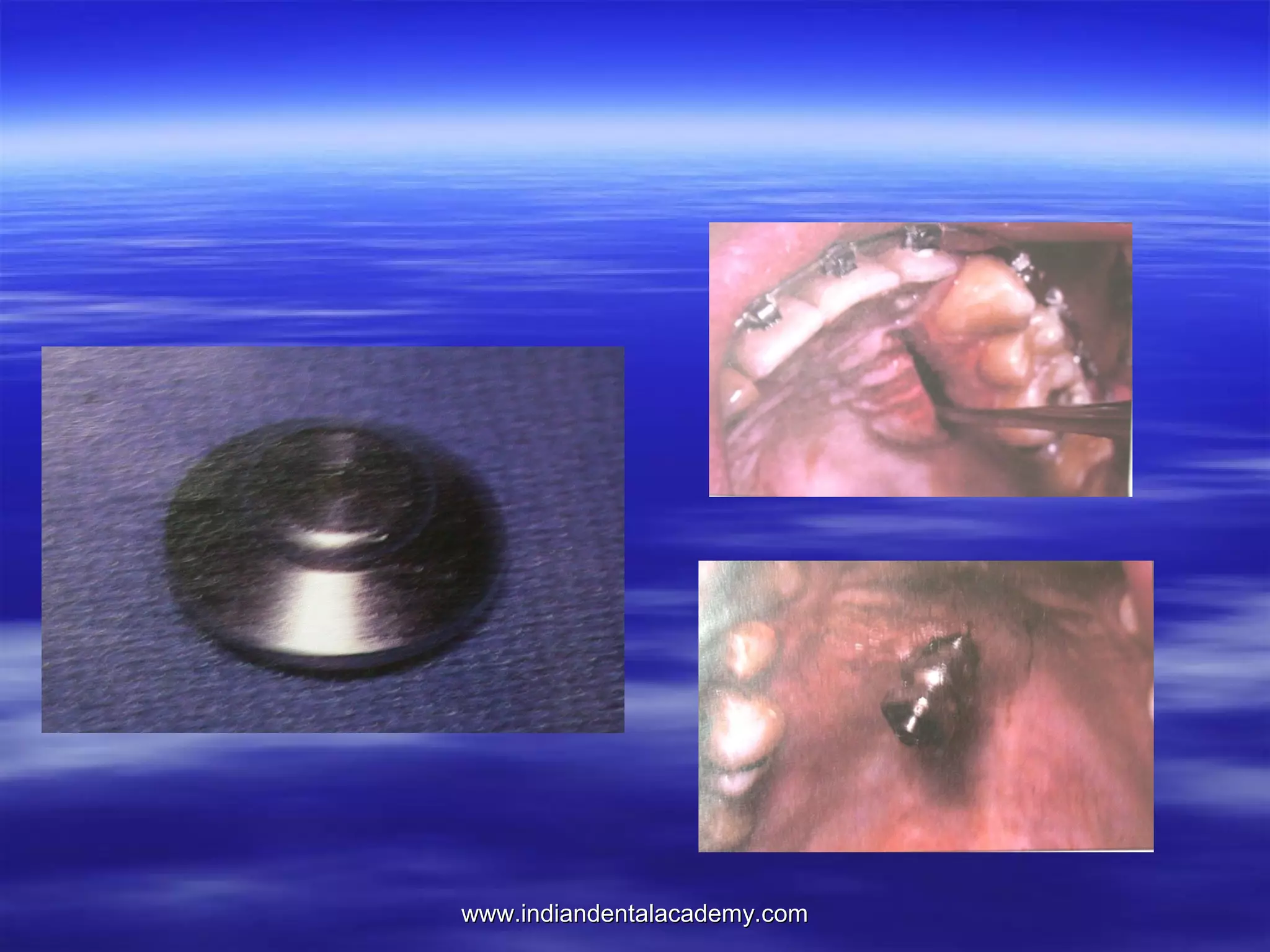
Onplant & Ortho-Implant.
 Onplant:-Block
&Hoffman.
 It is a flat disk shaped
fixture available in 8 and
10mm in diameter
 It has a HA coated surface
for integration with the
surrounding bone.

www.indiandentalacademy.com
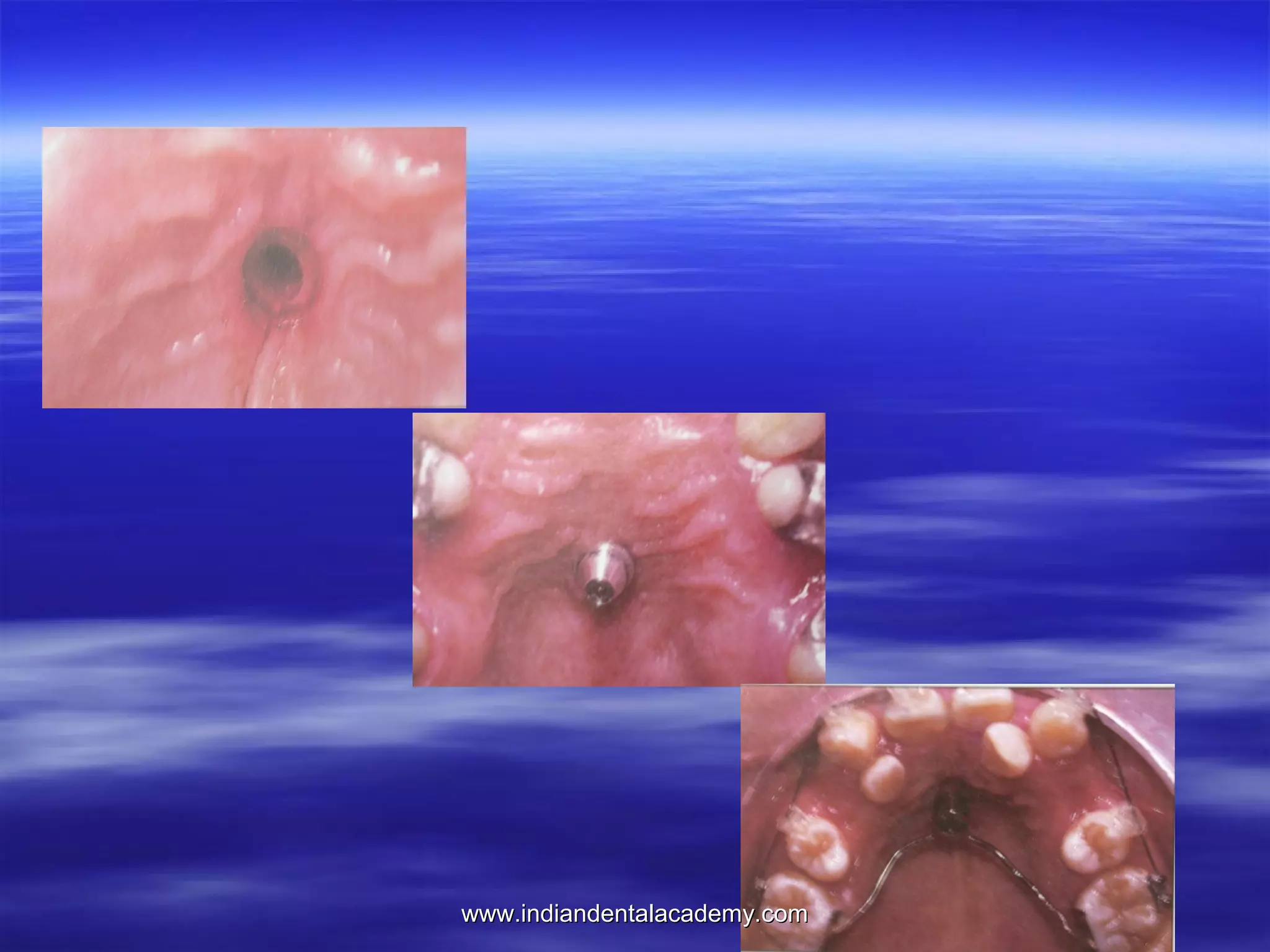
Ortho-Implant
- Celenza

& Hochman

•Similar to onplant but it is an endosseous Implant.
•Its surface is sandblasted and etched to
increase the adhesion to the surrounding bone

www.indiandentalacademy.com
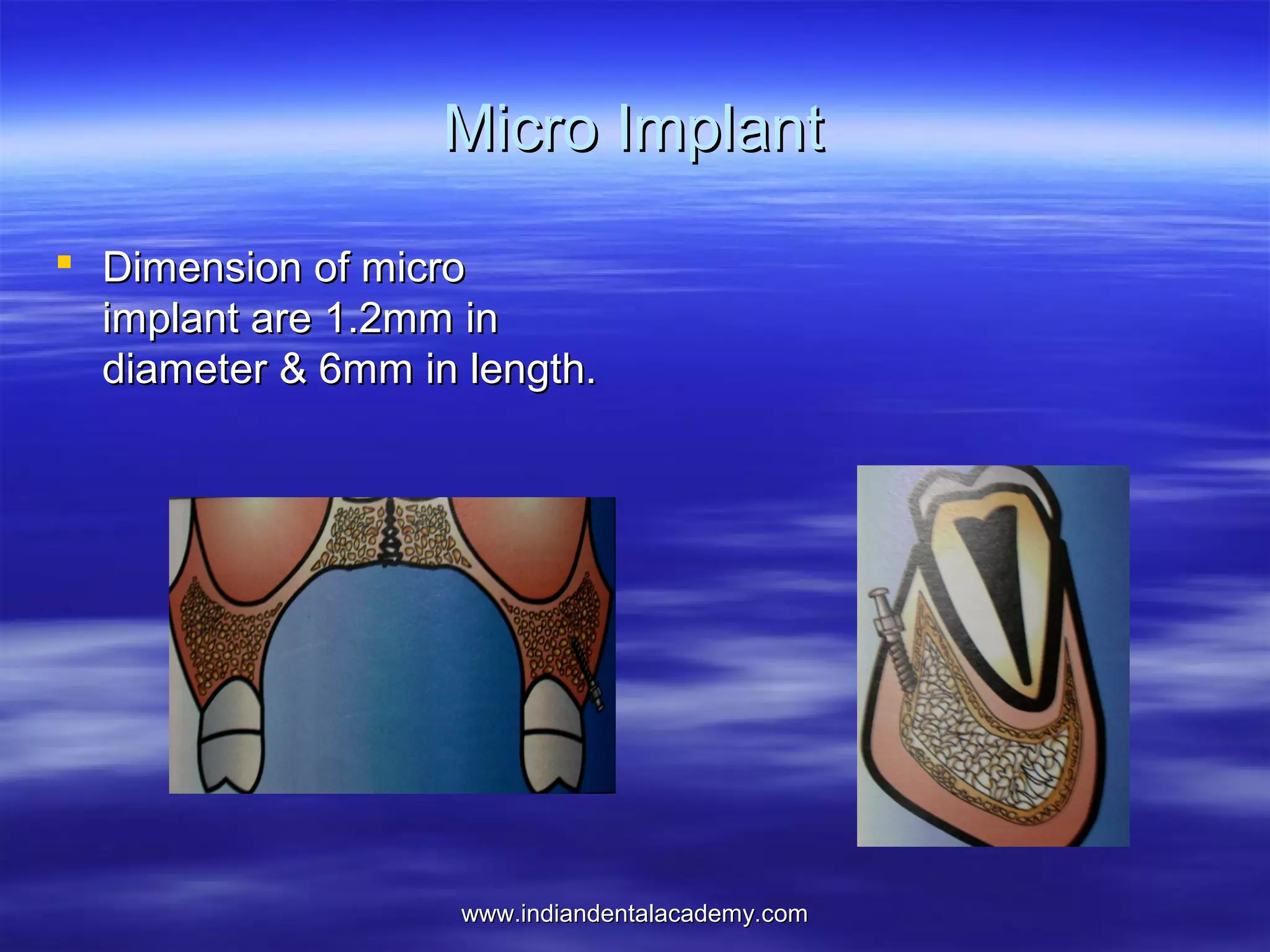
Micro Implant
 Dimension of micro
implant are 1.2mm in
diameter & 6mm in length.

www.indiandentalacademy.com
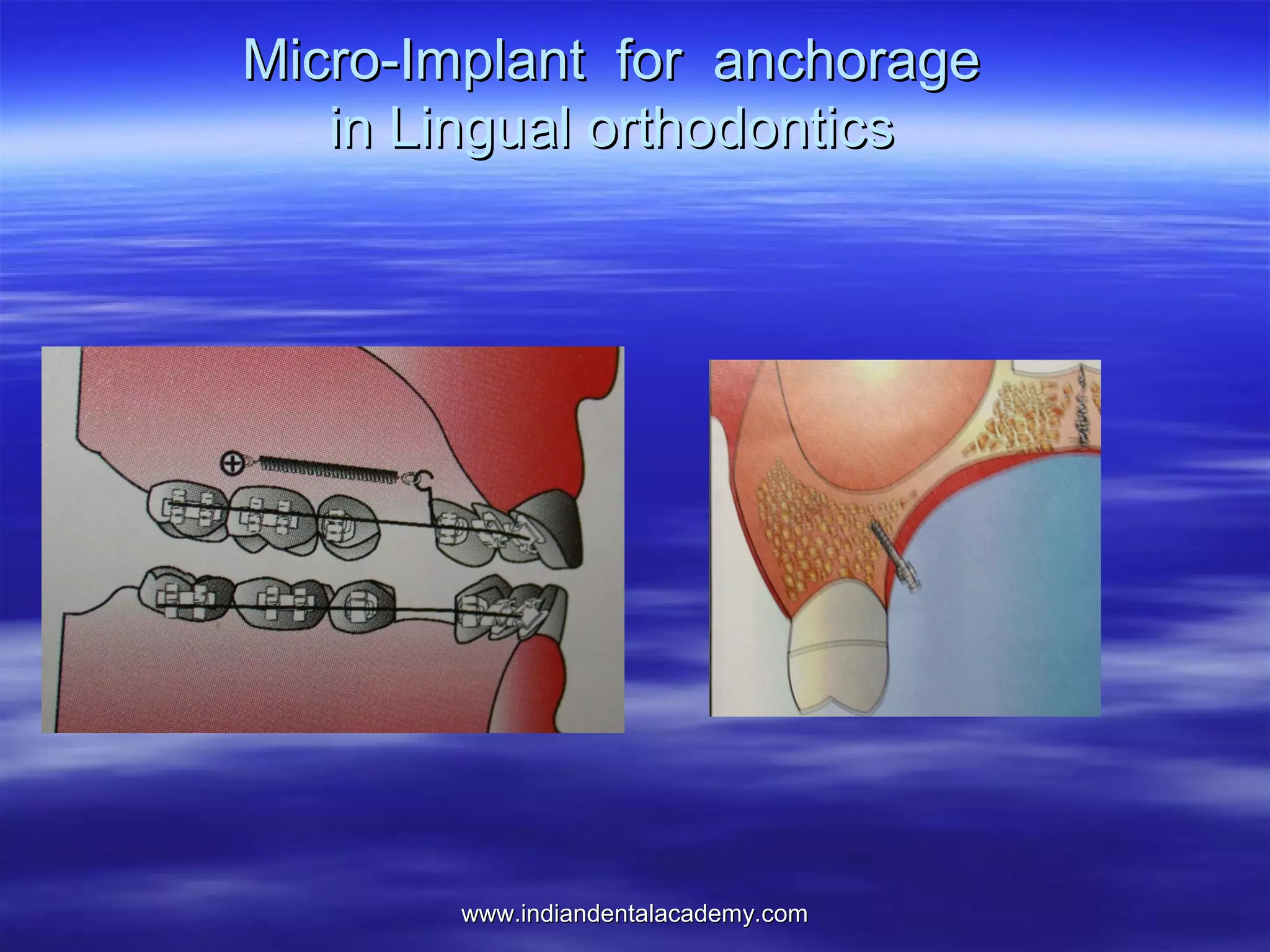
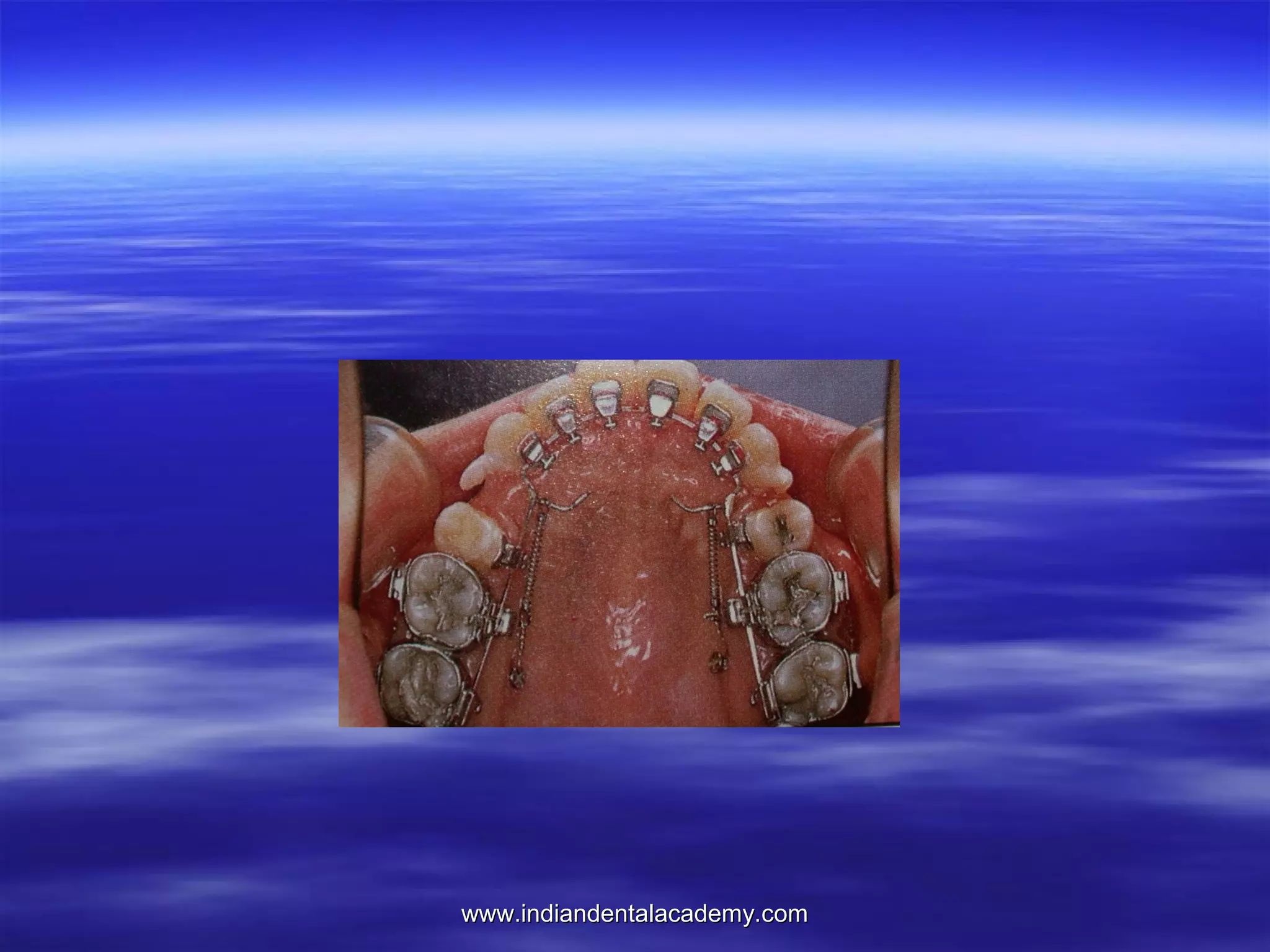
Micro-Implant for anchorage
in Lingual orthodontics

www.indiandentalacademy.com
MAGNETS
IN
ORTHODONTICS

www.indiandentalacademy.com
 Introduction
 Types of magnetic materials
 Properties of magnets
 Application of magnets in orthodontics.
www.indiandentalacademy.com
 In 1953, magnets were first used for denture
retention by BEHRAN & EGAN.

 Use of magnets in orthodontic- BLECHMAN &
SMILEY.

www.indiandentalacademy.com
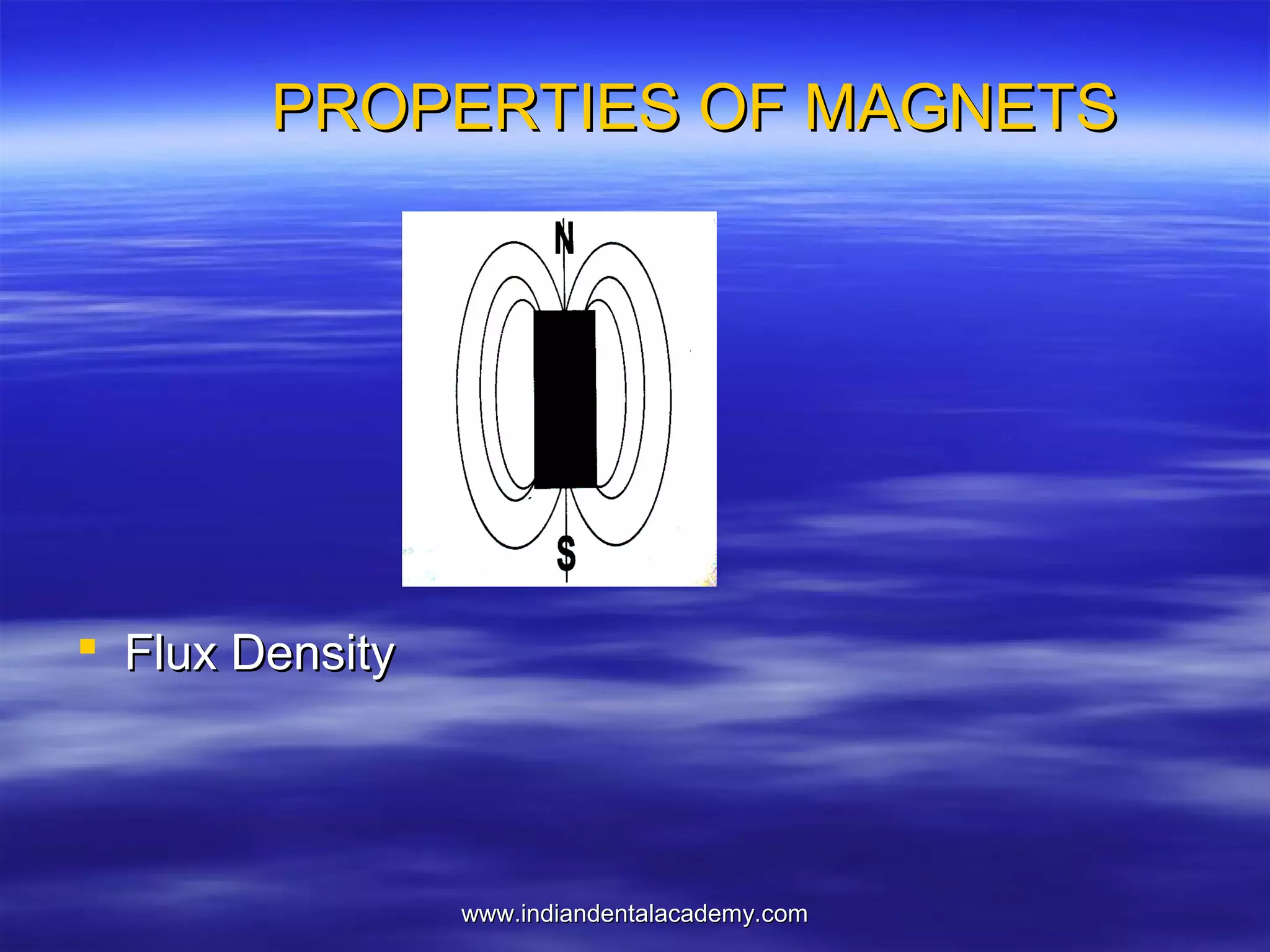
PROPERTIES OF MAGNETS

 Flux Density

www.indiandentalacademy.com
 In dentistry, ferromagnetic materials with
static field are used.
 Magnetocrystalline Anisotropy.
 Coercivity.

www.indiandentalacademy.com
 Coulombs law:-This law states that force between
two magnetic poles is directly proportional to
magnitude & inversely proportional to square of
the distance between them.
 Curie point:-Pierre Curie(1859-1906)

www.indiandentalacademy.com
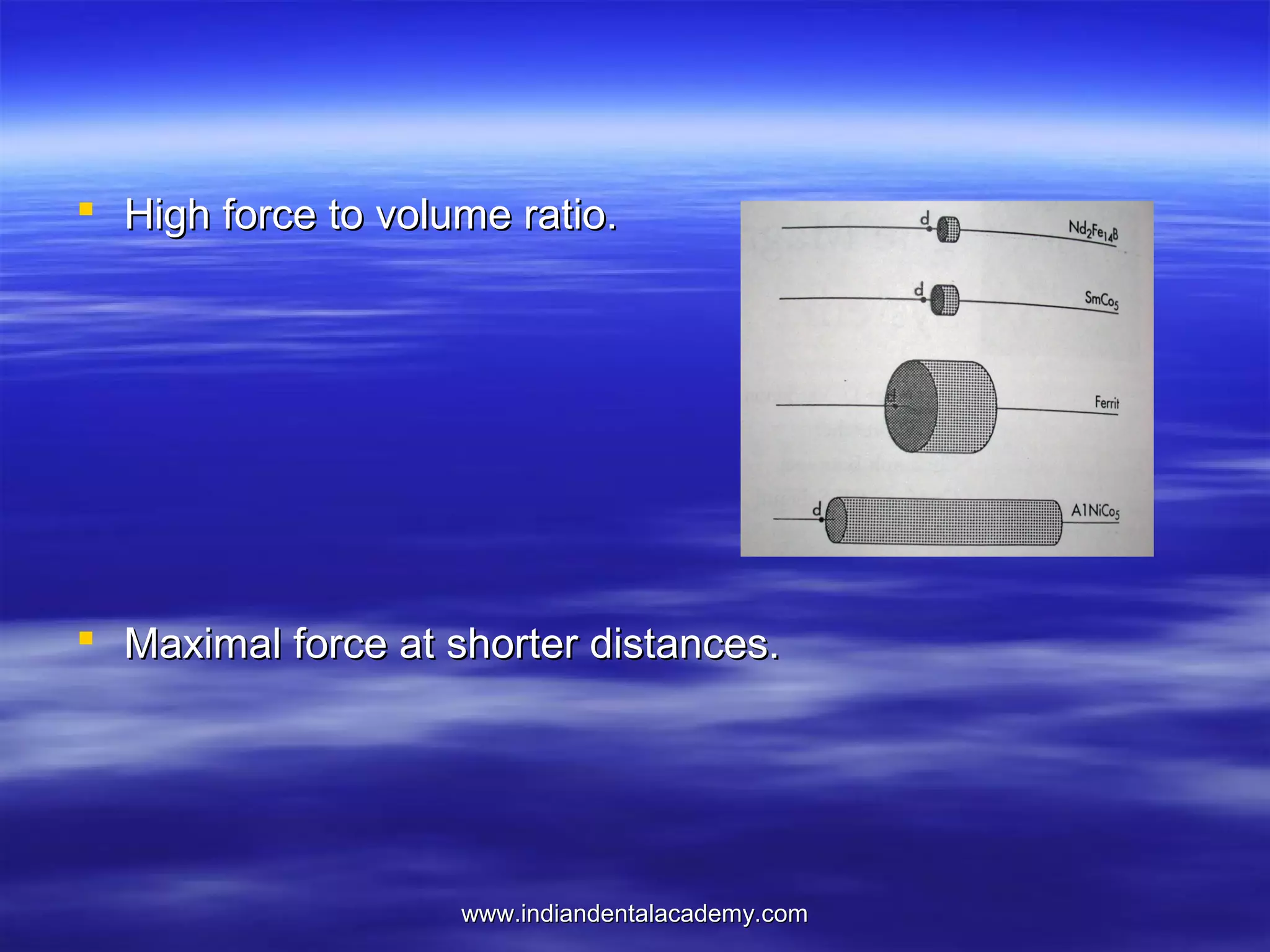
 High force to volume ratio.

 Maximal force at shorter distances.

www.indiandentalacademy.com
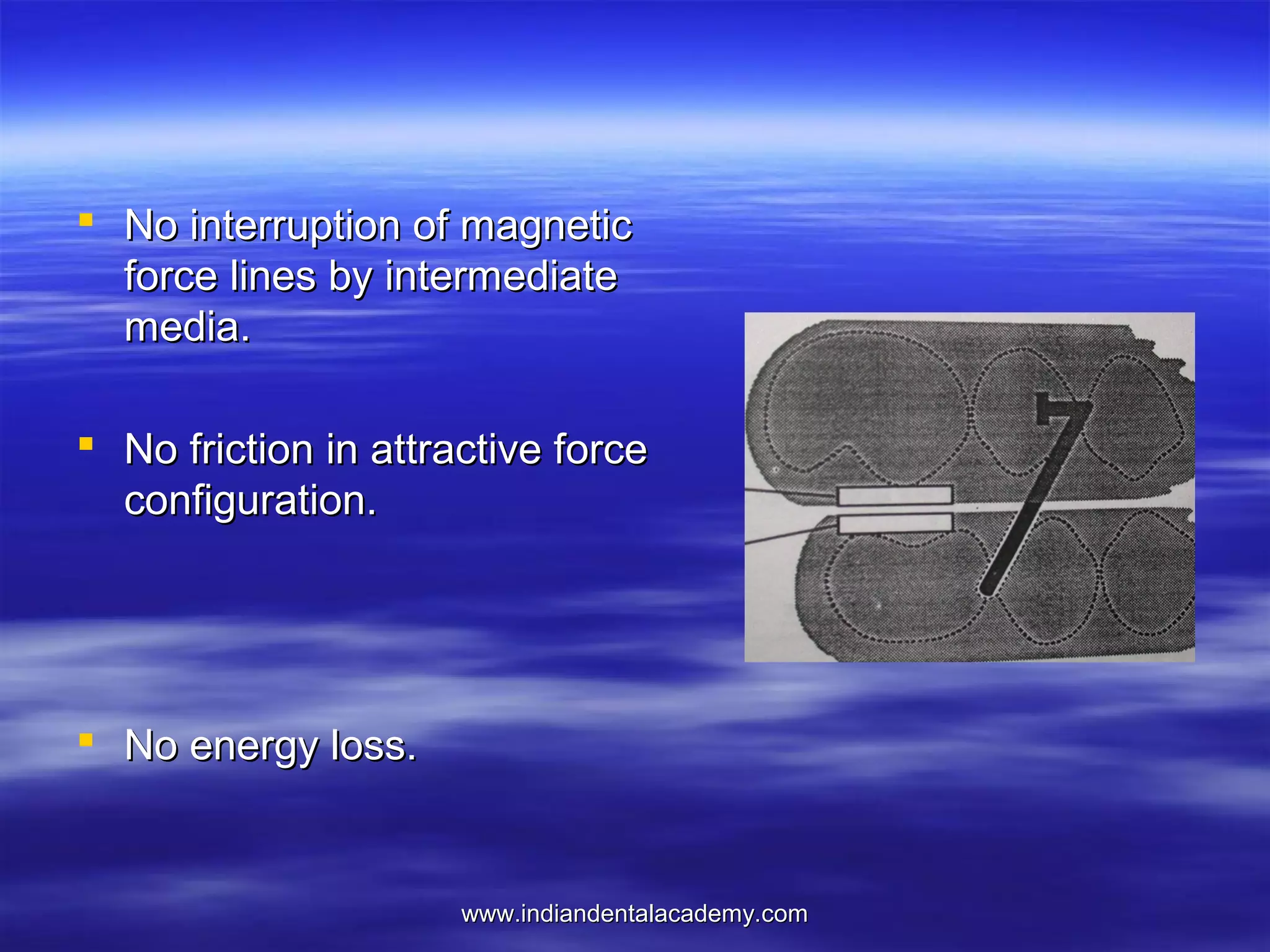
 No interruption of magnetic
force lines by intermediate
media.
 No friction in attractive force
configuration.

 No energy loss.

www.indiandentalacademy.com
TYPES OF MAGNETIC MATERIALS







Platinum-cobalt(Pt-co)
Aluminium-Nickel-Cobalt(Al-Ni-Co)
Ferrite
Chromium-cobalt-Iron
Samarium Cobalt(SmCo)
Neodymium-Iron-Boron(Nd2Fe B)
14

www.indiandentalacademy.com
 SAMARIUM-COBALT (SmCo5&Sm2Co17)
MAGNETS:-

-high resistance to demagnetization.

-corrosion resistance.

www.indiandentalacademy.com
 Advantages:-Continuous force is exerted.
- Eliminates the patient co-operation.
-No friction.
 Disadvantages:-Tarnish &corrosion products are cytotoxic.
-Cost factor

www.indiandentalacademy.com
 Biological effect of magnetic forces:-

Aronson:-thinning of epithelium under
attracting & repelling magnets.
McDonald - proliferative activity of fibroblasts
in presence of static magnetic field
Lars Bondemark & Kurol studied changes in
human dental pulp and gingival tissue.
www.indiandentalacademy.com
APPLICATIONS OF MAGNETIC
APPLIANCES
1.
2.
3.
4.
5.
6.

Tooth intrusion
Expansion
Tooth Impaction
Space closure
Molar distalization
Magnetic Edgewise brackets

7.
8.

Functional Appliances.
Retainers.

www.indiandentalacademy.com
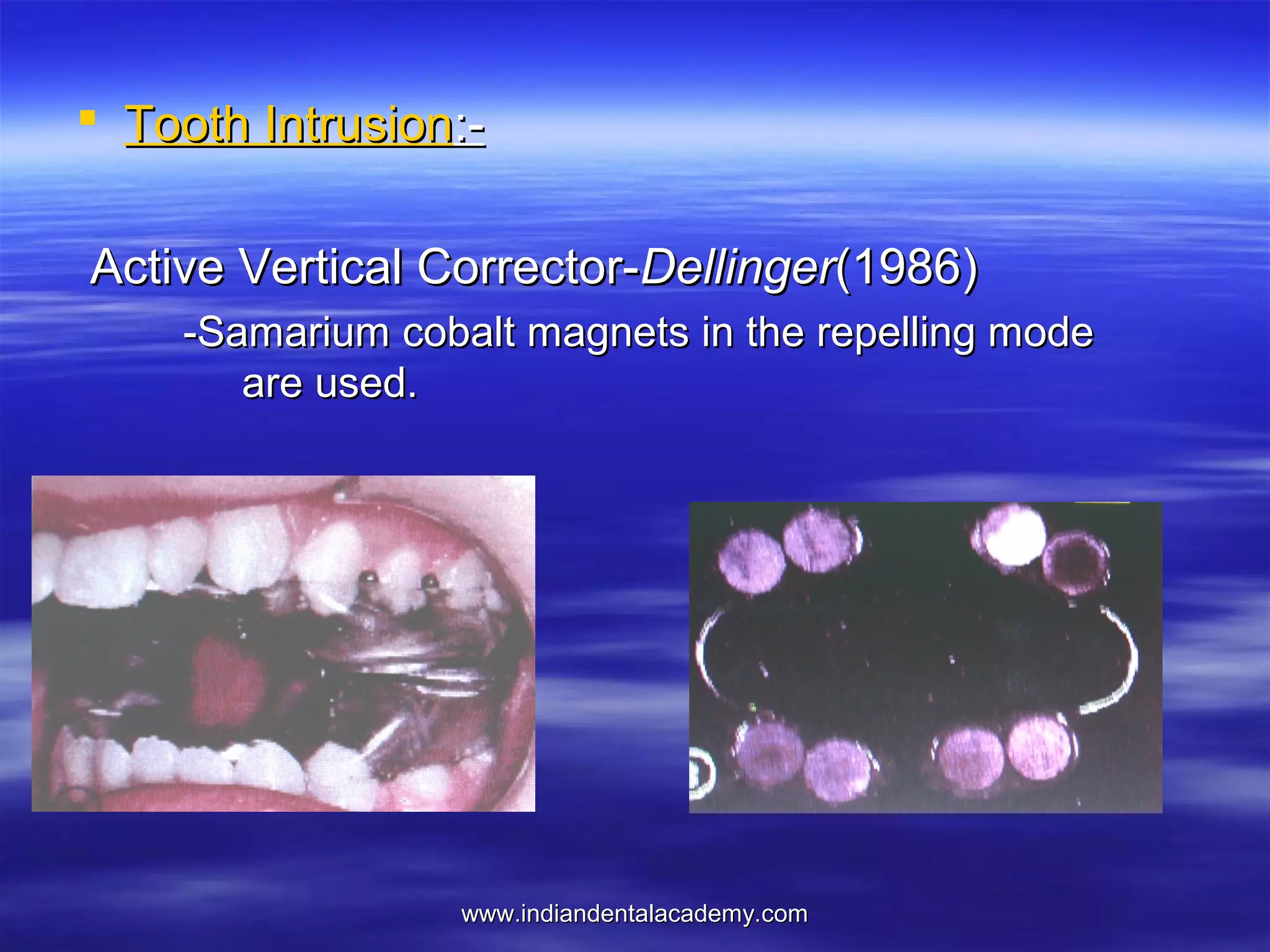
 Tooth Intrusion:Active Vertical Corrector-Dellinger(1986)
-Samarium cobalt magnets in the repelling mode
are used.

www.indiandentalacademy.com
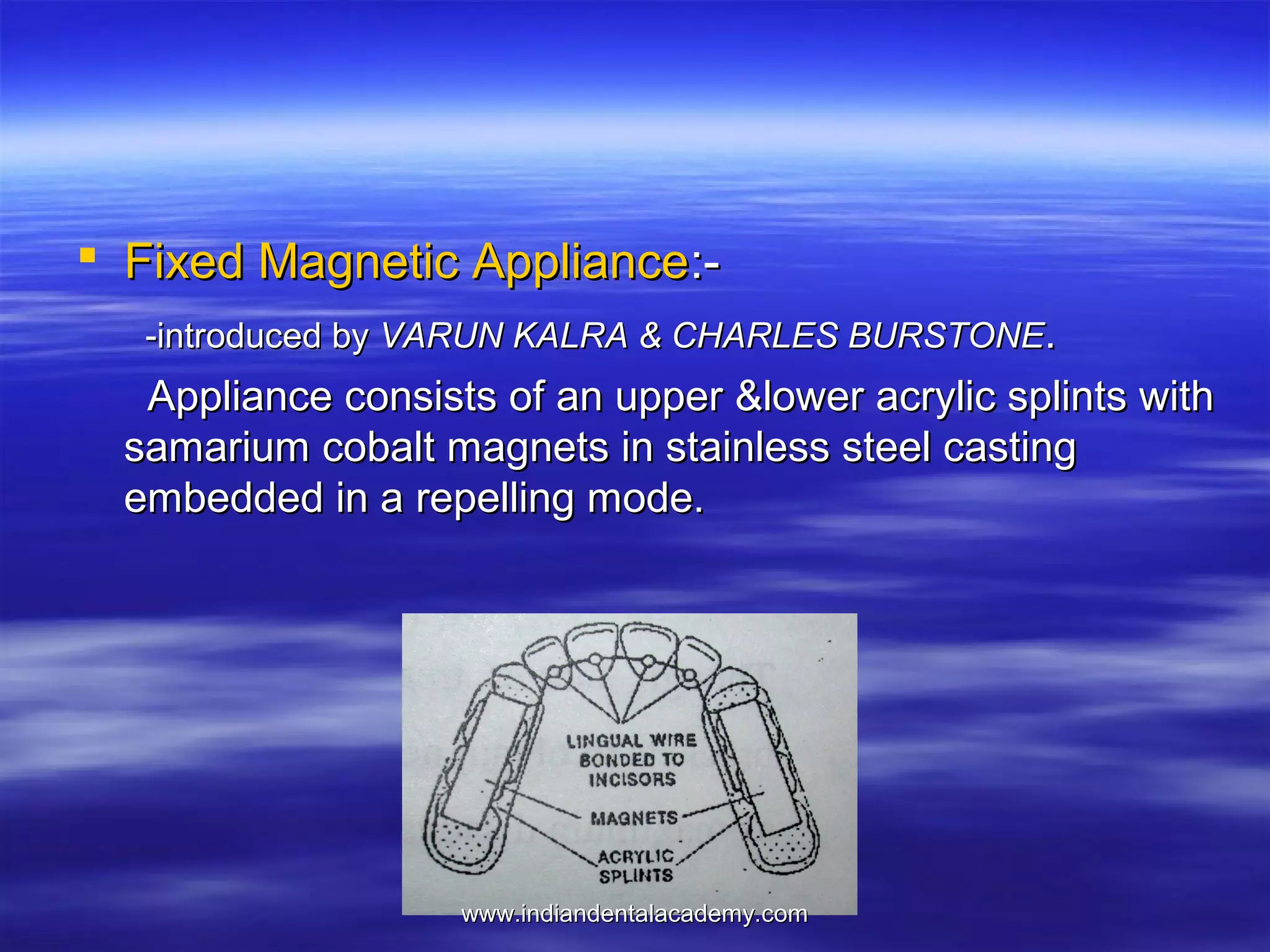
 Fixed Magnetic Appliance:-introduced by VARUN KALRA & CHARLES BURSTONE.

Appliance consists of an upper &lower acrylic splints with
samarium cobalt magnets in stainless steel casting
embedded in a repelling mode.

www.indiandentalacademy.com


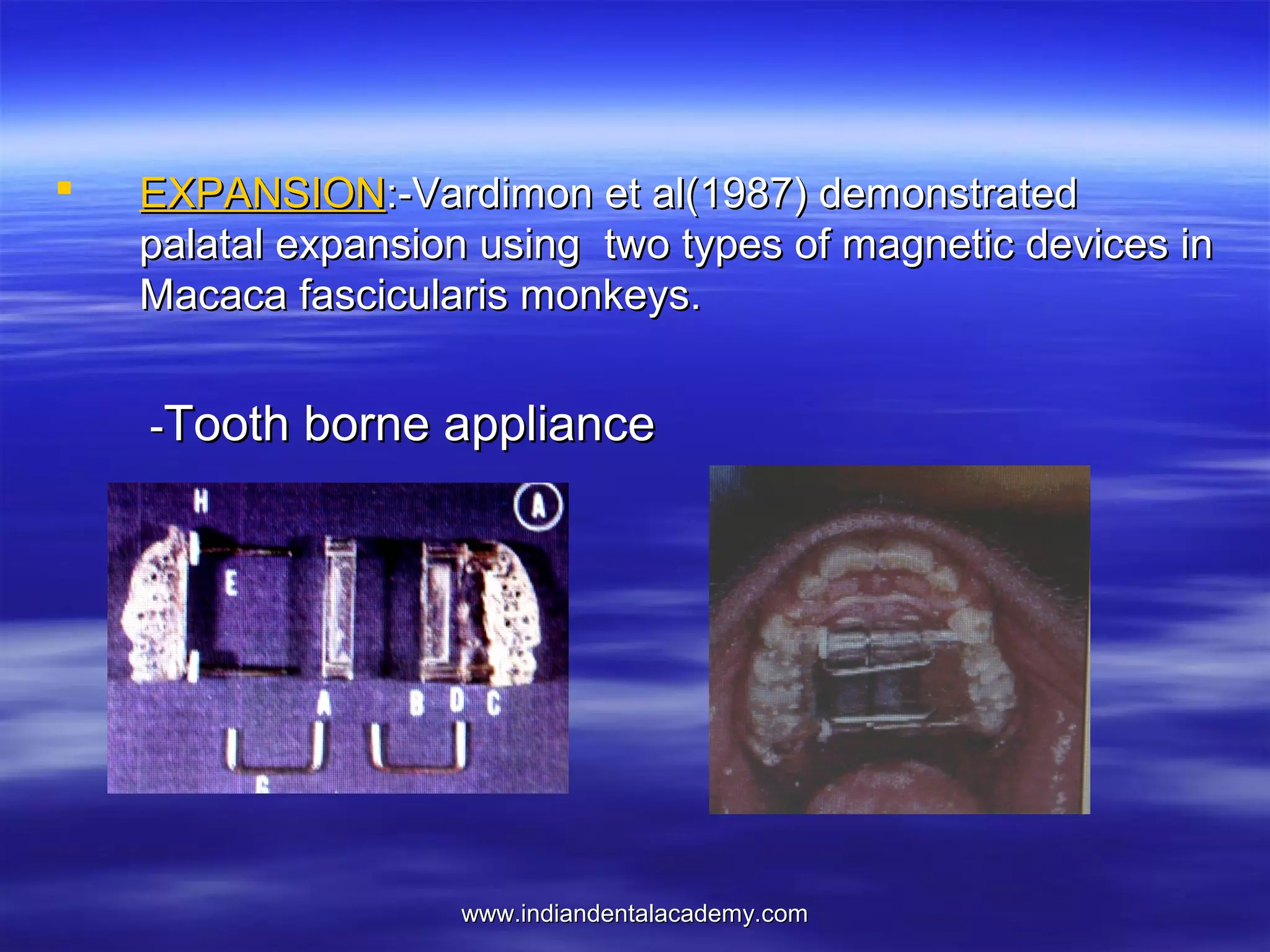
EXPANSION:-Vardimon et al(1987) demonstrated
palatal expansion using two types of magnetic devices in
Macaca fascicularis monkeys.
-Tooth borne appliance

www.indiandentalacademy.com
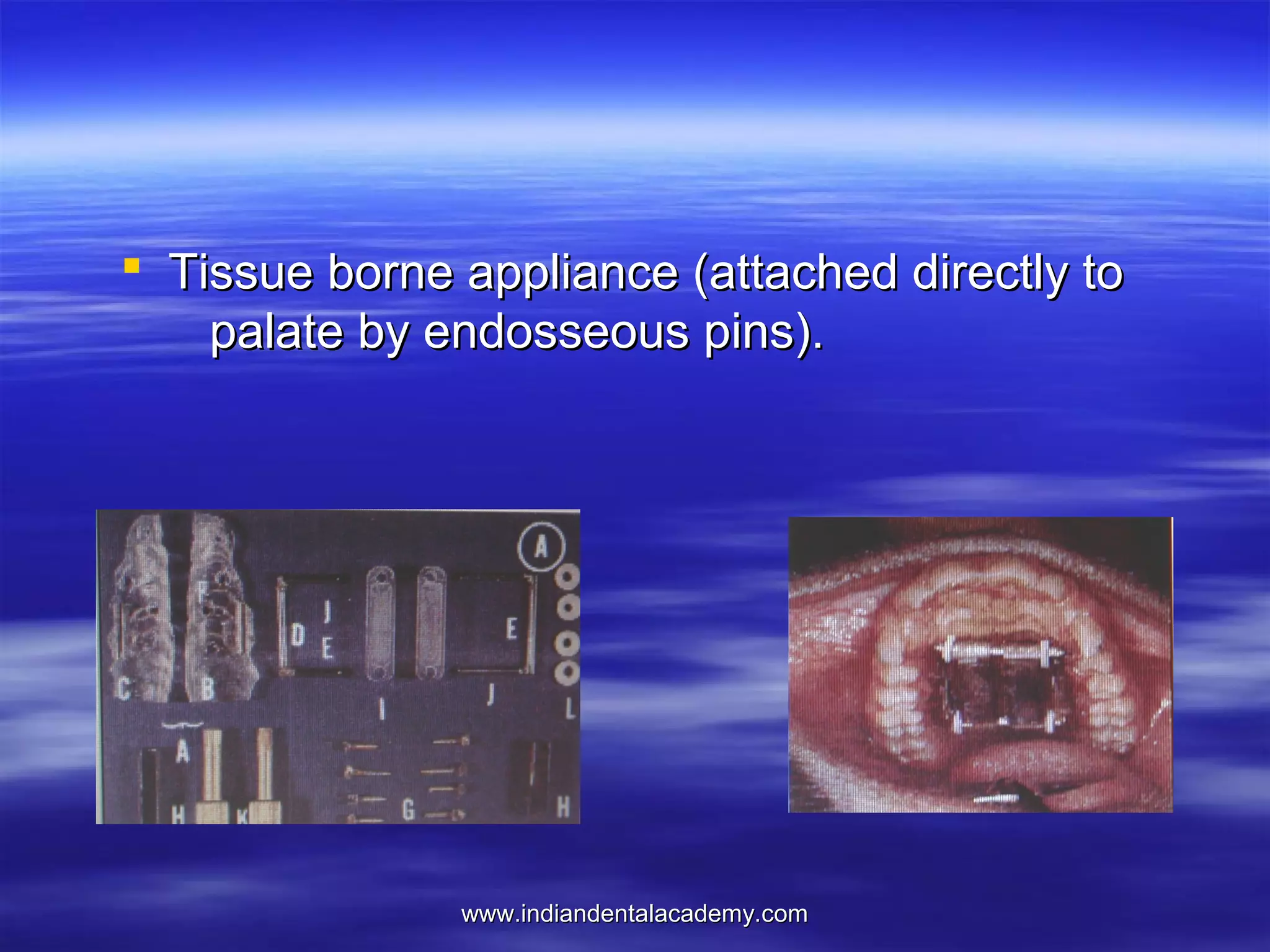
 Tissue borne appliance (attached directly to
palate by endosseous pins).

www.indiandentalacademy.com
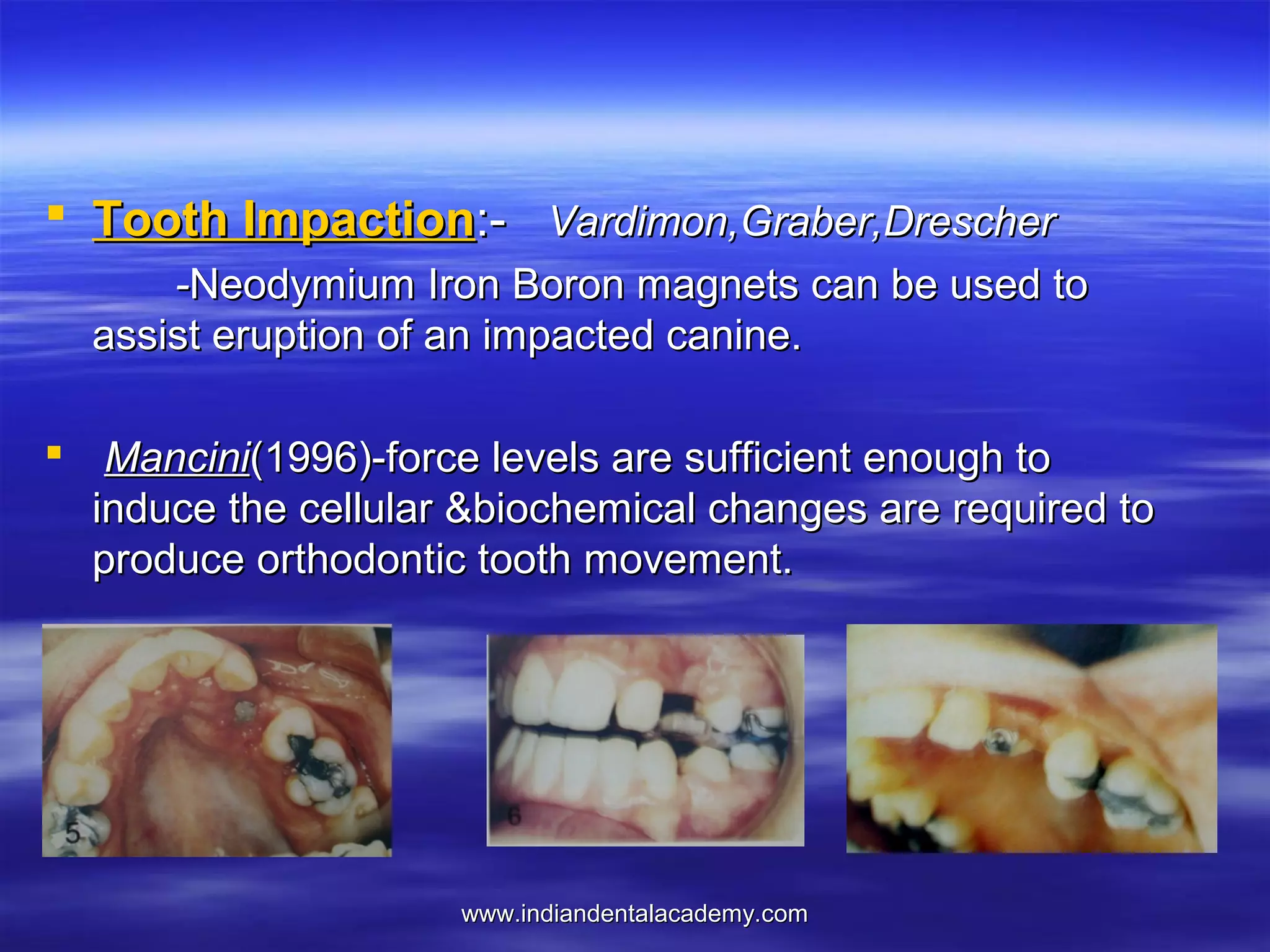
 Tooth Impaction:- Vardimon,Graber,Drescher
-Neodymium Iron Boron magnets can be used to
assist eruption of an impacted canine.
 Mancini(1996)-force levels are sufficient enough to
induce the cellular &biochemical changes are required to
produce orthodontic tooth movement.

www.indiandentalacademy.com
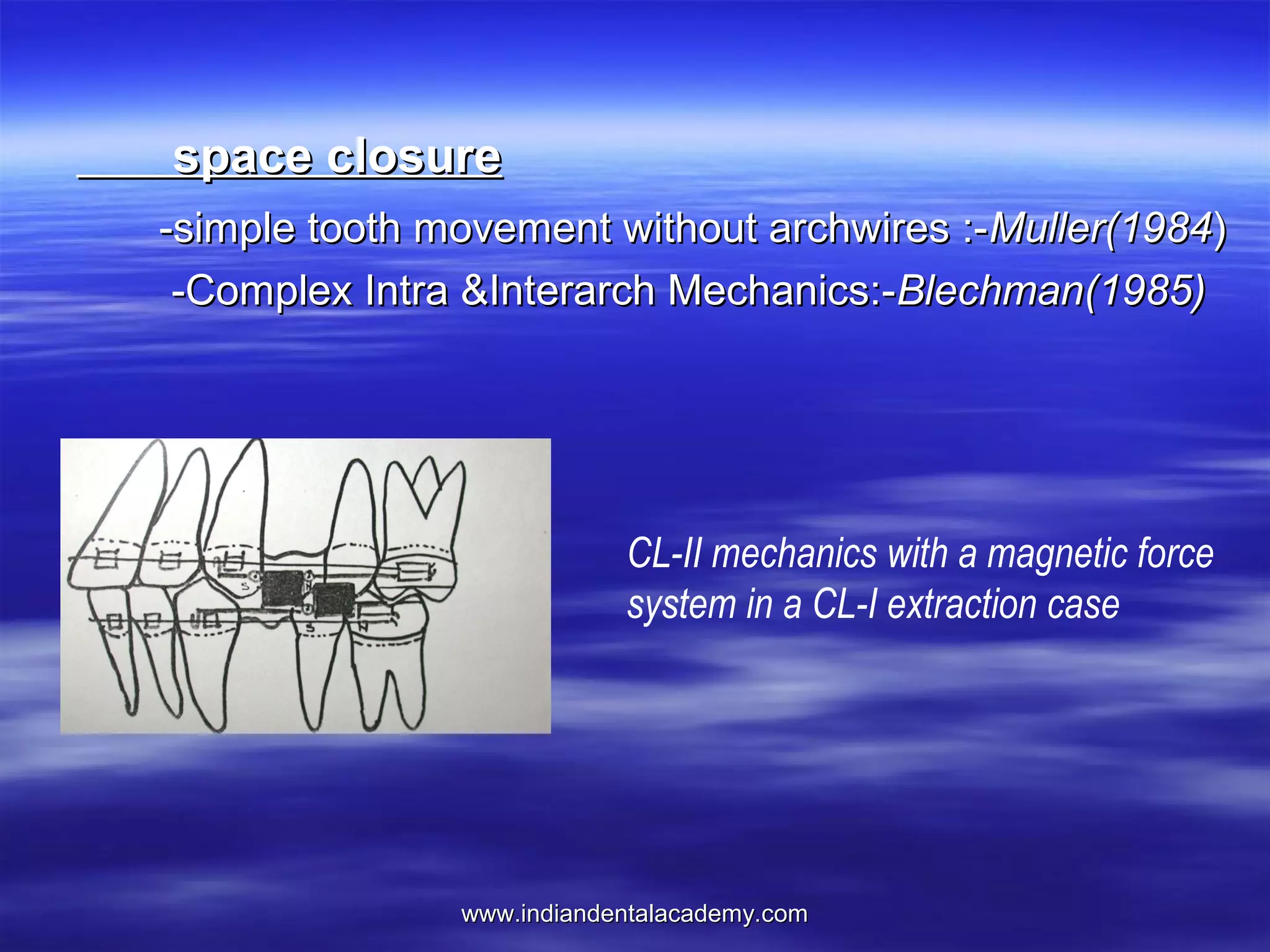
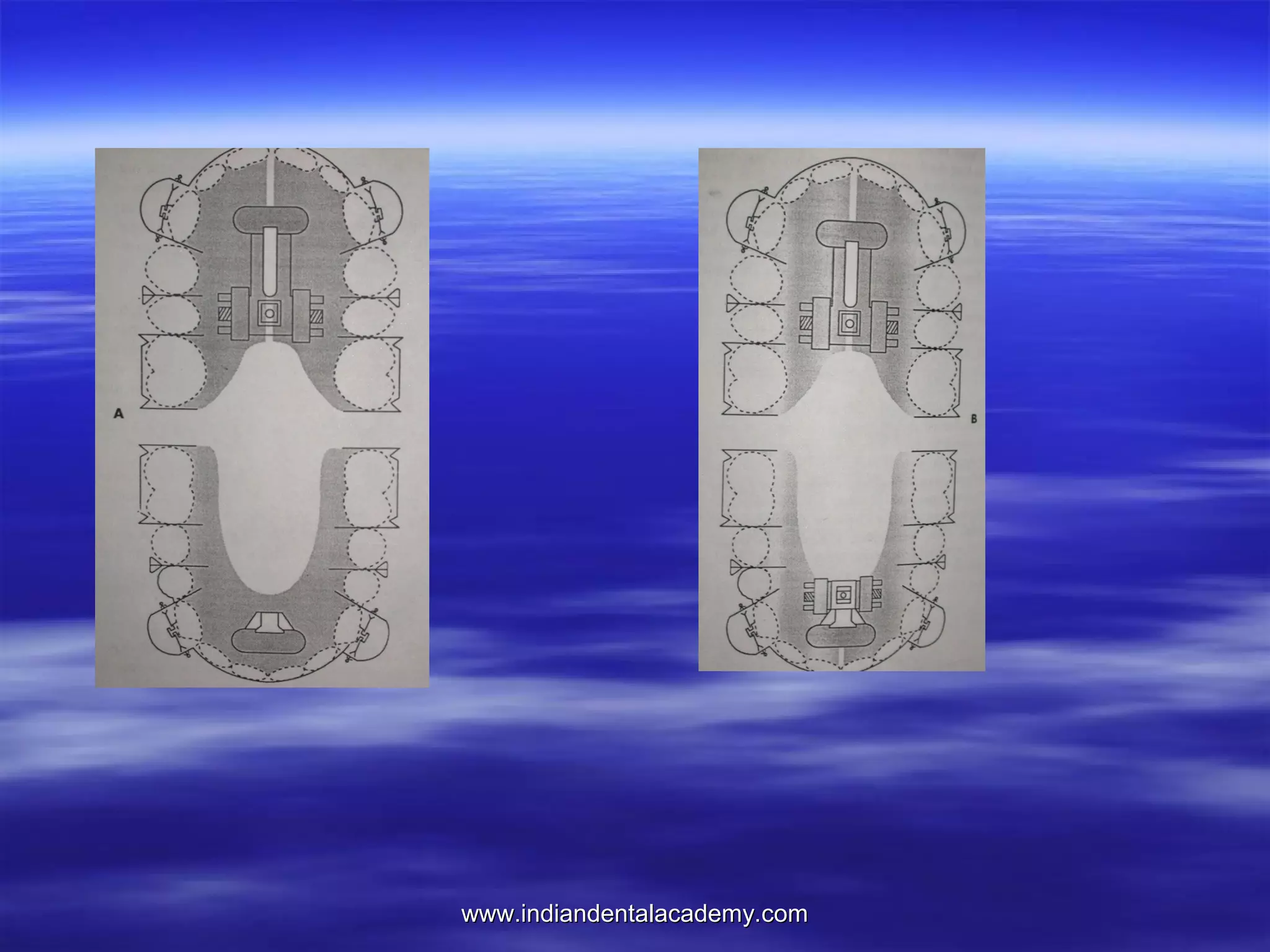
space closure
-simple tooth movement without archwires :-Muller(1984)
-Complex Intra &Interarch Mechanics:-Blechman(1985)

CL-II mechanics with a magnetic force
system in a CL-I extraction case

www.indiandentalacademy.com
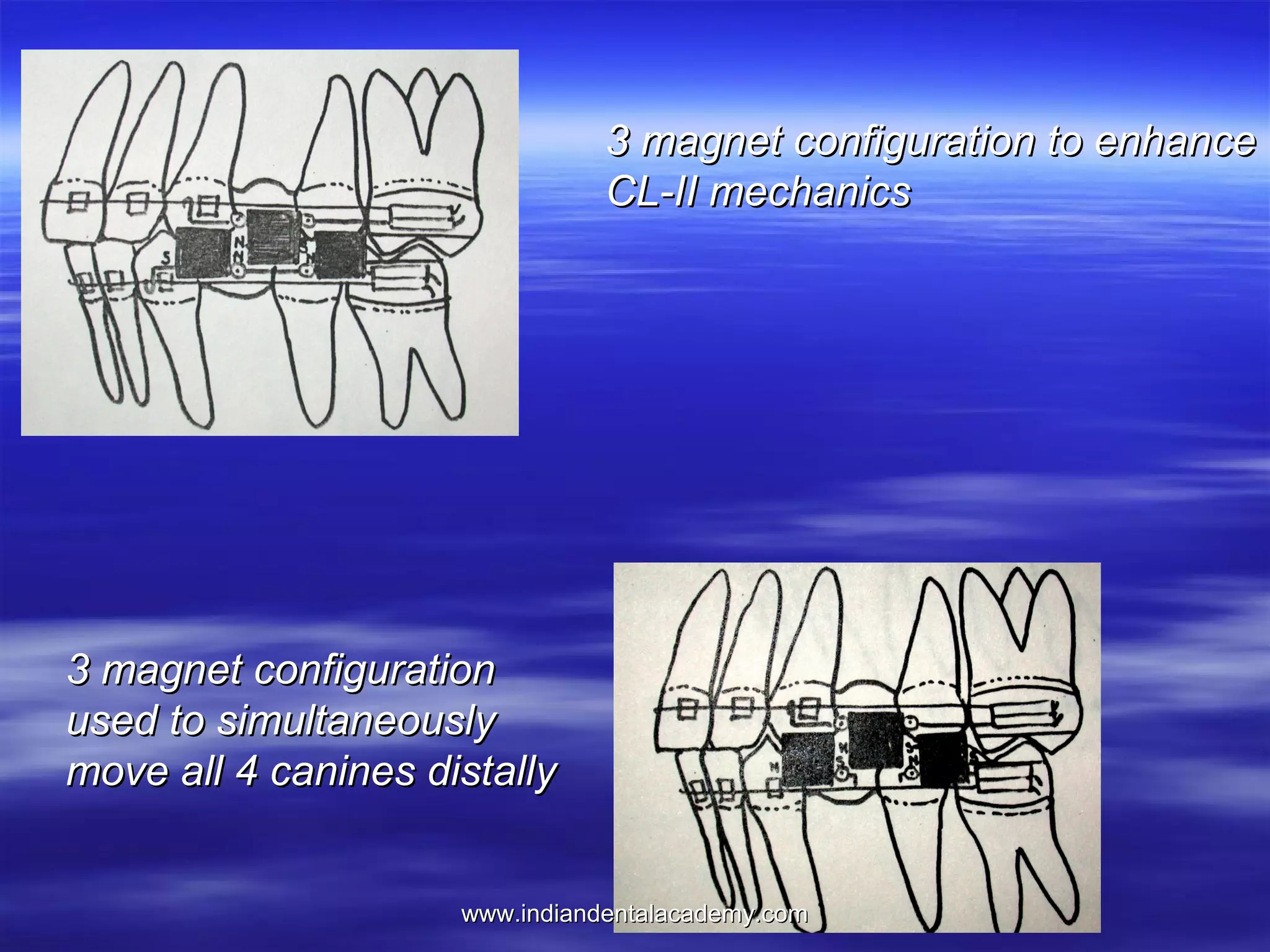
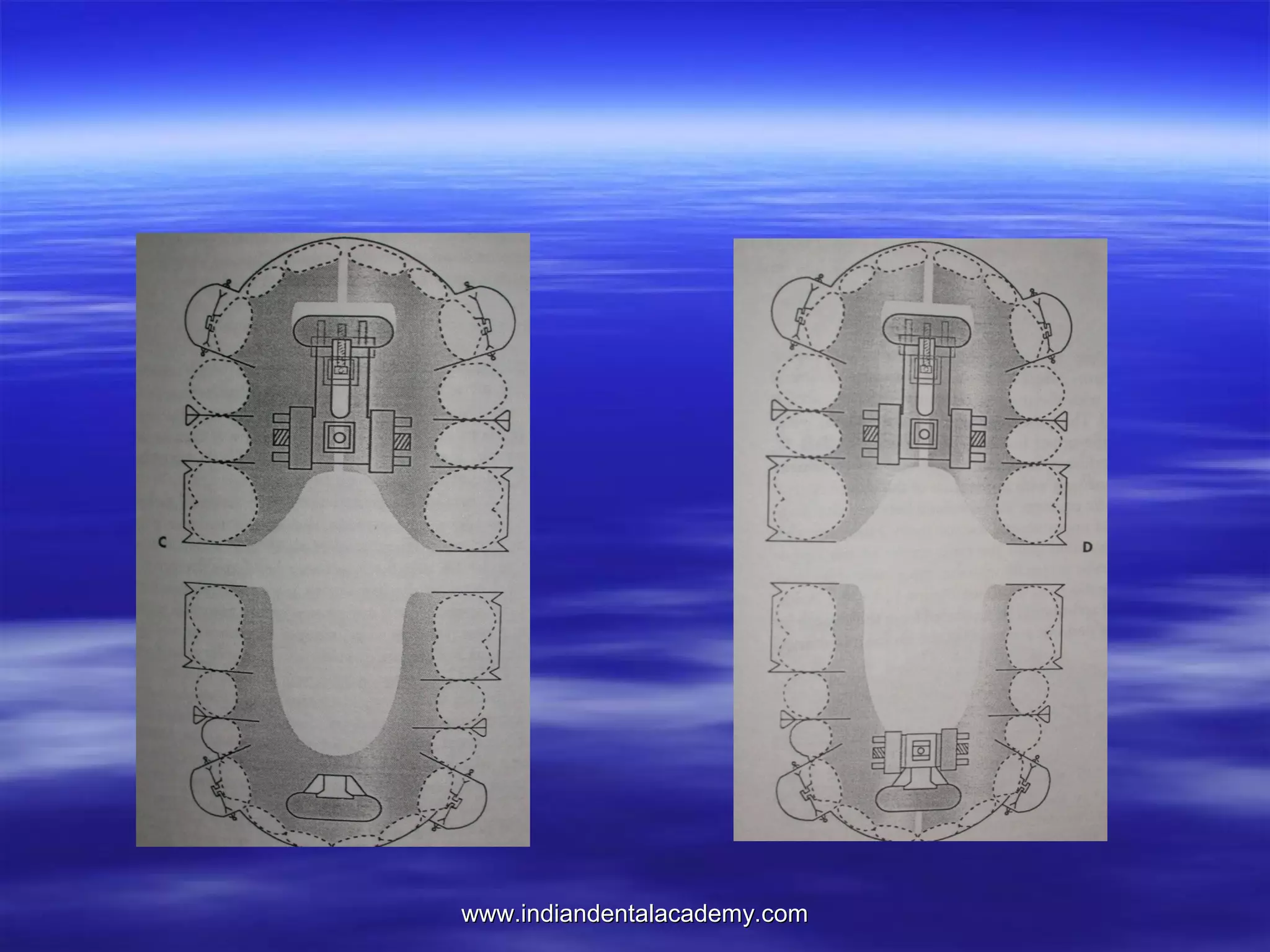
3 magnet configuration to enhance
CL-II mechanics

3 magnet configuration
used to simultaneously
move all 4 canines distally
www.indiandentalacademy.com
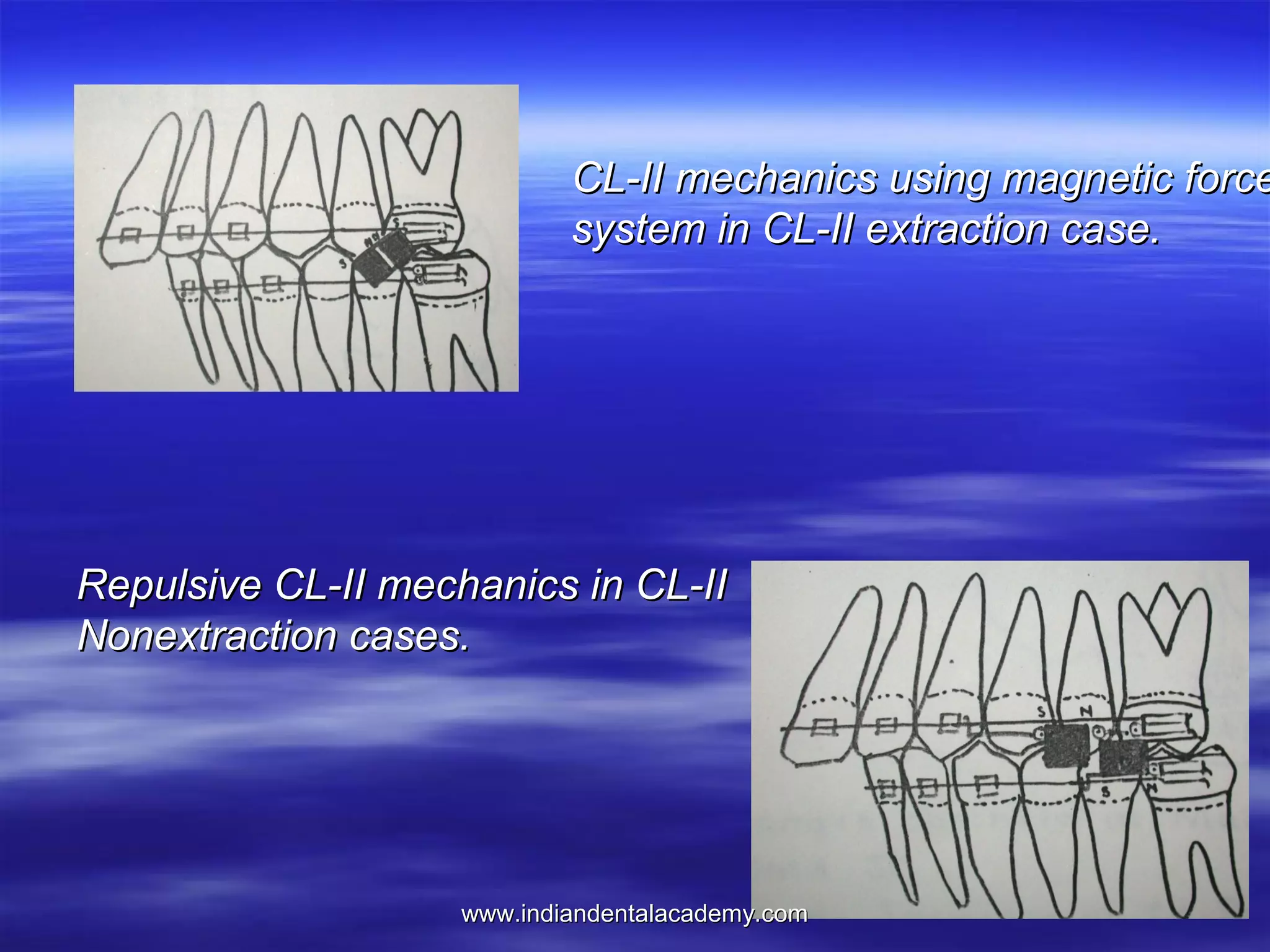
CL-II mechanics using magnetic force
system in CL-II extraction case.

Repulsive CL-II mechanics in CL-II
Nonextraction cases.

www.indiandentalacademy.com
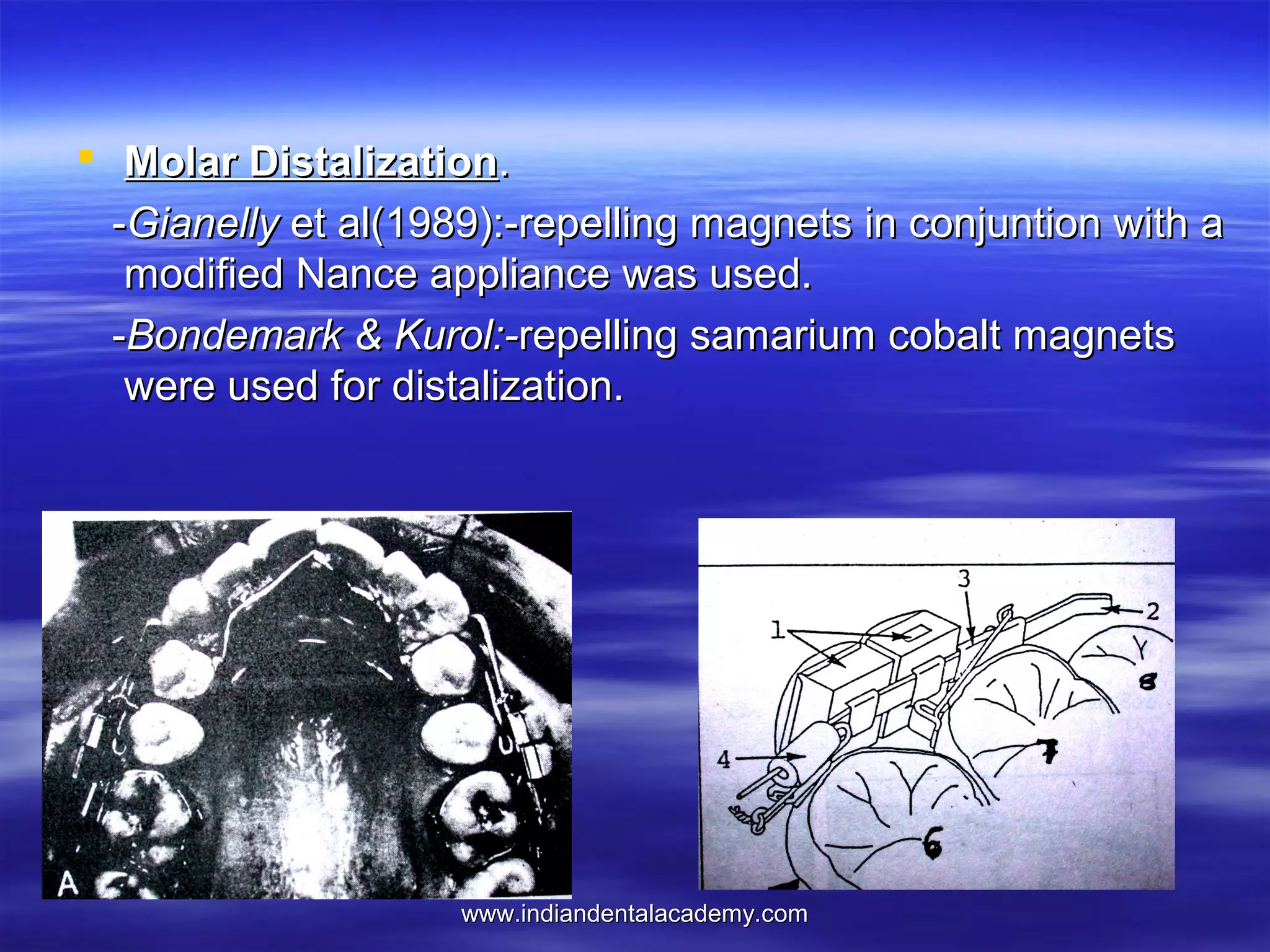
 Molar Distalization.
-Gianelly et al(1989):-repelling magnets in conjuntion with a
modified Nance appliance was used.
-Bondemark & Kurol:-repelling samarium cobalt magnets
were used for distalization.

www.indiandentalacademy.com
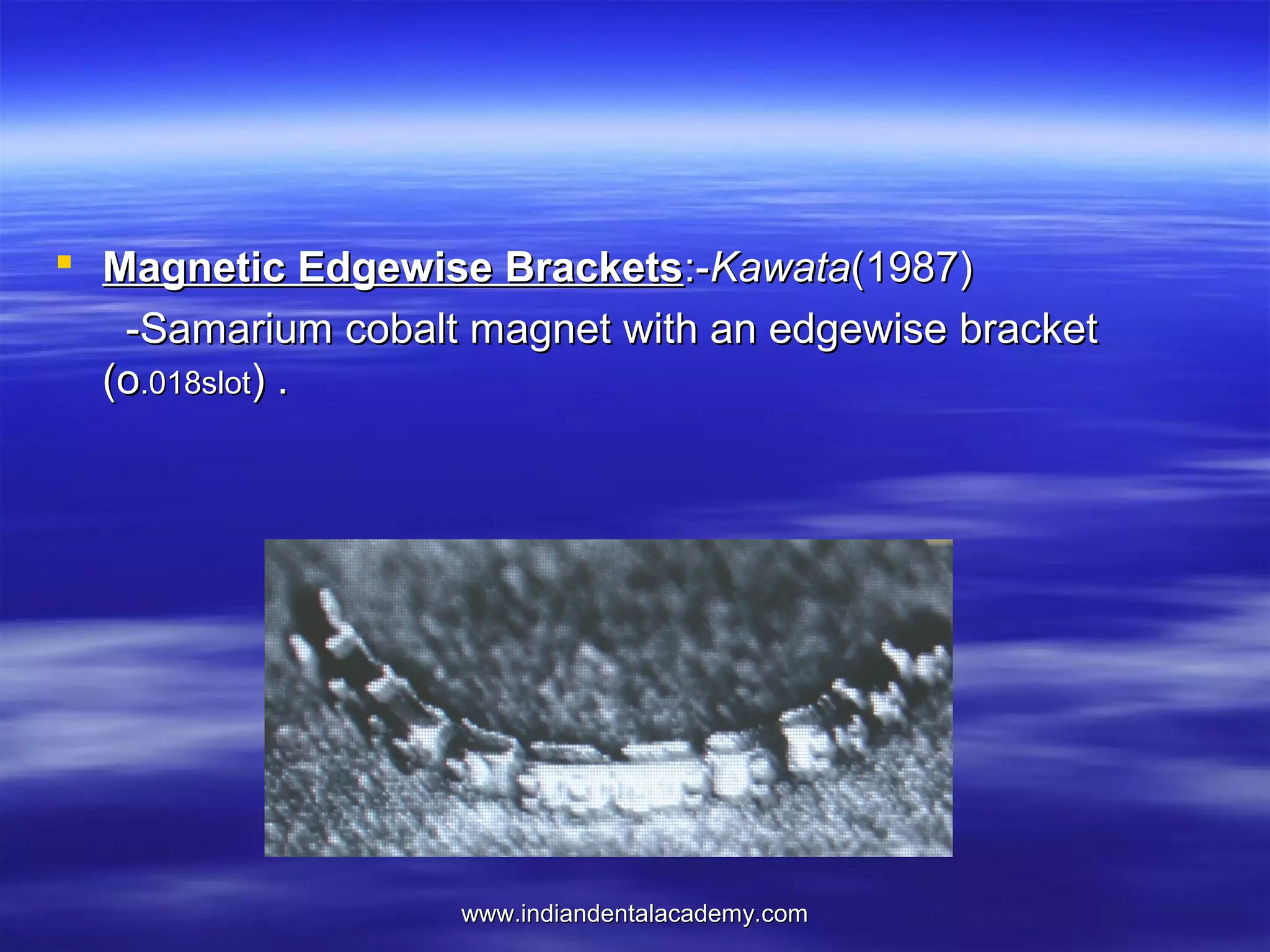
 Magnetic Edgewise Brackets:-Kawata(1987)
-Samarium cobalt magnet with an edgewise bracket
(o.018slot) .

www.indiandentalacademy.com
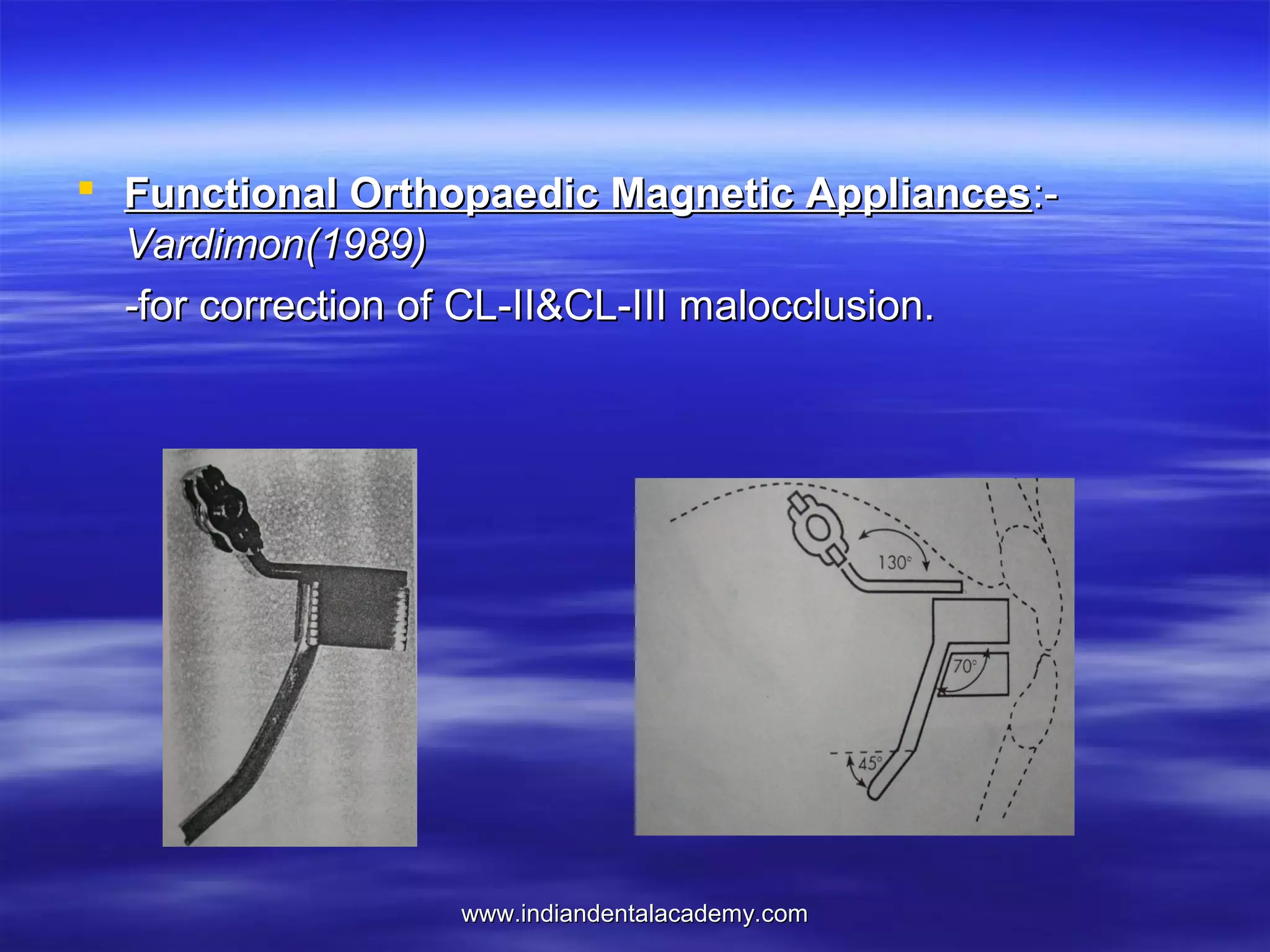
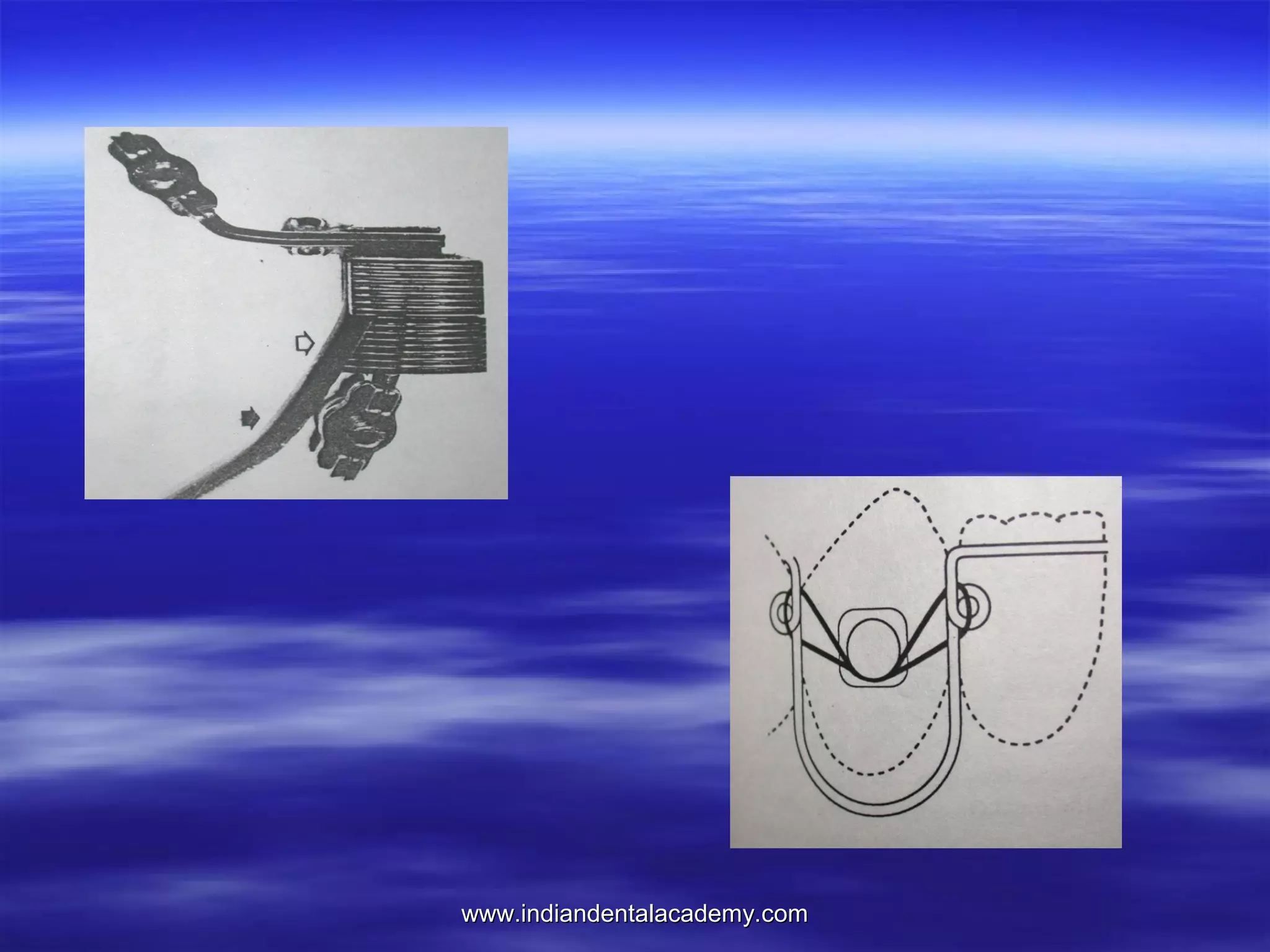
 Functional Orthopaedic Magnetic Appliances:Vardimon(1989)
-for correction of CL-II&CL-III malocclusion.

www.indiandentalacademy.com
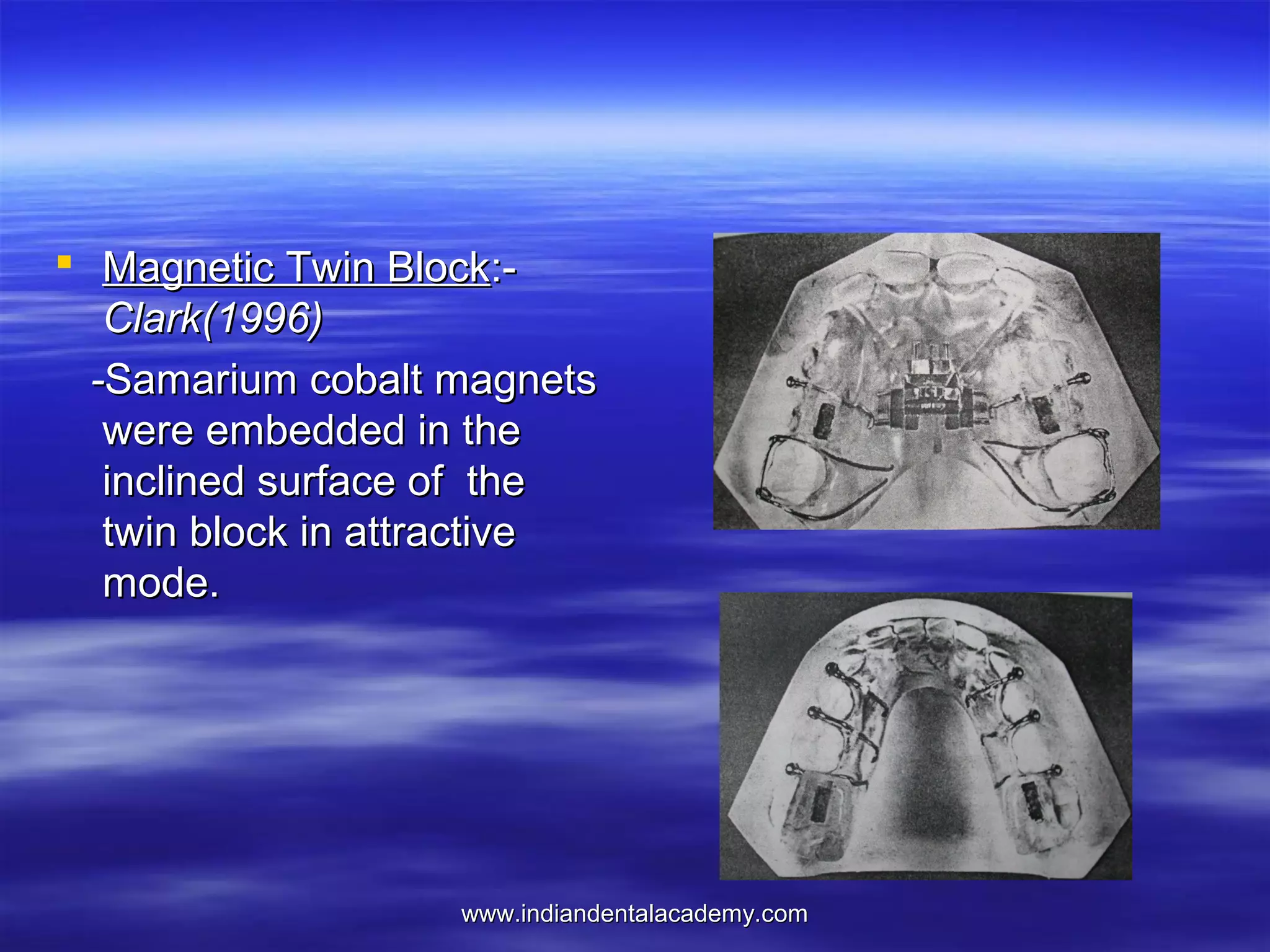
 Magnetic Twin Block:Clark(1996)
-Samarium cobalt magnets
were embedded in the
inclined surface of the
twin block in attractive
mode.

www.indiandentalacademy.com
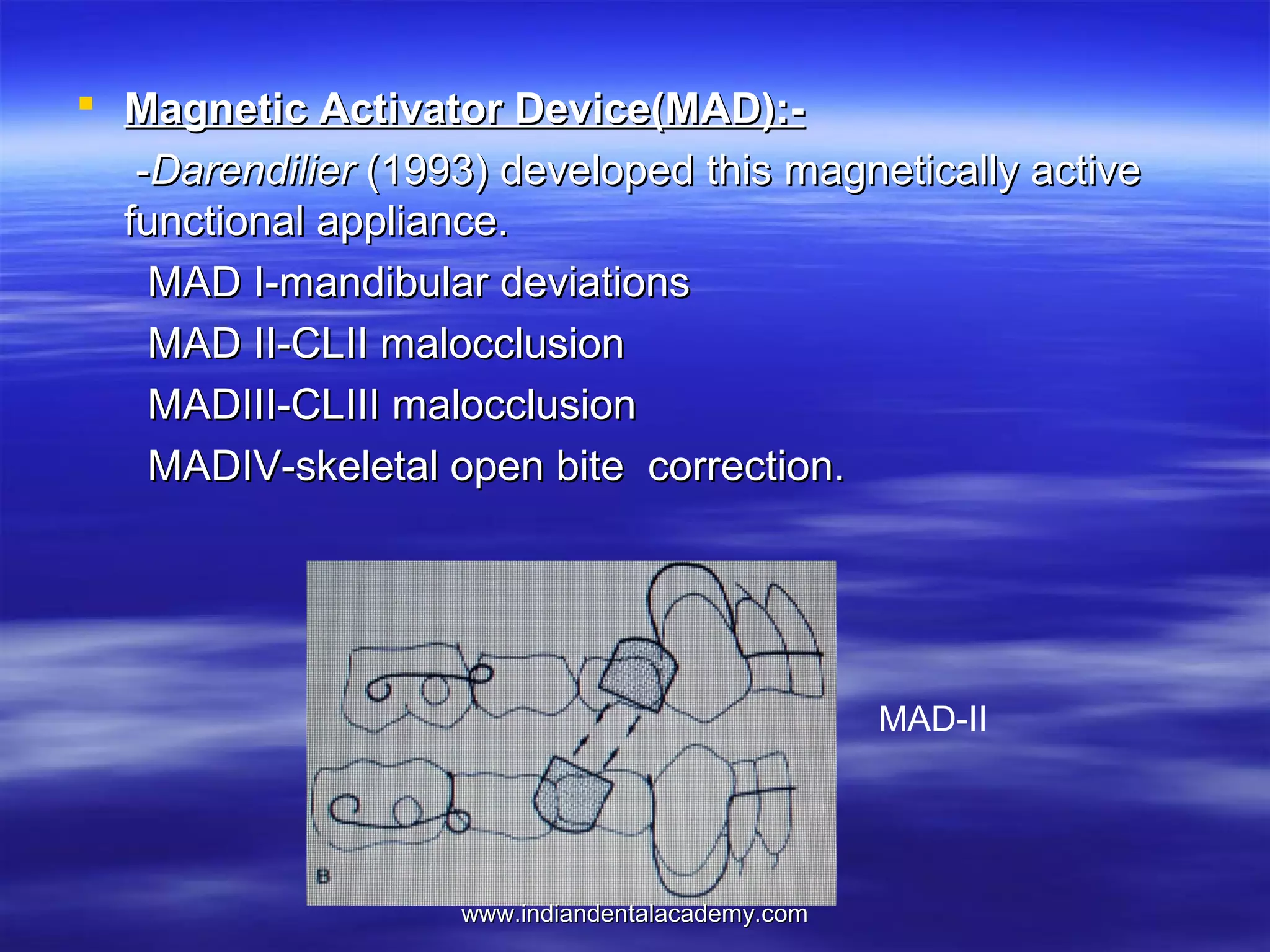
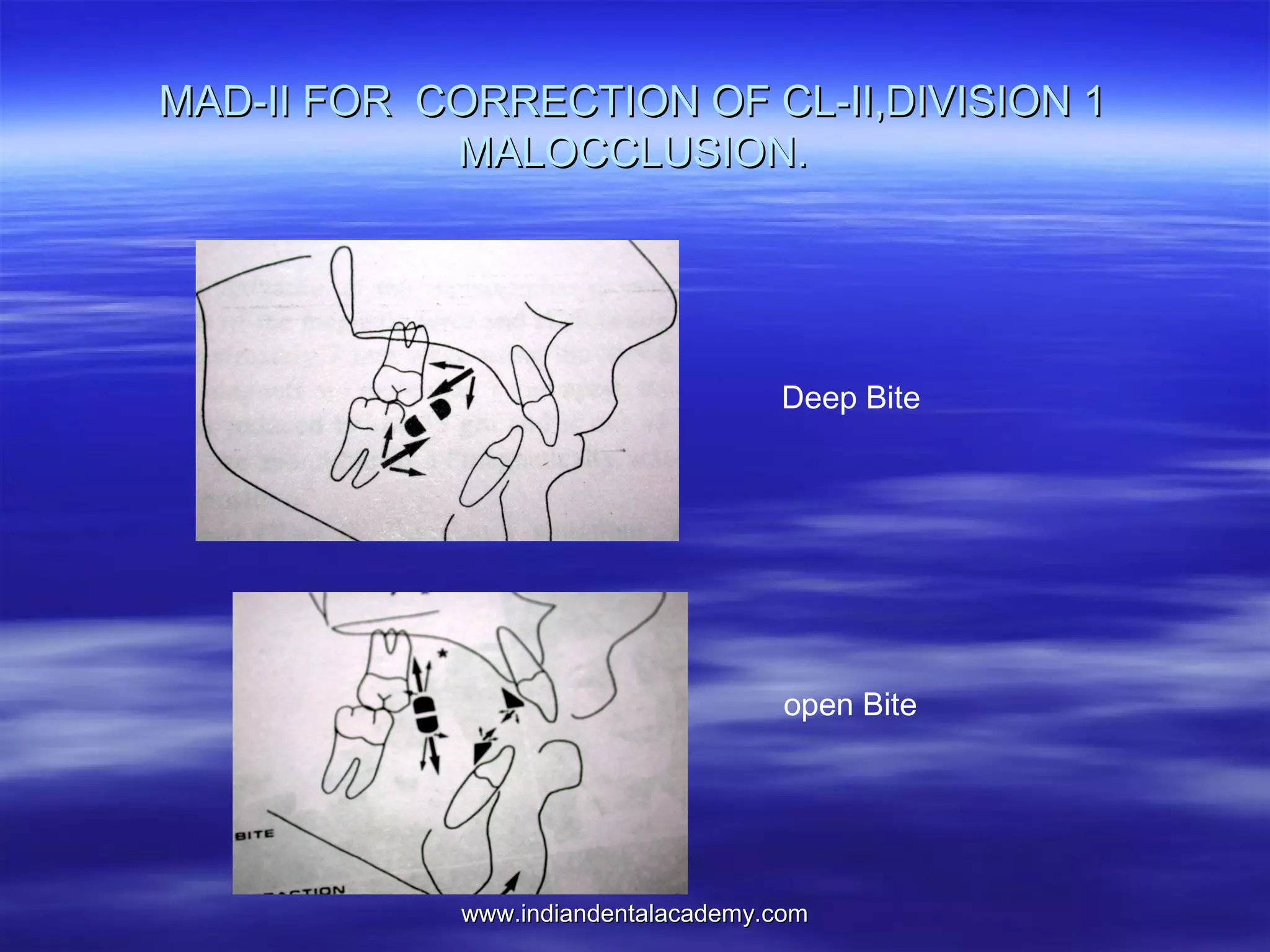
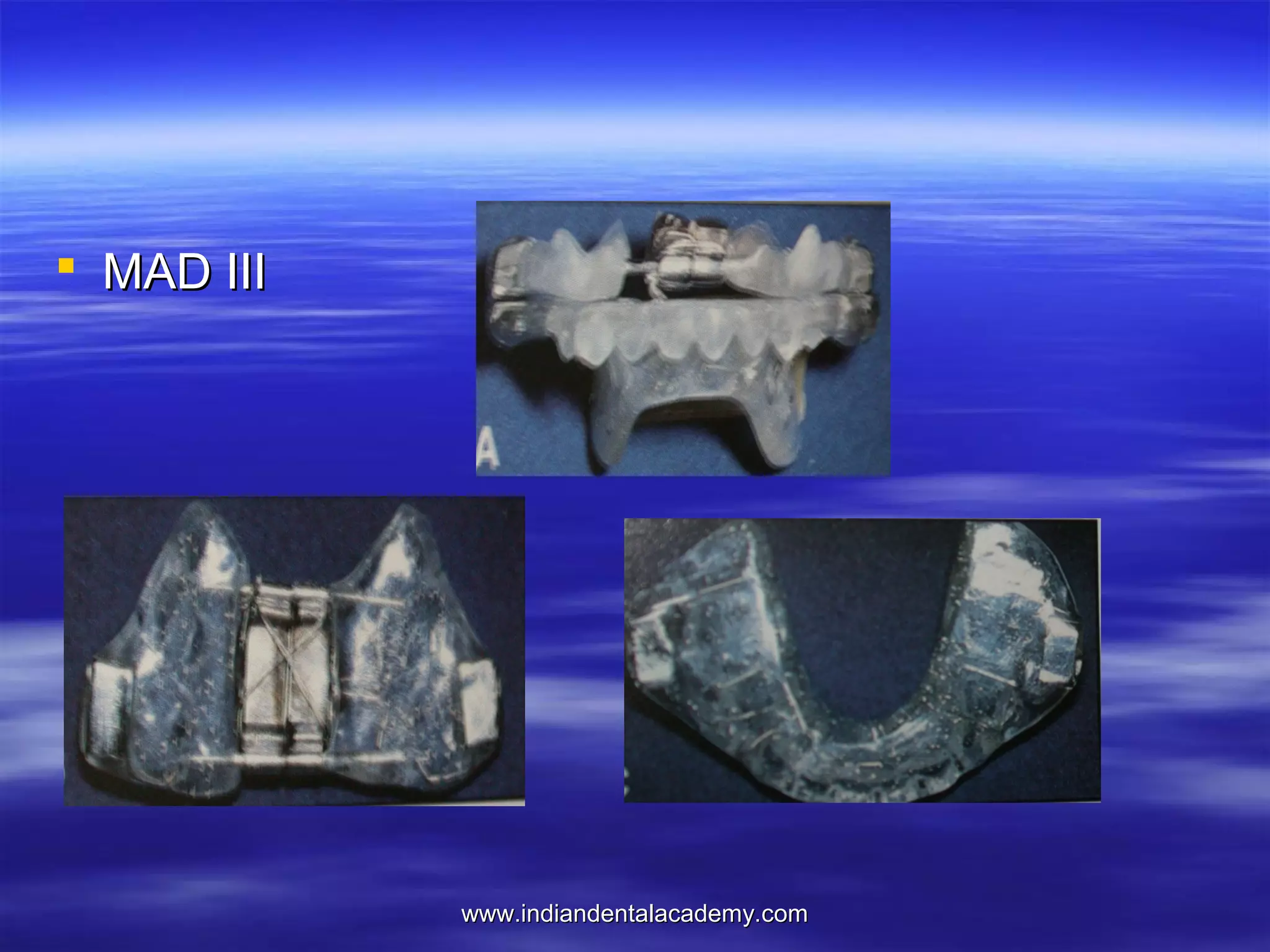
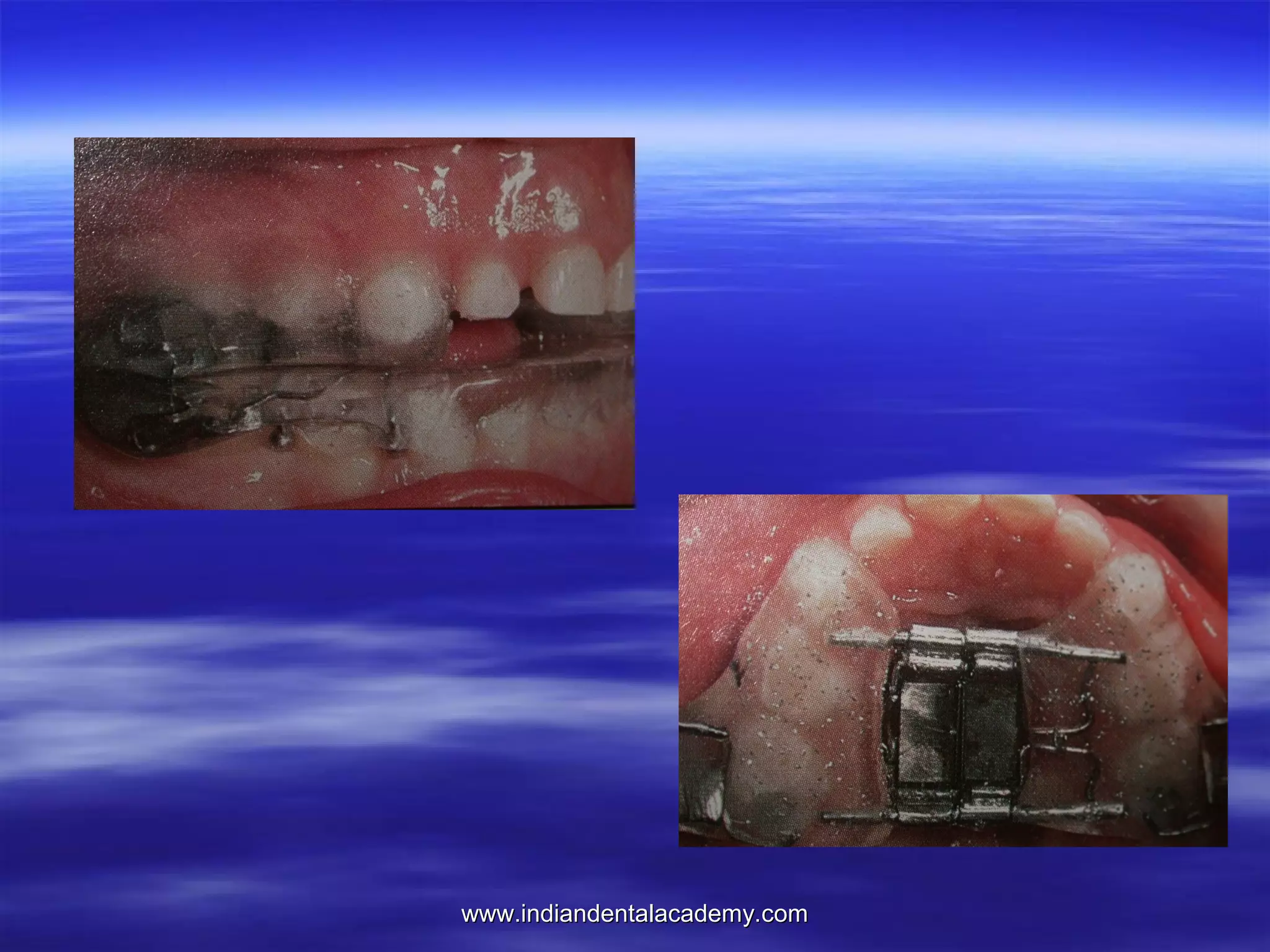
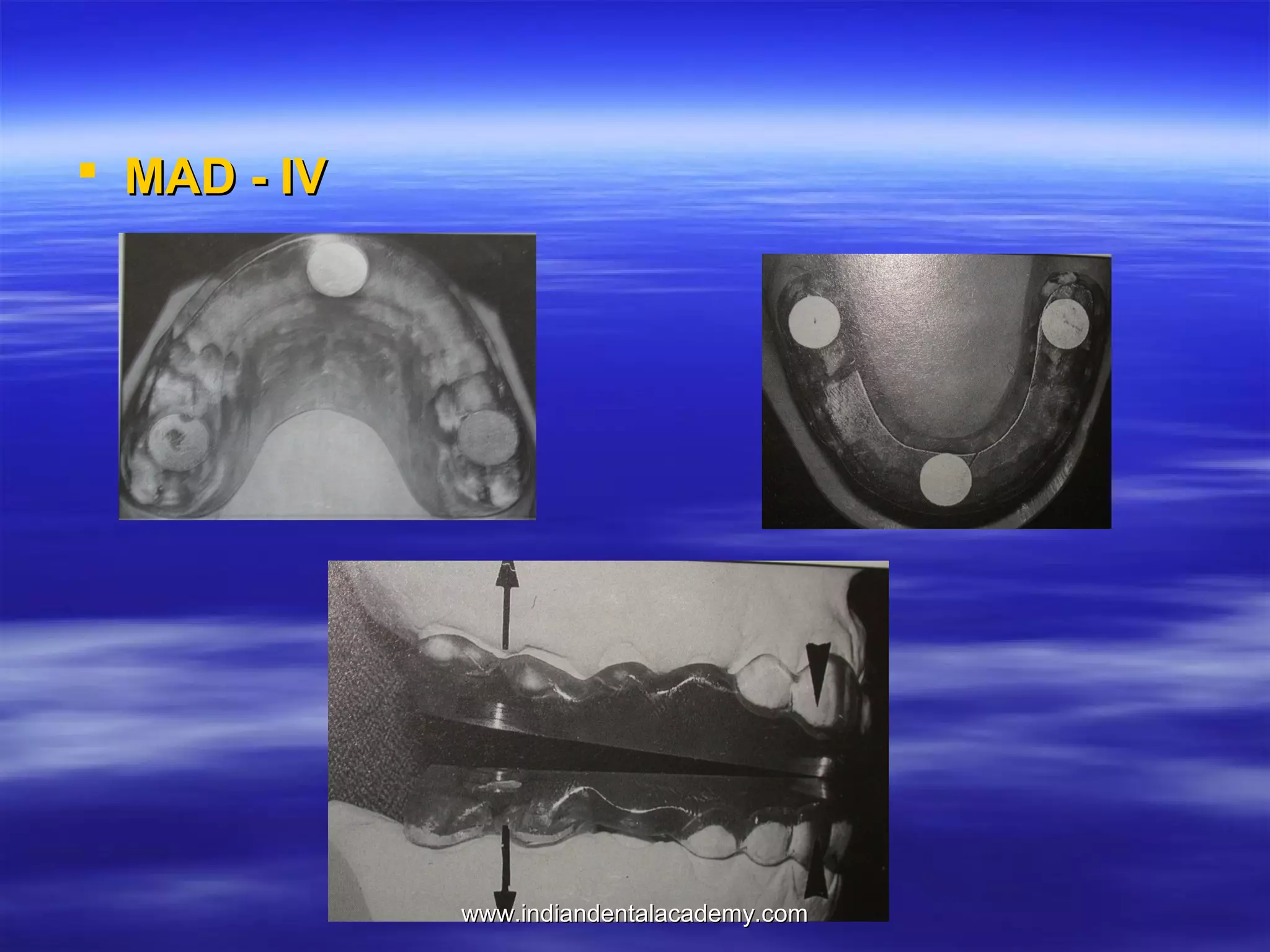
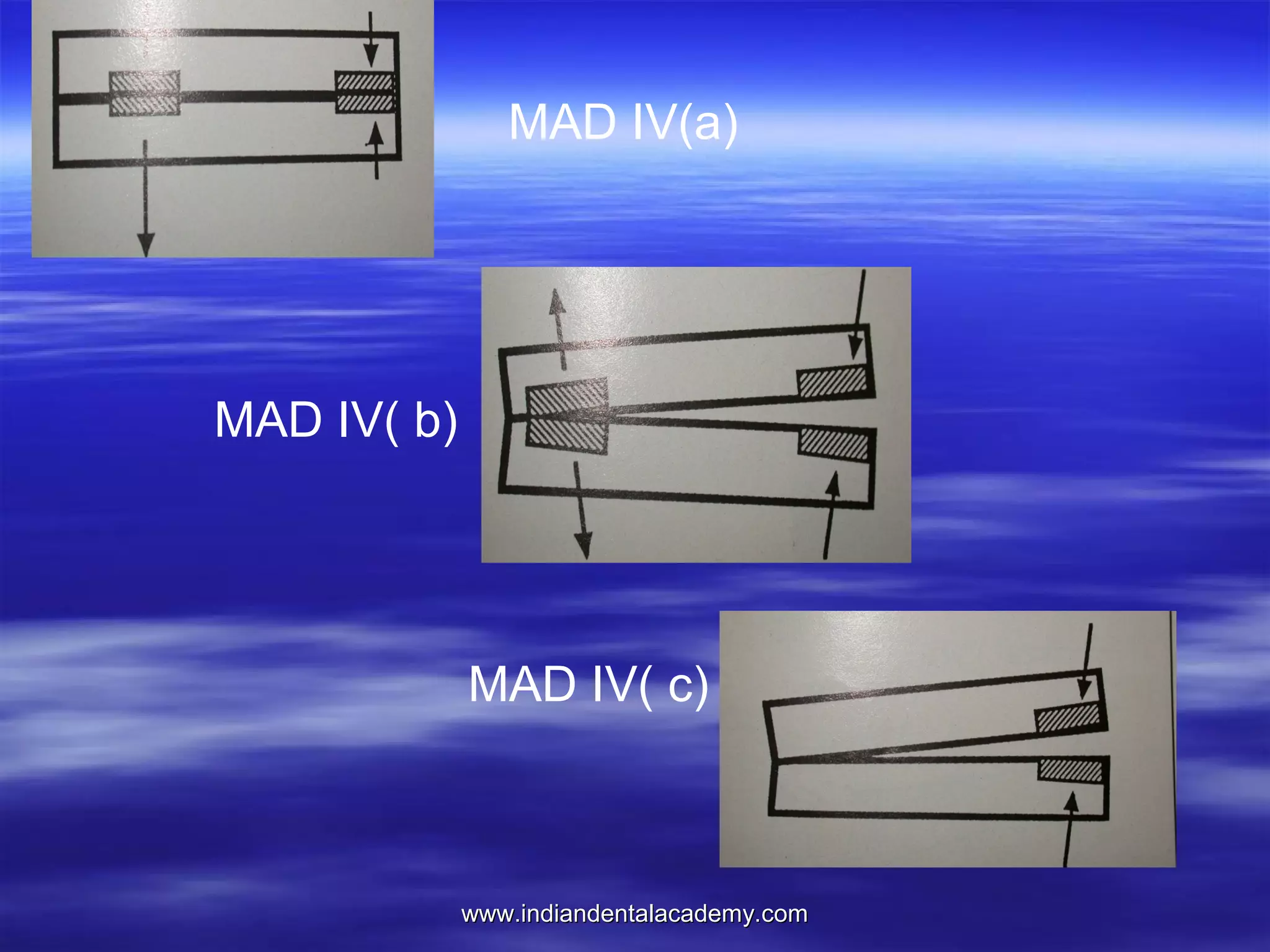
 Magnetic Activator Device(MAD):-Darendilier (1993) developed this magnetically active
functional appliance.
MAD I-mandibular deviations
MAD II-CLII malocclusion
MADIII-CLIII malocclusion
MADIV-skeletal open bite correction.

MAD-II

www.indiandentalacademy.com
MAD-II FOR CORRECTION OF CL-II,DIVISION 1
MALOCCLUSION.

Deep Bite

open Bite

www.indiandentalacademy.com
 MAD III

www.indiandentalacademy.com
 MAD - IV

www.indiandentalacademy.com
MAD IV(a)

MAD IV( b)

MAD IV( c)

www.indiandentalacademy.com
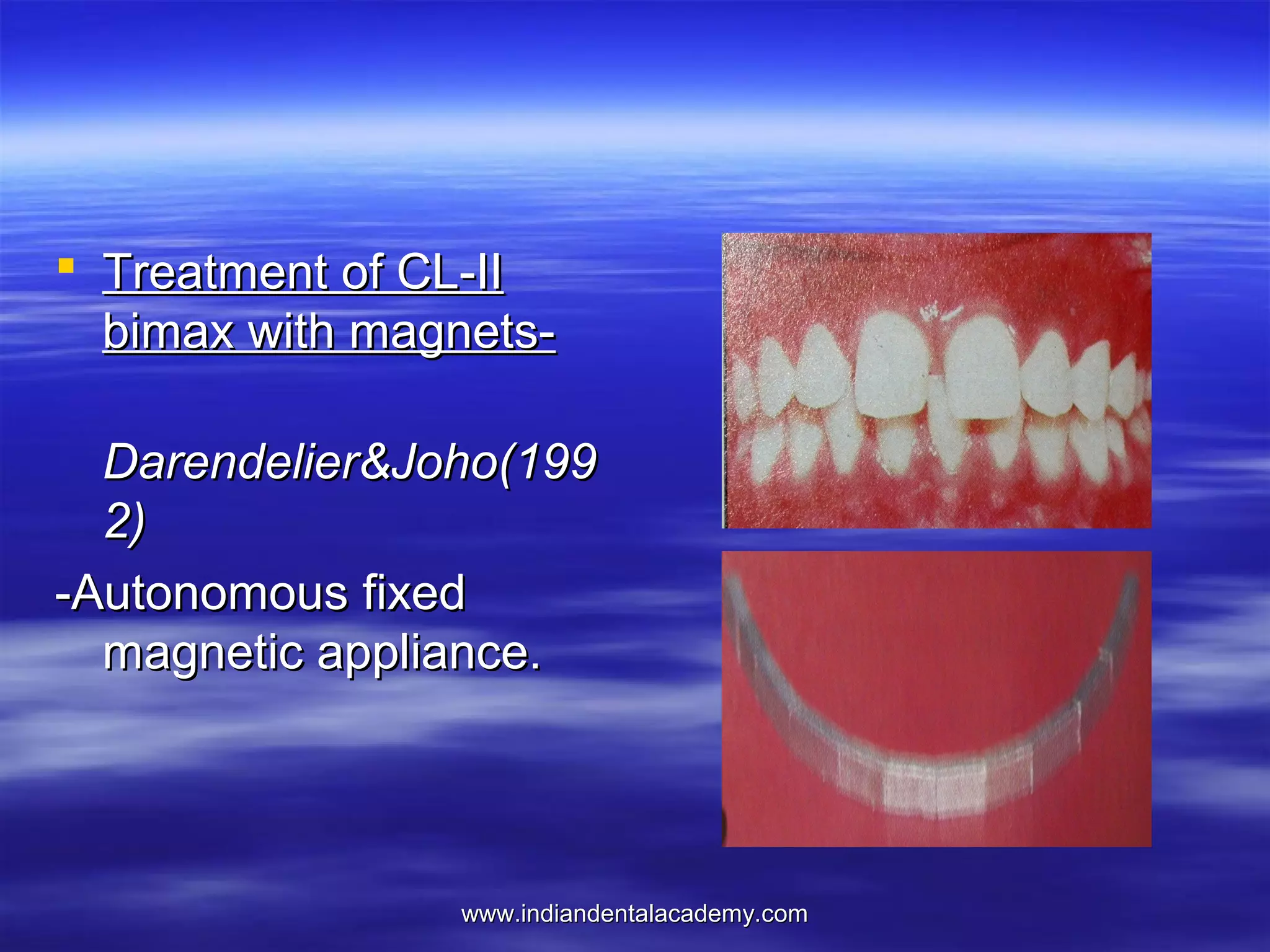
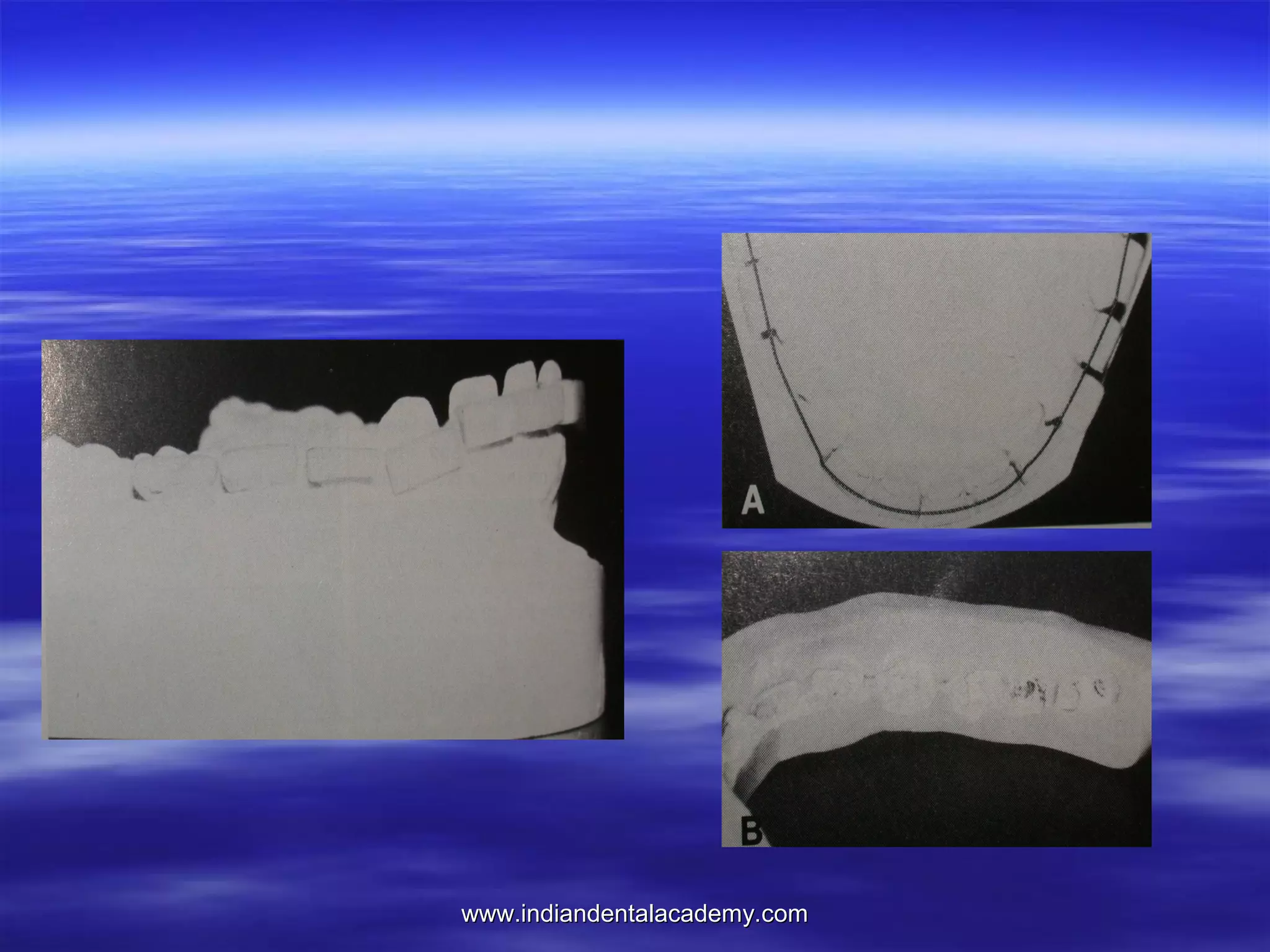
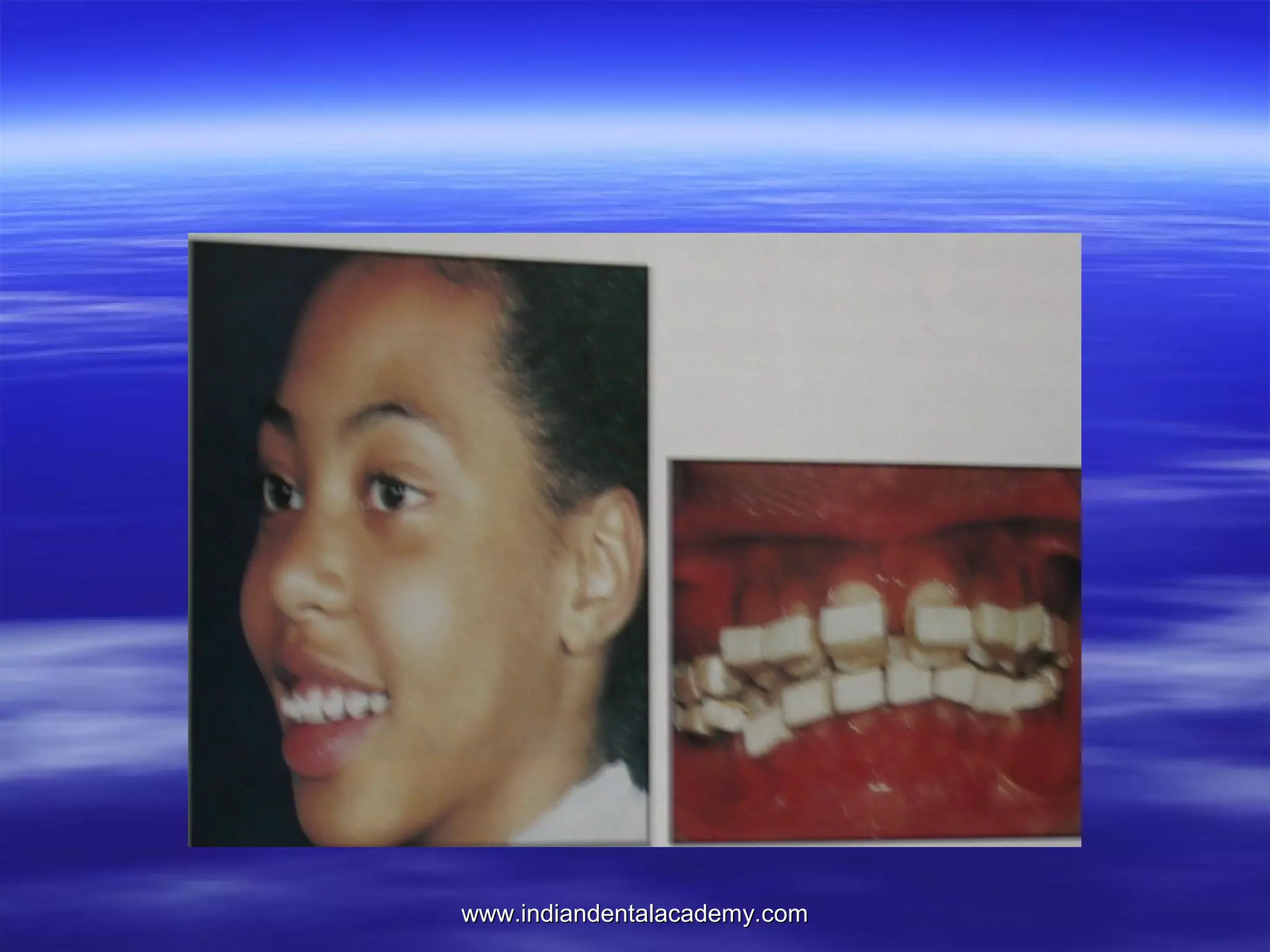
 Treatment of CL-II
bimax with magnetsDarendelier&Joho(199
2)
-Autonomous fixed
magnetic appliance.

www.indiandentalacademy.com
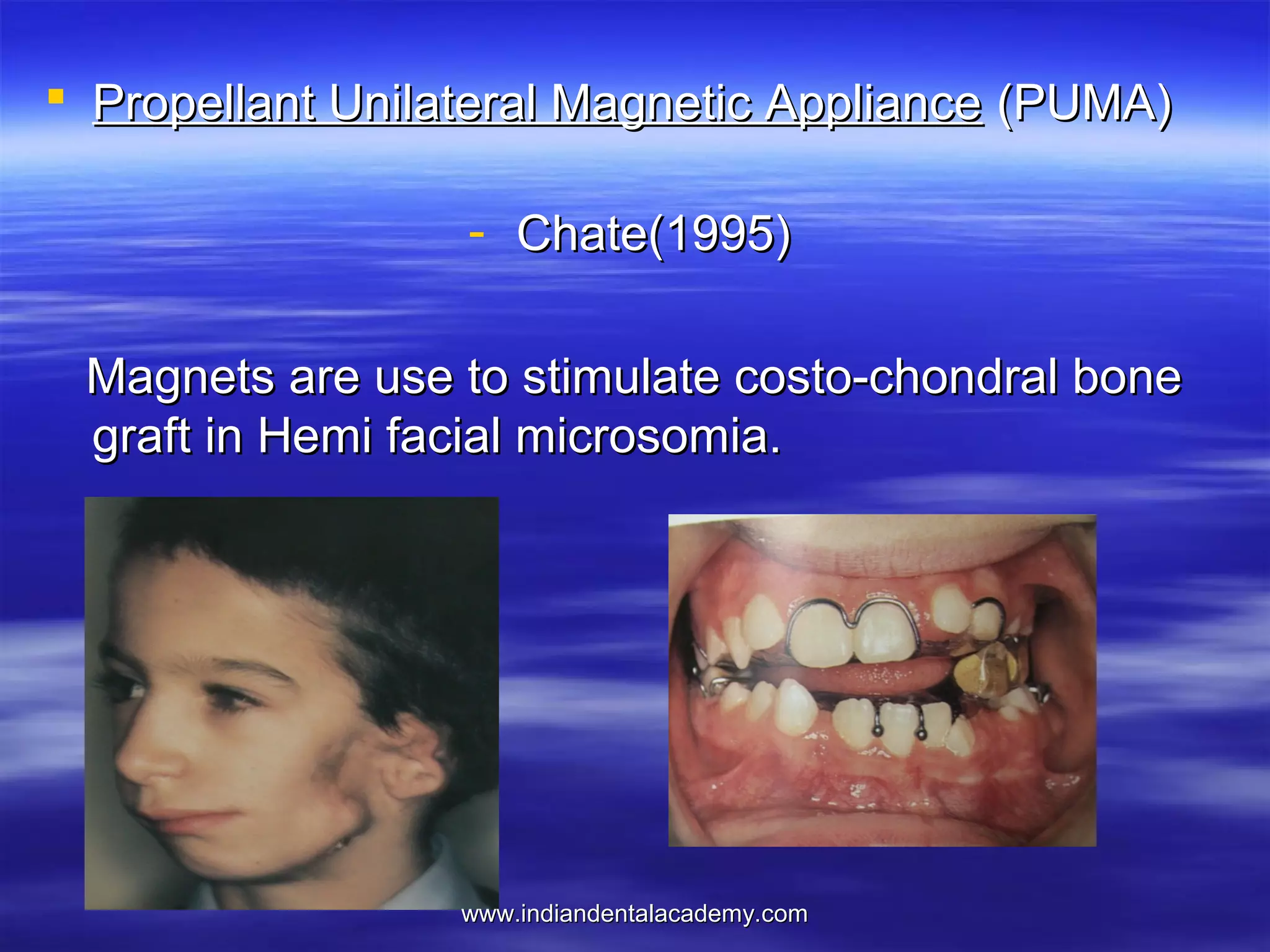
 Propellant Unilateral Magnetic Appliance (PUMA)
- Chate(1995)
Magnets are use to stimulate costo-chondral bone
graft in Hemi facial microsomia.

www.indiandentalacademy.com
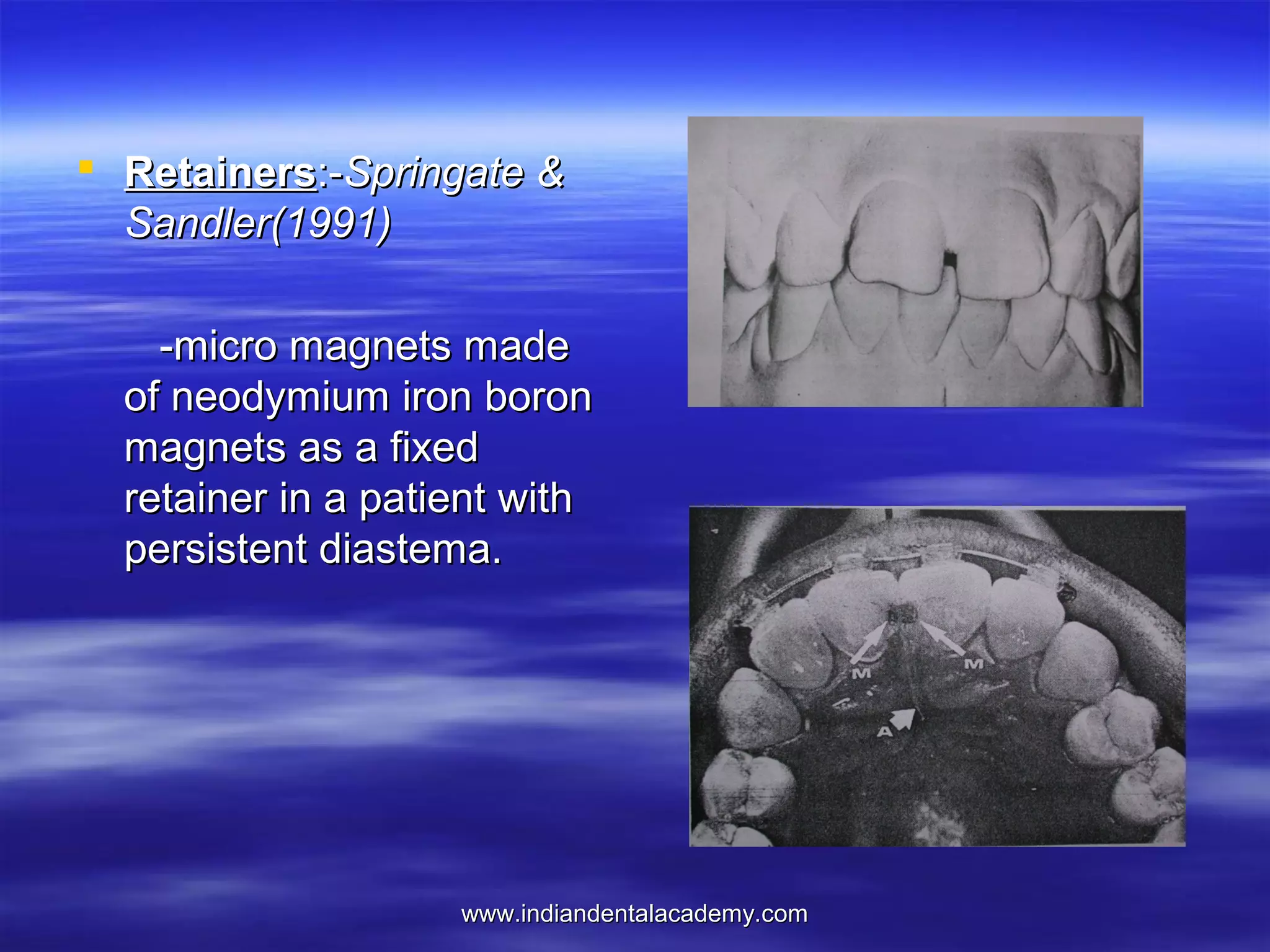
 Retainers:-Springate &
Sandler(1991)
-micro magnets made
of neodymium iron boron
magnets as a fixed
retainer in a patient with
persistent diastema.

www.indiandentalacademy.com
 Bibiliography:-

-Dentofacial Orthopedics with functional appliances-T.M Graber,
Rakosi,Petrovic.
-

www.indiandentalacademy.com
Thank you
www.indiandentalacademy.com
Leader in continuing dental education

www.indiandentalacademy.com

Implants in orthodontics /certified fixed orthodontic courses by Indian dental academy