Guided by –
Dr. Shruti Mittal
Professor & Hod
Department of orthodontics and dentofacial orthopaedics
 Introduction
 Torquing auxiliaries with spurs
 Other torquing auxuliary designs
 Uprighting springs in new australian wire
 Securing the new springs
 Conclusion
 References
 Torque is inclination of dental crown antero
posteriorly in the anterior teeth and
transversal in posterior teeth – 3rd key in
occlusion
 Torque provides control over root movements
 By Dr. Begg
 Unique advantage – separates root moving
forces from archwire forces.
 Reactions generated are spread to entire
arch
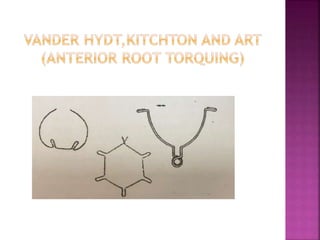
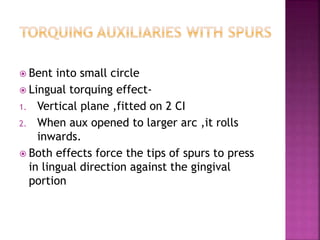
 Bent into small circle
 Lingual torquing effect-
1. Vertical plane ,fitted on 2 CI
2. When aux opened to larger arc ,it rolls
inwards.
 Both effects force the tips of spurs to press
in lingual direction against the gingival
portion
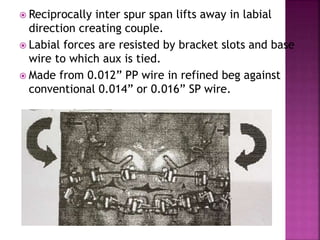
 Reciprocally inter spur span lifts away in labial
direction creating couple.
 Labial forces are resisted by bracket slots and base
wire to which aux is tied.
 Made from 0.012” PP wire in refined beg against
conventional 0.014” or 0.016” SP wire.
1. Length of spur :- Longer spur produces gentler
and constant force so Avg length of spur should
be 5 mm, depending on clinical crown height,
1 mm short of gum.
2. Inclination of spur :- kept at 0 deg to occlusal
plane for 100% activation simulating forces
produced by heavier wires with lesser degree
of activation.
3. Angle of spur :- inter spur span opens up and
the legs of spur tend to converge and may
cross each other on tying, which is remedied
by slightly over angulating the spur and legs
being divergent, on placing spurs will move to
MD centre of crowns keeping legs parallel.
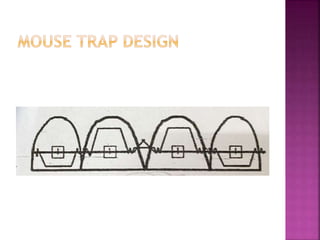
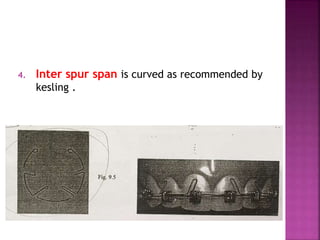
4. Inter spur span is curved as recommended by
kesling .
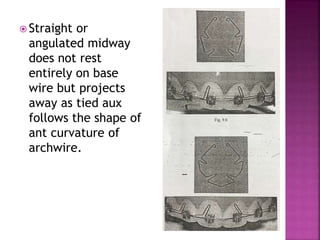
 Straight or
angulated midway
does not rest
entirely on base
wire but projects
away as tied aux
follows the shape of
ant curvature of
archwire.
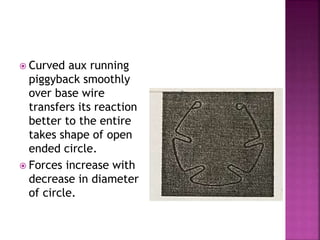
 Curved aux running
piggyback smoothly
over base wire
transfers its reaction
better to the entire
takes shape of open
ended circle.
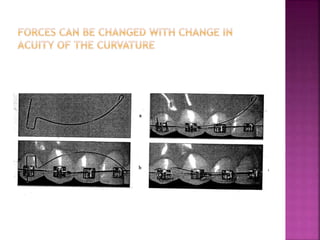
 Forces increase with
decrease in diameter
of circle.
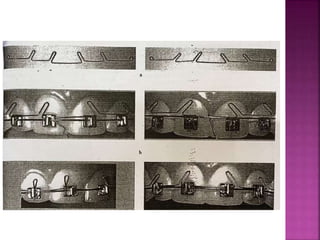
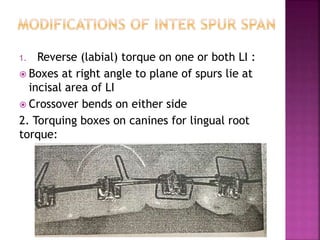
1. Reverse (labial) torque on one or both LI :
 Boxes at right angle to plane of spurs lie at
incisal area of LI
 Crossover bends on either side
2. Torquing boxes on canines for lingual root
torque:
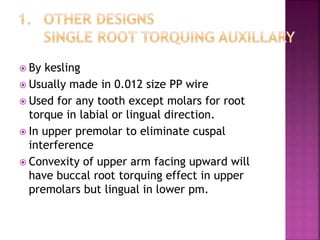
 By kesling
 Usually made in 0.012 size PP wire
 Used for any tooth except molars for root
torque in labial or lingual direction.
 In upper premolar to eliminate cuspal
interference
 Convexity of upper arm facing upward will
have buccal root torquing effect in upper
premolars but lingual in lower pm.
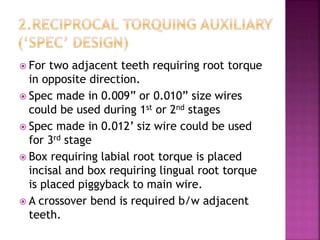
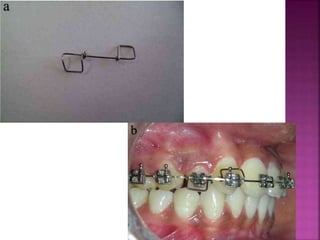
 For two adjacent teeth requiring root torque
in opposite direction.
 Spec made in 0.009” or 0.010” size wires
could be used during 1st or 2nd stages
 Spec made in 0.012’ siz wire could be used
for 3rd stage
 Box requiring labial root torque is placed
incisal and box requiring lingual root torque
is placed piggyback to main wire.
 A crossover bend is required b/w adjacent
teeth.
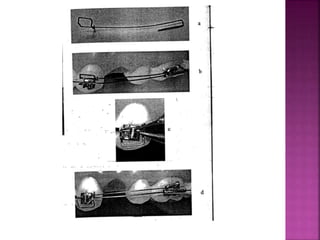
 For controlling roots of canines or premolars
 By FRANCIKUS TAN in 1987 in JOURNAL OF
CLINICAL ORTHODONTICS
 for labial root movement of palatally
impacted max canine with aligned crown.
 Inverted for lingual root torque
 Made from 0.012” P+ wire and fitted in
conjunction with 0.018” & 0.020” base wire.
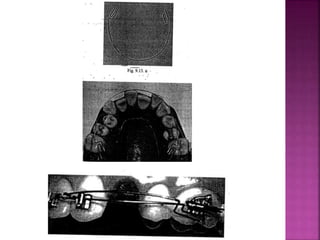
 To torque roots buccally In 3rd stage for u6
crown rolling buccally .
 Boot design occlusal extensions on the
molars & inserted from the mesial end of
molar tubes.
 Boot portion is twisted lingually and givena
toe in, auxillary is suitably contracted.
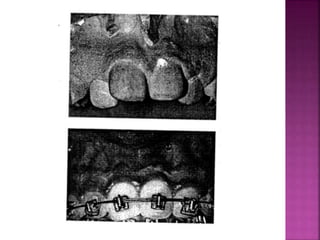
 Design similar to jenner auxillary
 Made from 0.012” size wire and placed with
convexity of the auxillary facing gingivally.
 Engaged first in incisors brackets, main wire
is then engaged piggyback.
 Boxes extend labially on the incisal area of
the crowns.
 In lower incisors where central incisors and
the canines are normal & no reciprocal
lingual root torque.
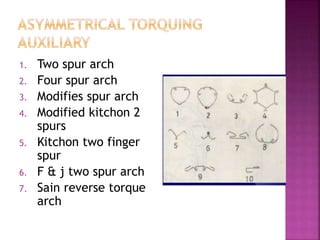
1. Two spur arch
2. Four spur arch
3. Modifies spur arch
4. Modified kitchon 2
spurs
5. Kitchon two finger
spur
6. F & j two spur arch
7. Sain reverse torque
arch
 New australian wires
 Beggs appliance lacks mesio-distal control
 MD angulation of the roots correction during
third stage.
 Springs made in 0.016” , 0.018” & 0.014”
size wires.
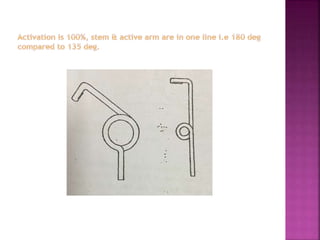
 Mollenhauer introduced mini springs made in
0.009” size supreme grade wire.
 Difference from older springs :-
1. Coil is only twice the wire size
2. Stem runs tangential to the coil
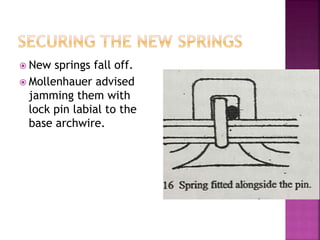
 New springs fall off.
 Mollenhauer advised
jamming them with
lock pin labial to the
base archwire.
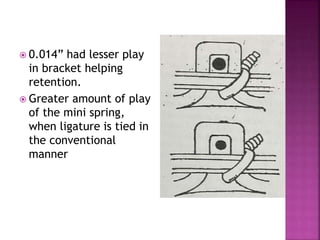
 0.014” had lesser play
in bracket helping
retention.
 Greater amount of play
of the mini spring,
when ligature is tied in
the conventional
manner
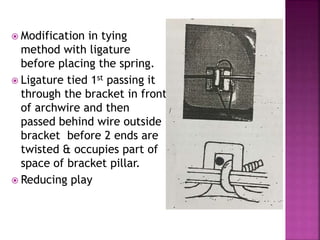
 Modification in tying
method with ligature
before placing the spring.
 Ligature tied 1st passing it
through the bracket in front
of archwire and then
passed behind wire outside
bracket before 2 ends are
twisted & occupies part of
space of bracket pillar.
 Reducing play
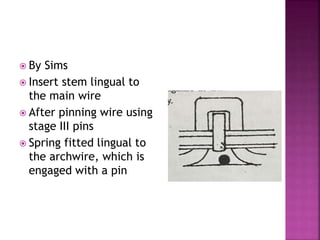
 By Sims
 Insert stem lingual to
the main wire
 After pinning wire using
stage III pins
 Spring fitted lingual to
the archwire, which is
engaged with a pin
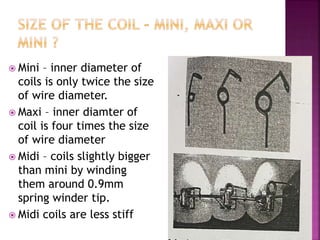
 Mini – inner diameter of
coils is only twice the size
of wire diameter.
 Maxi – inner diamter of
coil is four times the size
of wire diameter
 Midi – coils slightly bigger
than mini by winding
them around 0.9mm
spring winder tip.
 Midi coils are less stiff
 Auxiliaries provide adequate controlled light
forces by clinician providing aesthetic
results.
1. Kesling p.c : begg theory and technique: past
present and future: johnston LE, editor: new
vistas in orthodontics, lea and febiger,
philadelphia, 1985 chapter 9; page 32
2. Karandikar G: the mouse trap auxiliary.manual
of 2nd ios pg convention dharwad
3. Swain bf: the begg technique: graber TM,
swain BF, current principles and technique ed
2, st louis, C. C. Mosby Company, page 794,
1975
4. Begg PR: begg PR, kesling PC: begg orthodontic
theory and technique, ed 3, philadephia: w b
saunders, page 132,1971
5. Tan f: begg reverse torquing auxiliary: j clin
orthod; 21: 789, 1987.
Torquing auxiliaries

Torquing auxiliaries

  • 2.
    Guided by – Dr.Shruti Mittal Professor & Hod Department of orthodontics and dentofacial orthopaedics
  • 3.
     Introduction  Torquingauxiliaries with spurs  Other torquing auxuliary designs  Uprighting springs in new australian wire  Securing the new springs  Conclusion  References
  • 4.
     Torque isinclination of dental crown antero posteriorly in the anterior teeth and transversal in posterior teeth – 3rd key in occlusion  Torque provides control over root movements  By Dr. Begg  Unique advantage – separates root moving forces from archwire forces.  Reactions generated are spread to entire arch
  • 7.
     Bent intosmall circle  Lingual torquing effect- 1. Vertical plane ,fitted on 2 CI 2. When aux opened to larger arc ,it rolls inwards.  Both effects force the tips of spurs to press in lingual direction against the gingival portion
  • 8.
     Reciprocally interspur span lifts away in labial direction creating couple.  Labial forces are resisted by bracket slots and base wire to which aux is tied.  Made from 0.012” PP wire in refined beg against conventional 0.014” or 0.016” SP wire.
  • 9.
    1. Length ofspur :- Longer spur produces gentler and constant force so Avg length of spur should be 5 mm, depending on clinical crown height, 1 mm short of gum. 2. Inclination of spur :- kept at 0 deg to occlusal plane for 100% activation simulating forces produced by heavier wires with lesser degree of activation. 3. Angle of spur :- inter spur span opens up and the legs of spur tend to converge and may cross each other on tying, which is remedied by slightly over angulating the spur and legs being divergent, on placing spurs will move to MD centre of crowns keeping legs parallel.
  • 11.
    4. Inter spurspan is curved as recommended by kesling .
  • 12.
     Straight or angulatedmidway does not rest entirely on base wire but projects away as tied aux follows the shape of ant curvature of archwire.
  • 13.
     Curved auxrunning piggyback smoothly over base wire transfers its reaction better to the entire takes shape of open ended circle.  Forces increase with decrease in diameter of circle.
  • 14.
    1. Reverse (labial)torque on one or both LI :  Boxes at right angle to plane of spurs lie at incisal area of LI  Crossover bends on either side 2. Torquing boxes on canines for lingual root torque:
  • 15.
     By kesling Usually made in 0.012 size PP wire  Used for any tooth except molars for root torque in labial or lingual direction.  In upper premolar to eliminate cuspal interference  Convexity of upper arm facing upward will have buccal root torquing effect in upper premolars but lingual in lower pm.
  • 17.
     For twoadjacent teeth requiring root torque in opposite direction.  Spec made in 0.009” or 0.010” size wires could be used during 1st or 2nd stages  Spec made in 0.012’ siz wire could be used for 3rd stage  Box requiring labial root torque is placed incisal and box requiring lingual root torque is placed piggyback to main wire.  A crossover bend is required b/w adjacent teeth.
  • 19.
     For controllingroots of canines or premolars  By FRANCIKUS TAN in 1987 in JOURNAL OF CLINICAL ORTHODONTICS  for labial root movement of palatally impacted max canine with aligned crown.  Inverted for lingual root torque  Made from 0.012” P+ wire and fitted in conjunction with 0.018” & 0.020” base wire.
  • 21.
     To torqueroots buccally In 3rd stage for u6 crown rolling buccally .  Boot design occlusal extensions on the molars & inserted from the mesial end of molar tubes.  Boot portion is twisted lingually and givena toe in, auxillary is suitably contracted.
  • 23.
     Design similarto jenner auxillary  Made from 0.012” size wire and placed with convexity of the auxillary facing gingivally.  Engaged first in incisors brackets, main wire is then engaged piggyback.  Boxes extend labially on the incisal area of the crowns.  In lower incisors where central incisors and the canines are normal & no reciprocal lingual root torque.
  • 25.
    1. Two spurarch 2. Four spur arch 3. Modifies spur arch 4. Modified kitchon 2 spurs 5. Kitchon two finger spur 6. F & j two spur arch 7. Sain reverse torque arch
  • 26.
     New australianwires  Beggs appliance lacks mesio-distal control  MD angulation of the roots correction during third stage.  Springs made in 0.016” , 0.018” & 0.014” size wires.  Mollenhauer introduced mini springs made in 0.009” size supreme grade wire.  Difference from older springs :- 1. Coil is only twice the wire size 2. Stem runs tangential to the coil
  • 28.
     New springsfall off.  Mollenhauer advised jamming them with lock pin labial to the base archwire.
  • 29.
     0.014” hadlesser play in bracket helping retention.  Greater amount of play of the mini spring, when ligature is tied in the conventional manner
  • 30.
     Modification intying method with ligature before placing the spring.  Ligature tied 1st passing it through the bracket in front of archwire and then passed behind wire outside bracket before 2 ends are twisted & occupies part of space of bracket pillar.  Reducing play
  • 31.
     By Sims Insert stem lingual to the main wire  After pinning wire using stage III pins  Spring fitted lingual to the archwire, which is engaged with a pin
  • 32.
     Mini –inner diameter of coils is only twice the size of wire diameter.  Maxi – inner diamter of coil is four times the size of wire diameter  Midi – coils slightly bigger than mini by winding them around 0.9mm spring winder tip.  Midi coils are less stiff
  • 33.
     Auxiliaries provideadequate controlled light forces by clinician providing aesthetic results.
  • 34.
    1. Kesling p.c: begg theory and technique: past present and future: johnston LE, editor: new vistas in orthodontics, lea and febiger, philadelphia, 1985 chapter 9; page 32 2. Karandikar G: the mouse trap auxiliary.manual of 2nd ios pg convention dharwad 3. Swain bf: the begg technique: graber TM, swain BF, current principles and technique ed 2, st louis, C. C. Mosby Company, page 794, 1975 4. Begg PR: begg PR, kesling PC: begg orthodontic theory and technique, ed 3, philadephia: w b saunders, page 132,1971 5. Tan f: begg reverse torquing auxiliary: j clin orthod; 21: 789, 1987.