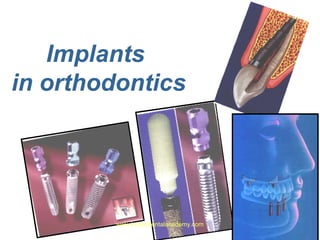

Implants
in orthodontics

www.indiandentalacademy.com
INDIAN DENTAL ACADEMY
Leader in continuing dental education
www.indiandentalacademy.com

www.indiandentalacademy.com
contents






Introduction
Historical background
Classification of implants
Basic terminologies
principles

www.indiandentalacademy.com
Historical background

www.indiandentalacademy.com
 Earliest dental implants used were of stone
& ivory, cited in archeological records of
china & Egypt , before the common era.
 Gold & ivory dental implants were used in
16th & 17th century.

www.indiandentalacademy.com
Metal implants device of gold , lead, iridium,
stainless steel, cobalt alloy were developed
in 20th century.
Cobalt – chromium – molybdenum subperiosteal & titanium blade implants were
introduced in 1940s & 60s respectively &
became the most popular & successful
implants device from 1950-80 .
www.indiandentalacademy.com
Exaggerated claims in the wake of long term
morbidity & unpredictability engendered
disbelief & disinterest & even denial on the
part of organized dentistry.
These implants never really caught.

www.indiandentalacademy.com
Ancient implants –
Attempts to replace lost teeth with endosteal
implants have been traced to ancient egyptian &
south American civilization.
A skull from Pre Columbian era in museum shows
an artificial tooth carved from dark stone replaced
a lower left lateral incisor.
Implanted animal & carved ivory tooth cited in
ancient Egyptian writings are oldest examples of
primitive implantology.
www.indiandentalacademy.com
Early implants –
1809 Maggido placed a single staged gold implant
without a crown to heal passively in a fresh
extraction site ,just above the gingiva the crown
was added after healing.
The insertions of such tooth roots of gold was added
after healing .
The insertion of such teeth roots of gold was
inevitably followed by intense pain & gingival
inflammation
www.indiandentalacademy.com
Terminologies

www.indiandentalacademy.com
Implant-:
A dental implant is a device of
biocompatible material/s placed within or
against the mandibular or maxillary bone to
provide additional or enhanced support for a
prosthesis or tooth.

www.indiandentalacademy.com
Endosteal implantEndo – within
Osteal – bone.
alloplastic material surgically
inserted into a residual bony ridge, primarily
to serve as a prosthodontic foundation.
Endosteal implants – root forms
plant form.
www.indiandentalacademy.com
Cylinder fit ( press fit )-: root form implants
depends upon microscopic retention & / or
bonding to the bone & usually are pushed or
tapped into a prepared bone .
Screw root form are threaded into a bone site
& have obvious macroscopic retentive
elements
for initial bone fixation
.combination root forms are common &
have feature of both cylinder & screw root
form.
www.indiandentalacademy.com
Subperiosteal implants –
Because there is often not enough bone in
which to place an endosteal implant
dentists turned to placing a on & around the
bone

www.indiandentalacademy.com
Transosteal implants –
175 Small introduced the transosteal
mandibular
staple
bone
plate,
a
reconstructive device placed through a
submental incisions & attached to the
mandible with multiple fixation & 2
transosteal screws to support a full arch
prosthesis.
www.indiandentalacademy.com
CLASSIFICATION

www.indiandentalacademy.com
Implants

Endosteal

Root form

subperiosteal

plate/blade form

transosteal

endodontic stabilizer

www.indiandentalacademy.com
Endoosteal implants –
Endosteal implants comprise one broad
category of implants . The most commonly
applicable abutment providing modalities
are endosteal.
The endosteal implants are placed within a
fully or partially edentulous alveolar ridges
with sufficient residual bone available.
www.indiandentalacademy.com
Some endosteal implants are attached to
components for the retention of a fixed or
removable prosthesis. Other implants are
equipped with an abutment integral with the
implant body, which protrudes into the oral
cavity during healing.

www.indiandentalacademy.com
Root form –
root form implants are designed to resemble
the shape of a natural tooth root. They
usually are circular in cross section .
As a general rule root form must achieve
osseointegration to succeed. Therefore they
are placed in a functional state during
healing until they are osseointegrated
www.indiandentalacademy.com
Most of the root forms are 2 stage implants .
Stage 1 – is submersion or semi submersion.
To permit a functional healing
Stage 2 – is attachment of an abutment or
retention mechanism.
A root form can be placed anywhere in the
mandible or maxilla where there is sufficient
bone available.
www.indiandentalacademy.com
Plate / Blade form –
As the name suggests the basic shape of plate or
blade implant is similar to that of a metal plate or
blade in cross section . Some plate blade forms
have combination of parallel & tapered sides.
Plate / Blade forms are unique among implants in
that they can function successfully in either
osseointegration or osteopreservation mode of
tissue integration.
www.indiandentalacademy.com
Plate/blade form implants

www.indiandentalacademy.com
Endodontic stabilizer implants

www.indiandentalacademy.com
The endodontic stabilizers function in the
osteopreservation mode of tissue integeration

www.indiandentalacademy.com
Ramus frame implants –
often intended for treatment of total
mandibular edentulism with severe alveolar
ridge resorption.

www.indiandentalacademy.com
Transosteal implants –
Surgically invasive & technique sensitive.
These implants feature a plate that is placed
against the exposed inferior border of the
mandible with extension that pass from this
plate through symphyseal area out of the
creast of the alce

www.indiandentalacademy.com
Consultation
 Chief complaint
 Patients Goals of Treatment

www.indiandentalacademy.com
Clinical Examination




Medical examination
Radiography
Diagnostic Models

www.indiandentalacademy.com
Diagnosis & Treatment Planning




Periodontics
Operative
Prosthodontics
– Abutment support evaluations
 New implant abutment support
– Evaluation of available bone
 Quality
 Quantity
– Choice of implant modality
 Endosteal
- root form
- plate / blade form
 Subperiosteal

 Natural implant abutment support
www.indiandentalacademy.com
 Goal-oriented case presentation
– Other treatment options
– Thoroughly informed consent





Acceptance of treatment plan
Treatment
Maintenance
– Professional maintenance
 Recall examination and prophylaxis
 Early detection & treatment related complication
 Patient education

– Home care
www.indiandentalacademy.com
Rigid Implant Anchorage to Close a Mandibular
First Molar Extraction Site
Age = 34 year
Sex = Male
Class I mutilated malocclusion
Missing: maxillary right first and mandibular left
first permanent molars
 Treatment : Implant-supported anchorage
 Tx planning : non-extraction  to close the
asymmetric first molar extraction  unidirectional
(mesial) space closure.





www.indiandentalacademy.com

W. EUGENE ROBERTS,
CHARLES L. NELSON,
CHARLES J. GOODACRE,
www.indiandentalacademy.com
$

www.indiandentalacademy.com
The use of implants for orthodontic correction of
an open bite
Beth Prosterman, DDS, Leonard Prosterman, BA, DDS, MS, Cert.Ortho.,
Ronald Fisher, BSc, DMD, MSD, Mervyn Gornitsky, BSc, DDS

The patient, a 25-year-old healthy man, sustained a
traumatic injury to the anterior mandible. A
panoramic radiograph revealed nondisplaced
horizontal and vertical fractures of the mandibular
anterior alveolar processes with displacement of
lower right incisors, canine, and premolar. The
lower left incisors were avulsed at the time of
trauma. He was treated initially with a temporary
acrylic splint involving the lower right incisors, and
the lower canines and premolar.
www.indiandentalacademy.com
.

www.indiandentalacademy.com
Prediction of mandibular growth
rotation
A. Björk, Odont. Dr.
 The technique whereby metal implants are
inserted in bone has been used in animals for
more than a century.
 The application of the method in craniometric
studies of growth in man is of more recent date.
begun in 1951.
 It comprised study of 100 children of each sex
covering the age period from 4 to 24 years. The
sample consists of normal children with and
without malocclusion and also children with
pathologic conditions.
www.indiandentalacademy.com
A growth analysis consists essentially of three items,
each of which is clinically significant:
1. An assessment of the development in shape of
the face which, in the first place, implies changes
in the intermaxillary relationship.
2. An assessment of whether the intensity of the
facial growth in general is high or low.
3. An evaluation of the individual rate of maturation.
This is important in establishing whether puberty
has been reached and when the growth may be
expected to be completed.
www.indiandentalacademy.com
Osseointegrated titanium, implants for
maxillofacial protraction in monkeys

www.indiandentalacademy.com
Forced eruption and implant site
development: Soft tissue response
Theo Mantzikos, DMD, and Ilan Shamus, DDS

www.indiandentalacademy.com
Roentgen stereometry with the aid of metallic
implants in hemifacial microsomia

 Bodil Rune, Odont. Dr., Karl-Victor Sarnäs, M.S., Odont. Dr., Göran
Selvik,
M.D.,
and
Sten
Jacobsson,
M.D.
Malmö and Lund,

www.indiandentalacademy.com
Thank you
www.indiandentalacademy.com
Leader in continuing dental education

www.indiandentalacademy.com

Implants in orthodontics 2 /certified fixed orthodontic courses by Indian dental academy

  • 1.
  • 2.
    INDIAN DENTAL ACADEMY Leaderin continuing dental education www.indiandentalacademy.com www.indiandentalacademy.com
  • 3.
    contents      Introduction Historical background Classification ofimplants Basic terminologies principles www.indiandentalacademy.com
  • 4.
  • 5.
  • 6.
     Earliest dentalimplants used were of stone & ivory, cited in archeological records of china & Egypt , before the common era.  Gold & ivory dental implants were used in 16th & 17th century. www.indiandentalacademy.com
  • 7.
    Metal implants deviceof gold , lead, iridium, stainless steel, cobalt alloy were developed in 20th century. Cobalt – chromium – molybdenum subperiosteal & titanium blade implants were introduced in 1940s & 60s respectively & became the most popular & successful implants device from 1950-80 . www.indiandentalacademy.com
  • 8.
    Exaggerated claims inthe wake of long term morbidity & unpredictability engendered disbelief & disinterest & even denial on the part of organized dentistry. These implants never really caught. www.indiandentalacademy.com
  • 9.
    Ancient implants – Attemptsto replace lost teeth with endosteal implants have been traced to ancient egyptian & south American civilization. A skull from Pre Columbian era in museum shows an artificial tooth carved from dark stone replaced a lower left lateral incisor. Implanted animal & carved ivory tooth cited in ancient Egyptian writings are oldest examples of primitive implantology. www.indiandentalacademy.com
  • 10.
    Early implants – 1809Maggido placed a single staged gold implant without a crown to heal passively in a fresh extraction site ,just above the gingiva the crown was added after healing. The insertions of such tooth roots of gold was added after healing . The insertion of such teeth roots of gold was inevitably followed by intense pain & gingival inflammation www.indiandentalacademy.com
  • 11.
  • 12.
    Implant-: A dental implantis a device of biocompatible material/s placed within or against the mandibular or maxillary bone to provide additional or enhanced support for a prosthesis or tooth. www.indiandentalacademy.com
  • 13.
    Endosteal implantEndo –within Osteal – bone. alloplastic material surgically inserted into a residual bony ridge, primarily to serve as a prosthodontic foundation. Endosteal implants – root forms plant form. www.indiandentalacademy.com
  • 14.
    Cylinder fit (press fit )-: root form implants depends upon microscopic retention & / or bonding to the bone & usually are pushed or tapped into a prepared bone . Screw root form are threaded into a bone site & have obvious macroscopic retentive elements for initial bone fixation .combination root forms are common & have feature of both cylinder & screw root form. www.indiandentalacademy.com
  • 15.
    Subperiosteal implants – Becausethere is often not enough bone in which to place an endosteal implant dentists turned to placing a on & around the bone www.indiandentalacademy.com
  • 16.
    Transosteal implants – 175Small introduced the transosteal mandibular staple bone plate, a reconstructive device placed through a submental incisions & attached to the mandible with multiple fixation & 2 transosteal screws to support a full arch prosthesis. www.indiandentalacademy.com
  • 17.
  • 18.
  • 19.
    Endoosteal implants – Endostealimplants comprise one broad category of implants . The most commonly applicable abutment providing modalities are endosteal. The endosteal implants are placed within a fully or partially edentulous alveolar ridges with sufficient residual bone available. www.indiandentalacademy.com
  • 20.
    Some endosteal implantsare attached to components for the retention of a fixed or removable prosthesis. Other implants are equipped with an abutment integral with the implant body, which protrudes into the oral cavity during healing. www.indiandentalacademy.com
  • 21.
    Root form – rootform implants are designed to resemble the shape of a natural tooth root. They usually are circular in cross section . As a general rule root form must achieve osseointegration to succeed. Therefore they are placed in a functional state during healing until they are osseointegrated www.indiandentalacademy.com
  • 22.
    Most of theroot forms are 2 stage implants . Stage 1 – is submersion or semi submersion. To permit a functional healing Stage 2 – is attachment of an abutment or retention mechanism. A root form can be placed anywhere in the mandible or maxilla where there is sufficient bone available. www.indiandentalacademy.com
  • 23.
    Plate / Bladeform – As the name suggests the basic shape of plate or blade implant is similar to that of a metal plate or blade in cross section . Some plate blade forms have combination of parallel & tapered sides. Plate / Blade forms are unique among implants in that they can function successfully in either osseointegration or osteopreservation mode of tissue integration. www.indiandentalacademy.com
  • 24.
  • 25.
  • 26.
    The endodontic stabilizersfunction in the osteopreservation mode of tissue integeration www.indiandentalacademy.com
  • 27.
    Ramus frame implants– often intended for treatment of total mandibular edentulism with severe alveolar ridge resorption. www.indiandentalacademy.com
  • 28.
    Transosteal implants – Surgicallyinvasive & technique sensitive. These implants feature a plate that is placed against the exposed inferior border of the mandible with extension that pass from this plate through symphyseal area out of the creast of the alce www.indiandentalacademy.com
  • 29.
    Consultation  Chief complaint Patients Goals of Treatment www.indiandentalacademy.com
  • 30.
  • 31.
    Diagnosis & TreatmentPlanning    Periodontics Operative Prosthodontics – Abutment support evaluations  New implant abutment support – Evaluation of available bone  Quality  Quantity – Choice of implant modality  Endosteal - root form - plate / blade form  Subperiosteal  Natural implant abutment support www.indiandentalacademy.com
  • 32.
     Goal-oriented casepresentation – Other treatment options – Thoroughly informed consent    Acceptance of treatment plan Treatment Maintenance – Professional maintenance  Recall examination and prophylaxis  Early detection & treatment related complication  Patient education – Home care www.indiandentalacademy.com
  • 33.
    Rigid Implant Anchorageto Close a Mandibular First Molar Extraction Site Age = 34 year Sex = Male Class I mutilated malocclusion Missing: maxillary right first and mandibular left first permanent molars  Treatment : Implant-supported anchorage  Tx planning : non-extraction  to close the asymmetric first molar extraction  unidirectional (mesial) space closure.     www.indiandentalacademy.com W. EUGENE ROBERTS, CHARLES L. NELSON, CHARLES J. GOODACRE,
  • 34.
  • 35.
  • 36.
  • 37.
  • 38.
  • 39.
    The use ofimplants for orthodontic correction of an open bite Beth Prosterman, DDS, Leonard Prosterman, BA, DDS, MS, Cert.Ortho., Ronald Fisher, BSc, DMD, MSD, Mervyn Gornitsky, BSc, DDS The patient, a 25-year-old healthy man, sustained a traumatic injury to the anterior mandible. A panoramic radiograph revealed nondisplaced horizontal and vertical fractures of the mandibular anterior alveolar processes with displacement of lower right incisors, canine, and premolar. The lower left incisors were avulsed at the time of trauma. He was treated initially with a temporary acrylic splint involving the lower right incisors, and the lower canines and premolar. www.indiandentalacademy.com
  • 40.
  • 41.
  • 42.
  • 43.
  • 44.
  • 45.
    Prediction of mandibulargrowth rotation A. Björk, Odont. Dr.  The technique whereby metal implants are inserted in bone has been used in animals for more than a century.  The application of the method in craniometric studies of growth in man is of more recent date. begun in 1951.  It comprised study of 100 children of each sex covering the age period from 4 to 24 years. The sample consists of normal children with and without malocclusion and also children with pathologic conditions. www.indiandentalacademy.com
  • 46.
    A growth analysisconsists essentially of three items, each of which is clinically significant: 1. An assessment of the development in shape of the face which, in the first place, implies changes in the intermaxillary relationship. 2. An assessment of whether the intensity of the facial growth in general is high or low. 3. An evaluation of the individual rate of maturation. This is important in establishing whether puberty has been reached and when the growth may be expected to be completed. www.indiandentalacademy.com
  • 47.
  • 48.
    Osseointegrated titanium, implantsfor maxillofacial protraction in monkeys www.indiandentalacademy.com
  • 49.
  • 50.
  • 51.
  • 52.
  • 53.
  • 54.
  • 55.
  • 56.
  • 57.
  • 58.
    Forced eruption andimplant site development: Soft tissue response Theo Mantzikos, DMD, and Ilan Shamus, DDS www.indiandentalacademy.com
  • 59.
  • 60.
  • 61.
  • 62.
  • 63.
    Roentgen stereometry withthe aid of metallic implants in hemifacial microsomia  Bodil Rune, Odont. Dr., Karl-Victor Sarnäs, M.S., Odont. Dr., Göran Selvik, M.D., and Sten Jacobsson, M.D. Malmö and Lund, www.indiandentalacademy.com
  • 64.
  • 65.
  • 66.
  • 67.
  • 68.
  • 69.
    Thank you www.indiandentalacademy.com Leader incontinuing dental education www.indiandentalacademy.com