Presenter: Dr. Aisha Khoja
Resident, Orthodontics
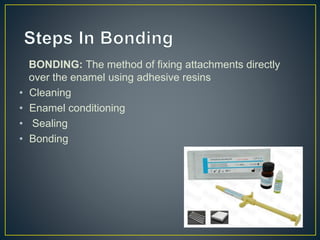
BONDING: The method of fixing attachments directly
over the enamel using adhesive resins
• Cleaning
• Enamel conditioning
• Sealing
• Bonding
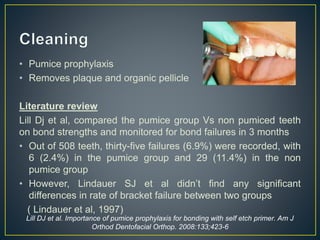
• Pumice prophylaxis
• Removes plaque and organic pellicle
Literature review
Lill Dj et al, compared the pumice group Vs non pumiced teeth
on bond strengths and monitored for bond failures in 3 months
• Out of 508 teeth, thirty-five failures (6.9%) were recorded, with
6 (2.4%) in the pumice group and 29 (11.4%) in the non
pumice group
• However, Lindauer SJ et al didn’t find any significant
differences in rate of bracket failure between two groups
( Lindauer et al, 1997)
Lill DJ et al. Importance of pumice prophylaxis for bonding with self etch primer. Am J
Orthod Dentofacial Orthop. 2008:133;423-6
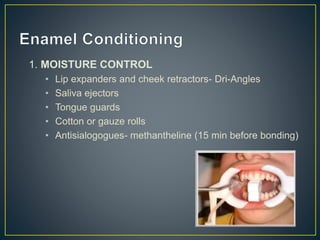
1. MOISTURE CONTROL
• Lip expanders and cheek retractors- Dri-Angles
• Saliva ejectors
• Tongue guards
• Cotton or gauze rolls
• Antisialogogues- methantheline (15 min before bonding)
2. ENAMEL PRETREATMENT
• Etching : 37% orthophosphoric acid for 15-30seconds
10% maleic acid, polyacrylic acid (weak SBS)
Laser etching ( can’t achieve standard etching
pattern)
• Etching removes 3-10 microns of surface enamel
• Washing and drying: for 5-10 seconds
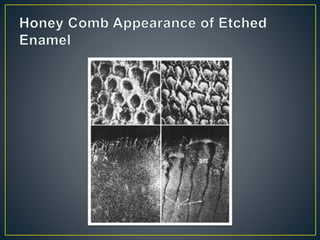
• Etched surface: dull white frosty, honey comb appearance
• Saliva contamination should be avoided
• Blood contamination requires re-rinsing and drying (
protective liquid polish e.g. Bicover)
• Sandblasting ( Air-abrasive technique) - low SBS (shear
bond strength)
• Sandblasting + acid etching = comparable or higher SBS
2. ENAMEL PRETREATMENT
• Enamel Deproteinization
- Acquired pellicle covering the surface of enamel is biofilm free
of bacterial colonization
- Composed of proteins, glycoproteins, enzymes and mucins
- make it difficult for composite to adhere to tooth enamel
diminishing SBS
- Use of 5.25% sodium hypochlorite for 60 seconds as a
deproteinizing agent before etching give good results (Justus
et al, 2010)
- Enamel deproteinization with 10% papain gel increases the
shear bond strength
Matheus Melo Pithon et al. Effect of 10% papain gel on enamel deproteinization before bonding
procedure. Angle Orthod. 2012;82:541–545.
• Thin layer of bonding agent- gentle air burst for 1-2
seconds
• Functions: - To achieve proper bond strength
- Improve resistance to micro leakage
• Moisture-Insensitive primers ( hydrophilic primers)
• Difficult moisture control situation
• Self etching primers
• Combine conditioning and priming (e.g. Transbond)
• Active ingredient: methacrylated phosphoric acid
ester
• Chemical bond: hybrid layer of 3-4 microns
• Improve chair side time efficiency, cost effective
• Bond strength is lower than the conventional
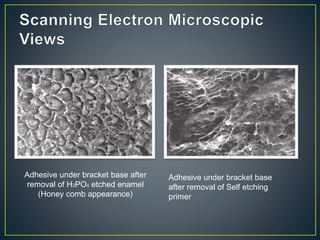
Adhesive under bracket base after
removal of H3PO4 etched enamel
(Honey comb appearance)
Adhesive under bracket base
after removal of Self etching
primer
ADHESIVE MATERIALS
• Composite resins
• Acrylic resins : methyl methacrylate monomers + ultrafine
powder
- Form linear polymers
- Suitable for plastic brackets
• Diacrylate resins: acrylic modified epoxy resins BIS-GMA
- Form crosslinking network
- Increase strength, less water absorption and less
polymerization shrinkage
- Suitable for metal brackets
ADHESIVE MATERIALS
• Glass ionomer cements
- Introduced primarily as luting agent and direct restorative
material
- Resin modified glass ionomer cement- 10% HEMA ( Fuji-
Ortho)
• Advantages
- Flouride release lessen decalcification around brackets
- Chemically adhere to enamel and bracket base
- Easier to remove after debonding (Norevall et al.,1995)
• Disadvantages
- Bond failure rate was 24.8% than composite resin failure rate
of 7.4% ( Matthew et al, 1999)
Matthew Gworski et al. Decalcification and bond failure: A comparison of a glass ionomer and
a composite resin bonding system in vivo. Am J Orthod Dentofacial Orthop 1999;116:518-21
• Polymerization from dimethacrylate resin monomer is never
complete
• Monomers identified in orthodontic composites:
• BISGMA
• TEGDMA
• UDMA
• HEMA
• Necrosis of pulp: Depletion of glutathione, production of
reactive oxygen species
• Precautions
- Amount of composite resin should be kept at minimum
- Excess (flash) should be removed before the resin
polymerize
- Ask patient to spit or wash their mouths for first 30 min (
monomer release is maximal)
TYPES OF ADHESIVES
• No mix adhesive
• Light-Polymerized Adhesives
- Curing: activation of photo initiator e.g.
Camphoroquinone
- Extended working time
- Bond strength are comparable to the chemically cured
composite (Swartz ML. 2004)
- Metallic and ceramic pre-coated with light cured
composites becoming popular
- Recent innovations: light activated color change
adhesives (APC Plus.3M/Unitek)
LIGHT SOURCES:
• Conventional halogen lights (Ortholoux XT)
- Maximum absorption in blue region of visible light (470nm)
- Curing time: 20 sec for composite resins
40 sec for RM-GIC
- Inconvenient for patient
• High intensity halogen lights (fast halogens)
- Increase light intensity with wavelength ( 400-505nm)
- Turbo tips to focus into small area
- Reduce curing time almost half to conventional bulbs
LIGHT SOURCES
• Plasma arc sources
- Tungsten anode and cathode in quartz tube filled with xenon
- Provide light intensity of 1200-1500 mW/cm2 and wavelength
of 380-495nm)
- Curing time: 3-5 sec for metal brackets and even shorter for
ceramic brackets ( Sfondrini et al. 2004)
- High heat generation can possibly harm the pulp tissue (
5.16°C vs 1.86°C for halogen bulbs)
• Light Emitting Diodes (LED’s)
- Small, cordless, generate minimal heat, perform favorably
- Curing time: 10sec for metal and 5 seconds for ceramic
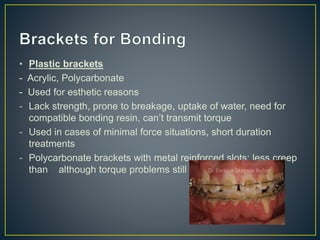
• Plastic brackets
- Acrylic, Polycarbonate
- Used for esthetic reasons
- Lack strength, prone to breakage, uptake of water, need for
compatible bonding resin, can’t transmit torque
- Used in cases of minimal force situations, short duration
treatments
- Polycarbonate brackets with metal reinforced slots: less creep
than although torque problems still exist
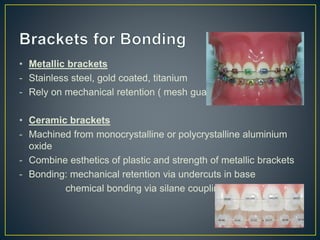
• Metallic brackets
- Stainless steel, gold coated, titanium
- Rely on mechanical retention ( mesh guaze)
• Ceramic brackets
- Machined from monocrystalline or polycrystalline aluminium
oxide
- Combine esthetics of plastic and strength of metallic brackets
- Bonding: mechanical retention via undercuts in base
chemical bonding via silane coupling agent
• Ceramic brackets
Disadvantages
- Greater friction resistance between wire and ceramic
brackets (steel slots inserts are more reliable)
- More prone to breakage/ brittle
- More difficult to debond (wing fractures)
- Attracts more plaque and less hygienic
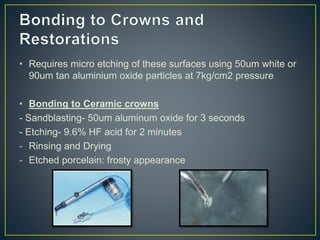
• Requires micro etching of these surfaces using 50um white or
90um tan aluminium oxide particles at 7kg/cm2 pressure
• Bonding to Ceramic crowns
- Sandblasting- 50um aluminum oxide for 3 seconds
- Etching- 9.6% HF acid for 2 minutes
- Rinsing and Drying
- Etched porcelain: frosty appearance
Bonding to Amalgam
• Small amalgam restorations
- Sanblasting: 50um aluminum oxide for 3 seconds
- Conditioning enamel- 37% phosphoric acid gel for 15 seconds
- Sealant, Bond as usual
• Large amalgam resorations
- Sandblasting: 50um aluminum oxide for 3 seconds
- Use of intermediate resins ( metal primer, All-Bond2) for 30
sec or adhesive resins that bond chemically( 4-META)
- Sealant and bond as usual
Bonding to Gold
• In vitro:
- High bond strengths
- Sandblasting, electrolyte tin plating
Clinically: not frequently encountered
Bonding to Composite
- Remove the previous old surface with rotary instrument
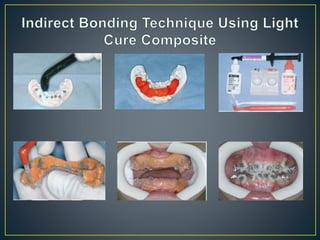
Tray Preparation
• Impression taking
• Work model preparation
- Isolate model with separating medium
- Bracket placement with proper angulations
• Transfer try
- Material: putty silicone, thermoplastics, polysiloxane
- Soak model in warm water as long as it takes to dissolve lab
adhesive
- Sandblast adhesive bases with micro-etching unit
- Use acetone to remove separating media
• Bonding
- Enamel conditioning
- Apply intermediate resin on the tooth surface and adhesive on
each individual bracket
- Seat the tray with equal pressure to occlusal, buccal and labial
surface
- Allow 2 minutes curing time
- Remove excess flash
Advantages
• Reduce chair side time
• More accurate positioning of brackets
• Advantageous for lingual bonding
Disadvantages
• Technique sensitive
• Removal of excess adhesive is difficult
• Risk of adhesive leakage in interproximal areas disturb oral
hygiene
• Bond failure rate is higher
• Removal of adhesive from the bracket base completely
without damaging or weakening its backing or distorting slot
Methods:
• Heat (about 450°C) to burn off the resin
• Electro polishing to remove any tarnish or oxide buildup
• Recycling has dropped off now (less than 10% orthodontists
use it)
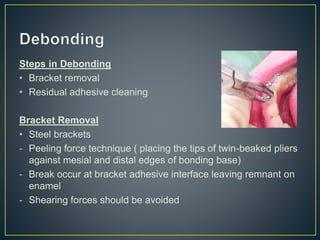
Steps in Debonding
• Bracket removal
• Residual adhesive cleaning
Bracket Removal
• Steel brackets
- Peeling force technique ( placing the tips of twin-beaked pliers
against mesial and distal edges of bonding base)
- Break occur at bracket adhesive interface leaving remnant on
enamel
- Shearing forces should be avoided
Bracket Removal
• Ceramic brackets
- More likely to cause enamel fracture
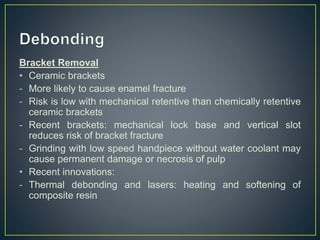
- Risk is low with mechanical retentive than chemically retentive
ceramic brackets
- Recent brackets: mechanical lock base and vertical slot
reduces risk of bracket fracture
- Grinding with low speed handpiece without water coolant may
cause permanent damage or necrosis of pulp
• Recent innovations:
- Thermal debonding and lasers: heating and softening of
composite resin
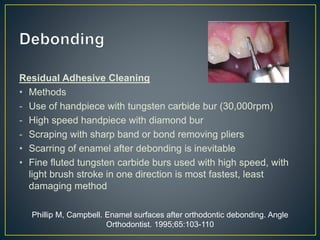
Residual Adhesive Cleaning
• Methods
- Use of handpiece with tungsten carbide bur (30,000rpm)
- High speed handpiece with diamond bur
- Scraping with sharp band or bond removing pliers
• Scarring of enamel after debonding is inevitable
• Fine fluted tungsten carbide burs used with high speed, with
light brush stroke in one direction is most fastest, least
damaging method
Phillip M, Campbell. Enamel surfaces after orthodontic debonding. Angle
Orthodontist. 1995;65:103-110
• ENAMEL TEAROUTS
• Type of filler particles used in adhesive
- Small filler particles reinforce the enamel tags (fill 3-5microns
holes)
- Macro fillers create natural break point between enamel-
adhesive interface
- Unfilled resins: no natural break point
• Location of bond breakage
- Should be at enamel-adhesive interface (mechanical
retention)
- Break at adhesive-bracket interface: more damage (chemical
retention)
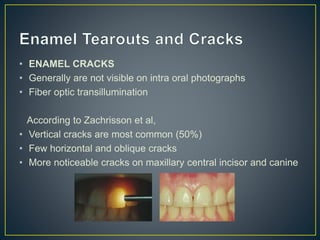
• ENAMEL CRACKS
• Generally are not visible on intra oral photographs
• Fiber optic transillumination
According to Zachrisson et al,
• Vertical cracks are most common (50%)
• Few horizontal and oblique cracks
• More noticeable cracks on maxillary central incisor and canine
ENAMEL CRACKS
Clinical Implication
• Pre-treatment examination of cracks and its documentation
• Inform patient if pronounced cracks are visible
• Observe cracks after debonding
• Detect any horizontal cracks- bonding/debonding technique
needs improvement
• Gentle manipulation of debonding instruments
• Daily rinsing with dilute (0.05%) sodium fluoride during
treatment and retention period
• Fluoride dentifrices
• Fluoride varnish in decalcified areas
• Oral hygiene measures
• Technique used to remove superficial enamel opacities,
brown-yellow enamel discoloration, when re mineralizing
capacity is exhausted
• Abrasive gel = 18% HCL, fine pumice and glycerin
Procedure:
• Isolate gingiva with rubber dam
• Gel is applied using electric tooth brush for 3-5 minutes
• Rinse for a minute
• Procedure can be repeated 2-3 times/month
Always make the care of your patient your first concern
“People don't care how much you know, until they know how much
you care!!” John C. Maxwell

Bonding and debonding in orthodontics

  • 1.
    Presenter: Dr. AishaKhoja Resident, Orthodontics
  • 2.
    BONDING: The methodof fixing attachments directly over the enamel using adhesive resins • Cleaning • Enamel conditioning • Sealing • Bonding
  • 3.
    • Pumice prophylaxis •Removes plaque and organic pellicle Literature review Lill Dj et al, compared the pumice group Vs non pumiced teeth on bond strengths and monitored for bond failures in 3 months • Out of 508 teeth, thirty-five failures (6.9%) were recorded, with 6 (2.4%) in the pumice group and 29 (11.4%) in the non pumice group • However, Lindauer SJ et al didn’t find any significant differences in rate of bracket failure between two groups ( Lindauer et al, 1997) Lill DJ et al. Importance of pumice prophylaxis for bonding with self etch primer. Am J Orthod Dentofacial Orthop. 2008:133;423-6
  • 4.
    1. MOISTURE CONTROL •Lip expanders and cheek retractors- Dri-Angles • Saliva ejectors • Tongue guards • Cotton or gauze rolls • Antisialogogues- methantheline (15 min before bonding)
  • 5.
    2. ENAMEL PRETREATMENT •Etching : 37% orthophosphoric acid for 15-30seconds 10% maleic acid, polyacrylic acid (weak SBS) Laser etching ( can’t achieve standard etching pattern) • Etching removes 3-10 microns of surface enamel • Washing and drying: for 5-10 seconds • Etched surface: dull white frosty, honey comb appearance • Saliva contamination should be avoided • Blood contamination requires re-rinsing and drying ( protective liquid polish e.g. Bicover) • Sandblasting ( Air-abrasive technique) - low SBS (shear bond strength) • Sandblasting + acid etching = comparable or higher SBS
  • 7.
    2. ENAMEL PRETREATMENT •Enamel Deproteinization - Acquired pellicle covering the surface of enamel is biofilm free of bacterial colonization - Composed of proteins, glycoproteins, enzymes and mucins - make it difficult for composite to adhere to tooth enamel diminishing SBS - Use of 5.25% sodium hypochlorite for 60 seconds as a deproteinizing agent before etching give good results (Justus et al, 2010) - Enamel deproteinization with 10% papain gel increases the shear bond strength Matheus Melo Pithon et al. Effect of 10% papain gel on enamel deproteinization before bonding procedure. Angle Orthod. 2012;82:541–545.
  • 8.
    • Thin layerof bonding agent- gentle air burst for 1-2 seconds • Functions: - To achieve proper bond strength - Improve resistance to micro leakage • Moisture-Insensitive primers ( hydrophilic primers) • Difficult moisture control situation • Self etching primers • Combine conditioning and priming (e.g. Transbond) • Active ingredient: methacrylated phosphoric acid ester • Chemical bond: hybrid layer of 3-4 microns • Improve chair side time efficiency, cost effective • Bond strength is lower than the conventional
  • 9.
    Adhesive under bracketbase after removal of H3PO4 etched enamel (Honey comb appearance) Adhesive under bracket base after removal of Self etching primer
  • 10.
    ADHESIVE MATERIALS • Compositeresins • Acrylic resins : methyl methacrylate monomers + ultrafine powder - Form linear polymers - Suitable for plastic brackets • Diacrylate resins: acrylic modified epoxy resins BIS-GMA - Form crosslinking network - Increase strength, less water absorption and less polymerization shrinkage - Suitable for metal brackets
  • 11.
    ADHESIVE MATERIALS • Glassionomer cements - Introduced primarily as luting agent and direct restorative material - Resin modified glass ionomer cement- 10% HEMA ( Fuji- Ortho) • Advantages - Flouride release lessen decalcification around brackets - Chemically adhere to enamel and bracket base - Easier to remove after debonding (Norevall et al.,1995) • Disadvantages - Bond failure rate was 24.8% than composite resin failure rate of 7.4% ( Matthew et al, 1999) Matthew Gworski et al. Decalcification and bond failure: A comparison of a glass ionomer and a composite resin bonding system in vivo. Am J Orthod Dentofacial Orthop 1999;116:518-21
  • 12.
    • Polymerization fromdimethacrylate resin monomer is never complete • Monomers identified in orthodontic composites: • BISGMA • TEGDMA • UDMA • HEMA • Necrosis of pulp: Depletion of glutathione, production of reactive oxygen species • Precautions - Amount of composite resin should be kept at minimum - Excess (flash) should be removed before the resin polymerize - Ask patient to spit or wash their mouths for first 30 min ( monomer release is maximal)
  • 13.
    TYPES OF ADHESIVES •No mix adhesive • Light-Polymerized Adhesives - Curing: activation of photo initiator e.g. Camphoroquinone - Extended working time - Bond strength are comparable to the chemically cured composite (Swartz ML. 2004) - Metallic and ceramic pre-coated with light cured composites becoming popular - Recent innovations: light activated color change adhesives (APC Plus.3M/Unitek)
  • 14.
    LIGHT SOURCES: • Conventionalhalogen lights (Ortholoux XT) - Maximum absorption in blue region of visible light (470nm) - Curing time: 20 sec for composite resins 40 sec for RM-GIC - Inconvenient for patient • High intensity halogen lights (fast halogens) - Increase light intensity with wavelength ( 400-505nm) - Turbo tips to focus into small area - Reduce curing time almost half to conventional bulbs
  • 15.
    LIGHT SOURCES • Plasmaarc sources - Tungsten anode and cathode in quartz tube filled with xenon - Provide light intensity of 1200-1500 mW/cm2 and wavelength of 380-495nm) - Curing time: 3-5 sec for metal brackets and even shorter for ceramic brackets ( Sfondrini et al. 2004) - High heat generation can possibly harm the pulp tissue ( 5.16°C vs 1.86°C for halogen bulbs) • Light Emitting Diodes (LED’s) - Small, cordless, generate minimal heat, perform favorably - Curing time: 10sec for metal and 5 seconds for ceramic
  • 16.
    • Plastic brackets -Acrylic, Polycarbonate - Used for esthetic reasons - Lack strength, prone to breakage, uptake of water, need for compatible bonding resin, can’t transmit torque - Used in cases of minimal force situations, short duration treatments - Polycarbonate brackets with metal reinforced slots: less creep than although torque problems still exist
  • 17.
    • Metallic brackets -Stainless steel, gold coated, titanium - Rely on mechanical retention ( mesh guaze) • Ceramic brackets - Machined from monocrystalline or polycrystalline aluminium oxide - Combine esthetics of plastic and strength of metallic brackets - Bonding: mechanical retention via undercuts in base chemical bonding via silane coupling agent
  • 18.
    • Ceramic brackets Disadvantages -Greater friction resistance between wire and ceramic brackets (steel slots inserts are more reliable) - More prone to breakage/ brittle - More difficult to debond (wing fractures) - Attracts more plaque and less hygienic
  • 19.
    • Requires microetching of these surfaces using 50um white or 90um tan aluminium oxide particles at 7kg/cm2 pressure • Bonding to Ceramic crowns - Sandblasting- 50um aluminum oxide for 3 seconds - Etching- 9.6% HF acid for 2 minutes - Rinsing and Drying - Etched porcelain: frosty appearance
  • 20.
    Bonding to Amalgam •Small amalgam restorations - Sanblasting: 50um aluminum oxide for 3 seconds - Conditioning enamel- 37% phosphoric acid gel for 15 seconds - Sealant, Bond as usual • Large amalgam resorations - Sandblasting: 50um aluminum oxide for 3 seconds - Use of intermediate resins ( metal primer, All-Bond2) for 30 sec or adhesive resins that bond chemically( 4-META) - Sealant and bond as usual
  • 21.
    Bonding to Gold •In vitro: - High bond strengths - Sandblasting, electrolyte tin plating Clinically: not frequently encountered Bonding to Composite - Remove the previous old surface with rotary instrument
  • 22.
    Tray Preparation • Impressiontaking • Work model preparation - Isolate model with separating medium - Bracket placement with proper angulations • Transfer try - Material: putty silicone, thermoplastics, polysiloxane - Soak model in warm water as long as it takes to dissolve lab adhesive - Sandblast adhesive bases with micro-etching unit - Use acetone to remove separating media
  • 23.
    • Bonding - Enamelconditioning - Apply intermediate resin on the tooth surface and adhesive on each individual bracket - Seat the tray with equal pressure to occlusal, buccal and labial surface - Allow 2 minutes curing time - Remove excess flash
  • 25.
    Advantages • Reduce chairside time • More accurate positioning of brackets • Advantageous for lingual bonding Disadvantages • Technique sensitive • Removal of excess adhesive is difficult • Risk of adhesive leakage in interproximal areas disturb oral hygiene • Bond failure rate is higher
  • 26.
    • Removal ofadhesive from the bracket base completely without damaging or weakening its backing or distorting slot Methods: • Heat (about 450°C) to burn off the resin • Electro polishing to remove any tarnish or oxide buildup • Recycling has dropped off now (less than 10% orthodontists use it)
  • 27.
    Steps in Debonding •Bracket removal • Residual adhesive cleaning Bracket Removal • Steel brackets - Peeling force technique ( placing the tips of twin-beaked pliers against mesial and distal edges of bonding base) - Break occur at bracket adhesive interface leaving remnant on enamel - Shearing forces should be avoided
  • 28.
    Bracket Removal • Ceramicbrackets - More likely to cause enamel fracture - Risk is low with mechanical retentive than chemically retentive ceramic brackets - Recent brackets: mechanical lock base and vertical slot reduces risk of bracket fracture - Grinding with low speed handpiece without water coolant may cause permanent damage or necrosis of pulp • Recent innovations: - Thermal debonding and lasers: heating and softening of composite resin
  • 29.
    Residual Adhesive Cleaning •Methods - Use of handpiece with tungsten carbide bur (30,000rpm) - High speed handpiece with diamond bur - Scraping with sharp band or bond removing pliers • Scarring of enamel after debonding is inevitable • Fine fluted tungsten carbide burs used with high speed, with light brush stroke in one direction is most fastest, least damaging method Phillip M, Campbell. Enamel surfaces after orthodontic debonding. Angle Orthodontist. 1995;65:103-110
  • 30.
    • ENAMEL TEAROUTS •Type of filler particles used in adhesive - Small filler particles reinforce the enamel tags (fill 3-5microns holes) - Macro fillers create natural break point between enamel- adhesive interface - Unfilled resins: no natural break point • Location of bond breakage - Should be at enamel-adhesive interface (mechanical retention) - Break at adhesive-bracket interface: more damage (chemical retention)
  • 31.
    • ENAMEL CRACKS •Generally are not visible on intra oral photographs • Fiber optic transillumination According to Zachrisson et al, • Vertical cracks are most common (50%) • Few horizontal and oblique cracks • More noticeable cracks on maxillary central incisor and canine
  • 32.
    ENAMEL CRACKS Clinical Implication •Pre-treatment examination of cracks and its documentation • Inform patient if pronounced cracks are visible • Observe cracks after debonding • Detect any horizontal cracks- bonding/debonding technique needs improvement • Gentle manipulation of debonding instruments
  • 33.
    • Daily rinsingwith dilute (0.05%) sodium fluoride during treatment and retention period • Fluoride dentifrices • Fluoride varnish in decalcified areas • Oral hygiene measures
  • 34.
    • Technique usedto remove superficial enamel opacities, brown-yellow enamel discoloration, when re mineralizing capacity is exhausted • Abrasive gel = 18% HCL, fine pumice and glycerin Procedure: • Isolate gingiva with rubber dam • Gel is applied using electric tooth brush for 3-5 minutes • Rinse for a minute • Procedure can be repeated 2-3 times/month
  • 35.
    Always make thecare of your patient your first concern “People don't care how much you know, until they know how much you care!!” John C. Maxwell

Editor's Notes

  • #4 Cleaning of teeth with pumice will remove plaque and organic pellicle that normally covers the teeth. Avoid traumatizing gingivl margin and initiating bleeding. Need for conventional pumicing is contraversial or has been questioned. However it is always better to pumice the areas which are difficult to clean and where plaque accumulatin is more
  • #5 Salivary control is very crucial Methantheline 50mg per 45kg body weight
  • #6 Once the isolation has been achieved, the enamel is etched by gel or solution. Etching time less than 15 sec and more than 30 sec has been shown to decrease the bonding strength. Biscover can be used in areas of impacted teeth and partially impacted teeth, or in cases of mild gingivitis where blood contamination is a risk Laser etching produce the thermally induced changes within the enamel to the depth of 10-20um. Vaporizatin of water trapped in hydroxyapatitie crystals. Etchant is rinsed off with abundant water spray and they teeth are dried thoroughly with moisture and oil free air source. Enamel loss in sandblasting is less than the acid etching
  • #7 In the first figure the prisms centre have been removed preferentially, whereas in the second figure the loss of prisms peripheries demonstrate the head and tail arrangement of prisms
  • #8 Papain is an alkaloid enzyme extracted from the papaya. It is obtained from the latex in the leaves and skin of the mature fruit. It has a proteolytic action and presents antibacterial and anti-inflammatory properties, acting as an agent for the removal of necrotic remains, without cytotoxic effects on the tissues. 3,5,6
  • #9 Combining conditioning and priming into a single step results in improved chair side efficiency and cost effectiveness for clinician and saves time.The phosphote group dissolves the calcium and removes it frm hydroxyapatitie. The removed calcium form complex with phosphate group and is incorporated into network when primer polymerizes.
  • #10 With SEPP one finds an irregular but smooth hybrid layer 3-4 microns thick and irregular tag formation with no apparent indentations of enamel prism
  • #12 These cements have distinctive properties. First they adhere chemically to both enamel and metal. Seond, they release fluride and prevent decalcifications, third they can be removed easily after debonding. Powder flouroaluminosilicates Liquid polyacrylic acid Resin modified glass ionomer can be dual cured or tri cured ( chemical, light and by cement setting reaction)
  • #13 Monomer release is maximal in first 30-60min
  • #14 One paste under light pressure is brought together with primer fluid on enamel Precoated brackets: have consistent quality of adhesive, reduced flash, reduced waste, improved cross infection and adequate bond strength Recent innovation: help identify the excess adhesive for removal during bonding procedure
  • #16 The xenon gas becomes ionized and forms plasma that consist of positive and negative particles that generates and intense light when electric current is passed. However the orthodontic light cure bonding do no exceed the critical 5.5 degree centrigrade of critical value. Permanent damage of pulp occurs when temp rose to 42.5 degree centrigrade
  • #17 Ceramic brackets: microcrystalline, mechanical ball, dovetail, dimpled chemo/mechanical
  • #20 Microetcher intraoral sandblaster useful for preparing microretentive surfaces in metals and dental materials. Appliance consists of container for the aluminium oxide powder and push button for finger control and movable nozzle where the abrsive particles are deleivered. It is also useful for removing old composites and improving retension of loss brackets before rebonding
  • #22 Oxygen inhibiting layer is produced in old composite that has to be removed to achieve good bonding
  • #23 Take an imression and pour up a stone model Select brackets for each tooth Isolate the stone model with separating medium Attch brackets to teeth with composite resin or use adhesive precoated brackets Check all measurement and alignments Make a transfer tray for brackets. Materials can be putty After removing transfer tray sandblast the
  • #26 However with proper technique ussed failure rates are comparable
  • #31 Clinical implication: use bracket that have mechanical retention . And debonding instrument technique that will break the bond between enamal-adhesive interface leaving majority of composite on the tooth. Avoid scrapping with hand instrument vigorously