BODY TEMPERATURE
Dr. UJJWAL DEEP
JR1 (DNB INTERNAL MEDICINE)
 Body temperature is a measure of the body’s ability to generate and get rid of
heat.
 Normal core body temperature (the temperature within the deep tissue of the
body) is between 35.6 & 37.8 degree Celsius (97.0 & 100.4 F)
 Closest to core body temperature measured is
Rectal or vaginal > Ear (tympanic) > Oral (0.5 C less than Ear) > Axillary
lower than oral)
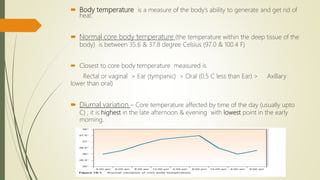
 Diurnal variation – Core temperature affected by time of the day (usually upto
C) , it is highest in the late afternoon & evening with lowest point in the early
morning.
THERMOMETERS
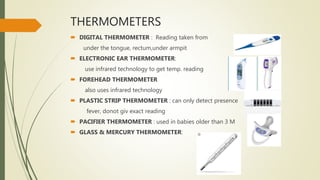
 DIGITAL THERMOMETER : Reading taken from
under the tongue, rectum,under armpit
 ELECTRONIC EAR THERMOMETER:
use infrared technology to get temp. reading
 FOREHEAD THERMOMETER
also uses infrared technology
 PLASTIC STRIP THERMOMETER : can only detect presence
fever, donot giv exact reading
 PACIFIER THERMOMETER : used in babies older than 3 M
 GLASS & MERCURY THERMOMETER:
THERMOREGULATION
MECHANISM OF BODILY HEAT LOSS
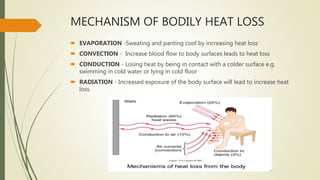
 EVAPORATION -Sweating and panting cool by increasing heat loss
 CONVECTION - Increase blood flow to body surfaces leads to heat loss
 CONDUCTION - Losing heat by being in contact with a colder surface e.g.
swimming in cold water or lying in cold floor
 RADIATION - Increased exposure of the body surface will lead to increase heat
loss.
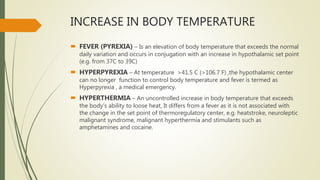
INCREASE IN BODY TEMPERATURE
 FEVER (PYREXIA) – Is an elevation of body temperature that exceeds the normal
daily variation and occurs in conjugation with an increase in hypothalamic set point
(e.g. from 37C to 39C)
 HYPERPYREXIA – At temperature >41.5 C (>106.7 F) ,the hypothalamic center
can no longer function to control body temperature and fever is termed as
Hyperpyrexia , a medical emergency.
 HYPERTHERMIA – An uncontrolled increase in body temperature that exceeds
the body’s ability to loose heat, It differs from a fever as it is not associated with
the change in the set point of thermoregulatory center, e.g. heatstroke, neuroleptic
malignant syndrome, malignant hyperthermia and stimulants such as
amphetamines and cocaine.
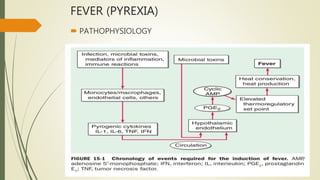
FEVER (PYREXIA)
 PATHOPHYSIOLOGY
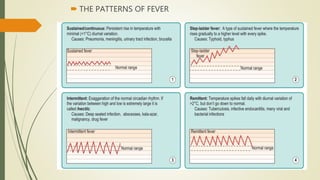
 THE PATTERNS OF FEVER
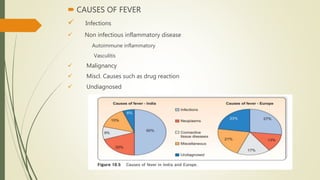
 CAUSES OF FEVER
 Infections
 Non infectious inflammatory disease
Autoimmune inflammatory
Vasculitis
 Malignancy
 Miscl. Causes such as drug reaction
 Undiagnosed
CAUSES OF FEVER A/W SYSTEMS
 RESPIRATORY SYSTEM
 URTI suggested by rhinorrhea, nasal stuffiness, sneezing, sore throat,
cough & a hoarse voice
 Sinusitis A/W facial pain and headache
 Otitis A/W ear pain, ear discharge , with or without auditory symptoms
 LRTI suggested by cough with purulent sputum, shortness of breath,
wheeze or chest pain.
Hemoptysis suggest invasion of or damage to the blood vessels of the
lung , presents in tuberculosis, invasive fungal infection or noninfectious
causes such as lung cancer or vasculitis.
 GNITOURINARY SYSTEM
 Lower urinary tract infection presents with combination of dysuria,
frequency, urgency, change in smell or
colour of urine
 Upper urinary tract infection have above symptoms with additional
loin or back pain
 Sexually transmitted infection & PID have same symptoms with additional
vaginal or urethral discharge, dyspareunia,
anogenital ulcer, genital warts, swelling of scrotum
& lymph glands in the groin.
 Vaginal candidiasis presents with LUTI symptoms with whitish vaginal
vaginal discharge and vaginal itching
 Bacterial vaginosis presents with watery , foul smeling vaginal discharge
 GASTROINTESTINAL SYSTEM
 Gastrointestinal Infection - A/W abdominal pain & diarrhea
 Hepatitis
 Cholecystitis and Cholangitis – pain in RUQ A/W nausea
 Intra abdominal infection – includes Bowel perforation , peritonitis
 NERVOUS SYSTEM
A/W Headache, Photophobia, Vomiting, Altered consciousness, Fits,
Fainting, Muscle weakness, numbness, paralysis, tremors, change
in behavior
 Meningitis – neck stiffness
 Encephalitis- usually viral in etiology but can be bacterial or parasitic
 Intracranial abcess
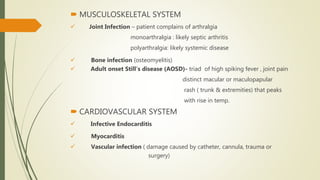
 MUSCULOSKELETAL SYSTEM
 Joint Infection – patient complains of arthralgia
monoarthralgia : likely septic arthritis
polyarthralgia: likely systemic disease
 Bone infection (osteomyelitis)
 Adult onset Still’s disease (AOSD)- triad of high spiking fever , joint pain
distinct macular or maculopapular
rash ( trunk & extremities) that peaks
with rise in temp.
 CARDIOVASCULAR SYSTEM
 Infective Endocarditis
 Myocarditis
 Vascular infection ( damage caused by catheter, cannula, trauma or
surgery)
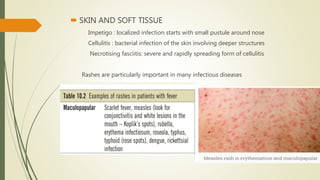
 SKIN AND SOFT TISSUE
Impetigo : localized infection starts with small pustule around nose
Cellulitis : bacterial infection of the skin involving deeper structures
Necrotising fasciitis: severe and rapidly spreading form of cellulitis
Rashes are particularly important in many infectious diseases
PYREXIA OF UNKNOWN ORIGIN
 Defination : A fever > 38.3 C for 2 weeks during which time there has been atleast
 three separate out patient appointments, OR
 3 days in hospital
 1 weeks’ worth of appropriate and thorough investigation
 Causes falls in two category
 a common disease presenting in an atypical way
 an uncommon disease presenting typically
DECREASE IN BODY TEMPERATURE
 HYPOTHERMIA : core body temperature < 35 C
MILD (32-35 C) – Thermogenesis is still possible
Moderate (29-32 C) - progressive failure of thermogenesis
Severe (< 29 C) – Poikilothermic and increased risk of malignant
cardia arrhythmias.
MILD HYPOTHERMIA (32-35 C)
 FEATURES
 Shivering
 Apathy
 Ataxia
 Dysarthria – slurred speech
 Tachycardia
MODERATE HYPOTHERMIA (29-32 C)
 FEATURE
 Loss of shivering
 Altered mental state
 Muscular rigidity
 Bradycardia
 Hypotension
SEVERE HYPOTHERMIA (<29 C)
 FEATURES
 Almost undetectable signs of life
 Coma
 Fixed and dilated pupils
 Areflexia
 profound bradycardia and hypotension
TYPES OF HYPOTHERMIA
 PRIMARY HYPOTHERMIA
Due to environmental exposure with no underlying medical condition
 SECONDARY HYPOTHERMIA
Resulting from medical illness lowering the temperature
set-point.
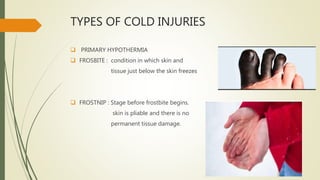
TYPES OF COLD INJURIES
 PRIMARY HYPOTHERMIA
 FROSBITE : condition in which skin and
tissue just below the skin freezes
 FROSTNIP : Stage before frostbite begins.
skin is pliable and there is no
permanent tissue damage.
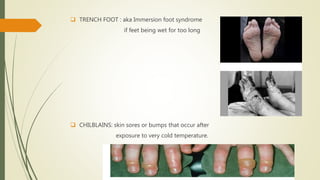
 TRENCH FOOT : aka Immersion foot syndrome
if feet being wet for too long
 CHILBLAINS: skin sores or bumps that occur after
exposure to very cold temperature.
FACTORS PREDISPOSING HYPOTHERMIA
 DECREASE HEAT PRODUCTION:
Age extremes
Inadequate stored fuel(hypoglycemia, malnutrition)
Endocrine or neuromuscular (low thyroid,etc)
 INCREASED HEAT LOSS
Exposure(including poor preparation and acclimatization)
Skin(burns)
 IMPAIRED THERMOREGULATION
 CENTRAL : Trauma or Neoplastic lesion, degenerative processes, congenital
 PERIPHERAL: Acute spinal cord transection(loss of peripheral
vasoconstriction)
 METABOLIC : DKA , uremia, hypoglycemia, sepsis, pancreatitis
 MEDICATION : Narcotics (stops shivering responce)
barbiturate , benzodiazepines, anti- seizures, anti- psychotics
THANK YOU

Body temperature

  • 1.
    BODY TEMPERATURE Dr. UJJWALDEEP JR1 (DNB INTERNAL MEDICINE)
  • 2.
     Body temperatureis a measure of the body’s ability to generate and get rid of heat.  Normal core body temperature (the temperature within the deep tissue of the body) is between 35.6 & 37.8 degree Celsius (97.0 & 100.4 F)  Closest to core body temperature measured is Rectal or vaginal > Ear (tympanic) > Oral (0.5 C less than Ear) > Axillary lower than oral)  Diurnal variation – Core temperature affected by time of the day (usually upto C) , it is highest in the late afternoon & evening with lowest point in the early morning.
  • 3.
    THERMOMETERS  DIGITAL THERMOMETER: Reading taken from under the tongue, rectum,under armpit  ELECTRONIC EAR THERMOMETER: use infrared technology to get temp. reading  FOREHEAD THERMOMETER also uses infrared technology  PLASTIC STRIP THERMOMETER : can only detect presence fever, donot giv exact reading  PACIFIER THERMOMETER : used in babies older than 3 M  GLASS & MERCURY THERMOMETER:
  • 4.
  • 5.
    MECHANISM OF BODILYHEAT LOSS  EVAPORATION -Sweating and panting cool by increasing heat loss  CONVECTION - Increase blood flow to body surfaces leads to heat loss  CONDUCTION - Losing heat by being in contact with a colder surface e.g. swimming in cold water or lying in cold floor  RADIATION - Increased exposure of the body surface will lead to increase heat loss.
  • 6.
    INCREASE IN BODYTEMPERATURE  FEVER (PYREXIA) – Is an elevation of body temperature that exceeds the normal daily variation and occurs in conjugation with an increase in hypothalamic set point (e.g. from 37C to 39C)  HYPERPYREXIA – At temperature >41.5 C (>106.7 F) ,the hypothalamic center can no longer function to control body temperature and fever is termed as Hyperpyrexia , a medical emergency.  HYPERTHERMIA – An uncontrolled increase in body temperature that exceeds the body’s ability to loose heat, It differs from a fever as it is not associated with the change in the set point of thermoregulatory center, e.g. heatstroke, neuroleptic malignant syndrome, malignant hyperthermia and stimulants such as amphetamines and cocaine.
  • 7.
  • 8.
  • 10.
     CAUSES OFFEVER  Infections  Non infectious inflammatory disease Autoimmune inflammatory Vasculitis  Malignancy  Miscl. Causes such as drug reaction  Undiagnosed
  • 11.
    CAUSES OF FEVERA/W SYSTEMS  RESPIRATORY SYSTEM  URTI suggested by rhinorrhea, nasal stuffiness, sneezing, sore throat, cough & a hoarse voice  Sinusitis A/W facial pain and headache  Otitis A/W ear pain, ear discharge , with or without auditory symptoms  LRTI suggested by cough with purulent sputum, shortness of breath, wheeze or chest pain. Hemoptysis suggest invasion of or damage to the blood vessels of the lung , presents in tuberculosis, invasive fungal infection or noninfectious causes such as lung cancer or vasculitis.
  • 12.
     GNITOURINARY SYSTEM Lower urinary tract infection presents with combination of dysuria, frequency, urgency, change in smell or colour of urine  Upper urinary tract infection have above symptoms with additional loin or back pain  Sexually transmitted infection & PID have same symptoms with additional vaginal or urethral discharge, dyspareunia, anogenital ulcer, genital warts, swelling of scrotum & lymph glands in the groin.  Vaginal candidiasis presents with LUTI symptoms with whitish vaginal vaginal discharge and vaginal itching  Bacterial vaginosis presents with watery , foul smeling vaginal discharge
  • 13.
     GASTROINTESTINAL SYSTEM Gastrointestinal Infection - A/W abdominal pain & diarrhea  Hepatitis  Cholecystitis and Cholangitis – pain in RUQ A/W nausea  Intra abdominal infection – includes Bowel perforation , peritonitis  NERVOUS SYSTEM A/W Headache, Photophobia, Vomiting, Altered consciousness, Fits, Fainting, Muscle weakness, numbness, paralysis, tremors, change in behavior  Meningitis – neck stiffness  Encephalitis- usually viral in etiology but can be bacterial or parasitic  Intracranial abcess
  • 14.
     MUSCULOSKELETAL SYSTEM Joint Infection – patient complains of arthralgia monoarthralgia : likely septic arthritis polyarthralgia: likely systemic disease  Bone infection (osteomyelitis)  Adult onset Still’s disease (AOSD)- triad of high spiking fever , joint pain distinct macular or maculopapular rash ( trunk & extremities) that peaks with rise in temp.  CARDIOVASCULAR SYSTEM  Infective Endocarditis  Myocarditis  Vascular infection ( damage caused by catheter, cannula, trauma or surgery)
  • 15.
     SKIN ANDSOFT TISSUE Impetigo : localized infection starts with small pustule around nose Cellulitis : bacterial infection of the skin involving deeper structures Necrotising fasciitis: severe and rapidly spreading form of cellulitis Rashes are particularly important in many infectious diseases
  • 18.
    PYREXIA OF UNKNOWNORIGIN  Defination : A fever > 38.3 C for 2 weeks during which time there has been atleast  three separate out patient appointments, OR  3 days in hospital  1 weeks’ worth of appropriate and thorough investigation  Causes falls in two category  a common disease presenting in an atypical way  an uncommon disease presenting typically
  • 20.
    DECREASE IN BODYTEMPERATURE  HYPOTHERMIA : core body temperature < 35 C MILD (32-35 C) – Thermogenesis is still possible Moderate (29-32 C) - progressive failure of thermogenesis Severe (< 29 C) – Poikilothermic and increased risk of malignant cardia arrhythmias.
  • 21.
    MILD HYPOTHERMIA (32-35C)  FEATURES  Shivering  Apathy  Ataxia  Dysarthria – slurred speech  Tachycardia
  • 22.
    MODERATE HYPOTHERMIA (29-32C)  FEATURE  Loss of shivering  Altered mental state  Muscular rigidity  Bradycardia  Hypotension
  • 23.
    SEVERE HYPOTHERMIA (<29C)  FEATURES  Almost undetectable signs of life  Coma  Fixed and dilated pupils  Areflexia  profound bradycardia and hypotension
  • 24.
    TYPES OF HYPOTHERMIA PRIMARY HYPOTHERMIA Due to environmental exposure with no underlying medical condition  SECONDARY HYPOTHERMIA Resulting from medical illness lowering the temperature set-point.
  • 25.
    TYPES OF COLDINJURIES  PRIMARY HYPOTHERMIA  FROSBITE : condition in which skin and tissue just below the skin freezes  FROSTNIP : Stage before frostbite begins. skin is pliable and there is no permanent tissue damage.
  • 26.
     TRENCH FOOT: aka Immersion foot syndrome if feet being wet for too long  CHILBLAINS: skin sores or bumps that occur after exposure to very cold temperature.
  • 27.
    FACTORS PREDISPOSING HYPOTHERMIA DECREASE HEAT PRODUCTION: Age extremes Inadequate stored fuel(hypoglycemia, malnutrition) Endocrine or neuromuscular (low thyroid,etc)  INCREASED HEAT LOSS Exposure(including poor preparation and acclimatization) Skin(burns)  IMPAIRED THERMOREGULATION
  • 28.
     IMPAIRED THERMOREGULATION CENTRAL : Trauma or Neoplastic lesion, degenerative processes, congenital  PERIPHERAL: Acute spinal cord transection(loss of peripheral vasoconstriction)  METABOLIC : DKA , uremia, hypoglycemia, sepsis, pancreatitis  MEDICATION : Narcotics (stops shivering responce) barbiturate , benzodiazepines, anti- seizures, anti- psychotics
  • 29.