Temperature: Oral, Rectal, Tympanic and Axillary
Using Digital Thermometers
The body temperature of infants and children can change quickly. Age, activity and time of day
can all affect a child’s normal temperature. If your child feels warmer than usual to your touch,
is sweating, shivering or seems ill, or if he or she is going to have surgery, the doctor will need
to know his temperature. A child's temperature can also show if an infection is responding to
medicine the child may be taking. This Helping Hand tells about the four most usual ways of
taking a temperature at home.
Kinds of Thermometers
The kind of thermometers doctors recommend for home use are digital (Picture 1). Mercury
thermometers (glass with a silver line that shows the temperature) are no longer
recommended. Mercury is toxic and can spill out if a glass thermometer is broken.
Ways to Take a Temperature
There are 4 ways to take a temperature at home: Oral (by mouth), rectal (by rectum or
bottom), tympanic (just inside the ear canal) and axillary (under the arm). The method
used usually depends on your child's age.
 For a newborn through 3 months, take a rectal temperature.
 For children 3 months through 3 years, take a rectal, ear or axillary temperature.
 For children 4 years to 5 years, take a rectal, oral, ear or axillary temperature.
 For children 5 years or older (who can hold the thermometer under the tongue and keep the
mouth closed), take an oral, ear or axillary temperature.
Remember: Children move around. To be sure you are recording your child’s correct
temperature never leave him alone while you are using a thermometer.
HH-II-189 4/11 Copyright 1975-2011, Nationwide Children’s Hospital
Picture 1 (a)Oral digital thermometer; (b) Rectal digital thermometer; (c) Digital ear thermometer.
(a)
(b)
(c)
Temperature: Oral, Rectal, Axillary and Tympanic Page 2 of 4
How to Take a Temperature
Oral Temperature
 Use a thermometer with a long bulb.
 Be sure your child has not had anything hot or cold to eat
or drink for 20 minutes before you take his temperature.
 If your child has been sleeping, give him time to
wake up completely.
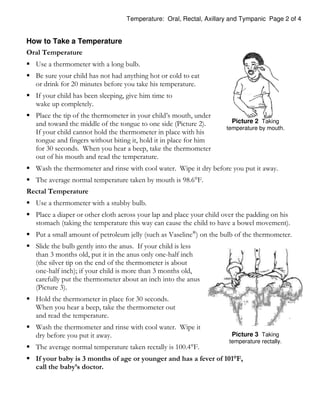
 Place the tip of the thermometer in your child’s mouth, under
and toward the middle of the tongue to one side (Picture 2).
If your child cannot hold the thermometer in place with his
tongue and fingers without biting it, hold it in place for him
for 30 seconds. When you hear a beep, take the thermometer
out of his mouth and read the temperature.
 Wash the thermometer and rinse with cool water. Wipe it dry before you put it away.
 The average normal temperature taken by mouth is 98.6°F.
Rectal Temperature
 Use a thermometer with a stubby bulb.
 Place a diaper or other cloth across your lap and place your child over the padding on his
stomach (taking the temperature this way can cause the child to have a bowel movement).
 Put a small amount of petroleum jelly (such as Vaseline®
) on the bulb of the thermometer.
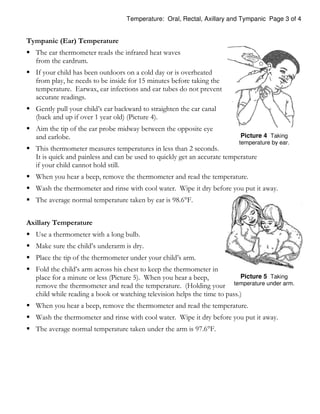
 Slide the bulb gently into the anus. If your child is less
than 3 months old, put it in the anus only one-half inch
(the silver tip on the end of the thermometer is about
one-half inch); if your child is more than 3 months old,
carefully put the thermometer about an inch into the anus
(Picture 3).
 Hold the thermometer in place for 30 seconds.
When you hear a beep, take the thermometer out
and read the temperature.
 Wash the thermometer and rinse with cool water. Wipe it
dry before you put it away.
 The average normal temperature taken rectally is 100.4°F.
 If your baby is 3 months of age or younger and has a fever of 101°F,
call the baby’s doctor.
Picture 2 Taking
temperature by mouth.
Picture 3 Taking
temperature rectally.
Temperature: Oral, Rectal, Axillary and Tympanic Page 3 of 4
Tympanic (Ear) Temperature
 The ear thermometer reads the infrared heat waves
from the eardrum.
 If your child has been outdoors on a cold day or is overheated
from play, he needs to be inside for 15 minutes before taking the
temperature. Earwax, ear infections and ear tubes do not prevent
accurate readings.
 Gently pull your child’s ear backward to straighten the ear canal
(back and up if over 1 year old) (Picture 4).
 Aim the tip of the ear probe midway between the opposite eye
and earlobe.
 This thermometer measures temperatures in less than 2 seconds.
It is quick and painless and can be used to quickly get an accurate temperature
if your child cannot hold still.
 When you hear a beep, remove the thermometer and read the temperature.
 Wash the thermometer and rinse with cool water. Wipe it dry before you put it away.
 The average normal temperature taken by ear is 98.6°F.
Axillary Temperature
 Use a thermometer with a long bulb.
 Make sure the child’s underarm is dry.
 Place the tip of the thermometer under your child’s arm.
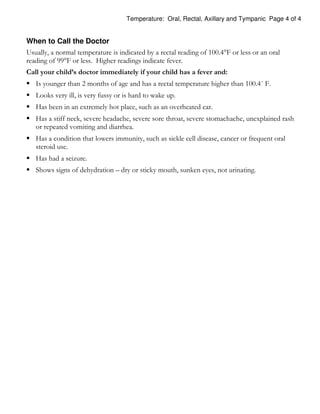
 Fold the child’s arm across his chest to keep the thermometer in
place for a minute or less (Picture 5). When you hear a beep,
remove the thermometer and read the temperature. (Holding your
child while reading a book or watching television helps the time to pass.)
 When you hear a beep, remove the thermometer and read the temperature.
 Wash the thermometer and rinse with cool water. Wipe it dry before you put it away.
 The average normal temperature taken under the arm is 97.6°F.
Picture 4 Taking
temperature by ear.
Picture 5 Taking
temperature under arm.
Temperature: Oral, Rectal, Axillary and Tympanic Page 4 of 4
When to Call the Doctor
Usually, a normal temperature is indicated by a rectal reading of 100.4°F or less or an oral
reading of 99°F or less. Higher readings indicate fever.
Call your child’s doctor immediately if your child has a fever and:
 Is younger than 2 months of age and has a rectal temperature higher than 100.4˚ F.
 Looks very ill, is very fussy or is hard to wake up.
 Has been in an extremely hot place, such as an overheated car.
 Has a stiff neck, severe headache, severe sore throat, severe stomachache, unexplained rash
or repeated vomiting and diarrhea.
 Has a condition that lowers immunity, such as sickle cell disease, cancer or frequent oral
steroid use.
 Has had a seizure.
 Shows signs of dehydration – dry or sticky mouth, sunken eyes, not urinating.

TEMPERATURE

  • 1.
    Temperature: Oral, Rectal,Tympanic and Axillary Using Digital Thermometers The body temperature of infants and children can change quickly. Age, activity and time of day can all affect a child’s normal temperature. If your child feels warmer than usual to your touch, is sweating, shivering or seems ill, or if he or she is going to have surgery, the doctor will need to know his temperature. A child's temperature can also show if an infection is responding to medicine the child may be taking. This Helping Hand tells about the four most usual ways of taking a temperature at home. Kinds of Thermometers The kind of thermometers doctors recommend for home use are digital (Picture 1). Mercury thermometers (glass with a silver line that shows the temperature) are no longer recommended. Mercury is toxic and can spill out if a glass thermometer is broken. Ways to Take a Temperature There are 4 ways to take a temperature at home: Oral (by mouth), rectal (by rectum or bottom), tympanic (just inside the ear canal) and axillary (under the arm). The method used usually depends on your child's age. For a newborn through 3 months, take a rectal temperature. For children 3 months through 3 years, take a rectal, ear or axillary temperature. For children 4 years to 5 years, take a rectal, oral, ear or axillary temperature. For children 5 years or older (who can hold the thermometer under the tongue and keep the mouth closed), take an oral, ear or axillary temperature. Remember: Children move around. To be sure you are recording your child’s correct temperature never leave him alone while you are using a thermometer. HH-II-189 4/11 Copyright 1975-2011, Nationwide Children’s Hospital Picture 1 (a)Oral digital thermometer; (b) Rectal digital thermometer; (c) Digital ear thermometer. (a) (b) (c)
  • 2.
    Temperature: Oral, Rectal,Axillary and Tympanic Page 2 of 4 How to Take a Temperature Oral Temperature Use a thermometer with a long bulb. Be sure your child has not had anything hot or cold to eat or drink for 20 minutes before you take his temperature. If your child has been sleeping, give him time to wake up completely. Place the tip of the thermometer in your child’s mouth, under and toward the middle of the tongue to one side (Picture 2). If your child cannot hold the thermometer in place with his tongue and fingers without biting it, hold it in place for him for 30 seconds. When you hear a beep, take the thermometer out of his mouth and read the temperature. Wash the thermometer and rinse with cool water. Wipe it dry before you put it away. The average normal temperature taken by mouth is 98.6°F. Rectal Temperature Use a thermometer with a stubby bulb. Place a diaper or other cloth across your lap and place your child over the padding on his stomach (taking the temperature this way can cause the child to have a bowel movement). Put a small amount of petroleum jelly (such as Vaseline® ) on the bulb of the thermometer. Slide the bulb gently into the anus. If your child is less than 3 months old, put it in the anus only one-half inch (the silver tip on the end of the thermometer is about one-half inch); if your child is more than 3 months old, carefully put the thermometer about an inch into the anus (Picture 3). Hold the thermometer in place for 30 seconds. When you hear a beep, take the thermometer out and read the temperature. Wash the thermometer and rinse with cool water. Wipe it dry before you put it away. The average normal temperature taken rectally is 100.4°F. If your baby is 3 months of age or younger and has a fever of 101°F, call the baby’s doctor. Picture 2 Taking temperature by mouth. Picture 3 Taking temperature rectally.
  • 3.
    Temperature: Oral, Rectal,Axillary and Tympanic Page 3 of 4 Tympanic (Ear) Temperature The ear thermometer reads the infrared heat waves from the eardrum. If your child has been outdoors on a cold day or is overheated from play, he needs to be inside for 15 minutes before taking the temperature. Earwax, ear infections and ear tubes do not prevent accurate readings. Gently pull your child’s ear backward to straighten the ear canal (back and up if over 1 year old) (Picture 4). Aim the tip of the ear probe midway between the opposite eye and earlobe. This thermometer measures temperatures in less than 2 seconds. It is quick and painless and can be used to quickly get an accurate temperature if your child cannot hold still. When you hear a beep, remove the thermometer and read the temperature. Wash the thermometer and rinse with cool water. Wipe it dry before you put it away. The average normal temperature taken by ear is 98.6°F. Axillary Temperature Use a thermometer with a long bulb. Make sure the child’s underarm is dry. Place the tip of the thermometer under your child’s arm. Fold the child’s arm across his chest to keep the thermometer in place for a minute or less (Picture 5). When you hear a beep, remove the thermometer and read the temperature. (Holding your child while reading a book or watching television helps the time to pass.) When you hear a beep, remove the thermometer and read the temperature. Wash the thermometer and rinse with cool water. Wipe it dry before you put it away. The average normal temperature taken under the arm is 97.6°F. Picture 4 Taking temperature by ear. Picture 5 Taking temperature under arm.
  • 4.
    Temperature: Oral, Rectal,Axillary and Tympanic Page 4 of 4 When to Call the Doctor Usually, a normal temperature is indicated by a rectal reading of 100.4°F or less or an oral reading of 99°F or less. Higher readings indicate fever. Call your child’s doctor immediately if your child has a fever and: Is younger than 2 months of age and has a rectal temperature higher than 100.4˚ F. Looks very ill, is very fussy or is hard to wake up. Has been in an extremely hot place, such as an overheated car. Has a stiff neck, severe headache, severe sore throat, severe stomachache, unexplained rash or repeated vomiting and diarrhea. Has a condition that lowers immunity, such as sickle cell disease, cancer or frequent oral steroid use. Has had a seizure. Shows signs of dehydration – dry or sticky mouth, sunken eyes, not urinating.