.BODY LANGUAGE
BY
Sujith Bhaskar R
..
Body Language
(Nonverbal Behavior)
magic © 2004. All Rights Reserved.
May be reproduced with proper citation for educational purposes.
Introduction
 Body Language is the unspoken communication that
goes on in every Face-to-Face encounter with
another human being. It tells you their true feelings
towards you and how well your words are being
received. Between 60-80% of our message is
communicated through our Body Language, only 7-
10% is attributable to the actual words of a
conversation.
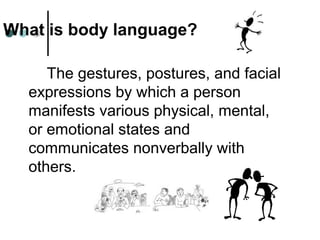
What is body language?
The gestures, postures, and facial
expressions by which a person
manifests various physical, mental,
or emotional states and
communicates nonverbally with
others.
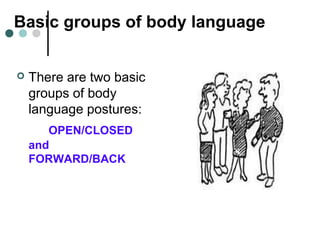
Basic groups of body language
 There are two basic
groups of body
language postures:
OPEN/CLOSED
and
FORWARD/BACK
The posture groups combine to
create four basic modes
They are
 Responsive
 Reflective
 Combative
 Fugitive
Responsive
 In responsive mode, OPEN/FORWARD
the person is actively accepting.
 Interpretation types
- Engaged
 Eager
 Ready to agree
Examples…
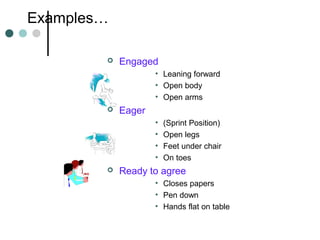
 Engaged
• Leaning forward
• Open body
• Open arms
 Eager
• (Sprint Position)
• Open legs
• Feet under chair
• On toes
 Ready to agree
• Closes papers
• Pen down
• Hands flat on table
Reflective
 In reflective mode, OPEN/BACK, people are
interested and receptive but not actively
accepting.
 Interpretation types
- Listening
 Evaluating
 Attentive
Examples…
 Listening
• Head tilted
• Lots of eye contact
• Nodding
• High blink rate
 Evaluating
• Sucks glasses / pencils
• Strokes chin
• Looks up and right
• Legs crossed in 4 pos.
• ( Ankle on knee )
 Attentive
• ( Standing )
• Arms behind back
• Smile
• Open feet
Combative
 In combative mode, CLOSED/FORWARD,
there is active resistance
 Interpretation types
 Defiant
 Lying
 Let me speak
 Aggressive
Examples…
 Let me speak
• Finger tapping
• Foot tapping
• Staring
 Aggressive
• Leaning forwards
• Finger pointing
• Fist clenched
 Defiant
• ( standing )
• Hands on hips
• Frown
 Lying
• Touches face
• Hands over mouth
• Pulls ear
• Eyes down
• Glances at you
• Shift in seat
• Looks down and to left
Fugitive
 In fugitive mode, CLOSED/BACK, people
are trying to escape physically through the
door or mentally into boredom.
 Interpretation types
 Bored
 Let me go
 Rejection
 Defensive
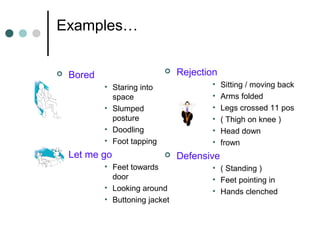
Examples…
 Bored
• Staring into
space
• Slumped
posture
• Doodling
• Foot tapping
 Let me go
• Feet towards
door
• Looking around
• Buttoning jacket
 Rejection
• Sitting / moving back
• Arms folded
• Legs crossed 11 pos
• ( Thigh on knee )
• Head down
• frown
 Defensive
• ( Standing )
• Feet pointing in
• Hands clenched
Conclusion
 Knowing how to read body language is a
useful communication skill. So one should
know how to use it. It might help us in a
job interview, that crucial meeting, the
business function, or that special date!
Thank you
magic © 2004. All Rights Reserved.
May be reproduced with proper citation for
educational purposes.
Body Language
(Nonverbal Behavior)
magic © 2004. All Rights Reserved.
May be reproduced with proper citation for educational purposes.

Body language. is very important

  • 1.
  • 2.
    Body Language (Nonverbal Behavior) magic© 2004. All Rights Reserved. May be reproduced with proper citation for educational purposes.
  • 3.
    Introduction  Body Languageis the unspoken communication that goes on in every Face-to-Face encounter with another human being. It tells you their true feelings towards you and how well your words are being received. Between 60-80% of our message is communicated through our Body Language, only 7- 10% is attributable to the actual words of a conversation.
  • 4.
    What is bodylanguage? The gestures, postures, and facial expressions by which a person manifests various physical, mental, or emotional states and communicates nonverbally with others.
  • 5.
    Basic groups ofbody language  There are two basic groups of body language postures: OPEN/CLOSED and FORWARD/BACK
  • 6.
    The posture groupscombine to create four basic modes They are  Responsive  Reflective  Combative  Fugitive
  • 7.
    Responsive  In responsivemode, OPEN/FORWARD the person is actively accepting.  Interpretation types - Engaged  Eager  Ready to agree
  • 8.
    Examples…  Engaged • Leaningforward • Open body • Open arms  Eager • (Sprint Position) • Open legs • Feet under chair • On toes  Ready to agree • Closes papers • Pen down • Hands flat on table
  • 9.
    Reflective  In reflectivemode, OPEN/BACK, people are interested and receptive but not actively accepting.  Interpretation types - Listening  Evaluating  Attentive
  • 10.
    Examples…  Listening • Headtilted • Lots of eye contact • Nodding • High blink rate  Evaluating • Sucks glasses / pencils • Strokes chin • Looks up and right • Legs crossed in 4 pos. • ( Ankle on knee )  Attentive • ( Standing ) • Arms behind back • Smile • Open feet
  • 11.
    Combative  In combativemode, CLOSED/FORWARD, there is active resistance  Interpretation types  Defiant  Lying  Let me speak  Aggressive
  • 12.
    Examples…  Let mespeak • Finger tapping • Foot tapping • Staring  Aggressive • Leaning forwards • Finger pointing • Fist clenched  Defiant • ( standing ) • Hands on hips • Frown  Lying • Touches face • Hands over mouth • Pulls ear • Eyes down • Glances at you • Shift in seat • Looks down and to left
  • 13.
    Fugitive  In fugitivemode, CLOSED/BACK, people are trying to escape physically through the door or mentally into boredom.  Interpretation types  Bored  Let me go  Rejection  Defensive
  • 14.
    Examples…  Bored • Staringinto space • Slumped posture • Doodling • Foot tapping  Let me go • Feet towards door • Looking around • Buttoning jacket  Rejection • Sitting / moving back • Arms folded • Legs crossed 11 pos • ( Thigh on knee ) • Head down • frown  Defensive • ( Standing ) • Feet pointing in • Hands clenched
  • 15.
    Conclusion  Knowing howto read body language is a useful communication skill. So one should know how to use it. It might help us in a job interview, that crucial meeting, the business function, or that special date!
  • 16.
    Thank you magic ©2004. All Rights Reserved. May be reproduced with proper citation for educational purposes.
  • 17.
    Body Language (Nonverbal Behavior) magic© 2004. All Rights Reserved. May be reproduced with proper citation for educational purposes.