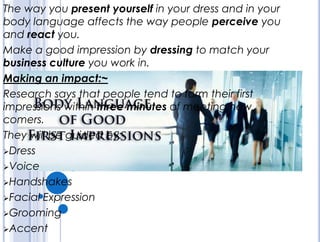
The way you present yourself in your dress and in your
body language affects the way people perceive you
and react you.
Make a good impression by dressing to match your
business culture you work in.
Making an impact:~
Research says that people tend to form their first
impressions within three minutes of meeting new
comers.
They will be guided by:-
Dress
Voice
Handshakes
Facial Expression
Grooming
Accent
FEW IMPORTANT CRITERIA OF
READING A BODY POSTURES.
 Because of its subtlety range, body
language is difficult to read and to control.
In communication,
 Seeing is more important than hearing.
 Broad understanding of body language.
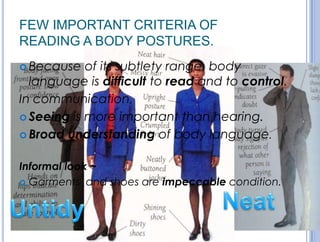
Informal look ~
 Garments and shoes are impeccable condition.
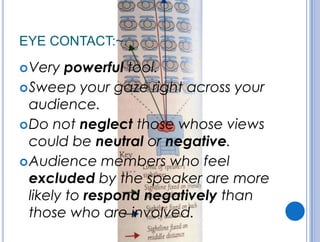
EYE CONTACT:~.
Very powerful tool.
Sweep your gaze right across your
audience.
Do not neglect those whose views
could be neutral or negative.
Audience members who feel
excluded by the speaker are more
likely to respond negatively than
those who are involved.
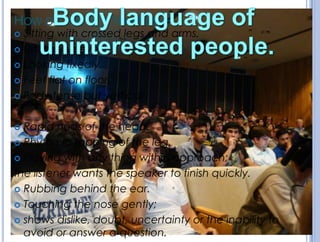
HOW DO WE GET TO KNOW~
 Sitting with crossed legs and arms.
 Unblinking eyes.
 Looking fixedly.
 Feet flat on floor.
 Body tense but vertical .
 Rapid nods of the head.
 Rhythmic tapping of the leg.
 Playing with any thing within approach;
the listener wants the speaker to finish quickly.
 Rubbing behind the ear.
 Touching the nose gently;
 shows dislike, doubt, uncertainty or the inability to
avoid or answer a question.
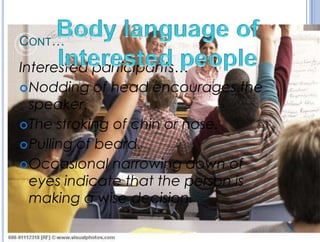
CONT…
Interested participants…
Nodding of head encourages the
speaker.
The stroking of chin or nose.
Pulling of beard.
Occasional narrowing down of
eyes indicate that the person is
making a wise decision.
FEW TIPS FOR FIRST IMPRESSION
As you enter for the interview…
Polite acknowledgment of
gratitude.
Relaxed but upright posture.
Positive tone.
Proper eye contact(without
staring).
Practice a firm and dry handshake.
Be alert.
Sit erect.
To stimulate good feelings, smile
A genuine smile…
 Stimulates your own sense of well-being.
 Shows that you are:- approachable,
co-operative, and trustworthy.
 Most importantly, smiling directly shows
how other people respond to you.
To improve your speech, use your hands
 Broca’s area of brain, important for
speech production when wave our
hands.
 Gesturing as we talk can actually power
up our thinking.
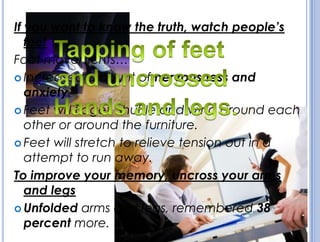
If you want to know the truth, watch people’s
feet
Foot movements…
 Increased amount of nervousness and
anxiety.
 Feet will fidget, shuffle and wind around each
other or around the furniture.
 Feet will stretch to relieve tension out in a
attempt to run away.
To improve your memory, uncross your arms
and legs
 Unfolded arms and legs, remembered 38
percent more.
-Wikipedia.
-DK publications.
-Search engine: Google.

Body language

  • 2.
    The way youpresent yourself in your dress and in your body language affects the way people perceive you and react you. Make a good impression by dressing to match your business culture you work in. Making an impact:~ Research says that people tend to form their first impressions within three minutes of meeting new comers. They will be guided by:- Dress Voice Handshakes Facial Expression Grooming Accent
  • 3.
    FEW IMPORTANT CRITERIAOF READING A BODY POSTURES.  Because of its subtlety range, body language is difficult to read and to control. In communication,  Seeing is more important than hearing.  Broad understanding of body language. Informal look ~  Garments and shoes are impeccable condition.
  • 4.
    EYE CONTACT:~. Very powerfultool. Sweep your gaze right across your audience. Do not neglect those whose views could be neutral or negative. Audience members who feel excluded by the speaker are more likely to respond negatively than those who are involved.
  • 5.
    HOW DO WEGET TO KNOW~  Sitting with crossed legs and arms.  Unblinking eyes.  Looking fixedly.  Feet flat on floor.  Body tense but vertical .  Rapid nods of the head.  Rhythmic tapping of the leg.  Playing with any thing within approach; the listener wants the speaker to finish quickly.  Rubbing behind the ear.  Touching the nose gently;  shows dislike, doubt, uncertainty or the inability to avoid or answer a question.
  • 6.
    CONT… Interested participants… Nodding ofhead encourages the speaker. The stroking of chin or nose. Pulling of beard. Occasional narrowing down of eyes indicate that the person is making a wise decision.
  • 7.
    FEW TIPS FORFIRST IMPRESSION As you enter for the interview… Polite acknowledgment of gratitude. Relaxed but upright posture. Positive tone. Proper eye contact(without staring). Practice a firm and dry handshake. Be alert. Sit erect.
  • 8.
    To stimulate goodfeelings, smile A genuine smile…  Stimulates your own sense of well-being.  Shows that you are:- approachable, co-operative, and trustworthy.  Most importantly, smiling directly shows how other people respond to you. To improve your speech, use your hands  Broca’s area of brain, important for speech production when wave our hands.  Gesturing as we talk can actually power up our thinking.
  • 9.
    If you wantto know the truth, watch people’s feet Foot movements…  Increased amount of nervousness and anxiety.  Feet will fidget, shuffle and wind around each other or around the furniture.  Feet will stretch to relieve tension out in a attempt to run away. To improve your memory, uncross your arms and legs  Unfolded arms and legs, remembered 38 percent more.
  • 10.