www.company.com
P
F
C
C
O
www.company.com
Board Roles and Responsibilities
Major Duties of Board of Directors
 Provide continuity for the organization
 Select and appoint a chief executive
 Govern the organization by broad
policies and objectives
P
F
C
C
O
www.company.com
 Acquire sufficient resources for the
organization's operations
 Account to the public for the products
and services of the organization and
expenditures
Board Roles and Responsibilities
P
F
C
C
O
www.company.com
Major Responsibilities of Board of Directors
 Determine the Organization's Mission
and Purpose
 Select / create the Executive Committee
 Support the Executive and Review his
or her performance
 Ensure Effective Organizational
Planning
P
F
C
C
O
www.company.com
 Ensure Adequate Resources
 Manage Resources Effectively
 Determine and Monitor the
Organization's Programs and Services
 Enhance the Organization's Public
Image
 Serve as a Court of Appeal
 Assess Its Own Performance
Major Responsibilities of Board of Directors
P
F
C
C
O
www.company.com
Board Chair Job Description
 Is a member of the Board
 Serves as the Chief Governance/
Volunteer of the organization
 Is a partner with the Chief Executive in
achieving the organization's mission
 Provides leadership to the Board of
Directors
P
F
C
C
O
www.company.com
 Chairs meetings of the Board after developing
the agenda with the Chief Executive
 Encourages Board's role in strategic planning
 Appoints the chairpersons of committees, in
consultation with other Board members
 Serves ex officio as a member of committees
and attends their meetings when invited.
Board Chair Job Description
P
F
C
C
O
www.company.com
 Discusses issues confronting the
organization with the Chief Executive.
 Helps guide and mediate Board actions
with respect to organizational priorities
and governance concerns.
 Reviews with the Chief Executive any
issues of concern to the Board.
Board Chair Job Description
P
F
C
C
O
www.company.com
 Monitors financial planning and financial
reports.
 Formally evaluates the performance of the
Chief Executive and informally evaluates the
effectiveness of the Board members.
 Evaluates annually the performance of the
organization in achieving its mission.
 Performs other responsibilities assigned by
the Board.
Board Chair Job Description
P
F
C
C
O
www.company.com
Vice Chair Job Description
 Is a member of the Board
 Performs Chair responsibilities when the Chair
cannot be available
 Reports to the Board's Chair
 Works closely with the Chair and other staff
 Participates closely with the Chair to develop
and implement officer transition plans.
 Performs other responsibilities as
assigned by the Board.
P
F
C
C
O
www.company.com
Committee Chair Job Description
 Is a member of the Board
 Sets tone for the committee work.
 Ensures that members have the
information needed to do their jobs.
 Oversees the logistics of committee's
operations.
 Reports to the Board's Chair.
P
F
C
C
O
www.company.com
 Reports to the full Board on committee's
decisions/recommendations.
 Works closely with the Chief Executive
and other staff as agreed to by the Chief
Executive.
 Assigns work to the committee members
 Initiates and leads the committee's
annual evaluation.
Committee Chair Job Description
P
F
C
C
O
www.company.com
Board Member Job Description
 Regularly attends board meetings and
important related meetings.
 Makes serious commitment to participate
actively in committee work.
 Volunteers for and willingly accepts
assignments and completes them
thoroughly and on time.
 Stays informed about committee
matters
P
F
C
C
O
www.company.com
 Gets to know other committee members
and builds a collegial working
relationship that contributes to
consensus.
 Is an active participant in the committee's
annual evaluation and planning efforts.
 Participates in fund raising for the
organization.
Board Member Job Description
P
F
C
C
O
www.company.com
Board Secretary Job Description
 Appointed by the Board
 Maintains records of the board and ensures
effective management of organization's
records
 Manages minutes of board meeting
 Ensures minutes are distributed to members
shortly after each meeting
 Is sufficiently familiar with legal
documents
P
F
C
C
O
www.company.com
Board Treasurer Job Description
 Appointed by the Board
 Manages finances of the organization
 Administrates fiscal matters of the
organization
 Provides annual budget to the board for
members' approval
 Ensures development and board review of
financial policies and procedures
P
F
C
C
O
P
F
C
C
O
www.company.com
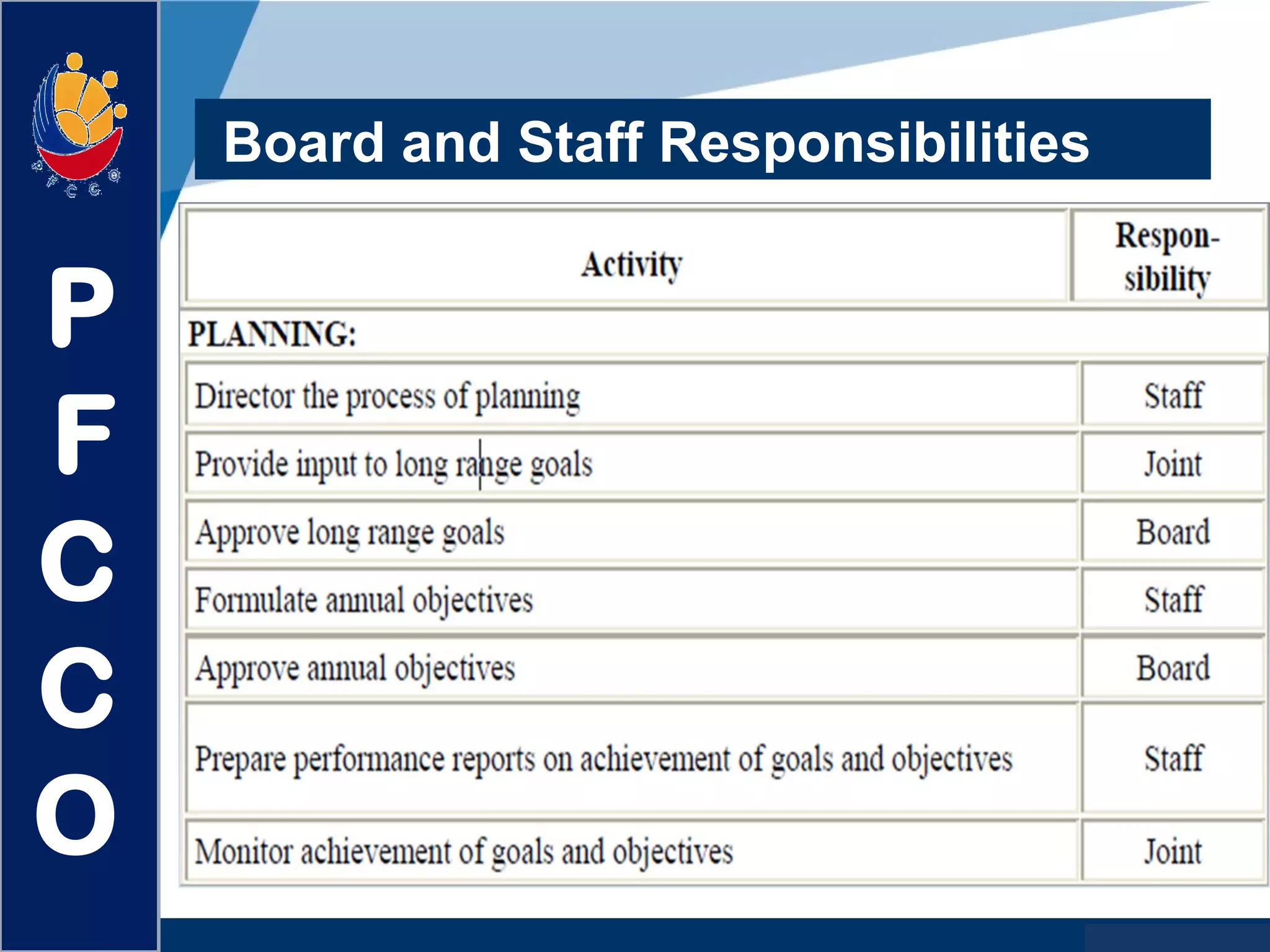
Board and Staff Responsibilities
P
F
C
C
O
www.company.com
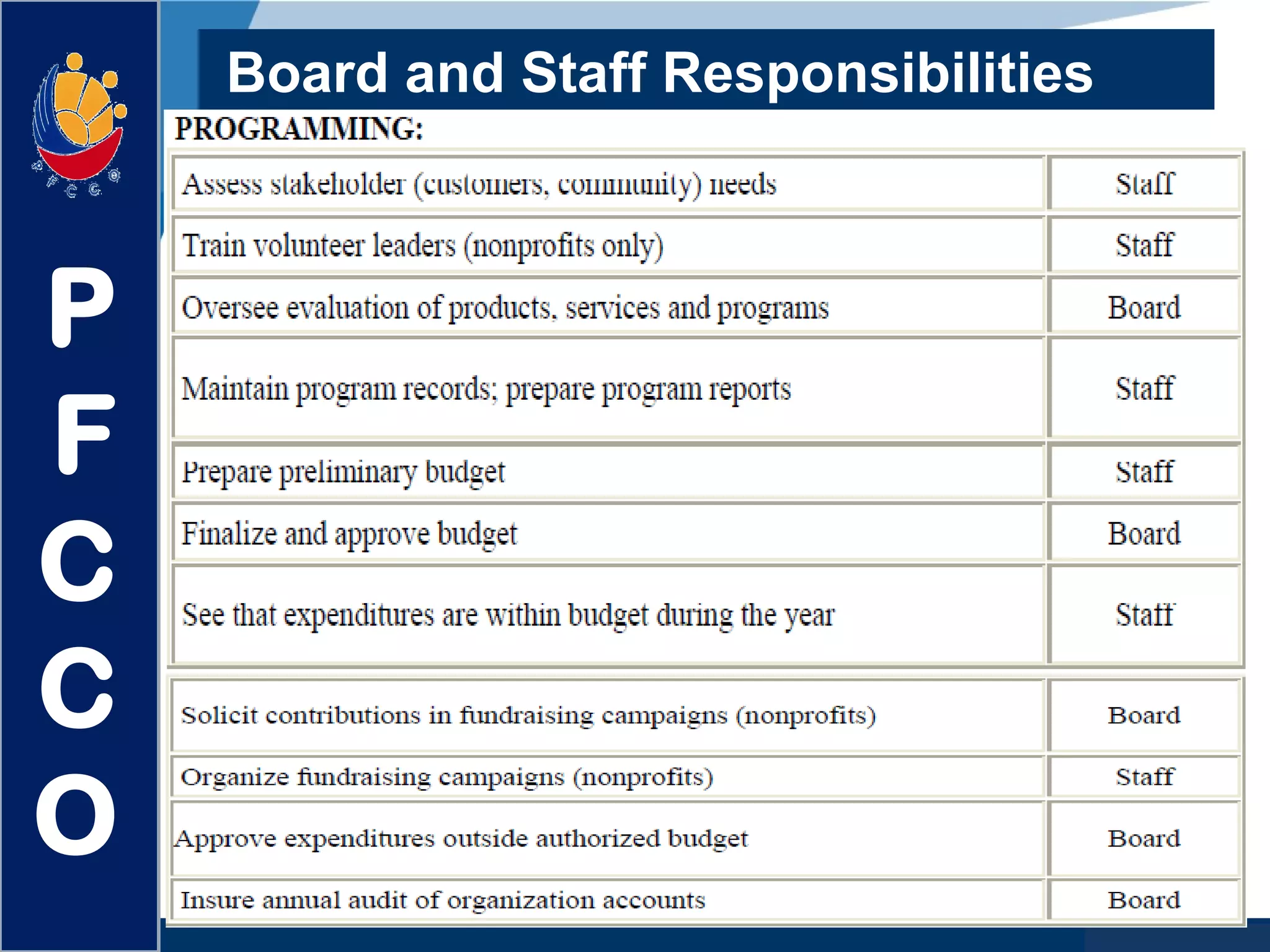
Board and Staff Responsibilities
P
F
C
C
O
www.company.com
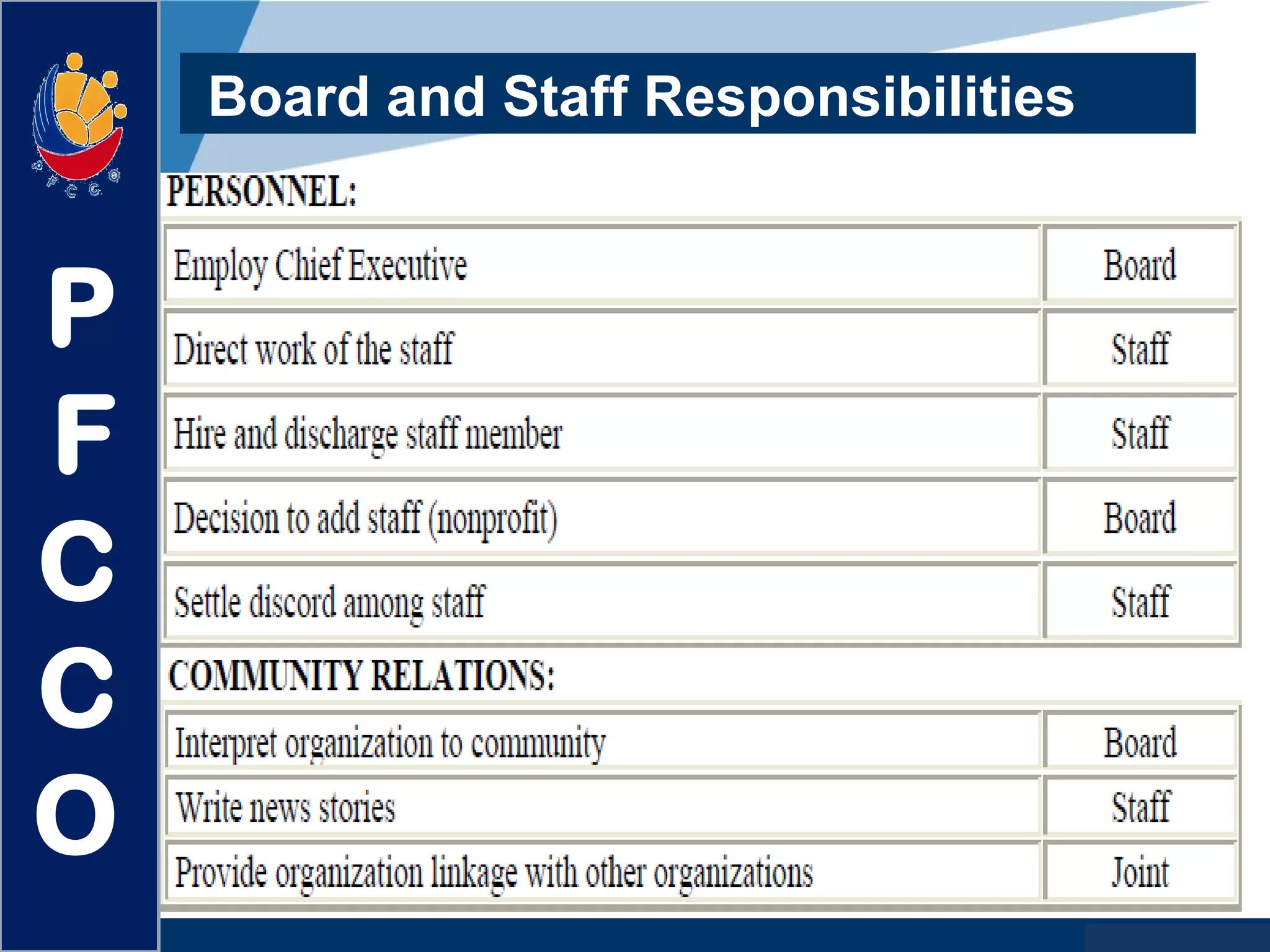
Board and Staff Responsibilities
P
F
C
C
O
www.company.com
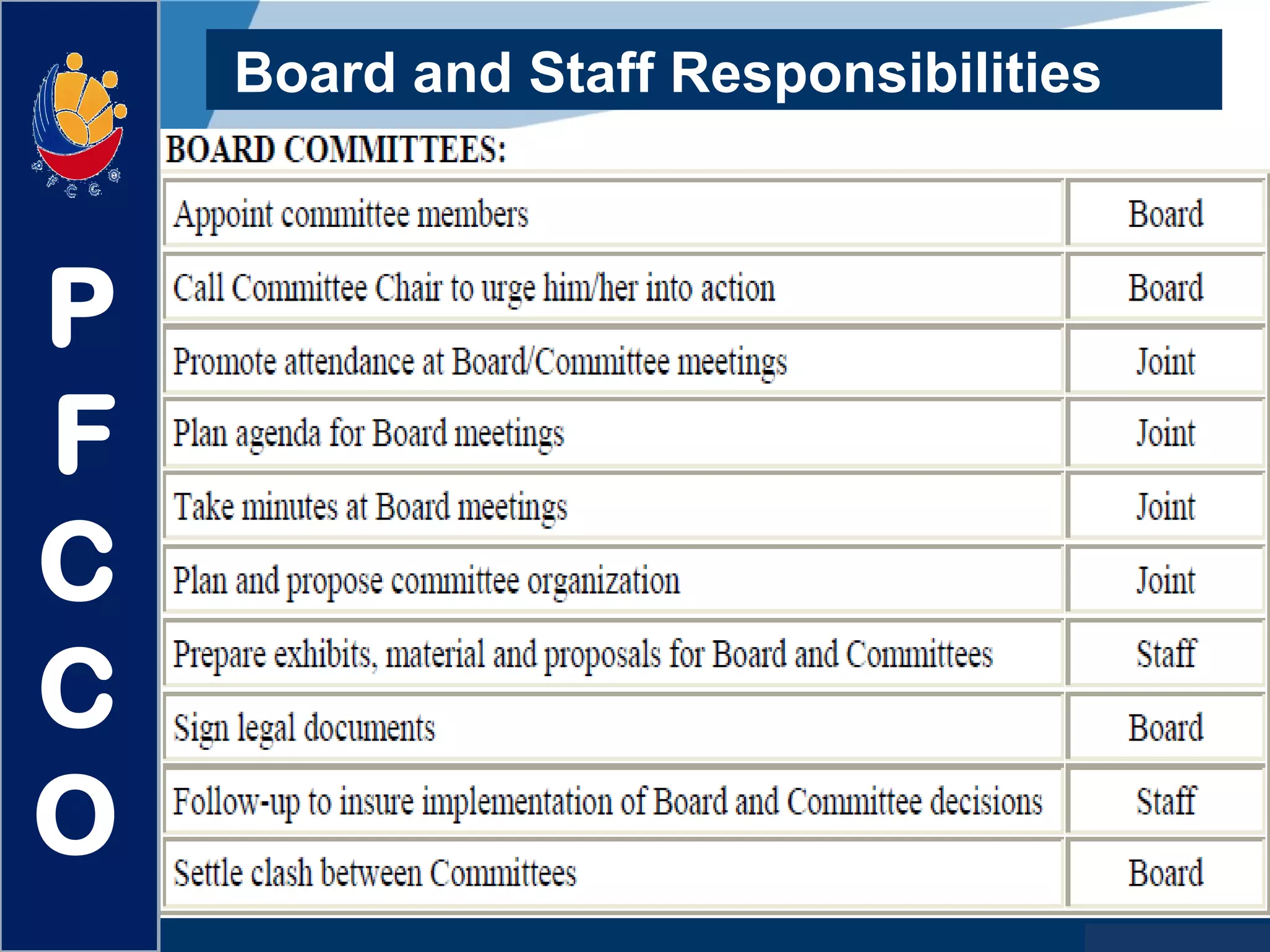
Board and Staff Responsibilities
P
F
C
C
O
www.company.com
Guidelines to Form an Advisory Group
(Committees)
Overall Benefit of an Advisory
`
`
What is an Advisory Group?
When Should an Advisory
Group Be Formed?
P
F
C
C
O
www.company.com
Typical Types of Board Committees
About Committees
 Establish committees when it's apparent
that issues are too complex.
 Standing committees should be included
in the by-laws/policies.
 Committees recommend policy for
approval by the entire board.
P
F
C
C
O
www.company.com
Committees make full use of board
members' expertise, time and
commitment.
They do not supplant responsibility of
each board member; they operate at the
board level and not the staff level.
 Committees may meet monthly every
two months, or every three months.
 Minutes should be recorded for all
board
P
F
C
C
O
www.company.com
Developing Committees
 Ensure the committee has a specific
charge or set of tasks to address
 Have at least two board members on
each committee, preferably three
 Don't have a member on more than
two committees
P
F
C
C
O
www.company.com
 In each board meeting, have each
committee chair report the committee's
work since the past board meeting
Consider having non-board volunteers as
members of the committee
 Consider having a relevant staff member
as a member of the committee as well
P
F
C
C
O
www.company.com
Committee chairs are often appointed by the
board chair
Consider having board meetings every other
month and committee meetings between the
board meeting
 The chief executive should service ex officio
to the board and any relevant committees
P
F
C
C
O
www.company.com
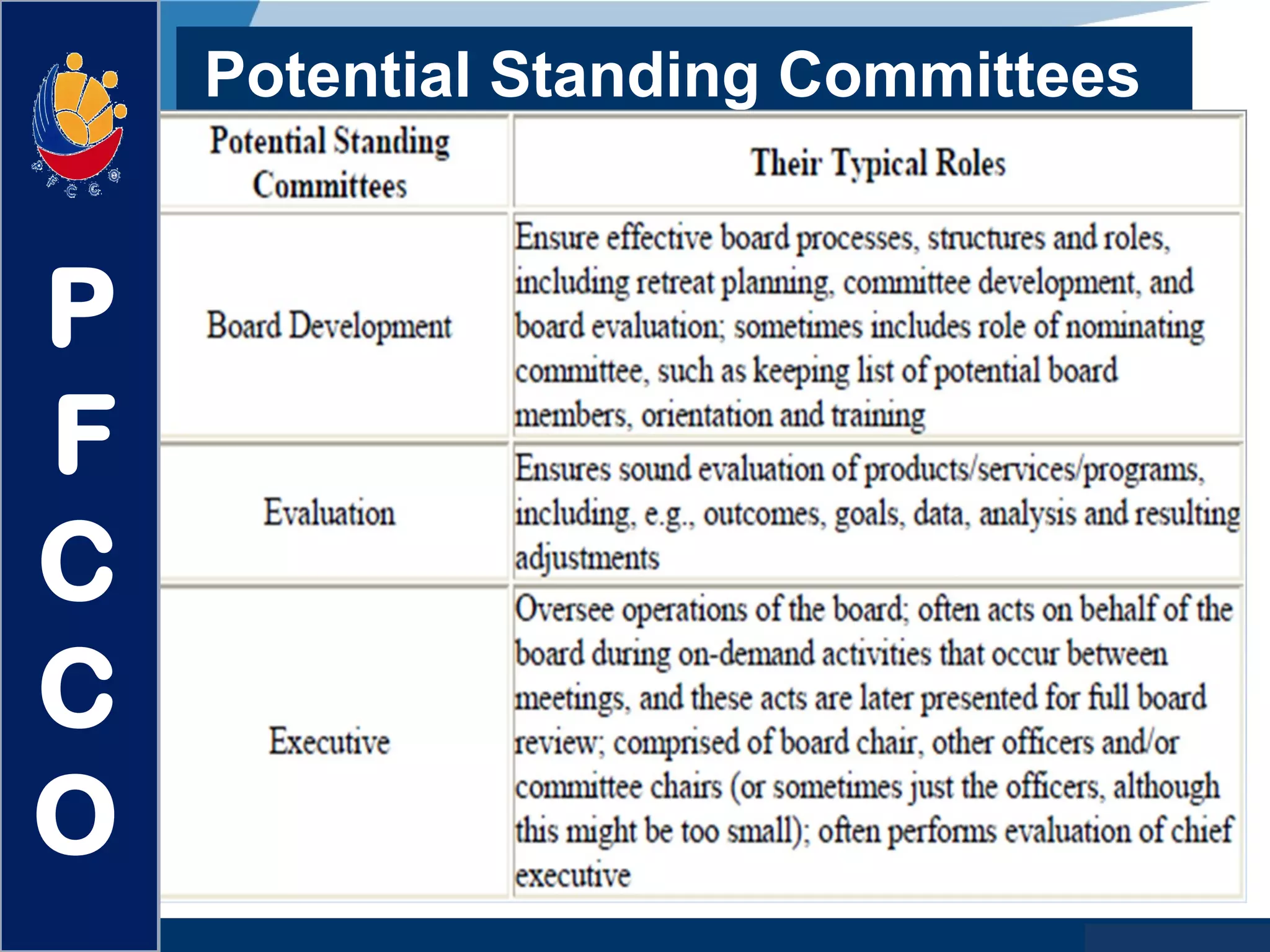
Potential Standing Committees
P
F
C
C
O
www.company.com
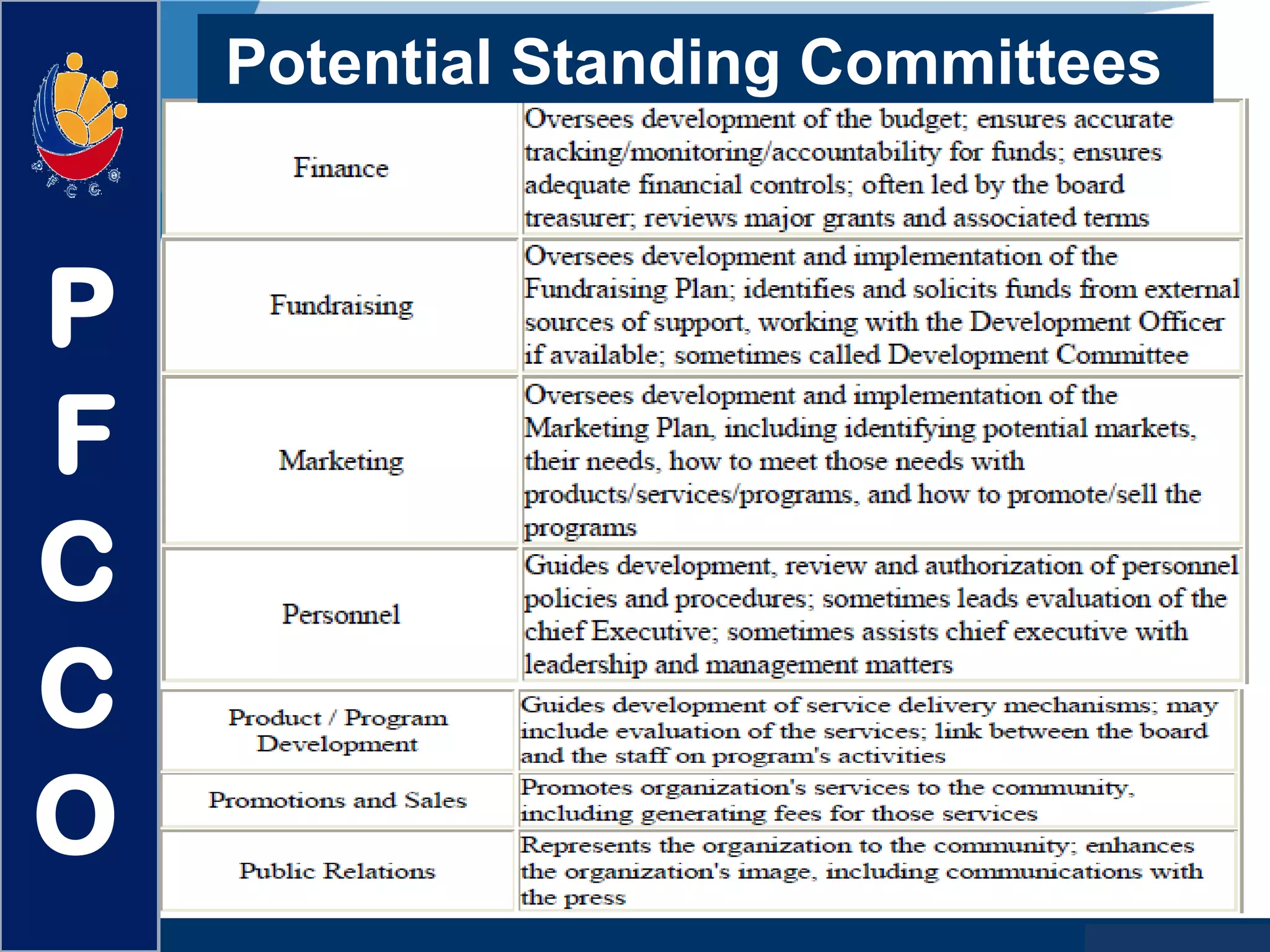
Potential Standing Committees
P
F
C
C
O
www.company.com
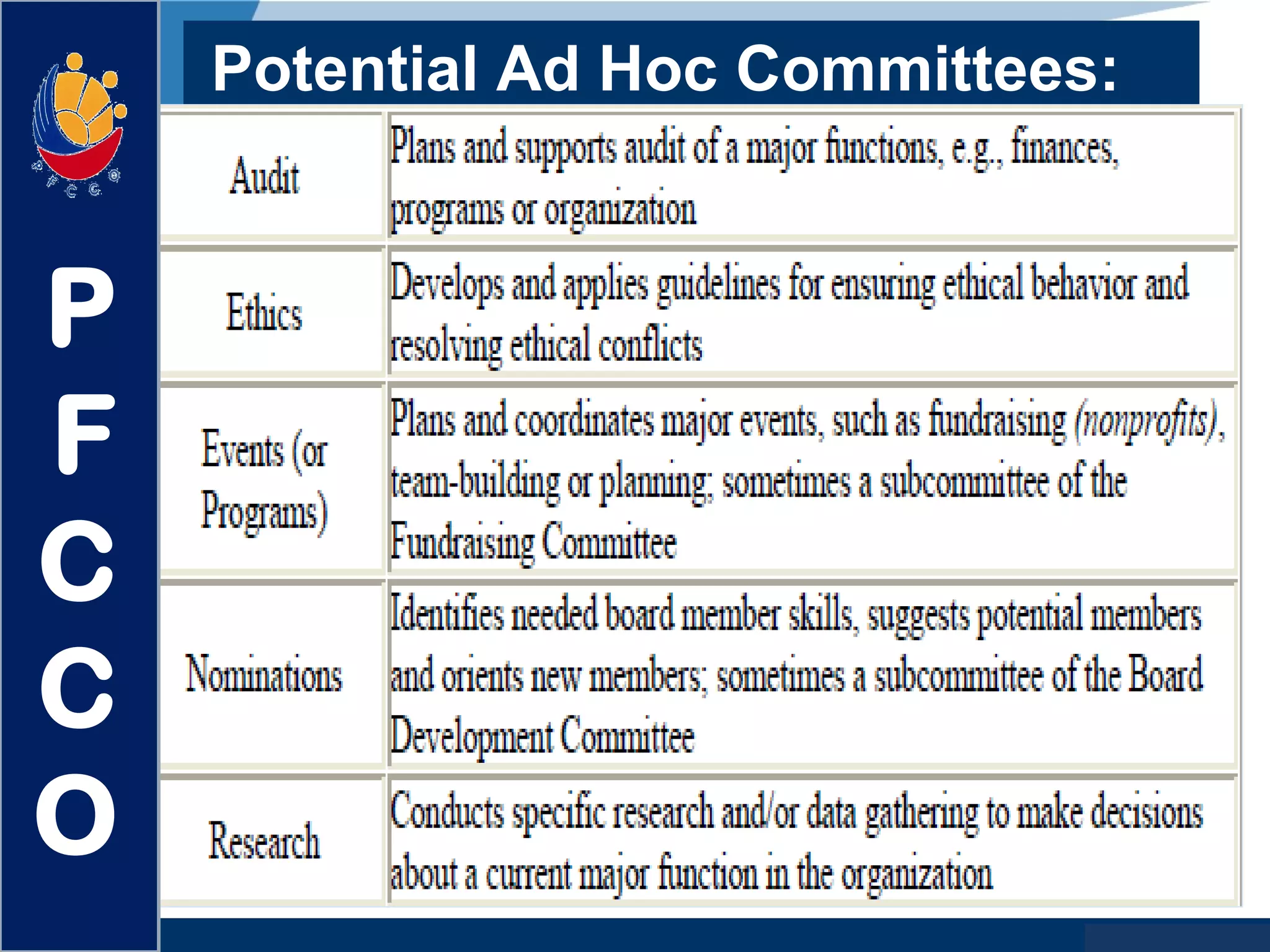
Potential Ad Hoc Committees:
P
F
C
C
O
www.company.com
How Should the Advisory Group
Be Defined/Organized?
P
F
C
C
O
www.company.com
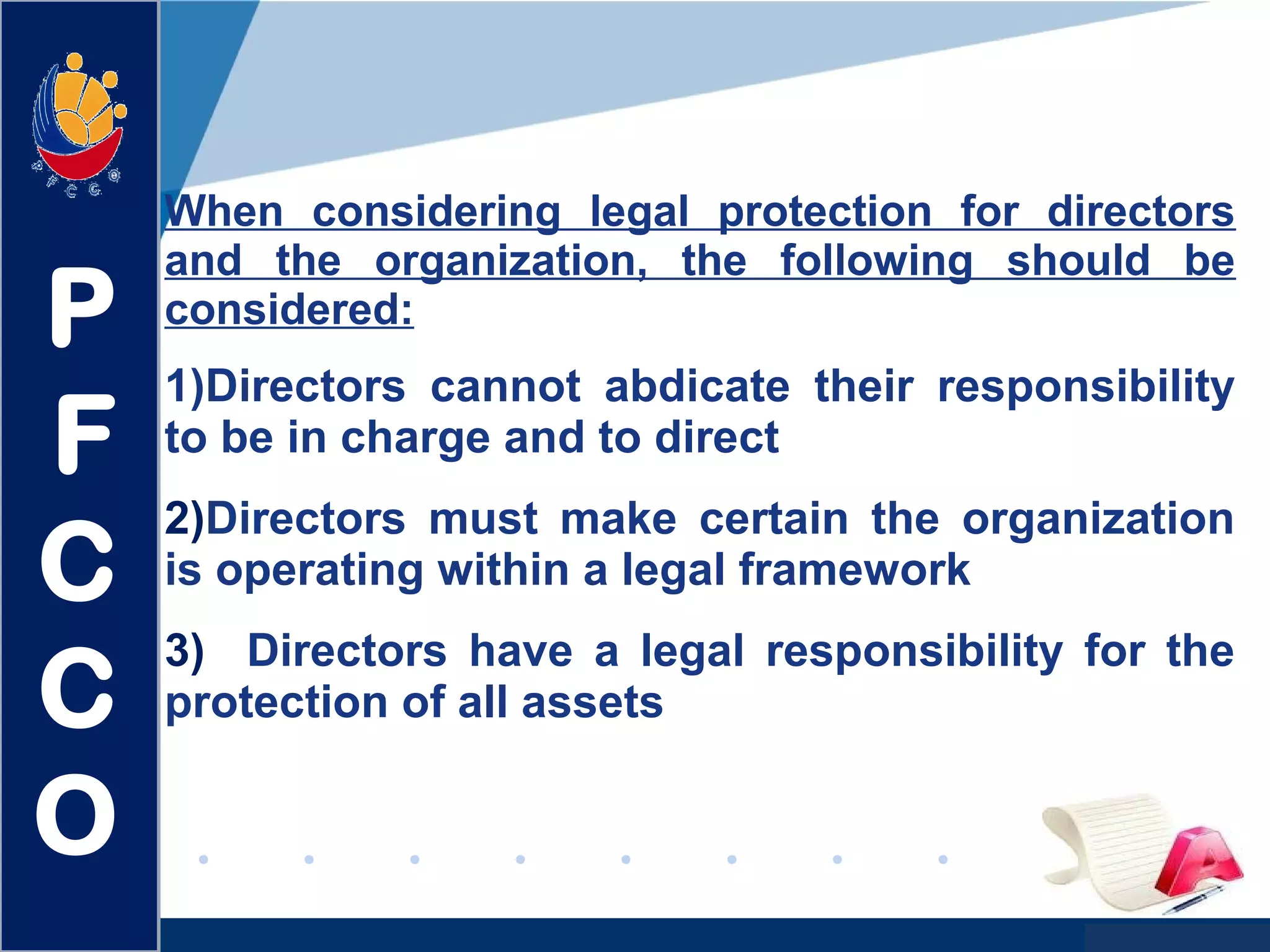
When considering legal protection for directors
and the organization, the following should be
considered:
1)Directors cannot abdicate their responsibility
to be in charge and to direct
2)Directors must make certain the organization
is operating within a legal framework
3) Directors have a legal responsibility for the
protection of all assets
P
F
C
C
O
www.company.com
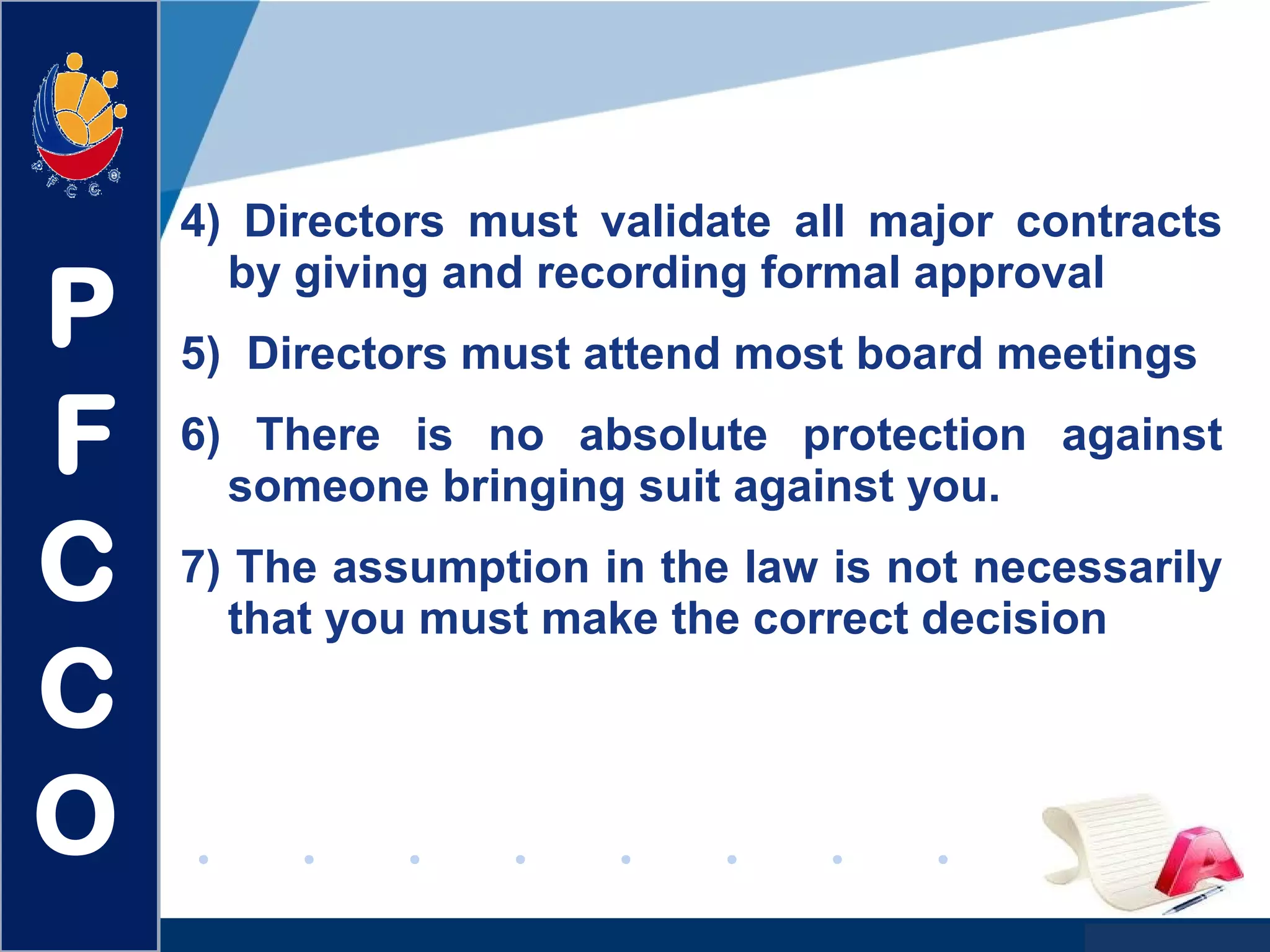
4) Directors must validate all major contracts
by giving and recording formal approval
5) Directors must attend most board meetings
6) There is no absolute protection against
someone bringing suit against you.
7) The assumption in the law is not necessarily
that you must make the correct decision
P
F
C
C
O
www.company.com
8) While you have the right to rely on
information supplied to you in due form,
and on the accuracy and integrity of
others you must use reasonable
judgment in this area, too.
9)If it smells fishy, find out where it has
been swimming -- and how long it has
been dead.
P
F
C
C
O
www.company.com
Some key suggestions:
 Attend meetings
 Read minutes and make sure they are
correct
 Record objections and ensure a debate
on controversial or difficult issues
 Always have comprehensive and up-
to-date personnel policies that are
reviewed by a professional.
P
F
C
C
O
www.company.com
 Ensure that all employment and income
taxes are paid.
 Schedule a presentation from an insurance
agent who is well versed in board liability
matters.
 Review financial statements and insist on
understanding them.
P
F
C
C
O
www.company.com
Staffing the Board
Joining a Board
 asking some basic questions before joining an
organization's board.
 Ask the following questions about the
organization's programs:
• What is the organization's mission?
• How do its current programs relate to the
mission?
• Does the organization have a strategic plan that
is reviewed and evaluated on a regular basis?
P
F
C
C
O
www.company.com
Ask the following questions about the
organization's financial status
• Is the financial condition of the organization
sound?
• Does the board discuss and approve the
annual budget?
• How often do board members receive
financial reports?
P
F
C
C
O
www.company.com
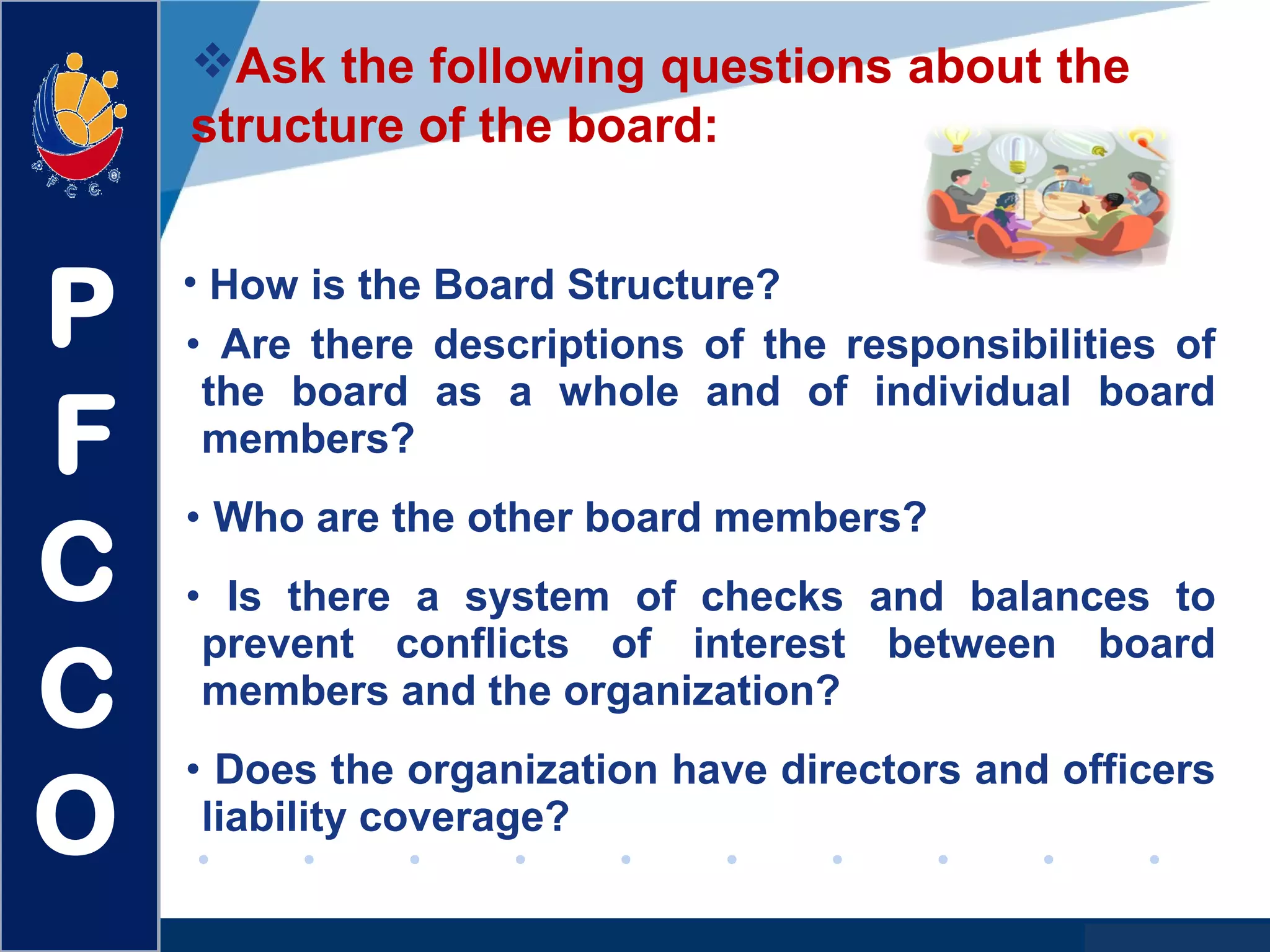
• Are there descriptions of the responsibilities of
the board as a whole and of individual board
members?
• Who are the other board members?
• Is there a system of checks and balances to
prevent conflicts of interest between board
members and the organization?
• Does the organization have directors and officers
liability coverage?
Ask the following questions about the
structure of the board:
• How is the Board Structure?
P
F
C
C
O
www.company.com
• What are the ways that you think I can
contribute as a board member?
• How much of my time will be required for
meetings and special events?
• How are committee assignments made?
Ask the following questions about
individual board members' responsibilities:
P
F
C
C
O
www.company.com
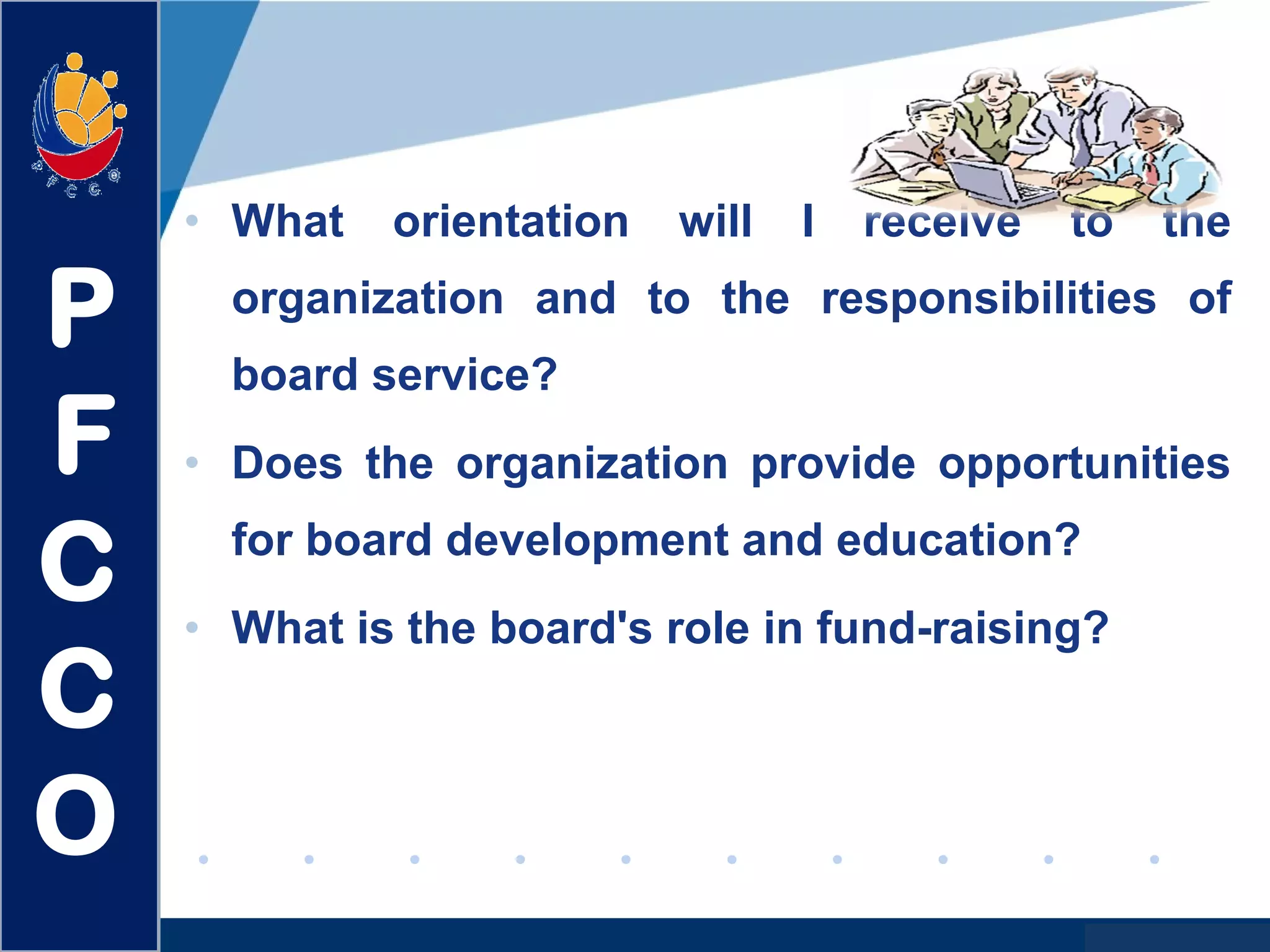
• What orientation will I receive to the
organization and to the responsibilities of
board service?
• Does the organization provide opportunities
for board development and education?
• What is the board's role in fund-raising?
P
F
C
C
O
www.company.com
Evaluate Your Interest in Serving on the Board
• Am I committed to the mission of the
organization?
• Can I contribute the time necessary to be an
effective board member?
• Am I comfortable with the approach and
tone of the organization's fund-raising
efforts?
P
F
C
C
O
www.company.com
• Can I contribute financial support consistent
with the organization's expectations of board
members and with my own means and
priorities?
• Can I place the organization's purposes and
interests above my own professional?
P
F
C
C
O
www.company.com
Background Material
The organization's annual report
The most recent audited financial
statement
A list of current board members, titles,
and all affiliations
A description of board members'
responsibilities
P
F
C
C
O
www.company.com
A board organization chart
A staff organization chart
The organization's newsletter, brochure,
or other publications
Newspaper or magazine articles about the
organization
A brief biography of the executive
committee and senior management
executives
P
F
C
C
O
www.company.com
Building Positive Board Relationships
Bring operational or any other concerns to
the attention of the board chair and the
member.
Demonstrate a willingness to listen to
others.
Disclose yourself to others in an open
fashion.
Publicly support your colleagues.
P
F
C
C
O
www.company.com
Publicly support decisions of the board
Adhere to a code of ethics that guides
your behavior.
Base recommended action on the board’s
agreed-upon mission, as opposed to
special interest.
P
F
C
C
O
www.company.com
Effective Board Leadership
Four essential roles of effective board
leadership
 Vision
 Structure
 Accountability
 Advocacy
P
F
C
C
O
www.company.com
Board decision-making model
 Define the problem
 Gather information
 Get the committee's or management
recommendation
 Get a second opinion
 Forecast consequences
 Check proposed decisions
 Decide,determine,settle,conclude and
resolve
P
F
C
C
O
www.company.com
Basic problem solving at its best
 Gather the facts
 Define the problem
 Get the options
 Get the manager's preferred alternative
 Get committee input
P
F
C
C
O
www.company.com
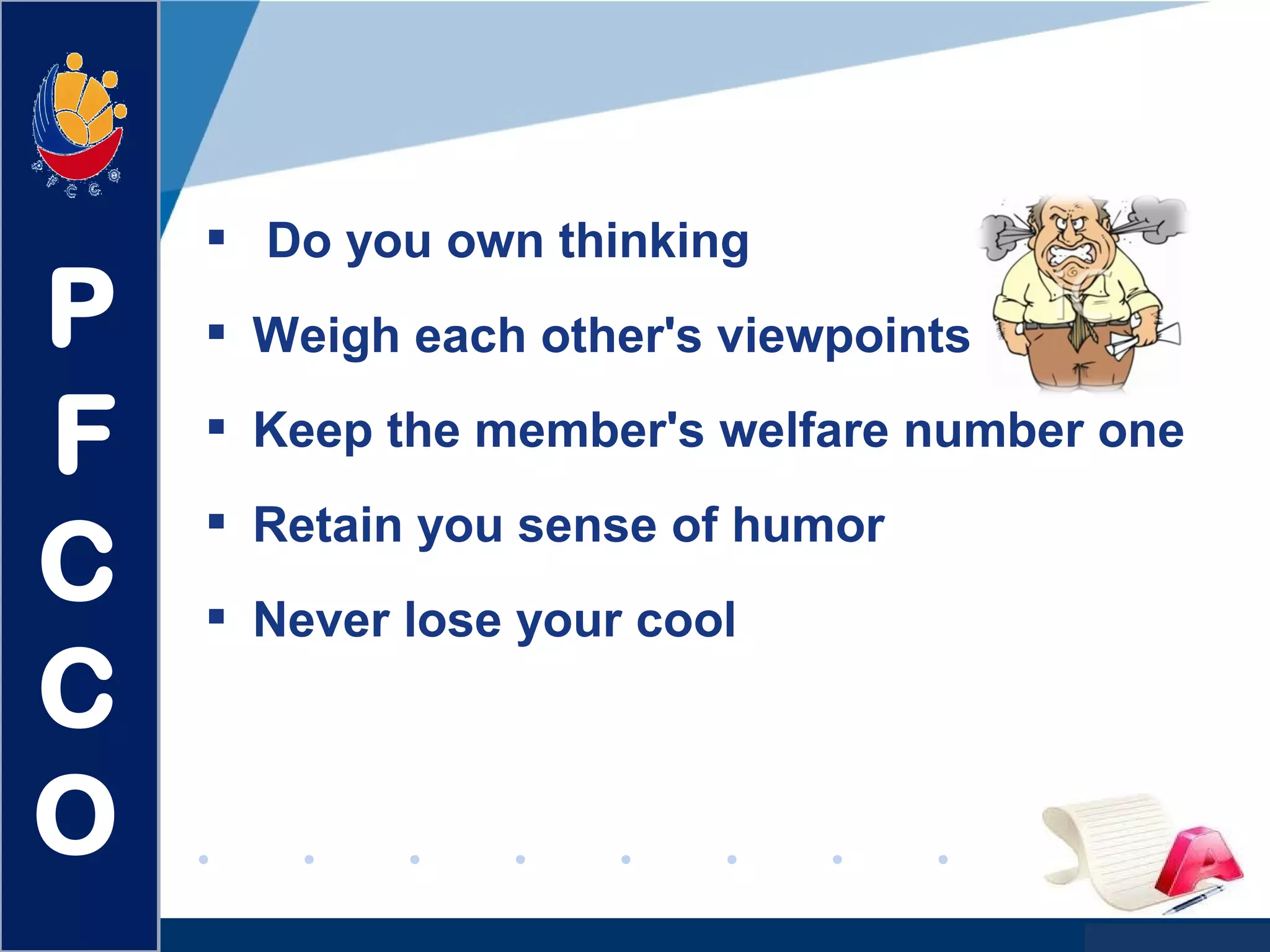
 Do you own thinking
 Weigh each other's viewpoints
 Keep the member's welfare number one
 Retain you sense of humor
 Never lose your cool
P
F
C
C
O
www.company.com
Recruiting and Orienting Board
Members
Guidelines for Recruiting New Board Members
1) Maintain an up-to-date list of potential
board candidates, including the particular
skills
2) Develop a Sample Board Application Form
for prospective new board members
3)Per any scheduling in the By-laws
P
F
C
C
O
www.company.com
Guidelines for Recruiting New Board Members
4) Reference the list of potential candidates to
recruit for board membership
5) The prospective new member should hear
about how the organization orients new
members
6) Identify if there are any potential conflicts of
interest with the candidate
P
F
C
C
O
www.company.com
7) Invite the prospective new member to a board
meeting
8) Call the prospective new member to hear if
they want to apply for joining the board or
not.
10) Notify new members and invite them to
subsequent board meetings and the board
orientation
Guidelines for Recruiting New Board Members
P
F
C
C
O
www.company.com
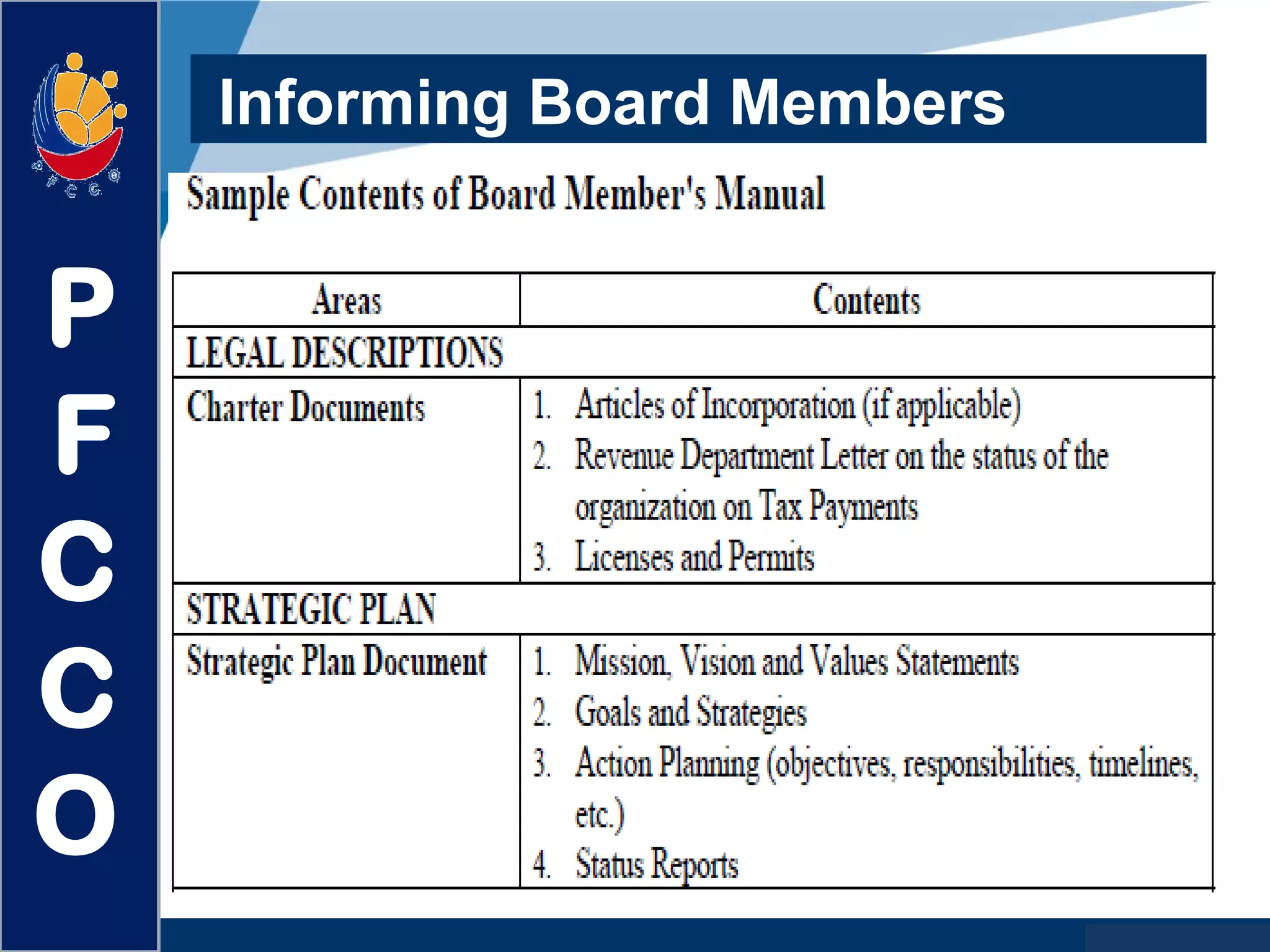
Informing Board Members
P
F
C
C
O
www.company.com
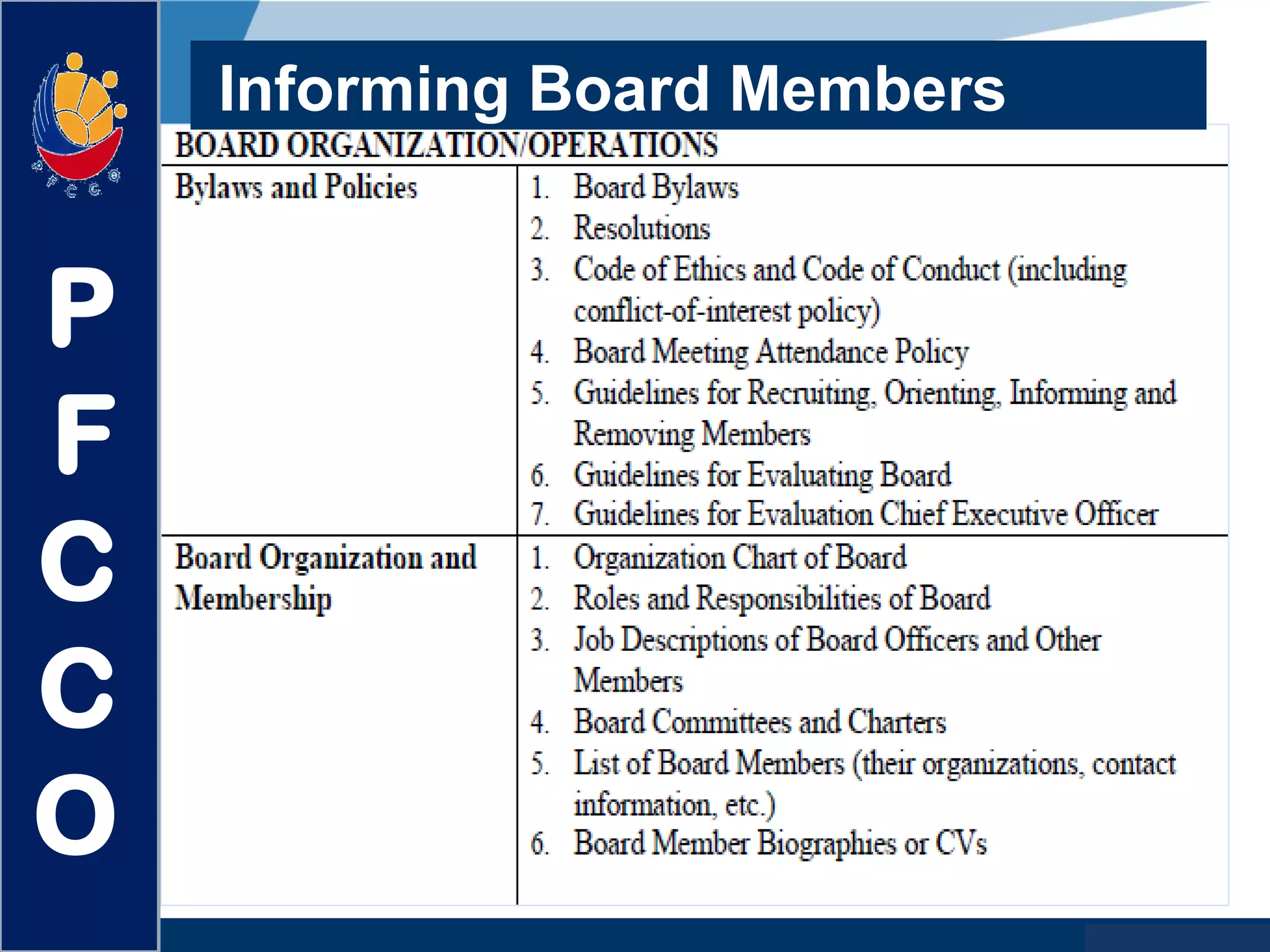
Informing Board Members
P
F
C
C
O
www.company.com
Board Operations
1) Startup Activities (to start the
organization)
a) Approve the mission statement
b) Approve Articles of Incorporation
c) Approve Bylaws
d) Select officers in the Board
e) Approve strategic plan and yearly budget
P
F
C
C
O
www.company.com
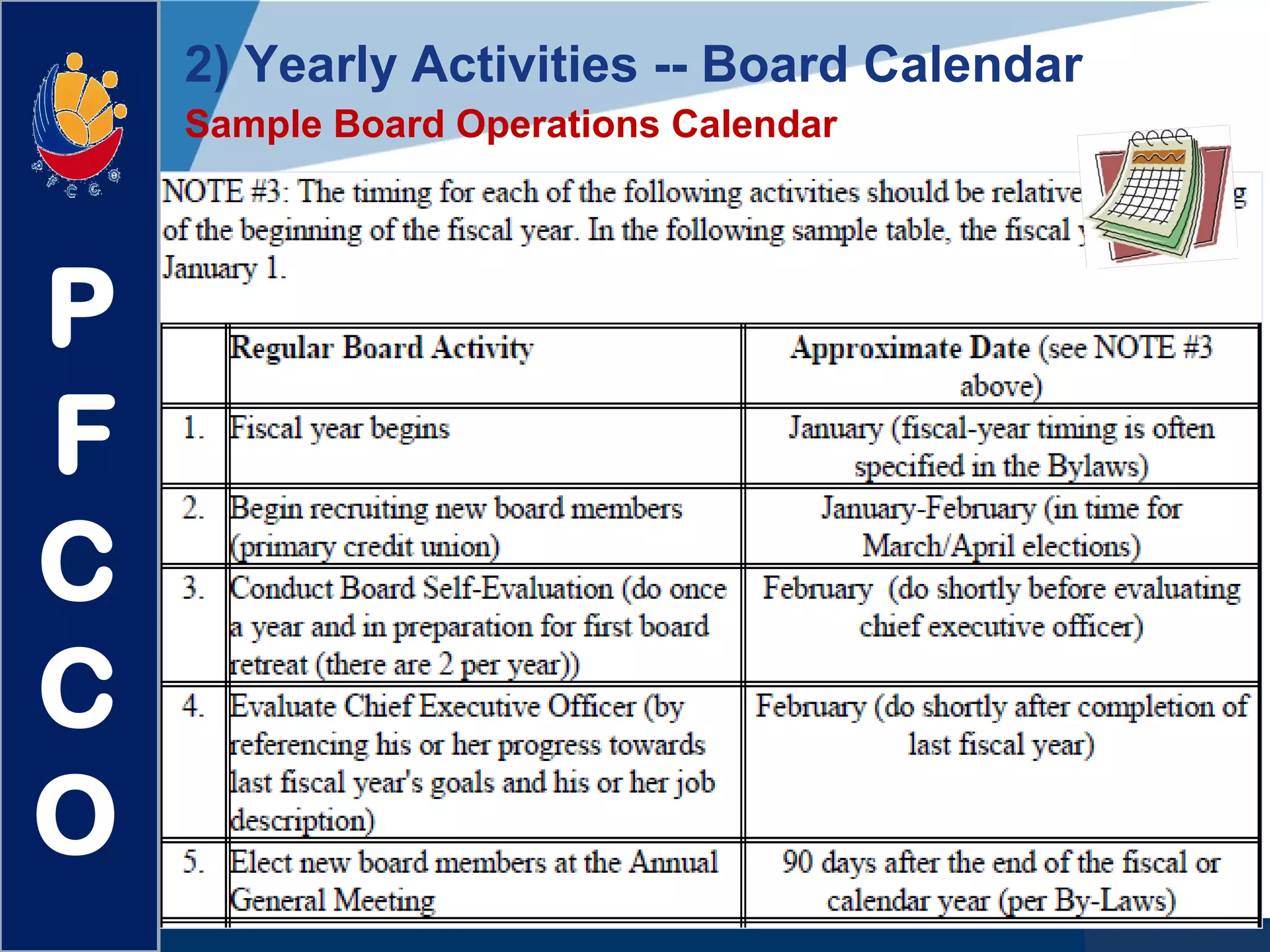
2) Yearly Activities -- Board Calendar
Sample Board Operations Calendar
P
F
C
C
O
www.company.com
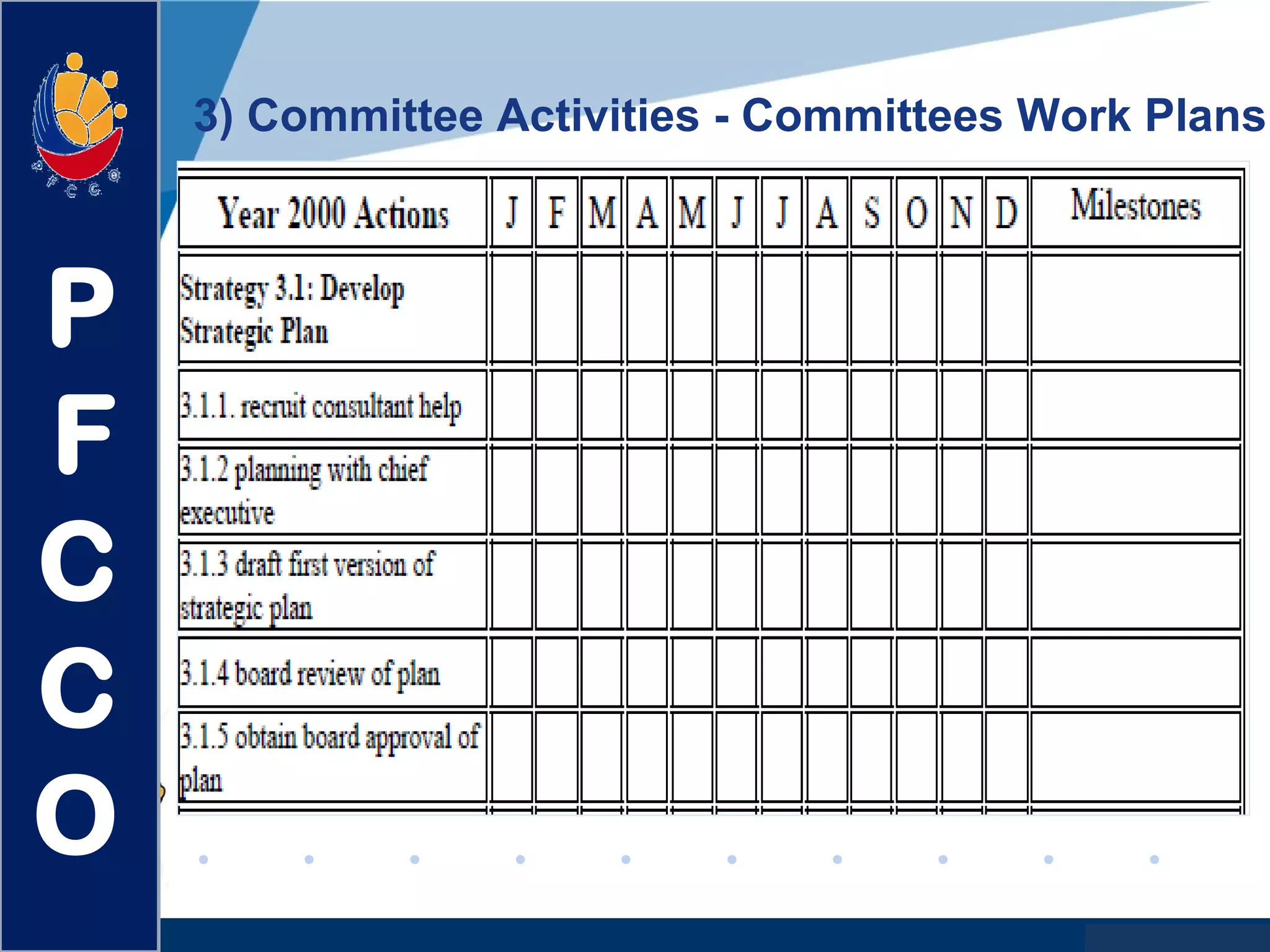
3) Committee Activities - Committees Work Plans
P
F
C
C
O
www.company.com
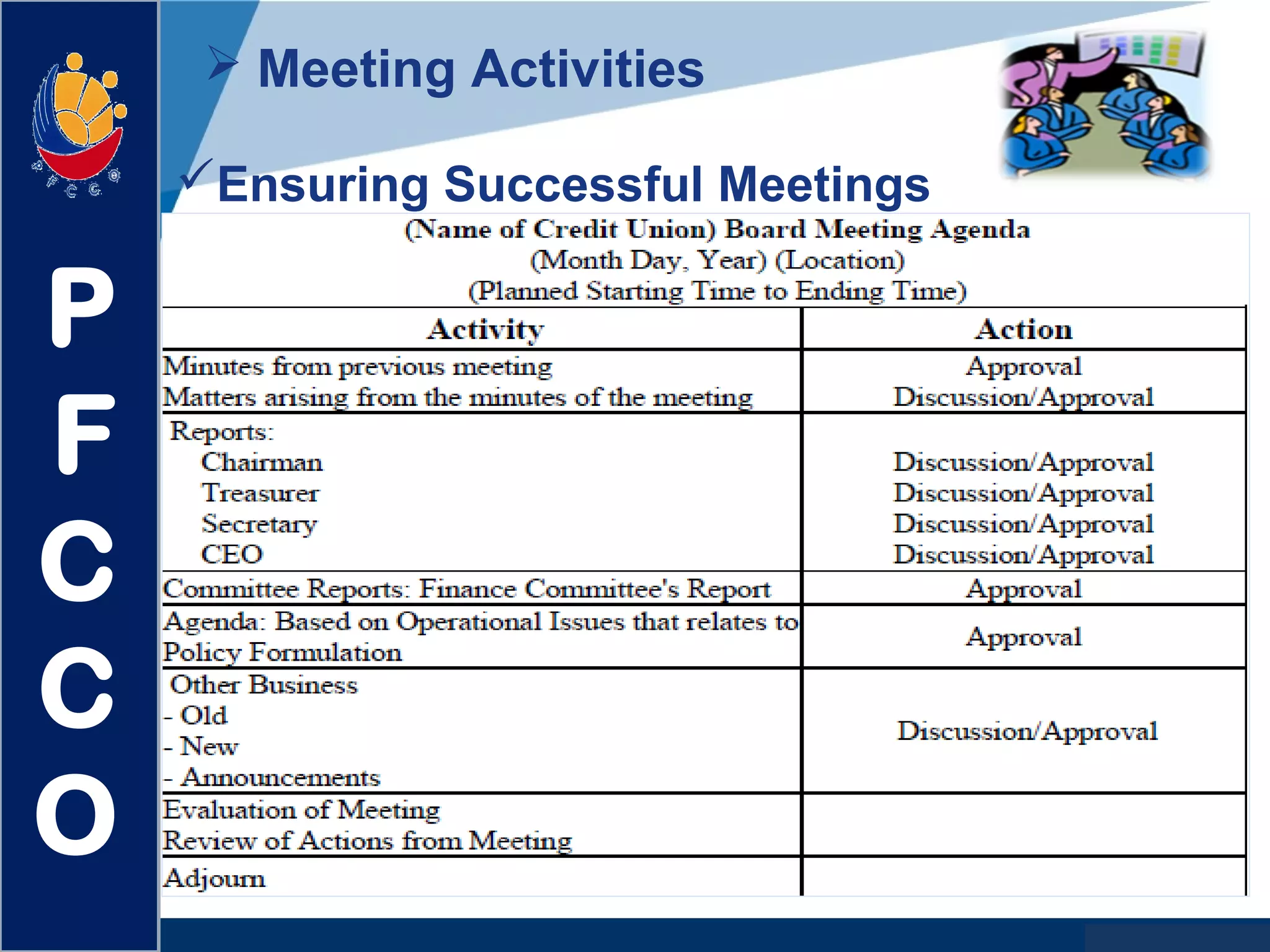
 Meeting Activities
Ensuring Successful Meetings
P
F
C
C
O
www.company.com
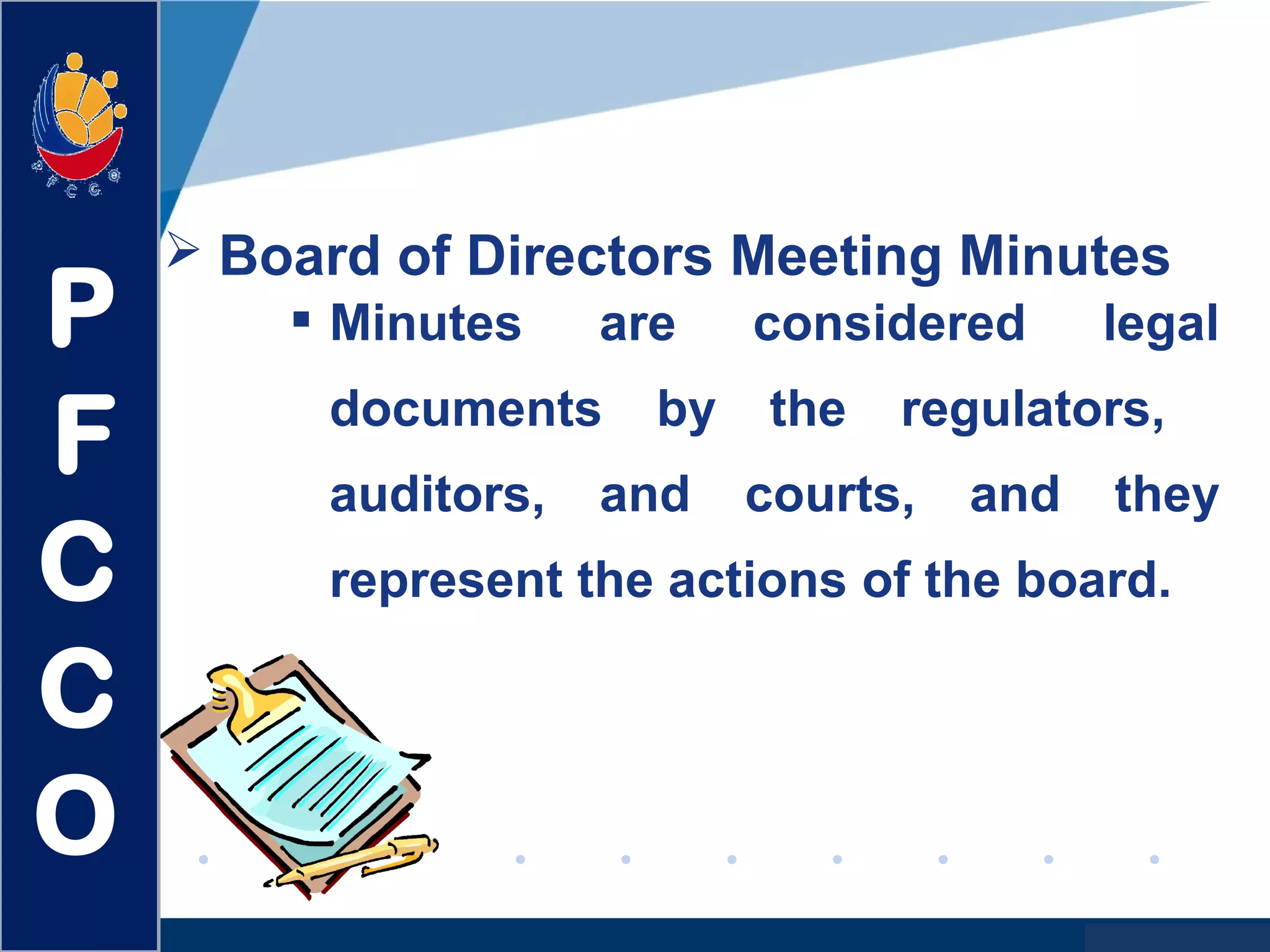
 Minutes are considered legal
documents by the regulators,
auditors, and courts, and they
represent the actions of the board.
 Board of Directors Meeting Minutes
P
F
C
C
O
www.company.com
Ideas to Generate Participation in Committees
 Ensure chair understand and can convey
the role of the committee to members
 Ensure adequate orientation that
describes the organization and its unique
services
 Remember that the organization and its
committees deserve strong attendance
and participation
P
F
C
C
O
www.company.com
Have ground rules that support
participation and attendance
Let go of "dead wood.“
Consider using subcommittees to
increase individual responsibilities and
focus on goals
Conduct yearly committee evaluations
that include a clear evaluation process
Ideas to Generate Participation in Committees
P
F
C
C
O
www.company.com
 Attempt to provide individual assignments
to the committee members
Have at least one staff member participate
in each committee to help with
administrative support and providing
information
Monitor quorum requirements for the
entire board
Ideas to Generate Participation in Committees
P
F
C
C
O
www.company.com
Develop a committee attendance policy
Generate minutes for each committee
meeting
In committee meeting reports, include
noting who is present and who is
absent.
Ideas to Generate Participation in Committees
P
F
C
C
O
www.company.com
Consider having low-attendance
members involved in some other form
of service to the organization
Have a "summit meeting" with
committee members to discuss the low
attendance problem
Rotate in new members every year.
Ideas to Generate Participation in Committees
P
F
C
C
O
www.company.com
Basic Guide to Conducting Effective Meetings
Opening Meetings
a)Always start on time
b)Welcome attendees and thank them for
their time
c)Review the agenda at the beginning of
each meeting
P
F
C
C
O
www.company.com
d) Note that a meeting recording
secretary will take the minutes
e) Model the kind of energy and
participant needed by meeting
participants
f) Clarify your role(s) in the meeting
P
F
C
C
O
www.company.com
Establishing Ground Rules for Meetings
• Four powerful ground rules are: participate,
get focus, maintain momentum and reach
closure.
• List your primary ground rules on the agenda.
• If you have new attendees you might review
each ground rule.
• Keep the ground rules posted at all times.
P
F
C
C
O
www.company.com
 Time Management
 One of the most difficult facilitation tasks
is time management
 You might ask attendees to help you
keep track of the time
 If the planned time on the agenda is
getting out of hand, present it to the
group and ask for their input as to a
resolution.
P
F
C
C
O
www.company.com
 Evaluations of Meeting Process
• It's amazing how often people will complain
about a meeting being a complete waste of
time
• Every couple of hours, conduct 5-10
minutes "satisfaction checks".
• In a round-table approach, quickly have
each participant indicate how they think the
meeting is going.
P
F
C
C
O
www.company.com
 Evaluating the Overall Meeting
• Leave 5-10 minutes at the end of the
meeting to evaluate the meeting.
• Have each member rank the meeting
from 1-5, with 5 as the highest.
• Have the chief executive rank the
meeting last.
P
F
C
C
O
www.company.com
 Closing Meetings
 Always end meetings on time and attempt
to end on a positive note.
 Review actions and assignments, and set
the time for the next meeting and ask
each person if they can make it or not.
 Clarify that meeting minutes
P
F
C
C
O
www.company.com
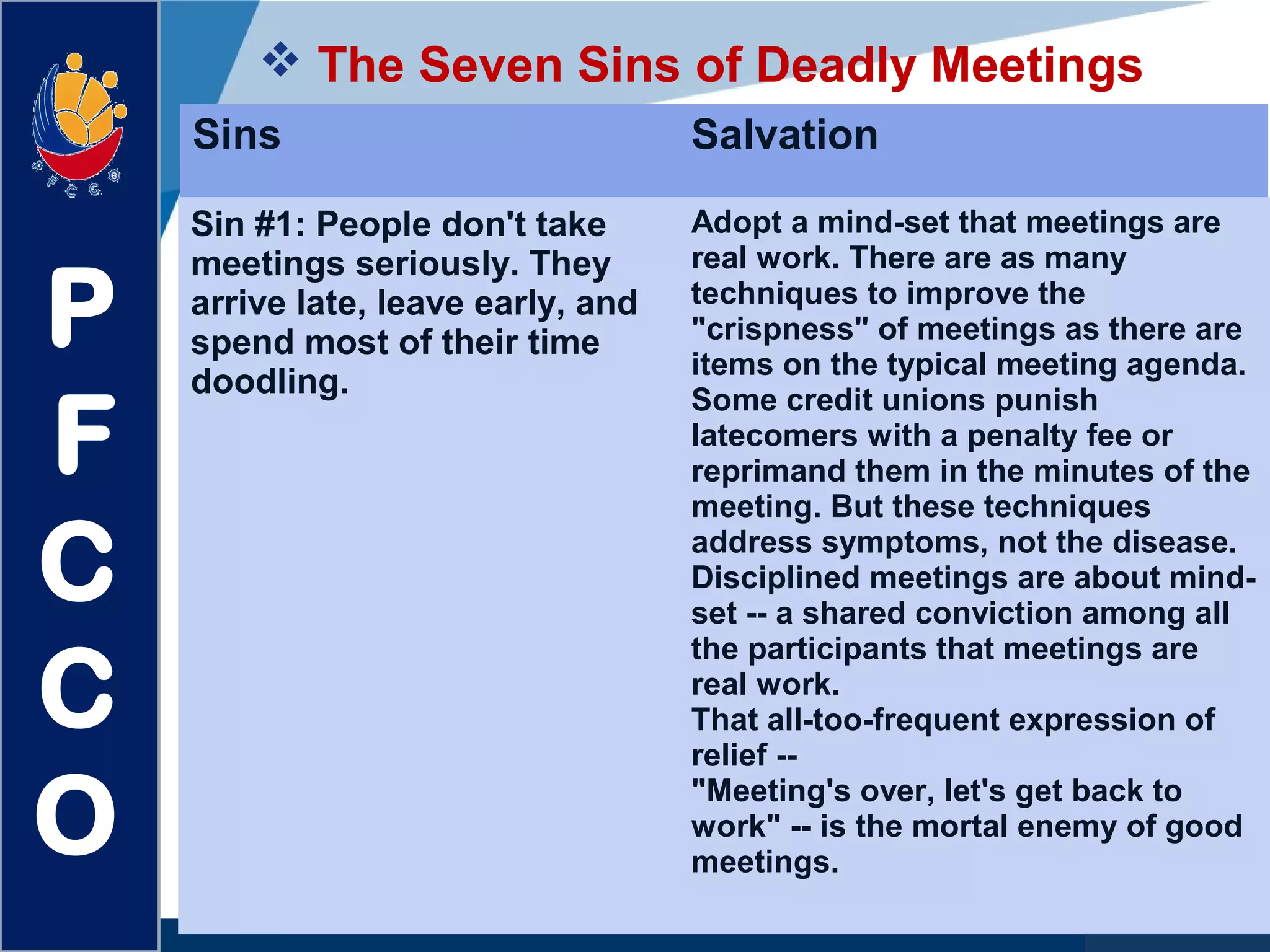
 The Seven Sins of Deadly Meetings
P
F
C
C
O
Sins Salvation
Sin #1: People don't take
meetings seriously. They
arrive late, leave early, and
spend most of their time
doodling.
Adopt a mind-set that meetings are
real work. There are as many
techniques to improve the
"crispness" of meetings as there are
items on the typical meeting agenda.
Some credit unions punish
latecomers with a penalty fee or
reprimand them in the minutes of the
meeting. But these techniques
address symptoms, not the disease.
Disciplined meetings are about mind-
set -- a shared conviction among all
the participants that meetings are
real work.
That all-too-frequent expression of
relief --
"Meeting's over, let's get back to
work" -- is the mortal enemy of good
meetings.
www.company.com
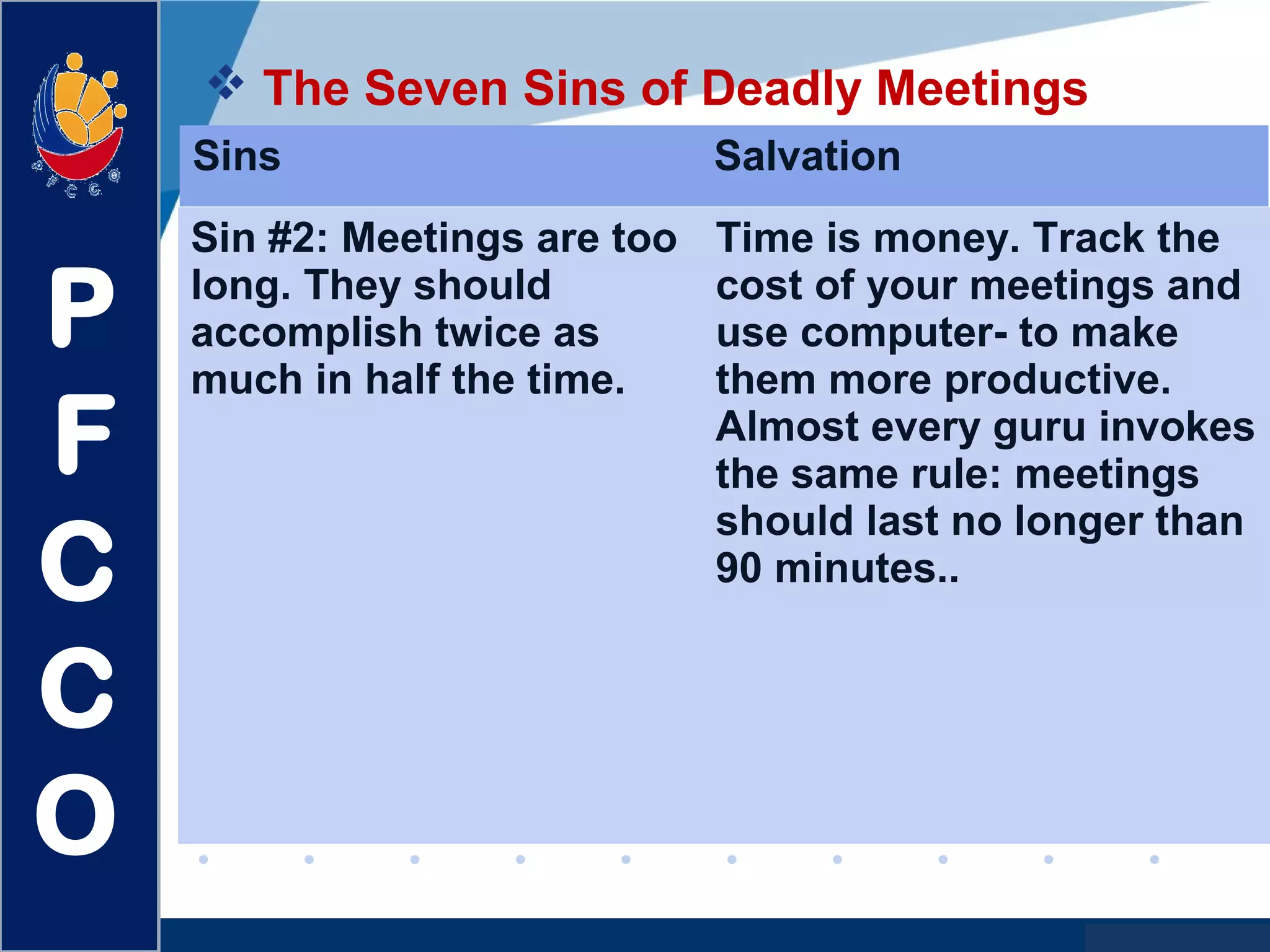
 The Seven Sins of Deadly Meetings
P
F
C
C
O
Sins Salvation
Sin #2: Meetings are too
long. They should
accomplish twice as
much in half the time.
Time is money. Track the
cost of your meetings and
use computer- to make
them more productive.
Almost every guru invokes
the same rule: meetings
should last no longer than
90 minutes..
www.company.com
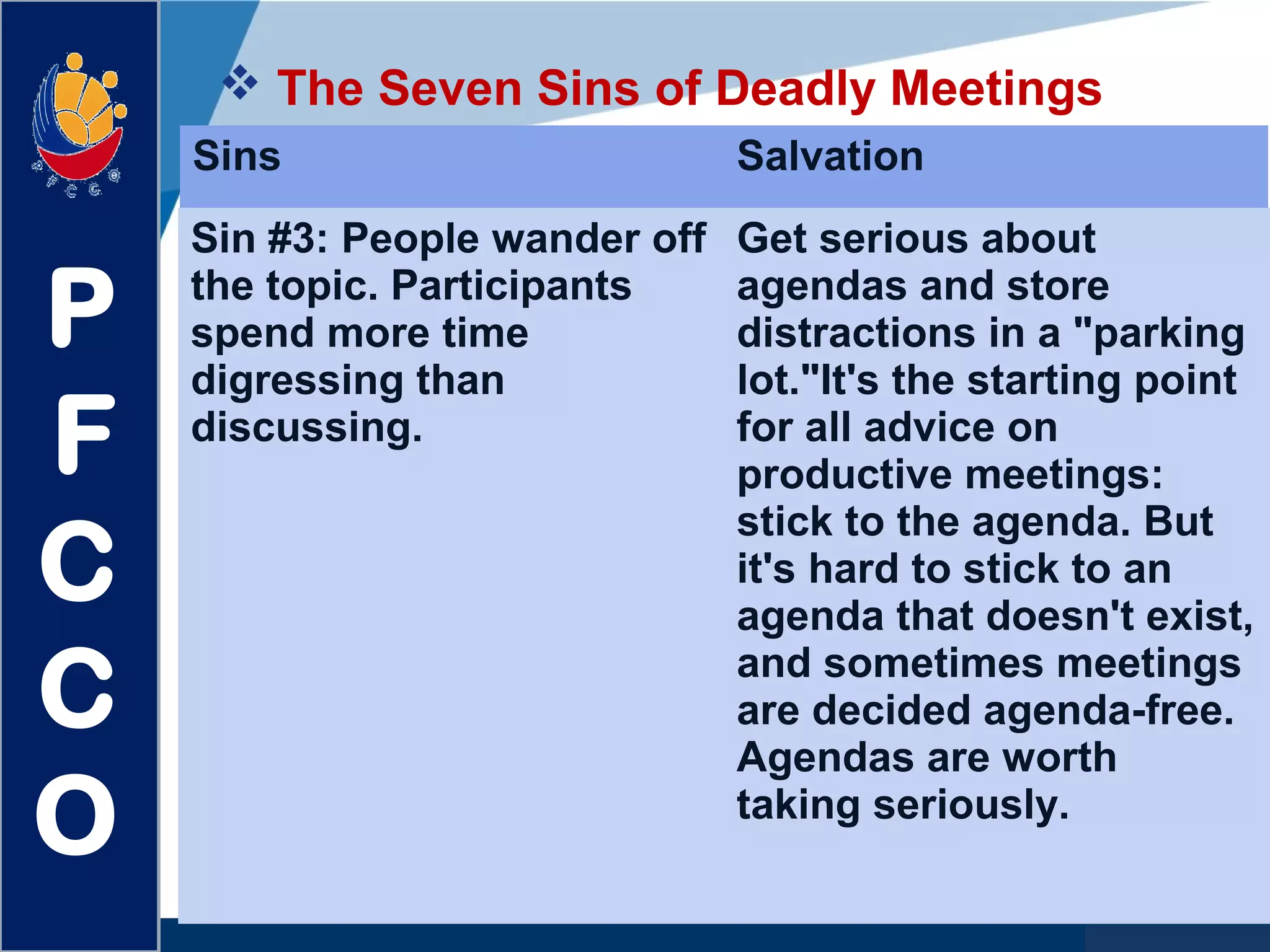
 The Seven Sins of Deadly Meetings
P
F
C
C
O
Sins Salvation
Sin #3: People wander off
the topic. Participants
spend more time
digressing than
discussing.
Get serious about
agendas and store
distractions in a "parking
lot."It's the starting point
for all advice on
productive meetings:
stick to the agenda. But
it's hard to stick to an
agenda that doesn't exist,
and sometimes meetings
are decided agenda-free.
Agendas are worth
taking seriously.
www.company.com
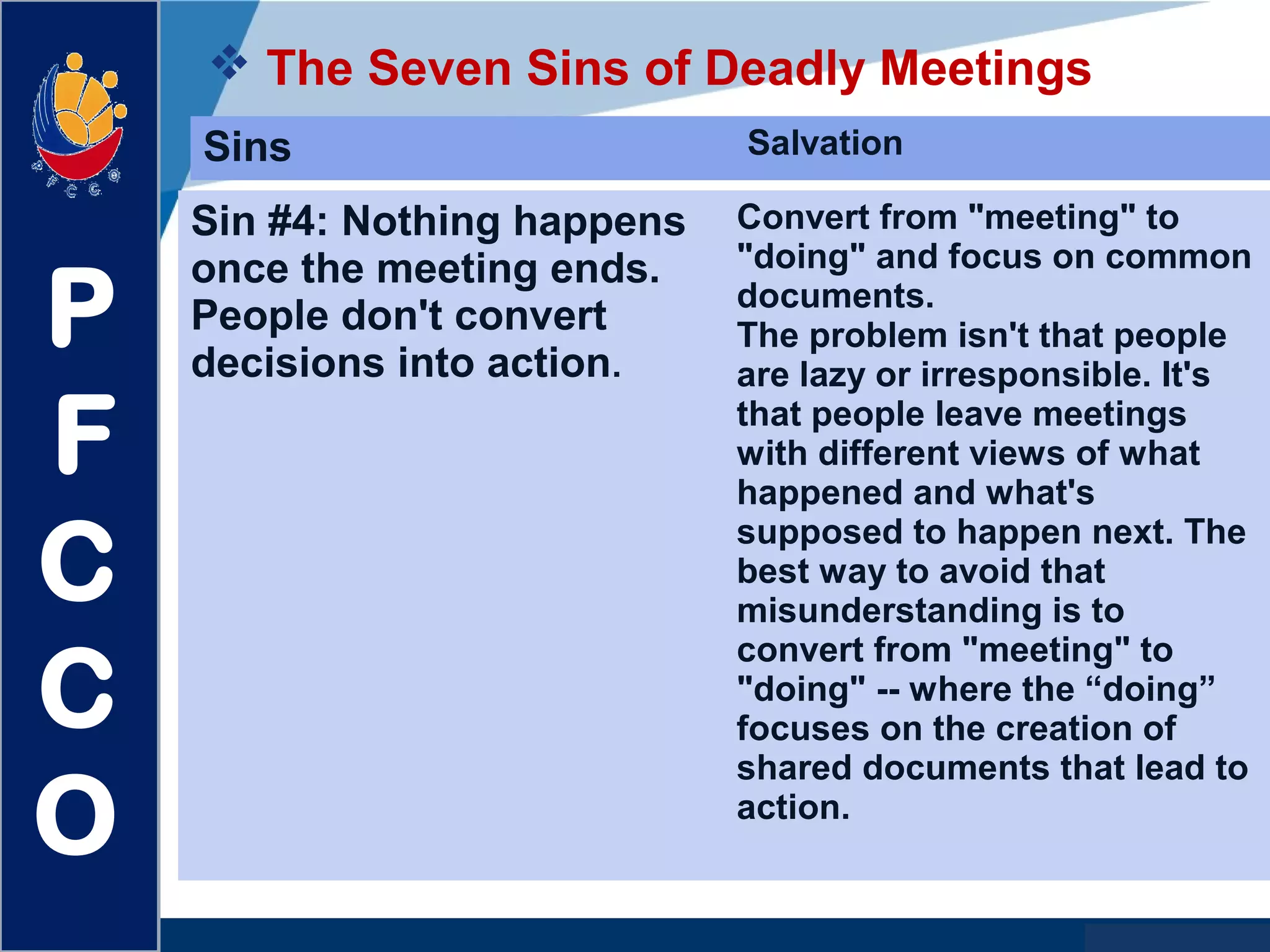
 The Seven Sins of Deadly Meetings
P
F
C
C
O
Sins Salvation
Sin #4: Nothing happens
once the meeting ends.
People don't convert
decisions into action.
Convert from "meeting" to
"doing" and focus on common
documents.
The problem isn't that people
are lazy or irresponsible. It's
that people leave meetings
with different views of what
happened and what's
supposed to happen next. The
best way to avoid that
misunderstanding is to
convert from "meeting" to
"doing" -- where the “doing”
focuses on the creation of
shared documents that lead to
action.
www.company.com
 The Seven Sins of Deadly Meetings
P
F
C
C
O
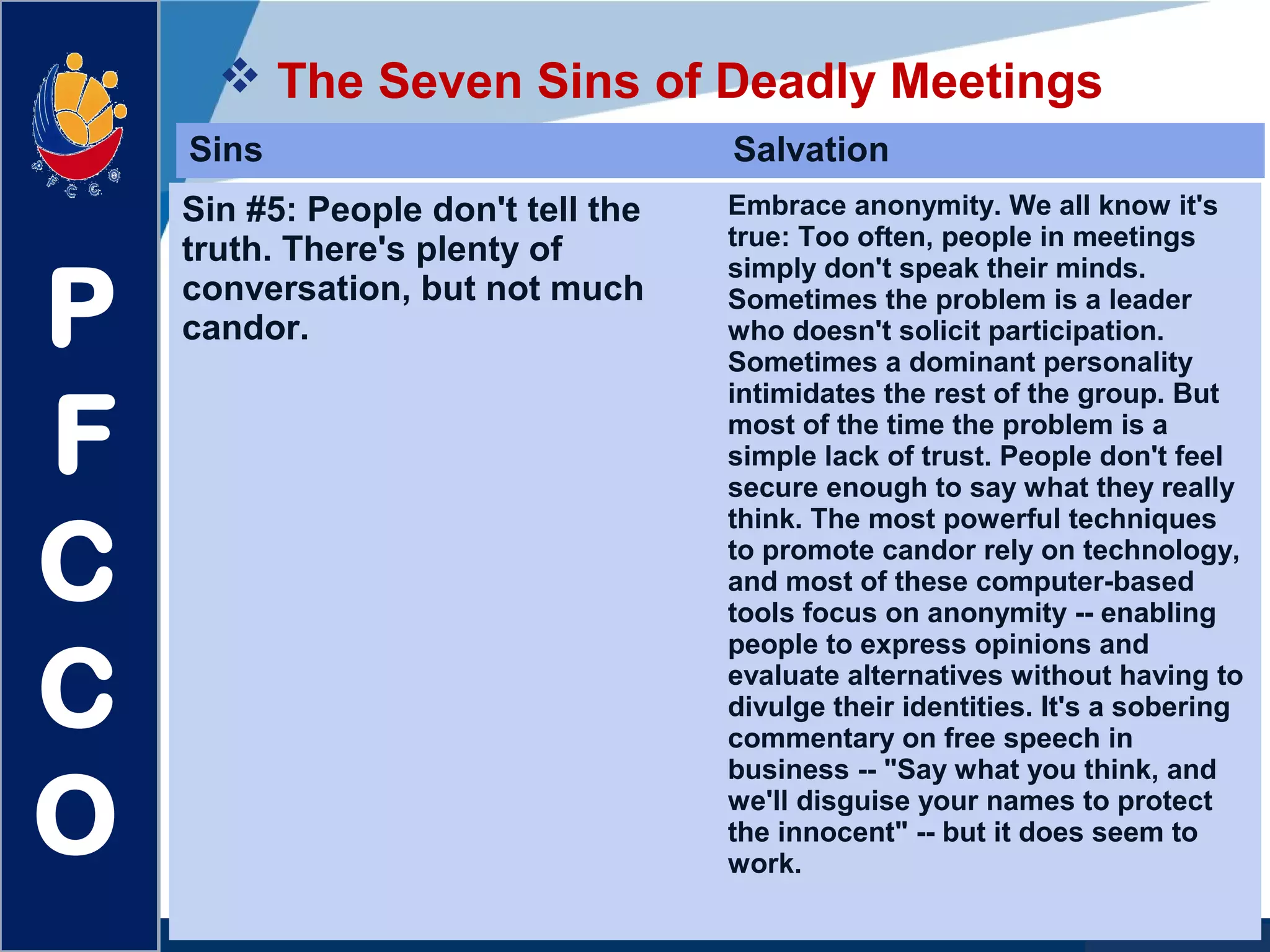
Sins Salvation
Sin #5: People don't tell the
truth. There's plenty of
conversation, but not much
candor.
Embrace anonymity. We all know it's
true: Too often, people in meetings
simply don't speak their minds.
Sometimes the problem is a leader
who doesn't solicit participation.
Sometimes a dominant personality
intimidates the rest of the group. But
most of the time the problem is a
simple lack of trust. People don't feel
secure enough to say what they really
think. The most powerful techniques
to promote candor rely on technology,
and most of these computer-based
tools focus on anonymity -- enabling
people to express opinions and
evaluate alternatives without having to
divulge their identities. It's a sobering
commentary on free speech in
business -- "Say what you think, and
we'll disguise your names to protect
the innocent" -- but it does seem to
work.
www.company.com
 The Seven Sins of Deadly Meetings
P
F
C
C
O
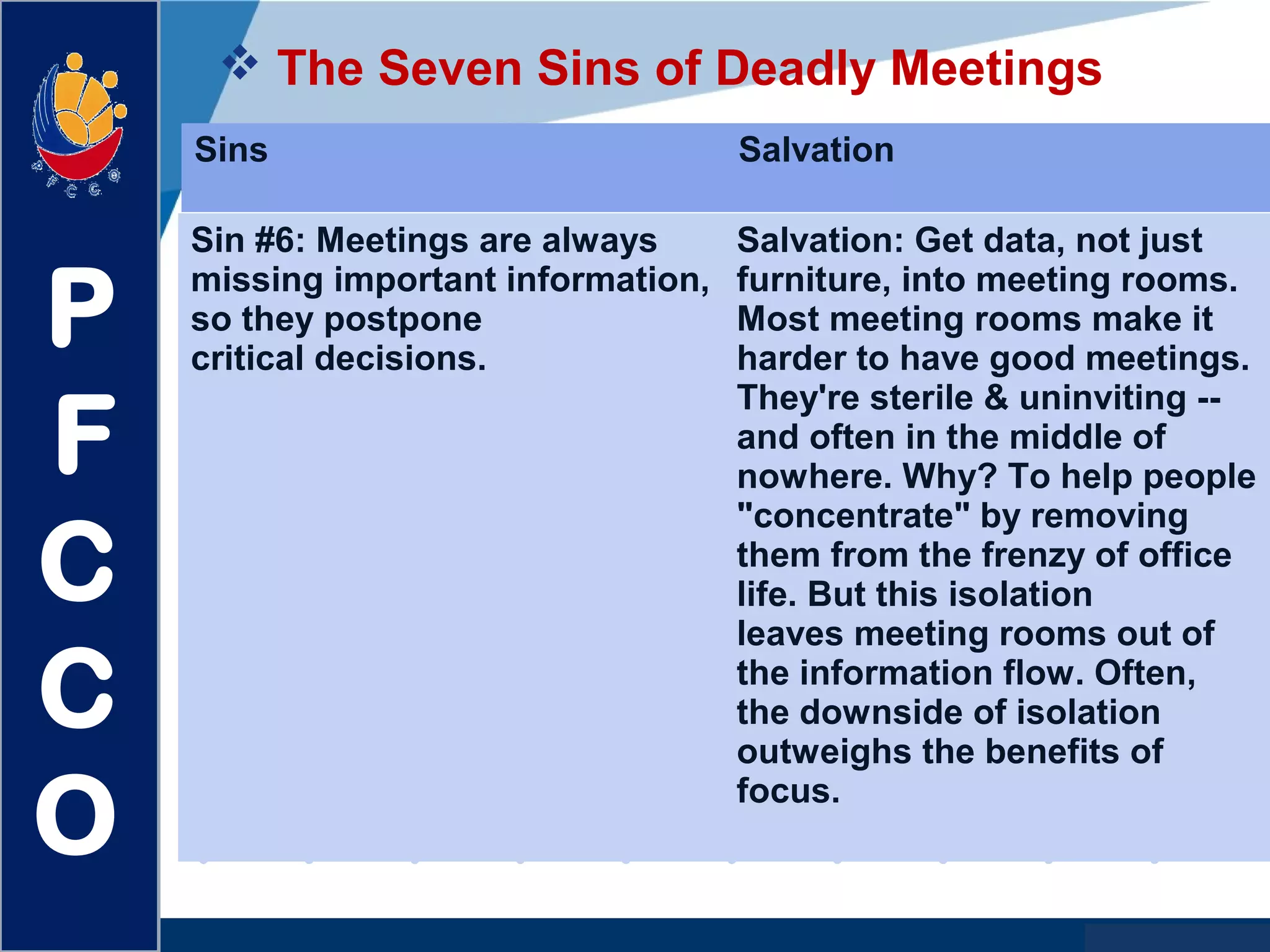
Sins Salvation
Sin #6: Meetings are always
missing important information,
so they postpone
critical decisions.
Salvation: Get data, not just
furniture, into meeting rooms.
Most meeting rooms make it
harder to have good meetings.
They're sterile & uninviting --
and often in the middle of
nowhere. Why? To help people
"concentrate" by removing
them from the frenzy of office
life. But this isolation
leaves meeting rooms out of
the information flow. Often,
the downside of isolation
outweighs the benefits of
focus.
www.company.com
 The Seven Sins of Deadly Meetings
P
F
C
C
O
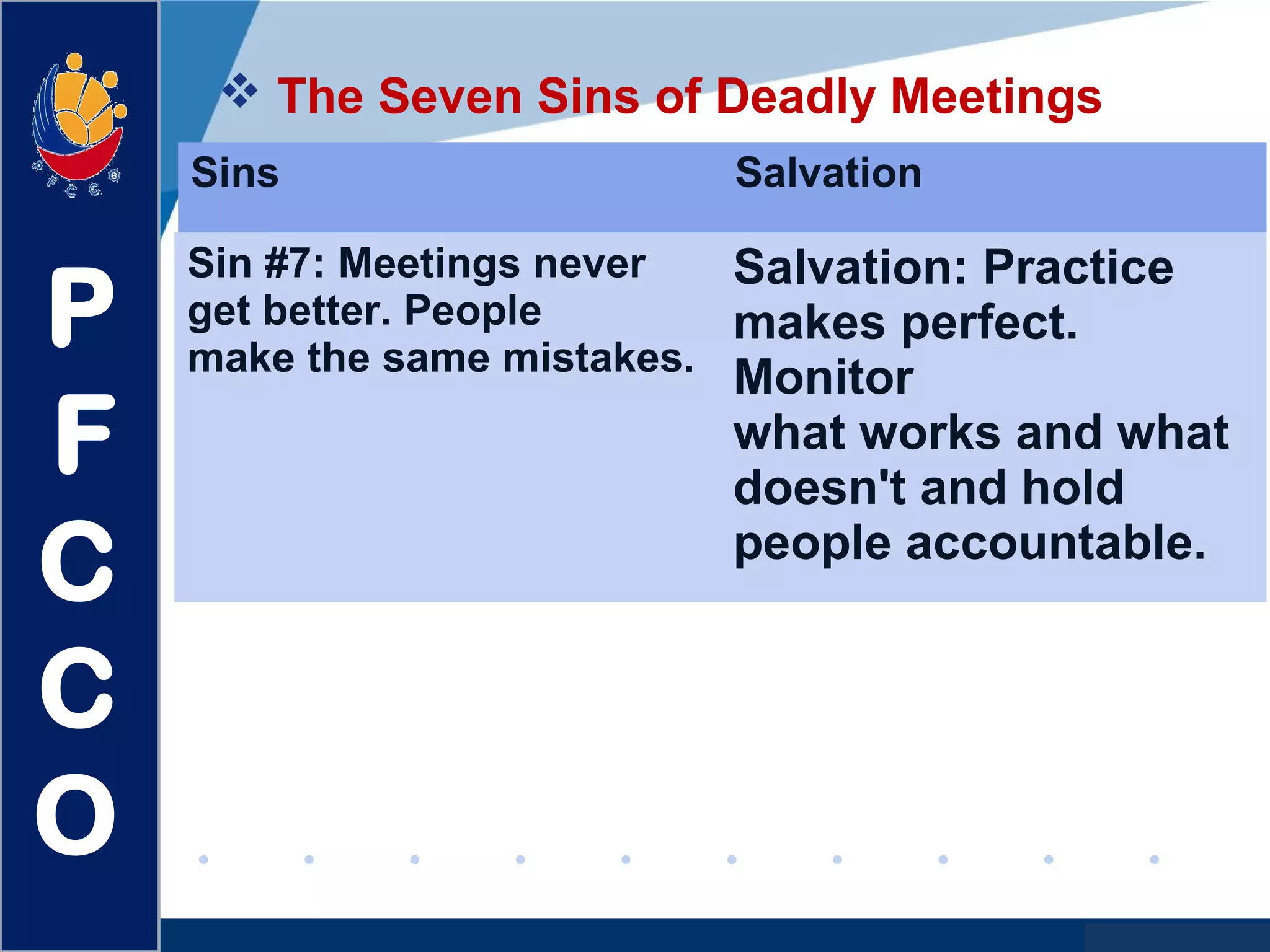
Sins Salvation
Sin #7: Meetings never
get better. People
make the same mistakes.
Salvation: Practice
makes perfect.
Monitor
what works and what
doesn't and hold
people accountable.
www.company.com
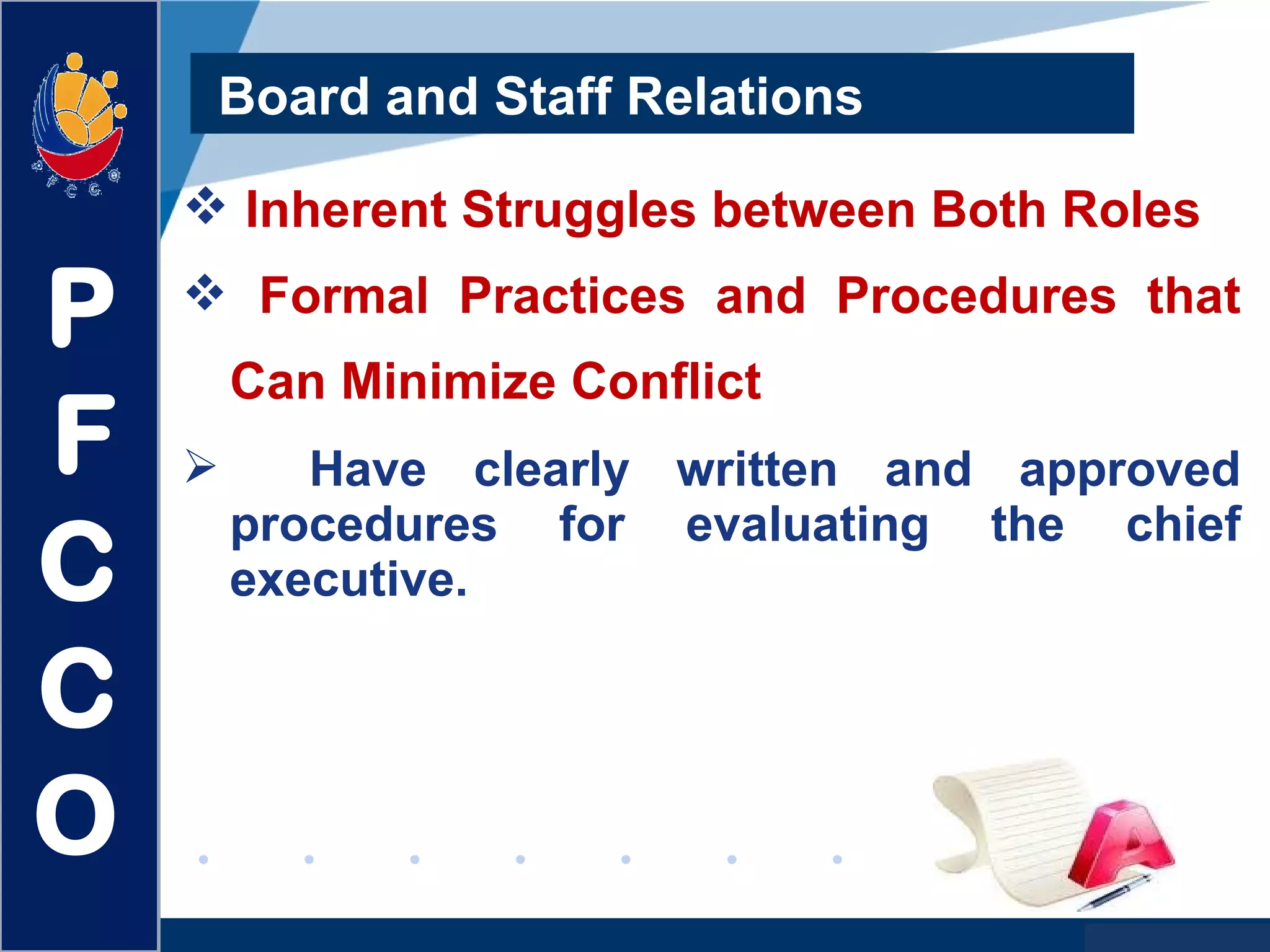
Board and Staff Relations
 Inherent Struggles between Both Roles
 Formal Practices and Procedures that
Can Minimize Conflict
 Have clearly written and approved
procedures for evaluating the chief
executive.
P
F
C
C
O
www.company.com
 Have regular board training sessions that
include overviews of the roles of board.
 When a new board chair or chief executive is
brought into the organization, the two of
them should meet to discuss how they can
work together as a team.
 The board chair can consult with the chief
executive when appointing chairs for various
committees
P
F
C
C
O
www.company.com
 Have clear written guidelines about the roles
of staff when they provide ongoing support
to board committees.
 Rotate the board chair position every few
years to ensure new and fresh perspectives
in the role
 Develop board chairs by having vice chairs
for a year who later become board chairs.
P
F
C
C
O
www.company.com
 Have a board-wide discussion about the
frequency
 Ensure all board members are trained about
the role of the board.
 The chief executive and board chair should
never conceal information from the rest of the
board
 Celebrate accomplishments, including by
naming the key people involved in bringing
about the successes
P
F
C
C
O
www.company.com
Personal Practices to Minimize Interpersonal
Conflicts
 Practice at least the basic skills in
interpersonal communications
 Whenever you feel conflict, identify to
yourself what it is that you're actually seeing
or hearing that might be causing the
conflict.
 If you're feeling uneasy, then say out loud
what you're feeling
P
F
C
C
O
www.company.com
 Recognize that conflict is inherent in
any successful relationship, particularly
in a board if all members are actively
meeting their responsibilities.
 Continue to try sense if the conflict is
around an organizational issue
P
F
C
C
O
www.company.com
If Worse Comes to Worse
 Approach the other person and ask for
five minutes of their uninterrupted time.
 If the other person says there's no
conflict that they are aware of then
assert to them that you would
appreciate it if they changed certain
behavior
P
F
C
C
O
www.company.com
 If the problem persists, ask to have time
with the Executive Committee to share
your concerns.
 If the problems persist, you might
consider getting outside help.
P
F
C
C
O
www.company.com
Evaluating Chief Executive Officer
What is the "Chief Executive Officer"?
 The "chief executive officer" is the singular
organizational position that is primarily
responsible to carry out the strategic plans
and policies as established by the board of
directors.
P
F
C
C
O
www.company.com
General Responsibilities of a Chief Executive
LEADER
 Advises the Board
 Advocates / promotes organization and
stakeholder change related to organization
mission
 Supports motivation of employees in
organization products/programs and
operations
P
F
C
C
O
www.company.com
VISIONARY / INFORMATION BEARER
 Ensures staff and Board have sufficient
and up-to-date information
 Looks to the future for change
opportunities
 Interfaces between Board and employees
 Interfaces between organization and
community
P
F
C
C
O
www.company.com
DECISION MAKER
 Formulates policies and planning
recommendations to the Board
 Decides or guides courses of
action in operations by staff
P
F
C
C
O
www.company.com
MANAGER
 Oversees operations of organization
 Implements plans
 Manages human resources of
organization
 Manages financial and physical
resources
P
F
C
C
O
www.company.com
BOARD DEVELOPER
 Assists in the selection and evaluation of
board members
 Makes recommendations, supports Board
during orientation and self-evaluation
 Supports Board's evaluation of Chief
Executive
P
F
C
C
O
www.company.com
Typical Major Functions/Responsibilities of
Chief Executive Officer
Board Administration and Support
Program, Product and Service Delivery
Financial, Tax, Risk and Facilities
Management
Human Resource Management
Community and Public Relations
Fundraising
P
F
C
C
O
www.company.com
Guidelines for Board of Directors Evaluation of Chief
Executive Officer
Benefits of Evaluating the Chief Executive
Officer
1)Ensures the Board is meeting its duty to
effectively lead the organization
2)Ensures organizational goals are being met
3) Ensures continued development of the Chief
Executive to more effectively conduct his or
her role
P
F
C
C
O
www.company.com
4)Ensures a formal and documented evaluation
process that meets standards of fairness and
practicality
5) Ensures the Chief Executive values his or her
role, is benefiting from it and therefore is more
likely to stay
6) Leaves written record of the Board's impression
of the Chief Executive's performance in case this
record is needed for future verification
P
F
C
C
O
www.company.com
Board Training
Guidelines to Prepare Board Training
 Regarding Timing of the Session
 Who Should Be Involved in Planning the
Session
 Selecting Topics and Materials for Board
Training
 Members' Preparation for Training
P
F
C
C
O

Board of directors toolkit final

  • 1.
  • 2.
    www.company.com Board Roles andResponsibilities Major Duties of Board of Directors  Provide continuity for the organization  Select and appoint a chief executive  Govern the organization by broad policies and objectives P F C C O
  • 3.
    www.company.com  Acquire sufficientresources for the organization's operations  Account to the public for the products and services of the organization and expenditures Board Roles and Responsibilities P F C C O
  • 4.
    www.company.com Major Responsibilities ofBoard of Directors  Determine the Organization's Mission and Purpose  Select / create the Executive Committee  Support the Executive and Review his or her performance  Ensure Effective Organizational Planning P F C C O
  • 5.
    www.company.com  Ensure AdequateResources  Manage Resources Effectively  Determine and Monitor the Organization's Programs and Services  Enhance the Organization's Public Image  Serve as a Court of Appeal  Assess Its Own Performance Major Responsibilities of Board of Directors P F C C O
  • 6.
    www.company.com Board Chair JobDescription  Is a member of the Board  Serves as the Chief Governance/ Volunteer of the organization  Is a partner with the Chief Executive in achieving the organization's mission  Provides leadership to the Board of Directors P F C C O
  • 7.
    www.company.com  Chairs meetingsof the Board after developing the agenda with the Chief Executive  Encourages Board's role in strategic planning  Appoints the chairpersons of committees, in consultation with other Board members  Serves ex officio as a member of committees and attends their meetings when invited. Board Chair Job Description P F C C O
  • 8.
    www.company.com  Discusses issuesconfronting the organization with the Chief Executive.  Helps guide and mediate Board actions with respect to organizational priorities and governance concerns.  Reviews with the Chief Executive any issues of concern to the Board. Board Chair Job Description P F C C O
  • 9.
    www.company.com  Monitors financialplanning and financial reports.  Formally evaluates the performance of the Chief Executive and informally evaluates the effectiveness of the Board members.  Evaluates annually the performance of the organization in achieving its mission.  Performs other responsibilities assigned by the Board. Board Chair Job Description P F C C O
  • 10.
    www.company.com Vice Chair JobDescription  Is a member of the Board  Performs Chair responsibilities when the Chair cannot be available  Reports to the Board's Chair  Works closely with the Chair and other staff  Participates closely with the Chair to develop and implement officer transition plans.  Performs other responsibilities as assigned by the Board. P F C C O
  • 11.
    www.company.com Committee Chair JobDescription  Is a member of the Board  Sets tone for the committee work.  Ensures that members have the information needed to do their jobs.  Oversees the logistics of committee's operations.  Reports to the Board's Chair. P F C C O
  • 12.
    www.company.com  Reports tothe full Board on committee's decisions/recommendations.  Works closely with the Chief Executive and other staff as agreed to by the Chief Executive.  Assigns work to the committee members  Initiates and leads the committee's annual evaluation. Committee Chair Job Description P F C C O
  • 13.
    www.company.com Board Member JobDescription  Regularly attends board meetings and important related meetings.  Makes serious commitment to participate actively in committee work.  Volunteers for and willingly accepts assignments and completes them thoroughly and on time.  Stays informed about committee matters P F C C O
  • 14.
    www.company.com  Gets toknow other committee members and builds a collegial working relationship that contributes to consensus.  Is an active participant in the committee's annual evaluation and planning efforts.  Participates in fund raising for the organization. Board Member Job Description P F C C O
  • 15.
    www.company.com Board Secretary JobDescription  Appointed by the Board  Maintains records of the board and ensures effective management of organization's records  Manages minutes of board meeting  Ensures minutes are distributed to members shortly after each meeting  Is sufficiently familiar with legal documents P F C C O
  • 16.
    www.company.com Board Treasurer JobDescription  Appointed by the Board  Manages finances of the organization  Administrates fiscal matters of the organization  Provides annual budget to the board for members' approval  Ensures development and board review of financial policies and procedures P F C C O P F C C O
  • 17.
    www.company.com Board and StaffResponsibilities P F C C O
  • 18.
    www.company.com Board and StaffResponsibilities P F C C O
  • 19.
    www.company.com Board and StaffResponsibilities P F C C O
  • 20.
    www.company.com Board and StaffResponsibilities P F C C O
  • 21.
    www.company.com Guidelines to Forman Advisory Group (Committees) Overall Benefit of an Advisory ` ` What is an Advisory Group? When Should an Advisory Group Be Formed? P F C C O
  • 22.
    www.company.com Typical Types ofBoard Committees About Committees  Establish committees when it's apparent that issues are too complex.  Standing committees should be included in the by-laws/policies.  Committees recommend policy for approval by the entire board. P F C C O
  • 23.
    www.company.com Committees make fulluse of board members' expertise, time and commitment. They do not supplant responsibility of each board member; they operate at the board level and not the staff level.  Committees may meet monthly every two months, or every three months.  Minutes should be recorded for all board P F C C O
  • 24.
    www.company.com Developing Committees  Ensurethe committee has a specific charge or set of tasks to address  Have at least two board members on each committee, preferably three  Don't have a member on more than two committees P F C C O
  • 25.
    www.company.com  In eachboard meeting, have each committee chair report the committee's work since the past board meeting Consider having non-board volunteers as members of the committee  Consider having a relevant staff member as a member of the committee as well P F C C O
  • 26.
    www.company.com Committee chairs areoften appointed by the board chair Consider having board meetings every other month and committee meetings between the board meeting  The chief executive should service ex officio to the board and any relevant committees P F C C O
  • 27.
  • 28.
  • 29.
    www.company.com Potential Ad HocCommittees: P F C C O
  • 30.
    www.company.com How Should theAdvisory Group Be Defined/Organized? P F C C O
  • 31.
    www.company.com When considering legalprotection for directors and the organization, the following should be considered: 1)Directors cannot abdicate their responsibility to be in charge and to direct 2)Directors must make certain the organization is operating within a legal framework 3) Directors have a legal responsibility for the protection of all assets P F C C O
  • 32.
    www.company.com 4) Directors mustvalidate all major contracts by giving and recording formal approval 5) Directors must attend most board meetings 6) There is no absolute protection against someone bringing suit against you. 7) The assumption in the law is not necessarily that you must make the correct decision P F C C O
  • 33.
    www.company.com 8) While youhave the right to rely on information supplied to you in due form, and on the accuracy and integrity of others you must use reasonable judgment in this area, too. 9)If it smells fishy, find out where it has been swimming -- and how long it has been dead. P F C C O
  • 34.
    www.company.com Some key suggestions: Attend meetings  Read minutes and make sure they are correct  Record objections and ensure a debate on controversial or difficult issues  Always have comprehensive and up- to-date personnel policies that are reviewed by a professional. P F C C O
  • 35.
    www.company.com  Ensure thatall employment and income taxes are paid.  Schedule a presentation from an insurance agent who is well versed in board liability matters.  Review financial statements and insist on understanding them. P F C C O
  • 36.
    www.company.com Staffing the Board Joininga Board  asking some basic questions before joining an organization's board.  Ask the following questions about the organization's programs: • What is the organization's mission? • How do its current programs relate to the mission? • Does the organization have a strategic plan that is reviewed and evaluated on a regular basis? P F C C O
  • 37.
    www.company.com Ask the followingquestions about the organization's financial status • Is the financial condition of the organization sound? • Does the board discuss and approve the annual budget? • How often do board members receive financial reports? P F C C O
  • 38.
    www.company.com • Are theredescriptions of the responsibilities of the board as a whole and of individual board members? • Who are the other board members? • Is there a system of checks and balances to prevent conflicts of interest between board members and the organization? • Does the organization have directors and officers liability coverage? Ask the following questions about the structure of the board: • How is the Board Structure? P F C C O
  • 39.
    www.company.com • What arethe ways that you think I can contribute as a board member? • How much of my time will be required for meetings and special events? • How are committee assignments made? Ask the following questions about individual board members' responsibilities: P F C C O
  • 40.
    www.company.com • What orientationwill I receive to the organization and to the responsibilities of board service? • Does the organization provide opportunities for board development and education? • What is the board's role in fund-raising? P F C C O
  • 41.
    www.company.com Evaluate Your Interestin Serving on the Board • Am I committed to the mission of the organization? • Can I contribute the time necessary to be an effective board member? • Am I comfortable with the approach and tone of the organization's fund-raising efforts? P F C C O
  • 42.
    www.company.com • Can Icontribute financial support consistent with the organization's expectations of board members and with my own means and priorities? • Can I place the organization's purposes and interests above my own professional? P F C C O
  • 43.
    www.company.com Background Material The organization'sannual report The most recent audited financial statement A list of current board members, titles, and all affiliations A description of board members' responsibilities P F C C O
  • 44.
    www.company.com A board organizationchart A staff organization chart The organization's newsletter, brochure, or other publications Newspaper or magazine articles about the organization A brief biography of the executive committee and senior management executives P F C C O
  • 45.
    www.company.com Building Positive BoardRelationships Bring operational or any other concerns to the attention of the board chair and the member. Demonstrate a willingness to listen to others. Disclose yourself to others in an open fashion. Publicly support your colleagues. P F C C O
  • 46.
    www.company.com Publicly support decisionsof the board Adhere to a code of ethics that guides your behavior. Base recommended action on the board’s agreed-upon mission, as opposed to special interest. P F C C O
  • 47.
    www.company.com Effective Board Leadership Fouressential roles of effective board leadership  Vision  Structure  Accountability  Advocacy P F C C O
  • 48.
    www.company.com Board decision-making model Define the problem  Gather information  Get the committee's or management recommendation  Get a second opinion  Forecast consequences  Check proposed decisions  Decide,determine,settle,conclude and resolve P F C C O
  • 49.
    www.company.com Basic problem solvingat its best  Gather the facts  Define the problem  Get the options  Get the manager's preferred alternative  Get committee input P F C C O
  • 50.
    www.company.com  Do youown thinking  Weigh each other's viewpoints  Keep the member's welfare number one  Retain you sense of humor  Never lose your cool P F C C O
  • 51.
    www.company.com Recruiting and OrientingBoard Members Guidelines for Recruiting New Board Members 1) Maintain an up-to-date list of potential board candidates, including the particular skills 2) Develop a Sample Board Application Form for prospective new board members 3)Per any scheduling in the By-laws P F C C O
  • 52.
    www.company.com Guidelines for RecruitingNew Board Members 4) Reference the list of potential candidates to recruit for board membership 5) The prospective new member should hear about how the organization orients new members 6) Identify if there are any potential conflicts of interest with the candidate P F C C O
  • 53.
    www.company.com 7) Invite theprospective new member to a board meeting 8) Call the prospective new member to hear if they want to apply for joining the board or not. 10) Notify new members and invite them to subsequent board meetings and the board orientation Guidelines for Recruiting New Board Members P F C C O
  • 54.
  • 55.
  • 56.
    www.company.com Board Operations 1) StartupActivities (to start the organization) a) Approve the mission statement b) Approve Articles of Incorporation c) Approve Bylaws d) Select officers in the Board e) Approve strategic plan and yearly budget P F C C O
  • 57.
    www.company.com 2) Yearly Activities-- Board Calendar Sample Board Operations Calendar P F C C O
  • 58.
    www.company.com 3) Committee Activities- Committees Work Plans P F C C O
  • 59.
  • 60.
    www.company.com  Minutes areconsidered legal documents by the regulators, auditors, and courts, and they represent the actions of the board.  Board of Directors Meeting Minutes P F C C O
  • 61.
    www.company.com Ideas to GenerateParticipation in Committees  Ensure chair understand and can convey the role of the committee to members  Ensure adequate orientation that describes the organization and its unique services  Remember that the organization and its committees deserve strong attendance and participation P F C C O
  • 62.
    www.company.com Have ground rulesthat support participation and attendance Let go of "dead wood.“ Consider using subcommittees to increase individual responsibilities and focus on goals Conduct yearly committee evaluations that include a clear evaluation process Ideas to Generate Participation in Committees P F C C O
  • 63.
    www.company.com  Attempt toprovide individual assignments to the committee members Have at least one staff member participate in each committee to help with administrative support and providing information Monitor quorum requirements for the entire board Ideas to Generate Participation in Committees P F C C O
  • 64.
    www.company.com Develop a committeeattendance policy Generate minutes for each committee meeting In committee meeting reports, include noting who is present and who is absent. Ideas to Generate Participation in Committees P F C C O
  • 65.
    www.company.com Consider having low-attendance membersinvolved in some other form of service to the organization Have a "summit meeting" with committee members to discuss the low attendance problem Rotate in new members every year. Ideas to Generate Participation in Committees P F C C O
  • 66.
    www.company.com Basic Guide toConducting Effective Meetings Opening Meetings a)Always start on time b)Welcome attendees and thank them for their time c)Review the agenda at the beginning of each meeting P F C C O
  • 67.
    www.company.com d) Note thata meeting recording secretary will take the minutes e) Model the kind of energy and participant needed by meeting participants f) Clarify your role(s) in the meeting P F C C O
  • 68.
    www.company.com Establishing Ground Rulesfor Meetings • Four powerful ground rules are: participate, get focus, maintain momentum and reach closure. • List your primary ground rules on the agenda. • If you have new attendees you might review each ground rule. • Keep the ground rules posted at all times. P F C C O
  • 69.
    www.company.com  Time Management One of the most difficult facilitation tasks is time management  You might ask attendees to help you keep track of the time  If the planned time on the agenda is getting out of hand, present it to the group and ask for their input as to a resolution. P F C C O
  • 70.
    www.company.com  Evaluations ofMeeting Process • It's amazing how often people will complain about a meeting being a complete waste of time • Every couple of hours, conduct 5-10 minutes "satisfaction checks". • In a round-table approach, quickly have each participant indicate how they think the meeting is going. P F C C O
  • 71.
    www.company.com  Evaluating theOverall Meeting • Leave 5-10 minutes at the end of the meeting to evaluate the meeting. • Have each member rank the meeting from 1-5, with 5 as the highest. • Have the chief executive rank the meeting last. P F C C O
  • 72.
    www.company.com  Closing Meetings Always end meetings on time and attempt to end on a positive note.  Review actions and assignments, and set the time for the next meeting and ask each person if they can make it or not.  Clarify that meeting minutes P F C C O
  • 73.
    www.company.com  The SevenSins of Deadly Meetings P F C C O Sins Salvation Sin #1: People don't take meetings seriously. They arrive late, leave early, and spend most of their time doodling. Adopt a mind-set that meetings are real work. There are as many techniques to improve the "crispness" of meetings as there are items on the typical meeting agenda. Some credit unions punish latecomers with a penalty fee or reprimand them in the minutes of the meeting. But these techniques address symptoms, not the disease. Disciplined meetings are about mind- set -- a shared conviction among all the participants that meetings are real work. That all-too-frequent expression of relief -- "Meeting's over, let's get back to work" -- is the mortal enemy of good meetings.
  • 74.
    www.company.com  The SevenSins of Deadly Meetings P F C C O Sins Salvation Sin #2: Meetings are too long. They should accomplish twice as much in half the time. Time is money. Track the cost of your meetings and use computer- to make them more productive. Almost every guru invokes the same rule: meetings should last no longer than 90 minutes..
  • 75.
    www.company.com  The SevenSins of Deadly Meetings P F C C O Sins Salvation Sin #3: People wander off the topic. Participants spend more time digressing than discussing. Get serious about agendas and store distractions in a "parking lot."It's the starting point for all advice on productive meetings: stick to the agenda. But it's hard to stick to an agenda that doesn't exist, and sometimes meetings are decided agenda-free. Agendas are worth taking seriously.
  • 76.
    www.company.com  The SevenSins of Deadly Meetings P F C C O Sins Salvation Sin #4: Nothing happens once the meeting ends. People don't convert decisions into action. Convert from "meeting" to "doing" and focus on common documents. The problem isn't that people are lazy or irresponsible. It's that people leave meetings with different views of what happened and what's supposed to happen next. The best way to avoid that misunderstanding is to convert from "meeting" to "doing" -- where the “doing” focuses on the creation of shared documents that lead to action.
  • 77.
    www.company.com  The SevenSins of Deadly Meetings P F C C O Sins Salvation Sin #5: People don't tell the truth. There's plenty of conversation, but not much candor. Embrace anonymity. We all know it's true: Too often, people in meetings simply don't speak their minds. Sometimes the problem is a leader who doesn't solicit participation. Sometimes a dominant personality intimidates the rest of the group. But most of the time the problem is a simple lack of trust. People don't feel secure enough to say what they really think. The most powerful techniques to promote candor rely on technology, and most of these computer-based tools focus on anonymity -- enabling people to express opinions and evaluate alternatives without having to divulge their identities. It's a sobering commentary on free speech in business -- "Say what you think, and we'll disguise your names to protect the innocent" -- but it does seem to work.
  • 78.
    www.company.com  The SevenSins of Deadly Meetings P F C C O Sins Salvation Sin #6: Meetings are always missing important information, so they postpone critical decisions. Salvation: Get data, not just furniture, into meeting rooms. Most meeting rooms make it harder to have good meetings. They're sterile & uninviting -- and often in the middle of nowhere. Why? To help people "concentrate" by removing them from the frenzy of office life. But this isolation leaves meeting rooms out of the information flow. Often, the downside of isolation outweighs the benefits of focus.
  • 79.
    www.company.com  The SevenSins of Deadly Meetings P F C C O Sins Salvation Sin #7: Meetings never get better. People make the same mistakes. Salvation: Practice makes perfect. Monitor what works and what doesn't and hold people accountable.
  • 80.
    www.company.com Board and StaffRelations  Inherent Struggles between Both Roles  Formal Practices and Procedures that Can Minimize Conflict  Have clearly written and approved procedures for evaluating the chief executive. P F C C O
  • 81.
    www.company.com  Have regularboard training sessions that include overviews of the roles of board.  When a new board chair or chief executive is brought into the organization, the two of them should meet to discuss how they can work together as a team.  The board chair can consult with the chief executive when appointing chairs for various committees P F C C O
  • 82.
    www.company.com  Have clearwritten guidelines about the roles of staff when they provide ongoing support to board committees.  Rotate the board chair position every few years to ensure new and fresh perspectives in the role  Develop board chairs by having vice chairs for a year who later become board chairs. P F C C O
  • 83.
    www.company.com  Have aboard-wide discussion about the frequency  Ensure all board members are trained about the role of the board.  The chief executive and board chair should never conceal information from the rest of the board  Celebrate accomplishments, including by naming the key people involved in bringing about the successes P F C C O
  • 84.
    www.company.com Personal Practices toMinimize Interpersonal Conflicts  Practice at least the basic skills in interpersonal communications  Whenever you feel conflict, identify to yourself what it is that you're actually seeing or hearing that might be causing the conflict.  If you're feeling uneasy, then say out loud what you're feeling P F C C O
  • 85.
    www.company.com  Recognize thatconflict is inherent in any successful relationship, particularly in a board if all members are actively meeting their responsibilities.  Continue to try sense if the conflict is around an organizational issue P F C C O
  • 86.
    www.company.com If Worse Comesto Worse  Approach the other person and ask for five minutes of their uninterrupted time.  If the other person says there's no conflict that they are aware of then assert to them that you would appreciate it if they changed certain behavior P F C C O
  • 87.
    www.company.com  If theproblem persists, ask to have time with the Executive Committee to share your concerns.  If the problems persist, you might consider getting outside help. P F C C O
  • 88.
    www.company.com Evaluating Chief ExecutiveOfficer What is the "Chief Executive Officer"?  The "chief executive officer" is the singular organizational position that is primarily responsible to carry out the strategic plans and policies as established by the board of directors. P F C C O
  • 89.
    www.company.com General Responsibilities ofa Chief Executive LEADER  Advises the Board  Advocates / promotes organization and stakeholder change related to organization mission  Supports motivation of employees in organization products/programs and operations P F C C O
  • 90.
    www.company.com VISIONARY / INFORMATIONBEARER  Ensures staff and Board have sufficient and up-to-date information  Looks to the future for change opportunities  Interfaces between Board and employees  Interfaces between organization and community P F C C O
  • 91.
    www.company.com DECISION MAKER  Formulatespolicies and planning recommendations to the Board  Decides or guides courses of action in operations by staff P F C C O
  • 92.
    www.company.com MANAGER  Oversees operationsof organization  Implements plans  Manages human resources of organization  Manages financial and physical resources P F C C O
  • 93.
    www.company.com BOARD DEVELOPER  Assistsin the selection and evaluation of board members  Makes recommendations, supports Board during orientation and self-evaluation  Supports Board's evaluation of Chief Executive P F C C O
  • 94.
    www.company.com Typical Major Functions/Responsibilitiesof Chief Executive Officer Board Administration and Support Program, Product and Service Delivery Financial, Tax, Risk and Facilities Management Human Resource Management Community and Public Relations Fundraising P F C C O
  • 95.
    www.company.com Guidelines for Boardof Directors Evaluation of Chief Executive Officer Benefits of Evaluating the Chief Executive Officer 1)Ensures the Board is meeting its duty to effectively lead the organization 2)Ensures organizational goals are being met 3) Ensures continued development of the Chief Executive to more effectively conduct his or her role P F C C O
  • 96.
    www.company.com 4)Ensures a formaland documented evaluation process that meets standards of fairness and practicality 5) Ensures the Chief Executive values his or her role, is benefiting from it and therefore is more likely to stay 6) Leaves written record of the Board's impression of the Chief Executive's performance in case this record is needed for future verification P F C C O
  • 97.
    www.company.com Board Training Guidelines toPrepare Board Training  Regarding Timing of the Session  Who Should Be Involved in Planning the Session  Selecting Topics and Materials for Board Training  Members' Preparation for Training P F C C O