


REPORT OF THE COMMITTEE ON
THE
FIANCIAL ASPECTS OF
CORPORATE GOVERNANCE
Submitted to:
Shaikh Masrick Hasan
Assistant professor,
Department of Finance
Jagannath University, Dhaka.
Submitted by:
MD. Asif Ibne Ahsan
On behalf of Group
MBA 6th Batch
Department of Finance
Jagannath University, Dhaka.
.
Members of Group:
SL No. Name ID no
1 MD. Asif Ibne Ahsan M150203047
2 Alim Ehsan Dipon M150203056
3 Akib Hossain Chowdhury M150203066
4 MD. Tariqul Islam Mukith M150203075
5 Tanvir Mahmud M150203083
Now Presenting …
MD. Asif Ibne Ahsan
Id: M150203047
Cadbury Committee Report (1992)
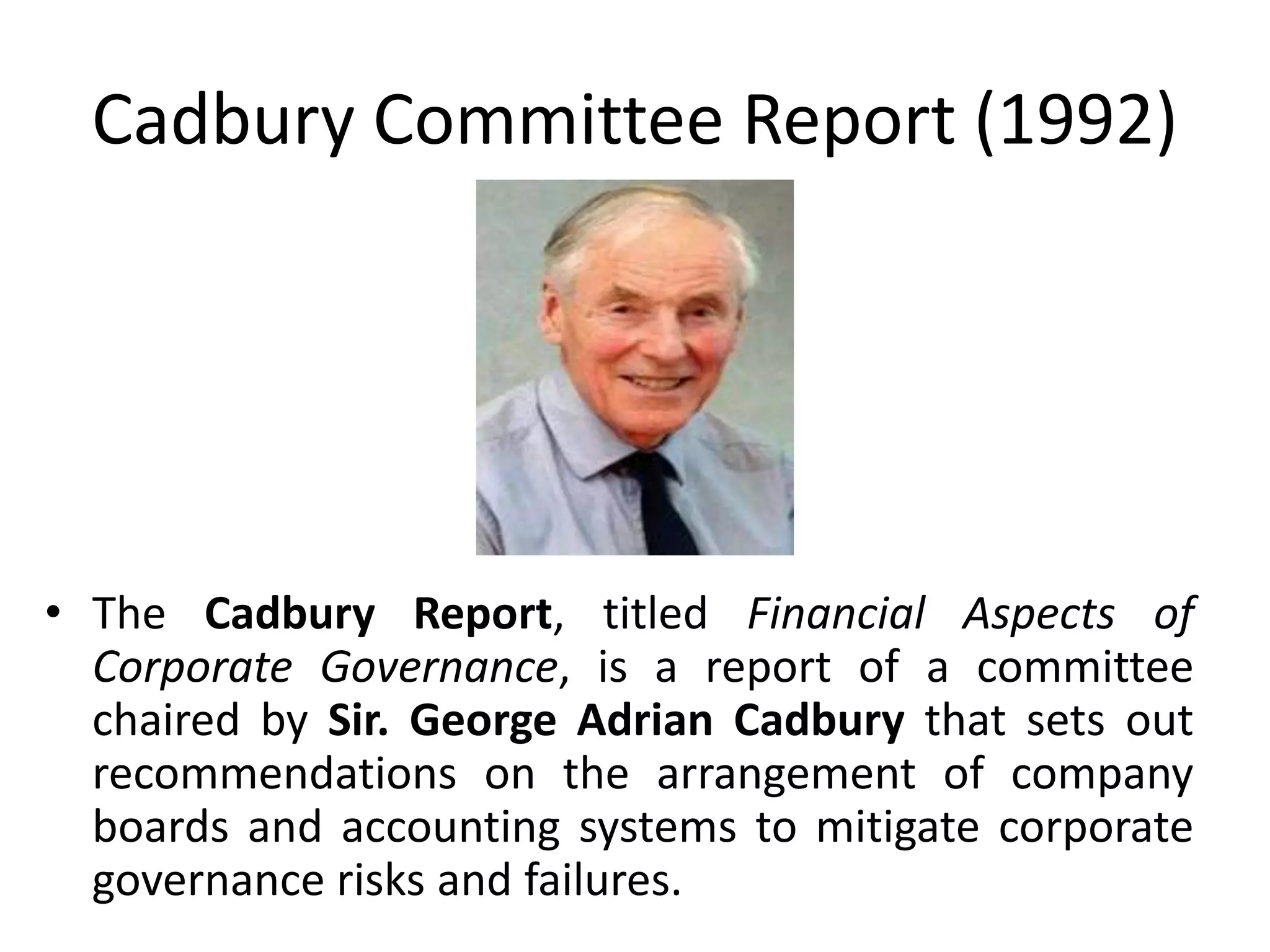
• The Cadbury Report, titled Financial Aspects of
Corporate Governance, is a report of a committee
chaired by Sir. George Adrian Cadbury that sets out
recommendations on the arrangement of company
boards and accounting systems to mitigate corporate
governance risks and failures.
Cadbury Committee Report (1992)
• The 'Cadbury Committee' was set up in May
1991 with a view to overcome the huge
problems of scams and failures occurring in
the corporate sector worldwide in the late
1980s and the early 1990s.
• It was formed by the Financial Reporting
Council, the London Stock of Exchange and
the accountancy profession, with the main
aim of addressing the financial aspects of
Corporate Governance.
Other objectives include :
i. uplift the low level of confidence both in
financial reporting and in the ability of auditors
to provide the safeguards which the users of
company's reports sought and expected;
ii. review the structure, rights and roles of board
of directors, shareholders and auditors by
making them more effective and accountable;
iii. address various aspects of accountancy
profession and make appropriate
recommendations, wherever necessary;
iv. raise the standard of corporate governance; etc
Corporate governance
Corporate governance is the system by which
• companies are directed and controlled.
• Boards of directors are responsible for the governance of their companies.
• The shareholders’ role in governance is to appoint the directors and the auditors
and to satisfy themselves that an appropriate governance structure is in place.
• The responsibilities of the board include setting the company’s strategic aims,
providing the leadership to put them into effect, supervising the management of
the business and reporting to shareholders on their stewardship.
Within that overall framework, the specifically financial aspects of corporate
governance are
• the way in which boards set financial policy and oversee its implementation.
• Financial controls, and
• the process whereby they report on the activities and progress of the company to
the shareholders.
THE SETTING FOR THE REPORT
• The Committee’s recommendations are focused on the control and
reporting functions of boards, and on the role of auditors.
• At the heart of the Committee’s recommendations is a Code of Best
Practice designed to achieve the necessary high standards of
corporate behavior.
• The Committee will remain responsible for reviewing the
implementation of its proposals. A programme of research will be
undertaken to assist the future monitoring of the Code.
• By adhering to the Code, listed companies will strengthen both
their control over their businesses and their public accountability.
• Bringing greater clarity to the respective responsibilities of
directors, shareholders and auditors will also strengthen trust in the
corporate system.
• Our proposals aim to strengthen the unitary board system and
increase its effectiveness, not to replace it.
Code Principles
The principles
• Openness
• integrity
• accountability.
• An open approach to the disclosure of
information contributes to the efficient working
of the market economy, prompts boards to take
effective action and allows shareholders and
others to scrutinize companies more thoroughly.
Now Presenting …
Alim Ehsan Dipon
Id: M150203056
ROLE OF BOARD OF DIRECTORS,
DUTIES OF BOARD AND ITS
COMPOSITIONS
Board Effectiveness
• Every public company should be headed by an effective
board which can both lead and control the business.
Within the context of the UK unitary board system, this
means a board made up of a combination of executive
directors, with their intimate knowledge of the
business, and of outside, non-executive directors, who
can bring a broader view to the company’s activities,
under a chairman who accepts the duties and
responsibilities which the post entails, whose role in
corporate governance is fundamental, and their
collective ability to provide both the leadership and the
checks and balances which effective governance
demands.
• The board should meet regularly, retain full and
effective control over the company and monitor
the executive management.
• All directors should have access to the advice and
services of the company secretary, who is
responsible to the board for ensuring that board
procedures are followed and that applicable rules
and regulations are complied with. Any question
of the removal of the company secretary should
be a matter for the board as a whole.
Role of the chairman
• Given the importance and particular nature of the
chairman’s role, it should in principle be separate from that
of the chief executive.
• The chairman’s role in securing good corporate governance
is crucial. Chairmen should be able to stand sufficiently
back from the day-to-day running of the business to ensure
that their boards are in full control of the company’s affairs
and alert to their obligations to their shareholders.
• It is for chairmen to make certain that their non-executive
directors receive timely, relevant information tailored to
their needs, that they are properly briefed on the issues
arising at board meetings, and that they make an effective
contribution as board members in practice.
Role of non-executive directors
• The Committee believes that the caliber of the
nonexecutive members of the board is of special
importance in setting and maintaining standards of
corporate governance.
• Non-executive directors should bring an independent
judgment to bear on issues of strategy, performance,
resources, including key appointments, and standards of
conduct.
• Non-executive directors should be appointed for specified
terms and reappointment should not be automatic.
• Non-executive directors should be selected through a
formal process and both this process and their
appointment should be a matter for the board as a whole.
Professional Advice
• Occasions may arise when directors have to
seek legal or financial advice in the
furtherance of their duties. They should
always be able to consult the company’s
advisers
• consider it necessary to take independent
professional advice we recommend that they
should be entitled to do so at the company’s
expense.
Directors Training
• Given the varying backgrounds, qualifications and
experience of directors, it is highly desirable that
they should all undertake some form of internal
or external training.
• This is particularly important for directors,
whether executive or non-executive, with no
previous board experience. Newly-appointed
board members are also entitled to expect a
proper process of induction into the company’s
affairs.
The Company Secretary
• The chairman and the board will look to the company
secretary for guidance on what their responsibilities
are under the rules and regulations to which they are
subject and on how those responsibilities.
• It should be standard practice for the company
secretary to administer, attend and prepare minutes of
board proceedings.
• The Committee expects that the company secretary
will be a source of advice to the chairman and to the
board on the implementation of the Code of Best
Practice.
Now Presenting …
Akib Hossain Chowdhury
Id:M150203066
Directors Responsibilities
• Shareholders are clear where the boundaries
between the duties of directors and auditors lie,
we recommended that a brief statement of
directors responsibilities for the accounts should
appear in the report and accounts, as a
counterpart to a statement by the auditors about
their reporting responsibilities.
• The appropriate position for the directors
statement is immediately before the auditors
report, which in future will include a
responsibilities.
Standards of Conduct & Nomination
Committees
• It is important that all employees should know
what standards of conduct are expected of them.
We regard it as good practice for boards of
directors to draw up codes of ethics or
statements of business practice and to publish
them both internally and externally.
• A nomination committee should have a majority
of non-executive directors on it and be chaired
either by the chairman or a non-executive
director.
Role of Audit Committee
• Monitoring the integrity of financial statement and any
formal announcements relating to financial performance.
• Reviewing internal financial control and unless there is a
separate board risk committee, reviewing the companies
internal control and risk management system.
• Monitoring and reviewing the effectiveness of the internal
audit function.
• Making recommendations to the board in relation to the
appointment, re-appointment and removal of the external
auditor.
• Reviewing the auditors independence and objectivity.
• Developing and implementing the non-audit service policy..
Dealing with their remunerations
• we recommend that future service contracts
should not exceed three years without
shareholders’ approval and that the Companies
Act should be amended inline with this
recommendation.
• Shareholders require that the remuneration of
directors should be both fair and competitive.
• The Annual General Meeting provides the
opportunity for shareholders to make their views
on such matters as director’s benefit known to
their boards.
Addressing reporting of financial
reporting and financial control
• It is the board’s duty to present a balanced and
understandable assessment of the company’s
position.
• The board should ensure that an objective and
professional relationship is maintained with the
auditors.
• The board should establish an audit committee of
at least three non-executive directors with
written terms of reference which deal clearly with
its authority and duties.
Now Presenting …
Tanvir Mahmud
Id:M150203083
Auditing
• The audit provides an external and objective
check on the way in which the financial
statements have been prepared and
presented
• Audits are a reassurance to all who have a
financial interest in companies, quite apart
from their value to boards of directors.
Professional objectivity
• Shareholders require auditors to work with and
not against management, while always remaining
professionally objective.
• Accounting standards provide important
reference points against which auditors exercise
their professional judgment.
• Shareholders look to the audit committee to
ensure that the auditors are able to put their
views in the event of any difference of opinion
with management.
Ways to increase effectiveness and
value of the audit
1. The ‘Expectations Gap’
There should be an extension of the audit which
will add to its value to all users of accounts and
bring it closer into line with public expectations.
2. Internal Control
Directors should report on the effectiveness of
their system of internal control, and that
developing guidance for auditors on relevant
audit procedures and the form in which auditors
should report.
3. Going Concern
Directors should state in the report and accounts
that the business is a going concern, with
supporting assumptions or qualifications as the
question of Legislation should be decided in the
light of experience.
4. Fraud
The auditor’s responsibility is ‘properly to plan,
perform and evaluate his audit work so as i;. have
a reasonable expectation of detecting material
misstatements in the financial statements’.
Auditors Liability
 The legal position with regard to civil liability laid
down by Cupar-o should be altered by statute at
the present time.
 Auditors are fully liable in negligence to the
companies they audit and their shareholders
collectively, and Caparo has not changed this.
 Increased litigation that could arise from
adapting the audit to meet changing needs and
expectations - a process which the Committee’s
report itself is intended to encourage.
Audit Confidence
• The committee welcome the initiatives of profession’s
ethical rules and disciplinary arrangements.
• Audit tendering will strengthen the standing and
independence of auditors.
• Techniques to improve and enforce auditing standards:
1. tighter accounting standard s
2. effective audit committees
3. rigorous and objective auditing
4. action by the accountancy profession.
Now Presenting …
MD. Tariqul Islam Mukith
Id:M150203075
THE SHAREHOLDERS
Accountability of Boards to
Shareholders
1. The formal relationship between the shareholders and the board of
directors is that the shareholders elect the directors
2. A number of proposals addressing this issue were put forward by
individual shareholders and shareholder organisations
3. On the first proposal, we have not seen evidence explaining how it would
be possible to form shareholder committees in such a way that they would
be both truly representative of all the company’s shareholders and able to
keep in regular touch with their changing constituencies
4. The second set of proposals raises such questions as what legislation
would be needed to alter the present thresholds for tabling shareholder
resolutions, and where the costs involved in circulating shareholder
communications should fall
5. In the meantime, shareholders can make their views known to the boards
of the companies in which they have invested by communicating with
them direct and through their attendance at general meetings
6. Shareholders have delegated many of their responsibilities as owners to
the directors who act as their stewards. It is for the shareholders to call
the directors to book if they appear to be failing in their stewardship and
they should use this power
7. Reports and accounts are presented to shareholders at the Annual
General Meeting, when they have the opportunity to comment on them
and to put their questions. In particular,
the Annual General Meeting gives all shareholders , whatever the size of
their shareholding, direct and public access to their boards
8. In the Committee’s view, both shareholders and boards of directors should
consider how the effectiveness of general meetings could be increased
and as a result the accountability of boards to all their shareholders
strengthened
Institutional Shareholders
9. The proportion of shares held by individuals and by institutions has
broadly reversed over the last thirty years so that institutional
shareholders now own the majority of shares of quoted companies
10.Given the weight of their votes , the way in which institutional
shareholders use their power to influence the standards of corporate
governance is of fundamental importance
11.The Committee, therefore, warmly welcomes the statement recently
published by the Institutional Shareholders ’ Committee on the
Responsibilities of institutional Shareholders in the UK and we draw
attention to three key conclusions which are basic to the development of a
constructive relationship between companies and their owners.
12.The Institutional Shareholders’ Committee’s advice to its members to use
their voting rights positively is important in the context of corporate
governance
Shareholder Communications
13. These conclusions on the role of institutional shareholders raise issues
over the lines of communication between boards and their shareholders.
The first issue is one of parity between shareholders.
14. A second issue which arises over communications between institutional
investors and companies is the danger of imparting inside information
15. If long-term relationships are to be developed , it is important that
companies should communicate their strategies to their major
shareholders and that their shareholders should understand them.
Shareholder Influence
13. Because of the importance of their collective stake, we look to the
institutions in particular, with the backing of the Institutional
Shareholders’ Committee, to use their influence as owners to ensure that
the companies in which they have invested comply with the Code
Conclusion
1. The Committee’s proposals are mutually supportive and should be taken
as a whole. The Code reflects existing best practice and few of our
recommendations require legislation
2. No system of corporate governance can be totally proof against fraud or
incompetence. The test is how far such aberrations can be discouraged
and how quickly they can be brought to light
3. Although the great majority of companies are both competently run and
audited under the present system of corporate governance, it is widely
accepted that standards within the corporate sector have to be raised
4. The way forward is through clear definitions of responsibility and an
acceptance by all involved that the highest standards of efficiency and
integrity are expected of them
5. This will involve a sharper sense of accountability and responsibility all
round - accountability by boards to their shareholders, responsibility on
the part of all shareholders to the companies they own
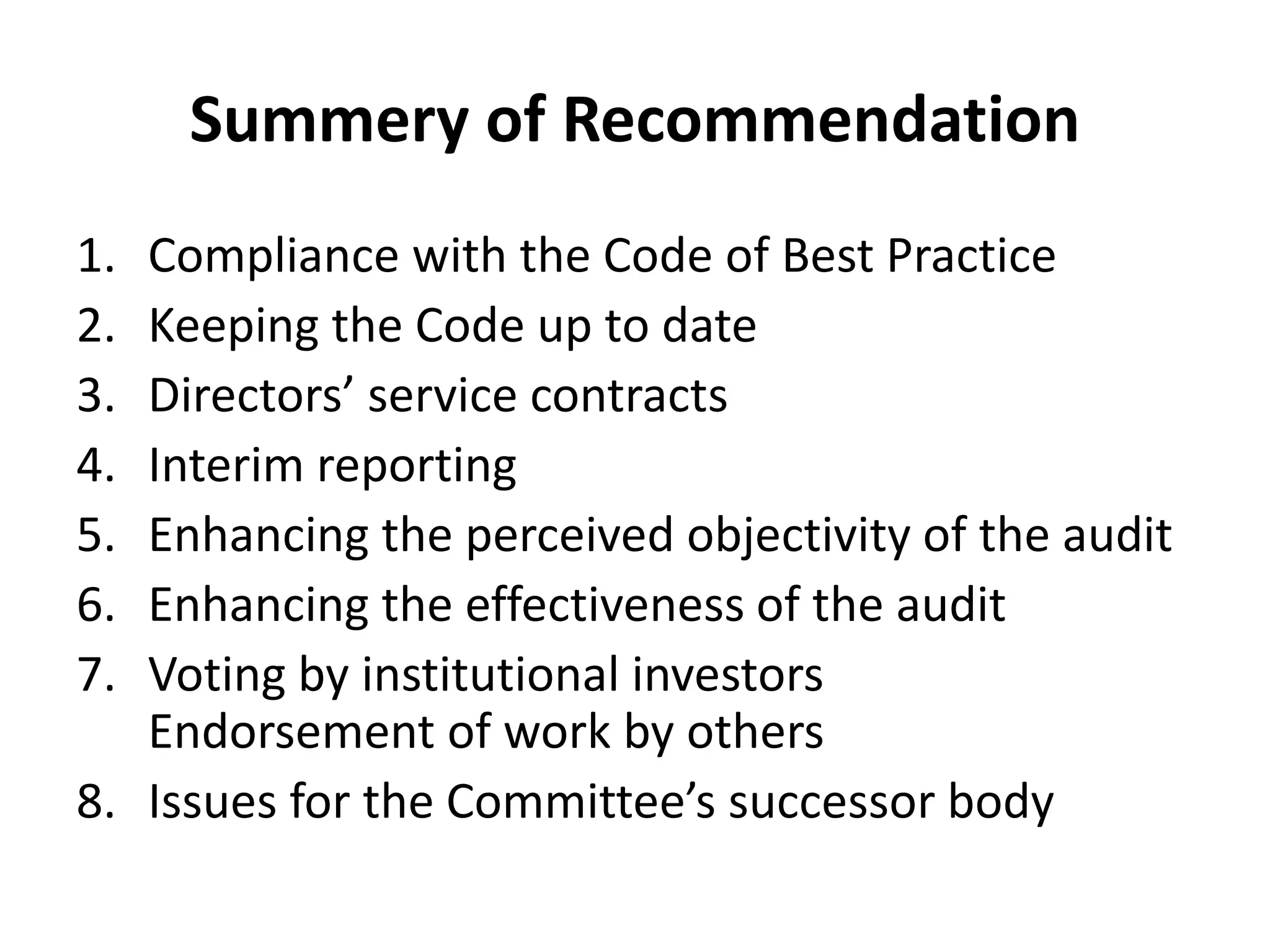
Summery of Recommendation
1. Compliance with the Code of Best Practice
2. Keeping the Code up to date
3. Directors’ service contracts
4. Interim reporting
5. Enhancing the perceived objectivity of the audit
6. Enhancing the effectiveness of the audit
7. Voting by institutional investors
Endorsement of work by others
8. Issues for the Committee’s successor body
The Code of Best Practice
1. The Board of Directors
2. Non-Executive Directors
3. Executive Directors
4. Reporting and Controls
Cadburi report

Cadburi report

  • 1.
    REPORT OF THECOMMITTEE ON THE FIANCIAL ASPECTS OF CORPORATE GOVERNANCE
  • 2.
    Submitted to: Shaikh MasrickHasan Assistant professor, Department of Finance Jagannath University, Dhaka. Submitted by: MD. Asif Ibne Ahsan On behalf of Group MBA 6th Batch Department of Finance Jagannath University, Dhaka. .
  • 3.
    Members of Group: SLNo. Name ID no 1 MD. Asif Ibne Ahsan M150203047 2 Alim Ehsan Dipon M150203056 3 Akib Hossain Chowdhury M150203066 4 MD. Tariqul Islam Mukith M150203075 5 Tanvir Mahmud M150203083
  • 4.
    Now Presenting … MD.Asif Ibne Ahsan Id: M150203047
  • 5.
    Cadbury Committee Report(1992) • The Cadbury Report, titled Financial Aspects of Corporate Governance, is a report of a committee chaired by Sir. George Adrian Cadbury that sets out recommendations on the arrangement of company boards and accounting systems to mitigate corporate governance risks and failures.
  • 6.
    Cadbury Committee Report(1992) • The 'Cadbury Committee' was set up in May 1991 with a view to overcome the huge problems of scams and failures occurring in the corporate sector worldwide in the late 1980s and the early 1990s. • It was formed by the Financial Reporting Council, the London Stock of Exchange and the accountancy profession, with the main aim of addressing the financial aspects of Corporate Governance.
  • 7.
    Other objectives include: i. uplift the low level of confidence both in financial reporting and in the ability of auditors to provide the safeguards which the users of company's reports sought and expected; ii. review the structure, rights and roles of board of directors, shareholders and auditors by making them more effective and accountable; iii. address various aspects of accountancy profession and make appropriate recommendations, wherever necessary; iv. raise the standard of corporate governance; etc
  • 8.
    Corporate governance Corporate governanceis the system by which • companies are directed and controlled. • Boards of directors are responsible for the governance of their companies. • The shareholders’ role in governance is to appoint the directors and the auditors and to satisfy themselves that an appropriate governance structure is in place. • The responsibilities of the board include setting the company’s strategic aims, providing the leadership to put them into effect, supervising the management of the business and reporting to shareholders on their stewardship. Within that overall framework, the specifically financial aspects of corporate governance are • the way in which boards set financial policy and oversee its implementation. • Financial controls, and • the process whereby they report on the activities and progress of the company to the shareholders.
  • 9.
    THE SETTING FORTHE REPORT • The Committee’s recommendations are focused on the control and reporting functions of boards, and on the role of auditors. • At the heart of the Committee’s recommendations is a Code of Best Practice designed to achieve the necessary high standards of corporate behavior. • The Committee will remain responsible for reviewing the implementation of its proposals. A programme of research will be undertaken to assist the future monitoring of the Code. • By adhering to the Code, listed companies will strengthen both their control over their businesses and their public accountability. • Bringing greater clarity to the respective responsibilities of directors, shareholders and auditors will also strengthen trust in the corporate system. • Our proposals aim to strengthen the unitary board system and increase its effectiveness, not to replace it.
  • 10.
    Code Principles The principles •Openness • integrity • accountability. • An open approach to the disclosure of information contributes to the efficient working of the market economy, prompts boards to take effective action and allows shareholders and others to scrutinize companies more thoroughly.
  • 11.
    Now Presenting … AlimEhsan Dipon Id: M150203056
  • 12.
    ROLE OF BOARDOF DIRECTORS, DUTIES OF BOARD AND ITS COMPOSITIONS
  • 13.
    Board Effectiveness • Everypublic company should be headed by an effective board which can both lead and control the business. Within the context of the UK unitary board system, this means a board made up of a combination of executive directors, with their intimate knowledge of the business, and of outside, non-executive directors, who can bring a broader view to the company’s activities, under a chairman who accepts the duties and responsibilities which the post entails, whose role in corporate governance is fundamental, and their collective ability to provide both the leadership and the checks and balances which effective governance demands.
  • 14.
    • The boardshould meet regularly, retain full and effective control over the company and monitor the executive management. • All directors should have access to the advice and services of the company secretary, who is responsible to the board for ensuring that board procedures are followed and that applicable rules and regulations are complied with. Any question of the removal of the company secretary should be a matter for the board as a whole.
  • 15.
    Role of thechairman • Given the importance and particular nature of the chairman’s role, it should in principle be separate from that of the chief executive. • The chairman’s role in securing good corporate governance is crucial. Chairmen should be able to stand sufficiently back from the day-to-day running of the business to ensure that their boards are in full control of the company’s affairs and alert to their obligations to their shareholders. • It is for chairmen to make certain that their non-executive directors receive timely, relevant information tailored to their needs, that they are properly briefed on the issues arising at board meetings, and that they make an effective contribution as board members in practice.
  • 16.
    Role of non-executivedirectors • The Committee believes that the caliber of the nonexecutive members of the board is of special importance in setting and maintaining standards of corporate governance. • Non-executive directors should bring an independent judgment to bear on issues of strategy, performance, resources, including key appointments, and standards of conduct. • Non-executive directors should be appointed for specified terms and reappointment should not be automatic. • Non-executive directors should be selected through a formal process and both this process and their appointment should be a matter for the board as a whole.
  • 17.
    Professional Advice • Occasionsmay arise when directors have to seek legal or financial advice in the furtherance of their duties. They should always be able to consult the company’s advisers • consider it necessary to take independent professional advice we recommend that they should be entitled to do so at the company’s expense.
  • 18.
    Directors Training • Giventhe varying backgrounds, qualifications and experience of directors, it is highly desirable that they should all undertake some form of internal or external training. • This is particularly important for directors, whether executive or non-executive, with no previous board experience. Newly-appointed board members are also entitled to expect a proper process of induction into the company’s affairs.
  • 19.
    The Company Secretary •The chairman and the board will look to the company secretary for guidance on what their responsibilities are under the rules and regulations to which they are subject and on how those responsibilities. • It should be standard practice for the company secretary to administer, attend and prepare minutes of board proceedings. • The Committee expects that the company secretary will be a source of advice to the chairman and to the board on the implementation of the Code of Best Practice.
  • 20.
    Now Presenting … AkibHossain Chowdhury Id:M150203066
  • 21.
    Directors Responsibilities • Shareholdersare clear where the boundaries between the duties of directors and auditors lie, we recommended that a brief statement of directors responsibilities for the accounts should appear in the report and accounts, as a counterpart to a statement by the auditors about their reporting responsibilities. • The appropriate position for the directors statement is immediately before the auditors report, which in future will include a responsibilities.
  • 22.
    Standards of Conduct& Nomination Committees • It is important that all employees should know what standards of conduct are expected of them. We regard it as good practice for boards of directors to draw up codes of ethics or statements of business practice and to publish them both internally and externally. • A nomination committee should have a majority of non-executive directors on it and be chaired either by the chairman or a non-executive director.
  • 23.
    Role of AuditCommittee • Monitoring the integrity of financial statement and any formal announcements relating to financial performance. • Reviewing internal financial control and unless there is a separate board risk committee, reviewing the companies internal control and risk management system. • Monitoring and reviewing the effectiveness of the internal audit function. • Making recommendations to the board in relation to the appointment, re-appointment and removal of the external auditor. • Reviewing the auditors independence and objectivity. • Developing and implementing the non-audit service policy..
  • 24.
    Dealing with theirremunerations • we recommend that future service contracts should not exceed three years without shareholders’ approval and that the Companies Act should be amended inline with this recommendation. • Shareholders require that the remuneration of directors should be both fair and competitive. • The Annual General Meeting provides the opportunity for shareholders to make their views on such matters as director’s benefit known to their boards.
  • 25.
    Addressing reporting offinancial reporting and financial control • It is the board’s duty to present a balanced and understandable assessment of the company’s position. • The board should ensure that an objective and professional relationship is maintained with the auditors. • The board should establish an audit committee of at least three non-executive directors with written terms of reference which deal clearly with its authority and duties.
  • 26.
    Now Presenting … TanvirMahmud Id:M150203083
  • 27.
    Auditing • The auditprovides an external and objective check on the way in which the financial statements have been prepared and presented • Audits are a reassurance to all who have a financial interest in companies, quite apart from their value to boards of directors.
  • 28.
    Professional objectivity • Shareholdersrequire auditors to work with and not against management, while always remaining professionally objective. • Accounting standards provide important reference points against which auditors exercise their professional judgment. • Shareholders look to the audit committee to ensure that the auditors are able to put their views in the event of any difference of opinion with management.
  • 29.
    Ways to increaseeffectiveness and value of the audit 1. The ‘Expectations Gap’ There should be an extension of the audit which will add to its value to all users of accounts and bring it closer into line with public expectations. 2. Internal Control Directors should report on the effectiveness of their system of internal control, and that developing guidance for auditors on relevant audit procedures and the form in which auditors should report.
  • 30.
    3. Going Concern Directorsshould state in the report and accounts that the business is a going concern, with supporting assumptions or qualifications as the question of Legislation should be decided in the light of experience. 4. Fraud The auditor’s responsibility is ‘properly to plan, perform and evaluate his audit work so as i;. have a reasonable expectation of detecting material misstatements in the financial statements’.
  • 31.
    Auditors Liability  Thelegal position with regard to civil liability laid down by Cupar-o should be altered by statute at the present time.  Auditors are fully liable in negligence to the companies they audit and their shareholders collectively, and Caparo has not changed this.  Increased litigation that could arise from adapting the audit to meet changing needs and expectations - a process which the Committee’s report itself is intended to encourage.
  • 32.
    Audit Confidence • Thecommittee welcome the initiatives of profession’s ethical rules and disciplinary arrangements. • Audit tendering will strengthen the standing and independence of auditors. • Techniques to improve and enforce auditing standards: 1. tighter accounting standard s 2. effective audit committees 3. rigorous and objective auditing 4. action by the accountancy profession.
  • 33.
    Now Presenting … MD.Tariqul Islam Mukith Id:M150203075
  • 34.
  • 35.
    Accountability of Boardsto Shareholders 1. The formal relationship between the shareholders and the board of directors is that the shareholders elect the directors 2. A number of proposals addressing this issue were put forward by individual shareholders and shareholder organisations 3. On the first proposal, we have not seen evidence explaining how it would be possible to form shareholder committees in such a way that they would be both truly representative of all the company’s shareholders and able to keep in regular touch with their changing constituencies 4. The second set of proposals raises such questions as what legislation would be needed to alter the present thresholds for tabling shareholder resolutions, and where the costs involved in circulating shareholder communications should fall
  • 36.
    5. In themeantime, shareholders can make their views known to the boards of the companies in which they have invested by communicating with them direct and through their attendance at general meetings 6. Shareholders have delegated many of their responsibilities as owners to the directors who act as their stewards. It is for the shareholders to call the directors to book if they appear to be failing in their stewardship and they should use this power 7. Reports and accounts are presented to shareholders at the Annual General Meeting, when they have the opportunity to comment on them and to put their questions. In particular, the Annual General Meeting gives all shareholders , whatever the size of their shareholding, direct and public access to their boards 8. In the Committee’s view, both shareholders and boards of directors should consider how the effectiveness of general meetings could be increased and as a result the accountability of boards to all their shareholders strengthened
  • 37.
    Institutional Shareholders 9. Theproportion of shares held by individuals and by institutions has broadly reversed over the last thirty years so that institutional shareholders now own the majority of shares of quoted companies 10.Given the weight of their votes , the way in which institutional shareholders use their power to influence the standards of corporate governance is of fundamental importance 11.The Committee, therefore, warmly welcomes the statement recently published by the Institutional Shareholders ’ Committee on the Responsibilities of institutional Shareholders in the UK and we draw attention to three key conclusions which are basic to the development of a constructive relationship between companies and their owners. 12.The Institutional Shareholders’ Committee’s advice to its members to use their voting rights positively is important in the context of corporate governance
  • 38.
    Shareholder Communications 13. Theseconclusions on the role of institutional shareholders raise issues over the lines of communication between boards and their shareholders. The first issue is one of parity between shareholders. 14. A second issue which arises over communications between institutional investors and companies is the danger of imparting inside information 15. If long-term relationships are to be developed , it is important that companies should communicate their strategies to their major shareholders and that their shareholders should understand them. Shareholder Influence 13. Because of the importance of their collective stake, we look to the institutions in particular, with the backing of the Institutional Shareholders’ Committee, to use their influence as owners to ensure that the companies in which they have invested comply with the Code
  • 39.
    Conclusion 1. The Committee’sproposals are mutually supportive and should be taken as a whole. The Code reflects existing best practice and few of our recommendations require legislation 2. No system of corporate governance can be totally proof against fraud or incompetence. The test is how far such aberrations can be discouraged and how quickly they can be brought to light 3. Although the great majority of companies are both competently run and audited under the present system of corporate governance, it is widely accepted that standards within the corporate sector have to be raised 4. The way forward is through clear definitions of responsibility and an acceptance by all involved that the highest standards of efficiency and integrity are expected of them 5. This will involve a sharper sense of accountability and responsibility all round - accountability by boards to their shareholders, responsibility on the part of all shareholders to the companies they own
  • 40.
    Summery of Recommendation 1.Compliance with the Code of Best Practice 2. Keeping the Code up to date 3. Directors’ service contracts 4. Interim reporting 5. Enhancing the perceived objectivity of the audit 6. Enhancing the effectiveness of the audit 7. Voting by institutional investors Endorsement of work by others 8. Issues for the Committee’s successor body
  • 41.
    The Code ofBest Practice 1. The Board of Directors 2. Non-Executive Directors 3. Executive Directors 4. Reporting and Controls