“The most profound technologies are
those that disappear” - Mark Weiser
Outline
 Goal
 Motivation
 Challenges of video streaming over
Bluetooth PAN
 Our approach
 Evaluation of approach
 Implementation
 Demo
 Conclusion

             The University of Texas at Austin   2
Goal
• Tie up three promising technologies – Video
  On Demand, Bluetooth, P2P
• To provide video on demand services in
  Bluetooth , using pure P2P approach
• A Pure P2P approach has a broader range of
  applicability, as one need not rely on server
  infrastructure anywhere . [as needed for a
  Hybrid P2P approach]
Motivation
• Increased usage of Bluetooth devices
• Promises of Bluetooth 3.0 – data rates up to
  480Mbps, energy efficient – making them a
  very attractive platform for development of
  ‘Smart Applications’
• Video-On-Demand is one of the most popular
  applications of the past decade
• P2P applications call the shots, in today’s
  Internet. Eg: Skype, Yahoo Messenger,
  Gnutella
Challenges
• Low end devices ; Devices can barely handle
  video processing
• Limitations of current Bluetooth technology
  (data rates only upto 2.0Mbps)
• A single sender – N recipients problem that
  can cause a bottleneck at the sender
• Fault tolerance is difficult to achieve in a
  dynamic environment
• Load balancing issues need to be addressed
• Support multiple sessions at the same server
Solution Sketch
• One video session per request will overload
  the server , which is also a low end device
• Simple 1 to N broadcast of video chunks from
  the Server will not work
• Server directly serves only some clients.
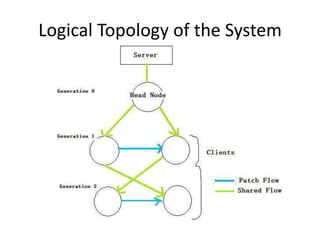
• A content distribution tree is formed amongst
  the clients
• Early client serve late coming clients
Logical Topology of the System
Benefits of introducing Head Node
• A client can have only a single video session. A
  server can support multiple server sessions.
• Out bound bandwidth is limited (about 200
  kilobytes per second only)
• An attempt to achieve optimal load balancing
  throughout the entire network
• Server serves only one node per session
• Seems a good idea. But …
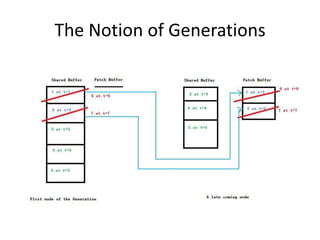
The Notion of Generations
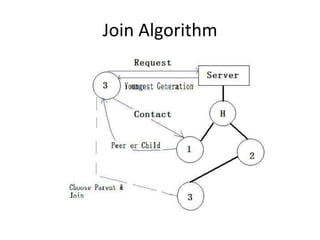
Join Algorithm
Catalog Maintenance
• Build a global catalog using periodic exchange of
  control information (Send only updates, not the
  entire data) and query it locally
• Provides fast search times
• Use soft state with ER
• Some information that this catalog could store
  are video lists at other nodes, current buffer
  usages, message processing backlogs, processor
  utilization and number of active server sessions
• Optimize by writing expired state to disk and
  garbage collect later
Fault Tolerance
• Failure of Head Node
   – Replicate the Head Node
   – Promote a child as head node when the server cannot
     support head node replication
• Failure of Server
   – Can do something about the intermittent failures of
     the servers by buffering future chunks at other nodes
   – Bandwidth is free. No issues
• Failure of Client nodes
   – Handled as in P2VOD
Load balancing
• Head node can become too overloaded for
  large G. [Large G offers higher fault tolerance].
• Hence, head node can be replicated to
  overcome this bottleneck
• A dynamic load balancing algorithm that can
  adapt the amount of replication and G, based
  on current load
Metrics
• Service Acceptance ratio : Given the
  parameters that model the system, what
  percentage of nodes can successfully join the
  system and receive the services
• Workload : The amount of work that is
  pending at each node at any particular time.
• Jitter : The amount of time a node waits for
  services during a given finite duration run of
  the protocol
SAR [Theoretical]
Average Jitter [Theoretical]
Workload distribution [Simulated]
Bluetube Implementation
Bluetube: Key points
• Currently supports MPEG-1 videos (good
  starting point)
• Video splitting
  – Videos are split into chunks (beforehand) and
    stored
• Application launched as server or client at any
  given instant
• Supports late coming peers
• RFCOMM
Server properties
• Selectively publishes videos
• Listens for client requests
• Upon receiving video request, sends “chunks”
  of the video to client
• Can handle multiple client requests (upto a
  maximum of 6)
Client properties
• Performs a devices search followed by services
  search
• Published videos get displayed on client
  screen
• Client selects a video to play
• Receives video chunks from server
• Chunk player plays chunks while buffering
  remaining chunks
Development Environment
• Sun Java Wireless Toolkit 2.5.2 for CLDC
  – Formerly known as J2ME Wireless Toolkit
• Key features:
  – Emulation environment designed to run
    applications on cell phones
  – Performance optimization and tuning
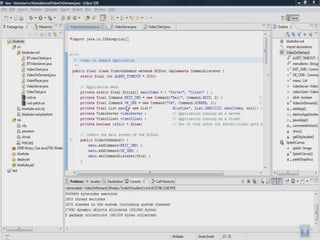
Demo
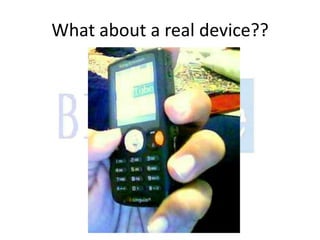
What about a real device??
Concluding remarks
• A first-of-its kind effort
• Establishes that reality is not far
• Future focus on using Gossip based protocols
  for improving performance
• Further analysis on intermittent server failure
  handling
• Better load balancing scheme
We had a dream…
   Thank you

Bluetube

  • 1.
    “The most profoundtechnologies are those that disappear” - Mark Weiser
  • 2.
    Outline  Goal  Motivation Challenges of video streaming over Bluetooth PAN  Our approach  Evaluation of approach  Implementation  Demo  Conclusion The University of Texas at Austin 2
  • 3.
    Goal • Tie upthree promising technologies – Video On Demand, Bluetooth, P2P • To provide video on demand services in Bluetooth , using pure P2P approach • A Pure P2P approach has a broader range of applicability, as one need not rely on server infrastructure anywhere . [as needed for a Hybrid P2P approach]
  • 4.
    Motivation • Increased usageof Bluetooth devices • Promises of Bluetooth 3.0 – data rates up to 480Mbps, energy efficient – making them a very attractive platform for development of ‘Smart Applications’ • Video-On-Demand is one of the most popular applications of the past decade • P2P applications call the shots, in today’s Internet. Eg: Skype, Yahoo Messenger, Gnutella
  • 5.
    Challenges • Low enddevices ; Devices can barely handle video processing • Limitations of current Bluetooth technology (data rates only upto 2.0Mbps) • A single sender – N recipients problem that can cause a bottleneck at the sender • Fault tolerance is difficult to achieve in a dynamic environment • Load balancing issues need to be addressed • Support multiple sessions at the same server
  • 6.
    Solution Sketch • Onevideo session per request will overload the server , which is also a low end device • Simple 1 to N broadcast of video chunks from the Server will not work • Server directly serves only some clients. • A content distribution tree is formed amongst the clients • Early client serve late coming clients
  • 7.
  • 8.
    Benefits of introducingHead Node • A client can have only a single video session. A server can support multiple server sessions. • Out bound bandwidth is limited (about 200 kilobytes per second only) • An attempt to achieve optimal load balancing throughout the entire network • Server serves only one node per session • Seems a good idea. But …
  • 9.
    The Notion ofGenerations
  • 10.
  • 11.
    Catalog Maintenance • Builda global catalog using periodic exchange of control information (Send only updates, not the entire data) and query it locally • Provides fast search times • Use soft state with ER • Some information that this catalog could store are video lists at other nodes, current buffer usages, message processing backlogs, processor utilization and number of active server sessions • Optimize by writing expired state to disk and garbage collect later
  • 12.
    Fault Tolerance • Failureof Head Node – Replicate the Head Node – Promote a child as head node when the server cannot support head node replication • Failure of Server – Can do something about the intermittent failures of the servers by buffering future chunks at other nodes – Bandwidth is free. No issues • Failure of Client nodes – Handled as in P2VOD
  • 13.
    Load balancing • Headnode can become too overloaded for large G. [Large G offers higher fault tolerance]. • Hence, head node can be replicated to overcome this bottleneck • A dynamic load balancing algorithm that can adapt the amount of replication and G, based on current load
  • 14.
    Metrics • Service Acceptanceratio : Given the parameters that model the system, what percentage of nodes can successfully join the system and receive the services • Workload : The amount of work that is pending at each node at any particular time. • Jitter : The amount of time a node waits for services during a given finite duration run of the protocol
  • 15.
  • 16.
  • 17.
  • 18.
  • 19.
    Bluetube: Key points •Currently supports MPEG-1 videos (good starting point) • Video splitting – Videos are split into chunks (beforehand) and stored • Application launched as server or client at any given instant • Supports late coming peers • RFCOMM
  • 20.
    Server properties • Selectivelypublishes videos • Listens for client requests • Upon receiving video request, sends “chunks” of the video to client • Can handle multiple client requests (upto a maximum of 6)
  • 21.
    Client properties • Performsa devices search followed by services search • Published videos get displayed on client screen • Client selects a video to play • Receives video chunks from server • Chunk player plays chunks while buffering remaining chunks
  • 22.
    Development Environment • SunJava Wireless Toolkit 2.5.2 for CLDC – Formerly known as J2ME Wireless Toolkit • Key features: – Emulation environment designed to run applications on cell phones – Performance optimization and tuning
  • 23.
  • 25.
    What about areal device??
  • 26.
    Concluding remarks • Afirst-of-its kind effort • Establishes that reality is not far • Future focus on using Gossip based protocols for improving performance • Further analysis on intermittent server failure handling • Better load balancing scheme
  • 27.
    We had adream… Thank you