David Atkinson BSc. Chem. Eng.
Technical Director
Westport, Ireland
May 2014
BLUERAD LTD
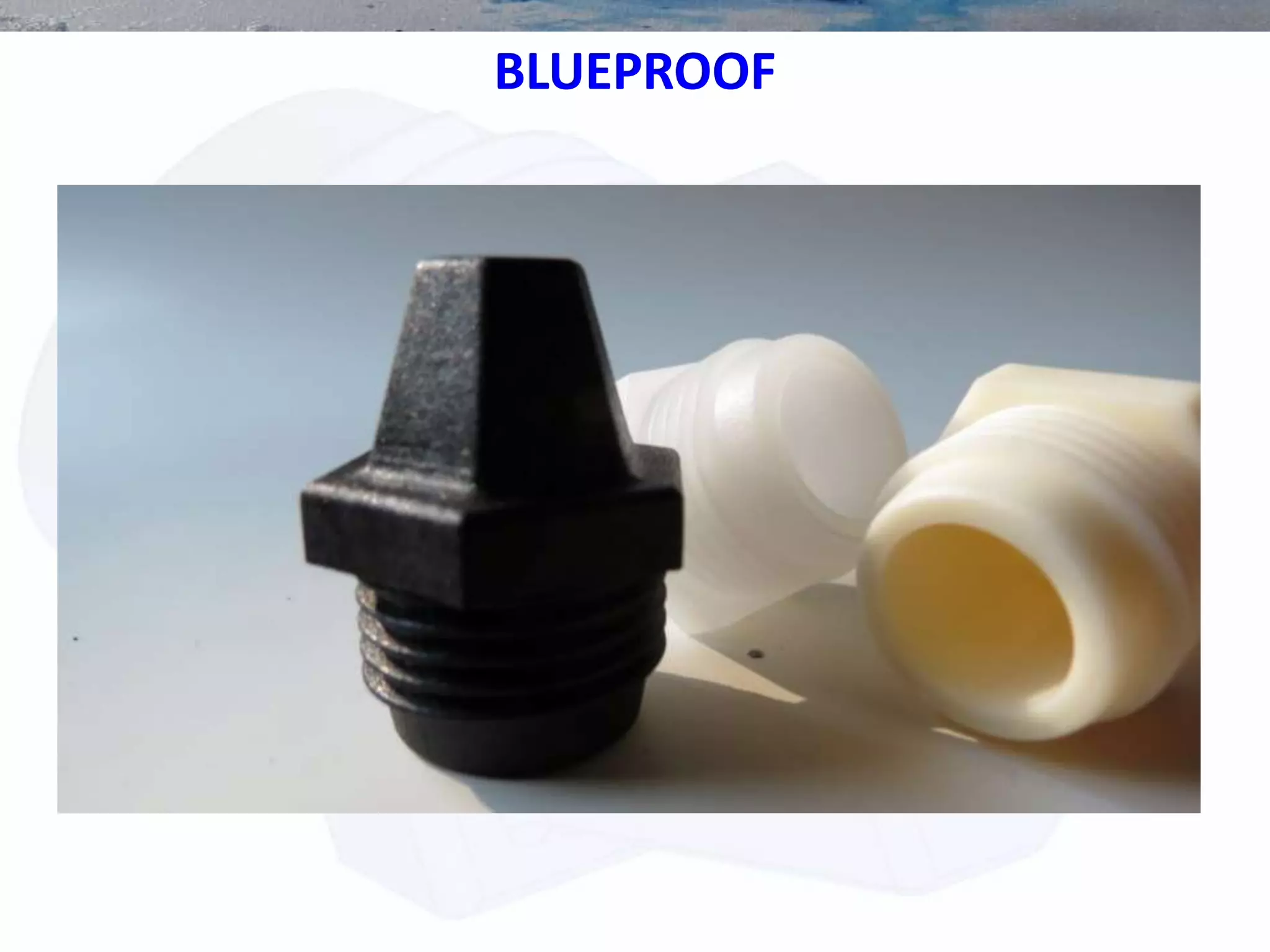
BLUEPROOF
Blueproof and Governors Island
This presentation precedes the overview of the Governors Island (GI)
experiments presented by Underwriters Laboratories (UL) and partially draws
from their GI presentation.
What UL will present is groundbreaking and is focused on protecting fire
crews. However the importance of these findings on structural design and its
influence on the home and the occupants in a fire cannot be ignored.
Bluerad are focused not just on the fire fighter in the front line but also the
public. New tactics will save fire fighters’ lives and I applaud that.
So, how can the other findings be implemented?
The first barrier we can implement quickly is Blueproof.
However, there is still a lot of work to be done on other aspects, some of
which this presentation will address.
• The GI experiments demonstrated that applying water directly into the
fire compartment, as soon as possible, resulted in the most effective
means of suppressing the fire
• This is not new and has been called by many names
– Blitz attack
– Resetting the fire
– Early water
– Transitional attack
Blueproof provides the method to achieve this
by already being present in the fire compartment
Blueproof and Governors Island
Blueproof Experiment Data
Blueproof has been proven to direct water onto the greatest heat source, where
and when it is needed the most.
An unpowered, self targeting, cost-effective fire suppression device that:
• dramatically reduces the temperatures throughout the structure
• helps to maintain oxygen levels within survivable limits, and reduces smoke
• protects fire fighters and occupants against flashover
• Starts to suppress the fire before the brigade receive the call.
• still requires input from the emergency services
• meets the requirements of the directive 2001/95/EC of the European
parliament and of the council of the 3 December 2001 on general product
safety
• Satisfies the requirements of As Low As Reasonably Practicable (ALARP)
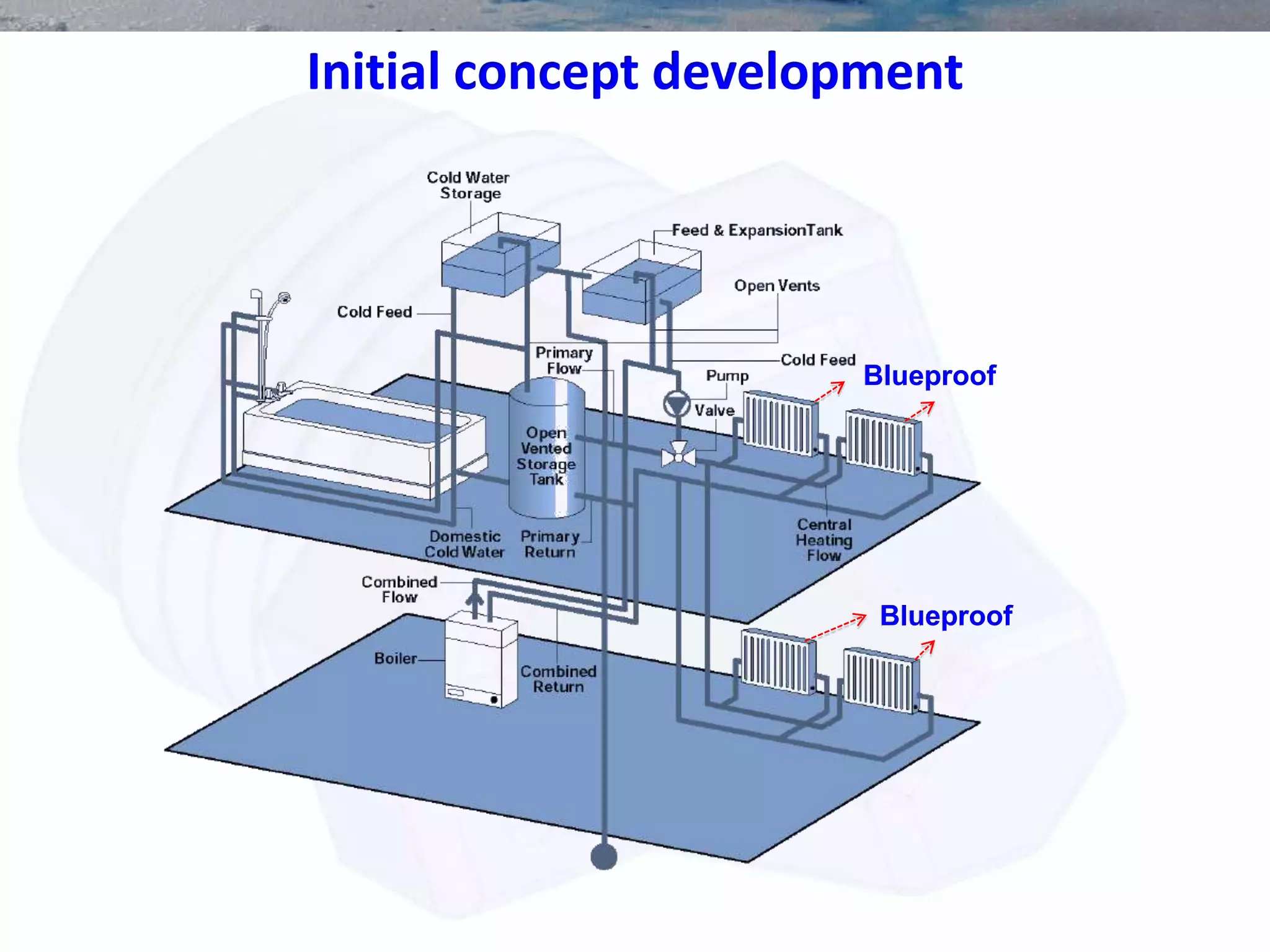
Initial concept development
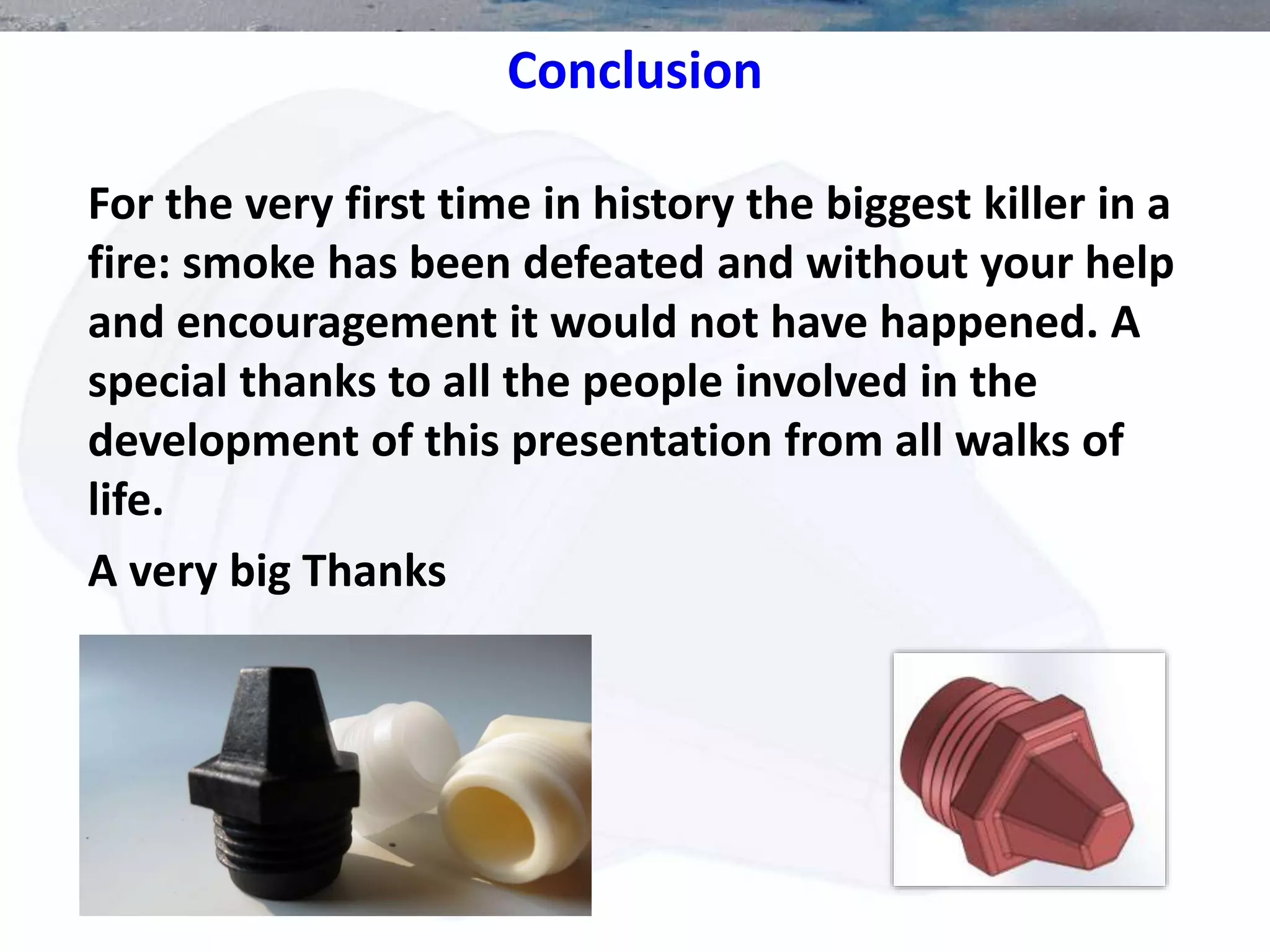
Blueproof
Blueproof
Initial Concept Development
• very little water has a massive effect on a fire[1]
• the amount of fluid in a heating panel gives twice the requirement to
suppress a fire in an average sized room [2]
• a high tech device can be used to release the fluid from the heating panel
• the device will meet the temperature and pressure requirements of a
household radiator under normal operating conditions (13 bar and 75 oC
operating and 85 oC max )[3]
[1] Ref: Essentials of Fire Fighting and Fire Department Operations 5th Edition correlated to the 2008 edition of NFPA
1001.
[2] Ref The Case For Space Royal Institute for British Architects 2011
[3] Ref. Din EN 442
From the initial observations based on science that have been the inspiration
to GI and Bluerad’s design team, we know:
Mode of Action
In a fire, the device releases the fluid in the heating panel into the room.
This happens when surface failure occurs along the lines of least resistance
[4] Spherulites embedded into a mosaic mesogen in the Maltese Cross pattern
The surface of Blueproof during
heat testing failing openWhy is this important?. Fluid flow and smoke
elimination.
Plastic Fails open in a Maltese Cross Pattern [4]
Surface design
We designed bursting discs, a form of Pressure Safety Valve (PSV)
designed to code [5]
[5] American Society of Mechanical Engineers (ASME)
A fire tested sample
displaying how the thinned
wall section formed a
nozzle
Thinned wall bursting disc
sections
Fire Testing
Tunnel Test experiments on Blueproof device
• confirmed activation time (avg. 44 seconds), way below the bench mark of
90 seconds for sprinkler in accordance to Code [6]
During full scale experiment with flame impingement [7]
• The device operated in all directions off five facets. It targeted the flames
This was unexpected as the device
targeted the flames 5 distinct
jets formed
[6] ASTM E84, NFPA 255, UL 723 and ULC S102
[7] ISO 5660-1-2002 Reaction to fire tests. Heat release, smoke production and mass loss rate. Part 1: Heat release
rate (Cone calorimeter method) International Organisation of standardization Geneva. 2002
Fire Testing
During full scale experiment without flame impingement [8]
• The device activated on the uppermost facet as the heat radiated down
from the ceiling
[8] ISO TC 021/SC 05 Fire Protection – Automatic Sprinkler Systems –
Part 13: Requirements and test methods for extended coverage sprinklers 14-06-2013
Integrity during fire
Did Blueproof melt?
• The air trapped at the top of the heating panel was forced through the
surface of the device during the Vicat (softening) phase
• Fluid passed through the device, it cooled and maintained its integrity.
• During full-scale fire experiments. Blueproofs retained their integrity as
shown below
All the above devices were subjected to direct flame impingement
on the test rig [7].
Device subjected to full
scale fire test displays
similar behaviour
Direct flame impingement
Typical spray patterns during activation
with flame impingement [7]
Heat flux equivalent to one upholstered chair. Enough energy to create flashover.
Temperature decay
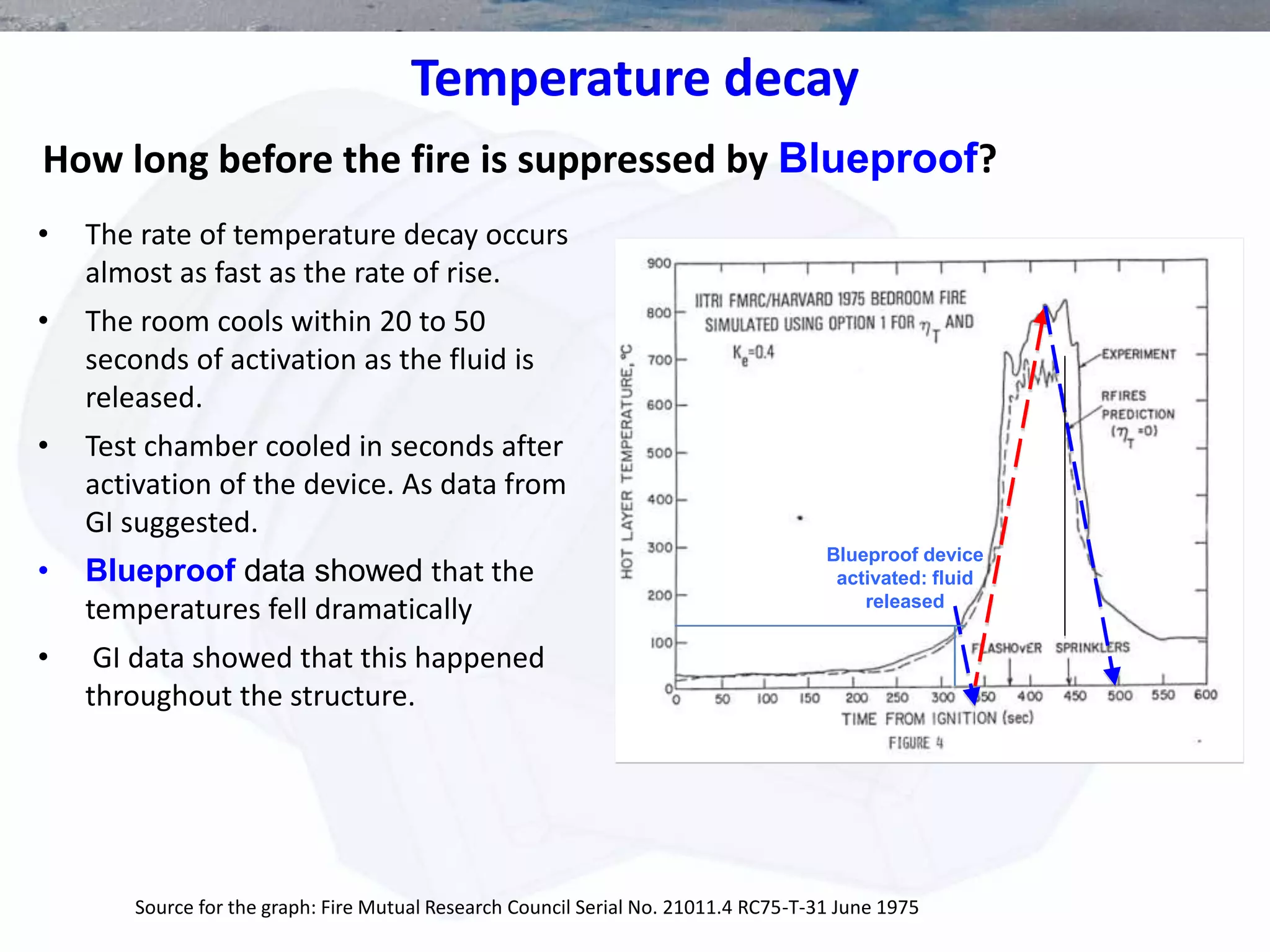
How long before the fire is suppressed by Blueproof?
• The rate of temperature decay occurs
almost as fast as the rate of rise.
• The room cools within 20 to 50
seconds of activation as the fluid is
released.
• Test chamber cooled in seconds after
activation of the device. As data from
GI suggested.
• Blueproof data showed that the
temperatures fell dramatically
• GI data showed that this happened
throughout the structure.
Source for the graph: Fire Mutual Research Council Serial No. 21011.4 RC75-T-31 June 1975
Blueproof device
activated: fluid
released
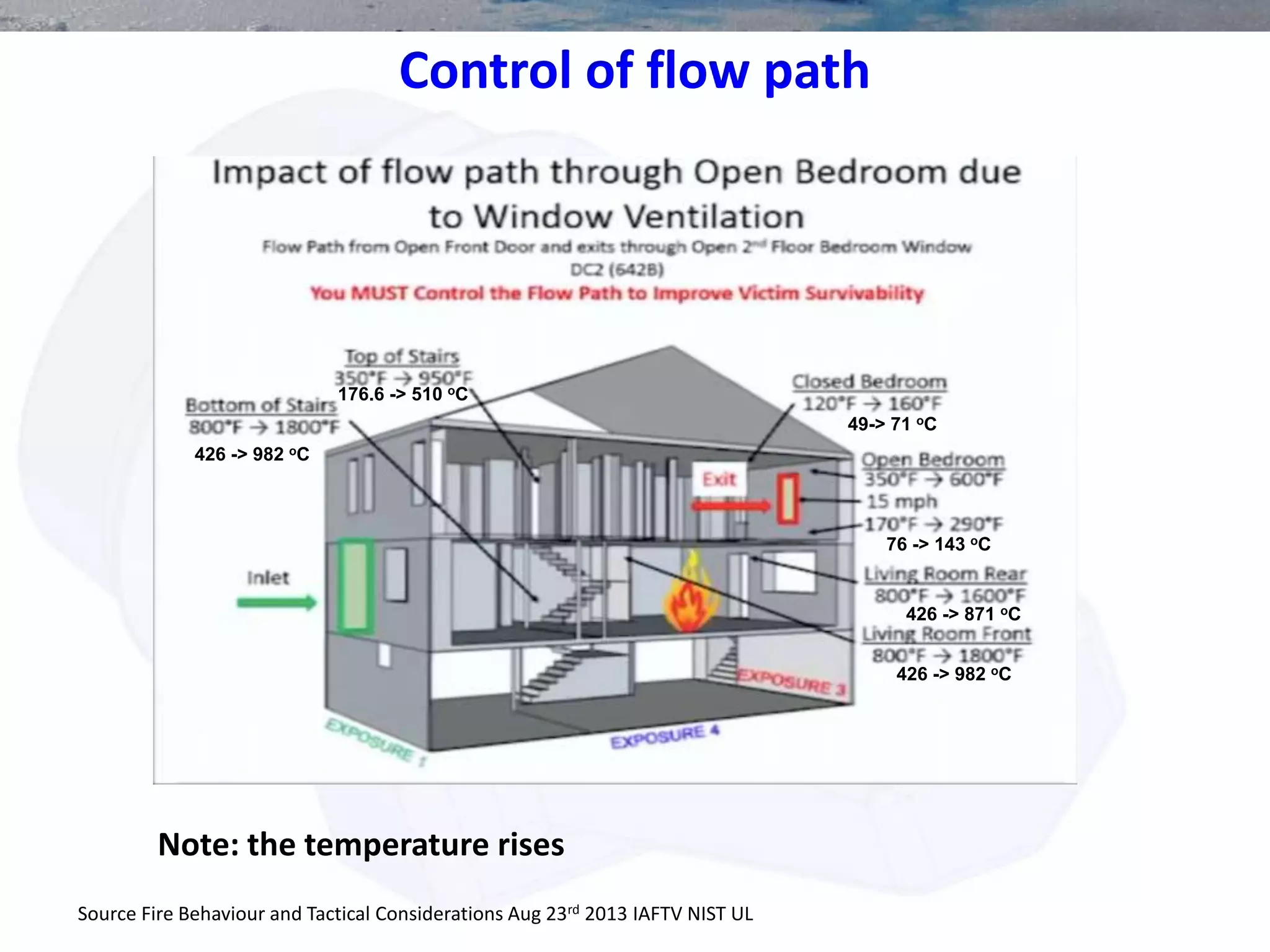
Control of flow path
176.6 -> 510 oC
426 -> 982 oC
49-> 71 oC
426 -> 982 oC
426 -> 871 oC
76 -> 143 oC
Source Fire Behaviour and Tactical Considerations Aug 23rd 2013 IAFTV NIST UL
Note: the temperature rises
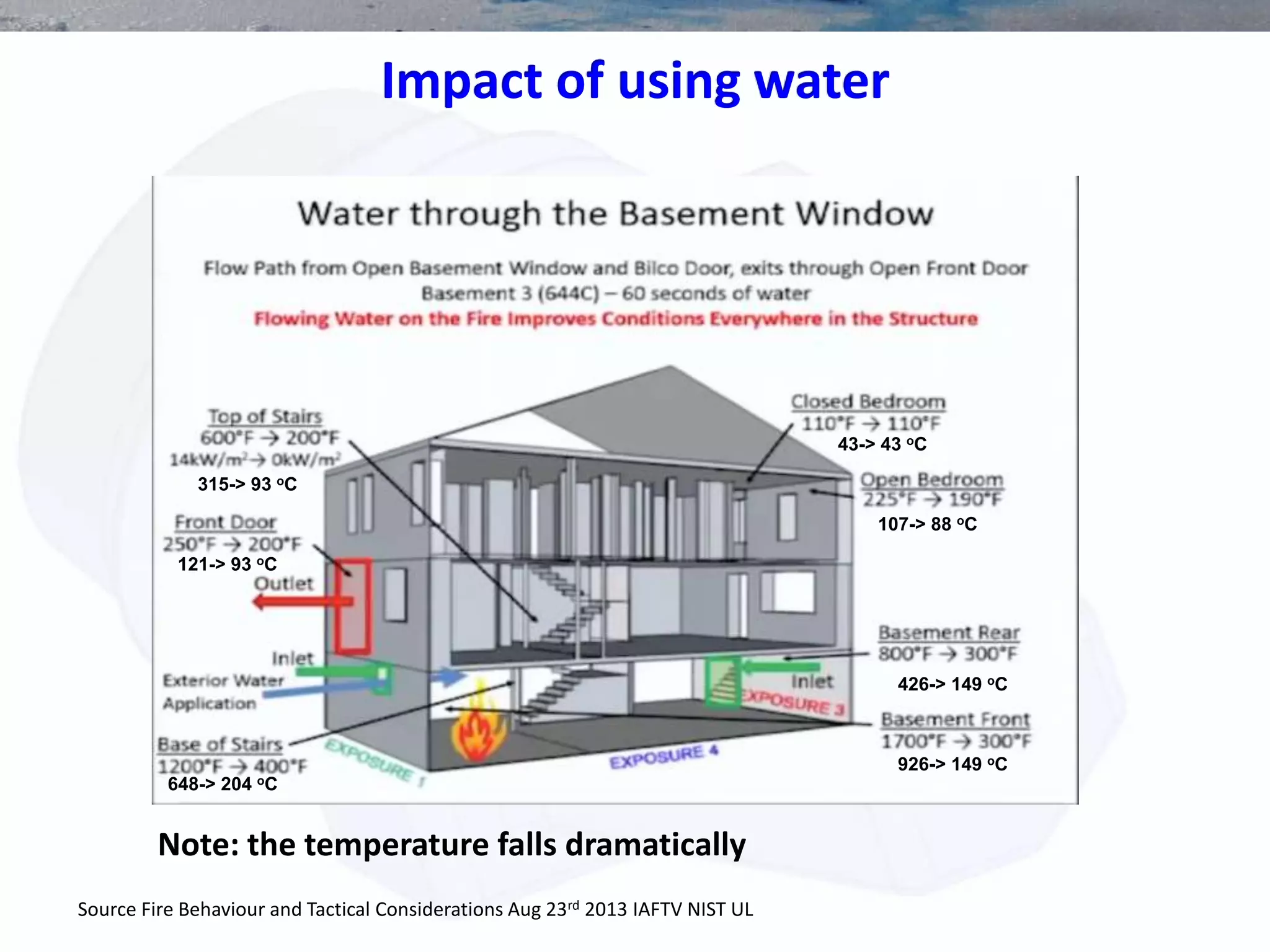
Impact of using water
Source Fire Behaviour and Tactical Considerations Aug 23rd 2013 IAFTV NIST UL
43-> 43 oC
107-> 88 oC
426-> 149 oC
926-> 149 oC
315-> 93 oC
121-> 93 oC
648-> 204 oC
Note: the temperature falls dramatically
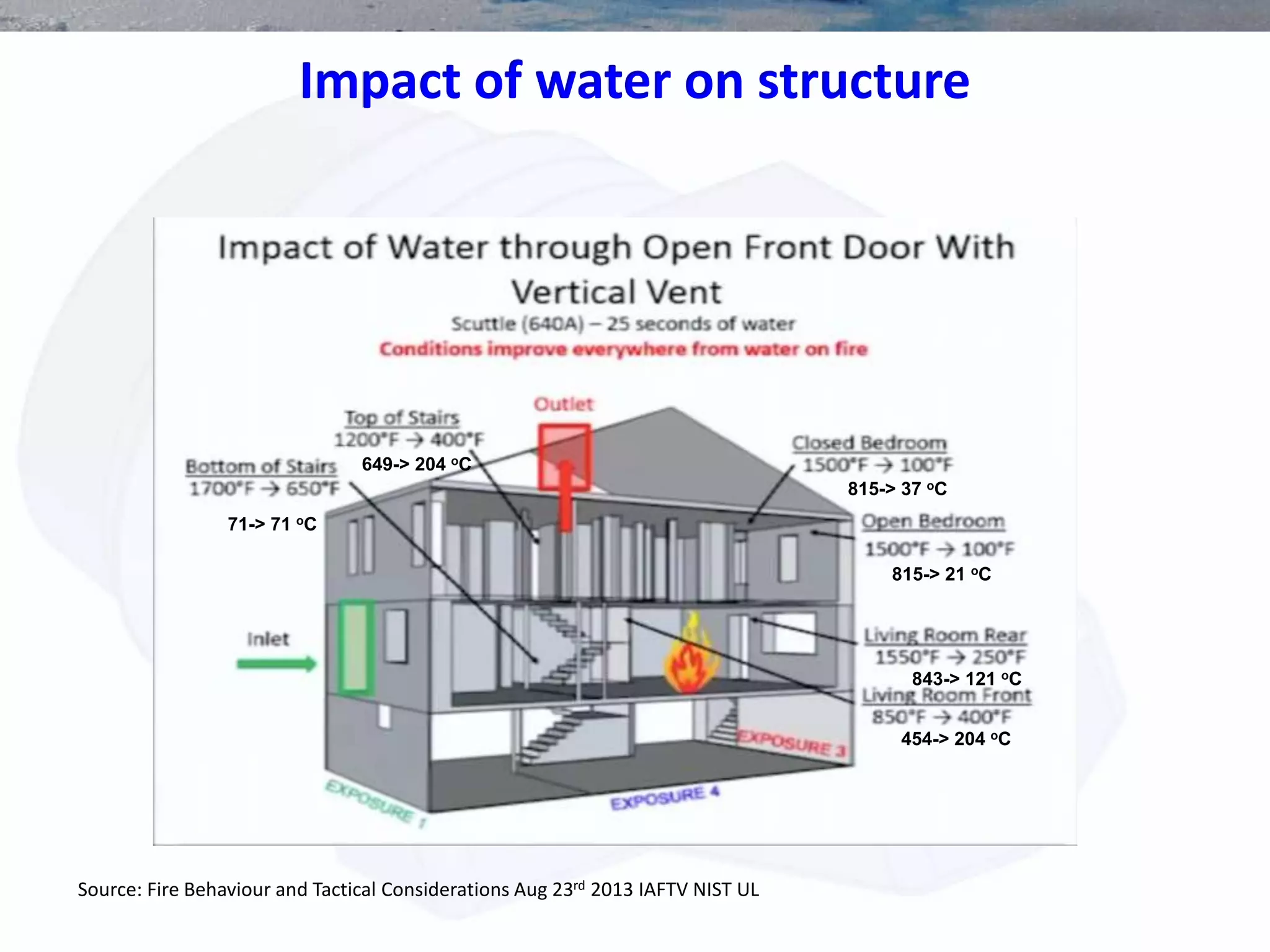
Impact of water on structure
Source: Fire Behaviour and Tactical Considerations Aug 23rd 2013 IAFTV NIST UL
815-> 37 oC
815-> 21 oC
843-> 121 oC
454-> 204 oC
649-> 204 oC
71-> 71 oC
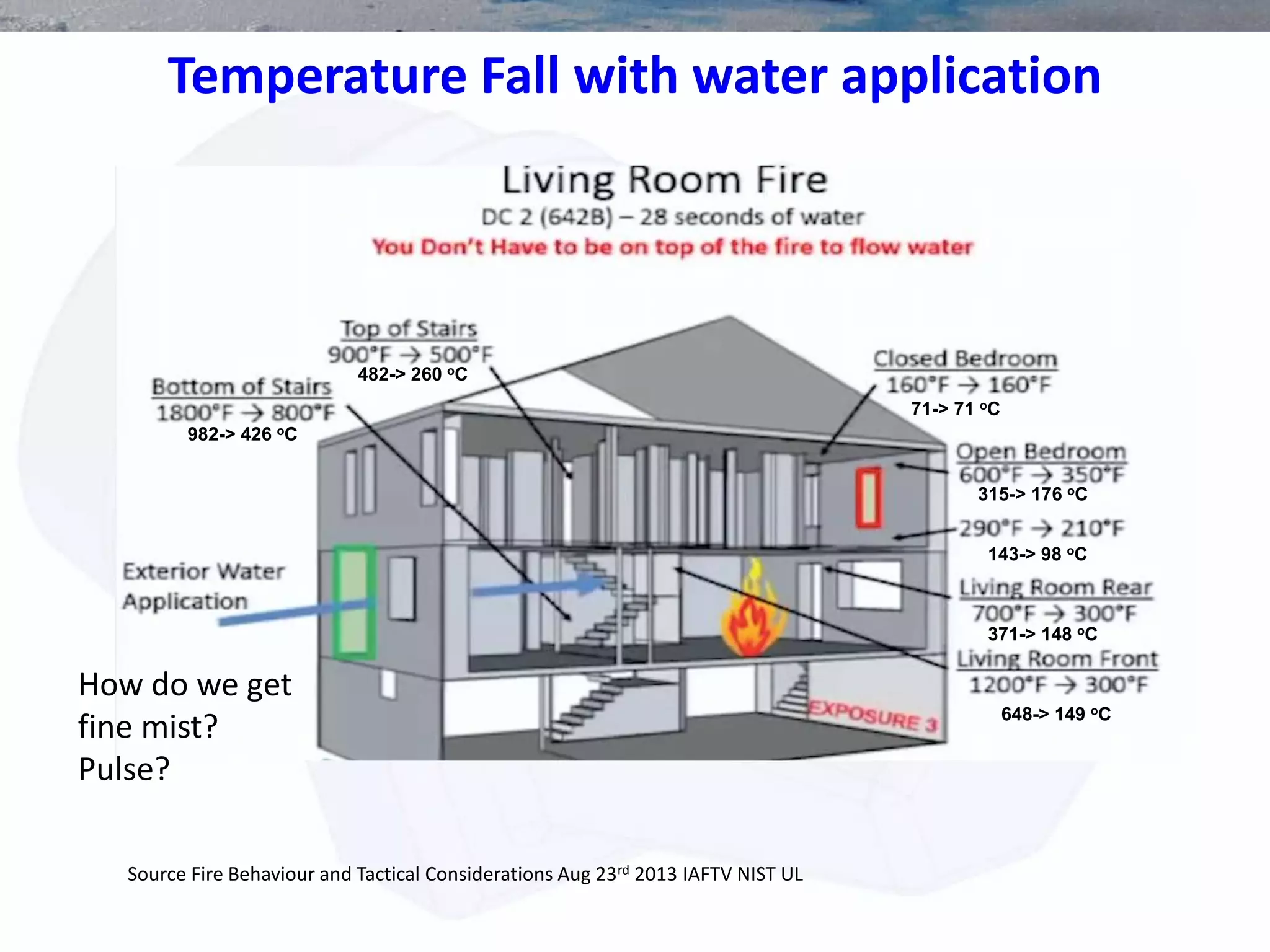
Temperature Fall with water application
Source Fire Behaviour and Tactical Considerations Aug 23rd 2013 IAFTV NIST UL
982-> 426 oC
482-> 260 oC
71-> 71 oC
315-> 176 oC
143-> 98 oC
371-> 148 oC
648-> 149 oC
How do we get
fine mist?
Pulse?
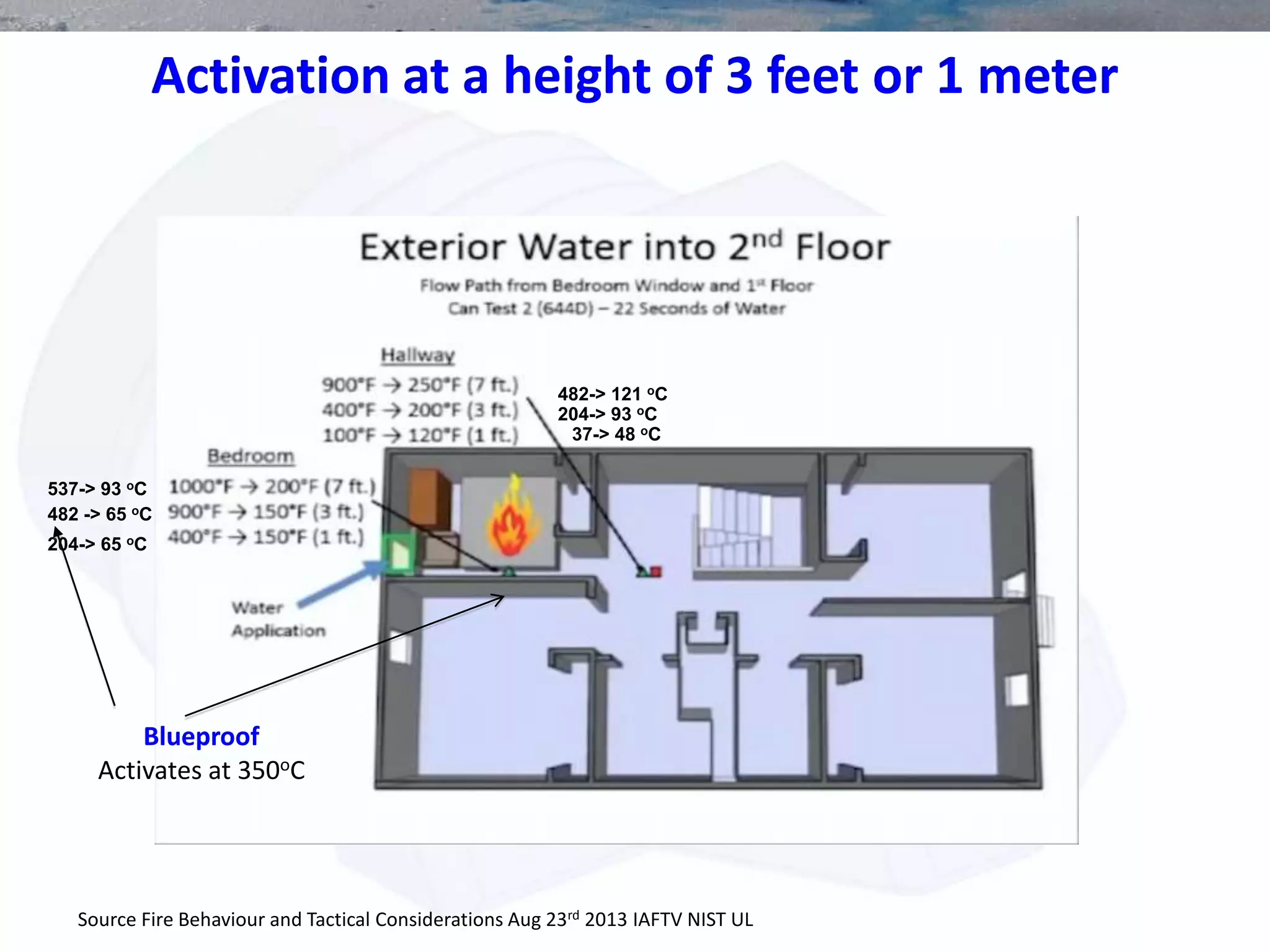
Activation at a height of 3 feet or 1 meter
Source Fire Behaviour and Tactical Considerations Aug 23rd 2013 IAFTV NIST UL
204-> 93 oC
37-> 48 oC
482-> 121 oC
204-> 65 oC
482 -> 65 oC
537-> 93 oC
Blueproof
Activates at 350oC
Blueproof full scale fire experiment
Accelerant added Fire started Fire suppressed by 5 distinct streams
created during experiment
Crib to ISO [8]
Blueproof head location
As per ISO [8] for a sidewall
mounted sprinkler head
Pressure incresed in heating
panel from 1.5 to over 9 bars
in seconds
Blueproof full scale fire experiment
• Temperatures fell by hundreds of degrees. The device self-targeted the
highest heat source and temperatures were suppressed within a few
minutes. There was minimal delay between fire onset and attack.
• Suppressing fire lessens oxygen depletion, improving the likelihood of
occupant survival.
• When fire fighters arrive they would enter a better controlled climate, in
which oxygen levels have stabilized and the whole structure is cooling.
• Blueproof attacks the fire locally not remotely. A fire crew making an
exterior water application has limitations to how and where they can
direct the hose stream because of obstacles.
• In the final Blueproof full scale fire experiment the layer of gases at the
ceiling was almost invisible. The instruments demonstrated the
temperature profile. The water blasting from the radiator at the ceiling
into the gases indicated that the radiated heat from those gases had
activated the device.
Water usage
Blueproof creates a cyclonic fog pattern. It does not entrain air to feed the fire
during interruption to flow. This contrasts with a fire fighter who may break
contact with the target due to manual handling errors and hence entrain air
when using a hose remotely.
Typical Blueproof
fog pattern at 3.5 bar [7]
In the full-scale fire
experiments
the pressure in the
heating panel increased to
over 9 bar in seconds and
forced the water from
the panel [8]
Cooling the gas layer
The cooling of the hot gas layer directly at the ceiling is significant.
This reduces the risk of flashover. It performs an action that has to be undertaken
by a fire fighter prior to room entry.
By spraying water into ceiling gases from below, Blueproof reduces the risk to the
fire fighter entering the structure to effect an attack and rescue.
If occupants open a door, it lessens the risk of them being struck by a wall of
flame during escape and evacuation.
But why is this so important?
Hydrocarbon gases go through phases. It is raw gases in a fire that are the most
dangerous form and are highly unpredictable. They do not gather at the ceiling in
one area they plume.
They go through tolerable limits. lower explosive limit (LEL) and upper explosive
limits (UEL). Between the LEL and the UEL they ignite.
We calibrate smoke alarms and gas detectors to react within a percentage of
these limits.
Migration of the gas layer
We have to stop the migration. This is so important as found in the gas industry.
On confirmed fire a zone is isolated. All ESDVs close, the systems de pressurize, HVAC
systems shut down and fire dampers close.
The same unprocessed raw hydrocarbon gases are produced in a house fire. But in the
home it is unrealistic to effect the isolation however, the threat remains the same.
Why isolate? The gases have had time to penetrate the electrical fittings and ignite.
Currently there is no form of fire trap between floors in the home.
There is nothing between the pipe tracts or service tracts in homes. Rooms are not
compartmentalized and the fire can easily spread through the ceiling to the upper floors
and through the cupboards, as proven at Governors Island.
A typical kitchen contains enough alcohol, sugars and feedstock to warrant a fire safe
enclosure in industry. The extraction systems, coated in oil and grease with no isolation
provide a direct route into the ceiling void and easily ignite.
Blueproof will reduce the effects of the migration.
Rapid Pressure Rise
During experiments the radiator/heating panel that Blueproof was attached to
absorbed the heat so quickly that its internal pressure increased, from 1.5 bar
to over 9 bar in seconds. This added pressure propelled the water into the
ceiling gases. This behaviour is called ‘Blocked in pressure’ and it is one of the
key questions used during a Hazards and Operability study (HAZOP).
It is one of the key factors to be address during the reverse flow and pressure
rise section of the HAZOP study.
The HAZOP studies system design to establish the need for additional safety
measures, of which a Pressure Safety Valves (PSV’s), in the case of fire or
pressure rise or fall, is one example. The HAZOP is an industrial requirement
and in some EU country’s a legal requirement. Normally it follows the guidelines
of ISO 17776. Blueproof is a form of PSV.
A heating panel is designed to withstand 13 bar in accordance to EN 442. In the
full scale fire experiment with two cribs and a fully developed fire, Blueproof
activated at around 9 bar but the pressure in the panel continued to rise to 10
bar. This is a typical display of blocked in pressure behaviour.
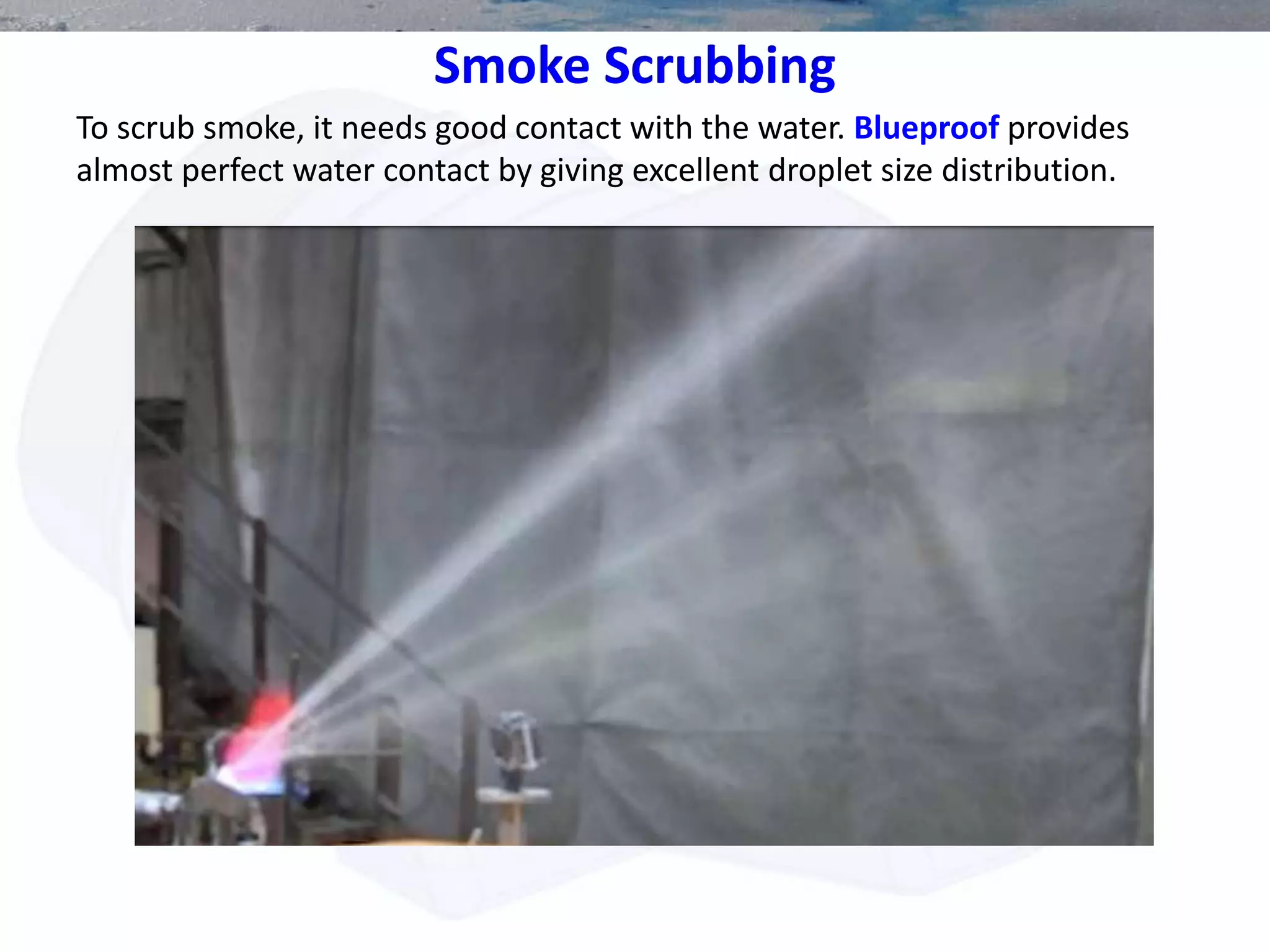
Smoke Scrubbing
To scrub smoke, it needs good contact with the water. Blueproof provides
almost perfect water contact by giving excellent droplet size distribution.
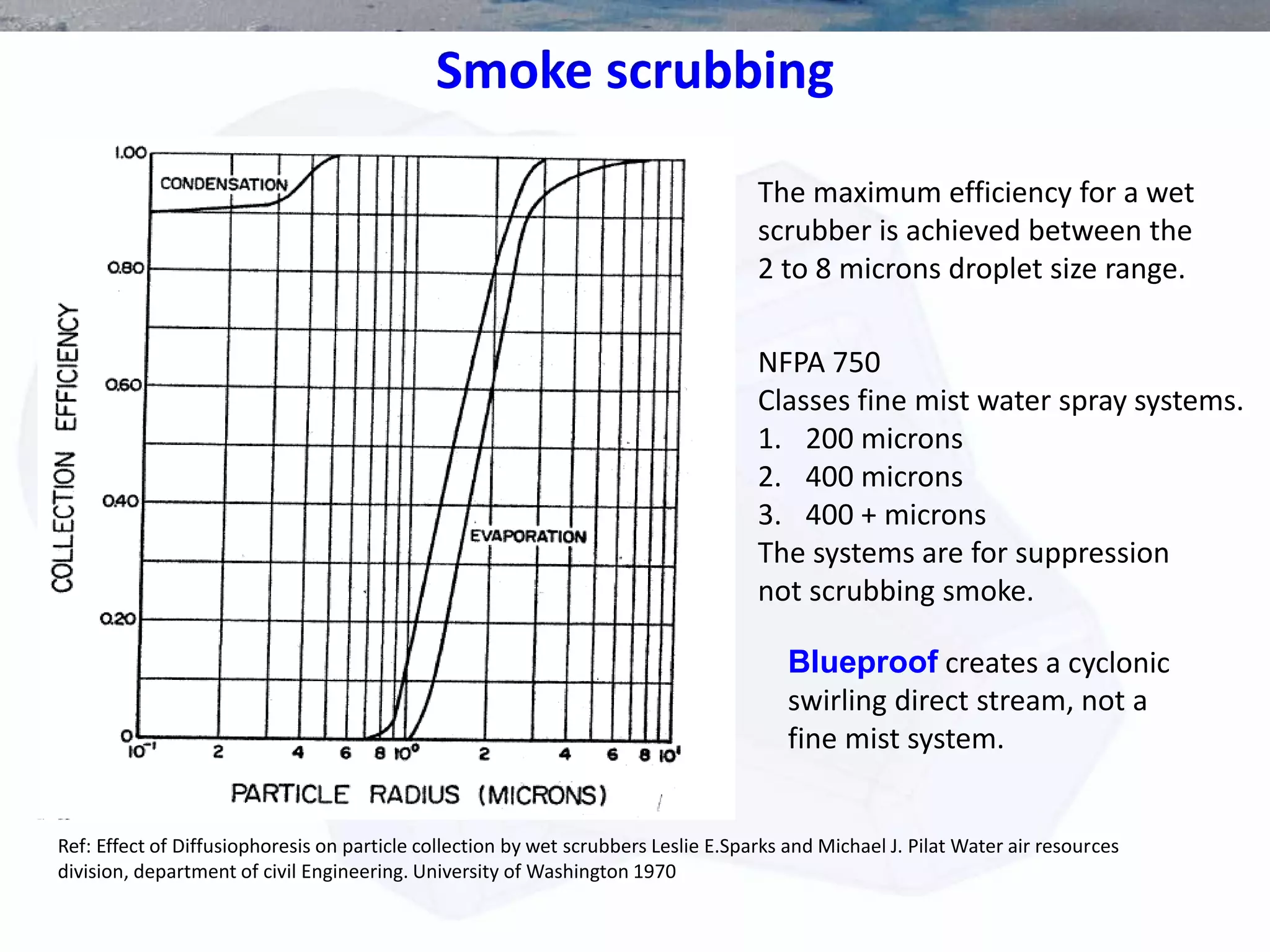
Smoke scrubbing
The maximum efficiency for a wet
scrubber is achieved between the
2 to 8 microns droplet size range.
Ref: Effect of Diffusiophoresis on particle collection by wet scrubbers Leslie E.Sparks and Michael J. Pilat Water air resources
division, department of civil Engineering. University of Washington 1970
NFPA 750
Classes fine mist water spray systems.
1. 200 microns
2. 400 microns
3. 400 + microns
The systems are for suppression
not scrubbing smoke.
Blueproof creates a cyclonic
swirling direct stream, not a
fine mist system.
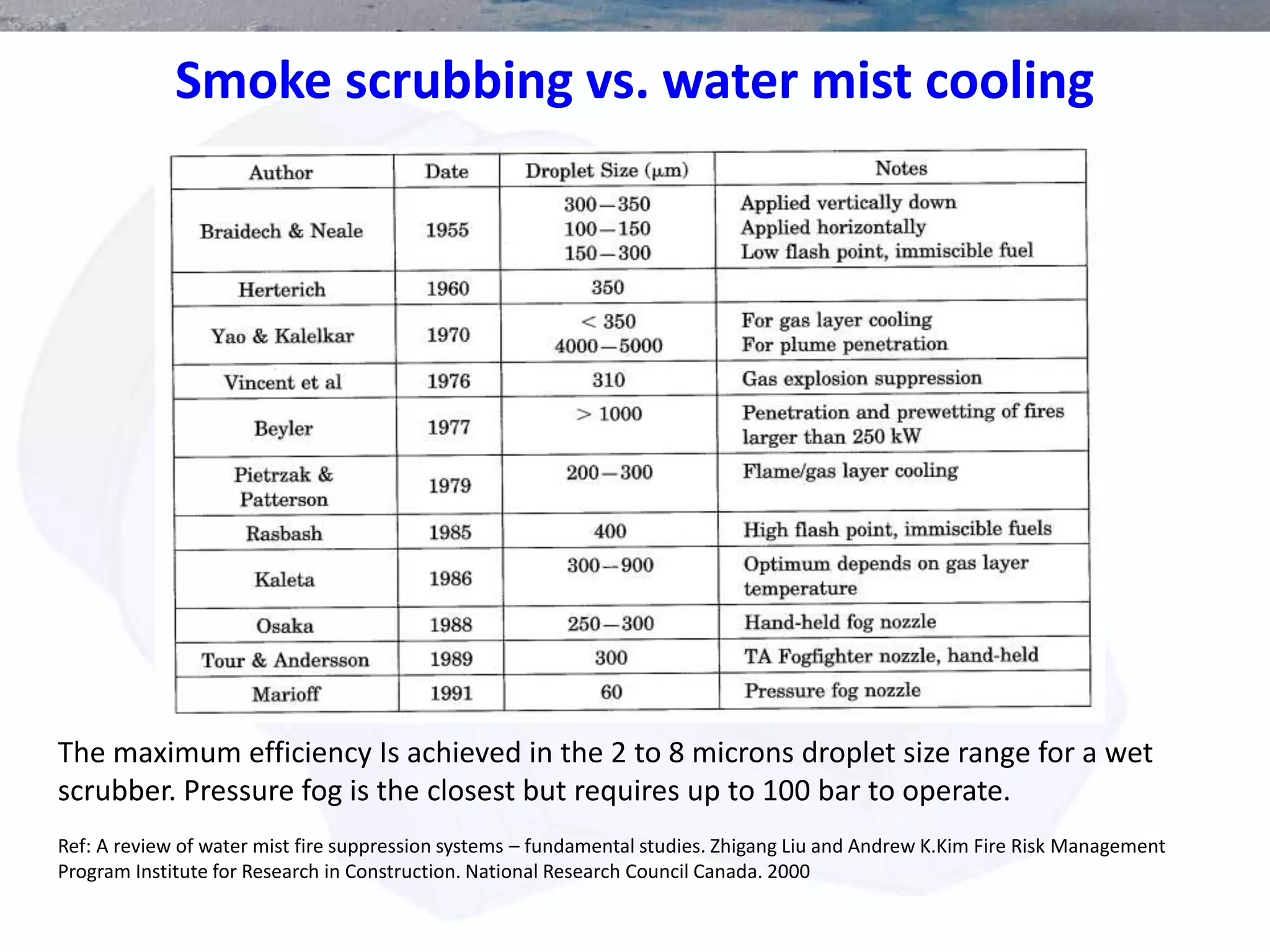
Smoke scrubbing vs. water mist cooling
The maximum efficiency Is achieved in the 2 to 8 microns droplet size range for a wet
scrubber. Pressure fog is the closest but requires up to 100 bar to operate.
Ref: A review of water mist fire suppression systems – fundamental studies. Zhigang Liu and Andrew K.Kim Fire Risk Management
Program Institute for Research in Construction. National Research Council Canada. 2000
Smoke scrubbing
Blueproof removed the smoke efficiently.
The device swirls the fluid flow and breaks up droplets by causing collisions.
This was shown in slide 8.
Cyclonic action and addition of steam produces a five fold increase in particulate removal.
99.9% smoke removal is possible using a steam venturi at 3.5 bar [8]
Blueproof by design is a venturi
The Venturi effect [9] is a jet effect; as with a funnel the velocity of the fluid increases as the
cross sectional area decreases, with the static pressure correspondingly decreasing.
According to the laws governing fluid dynamics, a fluid's velocity must increase as it passes
through a constriction to satisfy the principle of continuity,
Source: Spraying Systems Co
[8] Semrau et al , 1955.
[9] ‘The Venturi effect’ Wolfram Demonstrations Project.
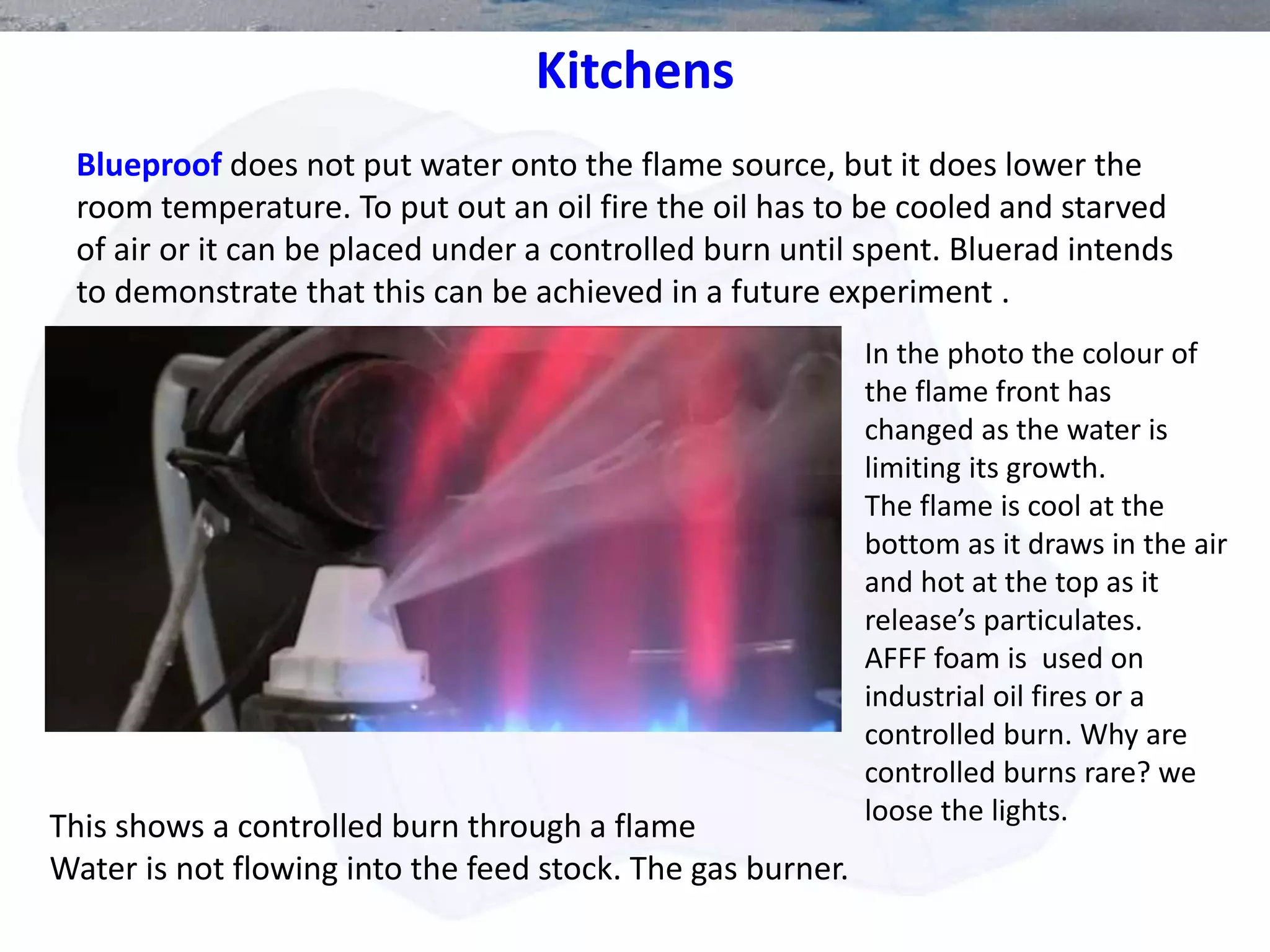
Blueproof does not put water onto the flame source, but it does lower the
room temperature. To put out an oil fire the oil has to be cooled and starved
of air or it can be placed under a controlled burn until spent. Bluerad intends
to demonstrate that this can be achieved in a future experiment .
This shows a controlled burn through a flame
Water is not flowing into the feed stock. The gas burner.
In the photo the colour of
the flame front has
changed as the water is
limiting its growth.
The flame is cool at the
bottom as it draws in the air
and hot at the top as it
release’s particulates.
AFFF foam is used on
industrial oil fires or a
controlled burn. Why are
controlled burns rare? we
loose the lights.
Kitchens
Kitchens
What GI proved is that kitchen fires do not follow the expected path.
In industry it is mandatory in kitchens :-
• to stop water hitting deep fat fryers.
• automatically isolate the HVAC systems.
and normally the area is totally flooded. Sprinklers are shielded. Extraction
systems have CO2 flooding.
In the home, fire blanket use is recommended to smother a pan fire.
However, oil has to be cooled to prevent re-ignition, and we do not shut in
cooker hood extraction systems.
With Blueproof a controlled burn can be undertaken. Loss of lights is not
important as the environmental and cost impact is negligible. In comparison to
to the likes of Dhahran and Zelten.
High Rise
GI and Bluerad experiments showed common results for fires in structures. UL
experimented in a 4 storey house and Bluerad in a fire test chamber. However
apartment blocks are common throughout Europe.
But how do our findings apply to high rise? UL experimented on separate floors.
The findings have not been applied to high rise.
Exterior fire attack & Flashover
• The final full scale experiment involved increased ventilation to the test
chamber.
• The fuel load in the test chamber had been doubled to ensure flashover
conditions.
• Flash over did not occur
Impact on building occupants
• Fire suppression from the interior at the onset with Blueproof massively
increases the potential survival time! Oxygen levels stabilized above
breathable limits!
• Smoke concentration falls as the oxygen concentrations stabilize.
• Potential survival times need to be determined
• Unfortunately smoldering has not been studied to the same extent as
flaming and there is a lack of quantitative guidelines [10]
• During a smoldering fire the device will activate. The time taken for this
needs to be determined as it can take between 22 and 306 minutes for a
bed to flame [11]
[11 ] V.Babrauskas and J.Kransky, ‘Upholstered Furniture Transition from Smoldering to
Flaming’ Journal of Forensic Science, Nov. pp 1029-1031 (1997)
[10 ] Section Two, Chapter 9, Smoldering Combustion, T.J. Ohlemiller Fire Dynamics
Conclusion
For the very first time in history the biggest killer in a
fire: smoke has been defeated and without your help
and encouragement it would not have happened. A
special thanks to all the people involved in the
development of this presentation from all walks of
life.
A very big Thanks

Blueproof Update to FEU May 2014

  • 1.
    David Atkinson BSc.Chem. Eng. Technical Director Westport, Ireland May 2014 BLUERAD LTD
  • 2.
  • 3.
    Blueproof and GovernorsIsland This presentation precedes the overview of the Governors Island (GI) experiments presented by Underwriters Laboratories (UL) and partially draws from their GI presentation. What UL will present is groundbreaking and is focused on protecting fire crews. However the importance of these findings on structural design and its influence on the home and the occupants in a fire cannot be ignored. Bluerad are focused not just on the fire fighter in the front line but also the public. New tactics will save fire fighters’ lives and I applaud that. So, how can the other findings be implemented? The first barrier we can implement quickly is Blueproof. However, there is still a lot of work to be done on other aspects, some of which this presentation will address.
  • 4.
    • The GIexperiments demonstrated that applying water directly into the fire compartment, as soon as possible, resulted in the most effective means of suppressing the fire • This is not new and has been called by many names – Blitz attack – Resetting the fire – Early water – Transitional attack Blueproof provides the method to achieve this by already being present in the fire compartment Blueproof and Governors Island
  • 5.
    Blueproof Experiment Data Blueproofhas been proven to direct water onto the greatest heat source, where and when it is needed the most. An unpowered, self targeting, cost-effective fire suppression device that: • dramatically reduces the temperatures throughout the structure • helps to maintain oxygen levels within survivable limits, and reduces smoke • protects fire fighters and occupants against flashover • Starts to suppress the fire before the brigade receive the call. • still requires input from the emergency services • meets the requirements of the directive 2001/95/EC of the European parliament and of the council of the 3 December 2001 on general product safety • Satisfies the requirements of As Low As Reasonably Practicable (ALARP)
  • 6.
  • 7.
    Initial Concept Development •very little water has a massive effect on a fire[1] • the amount of fluid in a heating panel gives twice the requirement to suppress a fire in an average sized room [2] • a high tech device can be used to release the fluid from the heating panel • the device will meet the temperature and pressure requirements of a household radiator under normal operating conditions (13 bar and 75 oC operating and 85 oC max )[3] [1] Ref: Essentials of Fire Fighting and Fire Department Operations 5th Edition correlated to the 2008 edition of NFPA 1001. [2] Ref The Case For Space Royal Institute for British Architects 2011 [3] Ref. Din EN 442 From the initial observations based on science that have been the inspiration to GI and Bluerad’s design team, we know:
  • 8.
    Mode of Action Ina fire, the device releases the fluid in the heating panel into the room. This happens when surface failure occurs along the lines of least resistance [4] Spherulites embedded into a mosaic mesogen in the Maltese Cross pattern The surface of Blueproof during heat testing failing openWhy is this important?. Fluid flow and smoke elimination. Plastic Fails open in a Maltese Cross Pattern [4]
  • 9.
    Surface design We designedbursting discs, a form of Pressure Safety Valve (PSV) designed to code [5] [5] American Society of Mechanical Engineers (ASME) A fire tested sample displaying how the thinned wall section formed a nozzle Thinned wall bursting disc sections
  • 10.
    Fire Testing Tunnel Testexperiments on Blueproof device • confirmed activation time (avg. 44 seconds), way below the bench mark of 90 seconds for sprinkler in accordance to Code [6] During full scale experiment with flame impingement [7] • The device operated in all directions off five facets. It targeted the flames This was unexpected as the device targeted the flames 5 distinct jets formed [6] ASTM E84, NFPA 255, UL 723 and ULC S102 [7] ISO 5660-1-2002 Reaction to fire tests. Heat release, smoke production and mass loss rate. Part 1: Heat release rate (Cone calorimeter method) International Organisation of standardization Geneva. 2002
  • 11.
    Fire Testing During fullscale experiment without flame impingement [8] • The device activated on the uppermost facet as the heat radiated down from the ceiling [8] ISO TC 021/SC 05 Fire Protection – Automatic Sprinkler Systems – Part 13: Requirements and test methods for extended coverage sprinklers 14-06-2013
  • 12.
    Integrity during fire DidBlueproof melt? • The air trapped at the top of the heating panel was forced through the surface of the device during the Vicat (softening) phase • Fluid passed through the device, it cooled and maintained its integrity. • During full-scale fire experiments. Blueproofs retained their integrity as shown below All the above devices were subjected to direct flame impingement on the test rig [7]. Device subjected to full scale fire test displays similar behaviour
  • 13.
    Direct flame impingement Typicalspray patterns during activation with flame impingement [7] Heat flux equivalent to one upholstered chair. Enough energy to create flashover.
  • 14.
    Temperature decay How longbefore the fire is suppressed by Blueproof? • The rate of temperature decay occurs almost as fast as the rate of rise. • The room cools within 20 to 50 seconds of activation as the fluid is released. • Test chamber cooled in seconds after activation of the device. As data from GI suggested. • Blueproof data showed that the temperatures fell dramatically • GI data showed that this happened throughout the structure. Source for the graph: Fire Mutual Research Council Serial No. 21011.4 RC75-T-31 June 1975 Blueproof device activated: fluid released
  • 15.
    Control of flowpath 176.6 -> 510 oC 426 -> 982 oC 49-> 71 oC 426 -> 982 oC 426 -> 871 oC 76 -> 143 oC Source Fire Behaviour and Tactical Considerations Aug 23rd 2013 IAFTV NIST UL Note: the temperature rises
  • 16.
    Impact of usingwater Source Fire Behaviour and Tactical Considerations Aug 23rd 2013 IAFTV NIST UL 43-> 43 oC 107-> 88 oC 426-> 149 oC 926-> 149 oC 315-> 93 oC 121-> 93 oC 648-> 204 oC Note: the temperature falls dramatically
  • 17.
    Impact of wateron structure Source: Fire Behaviour and Tactical Considerations Aug 23rd 2013 IAFTV NIST UL 815-> 37 oC 815-> 21 oC 843-> 121 oC 454-> 204 oC 649-> 204 oC 71-> 71 oC
  • 18.
    Temperature Fall withwater application Source Fire Behaviour and Tactical Considerations Aug 23rd 2013 IAFTV NIST UL 982-> 426 oC 482-> 260 oC 71-> 71 oC 315-> 176 oC 143-> 98 oC 371-> 148 oC 648-> 149 oC How do we get fine mist? Pulse?
  • 19.
    Activation at aheight of 3 feet or 1 meter Source Fire Behaviour and Tactical Considerations Aug 23rd 2013 IAFTV NIST UL 204-> 93 oC 37-> 48 oC 482-> 121 oC 204-> 65 oC 482 -> 65 oC 537-> 93 oC Blueproof Activates at 350oC
  • 20.
    Blueproof full scalefire experiment Accelerant added Fire started Fire suppressed by 5 distinct streams created during experiment Crib to ISO [8] Blueproof head location As per ISO [8] for a sidewall mounted sprinkler head Pressure incresed in heating panel from 1.5 to over 9 bars in seconds
  • 21.
    Blueproof full scalefire experiment • Temperatures fell by hundreds of degrees. The device self-targeted the highest heat source and temperatures were suppressed within a few minutes. There was minimal delay between fire onset and attack. • Suppressing fire lessens oxygen depletion, improving the likelihood of occupant survival. • When fire fighters arrive they would enter a better controlled climate, in which oxygen levels have stabilized and the whole structure is cooling. • Blueproof attacks the fire locally not remotely. A fire crew making an exterior water application has limitations to how and where they can direct the hose stream because of obstacles. • In the final Blueproof full scale fire experiment the layer of gases at the ceiling was almost invisible. The instruments demonstrated the temperature profile. The water blasting from the radiator at the ceiling into the gases indicated that the radiated heat from those gases had activated the device.
  • 22.
    Water usage Blueproof createsa cyclonic fog pattern. It does not entrain air to feed the fire during interruption to flow. This contrasts with a fire fighter who may break contact with the target due to manual handling errors and hence entrain air when using a hose remotely. Typical Blueproof fog pattern at 3.5 bar [7] In the full-scale fire experiments the pressure in the heating panel increased to over 9 bar in seconds and forced the water from the panel [8]
  • 23.
    Cooling the gaslayer The cooling of the hot gas layer directly at the ceiling is significant. This reduces the risk of flashover. It performs an action that has to be undertaken by a fire fighter prior to room entry. By spraying water into ceiling gases from below, Blueproof reduces the risk to the fire fighter entering the structure to effect an attack and rescue. If occupants open a door, it lessens the risk of them being struck by a wall of flame during escape and evacuation. But why is this so important? Hydrocarbon gases go through phases. It is raw gases in a fire that are the most dangerous form and are highly unpredictable. They do not gather at the ceiling in one area they plume. They go through tolerable limits. lower explosive limit (LEL) and upper explosive limits (UEL). Between the LEL and the UEL they ignite. We calibrate smoke alarms and gas detectors to react within a percentage of these limits.
  • 24.
    Migration of thegas layer We have to stop the migration. This is so important as found in the gas industry. On confirmed fire a zone is isolated. All ESDVs close, the systems de pressurize, HVAC systems shut down and fire dampers close. The same unprocessed raw hydrocarbon gases are produced in a house fire. But in the home it is unrealistic to effect the isolation however, the threat remains the same. Why isolate? The gases have had time to penetrate the electrical fittings and ignite. Currently there is no form of fire trap between floors in the home. There is nothing between the pipe tracts or service tracts in homes. Rooms are not compartmentalized and the fire can easily spread through the ceiling to the upper floors and through the cupboards, as proven at Governors Island. A typical kitchen contains enough alcohol, sugars and feedstock to warrant a fire safe enclosure in industry. The extraction systems, coated in oil and grease with no isolation provide a direct route into the ceiling void and easily ignite. Blueproof will reduce the effects of the migration.
  • 25.
    Rapid Pressure Rise Duringexperiments the radiator/heating panel that Blueproof was attached to absorbed the heat so quickly that its internal pressure increased, from 1.5 bar to over 9 bar in seconds. This added pressure propelled the water into the ceiling gases. This behaviour is called ‘Blocked in pressure’ and it is one of the key questions used during a Hazards and Operability study (HAZOP). It is one of the key factors to be address during the reverse flow and pressure rise section of the HAZOP study. The HAZOP studies system design to establish the need for additional safety measures, of which a Pressure Safety Valves (PSV’s), in the case of fire or pressure rise or fall, is one example. The HAZOP is an industrial requirement and in some EU country’s a legal requirement. Normally it follows the guidelines of ISO 17776. Blueproof is a form of PSV. A heating panel is designed to withstand 13 bar in accordance to EN 442. In the full scale fire experiment with two cribs and a fully developed fire, Blueproof activated at around 9 bar but the pressure in the panel continued to rise to 10 bar. This is a typical display of blocked in pressure behaviour.
  • 26.
    Smoke Scrubbing To scrubsmoke, it needs good contact with the water. Blueproof provides almost perfect water contact by giving excellent droplet size distribution.
  • 27.
    Smoke scrubbing The maximumefficiency for a wet scrubber is achieved between the 2 to 8 microns droplet size range. Ref: Effect of Diffusiophoresis on particle collection by wet scrubbers Leslie E.Sparks and Michael J. Pilat Water air resources division, department of civil Engineering. University of Washington 1970 NFPA 750 Classes fine mist water spray systems. 1. 200 microns 2. 400 microns 3. 400 + microns The systems are for suppression not scrubbing smoke. Blueproof creates a cyclonic swirling direct stream, not a fine mist system.
  • 28.
    Smoke scrubbing vs.water mist cooling The maximum efficiency Is achieved in the 2 to 8 microns droplet size range for a wet scrubber. Pressure fog is the closest but requires up to 100 bar to operate. Ref: A review of water mist fire suppression systems – fundamental studies. Zhigang Liu and Andrew K.Kim Fire Risk Management Program Institute for Research in Construction. National Research Council Canada. 2000
  • 29.
    Smoke scrubbing Blueproof removedthe smoke efficiently. The device swirls the fluid flow and breaks up droplets by causing collisions. This was shown in slide 8. Cyclonic action and addition of steam produces a five fold increase in particulate removal. 99.9% smoke removal is possible using a steam venturi at 3.5 bar [8] Blueproof by design is a venturi The Venturi effect [9] is a jet effect; as with a funnel the velocity of the fluid increases as the cross sectional area decreases, with the static pressure correspondingly decreasing. According to the laws governing fluid dynamics, a fluid's velocity must increase as it passes through a constriction to satisfy the principle of continuity, Source: Spraying Systems Co [8] Semrau et al , 1955. [9] ‘The Venturi effect’ Wolfram Demonstrations Project.
  • 30.
    Blueproof does notput water onto the flame source, but it does lower the room temperature. To put out an oil fire the oil has to be cooled and starved of air or it can be placed under a controlled burn until spent. Bluerad intends to demonstrate that this can be achieved in a future experiment . This shows a controlled burn through a flame Water is not flowing into the feed stock. The gas burner. In the photo the colour of the flame front has changed as the water is limiting its growth. The flame is cool at the bottom as it draws in the air and hot at the top as it release’s particulates. AFFF foam is used on industrial oil fires or a controlled burn. Why are controlled burns rare? we loose the lights. Kitchens
  • 31.
    Kitchens What GI provedis that kitchen fires do not follow the expected path. In industry it is mandatory in kitchens :- • to stop water hitting deep fat fryers. • automatically isolate the HVAC systems. and normally the area is totally flooded. Sprinklers are shielded. Extraction systems have CO2 flooding. In the home, fire blanket use is recommended to smother a pan fire. However, oil has to be cooled to prevent re-ignition, and we do not shut in cooker hood extraction systems. With Blueproof a controlled burn can be undertaken. Loss of lights is not important as the environmental and cost impact is negligible. In comparison to to the likes of Dhahran and Zelten.
  • 32.
    High Rise GI andBluerad experiments showed common results for fires in structures. UL experimented in a 4 storey house and Bluerad in a fire test chamber. However apartment blocks are common throughout Europe. But how do our findings apply to high rise? UL experimented on separate floors. The findings have not been applied to high rise.
  • 33.
    Exterior fire attack& Flashover • The final full scale experiment involved increased ventilation to the test chamber. • The fuel load in the test chamber had been doubled to ensure flashover conditions. • Flash over did not occur
  • 34.
    Impact on buildingoccupants • Fire suppression from the interior at the onset with Blueproof massively increases the potential survival time! Oxygen levels stabilized above breathable limits! • Smoke concentration falls as the oxygen concentrations stabilize. • Potential survival times need to be determined • Unfortunately smoldering has not been studied to the same extent as flaming and there is a lack of quantitative guidelines [10] • During a smoldering fire the device will activate. The time taken for this needs to be determined as it can take between 22 and 306 minutes for a bed to flame [11] [11 ] V.Babrauskas and J.Kransky, ‘Upholstered Furniture Transition from Smoldering to Flaming’ Journal of Forensic Science, Nov. pp 1029-1031 (1997) [10 ] Section Two, Chapter 9, Smoldering Combustion, T.J. Ohlemiller Fire Dynamics
  • 35.
    Conclusion For the veryfirst time in history the biggest killer in a fire: smoke has been defeated and without your help and encouragement it would not have happened. A special thanks to all the people involved in the development of this presentation from all walks of life. A very big Thanks

Editor's Notes

  • #8 4 times as much needed
  • #30 basically as you can see from the short clip