Bloodless Surgery: AcuteBloodless Surgery: Acute
Isovolemic Hemodilution at MMCIsovolemic Hemodilution at MMC
Akhil Rastogi, MDAkhil Rastogi, MD
Maimonides Medical CenterMaimonides Medical Center
Introduction to Acute IsovolemicIntroduction to Acute Isovolemic
Hemodilution (AIH)Hemodilution (AIH)
 Blood conservation technique also known asBlood conservation technique also known as
acute normovolemic hemodilution (ANH)acute normovolemic hemodilution (ANH)
 As whole blood is sequestered simulataneousAs whole blood is sequestered simulataneous
replacement occurs with crystalloid/colloidreplacement occurs with crystalloid/colloid
 Principle: less hemoglobin lost per mL ofPrinciple: less hemoglobin lost per mL of
hemorrhagehemorrhage
 For example, a patient with a hemoglobin of 14g/dLFor example, a patient with a hemoglobin of 14g/dL
who loses 1,000 mLs of blood during a surgicalwho loses 1,000 mLs of blood during a surgical
procedure has lost of 140 g of hemoglobin. Considerprocedure has lost of 140 g of hemoglobin. Consider
that same patient undergoing AIH to a hemoglobinthat same patient undergoing AIH to a hemoglobin
concentration of 10g/dL now losing 1,000 mLs ofconcentration of 10g/dL now losing 1,000 mLs of
blood. The hemoglobin content of that blood nowblood. The hemoglobin content of that blood now
contains only 100g of hemoglobincontains only 100g of hemoglobin
Advantages of AIHAdvantages of AIH
 Significant decrease in autologous bloodSignificant decrease in autologous blood
transfusionstransfusions  reduction of risks associated withreduction of risks associated with
autologous transfusion (ie bacterial infections,autologous transfusion (ie bacterial infections,
hemolytic reactions, etc)hemolytic reactions, etc)
 Preservation of clotting factors because wholePreservation of clotting factors because whole
blood given back instead of PRBC’sblood given back instead of PRBC’s
 Increased placental blood flow so not bad forIncreased placental blood flow so not bad for
fetusfetus
 More cost effective than autologous bloodMore cost effective than autologous blood
transfusionstransfusions
Contraindications to AIHContraindications to AIH
 Absolute contraindications:Absolute contraindications:
 ShockShock
 Respiratory failureRespiratory failure
 CHFCHF
 Severe anemiaSevere anemia
 Severe sepsisSevere sepsis
 As depth of GA increases, ability toAs depth of GA increases, ability to
tolerate anemia of AIH decreasestolerate anemia of AIH decreases
Brief Description of ProcedureBrief Description of Procedure
 AIH to be done in conjunction with cellAIH to be done in conjunction with cell
saversaver
 Blood collected intra-op, prior to skinBlood collected intra-op, prior to skin
incisionincision
 Either 2 large bore IV’s (16g+) or a-line +Either 2 large bore IV’s (16g+) or a-line +
one large bore IVone large bore IV
Brief Description of ProcedureBrief Description of Procedure
 Concurrent with blood sequestration isConcurrent with blood sequestration is
administration of crystalloid in 3:1 ratio or colloidadministration of crystalloid in 3:1 ratio or colloid
in 1:1 ratio up to 20mL/kg, followed by crystalloidin 1:1 ratio up to 20mL/kg, followed by crystalloid
administration in 3:1 ratio.administration in 3:1 ratio.
 Sequestered blood kept in OR up to 6 hrs withSequestered blood kept in OR up to 6 hrs with
proper identifiers and returned to patientproper identifiers and returned to patient
irrespective of amount of blood loss.irrespective of amount of blood loss.
 Fluid replacement site should be distal to bloodFluid replacement site should be distal to blood
sequestration site to avoid sequestering dilutedsequestration site to avoid sequestering diluted
bloodblood
Formula for AIH CalculationFormula for AIH Calculation
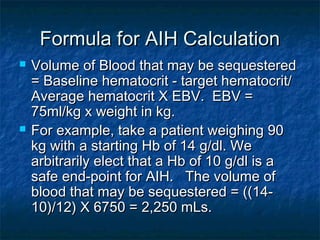
 Volume of Blood that may be sequesteredVolume of Blood that may be sequestered
= Baseline hematocrit - target hematocrit/= Baseline hematocrit - target hematocrit/
Average hematocrit X EBV. EBV =Average hematocrit X EBV. EBV =
75ml/kg x weight in kg.75ml/kg x weight in kg.
 For example, take a patient weighing 90For example, take a patient weighing 90
kg with a starting Hb of 14 g/dl. Wekg with a starting Hb of 14 g/dl. We
arbitrarily elect that a Hb of 10 g/dl is aarbitrarily elect that a Hb of 10 g/dl is a
safe end-point for AIH. The volume ofsafe end-point for AIH. The volume of
blood that may be sequestered = ((14-blood that may be sequestered = ((14-
10)/12) X 6750 = 2,250 mLs.10)/12) X 6750 = 2,250 mLs.
Initiation of AIH ProtoclInitiation of AIH Protocl
AIH protocol , in conjunction with cellAIH protocol , in conjunction with cell
saver, beginning in OB/Gyn and vascularsaver, beginning in OB/Gyn and vascular
surgery, with other services to followsurgery, with other services to follow

Bloodless surgery

  • 1.
    Bloodless Surgery: AcuteBloodlessSurgery: Acute Isovolemic Hemodilution at MMCIsovolemic Hemodilution at MMC Akhil Rastogi, MDAkhil Rastogi, MD Maimonides Medical CenterMaimonides Medical Center
  • 2.
    Introduction to AcuteIsovolemicIntroduction to Acute Isovolemic Hemodilution (AIH)Hemodilution (AIH)  Blood conservation technique also known asBlood conservation technique also known as acute normovolemic hemodilution (ANH)acute normovolemic hemodilution (ANH)  As whole blood is sequestered simulataneousAs whole blood is sequestered simulataneous replacement occurs with crystalloid/colloidreplacement occurs with crystalloid/colloid  Principle: less hemoglobin lost per mL ofPrinciple: less hemoglobin lost per mL of hemorrhagehemorrhage  For example, a patient with a hemoglobin of 14g/dLFor example, a patient with a hemoglobin of 14g/dL who loses 1,000 mLs of blood during a surgicalwho loses 1,000 mLs of blood during a surgical procedure has lost of 140 g of hemoglobin. Considerprocedure has lost of 140 g of hemoglobin. Consider that same patient undergoing AIH to a hemoglobinthat same patient undergoing AIH to a hemoglobin concentration of 10g/dL now losing 1,000 mLs ofconcentration of 10g/dL now losing 1,000 mLs of blood. The hemoglobin content of that blood nowblood. The hemoglobin content of that blood now contains only 100g of hemoglobincontains only 100g of hemoglobin
  • 3.
    Advantages of AIHAdvantagesof AIH  Significant decrease in autologous bloodSignificant decrease in autologous blood transfusionstransfusions  reduction of risks associated withreduction of risks associated with autologous transfusion (ie bacterial infections,autologous transfusion (ie bacterial infections, hemolytic reactions, etc)hemolytic reactions, etc)  Preservation of clotting factors because wholePreservation of clotting factors because whole blood given back instead of PRBC’sblood given back instead of PRBC’s  Increased placental blood flow so not bad forIncreased placental blood flow so not bad for fetusfetus  More cost effective than autologous bloodMore cost effective than autologous blood transfusionstransfusions
  • 4.
    Contraindications to AIHContraindicationsto AIH  Absolute contraindications:Absolute contraindications:  ShockShock  Respiratory failureRespiratory failure  CHFCHF  Severe anemiaSevere anemia  Severe sepsisSevere sepsis  As depth of GA increases, ability toAs depth of GA increases, ability to tolerate anemia of AIH decreasestolerate anemia of AIH decreases
  • 5.
    Brief Description ofProcedureBrief Description of Procedure  AIH to be done in conjunction with cellAIH to be done in conjunction with cell saversaver  Blood collected intra-op, prior to skinBlood collected intra-op, prior to skin incisionincision  Either 2 large bore IV’s (16g+) or a-line +Either 2 large bore IV’s (16g+) or a-line + one large bore IVone large bore IV
  • 6.
    Brief Description ofProcedureBrief Description of Procedure  Concurrent with blood sequestration isConcurrent with blood sequestration is administration of crystalloid in 3:1 ratio or colloidadministration of crystalloid in 3:1 ratio or colloid in 1:1 ratio up to 20mL/kg, followed by crystalloidin 1:1 ratio up to 20mL/kg, followed by crystalloid administration in 3:1 ratio.administration in 3:1 ratio.  Sequestered blood kept in OR up to 6 hrs withSequestered blood kept in OR up to 6 hrs with proper identifiers and returned to patientproper identifiers and returned to patient irrespective of amount of blood loss.irrespective of amount of blood loss.  Fluid replacement site should be distal to bloodFluid replacement site should be distal to blood sequestration site to avoid sequestering dilutedsequestration site to avoid sequestering diluted bloodblood
  • 7.
    Formula for AIHCalculationFormula for AIH Calculation  Volume of Blood that may be sequesteredVolume of Blood that may be sequestered = Baseline hematocrit - target hematocrit/= Baseline hematocrit - target hematocrit/ Average hematocrit X EBV. EBV =Average hematocrit X EBV. EBV = 75ml/kg x weight in kg.75ml/kg x weight in kg.  For example, take a patient weighing 90For example, take a patient weighing 90 kg with a starting Hb of 14 g/dl. Wekg with a starting Hb of 14 g/dl. We arbitrarily elect that a Hb of 10 g/dl is aarbitrarily elect that a Hb of 10 g/dl is a safe end-point for AIH. The volume ofsafe end-point for AIH. The volume of blood that may be sequestered = ((14-blood that may be sequestered = ((14- 10)/12) X 6750 = 2,250 mLs.10)/12) X 6750 = 2,250 mLs.
  • 8.
    Initiation of AIHProtoclInitiation of AIH Protocl AIH protocol , in conjunction with cellAIH protocol , in conjunction with cell saver, beginning in OB/Gyn and vascularsaver, beginning in OB/Gyn and vascular surgery, with other services to followsurgery, with other services to follow