Blood transfusion
By Amanuel Aychew
Moderator: Dr. Yohannes
30th Hidar 2009 EC
History
• In1628 William Harvey discovered the blood is in the circulatory system
• In 1665 the 1st successful blood transfusion dogdog by R.Lower
• In 1667 LambHuman by R. Lower but 10 yrs later it was prohibited
• In1818 British Obstetrician the 1st successful human transfusion for the dx
of PPH
• In 1900 Karl Landsteiner an Austrian physician discover the 3 human blood
groups A, B &C later on C changed to O
• In 1932 the 1st blood bank in Leningard hospital
• In 1939 Rh blood grouping was established by Philip Levine
• In Africa even though there are few studies it is reported that the 1st
blood transfusion occur in 1920’s and rapidly increased after 1945
In Ethiopia
National blood transfusion service was established in 1969 by Eth.
Red cross society.
In 2010 there were 12 regional blood bank with 52% hospital
coverage
In 2014 , 24 regional blood banks serving 8-12 hospitals in 100 km
radius  90% coverage
• Important numerical figures
Total number of units collected in 2004 was 24000 units /annum
in 2013 increased to 95,500 units/annum
Proportion of voluntary donation in 2012 was only 10%
in 2014 increased to 92.1%..................achieving WHO’s 80%
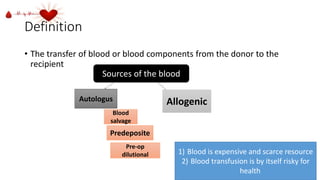
Definition
• The transfer of blood or blood components from the donor to the
recipient
Sources of the blood
Autologus Allogenic
Blood
salvage
Predeposite
Pre-op
dilutional 1) Blood is expensive and scarce resource
2) Blood transfusion is by itself risky for
health
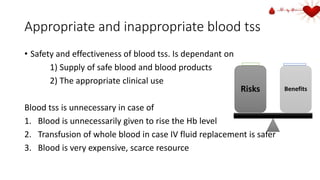
Appropriate and inappropriate blood tss
• Safety and effectiveness of blood tss. Is dependant on
1) Supply of safe blood and blood products
2) The appropriate clinical use
Blood tss is unnecessary in case of
1. Blood is unnecessarily given to rise the Hb level
2. Transfusion of whole blood in case IV fluid replacement is safer
3. Blood is very expensive, scarce resource
Risks Benefits
Principles of clinical transfusion
• Transfusion should be prescribed when the benefit out weights the
risk.
• Have clear indication and record it.
• Clinician should aware of transfusion-transmissible infections.
• Patient’s Hb value, although important it shouldn’t be the only
deciding factor to transfuse.
• Patient with acute blood loss is 1st resuscitated by IV fluids next blood
tss would be assessed.
Who is going to donate???
Donor health& risk assessment
• Any sign of debility, under nutrition, pallor, jaundice, cyanosis,
dyspnea, intoxication from alcohol and other drugs should be
assessed
• P/E Wt, V/S
• Venepuncture site should be examined
If pt don’t fit the general assessment he/she will be deffered (Donor
deferral)
1. Age
• Lower limits in many countries is 18 yrs
• Upper limit 60 to 70yrs
2. Donor appearance on inspection
• No cough, not be febrile
• R/o malnuitrition and any debilitating conditions
• Sound mental status
3. Minor illnesses
• Ha, malaise pain, fever, diarrhea (s/s of acute infection)
• Defer for 14 days
4. Weight
• Atleast 45 kg to donate 350ml blood
• 50 kg to donate 400ml
• No defined upper body weight limit
5. V/S
• PR 60-100
• Body Temp.not more than 37.6 oC
• B.P100-140/60-90
Should not more than 13%
of the total body mass
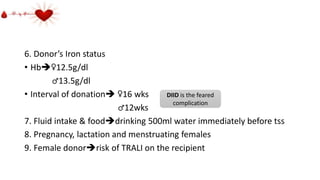
6. Donor’s Iron status
• Hb♀12.5g/dl
♂13.5g/dl
• Interval of donation ♀16 wks
♂12wks
7. Fluid intake & fooddrinking 500ml water immediately before tss
8. Pregnancy, lactation and menstruating females
9. Female donorrisk of TRALI on the recipient
DIID is the feared
complication
• Donor medical hx
Pt under Tx for Anemia
Hemoglobinopathies
Thrombocytopenia
IHD, MI, Arrhythemia
HTN+ Renal disease
Chronic or recurrent respiratory disease
DM who require insulin
thyrotoxicosis
Autoimmune disorders
Hematological malignancy
Defer the pt either
permanently or
temporarly
• Transfusion-transmitted infections (TTI) and donor’s risk assessment
Viral infections
Protozoal infections
Bacterial infections
Prion diseases
High risk behaviors
Multiple sexual act
Iv drug abuse
Detention in the prisons
Tattooing, piercing
Infection markers are
assessed in the
Laboratory eg. Ag or Ab
Assess
from the
Hx
Typing and cross matching
• Serologic compatibility for ABO and Rh is routinely.
• Rh –eve must receive only from Rh -eve
• In emergency case we can use O negative
Typing and cross matching is difficult in
1. Autoimmune hemolytic anemia
2. pts who have been multiple times transfused
3. Dextran administration before typing
Blood components
• It has literally cellular and plasma components.
CELLULAR COMPONENTS
1) Banked whole blood
• Very common type
• Shelf life of 6wks age of RBC inflammatory response & MOF
• All clotting factors are stable except factor V and VIII
• Hemolysis is rare
↑ed shelf life
stay
↓ed ADP & 2,3-
diphosphoglycerate
↓ed O2
transport
2) Fresh whole blood
• Blood that is administered with in 24hrs of donation
• It has greater coagulation activity
• Advanced technologies to test infectious disease made it to be the
best to use
• Can improve outcomes of pts with trauma –associated coagulopathy
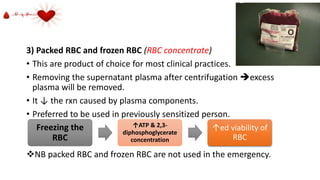
3) Packed RBC and frozen RBC (RBC concentrate)
• This are product of choice for most clinical practices.
• Removing the supernatant plasma after centrifugation excess
plasma will be removed.
• It ↓ the rxn caused by plasma components.
• Preferred to be used in previously sensitized person.
NB packed RBC and frozen RBC are not used in the emergency.
Freezing the
RBC
↑ATP & 2,3-
diphosphoglycerate
concentration
↑ed viability of
RBC
4) Leukocyte-reduced and Leukocyte-reduced /washed RBC
• WBC free blood preparation filtration that removes WBC 99.9%
• If necessary with additional saline washing
• Removal of WBC can prevent
all febrile non-hemolytic rxns
alloimmuniztion to HLA-1
CMV transmission
platelet transfusion refractoriness
• In most westerns currently the standard of blood cell transfusion
But predispose to
post-op infection
and MOF
5) Platelet concentration
• Used in conditions that result thrombocytopenia
• 1unit of PC is 50ml-60ml
• PC is capable of transmitting infectious disease and inducing allergic
rxn
• Single unit and pooled unit
Plasma components
1) Fresh-frozen plasma
• It is prepared from freshly donated blood
• It is the only source of factor V and vit-k dependent factors
• Best outcome if used in trauma-associated coagulopathies
• Infection risk: Capable of transmitting any agent present in cells or
plasma
…FFP
• Indications:
• As an alternative to Factor VIII for tx of:
von Willebrand Factor (von Willebrand’s disease).
Factor VIII (haemophilia A).
• Liver disease, Warfarin, depletion of coag factors…
• As a source of fibrinogen in acquired coagulopathies; e.g. DIC.
• Can be used in isolated Factor XIII deficiency.
2) Cryoprecipitate
• FFP but resuspended in 10-20ml plasma
• From single pack or more than 6 donor pack
3) Liquid plasma
• No liable coag factors
4) Virus inactivated plasma
• Methylene blue or UV inactivation to ↓ risk of HIV, HCV, HBV
• Expenssive
• For HAV, Parvo B-19 the inactivation is less effective
Other…
Human polymerized Hemoglobin (PolyHeme)
• O2 carrying resuscitation fluid
• PolyHeme is a temporary oxygen-carrying blood substitute made
from human hemoglobin
• Immediately available
Advantageof PolyHeme
absence of blood typing Ag
prolonged period of storage
no transfusion-transmitted infections (TTI)
Disadvantage
shorter half life in the blood
potential to ↑CVS problems
Indications of blood transfusion
1)To replace acute or major blood loss
Hemorrhagic shock
Major surgeries
Extensive burns
2)To Tx anemia
chronic loss
RBC destruction
Hemorrhoids
Bleeding disorders
Chronic PUD
Complications of Transfusion
Non-hemolytic rxns
• Febrile non-hemolytic rxns are ↑ in Temperature >1 oC
• Fairly common about 1%
• Postulated cause
preformed cytokines in donated blood and reciepent’s antibodies
reacting
• Pre-Tx by Paracetamol is helpful
• G –eve bacteria like Yersinia and Pseudomonas common cause
Non hemolytic…
Clinical presentation
• Fever Hemorrhagic manifestations
• Chills
• Tachycardia
• Hypotension, GI symptoms
Mng’t
• Discontinue the blood and send for culture
• O2 administration
• Adrenergic blockers
• Antibiotics
Prevention avoidance of outdated platelet
- Hemoglobinuria
- Hemoglobinemia
- DIC
Allergic rxns
• Relatively frequent 1% of all transfusion
• Mild and consists of
rash & urticaria
fever with in 60-90min after transfusion
• Sometimes anaphylactic shock
Mang’t
Administration of Antihistamines
In serious cases use Epinephrine or Steroids
Respiratory complications
• It is associated with circulatory overload
• It can occur in rapid infusion of blood, plasma expanders, crystalloids
which is severe in 1) older pts
2)underlying heart disease
• Central venous pressure must be monitored whenever large amount
of fluid is administered
• Overload s/s ↑ed venopressure
Dyspnea on P/E
Cough Auscultation Rale is noticed
Hypoxia
Tx Diuresis + slowing
the rate of blood
administration
Syndrome of Transfusion related acute lung
injury (TRALI)
• It is non-cardiogenic pulmonary edema related to transfusion
• s/s are similar to circulatory overload
• However TRALI is accompanied by chills, rigor, fever & bilateral
pulmonary infiltrate on chest X-ray 1-2hrs after transfusion
• Etiology unknown
Mang’t
Discontinue the blood + provision of pulmonary supports
1) Anti-HLA antibodies in the transfused
blood
2) Multiparity of the donor
Hemolytic rxns
1) Acute
• Occur with the administration of ABO incompatible blood {CFR=6%}
• Occurs with is the 1st , 24hrs
• There is intravascular RBC destruction
hemoglobinemia
hemoglobinuria
Ag-Ab
complex
Activation of
complement sys.
& factor XII
DIC
Acute renal
insufficiency
2) Delayed
• Occur 2-10th day after transfusion
• Extravascular hemolysis
• Mild anemia
• Indirect hyperbilirubinemia (unconjugated)
Transmission of disease
• Malaria
• Chagas disease
• Brucellosis
• Syphilis (very rare)
• HIV-1 & hcv
• HAV rarely
What is currently new?????
• Artificial blood transfusion may be reality by 2017 …. University of
Bristol London UK
• With this new method, scientists hope they’ll produce
“limitless” supply of type-O red blood cells
free of diseases and able to be transfused into any pt
• Blood and Transplant used stem cells from adult and umbilical cord
blood to create a small volume of manufactured red blood cells.
http://www.sctpn.net/1viralvoice/blog/2015/07/25/artificial-blood-transfusion-may-be-reality-by-2017-
science-technology-on/
Remember …
• World blood donor’s day is celebrated every year on 14th June
• On the day of birthday anniversary of Karl Landsteiner June 4, 1868
• In 2012 “every blood donor is a hero”
• In 2013 “Give the gift of life”
• In 2014 “safe blood for saving mothers”
• In 2015 “Thank you for saving my life”
This year
“2016” the
motto will be
Thank you
References
• F. Charles Burnicardi/Schwartz’s principles of surgery 9th Edition
• WHO /Update Ethiopia progress in 2014/ March2015
• Guidelines on assessing Donor suitability for blood donation/ WHO
2012
• The clinical use of blood handbook WHO geneva
• History of Blood transfusion in Sub-Saharan Africa
• EPHTI surgery Debub university

blood transfusion

  • 1.
    Blood transfusion By AmanuelAychew Moderator: Dr. Yohannes 30th Hidar 2009 EC
  • 2.
    History • In1628 WilliamHarvey discovered the blood is in the circulatory system • In 1665 the 1st successful blood transfusion dogdog by R.Lower • In 1667 LambHuman by R. Lower but 10 yrs later it was prohibited • In1818 British Obstetrician the 1st successful human transfusion for the dx of PPH • In 1900 Karl Landsteiner an Austrian physician discover the 3 human blood groups A, B &C later on C changed to O • In 1932 the 1st blood bank in Leningard hospital • In 1939 Rh blood grouping was established by Philip Levine
  • 3.
    • In Africaeven though there are few studies it is reported that the 1st blood transfusion occur in 1920’s and rapidly increased after 1945 In Ethiopia National blood transfusion service was established in 1969 by Eth. Red cross society. In 2010 there were 12 regional blood bank with 52% hospital coverage In 2014 , 24 regional blood banks serving 8-12 hospitals in 100 km radius  90% coverage
  • 4.
    • Important numericalfigures Total number of units collected in 2004 was 24000 units /annum in 2013 increased to 95,500 units/annum Proportion of voluntary donation in 2012 was only 10% in 2014 increased to 92.1%..................achieving WHO’s 80%
  • 5.
    Definition • The transferof blood or blood components from the donor to the recipient Sources of the blood Autologus Allogenic Blood salvage Predeposite Pre-op dilutional 1) Blood is expensive and scarce resource 2) Blood transfusion is by itself risky for health
  • 6.
    Appropriate and inappropriateblood tss • Safety and effectiveness of blood tss. Is dependant on 1) Supply of safe blood and blood products 2) The appropriate clinical use Blood tss is unnecessary in case of 1. Blood is unnecessarily given to rise the Hb level 2. Transfusion of whole blood in case IV fluid replacement is safer 3. Blood is very expensive, scarce resource Risks Benefits
  • 7.
    Principles of clinicaltransfusion • Transfusion should be prescribed when the benefit out weights the risk. • Have clear indication and record it. • Clinician should aware of transfusion-transmissible infections. • Patient’s Hb value, although important it shouldn’t be the only deciding factor to transfuse. • Patient with acute blood loss is 1st resuscitated by IV fluids next blood tss would be assessed.
  • 8.
    Who is goingto donate??? Donor health& risk assessment • Any sign of debility, under nutrition, pallor, jaundice, cyanosis, dyspnea, intoxication from alcohol and other drugs should be assessed • P/E Wt, V/S • Venepuncture site should be examined If pt don’t fit the general assessment he/she will be deffered (Donor deferral)
  • 9.
    1. Age • Lowerlimits in many countries is 18 yrs • Upper limit 60 to 70yrs 2. Donor appearance on inspection • No cough, not be febrile • R/o malnuitrition and any debilitating conditions • Sound mental status 3. Minor illnesses • Ha, malaise pain, fever, diarrhea (s/s of acute infection) • Defer for 14 days
  • 10.
    4. Weight • Atleast45 kg to donate 350ml blood • 50 kg to donate 400ml • No defined upper body weight limit 5. V/S • PR 60-100 • Body Temp.not more than 37.6 oC • B.P100-140/60-90 Should not more than 13% of the total body mass
  • 11.
    6. Donor’s Ironstatus • Hb♀12.5g/dl ♂13.5g/dl • Interval of donation ♀16 wks ♂12wks 7. Fluid intake & fooddrinking 500ml water immediately before tss 8. Pregnancy, lactation and menstruating females 9. Female donorrisk of TRALI on the recipient DIID is the feared complication
  • 12.
    • Donor medicalhx Pt under Tx for Anemia Hemoglobinopathies Thrombocytopenia IHD, MI, Arrhythemia HTN+ Renal disease Chronic or recurrent respiratory disease DM who require insulin thyrotoxicosis Autoimmune disorders Hematological malignancy Defer the pt either permanently or temporarly
  • 13.
    • Transfusion-transmitted infections(TTI) and donor’s risk assessment Viral infections Protozoal infections Bacterial infections Prion diseases High risk behaviors Multiple sexual act Iv drug abuse Detention in the prisons Tattooing, piercing Infection markers are assessed in the Laboratory eg. Ag or Ab Assess from the Hx
  • 14.
    Typing and crossmatching • Serologic compatibility for ABO and Rh is routinely. • Rh –eve must receive only from Rh -eve • In emergency case we can use O negative Typing and cross matching is difficult in 1. Autoimmune hemolytic anemia 2. pts who have been multiple times transfused 3. Dextran administration before typing
  • 18.
    Blood components • Ithas literally cellular and plasma components. CELLULAR COMPONENTS 1) Banked whole blood • Very common type • Shelf life of 6wks age of RBC inflammatory response & MOF • All clotting factors are stable except factor V and VIII • Hemolysis is rare ↑ed shelf life stay ↓ed ADP & 2,3- diphosphoglycerate ↓ed O2 transport
  • 19.
    2) Fresh wholeblood • Blood that is administered with in 24hrs of donation • It has greater coagulation activity • Advanced technologies to test infectious disease made it to be the best to use • Can improve outcomes of pts with trauma –associated coagulopathy
  • 20.
    3) Packed RBCand frozen RBC (RBC concentrate) • This are product of choice for most clinical practices. • Removing the supernatant plasma after centrifugation excess plasma will be removed. • It ↓ the rxn caused by plasma components. • Preferred to be used in previously sensitized person. NB packed RBC and frozen RBC are not used in the emergency. Freezing the RBC ↑ATP & 2,3- diphosphoglycerate concentration ↑ed viability of RBC
  • 21.
    4) Leukocyte-reduced andLeukocyte-reduced /washed RBC • WBC free blood preparation filtration that removes WBC 99.9% • If necessary with additional saline washing • Removal of WBC can prevent all febrile non-hemolytic rxns alloimmuniztion to HLA-1 CMV transmission platelet transfusion refractoriness • In most westerns currently the standard of blood cell transfusion But predispose to post-op infection and MOF
  • 22.
    5) Platelet concentration •Used in conditions that result thrombocytopenia • 1unit of PC is 50ml-60ml • PC is capable of transmitting infectious disease and inducing allergic rxn • Single unit and pooled unit
  • 23.
    Plasma components 1) Fresh-frozenplasma • It is prepared from freshly donated blood • It is the only source of factor V and vit-k dependent factors • Best outcome if used in trauma-associated coagulopathies • Infection risk: Capable of transmitting any agent present in cells or plasma
  • 24.
    …FFP • Indications: • Asan alternative to Factor VIII for tx of: von Willebrand Factor (von Willebrand’s disease). Factor VIII (haemophilia A). • Liver disease, Warfarin, depletion of coag factors… • As a source of fibrinogen in acquired coagulopathies; e.g. DIC. • Can be used in isolated Factor XIII deficiency.
  • 25.
    2) Cryoprecipitate • FFPbut resuspended in 10-20ml plasma • From single pack or more than 6 donor pack 3) Liquid plasma • No liable coag factors 4) Virus inactivated plasma • Methylene blue or UV inactivation to ↓ risk of HIV, HCV, HBV • Expenssive • For HAV, Parvo B-19 the inactivation is less effective
  • 26.
    Other… Human polymerized Hemoglobin(PolyHeme) • O2 carrying resuscitation fluid • PolyHeme is a temporary oxygen-carrying blood substitute made from human hemoglobin • Immediately available Advantageof PolyHeme absence of blood typing Ag prolonged period of storage no transfusion-transmitted infections (TTI)
  • 27.
    Disadvantage shorter half lifein the blood potential to ↑CVS problems
  • 28.
    Indications of bloodtransfusion 1)To replace acute or major blood loss Hemorrhagic shock Major surgeries Extensive burns 2)To Tx anemia chronic loss RBC destruction Hemorrhoids Bleeding disorders Chronic PUD
  • 29.
  • 33.
    Non-hemolytic rxns • Febrilenon-hemolytic rxns are ↑ in Temperature >1 oC • Fairly common about 1% • Postulated cause preformed cytokines in donated blood and reciepent’s antibodies reacting • Pre-Tx by Paracetamol is helpful • G –eve bacteria like Yersinia and Pseudomonas common cause
  • 34.
    Non hemolytic… Clinical presentation •Fever Hemorrhagic manifestations • Chills • Tachycardia • Hypotension, GI symptoms Mng’t • Discontinue the blood and send for culture • O2 administration • Adrenergic blockers • Antibiotics Prevention avoidance of outdated platelet - Hemoglobinuria - Hemoglobinemia - DIC
  • 35.
    Allergic rxns • Relativelyfrequent 1% of all transfusion • Mild and consists of rash & urticaria fever with in 60-90min after transfusion • Sometimes anaphylactic shock Mang’t Administration of Antihistamines In serious cases use Epinephrine or Steroids
  • 36.
    Respiratory complications • Itis associated with circulatory overload • It can occur in rapid infusion of blood, plasma expanders, crystalloids which is severe in 1) older pts 2)underlying heart disease • Central venous pressure must be monitored whenever large amount of fluid is administered • Overload s/s ↑ed venopressure Dyspnea on P/E Cough Auscultation Rale is noticed Hypoxia Tx Diuresis + slowing the rate of blood administration
  • 37.
    Syndrome of Transfusionrelated acute lung injury (TRALI) • It is non-cardiogenic pulmonary edema related to transfusion • s/s are similar to circulatory overload • However TRALI is accompanied by chills, rigor, fever & bilateral pulmonary infiltrate on chest X-ray 1-2hrs after transfusion • Etiology unknown Mang’t Discontinue the blood + provision of pulmonary supports 1) Anti-HLA antibodies in the transfused blood 2) Multiparity of the donor
  • 38.
    Hemolytic rxns 1) Acute •Occur with the administration of ABO incompatible blood {CFR=6%} • Occurs with is the 1st , 24hrs • There is intravascular RBC destruction hemoglobinemia hemoglobinuria Ag-Ab complex Activation of complement sys. & factor XII DIC Acute renal insufficiency
  • 39.
    2) Delayed • Occur2-10th day after transfusion • Extravascular hemolysis • Mild anemia • Indirect hyperbilirubinemia (unconjugated)
  • 40.
    Transmission of disease •Malaria • Chagas disease • Brucellosis • Syphilis (very rare) • HIV-1 & hcv • HAV rarely
  • 41.
    What is currentlynew????? • Artificial blood transfusion may be reality by 2017 …. University of Bristol London UK • With this new method, scientists hope they’ll produce “limitless” supply of type-O red blood cells free of diseases and able to be transfused into any pt • Blood and Transplant used stem cells from adult and umbilical cord blood to create a small volume of manufactured red blood cells. http://www.sctpn.net/1viralvoice/blog/2015/07/25/artificial-blood-transfusion-may-be-reality-by-2017- science-technology-on/
  • 42.
    Remember … • Worldblood donor’s day is celebrated every year on 14th June • On the day of birthday anniversary of Karl Landsteiner June 4, 1868 • In 2012 “every blood donor is a hero” • In 2013 “Give the gift of life” • In 2014 “safe blood for saving mothers” • In 2015 “Thank you for saving my life”
  • 43.
  • 44.
    References • F. CharlesBurnicardi/Schwartz’s principles of surgery 9th Edition • WHO /Update Ethiopia progress in 2014/ March2015 • Guidelines on assessing Donor suitability for blood donation/ WHO 2012 • The clinical use of blood handbook WHO geneva • History of Blood transfusion in Sub-Saharan Africa • EPHTI surgery Debub university

Editor's Notes

  • #19 Hct=35%-45% Hb12g/dl No functional plt storage in 2-6 oC in the blood banks Indications acute blood loss
  • #21 150-200ml Hb=20g/dl Hct=55-75% Indication replacement in anemic pt use with crystalloid
  • #22 Indication repeated tss hx of previous febrile illness to blood tss
  • #23 50- 60ml of plasma 55x 10 9 plts Store at 20-24 oC nevere store at 2-6 oC bec it ↓ plt func. Indication thrombocytopenia plt fun. defect
  • #24 200-300ml but in children it is smaller Rapidly frozen to -25 oC or colder Factor 8
  • #25 Allergic rxn are common Hypovolaemia is not an indication alone
  • #33 Tss associated circulatory overload TACO Incidence 1:200 CHF pts Mg’t ↑tss time , administer diuretics
  • #34 Bacterial contamination  sepsis and death 25% Clinical manifestation fever, chills, tachycardia, hypotension, GI symptoms like D, N, V
  • #36 This can occur in any kind of blood products
  • #37 Furosemide
  • #38 With admin of any plasma containing blood products Anti-HLA Ab priming neutrophils Components from the female donor can predispose to TRALI American association of blood bank is currently deferring females
  • #39 Pain at the site of infusion Flushing Chest pain and back pain
  • #40 Fever Recurrent anemia ↓ed Hepatoglobulin level +comb’s test But delayed rxn do not require specific intervention
  • #41 P.Malariae incubation period 8-100 days