HEMODYNAMIC
MONITORING
Subject:
Applied Doppler, Vascular Doppler.

Presented By: Syed Shoaib Muhammad
Topics
 Hemodynamic Definition.
 Purpose.
 Types of Blood Flow
 Spectral Display
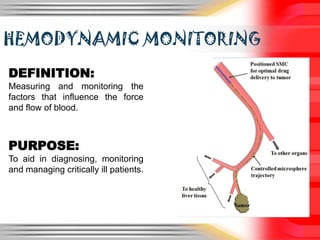
HEMODYNAMIC MONITORING
DEFINITION:
Measuring and monitoring the
factors that influence the force
and flow of blood.

PURPOSE:
To aid in diagnosing, monitoring
and managing critically ill patients.
Types of Blood Flow…….
Six types of blood flow seen in the Doppler

Ultrasound.
 Plug Flow
 Laminar Flow

 Parabolic Flow
 Disturbed Flow
 Turbulent Flow

 Pulsatile Flow
• The first we will discus the spectral
display.
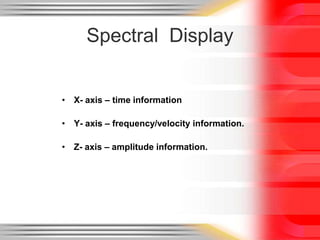
Spectral Display
• X- axis – time information
• Y- axis – frequency/velocity information.

• Z- axis – amplitude information.
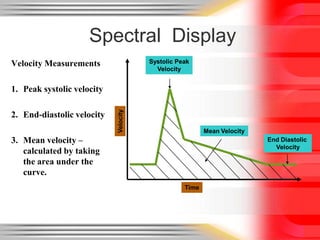
Spectral Display
Systolic Peak
Velocity

Velocity Measurements

2. End-diastolic velocity

Velocity

1. Peak systolic velocity

Mean Velocity

3. Mean velocity –
calculated by taking
the area under the
curve.

End Diastolic
Velocity

Time
Spectral Display
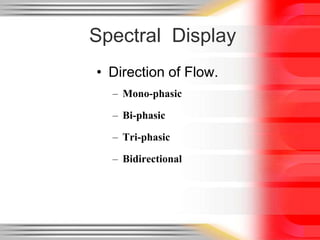
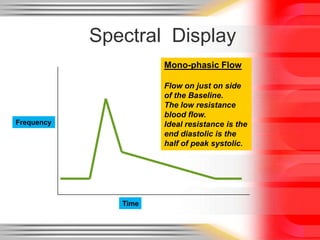
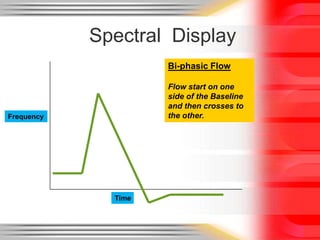
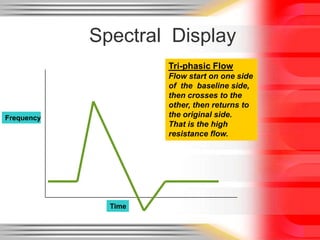
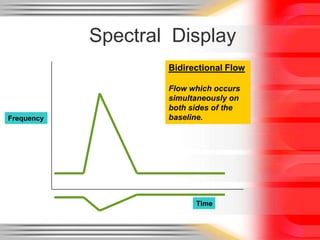
• Direction of Flow.
– Mono-phasic
– Bi-phasic
– Tri-phasic
– Bidirectional
Spectral Display
Mono-phasic Flow
Flow on just on side
of the Baseline.
The low resistance
blood flow.
Ideal resistance is the
end diastolic is the
half of peak systolic.

Frequency

Time
Spectral Display
Bi-phasic Flow
Flow start on one
side of the Baseline
and then crosses to
the other.

Frequency

Time
Spectral Display
Tri-phasic Flow
Flow start on one side
of the baseline side,
then crosses to the
other, then returns to
the original side.
That is the high
resistance flow.

Frequency

Time
Spectral Display
Bidirectional Flow

Frequency

Flow which occurs
simultaneously on
both sides of the
baseline.

Time
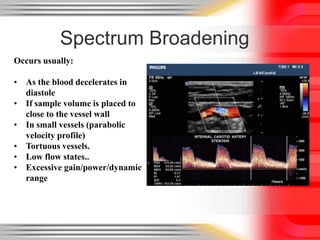
Spectrum Broadening
Occurs usually:

• As the blood decelerates in
diastole
• If sample volume is placed to
close to the vessel wall
• In small vessels (parabolic
velocity profile)
• Tortuous vessels.
• Low flow states..
• Excessive gain/power/dynamic
range
Spectral Display
Systolic Peak
Velocity

Resistive Index

Velocity

RI = Max – Min
Max

Mean Velocity
End Diastolic
Velocity

Time
Spectral Display
Systolic Peak
Velocity

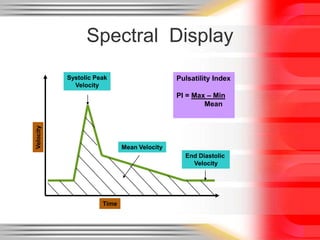
Pulsatility Index

Velocity

PI = Max – Min
Mean

Mean Velocity
End Diastolic
Velocity

Time
Spectral Display
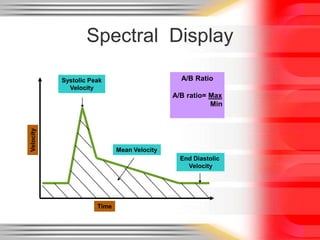
A/B Ratio

Systolic Peak
Velocity

Velocity

A/B ratio= Max
Min

Mean Velocity
End Diastolic
Velocity

Time
Types of Blood Flow
 Plug Flow
 Laminar Flow
 Parabolic Flow

 Disturbed Flow
 Turbulent Flow
 Pulsatile Flow
Types of Blood Flow
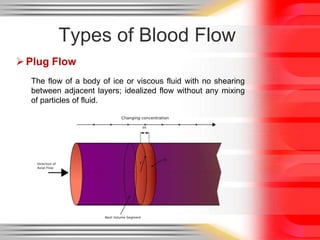
 Plug Flow
The flow of a body of ice or viscous fluid with no shearing
between adjacent layers; idealized flow without any mixing
of particles of fluid.
Types of Blood Flow
 Plug Flow
Types of Blood Flow
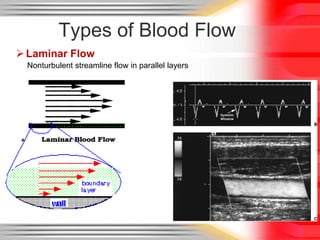
 Laminar Flow
Nonturbulent streamline flow in parallel layers
Types of Blood Flow
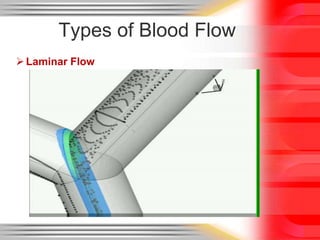
 Laminar Flow
Types of Blood Flow
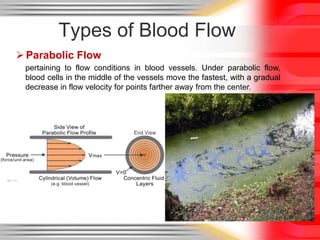
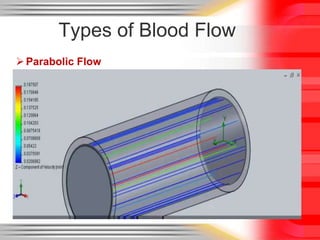
 Parabolic Flow
pertaining to flow conditions in blood vessels. Under parabolic flow,
blood cells in the middle of the vessels move the fastest, with a gradual
decrease in flow velocity for points farther away from the center.
Types of Blood Flow
 Parabolic Flow
Types of Blood Flow
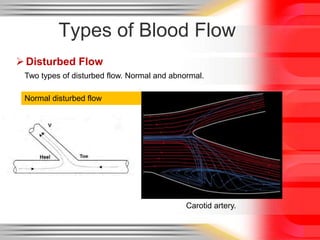
 Disturbed Flow
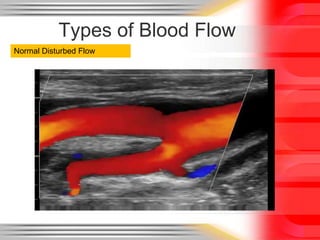
Two types of disturbed flow. Normal and abnormal.
Normal disturbed flow

Carotid artery.
Types of Blood Flow
Normal Disturbed Flow
Types of Blood Flow
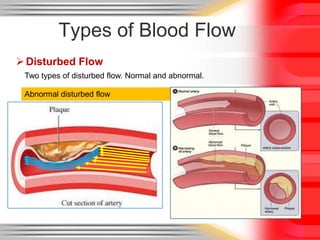
 Disturbed Flow
Two types of disturbed flow. Normal and abnormal.
Abnormal disturbed flow
Types of Blood Flow
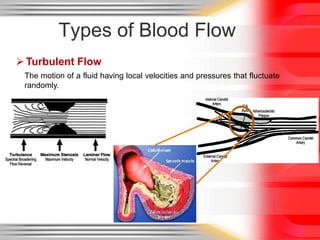
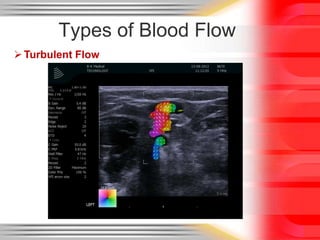
 Turbulent Flow
The motion of a fluid having local velocities and pressures that fluctuate
randomly.
Types of Blood Flow
 Turbulent Flow
Types of Blood Flow
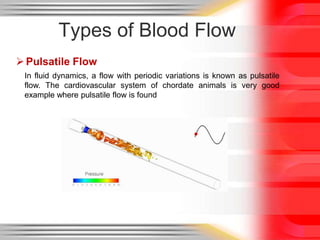
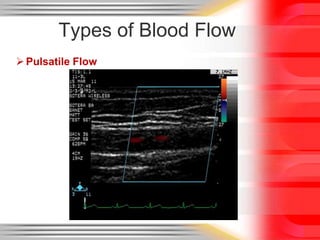
 Pulsatile Flow
In fluid dynamics, a flow with periodic variations is known as pulsatile
flow. The cardiovascular system of chordate animals is very good
example where pulsatile flow is found
Types of Blood Flow
 Pulsatile Flow
References..
• http://en.wikipedia.org/wiki/Hemodynamics

• http://www.thefreedictionary.com/laminar
• http://medical-dictionary.thefreedictionary.com/parabolic
• http://www.thefreedictionary.com/disturbed+flow
• https://www.youtube.com/watch?v=I241zL4vJ7A
Blood flow types

Blood flow types